
Ellis Island Immigration Museum: Memory, Myth and the Gateway to America
- The Introvert Traveler
- 6 hours ago
- 5 min read


Last visit: december 2024
My rating: 6/10
Duration of visit: 1,5 hour + 1 hour ferry round trip
A visit to the Ellis Island usually follows the same logistical itinerary as the visit to the nearby Statue of Liberty. The ferry that departs from Battery Park in New York City stops first at Liberty Island and then continues across the harbor to the former immigration station that processed millions of newcomers entering the United States.
For many travelers, Ellis Island represents the emotional counterpoint to the monumental symbolism of the Statue of Liberty. If the statue embodies an abstract ideal (liberty, opportunity, the promise of a new beginning) Ellis Island represents the bureaucratic reality of that promise: paperwork, inspections, waiting rooms, and uncertain futures.
Between 1892 and 1954, more than twelve million immigrants passed through Ellis Island. At the beginning of the twentieth century the station functioned as the principal gateway to the United States for those arriving by ship from Europe. Italians, Irish, Germans, Eastern Europeans, Jews fleeing persecution, and countless others stepped onto the island after exhausting transatlantic journeys that often lasted several weeks.
For many of them, Ellis Island was the first encounter with American authority.
Today the complex houses the Ellis Island National Museum of Immigration, a large exhibition space that attempts to narrate this vast human story. The building itself is the main artifact. Restored carefully during the late twentieth century, the structure preserves many of the original spaces where immigrants were processed.
The Registry Room
The most striking space is the Registry Room, often called the Great Hall.
This enormous hall is where the newly arrived immigrants were gathered after disembarking from the ships anchored in the harbor. From here they entered a long sequence of administrative and medical inspections that determined whether they would be allowed to enter the United States.
Standing in this vast room, one cannot avoid imagining the scenes that must have unfolded here a century ago: thousands of tired passengers, carrying small suitcases and bundles, waiting anxiously to learn whether they would be admitted or rejected.
The museum does a competent job reconstructing this atmosphere. Historical photographs line the walls, showing long lines of immigrants standing beneath the same vaulted ceiling that visitors see today. The space itself retains an austere bureaucratic character, large windows, tiled floors, wooden benches, suggesting a place designed for efficiency rather than comfort.
A Museum Built on Text
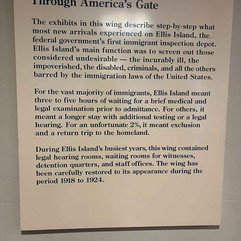
A large portion of the exhibition consists of text panels explaining the history of immigration in the United States.
Visitors move through chronological sections that describe the different waves of immigration: the mass arrival of Europeans in the late nineteenth century, the restrictive immigration laws of the 1920s, and the changing composition of immigration flows in the twentieth century.
For anyone moderately familiar with American history, much of this narrative will already sound familiar. The story of Ellis Island has been told countless times in books, documentaries, and films. Hollywood alone has transformed the immigrant experience into an entire cinematic genre.
This means that the museum rarely delivers major intellectual surprises.
However, the panels remain informative and well written. They place individual immigrant stories within broader historical processes: industrialization, political upheaval in Europe, religious persecution, and the economic transformation of the United States.
What the museum perhaps lacks in novelty, it compensates for with clarity. The narrative is structured carefully and allows visitors to understand how immigration shaped the demographic and cultural landscape of America.




Reconstructed Rooms and Everyday Objects
More evocative than the textual panels are the rooms that recreate the spaces used by immigrants during the processing procedures.
Several sections of the museum display original furniture, clothing, travel trunks, and personal belongings. These objects restore a sense of material reality that the historical narrative alone cannot convey.
One room reproduces the medical inspection area where doctors quickly examined immigrants for signs of disease. Another shows the dormitory spaces where some migrants had to spend the night while waiting for administrative decisions.
These reconstructed environments are effective because they transform abstract statistics into human experiences. A suitcase, a worn coat, or a handwritten letter reveals more about the immigrant journey than many paragraphs of explanation.
The museum also presents numerous family photographs, allowing visitors to see the faces of the people who once passed through the island. These images remind us that immigration was not merely a demographic phenomenon but a series of individual decisions, fears, and hopes.
Ellis Island: The Myth and the Reality
Ellis Island occupies a curious position in the cultural imagination of the United States.
On the one hand, it has become a powerful symbol of the American narrative: the idea that millions of people arrived here seeking opportunity and eventually contributed to building the country.
On the other hand, the historical reality was more complicated. Not everyone who arrived was admitted. Medical inspections, administrative requirements, and immigration quotas excluded a significant number of applicants.
The museum addresses these complexities, though generally in a measured and balanced tone. The emphasis remains on the transformative impact of immigration rather than on the more controversial aspects of American immigration policy.
Also particularly interesting are the satirical cartoons from the period, which address the issue of immigration with themes that, more than a century later, have essentially remained unchanged.




Film locations
It is impossible not to mention the famous scene in The Godfather Part II in which the young Vito Corleone arrives in New York from Italy as an immigrant and is mistakenly registered under the name of his village of origin.
A Visit Out of Historical Respect
In practical terms, visiting Ellis Island requires about one to two hours. The museum is large but the exhibition layout allows visitors to move quickly through the main sections.
From a purely intellectual perspective, the experience may feel somewhat familiar. Much of the historical narrative is already widely known, and the museum relies heavily on explanatory panels rather than immersive installations.
Yet the visit still retains a certain importance.
Ellis Island is one of those places where the physical location itself carries historical weight. Standing in the same rooms where millions of immigrants once waited for permission to enter a new life inevitably creates a moment of reflection.
In that sense, the visit functions less as a discovery and more as a gesture of historical acknowledgment.
One comes here not necessarily to learn something radically new, but to pay a quiet tribute to one of the defining chapters in the history of United States and, by extension, to the countless individual stories that passed through this small island in the harbor of New York.
A necessary stop in the memory of the city. Perhaps not much more than that, but sometimes that is already enough.
If you are planning a trip to New York, you may be interested in these posts.


Comments