
Apollo and Daphne by Gian Lorenzo Bernini (Borghese Gallery, Rome): marble on the verge of the impossible
- The Introvert Traveler
- 23 hours ago
- 13 min read

Last visit: November 2024
My opinion: MUST SEE
Visit duration: 1 to 2 hours
Date: 1622-1625
Here we are again in the Galleria Borghese, in this sanctuary of marvels that Rome bestows upon whoever dares to cross its threshold. After having paid our homage to the Rape of Proserpina, we move just a few metres, to Sala III, and we stand before another prodigy by Gian Lorenzo Bernini: the Apollo and Daphne. If the Proserpina left us speechless before the impossible softness of flesh carved in stone, this group achieves something that, in some ways, is even more staggering: here the marble does not merely yield under pressure. It sprouts. It dissolves. It becomes bark and foliage and wind-tossed hair, in what is unanimously considered the supreme technical achievement of Bernini's youthful production and, one could argue, of Baroque sculpture altogether. The earliest sources already acknowledged that this was a work to be judged by the eye alone, not by words, and I must confess that after spending a good while circling around it, I tend to agree: there is something about this marble group that simply resists verbal description.

1. The myth: a love story that ends in leaves
The source is Ovid's Metamorphoses, one of those texts that the Renaissance and Baroque periods plundered relentlessly for dramatic subjects. The story is deceptively simple. Apollo, god of poetry and the arts, brags about his skill with the bow, and Cupid decides to teach him a lesson by shooting him with a lead-tipped arrow that makes him fall desperately in love with the nymph Daphne. The nymph, however, is a devotee of Diana and has zero interest in romantic entanglements. What follows is a chase that reads like a tragedy compressed into a sprint: Apollo runs, Daphne runs faster, and when the god is about to seize her she implores her father, the river god Peneus, to destroy the beauty that has caused her ruin. Her prayer is granted. Bark envelops her legs, her fingers branch into twigs, her hair bursts into leaves. Apollo, heartbroken but undeterred, takes what remains of the woman he loves and crowns himself with laurel. From that day on, the plant is sacred to him.
Now, this being a pagan myth displayed in the residence of a cardinal, someone had to provide a moral safety net. That someone was Maffeo Barberini, future Pope Urban VIII and a man who clearly knew how to navigate the politics of art patronage. He composed a Latin couplet engraved on the pedestal that essentially warns the viewer: whoever chases the pleasures of a fleeting form ends up with a fistful of leaves, or worse, the taste of bitter berries. A convenient piece of moralising that turned a sensuous mythological episode into a meditation on the vanity of earthly desire, satisfying the ecclesiastical propriety of the setting. Whether Bernini himself cared much about this theological alibi or was simply absorbed in the challenge of turning stone into living transformation, I leave to the reader's imagination.
2. The commission: a sculpture born in fits and starts
The history of this work is anything but linear, and it tells us something about the frantic pace at which the young Bernini operated. Cardinal Scipione Borghese commissioned the group in 1622, and Bernini acquired the block of Carrara marble from the sculptor Francesco Stati for 100 scudi. But the carving was interrupted after roughly a year because there was a more urgent job to finish: the David, commissioned by Cardinal Montalto. Only in April 1624 did Bernini return to Daphne's metamorphosis, and the group was finally completed in the autumn of 1625. Think about that for a moment: this twenty-something sculptor was juggling multiple colossal commissions from the most powerful men in Rome, and each of these works would have been the career-defining masterpiece of any other artist. For Bernini, they were simply the output of a couple of very productive years.
He did not work alone. Giuliano Finelli, one of his most talented assistants, was entrusted with the foliage. Finelli was a virtuoso of the drill, and his contribution to the almost impossibly thin leaves and twigs is acknowledged by all the contemporary sources. How much exactly he carved and how much was Bernini's own hand remains debatable, but what is significant is the very decision to delegate parts of the work to a specialist. It reveals Bernini's priorities with perfect clarity: for him, invention always came first. Technical execution, however dazzling, was the servant of the idea, never the other way around. He could afford to let someone else carve the leaves because the conception, the emotional architecture, the spatial drama of the group were entirely his, and those were what mattered most.
The total compensation amounted to 1000 scudi, a very substantial sum. The pedestal was carved by Agostino Radi and completed by March 1625, and the group was installed in its dedicated room that August.

3. Compositional structure: freezing the unfreezing
This is where things get really interesting, and where the Apollo and Daphne does something that no sculptor had ever attempted before with this level of ambition. Until Bernini, the subject of Daphne's transformation had been treated almost exclusively by painters. In pictorial tradition, the chase was typically shown with Daphne already mid-transformation, arms raised, branches sprouting, Apollo in pursuit with his bow. It was a narrative captured at a comfortable, manageable stage.
Bernini chooses the most impossible moment of all: the exact split-second in which Apollo's hand touches Daphne and the metamorphosis begins. Not before, not after, but precisely at the tipping point. It is the sculptural equivalent of a photograph taken at 1/10000th of a second, except that the "camera" is a chisel and the "film" is a block of stone weighing several tons.
What makes this compositional choice so radical is that Bernini is asking marble to do something that marble categorically should not be able to do: represent transition. Marble is the material of permanence, of solidity, of things that are. Bernini forces it to represent something that is becoming, something caught in the act of ceasing to be one thing and not yet being another. Daphne's feet are already roots but still feet. Her fingers are already twigs but still fingers. Her skin is already bark but still skin. The whole figure exists in a state of ontological suspension that should be philosophically impossible in stone, and yet there it is, in Sala III, defying every reasonable expectation.
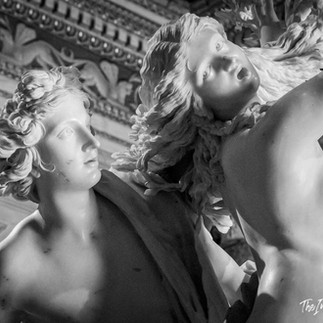
Originally, Bernini intended the group to be seen from a specific angle: placed against a wall near the spiral staircase, the viewer would first encounter Apollo from behind, in full sprint, and only upon advancing would the drama of the metamorphosis unfold. The narrative was sequential, almost cinematic. Today the sculpture sits at the centre of the room, which sacrifices that intended progression but offers compensation in the form of an endless series of revelations as you orbit around it. Every angle discloses something new: the tension in Apollo's outstretched hand, the horror dawning on Daphne's face, the extraordinary way the bark seems to be climbing her body in real time.
I must say, when I stood before this group, what struck me most forcefully, apart from the astonishing virtuosity and the perfection of the narrative composition of a work that is flawless from whatever perspective one chooses to view it, was not any single detail but the overall sensation of arrested movement. You feel, almost physically, that if you blinked the scene would advance by a fraction and everything would be different. It is that quality of precariousness, of being caught on the razor's edge between two states of being, that distinguishes this work from every other sculpture I have ever seen.
4. The metamorphosis in marble: virtuosity as philosophy
The leaves and twigs of the laurel into which Daphne is transforming are, by universal consensus, the most technically astonishing element of the statue. Their thinness borders on the absurd. You find yourself wondering how it is physically possible that stone can be this thin without shattering, and the answer involves a combination of extraordinary skill, a deep understanding of the crystalline structure of Carrara marble, and (let us be honest) a healthy dose of recklessness.
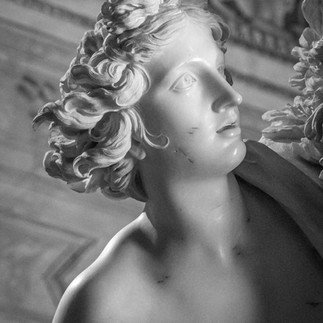
But here is what I find truly fascinating, and what elevates this work from mere technical showmanship to something philosophically profound. Bernini deliberately leaves visible the marks of his tools. Not because he was careless, but because the visibility of the process is part of the message. When you look closely at the bark wrapping Daphne's body, you can see the striations left by the claw chisel, and those striations simultaneously read as tool marks and as the texture of actual tree bark. The drill holes scattered among the curls of Apollo's hair are both evidence of the instrument that created them and visual elements that define the form of the ringlets. Bernini is essentially telling you: yes, this is marble, and yes, I carved it with these specific tools, and the magic lies precisely in the fact that knowing this does not diminish the illusion one bit.
This is a profoundly modern sensibility. Most sculptors before Bernini (and many after him) aimed to conceal the traces of their labour, to present the finished work as something that had simply materialised in its final form. Bernini does the opposite. He makes his technique manifest, transparent, almost pedagogical, and in doing so he paradoxically increases the wonder. Because when you can see the chisel marks and yet still feel that you are looking at living flesh transforming into living wood, the cognitive dissonance is even more powerful than if the illusion were seamless.


5. Execution technique: what the restoration of bernini's apollo and daphne revealed
This is the section I am most excited to write, because for anyone who loves sculpture not just as a spectator but as someone curious about the physical, manual, almost athletic act of wrestling stone into form, the findings of the 1995-1996 restoration are absolutely extraordinary (source Bernini Scultore, La Tecnica Esecutiva; Rome, De Luca Editori d'Arte, 2002).
A single block. Everything you see, Apollo, Daphne, the terrain, the roots, the entire laurel tree, was carved from one piece of Carrara marble. The block came from the Polvaccio quarries, the same source that supplied Michelangelo's most celebrated works. As Bernini rough-carved the stone, dark inclusions of pyrite and magnetite emerged, appearing as grey veins scattered across the white surface. The final polishing made them more visible rather than less, and you can spot them all over the figures, including a rather prominent grey speck on Daphne's nose. Interestingly, these blemishes disappear where the surface was left in its intermediate state (claw-chisel or rasp finish) because the matte texture absorbs them. On the luminous polished skin, though, they become part of the visual texture, a reminder that this is natural stone, not manufactured perfection.
A painter's logic applied to stone. What the restorers discovered is that Bernini treated his sculpting tools much like a painter treats brushes and pigments: each one produced a specific surface "tone", and the interplay between them created a visual richness comparable to a drawing with gradations of light and shadow. The polished nudity of the bodies, luminous and reflective, contrasts with the matte finish of Apollo's drapery, where the rasp was the final tool and no polishing powder was applied. The bark was deliberately left at the claw-chisel stage, its rough striations perfectly mimicking organic texture. Daphne's hair transitions from meticulously refined locks on the visible side to barely shaped stone on the back, where no spectator would ever look. If you mapped these different treatments onto a single chart, the result would resemble a tonal study, with areas of highlight, midtone and shadow, all achieved not through applied colour but through the varying degrees of surface refinement.
The drill: Bernini's secret weapon. The bow drill was arguably the most critical instrument in achieving the extraordinary delicacy that distinguishes this work. The restorers found drill holes everywhere: between every lock of hair, in every curl of Apollo's head, throughout the foliage and the berries of the laurel. For the thinnest terminal elements of the ringlets and for the deep undercuts in the canopy, the drill was indispensable. But Bernini did not use it mechanically. On the small leaves that mark the transformation of Daphne's hands, he tilted the drill at an oblique angle to produce shallow, elongated grooves instead of round perforations, mimicking the natural fissures of a vegetal surface. In the laurel canopy between the two bodies, a dense constellation of tiny holes, varying in depth and concentration, marks the junctions between branches and the grafting points of leaves and berries. The control required to calibrate these perforations (too deep and the stone breaks; too shallow and the form is undefined) is mind-boggling.
The errors. For me, this is the most humanising aspect of the entire restoration. Bernini made mistakes. Above Daphne's breasts, where the gentle swelling meets the base of the neck, there are rough depressions: the bush hammer struck too hard during the initial rough-out, biting deeper into the marble than intended. By the time Bernini reached the finishing stage, these depressions were impossible to remove without disrupting the harmonious contour of the torso. His solution was characteristically pragmatic: since the depressions are barely visible from below, which is the spectator's natural viewpoint, he simply left them. Similarly, on the inner surface of one of Daphne's fingers, a drill hole was placed in the wrong spot, right where the finger should have been. These are not failures; they are evidence that the sculptor was working directly, boldly, without the safety net of a full-scale preparatory model. He was carving from a small clay sketch and his own spatial intuition, and the occasional misjudgement was the price of that audacity.
Plaster armour for fragile stone. One of the cleverest technical solutions uncovered by the restoration involves the carving of the thinnest elements. To prevent the vibrations of the chisel from snapping the incredibly fragile leaf tips and finger extensions, Bernini encased them in plaster shells before carving the adjacent areas. These temporary protective casings absorbed the shock and allowed him to work aggressively right next to the most delicate forms without risking fracture. Once the carving was finished, the plaster was chipped away. But in a hidden, inaccessible cavity on Daphne's shoulder, a forgotten lump of plaster was discovered during the restoration, a charming piece of evidence that what lay beyond the spectator's sight simply did not concern the master.
The uncarved fingernail. My favourite detail of the entire restoration. On the middle finger of Daphne's left hand, concealed beneath a laurel leaf, the restorers found a fingernail that was never sculpted. It exists only as a graphite drawing on the marble surface, a design that was either forgotten or deliberately left unexecuted because the leaf would have hidden it anyway. There is something irresistibly poetic about this phantom fingernail, hovering on the boundary between intention and execution, between the drawing and the sculpture, between the idea and the stone. It is a tiny, accidental testament to the fact that even the greatest masterpieces are the product of a messy, imperfect, gloriously human process.
Pictures below from: Bernini Scultore, La Tecnica Esecutiva; Rome, De Luca Editori d'Arte, 2002


6. The comparison with painting and the classical tradition
Before Bernini, the story of Daphne's transformation belonged to painters. The subject had been depicted in countless canvases and frescoes, but never with this level of ambition in three dimensions. The reason is self-evident: a metamorphosis is a process, and processes unfold in time. Time is the domain of narrative arts like painting and poetry, not of sculpture, which is bound to a single, frozen instant. Bernini's audacity consisted in refusing to accept this limitation. He chose the one moment that compresses the entire story into a single image: the instant of contact and transformation.
In doing so, he clearly drew on his knowledge of classical statuary. The Apollo Belvedere, that icon of serene divine beauty, is the obvious reference for the male figure's pose and idealised anatomy. But Bernini's Apollo is not the composed, self-contained deity of the Vatican marble; he is a young man seized by an emotion he does not understand, his face caught between the exhilaration of the chase and the bewilderment of loss. This psychological complexity, this interest in the turbulent inner life of the characters, is entirely Bernini's invention and finds no real precedent in ancient art.
Where Michelangelo gave his figures monumental gravitas and sovereign physical power, Bernini gives them emotional fluidity. His bodies do not stand; they move, react, feel. And where Mannerist sculptors like Giambologna had experimented with multiple viewpoints and spiralling compositions, Bernini makes the counterintuitive choice of returning to a single, privileged viewpoint, yet fills that single view with a narrative density that the Mannerist approach had never achieved.
What sets Bernini apart from everyone before him is what I would call the "psychological approach": the extraordinarily rich spectrum of emotions he manages to represent within a single sculptural group. This element, entirely absent from classical sculpture and only tentatively explored in Renaissance work, constitutes a genuine artistic revolution. In a way that mirrors what was happening simultaneously in painting and theatre with artists like Rubens and the Carracci, Bernini introduces the dimension of inner experience into sculpture, making it the new standard against which all subsequent work would be measured.
I find that the Apollo and Daphne represents, even more than the Proserpina, the moment in which sculpture definitively enters the territory of the other arts: painting, theatre, poetry. It does not merely represent a story; it performs one. And the performance is so convincing that four centuries later, standing in Sala III with dozens of other visitors shuffling around you, you forget the room, forget the crowd, and for a few seconds you are simply there, in the mythological forest, watching a god lose the woman he loves to the indifference of nature.






7. A personal reflection
I want to close with a thought that occurred to me as I stood before the group. In the Rape of Proserpina, the central gesture, Pluto's hand sinking into the nymph's thigh, speaks of possession, of the body seized and claimed. In the Apollo and Daphne, the central gesture is the opposite: Apollo's hand reaching for Daphne's waist and touching not flesh but bark. It is a gesture of loss, of the beloved slipping away at the very moment of contact. The two sculptures, separated by just a few metres in the Galleria Borghese and by just a couple of years in Bernini's career, form a diptych about desire: one about desire fulfilled through violence, the other about desire thwarted by transformation.
Both works push marble to do things it was never meant to do. But if the Proserpina asks marble to be soft, the Apollo and Daphne asks marble to be alive, to be in the process of becoming something else. And this, I think, is why the Daphne continues to astonish us perhaps even more than the Proserpina: because the illusion it creates is not merely tactile but temporal. It does not just show us a moment; it shows us a moment that is passing, a present tense that contains within itself both a past (the chase) and a future (the tree). And that is something that no other sculpture, before or since, has ever quite managed to do.
If you visit the Galleria Borghese (and you absolutely must, if you find yourself in Rome), do yourself a favour: do not rush from one masterpiece to the next. Stand before the Apollo and Daphne for at least ten minutes. Walk around it slowly. Look at it from below, from the sides, from behind. Pay attention to the transitions: where polished skin becomes rough bark, where flowing hair becomes rigid leaf, where running feet become tangled roots. And then consider that all of this was conceived and executed by a man barely out of his adolescence, working with nothing but a hammer, a chisel, a drill, and an understanding of his material so profound that it borders on the supernatural.
If you are planning a trip to Rome you may be interested in these posts and these offers from Tiqets.