
Bernini and the Barberinis: Art, Power, and Invention in the Baroque. Review of the exhibition at Palazzo Barberini.
- The Introvert Traveler
- Mar 9
- 9 min read

Updated: Apr 14
Location: Gallerie Nazionali di Arte Antica - Palazzo Barberini
Visit duration: 1.5 hours (plus two hours for a possible visit to Palazzo Barberini)
My rating: 8/10
Tickets: Tiqets
The exhibition “Bernini and the Barberinis” held in the rooms of Palazzo Barberini in Rome from February 12 to June 14, 2026, addresses one of the most crucial issues in the history of 17th-century European art: the relationship between Gian Lorenzo Bernini and the Barberini family, particularly with Maffeo Barberini, who became pope in 1623 under the name of Urban VIII. The theme is not new to art historiography, but has rarely been analyzed with such a concentration of works, documents, and iconographic comparisons. The curatorial effort consists in demonstrating in a concrete and visual way how the Roman Baroque was not simply the result of a generic stylistic evolution, but rather the outcome of a specific relationship of patronage, political protection, and mutual legitimacy between artist and patron.
To understand the significance of the exhibition it is necessary to start from the historical context of the Barberini family, one of the most influential dynasties of seventeenth-century Rome. If you want to discover all of Bernini’s works in Rome, you can use ArtAtlas.
The Barberinis: political power and cultural patronage
The Barberini family, originally from Tuscany, reached the height of its fortune with the election of Maffeo Barberini to the papacy in 1623. Like many modern-day pontiffs, Urban VIII also used papal power as a tool for dynastic promotion. The Barberini pontificate was characterized by an extremely ambitious cultural policy. It was not simply a matter of building palaces or collecting works of art, but of redefining the very image of papal Rome.
The goal is twofold. On the one hand, to consolidate the family's prestige through a coherent and recognizable iconographic program. On the other, to reaffirm Rome's role as the artistic capital of Christianity at a time when the Catholic Church, following the Council of Trent, was using art as a tool of religious persuasion.
The pontificate of Urban VIII coincided with a period of extraordinary architectural and artistic activity. The city was transformed through monumental construction projects, fountains, palaces, churches, and scenographic displays. Bernini became the principal interpreter of this cultural policy. According to a famous phrase attributed to Urban VIII himself, reported in 17th-century sources, the artist's fortune and that of the pontiff were reciprocal: Bernini was fortunate to see Cardinal Barberini as pope, but equally fortunate for the pope to live under Bernini's pontificate.
Not everyone, however, appreciated the invasive nature with which the Barberini-Bernini duo turned Rome into an open-air construction site, even casually drawing on the spolia; just think of the well-known saying " Quod non fecerunt barbari, fecerunt Barberini"...
In any case, the relationship between the Baroque genius and his patron is the true conceptual center of the exhibition.
Bernini and Urban VIII: an artistic and political partnership
When Maffeo Barberini became pope, Bernini was just twenty-five years old. He was already known as a prodigious sculptor, having trained in his father Pietro Bernini 's workshop, but he was not yet the universal artist that history would remember.
It was Urban VIII who raised it to this status .
The Pope quickly realized that Bernini possessed a rare quality: the ability to integrate sculpture, architecture, and scenography into a unified language. He therefore didn't limit himself to commissioning statues and monuments, but entrusted him with some of the most symbolic projects of Baroque Rome. The most famous example, of course, is the Baldachin of St. Peter's , begun in 1624 and completed about a decade later.
This work is not just a monumental sculpture. It is a theatrical, architectural, and symbolic device that redefines the entire space of the basilica. Bernini successfully blends twisted columns, bronze, architecture, and iconography into a structure that simultaneously celebrates Peter's tomb and the power of the Barberini papacy.
The exhibition emphasizes this point, underlining how the Baroque is not a simple style but a political language.
The Baroque as an urban project
The relationship between Bernini and the Barberini family wasn't limited to individual works. Their partnership influenced the entire city of Rome.
During the pontificate of Urban VIII, the papal capital became an immense laboratory for artistic experimentation. Bernini created fountains, sculptures, architecture, and urban structures that defined the city's modern image.
Among the most emblematic works we can mention:
the Baldachin of St. Peter
the Triton Fountain
the Fountain of the Bees
the colonnade of St. Peter's Square (designed shortly after the Barberini pontificate but conceived in the same cultural climate)
Through these works, Rome takes on an unprecedented scenographic character. Architecture becomes theater. Urban space is designed to evoke emotion, movement, and wonder.
The exhibition at Palazzo Barberini suggests that this language was born precisely from the alliance between the artist and the pontiff.
The opening of the exhibition: Pietro Bernini and the beginnings of Gian Lorenzo Bernini
The exhibition opens with a section dedicated to Bernini's early years, appropriately highlighting the role of his father's workshop.
Among the most interesting works are some sculptures by Pietro Bernini, including Adam, Eve and the Serpent and works created in collaboration between father and son, such as the Putto on the Dragon .
This introduction is particularly effective because it allows us to understand how much the young Gian Lorenzo was initially inserted into the late-Mannerist tradition of Roman sculpture.


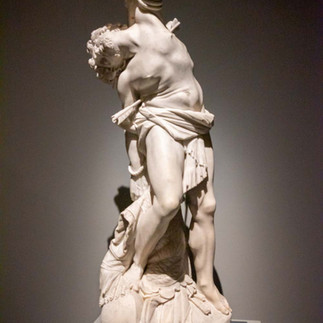


The decisive step forward comes with the Uffizi's Saint Lawrence, a youthful sculpture striking in its energy and naturalism. Here, the saint's body, stretched out on the grill, is treated not as an idealized figure but as a living organism, pervaded by muscular tension and emotional vibrations. The artist's ability to render the marble almost sensitive to light and movement, which would become his most recognizable signature, is already evident.


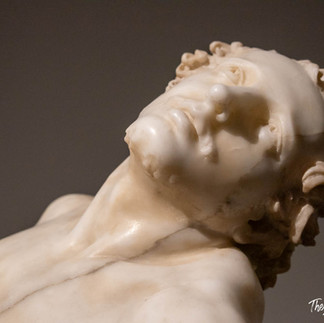


Drawings, documents and the construction site of San Pietro
One of the most interesting parts of the exhibition is the one dedicated to the documents and drawings relating to the construction site of St. Peter's.
On display are several studies for the Baldachin and for the statue of Saint Longinus , as well as models and engravings that allow us to reconstruct the creative process of the work.
Particularly curious is a document preserved in the archives of the Fabbrica di San Pietro that records a payment made by Bernini to Francesco Borromini, then employed as a stonemason on the construction site. The document is almost ironic when read in light of the famous (alleged?) rivalry between the two artists.


Bernini the portraitist: the mastery of the bust
A large part of the exhibition is dedicated to the production of portrait busts, which constitutes one of the fields in which Bernini achieved extraordinary technical and psychological results.
In seventeenth-century Rome, the bust was not just an artistic genre but a political tool. It served to spread the image of popes, cardinals, and members of the papal court.
Bernini developed a new concept of sculptural portraiture. He didn't simply reproduce facial features. Instead, he sought to capture the subject's vital energy.
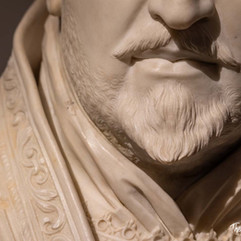
The portraits of Paul V and Gregory XV already demonstrate this tendency. The faces are not rigid, but rather pervaded by subtle muscular tension. The eyes seem to move in space. The surface of the marble continually varies between shiny and matte areas, where Bernini displays his mastery of illusionism in rendering different textures.
Urban VIII: building an image of power
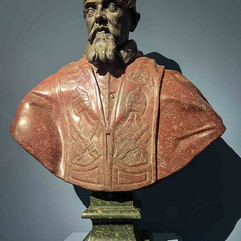
The heart of the exhibition is the extraordinary series of busts dedicated to Urban VIII.
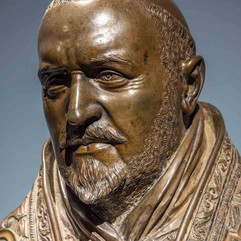
Various versions of the papal portrait in marble and bronze, from international museums and collections, are on display.
These busts are not simple portraits but propaganda tools. The pontiff appears sometimes bareheaded, sometimes wearing a mozzetta, sometimes wearing a camauro. Each variant corresponds to a specific symbolic register.
Bernini thus constructs a true iconography of papal power.
The face of Urban VIII is progressively transformed into an absolute image of spiritual authority.








Comparison with other sculptors
One of the exhibition's merits is that it does not isolate Bernini but places him within the context of Roman sculpture of the time, displaying some extraordinary works by other protagonists of Baroque sculpture.
Among these stand out:
The Equestrian Statuette of Carlo Barberini by Francesco Mochi
Bust of Michelangelo Buonarroti the Younger by Giuliano Finelli
the bust of Cardinal Santacroce by Alessandro Algardi
The comparison is enlightening.
Mochi represents a more traditional approach, still rooted in late Mannerism. Finelli takes the marble technique to an almost obsessive level of analytical precision. Algardi, on the other hand, proposes a more classical and composed sculpture.
In this context, Bernini appears as the artist who manages to combine technical virtuosity, theatricality and psychological strength.


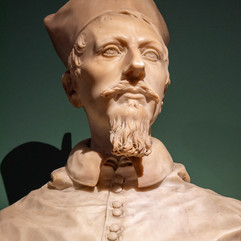


The exhibition does not delve into Algardi's innovative scope as a graphic designer, probably reserving the right to explore the topic in a future exhibition. He introduced the use of the smiley to represent the psychological profile of the portrayed subject, four centuries before Harvey Ball.

Bernini and bronze
An interesting aspect of the exhibition is the presence of some bronze works.
In the collective imagination, Bernini is above all a sculptor of marble. It is the material used for his most famous works, from the statues in Villa Borghese to his large monumental sculptures.
The presence of bronzes on display reminds us that Bernini used this material with great freedom and his usual mastery, creating textures that were unusual compared to the marble commonly associated with his work.
Works from private collections
A further element of interest in the exhibition is the presence of works from private collections, rarely visible to the public.
Among these I cite (more or less from memory, because I guiltily did not take note of them and out of laziness I did not buy the catalogue at the exhibition, reserving the right to purchase it comfortably from home):
Four Seasons by Pietro and Gian Lorenzo Bernini
Fall
the San Sebastiano Barberini
a pair of busts of Urban VIII
two bronze statues depicting Matilda of Canossa
The bust of Thomas Baker
Among the most spectacular works is the bust of Thomas Baker, from the Victoria and Albert Museum.
This is one of Bernini's most virtuosic portraits. The Englishman's face is rendered with extraordinary naturalism and spectacular vivacity. The marble surface seems to continually shift under the light, from the smooth areas of the face to the deepest folds of the drapery.

Gossip Moment
Among Bernini's students was Matteo Bonarelli, who was married to the beautiful Costanza Piccolomini, a descendant of the prominent Sienese family. She must have already resolved, with remarkable pragmatism, issues that contemporary feminism continues to debate in endless self-referential conferences, because while she was married to the sculptor from Lucca, she was also the lover of Gianlorenzo Bernini, as well as his younger brother Luigi.

The National Library of Florence preserves an anonymous document which recounts that Bernini, having discovered the affair between Costanza and her younger brother, waited in front of the lover's house to watch his brother emerge accompanied by the landlady with her hair in disarray. The situation quickly degenerated into a brawl; from this point on, versions diverge; the events, in fact, are also recounted in a letter sent by Bernini's mother, Angelica Galante Bernini, to Cardinal Francesco Barberini. The picturesque version, attributable to the anonymous BNF document, but to be taken with a grain of salt , relates that the Maestro chased his younger brother into St. Peter's, where the former displayed his percussive skills on Luigi's ribs, before instructing one of his servants to go and disfigure his lover Costanza. According to the mother of the two Berninis, the attack took place in Santa Maria Maggiore; in any case, there is no evidence that Costanza was actually disfigured. The protagonists of the affair received venial sanctions, which were extinguished after a few weeks and of all this, we have only one known work left, executed by Bernini for his own pleasure, the sensual portrait of Costanza, preserved in the Bargello Museum and exhibited at the exhibition.
The best comment
My award for the best commentary heard at the exhibition goes to:
Come on! I didn't know he could paint too!
The exhibition "Bernini and the Barberini": Conclusion
“Bernini and the Barberinis” is an exhibition that convincingly clarifies an essential point in the history of 17th-century art: the Baroque was born not only from the individual genius of an artist but from the encounter between talent and power.
Without the Barberinis, Bernini would probably still have been an extraordinary sculptor. But he would hardly have had the opportunity to transform Rome into the great Baroque theater we still know today.
The exhibition doesn't indulge in spectacular effects or overly theatrical display solutions. Instead, it focuses on the works and documents. This sober and philologically accurate approach allows for a clearer understanding of the complexity of one of the most decisive moments in European artistic culture.
The result is a balanced, scientifically grounded exhibition capable of accurately conveying the nature of the relationship between artist and patron that gave birth to the Roman Baroque.





Comments