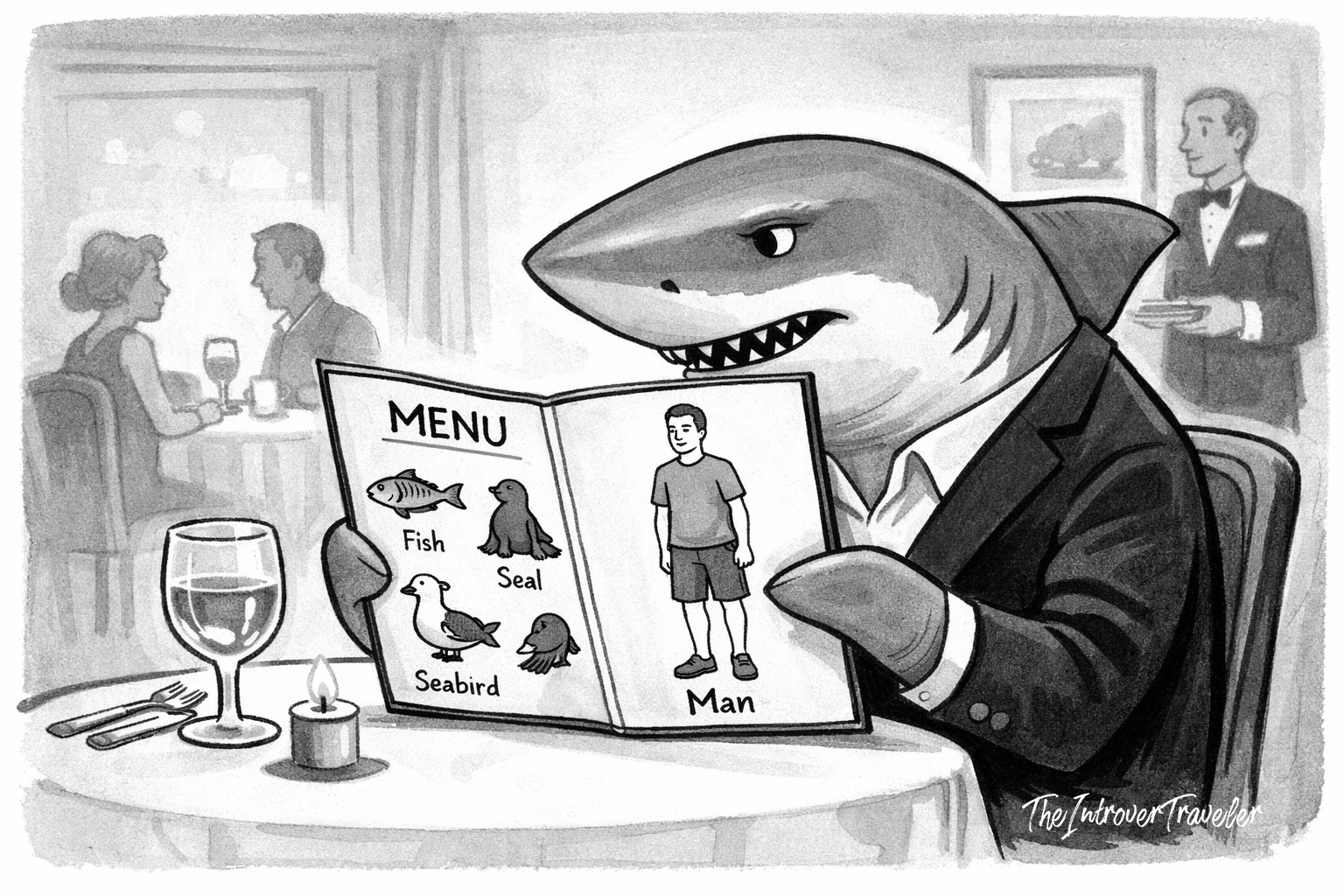
During one of my late-night wanderings, I came across an interesting post on Reddit by the user MajLoftonHenderson, dealing with the predatory behavior of the great white shark. The core question of the post was a very specific one: how many documented cases exist in which a great white shark, after biting a human, actually went on to consume the victim as prey? I found the post particularly compelling because I personally suspect that, after centuries of demonization of sharks (driven in no small part by Jaws, Spielberg’s masterpiece from a cinematic standpoint but a scientific disaster) the pendulum has swung all the way to the opposite extreme. What we are now witnessing is a form of generalized ideological denialism, one that seeks to portray sharks as cuddly, harmless aquatic pets. Any reference to the many Instagram influencers who enthusiastically promote this narrative is, of course, entirely intentional.
The Reddit post is interesting precisely because it seems to confirm what a balanced approach to the subject should conclude (and yes, I am fully aware that I am starting from a thesis here). Namely: no, sharks are not cuddly pets, but apex predators that deserve to be treated with appropriate respect; and yes, humans are not part of their habitual diet. As a result, when a shark swims past us while we splash around in the ocean, the likelihood that it will deliberately attack us is no greater than the likelihood that I, while walking through a park, might suddenly bite a passing chihuahua. I could do it, in theory, but I generally don’t, because chihuahuas are not part of my diet or my normal behavioral repertoire. The possible exception, perhaps, is the oceanic whitetip shark: if one passes close to you in the open ocean, there is a very real chance it will bite, simply because that is largely what it does: bite anything it encounters.
Now, since the establishment of an international registry of shark attacks roughly a century ago, the known cases in which a great white shark, after biting a human, did not disengage upon realizing the “mistake” but instead proceeded to feed are the following. I have made a few corrections to the Italian victims listed in the original Reddit post, which contained some inaccuracies.
William J. Goins (1926) USA HI
This list, of course, does not claim to be exhaustive. It does not include undocumented attacks, such as those that may have occurred, according to some unofficial sources, during shipwrecks involving undocumented migrants in the Sicily Channel. Nor does it include documented cases in which a great white shark consumed human remains but where it is unclear whether the behavior was predatory or necrophagous, as in the case of victims of the 1908 Messina earthquake and tsunami. Still, I believe the list has a non-negligible visual and conceptual impact. The fact that, over the course of a century, the names of people who died because they were actively and deliberately targeted as prey by sharks can fit on a single A4 page is strikingly telling when compared to the sheer number of people who have entered the world’s oceans over the same period. It is also worth noting that this list includes only great white shark attacks, not those involving tiger sharks or oceanic whitetips, such as the attacks in Egypt over the past two decades, nor those involving bull sharks, like the recent incidents in Sydney.
For decades, the behavior of the great white shark, and of sharks in general, toward humans has been framed through a reassuring, almost consolatory lens. The idea that sharks do not intentionally attack humans, but merely mistake them for more typical prey such as seals or sea lions, has become a mantra of modern shark outreach, an outreach I would add that is often ideological in nature. This explanation, known as the mistaken identity theory, undoubtedly played an important historical role. It helped dismantle the image of the shark as a bloodthirsty monster, an image fueled for decades by cinema, sensationalist media, and tabloid reporting. However, as often happens in behavioral biology, a theory that is useful in an initial phase risks becoming a misleading oversimplification when it is elevated to a universal explanation. Today, in light of data accumulated over more than half a century of observations, forensic analyses, and ethological studies, the mistaken identity theory appears increasingly insufficient to account for the full spectrum of shark bites.
The real breaking point lies in a fact that is rarely addressed openly in mainstream shark communication: there are documented, verifiable, and historically reconstructable cases of predation and consumption of humans by great white sharks. These are not arbitrary interpretations or sensationalist narratives, but events in which the victim’s body was partially or fully consumed, following dynamics incompatible with a simple exploratory bite followed by disengagement. The list published above does not demonstrate that sharks are habitual predators of humans, but it introduces a fact that cannot be ignored: intentional predation, however rare, is possible.
It is precisely here that the mistaken identity theory shows its most obvious cracks. The theory works reasonably well when analyzing attacks characterized by a single, often non-lethal bite, followed by rapid disengagement and no tissue consumption. It works far less well, if at all, when we observe multiple bites, repeated returns to the body, selective consumption of energetically rich tissues, and active pursuit or interception behaviors. In such cases, attributing the event to a perceptual error becomes increasingly difficult, especially in light of what we now know about sharks’ sensory and cognitive abilities. Studies based on bite pattern analysis, bite kinematics, and behavioral ecology indicate that sharks are perfectly capable of discriminating, already at first contact, the consistency, motor response, and energetic value of a potential target. The notion of a shark that “tastes” and only later realizes its mistake is becoming less and less convincing when confronted with empirical data.
In order to move beyond the rigidity of monocausal explanations, marine biologist Eric Clua has proposed a far more articulated interpretative model, now widely cited in the scientific literature. According to Clua, shark bites cannot be reduced to a single motivation, but must be understood as part of a spectrum of distinct behaviors.
Clua distinguishes the following categories of causes for shark bites:
Investigative / exploratory
For Clua’s classification, I refer to the following YouTube video as the source.
These include investigative or exploratory bites, in which the animal uses its mouth as a sensory tool; bites linked to feeding competition; defensive bites triggered by a perceived threat; accidental contacts due to poor coordination; bites related to dominance or territoriality; instinctive or reflexive responses to sudden stimuli; and finally true predatory bites, in which the objective is the acquisition of food. This framework has the great merit of restoring complexity to shark behavior and of clarifying a fundamental point: only a very small fraction of encounters with humans fall within the category of genuine predatory behavior.
One thing I always try to keep in mind when exploring this topic is that sharks do not have hands. The only tool they possess to explore the world, to defend themselves, or to fight is their mouth. The usual response to this observation is something along the lines of “I don’t care whether the shark was just exploring me with its mouth and didn’t intend to kill me, it was still a great white shark that bit me.” This is, in some respects, a reasonable reply, but it tends to underestimate the far more common scenario in which a shark passes close to a human and completely ignores them. This, in fact, is the most frequent behavior, as demonstrated by the numerous videos filmed by Scott Fairchild.
Another intriguing aspect that emerges from the Reddit post (and that, from what little I have read, seems to be cautiously entering the scientific literature) is that when the list of predation victims is examined closely, certain specific patterns appear to emerge, followed by long periods of apparent calm. This could be due to anomalous behavior by individual “problem” sharks. One Reddit user hypothesizes that when predatory behavior by individual sharks does occur, such as the tiger shark that killed Vladimir Popov in Hurghada in 2023, or the oceanic whitetips that caused multiple fatalities within a few weeks in Sharm El Sheikh in 2010, the targeted removal of those individual sharks might have a surgical effect on the frequency of attacks on humans, while safeguarding the broader shark population. A perhaps risky parallel that comes to mind is the case of the man-eating lions of Tsavo in 1898, which carried out numerous attacks on humans near the Tsavo River in Kenya. In the case of lions, we are dealing with predators that can, in fact, systematically prey on humans.
Statistical analyses based on major international databases such as the ISAF suggest that the majority of bites attributed to large predatory sharks fall within the exploratory or reactive domain. A significant proportion can be attributed to defensive behaviors or reflex responses, while only a minority (estimated at around ten to fifteen percent) shows characteristics compatible with genuine predatory intent. Within this latter category, cases of complete predation with consumption of the victim represent an extremely small fraction, well below one percent of documented encounters. This figure is crucial, because it allows us to reconcile two statements that only appear contradictory: the great white shark is not a specialized predator of humans, but it is not biologically or behaviorally incapable of considering a human as prey under particular circumstances.
To understand why predation on humans is so rare, one must look at the energetic biology of the great white shark. It is a highly specialized predator, optimized to hunt fat-rich prey such as pinnipeds, which offer a high caloric return relative to the effort involved. Humans, by contrast, are relatively lean prey, energetically inefficient and rarely available in the marine environment. When predation does occur, it seems to be favored by a combination of factors: large body size of the shark, often adult females; ecological contexts in which the shark is already in active hunting mode; isolation of the victim; lack of immediate alternative prey; and sensory conditions that facilitate target interception. In such cases, speaking of perceptual error becomes implausible. It is more accurate to interpret the event as a situational behavioral decision made by an opportunistic predator in a specific context.
Acknowledging this reality does not mean demonizing the great white shark or fueling irrational fears. On the contrary, it means abandoning an infantilizing narrative that oscillates between the monster and the misunderstood animal, in favor of a more adult and scientifically honest perspective. Sharks are not “man-eaters,” but they are not blind, stupid, or incapable of adapting their behavior to new situations either. They are complex predators, endowed with a broad and flexible behavioral repertoire, which in the vast majority of cases ignore humans entirely, but which in exceptionally rare circumstances—truly exceptional ones—may include us within their predatory spectrum.
Understanding this complexity does not make the ocean more dangerous; it simply makes it more real, and I believe this is the only truly correct way to approach the complexity of nature.
Disclaimer: I am not a marine biologist, nor a scientist. I am simply a curious and skeptical reader who tries to inform himself as thoroughly as possible and shares his doubts and his readings.