I have already published other posts on diving safety and, among the potential hazards faced by those who practice scuba diving, one of the most frightening—however remote—is finding oneself alone and adrift in the open ocean. For this extreme scenario, there are GPS-based systems designed for diving that allow a lost diver to transmit their position and call for rescue. In this post, I examine two of the most popular devices and explain which one I personally chose, and why.
In fact, in discussions about personal safety in remote or hostile environments—open sea, diving, but also mountains or deserts—it is quite common for fundamentally different products to be placed on the same level simply because they “allow you to call for help.” In reality, behind this superficial similarity lie radically different risk-management philosophies. The Garmin inReach Mini 2 (edit: the Garmin inReach 3 is now available) and the Nautilus Lifeline exemplify this dichotomy well: both are compact, rugged devices designed for critical situations, yet they are built for different operational scenarios, rely on different communication technologies, and correspond to rescue timelines and modalities that are not interchangeable.
The former (Garmin inReach Mini 2) is a satellite communicator intended for off-grid use, where there is no cellular coverage and the only possible interlocutor is a remote coordination center. The latter (Nautilus Lifeline) is a marine device that leverages infrastructure already present on vessels, communicating directly with the radios and chart plotters of nearby boats. Confusing the two means making a conceptual mistake even before a technological one. Analyzing them separately, by contrast, makes it possible to understand not only how they work, but above all when and why one is preferable to the other.
For a broader overview of safety when diving around the world, read my complete guide to scuba diving travel.
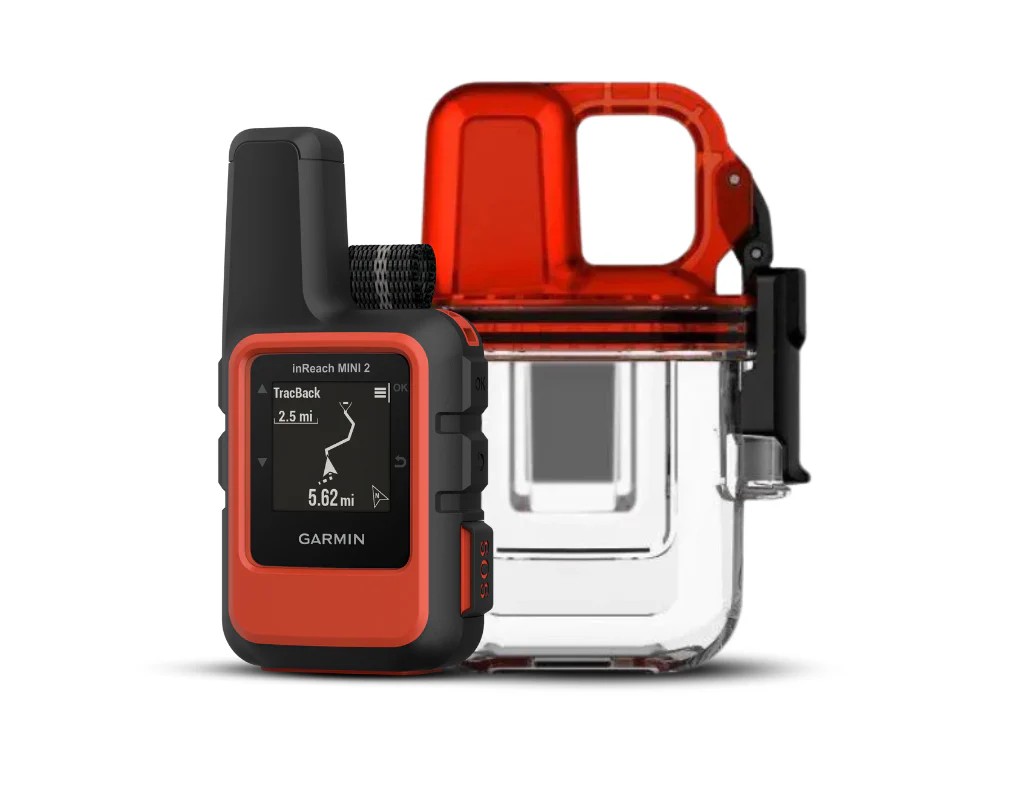
Garmin inReach Mini 2 – satellite communication and off-grid emergency management
At its core, the Garmin inReach Mini 2 is a personal satellite terminal. Its primary function is not simply to “send an SOS,” but to maintain a reliable communication channel in all those contexts where terrestrial networks are absent or irrelevant. The technological backbone of the system is the Iridium satellite network, a low-Earth-orbit constellation that provides truly global coverage, including polar regions and open oceans.
From an operational standpoint, this translates into a very simple concept: as long as the device has a reasonably clear view of the sky, it can transmit. The presence of nearby boats, radio repeaters, or cellular towers is irrelevant; the initial point of contact is always a remote coordination center, now operated by Garmin Response (formerly GEOS). Rescue is not “immediate” in the nautical sense of the term, but rather structured, progressive, and coordinated.
One of the most significant aspects of the inReach Mini 2 is its two-way communication capability. Unlike older one-way beacons, this is not a matter of broadcasting a signal into the void and hoping someone picks it up. After activating the SOS, the user can exchange text messages with a human operator, providing details about the situation, the number of people involved, and weather or medical conditions. This dramatically reduces the risk of false positives and allows rescue services to tailor their response more effectively.
In addition to the SOS function, the device offers full satellite messaging. It is possible to send and receive SMS messages or emails, either to predefined contacts or to other inReach devices. For those undertaking expeditions lasting several days or weeks, this is far from a trivial feature: it allows one to communicate delays, itinerary changes, or simply confirm that everything is proceeding as planned, thereby reducing the anxiety of those back home. More prosaically, when I am on a liveaboard in the middle of the Red Sea, disconnected for days on end, I can send a short email to my family to let them know that everything is fine—or leave an emergency contact to a client, if they truly cannot do without me.

On the subject of two-way communication, a clarification is warranted. While the device can indeed send and receive messages, the display is a basic LCD, not very different from that of a Nokia phone from 25 years ago, and the only way to compose messages is by using the two side arrows to select letters one by one. As someone who relies on reading glasses, I genuinely doubt that, adrift in the middle of the ocean and without my glasses, I would be able to type a coherent message to a coordination center. For me, the most realistic emergency scenario is therefore pressing the red button and waiting a few hours to see a helicopter appear. That said, it is possible to pre-configure preset messages that can be sent without having to compose them manually.
From an energy standpoint, the inReach Mini 2 uses an internal rechargeable lithium-ion battery, with real-world autonomy typically ranging from one to two weeks depending on tracking intervals and messaging usage. This is not a device you can “forget in your backpack for years”: it requires active power management, the use of power banks or onboard charging systems, and a minimum level of operational discipline.
A frequently underestimated yet crucial aspect is the subscription requirement. The inReach Mini 2 cannot be used without an active plan. This should not be seen merely as a recurring cost, but as an integral part of the service: the satellite network, the 24/7 coordination center, and the handling of messages and emergencies all entail structural costs. In return, the user gains access to a global rescue infrastructure, not just a simple transmitter. The subscription can, however, be suspended during periods of non-use and reactivated only when needed—a significant advantage for someone like me, who primarily relies on it during a few exotic diving trips each year.
In summary, the Garmin inReach Mini 2 is a tool for strategic safety. It is not designed to resolve an immediate emergency a few hundred meters away, but to ensure that, even in the most isolated point on the planet, there is a direct line to someone capable of activating rescue operations. The prospect of being lost in the middle of the ocean yet able to communicate with the outside world and broadcast my position is a source of considerable reassurance when diving in areas with strong currents or challenging conditions.
Another feature I find particularly useful is the ability to store waypoints. I used it in Tanzania during safaris to record the locations of visited sites, and I use it around the world to mark dive locations. Still in Tanzania, I also used the function that allowed me to share a live map with my family so they could check my position at any time (although, in hindsight, this proved unnecessary, as 4G connectivity worked exceptionally well almost everywhere).
The Garmin inReach Mini 2 is not specifically designed for scuba diving and requires an additional underwater housing, which must be purchased separately.
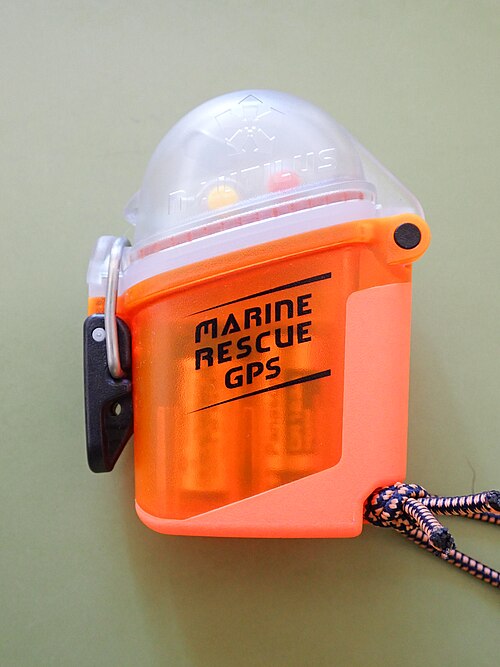
Nautilus Lifeline – the “intelligent man overboard” device for the real world at sea
The Nautilus Lifeline is built on an opposite assumption: at sea, the fastest rescue is almost always the closest one. In cases of man overboard or a lost diver, the difference between a benign outcome and a dramatic one is often measured in minutes, not hours. For this reason, the Lifeline does not rely on satellites, but instead uses maritime VHF frequencies, communicating directly with the onboard systems of nearby vessels.
The device integrates a high-precision GPS receiver and an AIS (Automatic Identification System) transmitter. When activated, it sends a “Man Overboard” alarm that immediately appears on the chart plotters and radar screens of AIS-equipped vessels within a range of tens of kilometers. In parallel, if configured with the MMSI of the mother ship, it can also transmit a DSC (Digital Selective Calling) signal directly to the VHF radio of the vessel from which the diver has become separated.
From an operational standpoint, this approach offers a major advantage: there are no intermediaries. There is no remote coordination center and no escalation chain. The boat sees the alarm, sees the coordinates, and can immediately maneuver toward the target. In diving scenarios involving current or rough seas, this immediacy is often decisive.
The Nautilus Lifeline is specifically designed for the underwater environment. It is waterproof to depths on the order of 130 meters, floats on the surface, and is compact enough to fit into a BCD pocket. It does not require recharging: it uses primary lithium batteries with a standby life measured in years. This seemingly minor detail is, in fact, one of its main strengths. The Lifeline can be left mounted on one’s gear for an entire season—or multiple seasons—without the concern of “finding it dead just when it’s needed.”
Another key aspect is the complete absence of subscriptions or recurring costs. Once purchased, the device works for as long as the batteries remain effective. There is no network to maintain, because the network is already there: the VHF radios and AIS systems installed on vessels. This makes the Nautilus particularly appealing for those seeking a simple, autonomous, and forget-proof solution.
Naturally, this technological choice also entails limitations. The Nautilus Lifeline is effective only if someone is listening. In open water, far from shipping lanes or in the absence of AIS-equipped vessels, its signal may not be received by anyone. It does not offer text messaging, continuous tracking, or the ability to explain the nature of the emergency; it is, by design, a single-purpose device.
And it is precisely this specialization that makes it so effective within its intended scope. The Lifeline does not try to do everything; it tries to do one thing, as quickly as possible: tell nearby boats, “I am here.”
That said, this technology has two obvious limitations. While the Garmin, by communicating with satellites, transmits vertically and simply requires a clear view of the sky (a fairly obvious condition for someone lost at sea), the Nautilus communicates horizontally with surrounding vessels, and its signal can be significantly degraded in rough sea conditions. Moreover, the realistic coverage range of the Nautilus does not exceed roughly 10 kilometers. This means that if there is no vessel in the immediate vicinity, or if the signal is disrupted by weather conditions, the Nautilus may prove completely ineffective. It is worth recalling that in the presence of strong currents, it does not take long for a lost diver to be carried more than 10 kilometers away from the support vessel.
Alternatives
I consider Garmin and Nautilus to be the two primary competitors in the market for diver locator devices.
For the sake of completeness, it is worth mentioning other comparable products currently available on the market:
ACR ResQLink View (link)
Conclusion – the best GPS locator for diving
Comparing the Garmin inReach Mini 2 and the Nautilus Lifeline as if they were direct competitors is misleading. In reality, they represent two different layers within the safety chain. The former operates on a global, strategic level, designed for total isolation and for emergencies that require remote coordination. The latter operates on a local, tactical level, where the reaction speed of nearby units is the decisive factor.
For those engaged in trekking, expeditions, crossings, or travel in areas without infrastructure, the inReach Mini 2 is a tool that is difficult to replace—not so much because of the SOS button itself, but because of the ability to remain in contact with the world even when the world is very far away. For those who dive, sail, or work at sea, the Nautilus Lifeline is an extremely rational response to one of the most concrete and underestimated risks: being separated from one’s vessel.
With a mature approach to safety—especially for those who practice complex or combined activities—the best choice is not always “one or the other.” More often, it is about integrating different tools, each optimized for a specific scenario. Safety, after all, is never a matter of marketing or spec sheets, but of time, context, and real probabilities. And on these three parameters, the Garmin inReach Mini 2 and the Nautilus Lifeline play different games, both entirely legitimate. Personally, however, I have preferred the former, as I believe it offers me greater assurance of being rescued under any conditions, in the unfortunate event of finding myself lost at sea.
This destination is part of my complete Scuba Diving Travel Guide, where different global diving environments and travel strategies are explained in detail.