
Everything you need to know about visiting Pompeii
- The Introvert Traveler
- Jan 21
- 22 min read

Updated: Mar 10

Last visit: October 2025
Visit duration: a full day
My rating: 10/10
The archaeological excavations of Pompeii represent, in terms of their breadth and depth of knowledge, the first and most significant case in the world of an ancient city preserved as if in a natural laboratory: a Roman polis that remained practically intact from the moment of its destruction in 79 AD until its gradual rediscovery starting in the 18th century.
Pompeii has been a UNESCO World Heritage Site since 1997, along with the Vesuvian areas of Herculaneum, Torre Annunziata, Oplontis, and Stabiae, by virtue of its exceptional universal value and its quality as a testimony to urban and social life in classical antiquity.
Pompeii is more than just an archaeological site; it is a layered archive of Roman daily life, urban planning, economics, religion, art, and technology. The exceptional state of preservation of the buildings, frescoes, mosaics, public and private spaces, along with the casts of buried human figures, evokes a sort of suspended moment, waiting to be interpreted.
A few numbers
Excavations began: Systematic excavations began in 1748 during the reign of Charles of Bourbon. Previous occasional interventions date back to the 16th century, with accidental discoveries, but it was from the 18th century that the city began to gradually be brought to light. Excavations are still ongoing.
Duration and continuity: the work of excavation, development and conservation has continued uninterruptedly for over 270 years , going through phases of methodological and critical research, rigorous documentation and preservation of the archaeological heritage.
Site extent: Pompeii covers over 44 hectares of fully excavated archaeological area, to which must be added a larger area for landscape protection and archaeological context.
Annual visitors: In 2024, the site recorded over 4 million visitors , an unprecedented figure that reflects Pompeii's primacy among the world's archaeological sites and its ability to catalyze global interest in Roman antiquity.
Contemporary management and sustainability: Due to pressures from mass tourism, recent management measures include a daily entry limit (up to 20,000 personalized tickets during peak seasons) and timed entry systems to mitigate the impact on the site and improve the visitor experience.
Placement in the Italian context: the Pompeii excavations are frequently ranked among the top places in Italy in terms of number of visitors; studies by the Ministry of Cultural Heritage indicate approximately 4 million visits per year, placing them second only to the Colosseum-Forum-Palatine archaeological complex in terms of access.
What was Pompeii?
Pompeii was a fully-fledged Roman city, not reducible to a single function, but rather the result of a balance between commerce, production, administration, and social life, seamlessly integrated into Rome's political and economic system. Its geographical location, on the southern edge of Campania felix, on extraordinarily fertile volcanic soil and a short distance from the sea, made it an economically active and well-connected center, capable of supporting a population estimated at between ten and twelve thousand inhabitants, divided into a complex social stratification that included municipal elites, entrepreneurial middle classes, enterprising freedmen, and a large component of slaves. Pompeii was a city that produced and traded: its urban fabric is dotted with shops, workshops, fullonicas (ancient laundries), lupanaria (brothels), bakeries, and businesses related to food processing, while its land was intensively exploited for viticulture and specialized crops also intended for export, placing the city in Mediterranean trade. At the same time, the quality of life, the presence of thermal baths , theatres , a large amphitheatre and a complex system of public spaces made Pompeii a pleasant and culturally refined place, capable of attracting extended stays of members of the Roman aristocracy, without however transforming it into a city exclusively devoted to holidays, a role which was rather the preserve of the coastal centres immediately overlooking the Gulf (Herculaneum, Oplontis and Stabiae and other centres hit by the eruption which are part of the visit to the archaeological area).
From a legal point of view, after the Social War it became a Roman colony ( Colonia Cornelia Veneria Pompeianorum), linked to Rome by administrative, fiscal and cultural ties, while maintaining a strong local Campanian identity.
The urban planning, the product of layered growth rather than a single plan, reveals a functional, rational, and adaptable city, with well-organized streets, advanced water systems, and a seamless integration of private spaces and economic activities, so much so that many domus were both homes and workplaces. Pompeii, therefore, was not an exception to the Roman landscape in terms of customs or vocation, but rather a vibrant city, where production, consumption, political representation, and leisure coexisted in a balance typical of the Roman world. What makes it unique today is not what it was, but the fact that that urban normality has come down to us unmediated, captured in the precise moment when daily life came to a halt and the city became, despite itself, an unwavering testament to Roman civilization.
What historical period did Pompeii belong to?
Visiting Pompeii takes us on a journey into the past, but to what precise stage of Rome's thousand-year history?
In 79 AD, the year of the destruction of Pompeii, Rome was fully in the Imperial age, far from the Republican phase and already separated by almost a century from the founding events of the Principate. The Republic had definitively ended in 27 BC with the rise of Octavian Augustus , and in 79 AD the Empire was governed by Titus, second emperor of the Flavian dynasty, who succeeded Vespasian. 79 AD, however, was placed in a phase of imperial stabilization, following the civil wars of the 1st century and the crisis of the Year of the Four Emperors (69 AD), in an Empire that was now administratively mature, centralized and relatively pacified. The extension of Roman dominions was then close to its maximum breadth: Rome controlled the entire Mediterranean basin, from southern Britain to Mesopotamia, from the Iberian Peninsula to North Africa, with a network of provinces governed by imperial officials, linked by efficient infrastructures and integrated by an advanced monetary economy. Technologically and socially, Roman society in 79 AD had reached an extraordinary level of complexity: aqueducts, sewers, large-scale masonry construction, domestic heating systems, a complex bureaucracy, and a widespread urban culture, with functional literacy, at least among the middle classes, and a vibrant circulation of ideas, goods, and people. Pompeii, at the time of its destruction, therefore did not belong to an "archaic" or transitional era, but to an imperial Rome already fully developed, powerful, self-confident, and convinced of its own permanence. And it is precisely this that makes the eruption of Vesuvius a historically disturbing event, because it strikes not a nascent or declining civilization, but a society at the pinnacle of its material and cultural organization.
What we see in Pompeii is the Roman Empire at its height.
The eruption of 79 AD: the night when time stood still
Pompeii was asleep. The shops were closed, the triclinia were silent, the cobbled streets gave off the warmth of the day just passed. Nothing, for those who lived there, suggested that this would be the city's last night. On August 24, 79 AD (or, according to some recent historiography, an autumnal date in October), Vesuvius broke a centuries-long silence and transformed a vibrant urban center into a crystallized snapshot of death. Pompeii was not "destroyed" in the common sense of the term: it was frozen in time, sealed by an extremely violent geological event that has paradoxically preserved its memory for us.
From a geological point of view, Vesuvius is an explosive stratovolcano, characterized by alternating lava flows and pyroclastic deposits. Its danger lies not in the relatively slow-moving, fluid lava, but in its ability to produce Plinian eruptions, so-called after the account provided by Pliny the Younger, an eyewitness of the event from the coast of Misenum. In such an eruption, the pressure of the gases accumulated in the magma generates an eruption column up to 30–33 kilometers high, which cyclically collapses, giving rise to pyroclastic flows: incandescent clouds of gas, ash, and rock fragments, capable of moving at speeds of over 100–300 km/h .
The eruption unfolded in several phases. The first, lasting several hours, saw a continuous rain of pumice and lapilli that gradually accumulated on the roofs of houses. Many buildings collapsed under the weight of this material; some of the population attempted to flee, others took refuge indoors, convinced, as often happens, that the worst was over. This was only the beginning. The truly lethal phase was that of the surges and pyroclastic flows, which struck Pompeii in the early hours of the following day.
The temperatures of these flows are now estimated to be between 250 and 500°C; in Herculaneum, closer to the volcano, higher temperatures were probably reached. In Pompeii, death was almost instantaneous: thermal shock, asphyxiation, collapse of soft tissue, with immediate cessation of vital functions. The famous casts do not depict people "slowly suffocated," but bodies captured at the exact moment of death, stiffened by a sudden and irreversible physical event. The postures (hands on the face, contracted limbs, attempts at protection) are the silent language of a few seconds of extreme awareness.
The number of victims is difficult to establish precisely. Just over 1,100 individuals have been found in Pompeii, but the city's total population is estimated to have been between 10,000 and 12,000. Many managed to escape; others died in areas not yet excavated or in peripheral areas. The total area affected by the eruption exceeded 1,000 km², involving the entire Gulf of Naples in an environmental crisis unprecedented in recorded history.
Pliny the Younger, in his letters to Tacitus, also recounts the rescue attempt led by his uncle, Pliny the Elder, commander of the fleet at Misenum. Driven by scientific curiosity and a sense of duty, he sailed toward the stricken areas, but died in Stabiae, likely from respiratory failure caused by volcanic gases. This is one of the first known cases of civil defense interventions ante litteram, tragically ineffective in the face of a natural phenomenon of such scale.
After the eruption, Pompeii was covered by a layer of sediment approximately 5 meters thick, which cemented together, preserving it completely from the elements for millennia, conserving it in a sort of natural time capsule.
When you walk through Pompeii today, what you see is not a "ruin" in the romantic sense of the term, but a snapshot of a precise moment, the negative of a city that suddenly stopped. Every street, every fresco, every body is the material residue of that brutal interruption.
The visit to Pompeii
Visiting Pompeii is not an experience comparable to that of a museum or a traditional archaeological site, but rather a prolonged journey through a real, expansive, physically demanding, and intellectually layered urban space, requiring time, attention, and a different mindset than that of rapid-fire tourism. Visitors should, first and foremost, expect scale: Pompeii cannot be "seen" in its entirety; it must be walked through, traversed, and every choice implies sacrifice. Once past the entrance, the initial impact is that of a city still discernible in its fundamental structure: streets, intersections, sidewalks, pedestrian crossings, with the constant sensation of moving not among isolated ruins but within a coherent urban organism.
The first major symbolic hub (accessible after a few minutes, if you enter the archaeological area from the Porta Marina entrance) is the Forum, the political, religious, and economic center of the city, a rectangular porticoed space that epitomizes Pompeii's public life and from which all civic functions ideally emanate; here, one immediately perceives the relationship between monumentality and everyday life, between representative architecture and human flow. Continuing, the visitor comes into contact with the most "lived-in" fabric of the city: shops opening onto the street, bakeries with millstones still in situ, fullonicas with vats for processing fabrics, taverns with brick counters, elements that convey a productive, noisy, and concrete Pompeii.
In this context, we find the Lupanar, often trivialized but actually crucial to understanding the regulation of sexuality and the trade of the body in the Roman world: not a scandalous or marginal place, but rather a functional, organized building, decorated with explanatory frescoes that served a practical rather than voyeuristic purpose, located in the heart of the city, not on its margins. Continuing toward the residential area, the experience radically changes tone: one enters the domus, and here Pompeii reveals its most intimate and, at the same time, most ideological dimension.


The House of the Faun represents the pinnacle of aristocratic living, not only in size but also in symbolic complexity: two atriums, peristyles, a sequence of spaces designed to impress the ancient visitor, and above all the famous mosaic of the Battle of Alexander, which is not simply an artistic masterpiece, but a cultural and political statement of belonging to a cultured and pro-Greek elite. Here, the modern visitor understands that the Roman home was not a private space in the contemporary sense, but a tool for social self-representation. Alongside these grand residences, a visit to the more modest homes, often with adjoining workshops, is equally essential for grasping the variety of the urban fabric and the interplay between work and home life. A necessary clarification regarding the House of the Faun: both the celebrated mosaic of Alexander the Great and the eponymous statue of the faun have been transferred to the National Archaeological Museum of Naples for conservation reasons; what you see in Pompeii are reproductions.

A must-see is definitely the House of the Vettii, which recently reopened after 20 years of closure for extensive restoration. It is one of the best-preserved villas, and the frescoes , mostly featuring mythological themes, are stunning. I found the architectural perspective representations particularly interesting, as they predate the art of the early Renaissance by centuries.


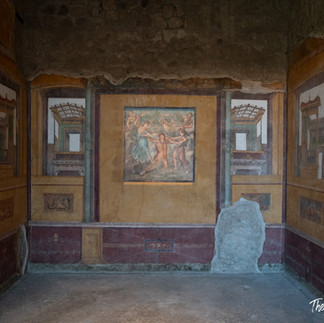


The baths, particularly the Stabian Baths , introduce us to another pillar of the Roman experience: the bath as a daily social practice, a place for meeting, discussion and consensus-building, with a technological level surprising in terms of efficiency and comfort.
Continuing towards the north-western edge of the site, the route leads first to the Villa of Diomede , interesting if only for its complex structure and the evident prestige that the villa must have enjoyed at the height of its splendor, and then to the Villa of the Mysteries, which I will talk about later, dedicating a specific paragraph to it.
Returning to the city's interior, the Amphitheater, one of the oldest surviving masonry amphitheaters, conveys the spectacular and collective dimension of Roman life, reminding us that Pompeii was also a mass city, capable of hosting events that engaged the entire population. The overall visitor experience is fragmented by necessity but coherent in structure: each street traveled refers to a function, each building to a social practice, and the cultured visitor is encouraged to hold this information together without reducing it to a catalogue of "things to see." What is increasingly striking, advancing for hours among worn paving stones and frescoed walls, is the continuity between ancient and modern gestures: cooking, working, praying, displaying, and having fun. Pompeii presents itself not as a romantic ruin, but as a city interrupted, and the most authentic experience of the visit occurs when one stops searching for the single masterpiece and begins to interpret the space as a whole, accepting the fatigue, the repetition, the loss of orientation as an integral part of a journey that is not only physical but also mental. Those who enter Pompeii with this mindset emerge with the awareness of having traveled not through a place of the past, but through a city that, by a paradox of history, continues to speak to the present with a clarity that no other archaeological site in the world can match.
Another site absolutely worth a visit is the House of Menander, in an excellent state of preservation; at the time of writing it is closed for restoration but should absolutely be included in any visitor itinerary (if open to visitors), especially for its beautiful mosaics.
Also worthy of mention is the House of the Lovers, recently reopened after years of restoration. This house is of particular archaeological interest, as it is one of the very few in which the second floor remains intact. The effects of the eruption of Vesuvius, both due to the different relative distances and exposure to the winds, were very different in Pompeii and Herculaneum. While in the latter the buildings remained substantially intact, having been struck by extremely hot air flows that carbonized the wood that made up the load-bearing structures of the buildings, Pompeii was struck by the progressive accumulation of lapilli and ash that settled on the buildings, causing them to collapse. The House of the Lovers represents an exception, allowing us to see the structure of a typical Pompeian building almost intact.
These are just a few of the essential stops, but not all of them. My advice (or rather, it's more of a recommendation) is to bring a paper map with you at the entrance and meticulously follow a route that includes all the points of interest marked on the map. Some of these may be closed during your visit, either due to ongoing restoration work or due to the rotation of exhibits to protect them from the onslaught of tourists.
In this post, I'm not including photographs of the eastern part of the city, which I had already visited on a previous visit. In particular, I'm missing the Amphitheater (known, among other things, for having been the venue for Pink Floyd's Live at Pompeii concert) and the Garden of the Fugitives (where the casts of some of the eruption's victims are kept; however, some casts are visible elsewhere during the visit), but I think that overall, the most interesting area of the city is the western one.
The Villa of Mysteries
The Villa of the Mysteries is, in my opinion, the place where Pompeii ceases to be an exceptionally preserved relic and becomes an intellectual experience of the highest order, capable of engaging the visitor on multiple levels: artistic, religious, anthropological, and symbolic. Located outside the city walls, along the road to Herculaneum, the villa presents itself from the outside as an imposing yet sober architectural structure, overlooking the Campanian agricultural landscape, almost suggesting a liminal dimension between city and countryside, between urban space and aristocratic leisure. And it is precisely this peripheral location that prepares the visitor for a radical shift in tone: here one enters not a domus intended for civic representation, but a place where private life, ritual, and the initiatory dimension seem to have played a central role. The experience inevitably culminates in the large room decorated with the celebrated pictorial cycle, often inaccurately described as "mysterious" in a vague sense, but which constitutes one of the most complex and fascinating figurative programs in all of Roman painting.
The almost life-size figures are arranged along the walls in a continuous sequence that envelops the viewer, blurring the distinction between real and depicted space and transforming the room into a kind of ritual theater. The dominant color, a deep, saturated red (the celebrated "Pompeian red"), creates a unified visual field that amplifies the emotional impact of the scenes and lends the cycle an almost sacred solemnity and a restless tone.
Interpretations have been numerous and debated for over a century, but what makes the Villa of the Mysteries extraordinary is not so much the possibility of definitively "deciphering" the meaning of the scenes, but their ability to suggest a coherent symbolic path, likely linked to a Dionysian initiation rite, perhaps connected to the passage to adulthood or marriage. The female figures, central to the narrative, seem to undergo a sequence of emotional and ritual states: anticipation, turmoil, revelation, integration, in a crescendo that culminates in the presence of Dionysus and Ariadne, an image of mystical union and the transcendence of the ordinary. What is striking is the absence of any purely decorative intent: every gesture, every glance, every object has a symbolic weight, and the entire pictorial cycle appears conceived as a transformative experience for the viewer, not as a simple domestic ornament. And yet, beyond the symbolic aspect, one cannot help but be captivated by the faces of the subjects depicted, which can also be interpreted as extremely vivid portraits of real people staring back at us from the depths of time, immortalized by the hand of an ancient artist.
From an artistic perspective, the execution is exceptional: the rendering of volumes, the mastery of space, the ability to suggest movement and emotional tension place this cycle among the absolute pinnacles of Roman wall painting, so much so that the Villa of the Mysteries is often cited as one of the few cases where we can glimpse, albeit indirectly, the visual impact of great lost Greek painting. But the villa is not just its frescoed triclinium: the entire architectural complex, with its residential, productive, and agricultural areas, demonstrates an integrated management of space, in which luxury, work, and ritual coexist without contradiction. This aspect is crucial to avoiding an overly spiritualized interpretation of the site: the Villa of the Mysteries was neither a temple nor a sanctuary, but a high-level private residence, where the religious dimension was organically integrated into the daily life of the Roman elite. Here Pompeii shows its most sophisticated and least tameable face, that of a culture capable of integrating myth, ritual, art, and private life into a coherent and powerful symbolic system.
The pictorial quality of the frescoes is astonishing and the art lover cannot help but be mesmerized in the contemplation of this work, looking for stylistic parallels with the great Masters known from the following centuries (Pontormo, Rosso Fiorentino, Ingres, Gustave Moreau are just some of the names that came to mind as I attempted a game of impossible quotations while admiring this masterpiece) and wondering about the identity of the unknown artist who left this enigmatic marvel to posterity. I almost felt dizzy at the thought of such a masterpiece that remained buried and unknown for millennia, preserved by meters of rock and volcanic deposits, and at how many ancient works there may be that are still unknown and waiting to be discovered, as well as those that have been lost forever.


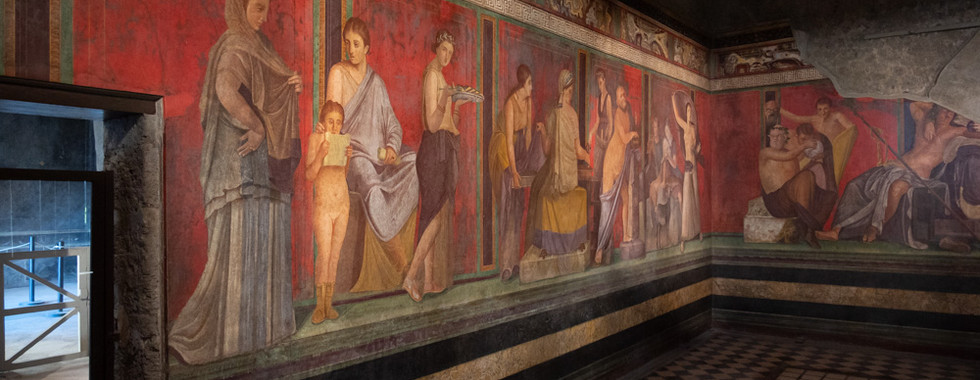


Speaking of Pompeian art, and in particular of the Villa of the Mysteries, I believe a brief digression is also necessary on the aforementioned "Pompeian red" that so impressed art lovers around the world when the frescoes of Pompeii were discovered.
The nature of Pompeian red has been the subject of a more nuanced and less intuitive scientific reinterpretation in recent years than long believed. Traditionally identified as an intentional red, obtained through pigments based on cinnabar or, more often, red ochre (hematite), the dominant color of many domestic and public spaces has recently been reconsidered in light of advanced archaeometric analyses. Studies conducted in recent years have demonstrated that in several cases, the currently visible red could be the result of a thermal transformation , due to the extremely high temperatures generated by the 79 AD eruption, of originally yellow pigments based on goethite (yellow ochre), which upon heating chemically convert to hematite, taking on a red hue. This hypothesis is no longer mere theoretical speculation: it has been confirmed for specific pictorial contexts through mineralogical and spectroscopic analyses, but cannot be extended indiscriminately to all Pompeian painting. And this is precisely the crucial point: many paintings still retain intense, stable, and perfectly legible yellows, demonstrating that not all surfaces were exposed to the same thermal conditions and that the eruption had a differentiated impact, varying depending on the location of the rooms, the time of collapse, the ventilation, and the thickness of the pyroclastic deposits. Furthermore, in many cases, red was deliberately chosen from the outset for its symbolic, prestigious, and perceptive value, especially in stately spaces, where it evoked luxury, solidity, and control of visual space. "Pompeian red," therefore, is not a single or univocal color, but a complex category , encompassing both intentional reds and "posthumous" reds, generated by the catastrophic event that made Pompeii what we see today.
In a 2011 interview , Sergio Omarini of the CNR stated that " the walls currently perceived as red are 246 and the yellow 57, but according to the results, they must have originally been 165 and 138 respectively, for a surely transformed area of over 150 square meters of wall. " He did not, however, refer specifically to the Villa of the Mysteries. At the time of writing, I have not yet been able to determine whether the Villa of the Mysteries belongs to the buildings where this color change occurred, and the question interests me quite a bit, as it would drastically alter the interpretation of the work of art. I reserve the right to investigate the matter further and update this post when I have gathered more solid evidence.

Sex and Eroticism in Pompeii

In Pompeii, sex, eroticism, and the cult of the phallus did not belong to a marginal, clandestine, or transgressive sphere, but constituted a symbolic language fully integrated into the religious, social, and apotropaic life of the city , radically different from modern sensibilities. Sexuality was conceived as a vital, generative, and protective force, and the phallus (fascinum) was its most powerful emblem: not an obscene object, but rather a sign of fertility, prosperity, and defense against the evil eye. This explains its omnipresence in urban space, carved on the facades of houses, etched into sidewalks, suspended as tintinnabula at shop entrances, or depicted in reliefs and frescoes, often accompanied by auspicious inscriptions. Pompeian eroticism is thus public, explicit, but not pornographic in the contemporary sense: it is functional, symbolic, and pedagogical. The Lupanar, often reduced to a prurient curiosity, should be read in this light: a regulated building, inserted into the urban fabric, with small rooms and frescoes that served as a visual catalogue of the services offered, likely also useful to an illiterate clientele. Prostitution was socially accepted, fiscally recognized, and legally distinct from the sphere of the legitimate family, without the moral burden that Christian tradition would attribute to it centuries later. Even more revealing is the erotic decoration of aristocratic domus, such as the House of the Vettii, where the image of Priapus weighing his phallus on a scale is not a provocation, but a declaration of wealth, abundance, and divine protection, strategically placed at the entrance to simultaneously welcome and disarm the visitor's gaze. Domestic eroticism was not confined to the most intimate private spaces, but could appear in atria and peristyles, places of social representation, demonstrating how permeable the boundary between public and private was in Roman culture. Even the language of graffiti, often explicit and direct, conveys a sexuality spoken, commented, ironic, lived without metaphysical shame: declarations of desire, sexual boasts, erotic insults, all contribute to delineating a society that did not separate the body from civil life. In Pompeii, sex was never dissociated from religion, fortune, or divine protection: the phallus was an amulet before it was a sexual symbol, and eroticism was part of a system of values in which the continuity of life, the fertility of the fields, and economic prosperity responded to the same cosmic logic. Understanding this aspect means avoiding moralistic or folkloristic interpretations and accepting that Pompeii presents us not with a licentious exception, but with a conception of the body and desire radically different from the current, puritanical one, coherent, structured, and deeply integrated into the functioning of the Roman city.
In any case, for anyone who is struck or disturbed by how explicit the display of sex was in Pompeii, I refer you to a reading of Martial or Catullus or Horace or Plautus.
If you are interested in fresco painting, you may also want to read my guide to the most important fresco cycles in Italy.
The casts of the victims' bodies
The casts of bodies are perhaps the most disturbing and intellectually challenging element of the Pompeii visit, because they represent the point at which archaeology ceases to be a discipline of space and becomes, unmediated, an archaeology of the human being. Their origins date back to the second half of the 19th century, when Giuseppe Fiorelli, then director of the excavations, realized that the voids left in the ash and lapilli bed by the decomposition of bodies could be filled with liquid plaster, restoring not only the outline of the deceased, but the exact position assumed at the moment of death. These are therefore not "statues" or interpretative reconstructions, but physical negatives of the event, three-dimensional imprints of real individuals captured at the final moment of the eruption and brought to light by pouring liquid plaster into the voids left by the now-dissolved bodies covered by the eruption sediments. As I wrote above, the pyroclastic eruption of Vesuvius unleashed a sudden storm on the city of Pompeii, and the air temperatures, approaching 500 degrees, caused the victims' almost instantaneous deaths, as they were rapidly covered in lapilli and ash that solidified over the centuries. The postures thus speak an immediate and universal language: huddled bodies, contracted limbs, hands raised to the face in an instinctive gesture of protection, adults clutching children, animals caught in stables or courtyards. Far from suggesting a slow and dramatic death in the cinematic sense of the term, the casts document a very rapid end, due to the thermal shock and asphyxiation caused by the pyroclastic flows; what remains captured is the body's final reflex, not a prolonged agony. From a scientific perspective, these casts have enabled increasingly sophisticated analyses in recent decades, from physical anthropology to tomographic investigations, which have revealed age, sex, pathologies, nutritional status, and even traces of clothing or personal objects, transforming the casts from simple "emotional icons" to extraordinarily precise biological and social documents. But their deeper value is perhaps ethical and cognitive: the casts force the visitor to confront the fact that Pompeii is not an abstract city or an ideal urban model, but rather a place inhabited by real individuals, with vulnerable bodies and suddenly interrupted destinies. In them, the eruption of 79 AD ceases to be a geological or historical event and becomes an absolute human experience, freeing Pompeii from any temptation to be aesthetically pleasing or romantic. Looking at a cast means accepting that what one observes is not a symbol of death, but its physical trace; and it is in this short circuit between science, memory and identification that the casts continue to exert, after two thousand years, a force that no reconstruction, however accurate, could ever equal.
Personally, on every visit to Pompeii, I'm always torn between the need to pause and contemplate these extraordinary historical artifacts and the embarrassment of behavior that, even after two millennia, I find somewhat voyeuristic and disrespectful of these touching relics. Unfortunately, I don't detect the same modesty in too many tourists, who pay rather morbid attention to the casts, not to mention those taking selfies to post on Instagram. The experience is even more extreme in Herculaneum, where, in place of the casts, you can see piles of skeletons of the victims who vainly attempted to escape to the sea.
The casts of the victims are visible in numerous places during the visit, but the main places are the Garden of the Fugitives (where many victims were found) and in the exhibition located at the southern entrance to the archaeological area, near Piazza dell'Anfiteatro.


Practical advice
Pompeii is an entire city, and I believe a full day is necessary to visit it completely unless you want to indulge in a vulgar "hit-and-run" tourism experience, limiting yourself to visiting only the main sites.
The area is mostly flat, but expect to cover at least 15km on foot , so wear comfortable shoes. There are no steep sections, so anyone, even those with less than optimal physical fitness, can visit, but expect a tiring day. Bring a reusable water bottle to refill at the few public fountains, and, if visiting in summer, sun protection; inside the archaeological area there is a refreshment area (you can find it by searching on Google for “Casina dell’Aquila”) that offers meals of decent quality and also accepts kidneys, lungs, and other vital organs as payment.
The best times to visit, in my opinion, are spring and autumn; summer in Southern Italy can be extremely hot, and walking all day under the blazing sun can be exhausting. Furthermore, opening hours vary depending on the season. Currently, from April 1st to October 31st, the area's opening hours are extended until 7:00 PM, allowing you to include the villas of Oplontis and Boscoreale in your visit. In particular, I believe the latter don't add much to your visit after visiting Pompeii, but it would be a shame not to dedicate even a minute to them once you're there. In particular, if you had to choose, I think the villa of Oplontis is still worth a brief visit, even if it doesn't measure up to the most beautiful Pompeii villas. Herculaneum is a different story, and I'll dedicate another post to it, as it requires a separate day's visit. A shuttle service is available near the area's southern exit to reach Oplontis and Boscoreale.
Since access to the area is limited, I recommend purchasing tickets in advance (at least that's what I did); the official website address is at the beginning of the post. It goes without saying that you must purchase the Plus ticket, which includes access to the Villa of the Mysteries.
As I've already mentioned, I also recommend picking up a paper map at the entrance; alternatively, during my visit, I tested the GPSMyCity service, which also includes multiple routes inside Pompeii, and found it to be generally convenient and efficient. (In this case, however, I also recommend carrying a power bank, as walking all day using your phone's GPS can seriously drain its battery, and exploring Pompeii requires extensive use of your phone to orient yourself at every turn without a paper map.) You can download both a map of the area and a 150-page guide to the main sites at this address.
The place is literally besieged by overtourism; perhaps, just maybe, by avoiding the weekends, you can avoid some of the crowds.
The best way to reach the ruins is to take the Circumvesuviana train from Naples Central Station and get off at the "Pompei Scavi - Villa dei Misteri" station. The train ride takes about half an hour, so staying overnight in Naples is highly recommended. Tickets can be purchased using the Go Eav app, which saves you some time at the station.



Comments