
Rome, the Church of Sant’Ignazio, Andrea Pozzo, and the social media apocalypse
- The Introvert Traveler
- Feb 28
- 9 min read

Updated: Apr 6

Last visit: November 2024
My rating: 7/10
Visit duration: 30 minutes
Italy in general, and Rome in particular, are so saturated with extraordinary works of art that it becomes almost too easy to focus only on the absolute peaks and to underestimate other exceptional works which, if they were located elsewhere, would enjoy far greater fame.
This is precisely the case with the Church of Sant’Ignazio di Loyola in Rome, which, for reasons I will explain below, represents a perfect synthesis of the sublime and the grotesque, a pairing I particularly enjoy addressing on this blog; I believe it is also a monument that, amid the disproportionate competition among sublime works of art that materializes throughout the entire city of Rome, went relatively unnoticed by the general public until not many years ago, when the world changed radically, and not necessarily for the better.
The Church of Sant’Ignazio di Loyola is located in the heart of Rome’s historic center, just a short walk from the Pantheon, overlooking the eighteenth-century square that bears its name. It was built between 1626 and 1650 as the church of the Jesuit Collegio Romano, to celebrate the canonization of Ignatius of Loyola (1622) and to assert the intellectual and spiritual role of the Society of Jesus in Counter-Reformation Rome. The architectural project is attributed to Orazio Grassi. The church fully belongs to the language of mature Roman Baroque, offering an exemplary synthesis of architecture, painting, and visual rhetoric in the service of Jesuit pedagogy.
The ceiling fresco by Andrea Pozzo at Sant’Ignazio in Rome
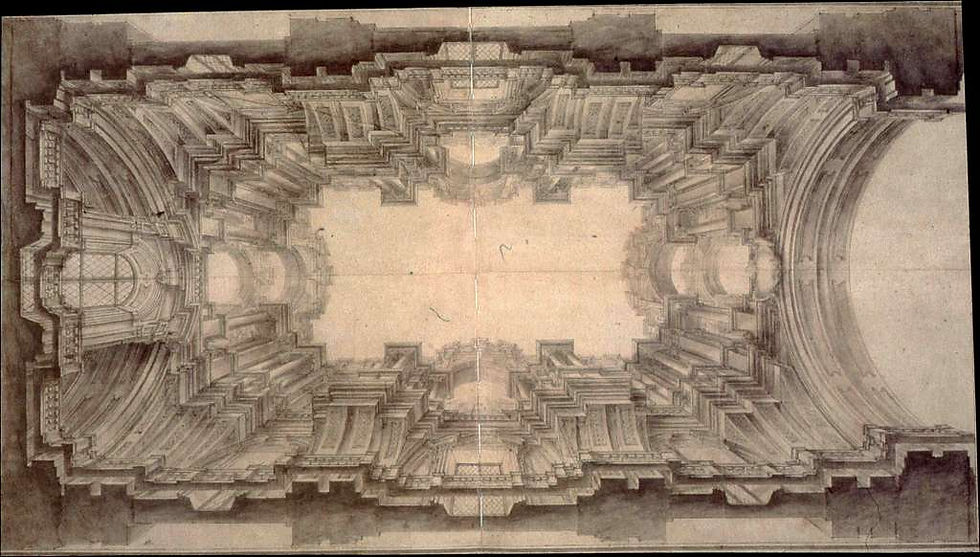
Taken on its own, the Church of Sant’Ignazio would not necessarily stand out among the countless magnificent monuments of Rome. I would not want to overstate my judgment, since I lack formal training in Baroque architecture, but to an average observer like myself it would simply be one of the many beautiful Baroque churches in the city, were it not for one fundamental element: the ceiling fresco painted by Andrea Pozzo between 1685 and 1694. This work represents one of the absolute pinnacles of European Baroque painting and, more specifically, one of the highest and most complex achievements in the history of quadratura and architectural trompe-l’œil. It is not merely a spectacular decoration, nor a virtuoso exercise for its own sake, but a conceptually sophisticated work grounded in a profound understanding of perspective geometry, visual perception, and the relationship between real and painted space.
The commission arose within the cultural and ideological context of the Society of Jesus at the height of its institutional maturity. After the canonization of Ignatius of Loyola in 1622, the church dedicated to him—built as part of the Collegio Romano—was meant to become a visual manifesto of the Jesuits’ role in the post-Tridentine Church: a learned order, scientifically up-to-date, capable of using the arts as tools of persuasion, education, and spiritual elevation. The choice of Andrea Pozzo—himself a Jesuit, painter, and theoretician of perspective and architecture—perfectly met this need: not a mere decorator, but an intellectual capable of translating a coherent theological and pedagogical vision into images.
The subject of the fresco is the Glory of Saint Ignatius and the Apotheosis of the Society of Jesus, articulated as a complex ascensional scene. At the center, Ignatius is received into heavenly glory, while around him unfolds a vertiginous painted architecture opening toward the sky, populated by allegorical figures, saints, angels, and personifications of the four continents then known. The message is clear and extraordinarily forceful: the Jesuit mission is universal, guided by divine light, projected beyond the boundaries of Europe and of history. And if the Jesuits themselves say so…
But what truly makes this work exceptional is not so much its iconographic program as the way that program is embodied in space.
The Church of Sant’Ignazio presents a far from trivial architectural problem: the nave is covered by a lunetted barrel vault, a structurally curved surface interrupted by lunettes, which makes the application of a coherent architectural perspective extremely difficult. In traditional perspective, vertical lines converge toward a vanishing point, while horizontal lines, if correctly constructed, tend to recede laterally. On a curved surface, however, a painted straight line inevitably appears curved when viewed from any point that is not perfectly orthogonal. Pozzo thus confronts a difficulty that could be described as structural: how to simulate rigorously rectilinear architecture on a surface that, by its very nature, distorts straightness.
The solution he adopts is of almost disarming refinement. Pozzo realizes that in a barrel vault the longitudinal lines—that is, those parallel to the main axis of the vault—do not undergo significant perceptual distortion from any viewing point. Exploiting this geometric property, he constructs the entire painted architectural system by arranging all entablatures, cornices, and horizontal elements as lines perfectly parallel to the axis of the vault. These lines, although in reality curved on the painted surface, are perceived by the viewer as perfectly straight. Conversely, lines that would otherwise appear problematic are intentionally calibrated and deformed so that the eye reconstructs them as straight when observed from the correct vantage point.
The virtuosity does not end there. Pozzo organizes the painted space into three distinct architectural levels, each characterized by a different intensity of light. This gradation of light is not merely a pictorial device but a true instrument of spatial construction: the lower level appears more solid and closer, the intermediate level introduces an ascensional progression, while the upper level progressively dissolves architectural matter into light and open sky. The effect is a dilation of real space that seems literally to break through the vault and continue beyond the physical limits of the building.
One of the most surprising aspects of the work concerns the treatment of the lunettes, those portions of the vault that become locally flat where the windows are located. From a geometric standpoint, these planar surfaces would inevitably have “betrayed” the perspectival illusion, interrupting the continuity of the painted space. Pozzo solves the problem with another stroke of genius: he disguises the flatness of the lunettes by painting on them the continuation of the illusionistic architecture, as if those surfaces too participated in the same curvature of the vault. In this way, what is structurally an interruption becomes visually invisible.
The choice of trompe-l’œil is therefore not a mere display of skill, but a decision deeply consistent with Jesuit theology. Illusion is not deception for its own sake, but an instrument of truth: through sensory illusion, the viewer is guided toward a higher, immaterial, spiritual reality. It is no coincidence that Pozzo placed marked viewing points on the church floor, from which the perspectival illusion recomposes itself perfectly. The work thus requires a conscious act on the part of the observer: one must stand in the right place, assume the correct position, in order to see the truth of the image. It is a powerful visual metaphor for the spiritual path proposed by the Jesuits.
From a stylistic standpoint, the Sant’Ignazio fresco represents an exceptionally high synthesis of painting, architecture, and the science of vision. The human figure—dynamic and theatrical—integrates seamlessly with the painted architecture, never becoming merely ancillary. The brushwork is controlled and functional to the construction of space, while color is subordinated to light and perspectival legibility. Nothing is left to chance: every deformation is calculated, every apparent “error” is in fact an optical correction.
For all these reasons, the vault of Sant’Ignazio has no true equivalent in the European panorama. It is not only one of the supreme achievements of Roman Baroque, but a work that pushes to the limit the very possibilities of perspectival representation on curved surfaces. Mathematical knowledge, painterly skill, architectural intelligence, and theological ambition converge within it. It is a work that does not merely astonish: it forces one to think, to question how we see, how space is constructed by the eye and the mind. And it is precisely this conceptual density, combined with absolute technical control, that makes Andrea Pozzo’s fresco at Sant’Ignazio one of the most radical and “impossible” artistic undertakings ever realized in Rome.
From a stylistic point of view, personally, I am not a great admirer of Andrea Pozzo, nor of Roman Baroque painting in general. It is a kind of polished, aestheticizing, and somewhat mannered painting that does not particularly resonate with me or move me emotionally; nor do I tend to overvalue gratuitous technical virtuosity. The frescoes of the Sistine Chapel, for example, are masterpieces not because it is astonishing that a man, essentially alone, executed a work of such technical difficulty, but because of the magnificent inventions of the Creation scenes, the elegance of gesture and chromatic richness of the Libyan Sibyl, the importance the ignudi have had in the history of art, and so on (and an affresco is, in any case, a virtuoso feat by definition—but I have already discussed that elsewhere). From an artistic standpoint, Andrea Pozzo’s fresco elicits rather cool reactions from me, but this is because, as I noted at the outset, Rome presents visitors with such an overwhelming profusion of ingenuity and beauty that one easily falls into the cognitive bias of undervaluing extraordinary works. Sant’Ignazio and its painted vault are sublime works which, at the very least, should compel the observer to linger over them at length, stimulating the intellect.
End of the first part and iconographic interlude.


Part Two and the Descent into Hell
If Andrea Pozzo’s inventions have lifted you to the highest peaks of ingenuity and intellect, Sant’Ignazio itself promptly takes care of hurling you into the abyss of horror.
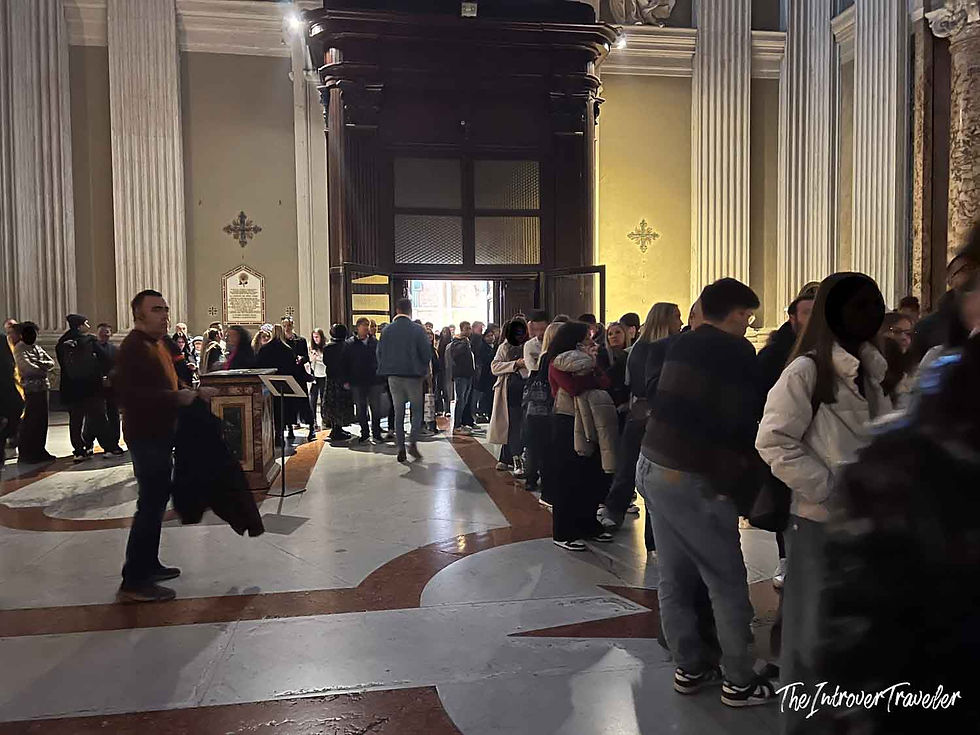
As soon as you cross the threshold of the church, you are immediately assailed by an incongruous sense of discomfort. Entry is free: no ticket office, no security checks. And yet, the moment you step inside, you encounter a long line of people waiting. The unease stems from the fact that the queue is inside the church, not outside, as one would naturally expect. After a brief moment of hesitation, you begin to wonder why all these people are standing in line inside a church—until your eye follows the queue to its head and discovers a large oblique mirror placed in the middle of the nave. A large mirror for selfies. Inside a church. For selfies.
And so it is: Andrea Pozzo’s fresco, long known primarily to art historians and specialists, has in recent years gained growing notoriety thanks—or perhaps due—to Instagram. Dozens of people flock here and queue up to strike a pose in front of this oversized mirror, with the great fresco behind them. Now, I am not a believer—quite the opposite, I am an atheist. With age I have become more tolerant, but over the course of my life I have not spared sharp judgments toward Catholic worship. That said, I believe every place deserves the respect proper to its nature: a place of worship as such, even if it is a faith that is not mine; a university as a place devoted to thought; a theater as a place where music is performed, and so on.
The spectacle of these people lining up for the selfish consumption of this space is instead so sloppy, obscene, and disrespectful toward the site that it is almost unbearable. If everyone were to start belching in unison, like some guttural Gregorian chant, it would be less obscene. That a church (and a Jesuit one, at that!) should abdicate its primary function and set up an apparatus dedicated to the vacuous, ephemeral, insipid, vain, and morbid exhibitionism that is the social-media selfie leaves me utterly dumbfounded. It is as if the grotesque had burst open right here, a stone’s throw from the Pantheon, spewing forth deformed, screaming demons and welcoming a macabre dance of zombies rushing in, while being replaced in the earthly world by an equal number of little devils.
They enter Sant’Ignazio in procession, with blank, expressionless faces, and they leave exactly as they entered: with one more selfie and a little less battery. They do not look at the church. Not a single one, during the minutes spent waiting to reach the mirror, even lifts their eyes to casually glance at the very object they have come to photograph. They do not look at the church; they use it for the brief instant necessary to take the shot. A sacred place reduced to a backdrop, an optical device, a content-printing machine for the algorithm. Baroque? A filter. Andrea Pozzo? A pretext. God? If there’s signal, maybe.
And then there is a further paradox. As I said, they never raise their gaze. They look at the screen that looks at the ceiling, not at the ceiling itself. It is a continuous, obsessive, pathological mediation. If Pozzo built an optical machine to educate the gaze, they have dismantled it and turned it into a narcissistic mirror, in an ineluctable, irreversible, tragic pagan rite of collective brain-deadening.
And so the sublime and the grotesque meet here, in Rome, at the very center of Sant’Ignazio.
This post is part of my section about the most important italian fresco paintings.
If you are planning a trip to Rome, you may be interested in these posts or this portfolio; and if you’re more interested in art than in selfies, you can use ArtAtlas to find all the artworks around Rome.


Comments