
Dolmabahçe Palace in Istanbul: The Twilight of the Ottoman Empire
- The Introvert Traveler
- 4 days ago
- 6 min read


Last visit: June 2025
My rating: 5/10
Duration of the visit: 1.5 hours
Visitors to Istanbul naturally tend to focus their attention on the monuments of the classical Ottoman imperial city, from the great mosques to the Topkapı complex, which served as the political heart of the empire for more than four centuries during the period of its greatest power. Dolmabahçe Palace in Istanbul represents something profoundly different. It is not the symbol of Ottoman ascent but of transformation and, above all, of crisis. Built in the nineteenth century on the European shores of the Bosphorus, Dolmabahçe marks the moment when the Ottoman Empire consciously attempted to redefine its image by adopting European political, cultural, and architectural models.
Visiting Dolmabahçe therefore means entering not the conquering Istanbul of the fifteenth and sixteenth centuries, the Ottoman Empire that once made the world tremble, but rather the capital of a state struggling to survive Western modernity by reinterpreting its languages and symbols. Even in this attempt to emulate the great European royal residences, one can perceive the expression of the decline of the Ottoman court.
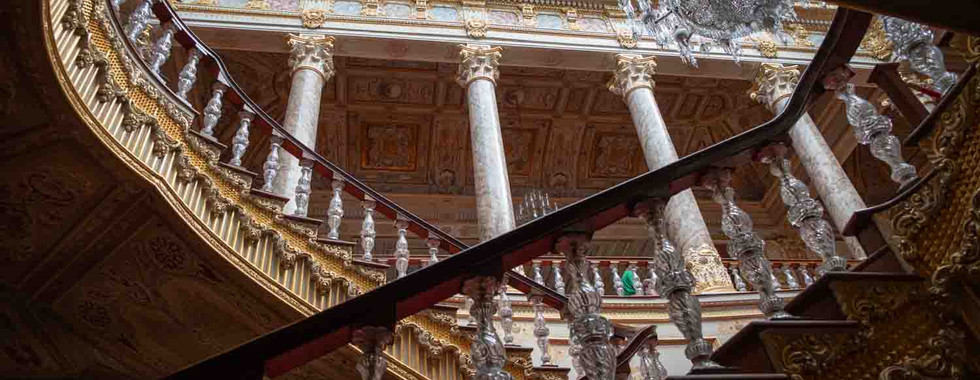
Note: photography is not permitted inside the palace, therefore this post includes only a few exterior photographs and some discreet interior shots, which inevitably fail to convey the palace in its entirety.
The historical reasons behind the construction of Dolmabahçe Palace in Istanbul
Until the mid nineteenth century, Ottoman sultans ruled from Topkapı Palace, a complex that perfectly reflected an Eastern conception of political authority. It was not a single monumental residence but a sequence of courtyards, pavilions, and separated spaces. The sovereign remained physically and symbolically distant from the outside world. By the nineteenth century, this model appeared increasingly anachronistic.
The Ottoman Empire was experiencing a period of profound political and military difficulty. Defeats against European powers, diplomatic pressure from Western monarchies, and growing economic dependence on Europe made the need for structural reform unmistakable. This was the era of the Tanzimat reforms, officially launched in 1839, which aimed to modernize administration, the military, and state institutions.
Sultan Abdülmecid I understood that the image of power itself also needed to change. European courts operated through diplomatic protocols grounded in monumental representations of the state. Ambassadors and foreign delegations were expected to be received in environments capable of communicating prestige and modernity. Topkapı was no longer adequate for this purpose.
The decision was therefore radical. A new imperial palace would be built following the model of European royal residences, overlooking the Bosphorus, the commercial and symbolic axis of the capital. The selected area had previously been a reclaimed bay, from which the name Dolmabahçe derives, literally meaning filled garden.
Construction began in 1843 and was completed in 1856, at enormous cost, further aggravating the already fragile financial condition of the empire.
Dolmabahçe was therefore not merely an architectural project but a political statement, an attempt to demonstrate that the Ottoman Empire could still sit at the same table as the European powers.
An Ottoman palace built in a European architectural language
From an architectural perspective, Dolmabahçe represents an almost total break with earlier Ottoman tradition.
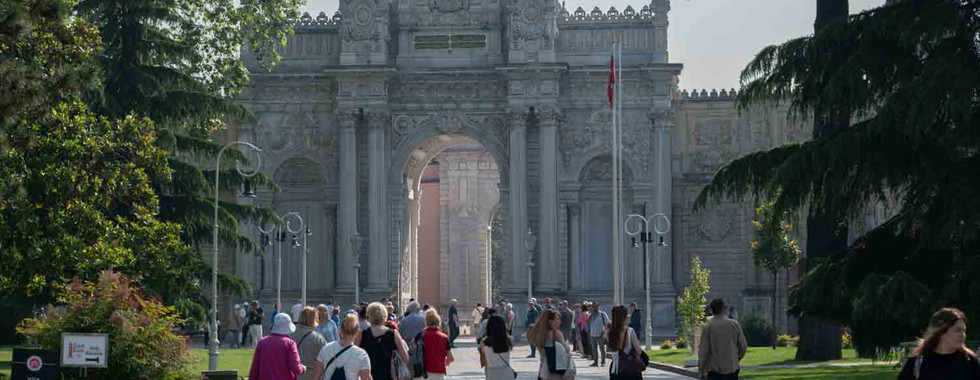
The building extends for approximately six hundred meters along the Bosphorus and presents a symmetrical and monumental façade clearly inspired by eighteenth and nineteenth century European palaces. Its style can be described as controlled eclecticism combining Baroque, Rococo, and Neoclassical elements reinterpreted through an Ottoman sensibility. The image of this sumptuous structure overlooking the Bosphorus still contributes today to the visual identity of Istanbul.
The internal organization nevertheless preserves the traditional functional division of the imperial court. The complex is structured into three main sections: the Selamlık, dedicated to official and administrative functions, the Harem, the private space of the imperial family, and the Muayede Hall, the grand ceremonial hall. This arrangement demonstrates how westernization remained largely formal rather than structural. Behind a European exterior, Ottoman social organization persisted.
One of the most spectacular elements is the Crystal Staircase, constructed with Baccarat crystal balustrades and gilded brass. Its theatrical effect perfectly reflects the representative function of the palace. Power was no longer meant to remain hidden but to impress.
The Muayede Hall represents the culmination of the architectural project. Covering approximately two thousand square meters and crowned by a dome rising thirty six meters high, the hall houses one of the largest crystal chandeliers in the world, weighing more than four tons. This space was used for official ceremonies and imperial religious celebrations.
The interiors are characterized by extensive use of precious materials. Marble from the island of Marmara, Egyptian porphyry, alabaster, and extraordinary quantities of gold employed in decoration and stucco work. It is estimated that more than fourteen tons of gold were used for interior gilding.
Equally significant was the early adoption of Western technologies. Dolmabahçe was among the first Ottoman imperial buildings equipped with gas lighting and later electricity and central heating, intended to present the palace as a technological manifesto of modernization.
Dolmabahçe remained the principal residence of the sultans until the end of the Ottoman Empire.
The palace acquired a new symbolic meaning with the birth of the Turkish Republic.
Mustafa Kemal Atatürk used Dolmabahçe as his presidential residence during his stays in Istanbul. It was here that he died on 10 November 1938. In the room where he passed away, the clocks are still stopped at 9:05, the exact moment of his death.

The visiting experience
A visit to Dolmabahçe differs significantly from that of other monuments in Istanbul.
Access takes place through imposing gates facing the Bosphorus, and from the very beginning the entrance suggests a far more European atmosphere than that of traditional Ottoman spaces. The gardens follow Western landscaping principles and gradually introduce visitors to the monumentality of the building.
The interiors can only be visited along predetermined guided routes established by the museum administration. As mentioned earlier, photography is not permitted inside the palace and although this limitation may frustrate bloggers and photographers, it also helps preserve a relatively controlled atmosphere, free from the constant mediation of smartphones that characterizes many major tourist sites.
The Selamlık generally constitutes the first part of the itinerary. Visitors move through reception halls, administrative offices, and diplomatic rooms that clearly reveal the intention to emulate European royal courts. Unlike Topkapı, where the hierarchy of power is suggested through increasingly restricted spaces, Dolmabahçe communicates authority through scale and decoration.
The transition into the Muayede Hall produces one of the most striking spatial effects of the visit. After passing through a sequence of relatively articulated rooms, the sudden opening of the grand ceremonial hall creates an almost theatrical perception of space.
The Harem offers a more intimate experience. The rooms are less monumental and convey a domestic dimension often absent from Western imaginings associated with the word harem. The apartments of the Valide Sultan and the imperial consorts reveal a balance between luxury and everyday functionality.
From a practical standpoint, the visit rarely requires more than two hours. Arriving in the morning is advisable in order to avoid larger tour groups and to enjoy the light over the Bosphorus, which contributes significantly to the overall perception of the palace.
Dolmabahçe and the historical meaning of an ending
Dolmabahçe does not possess the layered historical fascination of Hagia Sophia nor the political intimacy of Topkapı. Moreover, despite the sumptuous and almost excessive display of precious materials, the overall impression is that of a building lacking a true soul and at times appearing slightly faded. The evident emulation of European styles is historically interesting if the palace is interpreted as an emblem of Ottoman decline, yet it simultaneously deprives the structure of cultural authenticity.
It is the architecture of an empire attempting to reinvent itself by adopting external cultural codes without entirely abandoning its own identity. The result is an ambiguity that leaves visitors somewhat disoriented, as the splendor never fully matches the original European models, from the Royal Palace of Caserta to the Palace of Versailles. European in form, Ottoman in social structure, modern in ambition yet conceived at a moment of irreversible decline.
Leaving the palace and returning along the Bosphorus, the dominant sensation is not one of splendor but of transformation. Dolmabahçe tells the story of the moment when the Ottoman center of power ceased looking toward Asia and began definitively confronting Europe.
It is precisely this tension, more than decorative opulence, that makes the visit historically meaningful yet stylistically somewhat disappointing.
If you are planning a trip to Istanbul, you may also be interested in these related posts or photo galleries.
For a complete guide to Istanbul, see the full Istanbul travel guide.







Comments