Last visit: June 2025
My rating: 8/10
Length of visit: 20 minutes
Visiting Hagia Sophia in Istanbul means confronting one of the very few buildings in the world where architecture is not merely form, but condensed history, constructed ideology, theology made space. Hagia Sophia is not a monument “to be seen,” but a complex organism that has passed through empires, religions, and systems of power without ever losing its symbolic centrality. A Christian basilica, an imperial mosque, a secular museum, and once again a place of Islamic worship, Hagia Sophia should be visited not in search of a single identity, which it has never possessed, but to understand how architecture can become the most enduring and sophisticated battleground of history. You do not enter a building here: you enter an idea of the world.
If you are planning a trip to Istanbul you may be interested in these posts or these pictures.
This post is part of my full Istanbul travel guide.
The history of Hagia Sophia
The history of Hagia Sophia largely coincides with the history of Constantinople itself and, more broadly, with the trajectory of the great Mediterranean empires. The present building was constructed between 532 and 537 AD at the behest of Emperor Justinian I, in the aftermath of the devastating Nika Revolt, which had destroyed much of the city, including the two previous churches dedicated to Hagia Sophia (“Holy Wisdom”). Justinian seized the opportunity to launch an unprecedented monumental refoundation, conceiving Hagia Sophia not as a simple basilica but as the architectural embodiment of Christian cosmic order and imperial power. Designed by Anthemius of Tralles and Isidore of Miletus (two scholars appointed specifically for their expertise in physics and mathematics) the church introduced a radically new structural solution: a gigantic hemispherical dome suspended on pendentives, seemingly defying the laws of statics and transforming the interior into a unified, continuous volume flooded with light. At the consecration, according to tradition, Justinian exclaimed, “Solomon, I have surpassed you,” symbolically asserting Constantinople’s ambition to present itself as both a new Jerusalem and a new Rome.
For nearly a millennium, Hagia Sophia was the religious, political, and ceremonial heart of the Byzantine Empire: seat of the patriarch, site of imperial coronations, and stage for the most solemn liturgies of Eastern Christianity. Its history, however, was neither linear nor free from crises. The dome partially collapsed as early as 558 due to an earthquake and was rebuilt with a more elevated profile; further structural interventions followed over the centuries, attesting to the intrinsic fragility of such an ambitious work. During the Iconoclasm (8th–9th centuries), figurative decorations were partly destroyed or covered; with the end of the iconoclastic period, Hagia Sophia was once again enriched with extraordinary cycles of mosaics celebrating Christ, the Virgin, and the emperor in a visual language of exceptional theological and political sophistication. The moment of greatest humiliation for the building came in 1204, when the Fourth Crusade sacked Constantinople: Hagia Sophia was desecrated, stripped of its treasures, and temporarily converted into a Latin cathedral, marking an irreversible rupture between Eastern and Western Christianity.
With the Byzantine reconquest in 1261, Hagia Sophia returned to Orthodox worship, but the city never fully recovered its former power. When Mehmed II conquered Constantinople in 1453, Hagia Sophia was immediately converted into an imperial mosque. The transformation was not destructive but adaptive: the building was preserved, structurally reinforced, and integrated into the new symbolic system of the Ottoman Empire. Minarets, a mihrab, a minbar, and calligraphic medallions were added, while many Christian mosaics were plastered over, not so much to erase them as to conform to the norms of Islamic worship. In the following centuries, architects such as Sinan contributed to consolidating the structure, making Hagia Sophia a foundational model for Ottoman architecture, emulated in countless imperial mosques.
The transition to the modern era marked a further symbolic turning point. In 1935, within the secular and nationalist project of the Republic of Turkey, Mustafa Kemal Atatürk transformed Hagia Sophia into a museum. This decision sought to remove the building from religious conflict, presenting it as a universal heritage of humanity and enabling the restoration and rediscovery of its Byzantine mosaics. For decades, Hagia Sophia existed in this ambiguous yet fertile state of suspended identity, a place where Christian and Islamic layers coexisted under a secular aegis. In 2020, its reconversion into a mosque reopened the international debate over its contemporary meaning, demonstrating that Hagia Sophia has never ceased to be an “active” building, politically and symbolically. From the Justinianic basilica to the Ottoman mosque, from the republican museum to its current function as a place of worship, Hagia Sophia has never been a mere architectural container: it is a palimpsest of power, faith, and memory, in which each era has inscribed its own vision of the world without ever fully erasing those that came before.
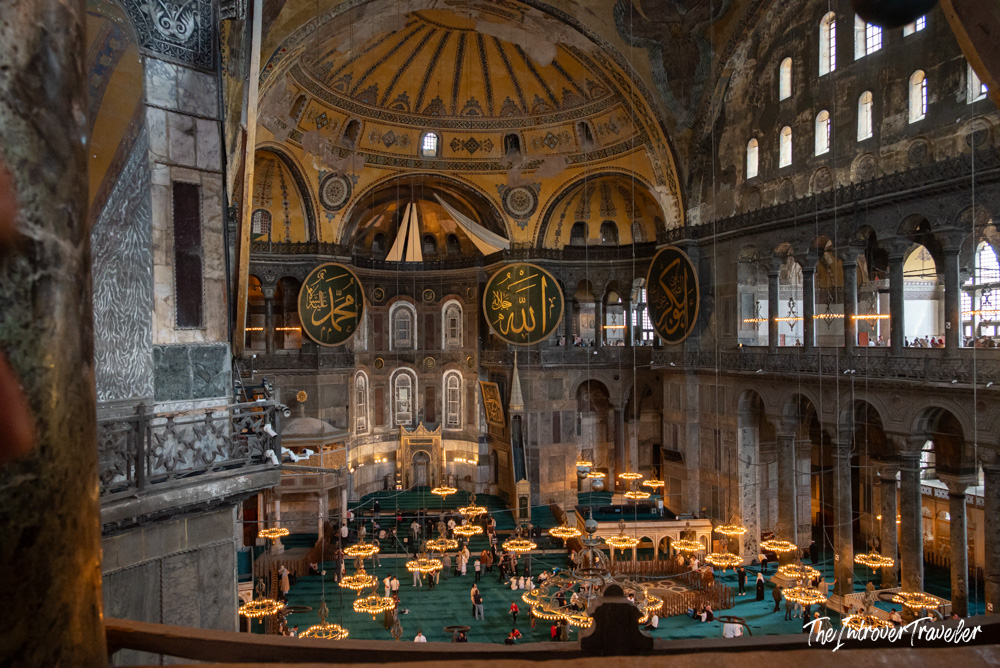
Hagia Sophia from an architectural perspective
From an architectural and structural point of view, Hagia Sophia represents a true unicum that eludes the canonical categories of late-antique architecture. The building is neither a longitudinal basilica in the classical sense nor a purely centralized structure, but a radical synthesis of the two typologies, achieved through engineering solutions of extraordinary audacity. The focal point of the space is the gigantic hemispherical dome, approximately 31 meters in diameter, set on four massive piers through a system of pendentives which, on this scale for the first time, allow a fluid transition from a square base to a circular covering. This solution, developed under the reign of Justinian I by the engineers Anthemius of Tralles and Isidore of Miletus, has no direct precedents and inaugurates a new conception of architectural space as a continuous volume, no longer articulated into compartments but perceived as a unified whole. The dome, lightened by forty windows at its base, appears literally suspended in light, producing an effect of dematerialization with profound symbolic implications: the structure does not assert itself as mass, but as apparition, an architectural allusion to the celestial sphere.
From a static standpoint, Hagia Sophia is an intrinsically unstable building, and precisely for this reason it is extraordinarily revealing of the tension between symbolic ambition and technical limits. The lateral thrusts generated by the dome are countered not by a compact wall system, but by a sequence of semi-domes and large exedrae arranged along the east–west axis, which function as counter-thrust elements while simultaneously expanding the interior space in depth. To the north and south, by contrast, the walls are lighter and articulated by superimposed colonnades, a condition that accentuates structural asymmetry and explains the building’s long history of collapses, reconstructions, and reinforcements. Earthquakes that struck Constantinople in the sixth and seventh centuries forced the dome to be raised and stiffened, altering its original curvature; in the Ottoman period, architects such as Mimar Sinan intervened with external buttresses and structural consolidations which, while altering the building’s original external appearance, ensured its survival.
The choice of building materials also reflects this logic of controlled experimentation. Lightweight bricks, elastic mortars, and spolia drawn from various regions of the Roman Empire were employed not merely for economic reasons, but to achieve a more flexible structural behavior capable of absorbing seismic stresses. The interior, originally clad in polychrome marbles and golden mosaics, further amplifies the perception of a space defined not by wall mass, but by continuous, reflective surfaces, in which the load-bearing structure is deliberately concealed. In this sense, Hagia Sophia is not only a technical masterpiece, but a theoretical statement: architecture understood not as a sum of static elements, but as a field of forces, an unstable equilibrium between gravity and light, between matter and transcendence.
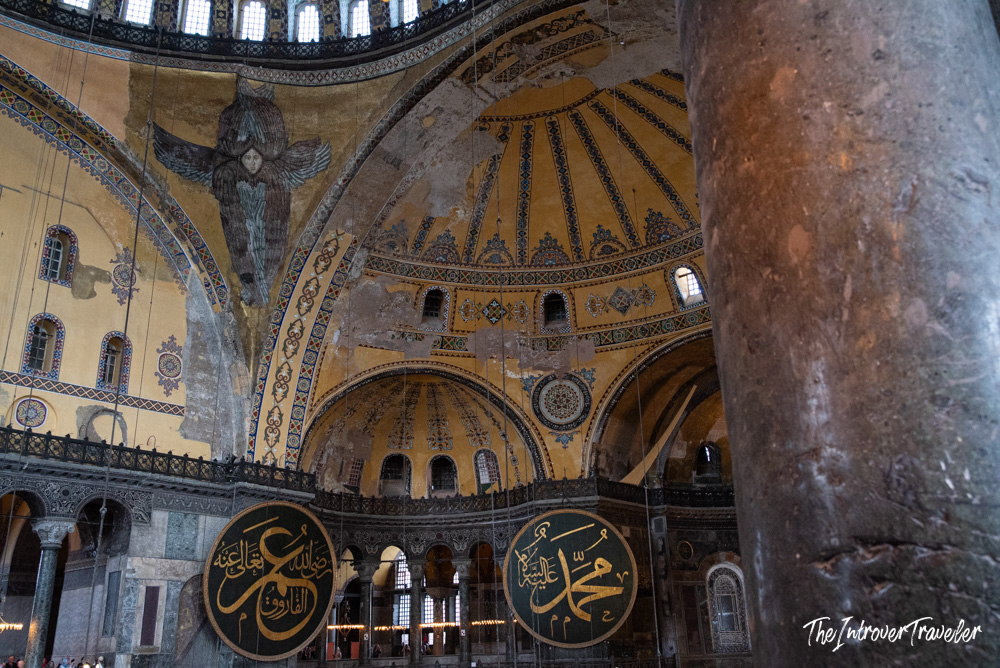
The mosaics of Hagia Sophia in Istanbul (Turkey)
From an artistic standpoint, Hagia Sophia is an almost paradigmatic case of “decoration as history” rather than mere ornament. Its mosaics do not form a single, unified cycle, but rather a palimpsest that records doctrinal fractures, political restorations, and changes of regime. It is significant that, in its earliest phase, the mosaic program was largely aniconic (composed of crosses and non-figurative motifs) whereas the great figurative images that we now identify as “the mosaics of Hagia Sophia” are largely later additions, closely connected to the resolution of the iconoclastic crises.
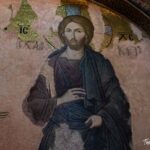
After the restoration of images, the apse was marked by a programmatic gesture: the Virgin and Child (inaugurated in 867) is not merely a devotional image, but a theological and imperial statement issued after decades of conflict over sacred imagery. Roughly contemporary was the Christ Pantocrator once depicted in the dome, now lost, which would have completed the ideological and visual hierarchy of the space, placing Christ as cosmic ruler above both the liturgy and the empire below.
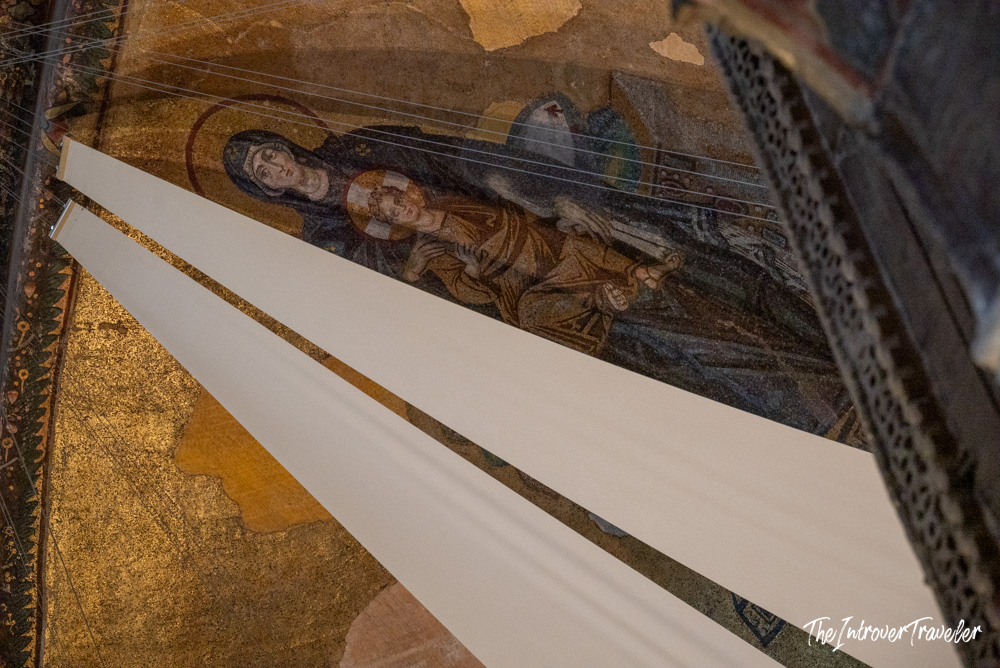
Alongside the Virgin and Child stand the quintessentially “political” mosaics. Above the Imperial Gate, the emperor is shown in proskynesis before Christ Pantocrator, visually asserting the subordination of earthly power to divine authority while simultaneously staging the liturgy of Byzantine power.
In the south-western vestibule, the Virgin enthroned receives the models of the city and the church offered by Constantine and Justinian. This image is one of exceptional ideological density, as it places both the Urbs and its temple, namely the Empire itself, under Marian protection.
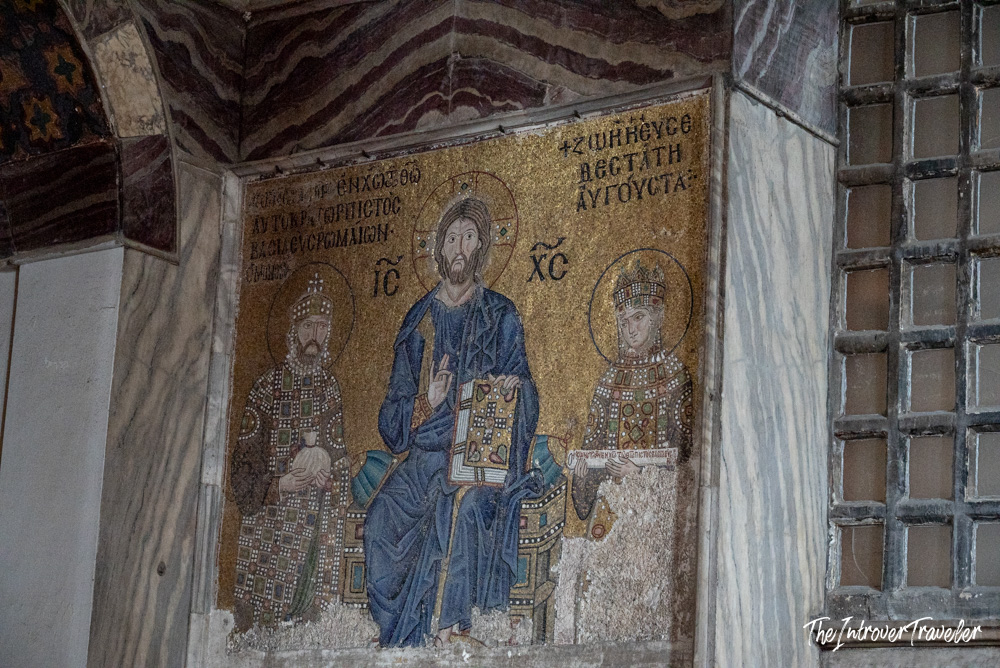
In the south gallery, the donor panels (such as the famous Zoe mosaic of the 11th century and the Komnenian panel with John II and Irene from the 12th century) transform court portraiture into a theological device: the emperor is not depicted merely as a patron, but as an actor within a symbolic economy in which donation is “converted” into legitimacy.
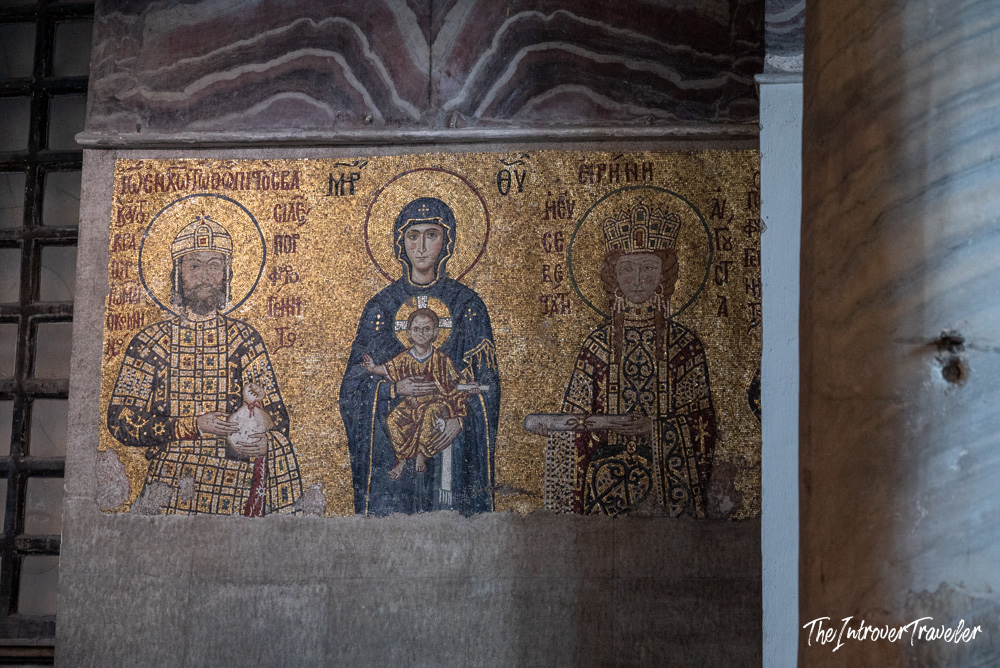
Finally, the Deësis (late 13th century, often associated with the period following the Byzantine reconquest of 1261) represents the aesthetic pinnacle of the late Palaiologan style. Here, hieratic rigidity gives way to a more human and emotive rendering of faces, and the painterly quality of the mosaic tessellation becomes almost a meditation on mercy and intercession.
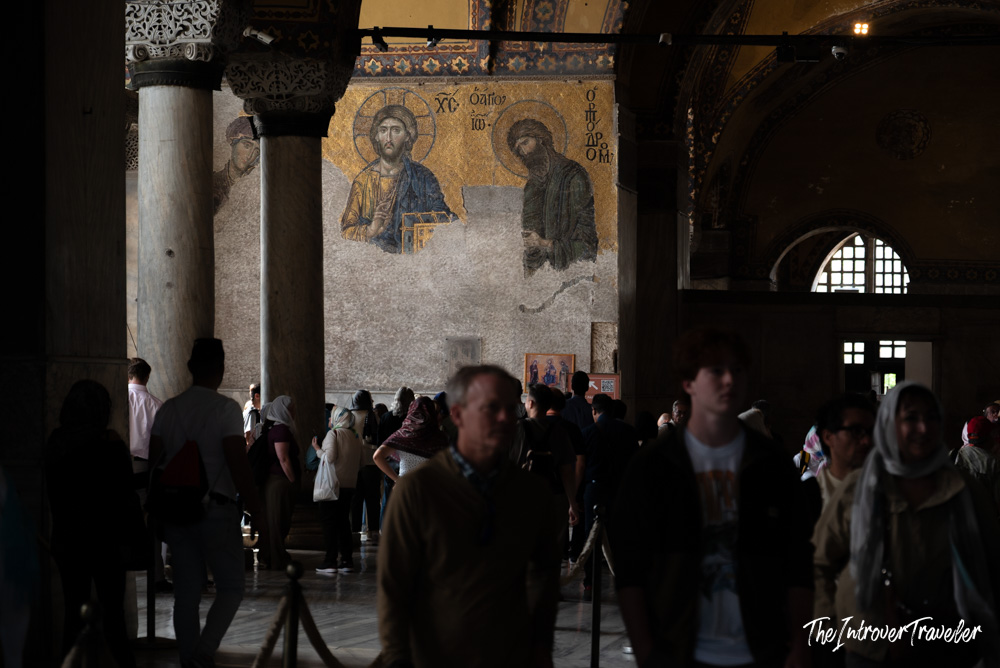
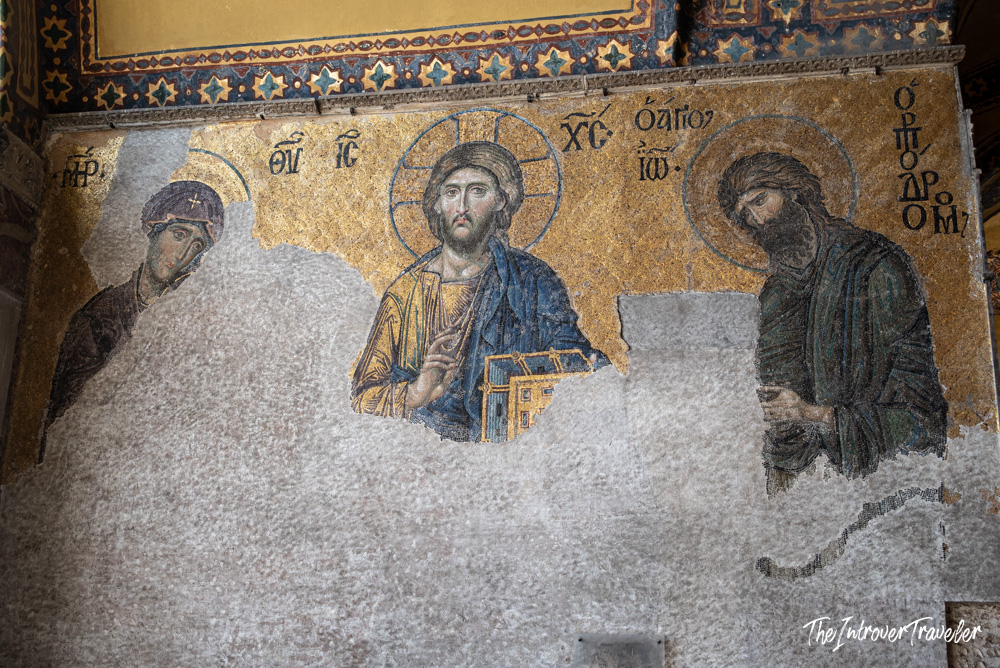
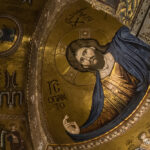
When placing the mosaics of Hagia Sophia within a broader chronological framework of Byzantine art, they come after the mosaics of Ravenna (from the Basilica of San Vitale to the Mausoleum of Galla Placidia, to cite the most famous examples) which are generally dated between the 5th and 6th centuries AD, and before those of the Palatine Chapel and the Cathedral of Monreale in Palermo, which are datable roughly to the 12th century AD.
The circular medallions
When observing the basilica from the upper gallery, the visual field is quite literally dominated by large circular panels bearing inscriptions in Arabic.
These panels are among the most emblematic interventions of the Ottoman period and represent a calligraphic reinterpretation of sacred space, rather than a mere decorative addition.
They consist of eight enormous wooden medallions (approximately 7.5 meters in diameter), created between 1847 and 1849 by the great Ottoman calligrapher Kazasker Mustafa Izzet Efendi, on the occasion of the 19th-century restorations commissioned by Sultan Abdülmecid I. Each disc bears, in monumental thuluth calligraphy, one of the fundamental names of Islam: Allah, Muhammad, Abu Bakr, ʿUmar, ʿUthman, ʿAli, Hasan, and Husayn.
These names are not chosen at random: alongside God and the Prophet appear the four “Rightly Guided” caliphs and the two grandsons of Muhammad, forming a kind of symbolic genealogy of Islamic power and legitimacy. Their placement, suspended between the massive piers and the dome, sets them in direct dialogue with the Byzantine architecture and with what remains, whether visible or covered, of the underlying Christian decorative program.
Conceptually, these panels serve a precise function: they do not erase Hagia Sophia, but re-semanticize it. Calligraphy, which in Islam replaces figurative imagery as the privileged mode of representing the sacred, asserts itself as a visual counterpoint to the Christian mosaics. It is a theological response before it is an aesthetic one: where Byzantine Christianity affirmed divine presence through the image, Ottoman Islam affirms the unity of God through the written word.
From a historical-artistic perspective, the medallions are also a declaration of cultural confidence. The calligraphy of Mustafa Izzet Efendi is not subordinate to the architecture; it dialogues on equal terms with one of the most complex spaces ever constructed. It is no coincidence that when Hagia Sophia was transformed into a museum in 1935, the decision was made not to remove them: by then, they had become an integral part of the building’s history, on a par with the Byzantine mosaics.
In short, these panels are not a marginal addition, but the visual translation of a shift in religious and political sovereignty. They do not conceal Hagia Sophia’s Christian past; they symbolically overwrite it, transforming the building into a true monumental palimpsest in which word and image, Islam and Christianity, do not cancel each other out but coexist in a state of permanent tension.
The effect of these panels, in my view, is highly evocative. On the one hand, one has the impression of standing in a space of an impossible syncretic cult, where ancient images of Christian worship alternate with representations of Islamic devotion; yet it is striking to realize that, despite the building’s turbulent history, the expressions of different (and opposing) faiths have overlapped without fully excluding one another. From another perspective, however, the superimposition of the symbols of the current cult over the older Christian icons evokes the millennia-long conflict that still opposes representatives of the two faiths today, in a representation that is profoundly dramatic.
Visiting the basilica
The fact that the basilica now functions as a mosque significantly limits the visitor experience. First of all (as also happens at St. Peter’s in Rome, to an even greater extent), entry requires passing through long and exhausting security checks. Once inside, access is limited to the upper gallery only, while the entire lower level is reserved for worshippers and prayer. As a result, rather than truly entering the basilica, visitors are confined to a kind of “bird’s-eye viewpoint”, which is partial and marginal.
Entering a place so saturated with history nonetheless has a strong emotional impact, but on a material level the experience is inevitably constrained, even if it is still possible, at least, to observe the principal mosaics at close range, which are artistically the most significant elements.
The visit is completed in less than an hour, much of which is spent navigating the security procedures.
My overall judgment of the visit is ambivalent. On the one hand, there is no doubt that the basilica is an extraordinary building, architecturally, aesthetically, historically, and culturally; it is majestic, imposing, and awe-inspiring. On the other hand, the highly restricted and regulated access ultimately leaves a lingering sense of constraint and latent dissatisfaction, born of the frustration of having such an exceptional monument before one’s eyes and being able to experience it only in part.