
New York travel guide: The Ultimate Guide to a City That Never Ends
- The Introvert Traveler
- Mar 8
- 45 min read

Updated: Apr 19

Last visit: December 2024
My rating: immeasurable
Length of visit: 1 week
There is a moment, usually somewhere around the third day, when New York stops being impressive and starts being exhausting. The scale is not metaphorical. The density is not a figure of speech. The city genuinely does not stop, does not lower its voice, does not offer pauses that were not engineered by someone with a real estate interest. Central Park exists because someone calculated that without it, the city would become unlivable. That calculation is, in miniature, what New York is: a machine that produces intensity and then, occasionally, manages it.
This is not the New York of tourist rhetoric, the one that is "magical" and "never sleeps" and "has something for everyone." That version is accurate the way a Wikipedia summary is accurate: technically defensible, experientially useless. The New York worth understanding is the one that built secular cathedrals out of money and called them skyscrapers, that turned immigration trauma into neighborhood mythology, that produced jazz and abstract expressionism and hip-hop more or less simultaneously and in the same few square miles, and that has been narrating itself through cinema for so long that certain street corners arrive pre-loaded with other people's memories.
This page exists because that city requires a frame, not a checklist. New York is not reducible to a sequence of attractions to be photographed and left behind. It is a system, and like all systems it only becomes legible when you understand the logic that holds it together.
This is the summary page, regularly updated, of my posts about New York. If you are planning a trip to New York, you can find the list of my posts here and my photographs here.
You might be interested in viewing the top sellers Tiqets offers for the USA.
The Ultimate travel Guide to New York — Table of Contents
Explore New York on this blog
These are the posts that so far I have made about New York:
Where to eat seafood in New York: a review of the Grand Central Oyster Bar
Where to eat seafood in New York: a review of the Fulton Fish Bar at the Pier 17
Where to eat chinese food: a review of Uluh
Where to eat chinese food: a review of House of Joy
Libraries and museums: The Morgan Library
Museums: A review of the MOMA
Museums: a guide to the Metropolitan Museum of Art (Part 1) (Part 2)
Museums: a review of the Guggenheim museum
Museums: a review of the Neue Galerie
Viewpoints: the Top of the Rock
What to do: a live concert at the Birdland
Airport lounges: a review of the American Express Centurion Lounge
Airport lounges: a review of the VIP One lounge
Airport lounges: a review of the Turkish Airlines lounge
The Numbers of New York
To truly understand the scale of New York, it helps to start with a few numbers. New York City has about 8.3 million residents, making it the most populous city in the United States, while the wider metropolitan area exceeds 20 million people, one of the largest urban concentrations on the planet. The administrative territory of the city covers roughly 783 km², of which just under 470 km² are land, with the remainder consisting of waterways and natural harbors. Manhattan, the most famous borough, is relatively small: only 59 km², yet every day it hosts more than 3 million people including residents, commuters, and visitors.
Urban density is therefore extraordinary. Manhattan exceeds 27,000 inhabitants per km², one of the highest densities among major Western cities. The entire urban system is served by one of the most extensive public transportation networks in the world: the New York City subway includes 472 stations and more than 380 km of track, carrying over 1.5 billion passenger trips annually in normal years. Even the city’s most famous urban park, Central Park, is surprisingly large: about 3.41 km², or roughly 341 hectares of green space in the heart of Manhattan.
The skyline is equally impressive. New York has more than 6,000 skyscrapers, of which over 290 exceed 150 meters in height. The tallest is One World Trade Center, rising 541 meters above Lower Manhattan. The city is also home to more than 26,000 restaurants, a figure that reflects the extraordinary gastronomic diversity of the metropolis.
Economically, New York operates on an immense scale. The metropolitan area generates more than $1.7 trillion in economic output, a value comparable to the GDP of major national economies. Wall Street and the Financial District remain one of the principal centers of global finance.
One statistic that often surprises visitors concerns safety. During the 1970s and 1980s New York was associated with extremely high crime rates, but the situation has changed dramatically over the past decades. Today the homicide rate is around 5 cases per 100,000 inhabitants, far lower than in the past and comparable to, or below, many major American cities. In 2023 the city recorded about 386 homicides, a drastic decline from the more than 2,200 murders per year recorded in the early 1990s.
Finally, a few symbolic figures illustrate the cultural scale of the city. New York hosts more than 170 museums, over 40 Broadway theaters, about 1,700 public parks, and a library network of more than 200 branches across the New York Public Library, Brooklyn Public Library, and Queens Public Library systems.
Taken together, these numbers reveal a simple truth: New York is not merely a very large city. It is a metropolis operating on an almost continental scale, where urban density, infrastructure, economic power, and cultural production reach levels rarely matched by any other Western city.

New York: The Social and Economic Landscape
From a socioeconomic perspective, New York is one of the most heterogeneous and stratified cities in the contemporary world. Its population of roughly 8.3 million residents is composed of an extraordinarily diverse combination of ethnic and cultural groups. According to data from the U.S. Census Bureau, about 31% of residents are non-Hispanic white, roughly 29% are Hispanic or Latino, about 24% are African American, while Asian communities account for around 15% of the population, a share that has grown steadily over recent decades. More than 36% of residents were born outside the United States, one of the highest proportions among major global cities. This means that over three million New Yorkers are first-generation immigrants, originating primarily from Latin America, the Caribbean, China, India, Korea, and countries of Eastern Europe. In many neighborhoods English is not even the most commonly spoken language on the streets, and it is estimated that more than 200 languages are used across the city, making New York one of the most linguistically diverse metropolises on the planet.
This extraordinary cultural plurality, however, coexists with a highly unequal distribution of wealth, one of the structural characteristics of the city’s economy. New York is one of the world’s principal financial centers and concentrates an immense amount of wealth. The metropolitan area hosts the largest number of billionaires in the world and an exceptional concentration of financial capital linked to Wall Street, the technology sector, media industries, and real estate. Yet this wealth is distributed very asymmetrically. The average household income in the city is around $80,000 per year, but the median income is significantly lower, indicating a strong polarization between very affluent households and economically vulnerable populations.
Inequality is also reflected in the urban geography of the city. Neighborhoods such as Upper East Side, Tribeca, or Hudson Yards host some of the most expensive real estate in the world, with apartments that can easily exceed $20 or even $30 million. At the same time, many areas of the Bronx, Brooklyn, and Queens display significantly lower income levels and a substantial share of households living below the poverty threshold. According to official estimates, roughly 18% of New York’s population lives below the federal poverty line, while a much larger portion sits just above it and still faces an extremely high cost of living.
Housing costs are one of the main drivers of this inequality. The average rent in Manhattan can exceed $4,000 per month for a standard apartment, making housing one of the central economic challenges for the middle class and for the service workers who keep the city functioning. Despite this, New York continues to attract new residents and new businesses because it offers economic, cultural, and professional opportunities that are difficult to replicate elsewhere.
In this sense, New York embodies a classic paradox of global cities: a metropolis that produces immense amounts of wealth and innovation, yet where prosperity and precariousness often coexist within the same city block. It is precisely this tension between opportunity and inequality that defines much of the social dynamics of the contemporary city.
A Bit of History
The history of New York explains almost everything. It explains its openness to the world, its commercial character, its pluralism, and its obsession with movement. The Dutch settlement of New Amsterdam developed in the seventeenth century as a strategic port and already displayed a surprisingly diverse ethnic and religious composition. In 1664 it passed under English control and was renamed New York. Yet that mercantile nucleus on the edge of the Hudson never lost its original vocation. Sovereignty changed, language changed, scale changed, but its mission did not: to function as a hinge between flows of goods, capital, people, and ideas.
This commercial matrix should not be interpreted in a reductive sense. In New York, commerce did not merely produce wealth. It produced urban form. Wall Street is not just a famous name; it is the toponymic fossil of the wooden defensive wall built in the seventeenth century to protect the colony. The modern city thus preserves, in the language of its streets, traces of its earliest fears and ambitions.
When in the nineteenth century New York emerged as the principal port of the United States and the main gateway for immigration, its identity reached a new stage. No longer simply a city of Atlantic trade, it became a vast human laboratory — a metropolis that welcomes, filters, rejects, absorbs, and reconfigures. Arriving here often meant cutting ties with the past, yet also reinserting it into a new form. This is one reason why New York possesses an extraordinary narrative density. Every neighborhood is a sedimentation of arrivals; every façade is also a social archive.
During the nineteenth century this port city began to transform into the financial platform of the United States. The process was gradual but inexorable. The construction of the Erie Canal in 1825 linked the Hudson River to the Great Lakes, transforming New York into the natural terminal of the North American interior and diverting commercial centrality away from rival ports such as Philadelphia and Boston. The expansion of international trade and merchant finance steadily strengthened the role of Wall Street. The founding of the New York Stock Exchange in 1792, formalized through the Buttonwood Agreement, marked the first institutional step toward the construction of the American financial capital. Over the course of the nineteenth century banks, insurance companies, and railroad corporations increasingly concentrated in Manhattan, creating a financial ecosystem that within a few decades would place the city at the economic heart of the nation.
The first half of the twentieth century was the period in which New York definitively consolidated this primacy. During the 1920s the city experienced explosive growth. Industrial and financial capital translated into skyline. The great skyscrapers of Midtown and Lower Manhattan rose during these years, culminating in landmarks such as the Chrysler Building and the Empire State Building, while the urban population surpassed seven million inhabitants. This was the late phase of the so-called Gilded Age, when American economic energy manifested itself in the construction of museums, libraries, universities, and philanthropic foundations. The 1929 financial crash, however, struck New York severely. The collapse of Wall Street was not only a financial trauma but also a psychological shock that called into question the very idea of the city as an unlimited engine of prosperity.
During World War II, New York once again became a strategic global platform. The city’s port served as one of the main logistical centers of the American military apparatus, and its economy was revitalized by industrial mobilization. In the postwar period, as the United States emerged as a hegemonic power, New York consolidated its international role also on the political stage. In 1945, the United Nations headquarters was established along the East River, symbolizing a city that was no longer merely America’s financial capital but a global diplomatic crossroads.
Beginning in the 1970s, however, the metropolis entered a phase of severe urban crisis. Industrial decline, the suburban flight of the middle class, and a major fiscal crisis pushed the city to the brink of bankruptcy in 1975. Widespread crime, deteriorating infrastructure, and abandoned neighborhoods fueled the image of a metropolis in decay. Many places that today appear central in the cultural geography of New York, such as SoHo or the Lower East Side, were then areas marked by economic and social marginality.
The turning point came in the 1990s. The administration of Rudy Giuliani implemented particularly aggressive urban security policies and promoted a model of municipal governance aimed at reducing crime and revitalizing the city’s economy. The application of the broken windows theory, combined with the reorganization of the police department and the growing attractiveness of the financial and real estate sectors, contributed to a dramatic decline in crime and to a new cycle of urban investment.
Contemporary New York emerged from this long sequence of transformations. It remains the world’s leading financial center, home to Wall Street and to an unparalleled concentration of global capital. It is also a city that has repeatedly reinvented entire neighborhoods through processes of urban and cultural redevelopment, from Brooklyn to the waterfront districts of Manhattan. Above all, however, it has remained faithful to its original nature: a city built on flows; flows of money, immigrants, culture, and images. The seventeenth-century port has become a global metropolis, yet the underlying logic has not changed. New York still functions as a gigantic machine of exchange between the world and itself.
New York’s Great Invention Is Verticality
Many cities have monuments. New York has a skyline that functions as a continuous monument. Here the skyscraper is not merely a building type. It is an ideological device. It translates into height the logic of competition, the faith in technological progress, the concentration of capital, the scarcity of land, and a form of almost theatrical urban self-celebration.
For this reason, anyone who visits New York without seriously looking at its buildings, and not just their observation decks, understands only a fraction of the city. Its architecture tells the story of the transition from the nineteenth-century city of stone to the modern metropolis of steel, and later to the corporate city of curtain walls and glass. The most exhilarating chapter remains the period between the 1920s and the 1930s, when Manhattan expressed itself through its most recognizable architectural language: Art Déco.

Art Déco: When Capital Learned to Become Beauty
Art Déco in New York (more precisely in Manhattan) is not merely an ornamental style. It is the form through which metropolitan modernity learned to be elegant without losing its aggressiveness. Geometry, speed, metallization, verticality, mechanical symbolism, radiant suns, eagles, chrome finishes, and the rhythm of setbacks all converge to transform the building into an aesthetic machine.
The Chrysler Building is its almost perfect manifestation: a spectacular example of Art Deco architecture whose spire embodies the romantic essence of the New York skyscraper. This is not an exaggerated statement. The Chrysler is not simply beautiful. It is seductive, theatrical, almost insolent. The stainless-steel crown, the concentric arches, the eagles, and the details inspired by automotive design transform the skyscraper into a manifesto of industrial modernity.
The Empire State Building belongs to the same universe, but with a different grammar. Less playful, more imperial. More disciplined. More monument than jewel. Its stepped profile, the monumental lobby, and the almost austere quality of the whole make it the city’s great civic obelisk. It is difficult to think of a building that has synthesized so effectively symbolic power, commercial functionality, and the force of urban imagery.
If you want to read New York as an architectural text, this is exactly what you must do: look up. Observe the cornices, the setbacks, the pinnacles, the materials, the metallic details, the vestibules, the lobbies. The city reveals itself above all in the upper reaches of its buildings, where the distracted eye of mass tourism rarely looks. Yet it is also written across the façades of its structures, in their architectural elements and in every accessory detail that contributes to the urban design of Manhattan.

Not Only Art Deco
When people think about New York architecture, the mind immediately turns to Art Deco and the great skyscrapers of the 1920s and 1930s. Yet reducing the city to that single moment would mean ignoring an extraordinary stylistic stratification that reflects more than three centuries of urban transformation. New York is one of the rare places in the world where the evolution of modern Western architecture can be read almost didactically, from the neoclassical language of the young American republic to the most radical experiments of contemporary architecture.
One of the most important chapters actually precedes Art Deco and coincides with the Beaux-Arts and neoclassical season of the late nineteenth and early twentieth centuries. During that period New York, enriched by economic growth and the capital of the so-called Gilded Age, began constructing public buildings and cultural institutions in a monumental language inspired by the European academic tradition. The New York Public Library on Fifth Avenue, inaugurated in 1911, is one of the clearest examples of this civic ambition. Its white marble façade, the portico with Corinthian columns, and the monumental staircase reflect the idea that a library should possess the same architectural dignity as a temple of knowledge. The same language appears in buildings such as Grand Central Terminal or the original headquarters of the Morgan Library, where architecture became an instrument of cultural self-representation for the new American economic elite.
Alongside Beaux-Arts monumentality, another distinctive element of the New York urban landscape developed: the brownstone houses. These elegant row houses built in brown sandstone, widespread from the mid-nineteenth to the early twentieth century, still define neighborhoods such as the Upper West Side, Harlem, Brooklyn Heights, and Park Slope. With their exterior stoops, rhythmical façades, and compact proportions, brownstones represent a densified urban version of the bourgeois townhouse. They lack the spectacle of skyscrapers but contribute decisively to the visual quality of the city, creating entire blocks of remarkable formal coherence.
Another crucial chapter is the arrival of international modernism after World War II. During the 1950s and 1960s New York became one of the principal laboratories of the new architecture of glass and steel. The Seagram Building by Ludwig Mies van der Rohe, completed in 1958 on Park Avenue, remains one of the most influential examples of this era. The tower set back from the street and the open plaza in front of the building introduced a new way of conceiving the relationship between skyscraper and urban space. With modernism, ornament almost completely disappears and the building becomes a pure structure defined by the modular grid of the façade and the transparency of the curtain wall.
In recent decades the city has continued to evolve through an even more diversified architectural phase. Major contemporary architects have left distinctive marks on both the skyline and the urban fabric. The Guggenheim Museum by Frank Lloyd Wright, with its famous spiral ramp inaugurated in 1959, represents a radical break with traditional museum design. More recently buildings such as the Hearst Tower by Norman Foster, the New York Times Building designed by Renzo Piano, and the extremely slender residential towers rising in Midtown testify to the city’s entry into the era of global architecture.
What makes New York’s architecture so fascinating, therefore, is not merely the presence of individual masterpieces but the extraordinary coexistence of different architectural languages within a relatively compact urban space. Modernist skyscrapers, neoclassical palaces, nineteenth-century townhouses, contemporary towers, and industrial infrastructures often stand side by side on the same block. This constant overlap produces a dynamic architectural landscape in which the city never appears as a frozen museum but as an organism in continuous transformation. Ultimately, it is precisely this ability to absorb different eras and styles without losing coherence that makes New York one of the greatest architectural spectacles of the contemporary world.
A particular chapter of New York architecture is represented by its bridges, which are not merely transportation infrastructure but genuine engineering monuments. New York is a city built on water, articulated between islands, rivers, and bays, and its bridges have played a decisive role in transforming this urban archipelago into an integrated metropolis. The most famous is the Brooklyn Bridge, inaugurated in 1883, one of the first great steel suspension bridges in history and still one of the city’s most iconic images. Alongside it stand other monumental structures such as the Manhattan Bridge, the Williamsburg Bridge, and the Queensboro Bridge, which connect Manhattan to the surrounding boroughs across the East River. These bridges are not simply functional works: they embody the engineering ambition and the faith in progress that characterized New York’s growth between the nineteenth and twentieth centuries. Their stone towers, metal spans, and suspended cables create a unique urban landscape often immortalized in cinema and photography. Crossing them on foot, especially at sunset, allows visitors to perceive almost physically the geography of the city and the deep relationship between New York and its waters.

New York Is Not Only a Skyline — It Is Also Urban Direction
The genius of New York lies in the fact that its vertical density is balanced by a strong scenographic awareness of public space. The Manhattan grid is a rational structure, yet within that rationality the city has inserted memorable exceptions: pauses, visual axes, monumental backdrops.
Central Park is the most famous of these exceptions. Designed by Frederick Law Olmsted and Calvert Vaux in the second half of the nineteenth century, it was not conceived as a simple ornamental garden but as a democratic space capable of offering relief, freedom, and social mixing within the industrial metropolis. The Central Park Conservancy still emphasizes this idea of a park for everyone and of a masterpiece of landscape architecture.
This is the crucial point. In New York the park does not negate the city. It corrects it. It makes it livable without draining its energy. For this reason Central Park is not a bucolic parenthesis. It is a counterpoint. After the accumulation of traffic, shop windows, towers, signs, entrances, and crowded sidewalks, the park produces a different rhythm of perception. One realizes that the greatness of New York does not lie only in its intensity, but also in its ability to modulate that intensity.
Central Park is far more than a large urban park. It is, almost literally, the city’s breathing pause. When you enter the park after walking through Midtown or along Fifth Avenue, the perception changes immediately. The noise of traffic fades, the horizon lowers, and the geometry of the streets gives way to winding paths, open lawns, lakes, and artificial hills that appear natural but are in fact the result of a sophisticated landscape design.
Olmsted and Vaux conceived the park as an extremely elaborate scenic composition. They did not want to create a formal European-style garden but a landscape that would simulate the spontaneity of nature while being entirely constructed. The result is a carefully orchestrated sequence of environments. Shaded woods, open meadows, exposed rock formations, quiet lakes, ornamental bridges, and tree-lined avenues alternate with a rhythm that constantly invites the visitor to change pace and perspective. Every curve of the path seems designed to produce a new frame.
The park is also a place of remarkable biological richness. Thousands of trees belonging to numerous species grow within its boundaries and, especially during spring and autumn, the changing colors transform the landscape into something almost painterly. For anyone with even minimal naturalistic sensitivity it is easy to forget that they are standing in the heart of one of the densest cities on the planet. In some areas, such as the Ramble, vegetation is intentionally left wilder to create the impression of spontaneous nature. It is no coincidence that Central Park is also a major site for birdwatchers, since migratory birds use it as a rare green corridor in the middle of the metropolis.
But the real meaning of Central Park becomes clear when observing how the city uses it. It is not a contemplative park in the traditional sense. It is an intensely lived space. Runners at dawn, families on the lawns, musicians, photographers, students lying in the grass, ice skaters in winter. The park is not isolated from urban life. It is its complement. It functions as a vast shared public space where the social variety of New York manifests itself naturally.
And it is precisely here that Central Park reveals its greatness as a project. It is not simply beautiful, immensely beautiful, as immense is everything in New York. It is necessary. In a city built on speed, density, and vertical ambition, this artificial landscape provides a form of equilibrium. It does not subtract energy from the metropolis. It balances it. It allows the city to remain intensely urban without becoming unlivable. It is one of those places where one realizes that New York is not only an economic or architectural machine, but also an extraordinary work of urban direction.

New York Beyond Manhattan
Anyone who reduces New York to Manhattan commits an error that is almost cartographic before it is cultural. Manhattan is certainly the symbolic core of the city, the place where vertical density, global finance, the most famous museums, and the majority of images that have shaped the cinematic imagination of the metropolis are concentrated. Yet New York does not coincide with Manhattan. The city is composed of five distinct boroughs, each with its own urban, social, and cultural history: Manhattan, Brooklyn, Queens, the Bronx, and Staten Island. To understand New York means also leaving the verticality of Midtown and crossing into these other territories, which reveal a more complex and less monumental face of the metropolis.
Brooklyn is probably the borough that in recent decades has best embodied the process of New York’s urban transformation. For much of the twentieth century it was perceived as a vast working-class residential district, characterized by ethnic neighborhoods and an economy tied to port and industrial activity along the East River and the Brooklyn Navy Yard. In reality Brooklyn possesses a far older and more autonomous history. Before the administrative consolidation of 1898, when the five boroughs were unified into the modern City of New York, Brooklyn was an independent city and one of the most populous in the United States. This urban legacy is still visible in the variety of its neighborhoods, from the elegant brownstones of Brooklyn Heights and Park Slope to the converted industrial areas of Williamsburg and DUMBO. Over the past thirty years Brooklyn has become a highly dynamic urban laboratory, shaped by intense processes of gentrification that have attracted artists, designers, cultural entrepreneurs, and young professionals. The DUMBO waterfront, with its famous view of the Manhattan Bridge framed between old brick warehouses, is one of the most emblematic examples of this transformation: a former industrial zone turned creative district where galleries, photography studios, cafés, and tech spaces coexist with the port heritage of the area.
If Brooklyn represents the creative laboratory of the city, Queens embodies its global dimension. Geographically it is the largest borough and demographically one of the most heterogeneous. Communities from every continent coexist here, often concentrated in neighborhoods that reflect specific migration geographies. Jackson Heights is known for its Latin American and South Asian presence, Flushing for its large Chinese and Korean communities, and Astoria for its historic Greek and Middle Eastern roots. Queens lacks the monumental architecture of Manhattan, but it offers one of the most authentic urban experiences in the city. It is where New York appears less spectacular and more everyday. Not surprisingly, many New Yorkers consider Queens one of the best gastronomic destinations in the city. The concentration of regional cuisines from around the world creates a kind of living culinary atlas rarely matched elsewhere. Culturally the borough also hosts important institutions such as the Museum of the Moving Image in Astoria and the Queens Museum in Flushing Meadows, located in the park created for the 1939 and 1964 World’s Fairs.
The Bronx occupies a distinctive position in American urban history. Located north of Manhattan, it was gradually annexed to the city between the late nineteenth and early twentieth centuries. During the second half of the twentieth century the Bronx became a symbol of urban crisis in the United States. Industrial decline, the abandonment of entire neighborhoods, and severe social tensions produced in the 1970s the now-iconic images of burned buildings and devastated districts that came to define the media narrative of a declining metropolis. Yet this darker narrative also conceals extraordinary cultural vitality. The Bronx is universally recognized as the birthplace of hip-hop in the 1970s, one of the most influential cultural movements in contemporary global culture. Today the borough is experiencing a gradual process of renewal and still hosts important institutions such as the Bronx Museum of the Arts and the New York Botanical Garden, one of the largest botanical gardens in the United States.
Even within Manhattan itself there are areas with strong and autonomous historical identities. Harlem, located in the northern part of the island, is one of the most significant examples. During the twentieth century Harlem became the main cultural center of the African American community in the United States. The Harlem Renaissance of the 1920s transformed the neighborhood into a major artistic and intellectual hub, where writers, musicians, and artists redefined African American cultural identity. Jazz clubs, theaters, and literary magazines fueled an extraordinary creative season that left a lasting imprint on American culture. Even today Harlem maintains a powerful cultural and musical identity, despite undergoing significant urban transformation in recent decades.
Finally there are the historic ethnic neighborhoods of Lower Manhattan, which narrate the long history of immigration in the city. Chinatown is one of the largest and most dynamic Chinese districts in the Western world. Established in the nineteenth century with the arrival of the first Chinese immigrants, the neighborhood has grown into a complex urban ecosystem composed of restaurants, markets, temples, cultural associations, and commercial activities. Walking through Mott Street, Canal Street, and the surrounding blocks means entering a city within the city, where language, gastronomy, and social life still preserve a strong Asian cultural imprint.
Adjacent to Chinatown lies Little Italy, today much smaller than it once was but still historically significant. At the end of the nineteenth century and during the early decades of the twentieth, this area hosted one of the largest Italian communities in the United States. Thousands of immigrants, particularly from southern Italy, settled here, creating a dense social fabric of shops, churches, associations, and traditions that left a lasting imprint on Italian-American culture.
Looking at New York through these neighborhoods reveals that the city is not merely a spectacular concentration of skyscrapers in Midtown or along Wall Street. It is a polycentric metropolis, built through successive waves of migration, economic transformation, and urban reinvention. Manhattan remains the symbolic heart of the city, but the true identity of New York emerges only when one crosses into its other territories. It is there that the metropolis reveals its most authentic dimension — not the one of postcards, but that of a city continually rebuilt by the people who inhabit it.
Cultural Institutions: Not Accessories, but the Urban Skeleton
One of the reasons New York dominates the global imagination is not only its economic power. It is the fact that this power has financed, collected, consolidated, and made accessible first-rate cultural institutions.
The Metropolitan Museum of Art, founded in 1870, was created with the explicit intention of bringing art and artistic education to the American public. The Museum of Modern Art (MoMA), founded in 1929, presented itself from the outset as an institution dedicated specifically to modern art, not as a guardian of the past but as a critical machine of the present. The Guggenheim, whose foundation dates to 1937 and whose first New York space opened in 1939, represents a different genealogy of modernism, one more closely linked to abstraction and later consecrated in the architectural icon designed by Frank Lloyd Wright.
To this constellation must be added other institutions of exceptional significance that I have discussed in individual posts and which here should be understood as part of a single cultural system: the Met, the Guggenheim, the Neue Galerie, the MoMA, the Morgan Library, and the New York Public Library. They are not simply stops on a tourist itinerary but chapters in the same urban autobiography.
The Neue Galerie occupies a distinctive position because it focuses on German and Austrian art and design of the early twentieth century, a specialization that is rare within the American museum landscape. The Morgan Library, originally conceived as the private library of J. Pierpont Morgan and completed in 1906, reveals the moment when the private collecting of the Gilded Age magnates was transformed into public cultural heritage.
The New York Public Library, in the monumental building on Fifth Avenue and 42nd Street inaugurated in 1911, is one of the places where New York shows its most noble face. The design of the vast reading room above the book stacks and the Beaux-Arts monumentality of the entire complex convey something simple yet rare: that an urban democracy takes knowledge seriously when it stages it with the same solemnity with which other civilizations once staged religious worship. Even the lions Patience and Fortitude have become part of the city’s civic mythology.
When discussing New York museums, one must also mention the Frick Collection. During my own visit to New York it was unfortunately closed, but it has now reopened in its historic Fifth Avenue mansion after an important renovation. It is an essential name because it perhaps best represents the intersection of Gilded Age wealth, private collecting, domestic scale, and extraordinary artistic quality.


Explore New York with ArtAtlas
If you love art and you’re planning to explore New York, I made something for you.
ArtAtlas is an interactive map available on this blog, designed to help art lovers discover museums, churches, and artworks across the city in a more intuitive way.
Consider it a small gift for those who prefer to navigate New York through art rather than through clichés.
Open the full New York ArtAtlas map in a new tab.
New York Is Also a City of Interiors
This aspect is often underestimated. The average visitor tends to imagine New York primarily as a city of exteriors: skyline, streetscapes, rooftops, viewpoints. In reality, New York is just as memorable for its interiors: libraries, Art Déco lobbies, concert halls, vaulted oyster bars, reading rooms, Viennese-style cafés preserved almost as museums, jazz clubs, railway stations, and skyscraper halls.
It is here that the city reveals its material culture. Marble, brass, decorated ceilings, dark wood, mosaics, stained glass, ceremonial symmetry. In a city often described as the triumph of speed, interiors instead remind us of the persistence of form, ritual, and detail.
New York and Jazz
New York and jazz are bound together by an almost organic relationship. Jazz is not simply music that can be heard in the city; it is one of the cultural forms through which New York defined its identity during the twentieth century. When jazz emerged as an autonomous musical language in the early decades of the last century, the city quickly became one of its principal centers of gravity. Not because jazz was born here (its roots lie in the American South, particularly in New Orleans) but because New York offered one of the most fertile environments in which the music could develop and evolve into a global artistic phenomenon.
The decisive moment came in the 1920s and 1930s, when Harlem became one of the great epicenters of African American culture. During the Harlem Renaissance, writers, artists, and musicians created an extraordinarily vibrant cultural environment. Jazz became the soundtrack of this era. Clubs such as the legendary Cotton Club, the Savoy Ballroom, and Minton’s Playhouse hosted some of the most influential musicians in the history of the genre. Duke Ellington, Billie Holiday, Thelonious Monk, Charlie Parker, and many others performed or passed through these venues, transforming New York into a musical capital capable of continually redefining the language of jazz.
Throughout the twentieth century the city became the laboratory in which several major stylistic evolutions of jazz emerged. Bebop, one of the most radical revolutions in the language of jazz, took shape in the 1940s in the clubs of Harlem and Midtown. In New York jazz ceased to be simply dance music and became a complex, intellectual, almost experimental art form.
Even today the city maintains a jazz scene of exceptional quality. Several historic clubs remain essential references for both musicians and enthusiasts. The Village Vanguard, in Greenwich Village, is probably the most famous temple of New York jazz. Opened in 1935, the venue has hosted some of the most important live recordings in jazz history and still maintains a program of remarkable quality.
Another essential address is Birdland, named after Charlie Parker and located in Midtown. Here jazz retains a more theatrical and spectacular dimension, with evening concerts that often feature leading musicians of the contemporary scene. For those seeking a more intimate atmosphere, Smalls Jazz Club, also in Greenwich Village, offers an almost archetypal experience: a small basement room where the audience listens just a few meters away from the musicians.
Alongside these historic venues there are other important institutions such as the Blue Note, one of the most famous jazz clubs in the world, and Jazz at Lincoln Center, the large concert complex directed for many years by Wynton Marsalis, which has played a major role in establishing jazz as a recognized pillar of American cultural heritage.
Listening to jazz in New York therefore means coming into contact with a musical tradition that is still alive. In a city that constantly reinvents itself, jazz remains one of the most authentic threads connecting contemporary New York to its extraordinary cultural history.
Gospel is not jazz, but the two share common roots. One experience I would have liked to try, but unfortunately did not manage during my visit, is attending a gospel service in Harlem. If you decide to do so, it is best to avoid performances staged specifically for tourists and instead look for a local church service. At first you may be observed with a certain curiosity, even a bit of suspicion, but if you stay long enough and show genuine interest, you will usually be welcomed with remarkable warmth.

That’s Entertainment!
Broadway represents one of the pillars of New York’s cultural life and one of the most influential theatrical systems in the world. The term Broadway actually refers to a specific theater district located in the heart of Midtown Manhattan, around Times Square, where more than forty professional theaters, each with over five hundred seats, are concentrated. It is here that the great American musical was born and consolidated, a form of performance that combines theater, music, dance, and stage design in productions that are often spectacular in scale.
Throughout the twentieth century Broadway became a global cultural industry, capable of launching works that would circulate for decades in theaters around the world. Classics such as The Phantom of the Opera, Chicago, The Lion King, and Hamilton demonstrate how the New York musical manages to combine popular entertainment, stage innovation, and an extremely high level of artistic professionalism. For many visitors, attending a Broadway performance is almost an urban ritual, an experience that allows one to perceive the theatrical vitality of the city beyond its museums and monumental architecture.
Alongside the theatrical tradition there exists another, less widely known but equally interesting aspect of New York’s entertainment culture: the possibility of attending live recordings of television programs. New York is one of the major centers of American television production, and several studios allow spectators to attend recordings free of charge. One of the most famous examples is The Tonight Show Starring Jimmy Fallon, recorded at the NBC studios in Rockefeller Center, where the audience participates directly in the energy of the show through interviews, comedy sketches, and musical performances.
Historic programs such as Saturday Night Live also occasionally offer free tickets through online reservation systems or lotteries, although demand is extremely high. Other talk shows, such as The Late Show with Stephen Colbert, recorded at the Ed Sullivan Theater, allow visitors to experience from the inside the machinery of American television.
Participating in these recordings is not merely a tourist curiosity. It is a way of entering the media backstage of the city and observing how New York continues to function as one of the great global centers of contemporary entertainment, where theater, television, and popular culture coexist within the same urban ecosystem.
Attending a Broadway or Off-Broadway show, or watching the recording of a television program, was one of the things I had planned to do during my visit to New York but unfortunately did not manage to experience. I therefore simply mention the opportunity as an integral part of the New York experience, without offering detailed recommendations.
Among the activities I had also considered, but ultimately did not manage to do, were attending a stand-up comedy show (for example at venues such as Village Underground) or watching a basketball game of the New York Knicks or a baseball game at Yankee Stadium. All these suggestions share a common denominator: New York’s extraordinary inclination toward spectacle.
The Big and Delicious Apple
The culinary scene of New York is one of the most direct reflections of the city’s cosmopolitan nature. Few metropolises in the world possess a comparable gastronomic density, not so much because of luxury restaurants or celebrity chefs, but because of the extraordinary variety of culinary traditions that coexist within the same urban space. New York cuisine, perfectly embodied by figures such as Anthony Bourdain, is not a regional cuisine in the European sense of the term. Rather, it is a mosaic built through more than a century of immigration, where each community has left a tangible trace in the streets, markets, and restaurants of the city.
One of the best starting points for understanding this gastronomic culture is street food. The classic hot dog, sold from carts along the avenues or near Central Park, is perhaps the most immediate symbol of the city. Its diffusion dates back to the late nineteenth century, when German immigrants introduced sausages served in bread rolls to the United States. Similarly, the pretzel, also of Central European origin, became one of the most recognizable urban snacks. To this tradition must be added specialties that have now entered the global gastronomic vocabulary, such as the New York–style bagel, the boiled and baked ring-shaped bread that finds one of its most iconic expressions when paired with smoked salmon and cream cheese.
Beyond street food there exists a much more complex universe composed of neighborhoods and specific culinary traditions. Chinatown is one of the places where this stratification is most evident. Here one can explore an impressive variety of regional Chinese cuisines, from Cantonese dim sum to the spicy dishes of Sichuan cooking. In the restaurants and tea houses of the neighborhood it becomes clear how New York has become one of the most important centers of the Asian diaspora in the Western world.
Nearby, what remains of Little Italy recalls the great wave of Italian immigration between the late nineteenth and early twentieth centuries. Although the neighborhood today is much smaller than it once was, it still preserves historic restaurants that testify to an important chapter of Italian-American gastronomic history. From the limited research I did before visiting New York, I suspected that many of the Italian restaurants in Little Italy had largely become tourist traps, but as an Italian traveling to New York, authentic Italian cuisine was hardly what I was looking for.
New York’s culinary identity is also deeply linked to the city’s maritime tradition. Historic establishments such as the Grand Central Oyster Bar, opened in 1913 inside Grand Central Terminal, demonstrate how oysters and seafood long formed an integral part of the city’s food culture. The restaurant, with its famous Guastavino-tiled vaulted ceilings, represents a somewhat disappointing yet historically fascinating gastronomic institution where architecture, history, and cuisine intersect.
In recent decades the city’s culinary landscape has continued to evolve, transforming New York into one of the most dynamic (and expensive) restaurant scenes in the world. Restaurants reinterpreting regional Asian cuisines, venues specializing in high-quality street food, and seafood restaurants overlooking the East River or the Hudson testify to a continuous process of gastronomic experimentation. Neighborhoods such as Lower Manhattan, Brooklyn, or the South Street Seaport waterfront have seen the emergence of new dining spaces that combine creative cuisine, contemporary design, and spectacular urban views.
Eating in New York therefore means traveling through the social history of the city. Every dish, from the morning bagel to the dim sum of Chinatown, tells a chapter of the great migratory narrative that built the metropolis. It is precisely this cultural stratification that makes the New York culinary scene so fascinating. There is no single cuisine of the city, indeed, paradoxically one might say that New York has no cuisine of its own. What exists instead is a constantly evolving gastronomic geography, capable of reflecting the energy and diversity of the metropolis itself.


Street Photography in New York: The City as an Unfinished Theater
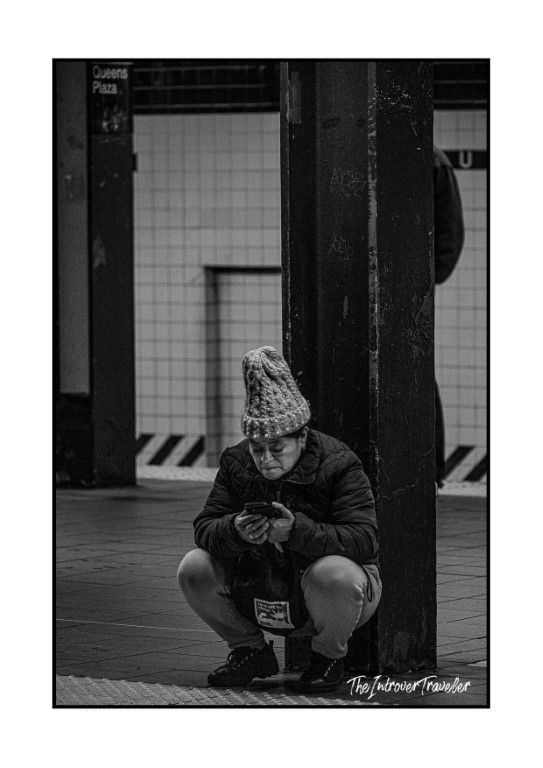
If there is a city in the world that seems almost designed for street photography, it is New York. Not because of some vague urban charm, but for very concrete reasons: the light filtering between the blocks, the vanishing lines of the grid, reflections in shop windows, fire escapes zigzagging across façades, subway entrances, the sharp shadows of winter, the contrast between anonymity and theatricality, and the inexhaustible, often picturesque humanity of the streets. Above all, it is the fact that almost every corner already contains a relationship between figure and background.
Street photography here does not need to chase the exceptional. It must train itself to recognize the energy of the ordinary. A man crossing Lexington Avenue with a coffee in his hand. A woman paused in front of a deli window. A tiny dog dragging, with ridiculous authority, an Upper West Side lady. A taxi driver trapped in the red glow of a traffic light. A violinist playing in a subway corridor. A runner in Central Park silhouetted against the pale winter backlight.
New York works photographically because it is both rigorous and unpredictable. The urban structure provides order; life breaks it. It is paradise for those who know how to wait for the right gesture within a composition that is already prepared.
Neighborhoods also change the visual syntax. Midtown offers vertical lines, density, compression, reflections, rhythm. Downtown is more discontinuous, rougher, more stratified. DUMBO plays with the monumental presence of bridges and powerful framing effects. The Upper East Side expresses a restrained elegance made of stone façades, doormen, tall windows, and discreet wealth. Chinatown and the Lower East Side require a sharper attention to human detail, commercial accumulation, and dense visual signage.
Few cities, in any case, are as photogenic as New York.
For those who are not photographers themselves but are simply preparing to visit the city, it is worth mentioning a few photographers who have captured New York in particularly representative ways:
More modestly, here you can find my own photographic portfolio of the city.
New York as a Film Location: The City That Taught Cinema How to Look at a City
New York has not merely been used by cinema. It has been interpreted by cinema to the point of becoming an autonomous form of the collective imagination. The Mayor’s Office of Media and Entertainment still actively supports audiovisual production as a structural component of the city’s identity, and the Museum of the City of New York has even developed an immersive project, You Are Here, based on hundreds of films set in the city, precisely to show how New York has been endlessly reinvented on screen.
Few places have enjoyed such historical cinematic photogenicity. In The French Connection, New York appears nervous, dirty, kinetic, almost feverish, a city of chases, elevated tracks, stations, and sidewalks stripped of romance. In Woody Allen’s cinema, and especially in Manhattan, it becomes an urban elegy: mental black and white, sentimental sophistication, cultivated neurosis. These are two almost opposite cities, yet both are authentic.
And this is precisely the cinematic greatness of New York. It allows incompatible interpretations without losing its identity. It can be a criminal metropolis, a romantic comedy, an architectural symphony, an ethnic drama, a coming-of-age story, an intellectual satire, a Christmas fable, or pure iconography of desire.
For travelers with even a minimal cinephile sensitivity, walking through New York means constantly recognizing shots and scenes. Not as a pilgrimage for fans, but as a way of understanding how cinema has fixed certain points of the city within a shared cultural memory. Bridges, diners, brownstones, lobbies, subway entrances, park benches, the skyline at sunset, in New York real places often arrive already charged with cinematic memory.
A list of films set in New York would be endless and ultimately sterile. I will simply mention a few titles in which the city itself becomes a true protagonist of the narrative — for those who might wish to whet their cinematic appetite before departure:

Books - New York in Literature
This is not the place to compile a full bibliography on New York. Once again, I will simply suggest, with no claim to completeness, a few books that I believe are intrinsically connected to the city and that are worth reading before departure to build anticipation, during the trip to sharpen perception, and after returning to prolong the nostalgia.
New York in Music
Here again the selection can only be arbitrary, or predictable, depending on one’s point of view, but if I had to suggest ten records to listen to before, during, and after a New York experience, I would suggest the following:
George Gershwin — Rhapsody in Blue — Symphonic portrait of American urban modernity.
Charlie Parker — Bird at the Roost — Incendiary bebop born in Manhattan jazz clubs.
Miles Davis — Kind of Blue — Modal jazz masterpiece of the 1950s New York scene.
John Coltrane — A Love Supreme — Spiritual jazz shaped within Harlem’s vibrant culture.
The Velvet Underground & Nico — The Velvet Underground & Nico — Avant-garde rock of artistic, decadent New York.
Steve Reich — Music for 18 Musicians — Hypnotic minimalism from the downtown New York scene.
Talking Heads — Remain in Light — Intellectual post-punk emerging from Manhattan’s CBGB era.
Grandmaster Flash & The Furious Five — The Message — Birth of hip-hop in the streets of the Bronx.
Lou Reed — New York — Cynical and literary urban chronicle of the city.
Sonny Rollins — Saxophone Colossus — Brilliant hard bop from the 1950s New York jazz scene.
Bookstores in New York
New York is also an extraordinary city for anyone who loves bookstores, because it still preserves a surprisingly vital literary ecosystem for a metropolis dominated by skyscrapers, finance, and digital platforms. Several bookstores have become genuine cultural institutions.
The first that must be mentioned is The Strand Bookstore, near Union Square, one of the most famous independent bookstores in the world. Founded in 1927, it is renowned for its motto “18 miles of books” and for its remarkable combination of new, used, and rare books covering virtually every imaginable discipline.
For those interested in art publishing and design, an essential address is Rizzoli Bookstore on Broadway, an elegant shop that retains the atmosphere of a European bookstore, with a refined selection of illustrated books, architecture, photography, and Italian culture.
Another key stop is McNally Jackson, an independent bookstore originally founded in SoHo and now with several locations across the city. It is widely appreciated for the quality of its literary selection and for its strong connection with the contemporary New York cultural scene.
For lovers of second-hand books and unexpected discoveries, it is worth visiting Housing Works Bookstore in SoHo. The shop is run by a nonprofit organization that supports social programs and maintains a surprisingly rich catalog of used books, often at very accessible prices.
Finally, Books Are Magic in Brooklyn deserves a visit. It is one of the most lively independent bookstores in the city, created with the explicit goal of preserving the role of the neighborhood bookstore within the urban cultural ecosystem.
Together, these bookstores reveal a less spectacular but deeply authentic side of New York: a city that, despite real estate pressure and digital transformation, still considers books and spaces for reading an integral part of its cultural life.
The Real New York Experience: Holding High and Low Together
The easiest mistake you can make with New York is to treat it as a list. Times Square, Central Park, the Empire State Building, the Statue of Liberty, Ellis Island, photograph, next. This approach produces a technically accurate yet experientially empty version of the city, the kind that leaves people saying they have "done" New York the way one does a spreadsheet.
The second mistake is the opposite and, frankly, more annoying one: treating the city as a purely intellectual object, a sequence of architectural references and cinematic citations that floats several meters above the actual pavement. New York as a Woody Allen film watched from a safe critical distance.
Neither works, because New York is one of the few cities where the high and the low are not separate registers but the same thing viewed from different angles. The Metropolitan Museum of Art contains one of the greatest collections of human civilization ever assembled in a single building, and it sits twelve minutes on foot from a halal cart that has been serving the same corner for thirty years. Both are New York. Neither explains the other, but you need both to understand the city.
The same logic applies vertically. Seen from Top of the Rock or from the Brooklyn Bridge at dusk, Manhattan is an almost abstract composition of economic ambition translated into stone and glass, one of the great visual arguments of the twentieth century. At street level, thirty seconds after descending, it is subway stairs and delivery bikes and someone arguing on the phone in three languages simultaneously. Both views are accurate. The panoramic one is seductive; the street-level one is true.
New York was not designed to be beautiful. It was designed to function, and what beauty it has is largely the accidental byproduct of that functional ambition. The skyscrapers exist because land was scarce and capital was abundant. The museums exist because Gilded Age money needed cultural legitimacy. The jazz clubs exist because Harlem in the 1920s was producing one of the greatest artistic explosions in American history under conditions that were, by any reasonable measure, terrible. The Morgan Library and the Guggenheim and the MoMA and the Art Deco lobbies and the brownstones and the bridges are all, in different ways, money becoming form. Understanding that does not diminish them. It makes them more interesting.
The version of New York worth visiting, and worth reading about, is the one where the skyline and the halal cart and the Coltrane record and the subway delay are all part of the same argument. A city that has never been particularly interested in being coherent, but that has somehow managed, across four centuries of accumulation, to produce something that feels inevitable.

The Longevity of New York
For more than a century, New York has continued to occupy a hegemonic position, not only because it remains the financial capital of the planet, but also because it still manages to function simultaneously as archive and avant-garde. It preserves its Dutch, English, migratory, industrial, and financial past. It preserves the epic of the skyscraper, the dream of the encyclopedic museum, the prestige of the monumental library, the memory of jazz, the myth of cinema. Yet at the same time it continues to operate as a machine of symbolic renewal.
Many famous cities live off the inertia of their past. New York, by contrast, constantly circulates its own past, reactivating it rather than embalming it. It is a city that quotes itself without becoming a museum of itself, and that is perhaps its rarest quality.
If I had to reduce everything to a formula, it would be this: New York is a city that forces you to hold beauty and system together. It is not enough to admire it; one must read it. It is not enough to photograph it; one must understand its structure. It is not enough to visit it; one must accept that part of its power lies precisely in the fact that it cannot be exhausted.
Practical Advice
The first practical advice for visiting New York is simple: do not treat it as a city to “see entirely,” but as a metropolis to organize by areas, rhythms, and priorities. New York is enormous, dispersive, and physically demanding. Even though Manhattan appears compact on a map, walking distances accumulate quickly and time is easily consumed by waiting, crossings, security checks, and queues.
For this reason it is best to structure each day around coherent urban areas, such as Midtown, the Upper East Side, Lower Manhattan, or the Brooklyn waterfront, rather than zigzagging across the city simply because two places appear close on a map. Walking remains one of the best ways to understand New York, because it allows you to perceive the transitions between neighborhoods and the rhythm of the streets, nuances that hurried tourists often miss entirely.
When planning a trip to New York, it is useful to make an initial decision. One option is to focus on the most obvious New York, essentially Manhattan, with its major monuments and principal museums. Another, more ideological choice, would be to largely bypass Manhattan and explore other boroughs, such as Brooklyn or Harlem, which offer equally compelling experiences. A third possibility is an intermediate strategy, accepting painful compromises, because even a month in New York would not be enough to see everything.
Accommodation
From a logistical perspective, the choice of accommodation matters greatly. For a first visit, staying in Manhattan or in well-connected areas of Brooklyn or Queens drastically reduces wasted time and logistical complications, although it comes at a higher cost.
Times Square is central but often noisy, congested, and more expensive than necessary. Neighborhoods such as Midtown East, Bryant Park, Flatiron, Chelsea, Long Island City, or Downtown Brooklyn often offer a better balance between connectivity, perceived safety, and quality of urban experience.
In any case, before booking it is important to remember that hotel prices in New York are almost always higher than the initial rate shown online, because various taxes and fees are added. The city applies a hotel room occupancy tax of 5.875%, plus a daily fixed fee of $2 for rooms costing $40 or more, and in addition the combined New York sales tax of 8.875% applies, together with a New York State hotel unit fee of $1.50 per day.
In practice, the final price can increase significantly, so it is essential to verify the total cost before completing a reservation. My personal choice was a hotel in Queens, just across the East River, which offered relatively fast connections to Manhattan at somewhat more reasonable prices; It was a particularly good offer that I found on Amex Travel. If you would like to join the American Express program, this is my referral link, which currently grants you a € 560 welcome bonus.
If you are looking for accommodation in Manhattan, you can compare hotels here.
Urban Transportation
For public transport, the simplest solution today is OMNY, the contactless payment system used by the Metropolitan Transportation Authority (MTA). You can enter the subway or board buses simply by tapping the same contactless card or smartphone each time, without purchasing a MetroCard.
As of January 2026, a ride on the subway or local bus costs $3. The system includes a weekly fare cap of $35, provided you always use the same card or device within a seven-day period. In practice, each ride is charged individually until the total reaches $35; after that threshold is reached, further rides during the week are free. It is extremely convenient.
Buses remain underrated by tourists, but on many routes they are surprisingly useful, especially if you want to see the city above ground and avoid unnecessary underground transfers.
Understanding the Subway
A brief clarification about the New York subway can prevent many mistakes for first-time visitors. The network is large but becomes quite efficient once its basic logic is understood.
The fundamental distinction is between local trains and express trains.
Local trains stop at every station.
Express trains skip many intermediate stations and stop only at major nodes.
On larger lines there are therefore two pairs of tracks: the outer ones for local trains and the inner ones for express services. One of the most common tourist mistakes is boarding an express train when the intended stop is served only by local trains, which can result in skipping several stations in succession.
Another key concept is the directional terminology Uptown and Downtown. In Manhattan, trains are usually labeled this way rather than by compass directions.
Downtown generally indicates travel south, toward Lower Manhattan and the Financial District.
Uptown generally indicates travel north, toward Harlem, the Bronx, or Upper Manhattan.
Outside Manhattan the logic may vary slightly, but these two terms remain the principal orientation references.
Finally, in subway stations you will often encounter signs reading “Underpass.” This does not indicate an exit but an internal underground passage that allows you to cross the tracks or change direction without leaving the station and without paying another fare. It is particularly useful if you entered on the wrong side of the street and need to reach the opposite Uptown or Downtown platform.
Airports
Airport transfers also benefit from a bit of planning.
For JFK Airport, the most efficient route from Manhattan is often the combination LIRR + AirTrain. The Long Island Rail Road takes about 20 minutes from Penn Station or Grand Central to Jamaica Station, from which the AirTrain reaches the terminals in another 10–15 minutes. The subway costs less but takes longer and can be inconvenient with heavy luggage.
For LaGuardia, there is no direct subway connection. The Q70 LaGuardia Link bus connects the airport free of charge to Jackson Heights and Woodside, both excellent transfer points for the subway and the LIRR. Another option is the M60 SBS bus toward Manhattan.
For Newark Airport, the most straightforward route is NJ Transit to Newark Liberty Airport Station, followed by the AirTrain to the terminals. However, it is advisable to check service advisories, since in 2026 maintenance work may affect certain days or time slots.
Money, Taxes, and Tipping
Another practical aspect often underestimated concerns everyday payments. In New York almost everything can be paid by card, often more conveniently than cash, but displayed prices usually do not include sales tax, which in most cases is 8.875%.
Tipping is also not a folkloric option but a structural component of the service economy.
According to NYC Tourism guidelines:
Restaurants: 15–20%, with the higher percentage increasingly common
Hotel housekeeping: $2–5 per day
Bellhop: $1–2 per bag
Doorman calling a taxi: $2–5
In restaurants, after paying, you will typically be asked to select a tip (often 10%, 15%, or 20%) under the attentive gaze of the waiter who served you. Knowing this in advance avoids both awkward moments and apparently inflated final bills.
Seasons
New York changes much more across seasons than many visitors expect.
Summer can be hot, humid, and exhausting, especially in the subway and during midday hours.
Spring is variable, often windy or rainy but sometimes spectacularly pleasant.
Autumn is frequently one of the most enjoyable seasons, with cooler air and beautiful light.
Winter can be cold and occasionally snowy, though clear sunny days are not uncommon.
The practical summary is simple: dress in layers, wear truly comfortable shoes rather than elegant but useless ones, and bring a jacket appropriate for the season, especially because wind between the blocks and along the waterfronts can be surprisingly strong.
Behavior and Attitude
Finally, perhaps the most useful advice concerns behavior.
New York today is one of the safer large cities in the United States, but it remains a vast metropolis, so common sense applies: keep an eye on pockets and phones in crowded areas, use authorized services, avoid unofficial taxis at airports, and remain cautious toward overly aggressive vendors or rental offers.
It is also wise to book popular attractions in advance, particularly observatories, Broadway shows, temporary museum exhibitions, and well-known restaurants. Improvising in New York often means losing valuable time.
And one last piece of advice, less technical but essential: leave space for urban friction. Do not plan every minute. New York requires room for entering an Art Deco lobby, browsing a bookstore, changing direction, boarding a ferry simply for the view, or sitting on a bench and watching the city pass by.
It is precisely at that moment that New York stops being merely a destination, and finally begins to feel like New York.

Flying to New York
Visiting New York almost always means entering the United States through one of the three major airports serving the metropolitan area: John F. Kennedy International Airport (JFK), LaGuardia Airport (LGA), and Newark Liberty International Airport (EWR).
JFK is the main intercontinental hub and the most common gateway for flights arriving from Europe. LaGuardia primarily handles domestic and short-haul traffic, while Newark, located in the neighboring state of New Jersey but fully integrated into the city’s airport system, is a major hub for United Airlines and operates both domestic and international routes.
For travelers arriving from Europe, the first real contact with the United States happens not in the city itself but at the immigration checkpoint at the airport, a step that often worries visitors but is, in most cases, relatively quick and straightforward.
Citizens of Italy and most European countries enter the United States through the Visa Waiver Program, which allows tourism or business stays of up to 90 days without a traditional visa. However, travelers must obtain the ESTA (Electronic System for Travel Authorization) before departure. The ESTA is requested online and, once approved, remains valid for two years or until the passport expires.
Upon arrival in the United States, travelers pass through U.S. Customs and Border Protection (CBP), where an officer verifies the passport, the purpose of the trip, and the expected duration of the stay.
In recent years the process has been made faster by the MPC – Mobile Passport Control app, an official CBP tool that allows eligible travelers to complete the customs declaration digitally and submit certain information in advance before reaching passport control. The app generates a QR code that can be shown to the immigration officer and often allows access to dedicated lanes, reducing waiting times. It does not replace the officer’s inspection but can accelerate the process.
At JFK, there are sometimes specific lanes for travelers who have already submitted their information through the MPC app. However, the process can be somewhat unpredictable: sometimes these lanes are closed, and sometimes they are more crowded than the regular ones. My pragmatic approach is therefore simple: fill in the information in the app and then evaluate the situation upon arrival at passport control.
During the brief interview with the border officer, travelers are usually asked a few standard questions: the purpose of the trip, how long they intend to stay in the United States, where they will be staying, and occasionally what work they do in their home country. The questions are not intended to create difficulties but simply to confirm that the visit is genuinely temporary and touristic. The most useful advice is to answer clearly and calmly, without unnecessary details but also without appearing evasive. It is helpful to have the hotel address and return ticket readily available; in my case, they were indeed requested.
One issue that deserves particular attention concerns previous travel to Cuba. Since 2021, the United States has established that travelers who have visited Cuba after January 12, 2021 are no longer eligible for the Visa Waiver Program and therefore cannot use ESTA. In such cases, travelers must apply for a B1/B2 tourist visa at a U.S. embassy or consulate before departure.
Many travelers only discover this rule while completing the ESTA application, because the online form explicitly asks about trips to Cuba. When I visited New York in December 2024, my wife, who had previously traveled to Cuba, had to complete this section of the form. In practice, it simply meant waiting a few extra days for the ESTA approval and caused no problems at immigration. However, my impression is that the situation may have become more complicated in recent years, so it is advisable to verify the most current regulations before traveling.
Once immigration control has been completed, passengers proceed to baggage claim and customs. In most cases no further checks are carried out unless a traveler is selected for a random inspection. At that point one has finally entered the United States and can continue toward Manhattan or the other boroughs using taxis, trains, the subway, or rideshare services.
Regarding airports, on my blog I have also reviewed in detail several airport lounges in New York, including the Centurion Lounge at LaGuardia, the VIP One Lounge at JFK, and the Turkish Airlines Lounge at JFK; I had complimentary access to all these lounges using the American Express Platinum card; if you would like to join the American Express program, this is my referral link, which currently grants you a € 560 welcome bonus.
In qualità di affiliato Amazon, potrei guadagnare una piccola commissione dagli acquisti idonei effettuati tramite i link presenti in questo articolo, senza alcun costo aggiuntivo per il lettore.


Comments