
The Monreale Cathedral (Palermo): a Norman and Byzantine Treasure
- The Introvert Traveler
- Feb 21
- 8 min read

Updated: Feb 25
Last visit: November 2021
My rating: 10/10
Visit duration: one and a half hours
The Monreale Cathedral in Palermo is one of the most extraordinary monuments among the many treasures of the Sicilian capital. It is not merely a cathedral, but one of the most powerful visual manifestos of the medieval Mediterranean: a building in which political power, dynastic ambition, theology, and dialogue (sometimes conflict) between different cultures are condensed into a single architectural statement. Built in the 12th century at the behest of William II of Hauteville, Norman king of Sicily, the cathedral dominates the Conca d’Oro from the heights of Monreale as an assertion of royal and spiritual authority, in deliberate competition with the archbishopric of Palermo.
Its significance lies above all in its interior mosaic decoration: over 6,000 square metres of Byzantine mosaics on a gold ground, among the largest and best-preserved cycles in Europe, which translate into images a rigorously hierarchical, theologically coherent, and politically eloquent worldview. To visit Monreale is to enter a space in which Norman architecture, Byzantine iconography, and Western sensibility merge in a manner that is not merely decorative but ideological, offering the visitor not a simple visual spectacle, but a lesson in history, art, and power that is virtually unparalleled in the European landscape.

The History of the Cathedral
The history of Monreale Cathedral is inseparable from the history of Sicily as a space of cultural stratification and synthesis. After the long Byzantine phase (6th–9th centuries), which grafted onto the island a solid Greco-Eastern administrative tradition and a deep-rooted Christian iconography of Constantinopolitan origin, the Arab conquest (9th–11th centuries) radically transformed Sicily’s landscape. It introduced new urban layouts, advanced agricultural techniques, a refined court culture, and an architectural vocabulary that privileged geometry, rhythm, and abstract decoration. The arrival of the Normans in the 11th century did not erase this legacy but absorbed it and redirected it politically: the Norman rulers understood that control of the island could not be based on homogenization, but rather on the management of differences.
Within this context falls the foundation of the cathedral at the behest of William II of Hauteville (c. 1172), who made Monreale the seat of a powerful archbishopric directly linked to the crown, thereby removing it from the influence of Palermo. The monument translates this strategy into architectural form: the basilican structure and the language of power are Norman and Latin; the iconographic program of the mosaics is entrusted to Byzantine models and craftsmen, with a rigorously orthodox visual theology; while the ornamental vocabulary, spatial solutions, and attention to wall surfaces betray a sensibility forged within an Islamic milieu. Monreale thus becomes the most accomplished product of Norman Sicily; not a superficial compromise between cultures, but a coherent system in which Arab heritage, Byzantine learning, and Norman political ambition are orchestrated in the service of a precise idea of sacralized kingship and territorial control.
Construction began around 1172, at a moment when the Kingdom of Sicily had reached full administrative maturity and enjoyed strong internal stability. The project was not merely devotional: by founding a new cathedral and establishing an autonomous archbishopric, William II removed a vast territory from the authority of the archbishop of Palermo, strengthening the monarchy’s direct control over the Sicilian Church (it is also said that he intended to compete with the historical legacy of his grandfather Roger II, builder of the Palatine Chapel).
The building campaign progressed with exceptional speed for the period. The main architectural structure was substantially completed by 1182, the year of its consecration, while the vast mosaic cycle, entrusted to Byzantine craftsmen, probably from the Constantinopolitan area, continued into the final years of William’s reign, likely concluding around 1190. From the outset, the complex included not only the basilica but also the Benedictine monastery with its great cloister, an essential component of the Norman politico-religious project.
In subsequent centuries, the cathedral did not remain unchanged. Between the 16th and 18th centuries, lateral chapels, furnishings, and decorations in Renaissance and Baroque taste were added, most notably the Chapel of the Crucifix and that of Saint Benedict, partially altering the original sobriety of the spaces without compromising the medieval core. The western façade and the towers underwent reconstructions and restorations, particularly following damage caused by fires and earthquakes. In the 19th century, “restorative” interventions were undertaken in line with contemporary historicist sensibilities, aimed, sometimes controversially, at recovering the Romanesque-Norman appearance of the building.
The result is a monument that, despite adaptations and layers of later additions, preserves with remarkable clarity its original layout and ideological program: a work conceived as a foundational act of Norman power in Sicily and as a monumental synthesis of the cultures that had governed the island before and after the conquest.

The Architecture of Monreale Cathedral
From an architectural standpoint, Monreale Cathedral is a longitudinal basilica of deliberately “regal” proportions. Local descriptive and tourist literature traditionally cites a nave measuring approximately 102 metres in length and 40 metres in width, dimensions that reveal a building conceived to impress not only through decorative richness, but also through sheer spatial scale. The plan follows the typical Norman Sicilian scheme: a three-aisled basilica with transept and three apses (one main apse and two smaller lateral ones), conceived as a Western liturgical machine that nonetheless incorporates a formal and decorative vocabulary that is not exclusively “Latin.”
The exterior, in fact, relies heavily on the rhythmic articulation of volumes and on surface ornamentation. The apses are articulated with interlaced blind arches, a motif closely associated with the Arab-Norman horizon, functioning more as an ornamental “textile” applied to the surface than as an expression of structural logic. The western façade was historically characterized by two towers with an interposed portico; however, it must be noted that both the façade and, in particular, the portico underwent significant alterations in the early modern period (interventions well documented in art-historical literature) which make clear that the present appearance is the result of a long history of maintenance and formal updating.
The decisive element, however, lies in the fundamentally syncretic logic of the complex. Monreale is not simply a Romanesque building “embellished with Eastern decorations,” but an organism conceived within the Norman Kingdom of Sicily as the outcome of a material culture capable of orchestrating a dialogue between spatial concepts, structural systems, and decorative languages derived from Western, Islamic, and Byzantine traditions. Put differently, the planimetric framework and the very idea of monumentality are fully consistent with a Western political project; the ornamental skin of the exterior and certain approaches to surface treatment point toward Islamic taste; while the conception of the interior as a “total environment”, in which walls and volumes are visually absorbed by a continuous decorative envelope, prepares the ground for a Byzantine reading of the building as a theological space, even though the mosaic program itself belongs more properly to the realm of iconography than to architecture in the strict sense.

The Byzantine Mosaics
The mosaics of Monreale Cathedral are not a decorative “cladding,” but the building’s theological architecture: a continuous iconic skin that transforms the walls into a visual text and, above all, into a device for legitimizing Norman power through a language (Byzantine) that was perceived as the most authoritative for representing sacred kingship. Their overall extent amounts to roughly 6,500 square metres of interior mosaic surfaces, among the largest in the world within a medieval ecclesiastical context. Executed in glass tesserae on a gold ground, they are organized into a hierarchical and narrative program spanning the Old and New Testaments.
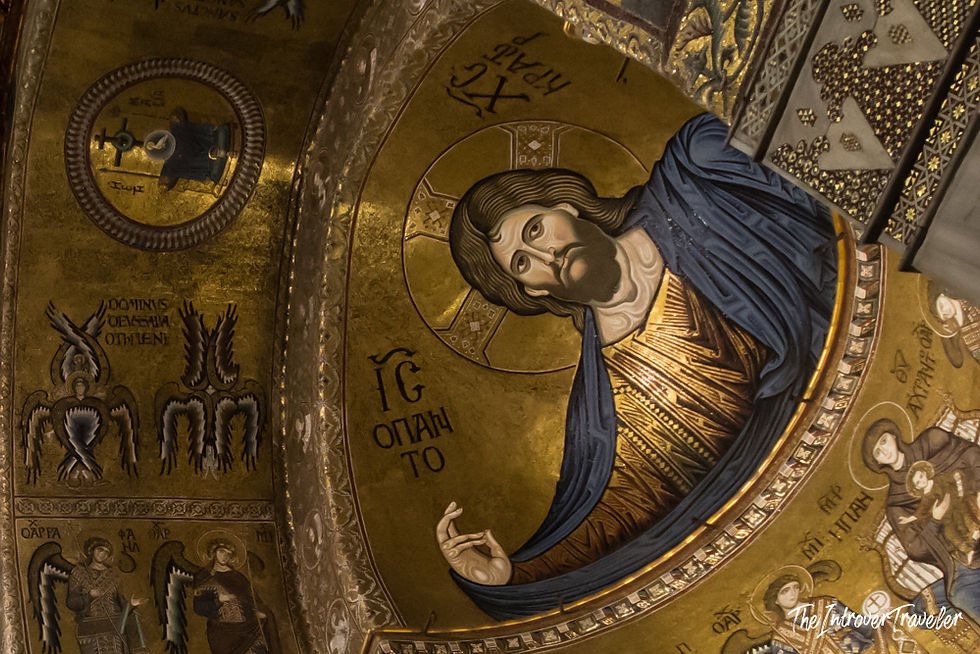
The focal point is the great apse conch with the figure of Christ Pantocrator, an “imperial” image of Christ as ruler and judge, dominating the liturgical space. By virtue of its scale and centrality, the figure is designed to be read from a great distance and to establish an immediate visual hierarchy (Christ at the summit, followed by lower registers populated by other sacred figures) according to a distinctly Byzantine principle of ordering the sacred within space. Around this theological axis unfold the narrative cycles along the nave and transept: biblical episodes arranged in sequences that do not aim at illustrative “realism,” but at a form of visual catechesis, in which both the selection of themes and their placement, closer to or farther from the presbytery, construct a doctrinal as well as narrative itinerary.
The very decision to ground the identity of the monument in such an extensive mosaic program must be read within the framework of Norman Sicily’s cultural syncretism, capable of accommodating Western, Islamic, and Byzantine forms, yet oriented by a precise political intention: to speak the figurative language of the Christian East in order to confer upon the monarchy an aura of continuity with the Mediterranean imperial tradition.

From an artistic and stylistic perspective, the mosaics of Monreale Cathedral represent one of the highest and latest achievements of Byzantine mosaic art in the Western world, occupying an intermediate and deliberately “selective” position in relation to earlier major models. Compared to the mosaics of the Palatine Chapel, executed some thirty years earlier under Roger II, Monreale displays a more solemn and systematic language. While the Palatine Chapel impresses through its extraordinary integration of architectural space, an Islamic-inspired wooden ceiling, and Byzantine iconography, Monreale relinquishes any sense of visual eclecticism in favor of a more uniform, almost “imperial” monumentality, in which the sacred narrative fully dominates the architectural framework. The Palatine mosaics are more intimate, narratively dense, at times more experimental; those of Monreale are more hierarchical, more expansive, and more explicitly didactic, conceived to be read as a vast, ordered, and all-encompassing visual code.
The comparison with Ravenna is even more revealing. The Ravennate cycles of the fifth and sixth centuries (San Vitale, Sant’Apollinare Nuovo) belong to an early, formative phase of Byzantine art, characterized by greater formal abstraction, more static figures, and a still-fluid relationship between Late Antique classicism and Christian symbolism. Monreale, by contrast, is the product of a fully mature Byzantine tradition: its figures are more elongated, more codified, less dependent on classical volumetric modeling, and more immersed in an iconic space devoid of real depth. Where Ravenna still preserves an echo of Romanitas, Monreale speaks a language that is definitively theological, in which beauty is not naturalistic but functional to the revelation of the sacred.
The most ambitious, inevitable, and programmatic comparison, however, is with Hagia Sophia in Istanbul. Monreale does not attempt to emulate its spatial complexity or engineering audacity; what it absorbs instead is its lexicon of authority: the Christ Pantocrator as the absolute image of divine power, the golden surface as a negation of earthly time, and frontal composition as a tool of visual and spiritual control. If Hagia Sophia represents the paradigm of imperial Byzantine art to which one inevitably looked in the twelfth century, Monreale stands as its fully conscious Western translation, adapted to a Latin context yet faithful to Eastern iconographic principles. In this sense, the mosaics of Monreale are not a provincial imitation but a cultural statement: they assert that Norman Sicily positions itself along the same symbolic axis as Constantinople, appropriating its figurative language to construct an autonomous idea of sacralized kingship.
The relationship, therefore, is not one of direct dependence but of shared visual language. Constantinople was not merely a place, but a normative center of Eastern Christian iconography: models, visual manuals, workshops, and prototypes circulated throughout the empire and beyond its borders. The workshops active at Monreale were almost certainly composed of mosaicists trained within the Constantinopolitan orbit, applying stabilized iconographic schemes (hierarchy of figures, frontal poses, gold backgrounds, standardized physiognomies) rather than “looking” to a single monument as a direct source. In this sense, Monreale does not look to Hagia Sophia as a historical archetype, but draws from the same imperial visual system that Hagia Sophia had helped to establish and that, in the twelfth century, was still fully operative.
It is precisely here that Monreale reveals its ambition: the use of a contemporary, authoritative, and universally recognized visual language, rather than an archaic one. If Ravenna represents the infancy of Byzantine art and the Palatine Chapel a phase of syncretic experimentation, Monreale belongs to the full maturity of the Middle Byzantine tradition, applying it with a coherence and a scale unmatched in the West. Not imitation, therefore, but a conscious appropriation of a living visual code, employed to place the Norman monarchy on the same symbolic plane as the Eastern Roman Empire.
Practical Tips
The visit requires approximately one hour to explore properly not only the cathedral itself but also the ancillary areas, including the presbytery, the lateral chapels, and the cloister. To this should be added the time needed to reach Monreale from Palermo—about one hour by public transport or roughly half an hour by taxi.
If you're planning a trip to Sicily, you may be interested in these posts.


Comments