
Fine dining restaurants in Istanbul: Lokanta 1741
- The Introvert Traveler
- 2 days ago
- 4 min read


Last visit: June 2025
My rating: 7/10
Price: €€€€ / €€€€€
Cuisine: Ottoman inspired fine dining
Within the restaurant scene of Istanbul, where the offer constantly oscillates between standardized tourist dining and contemporary venues often more concerned with aesthetics than with cuisine, Lokanta 1741 represents a rather convincing balance between historical setting, reinterpreted Ottoman cooking, and a carefully controlled sense of formal restraint.
The restaurant is located inside the Hürrem Sultan Hamam complex, just a short walk from Hagia Sophia and the Blue Mosque, in a position that could easily condemn it to becoming a straightforward tourist trap. In reality, once past the entrance, one immediately perceives a clear distance from restaurants designed solely to capture the tourist flow of Sultanahmet. The atmosphere is sober and elegant without ostentation, making intelligent use of the historical architecture of the complex. The dining rooms retain an intimate scale, with soft lighting and tables spaced far enough apart to allow normal conversation, a detail far from trivial in a city that can often be noisy even in high end settings. The lighting may be almost excessively dim, bordering on darkness, yet overall I found it preferable to the aggressively bright atmosphere common in many other restaurants.
The cuisine belongs to the increasingly interesting field of Ottoman culinary reinterpretation. This is neither fusion cooking nor experimental gastronomy in the strict sense. Rather, Lokanta 1741 works with historical recipes, lightening them and adapting them to contemporary international tastes without distorting their identity. The menu favors local and seasonal ingredients and demonstrates a certain philological attention to Anatolian and imperial culinary traditions.
After two cocktails with distinctly exotic and unusual flavors, whose ingredients I unfortunately did not note but whose taste I still clearly remember months later, and two amuse bouche of labneh served on toasted bread, our choice fell on the Çig Köfte, the Fener Sis, and the Kazlı Mantı, with the intention of experiencing representative flavors of Ottoman cuisine.


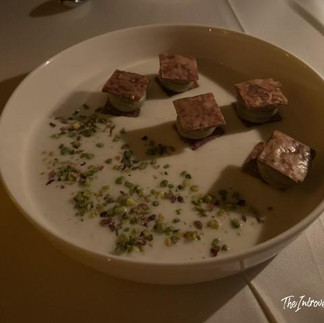


The Çig Köfte, one of the most emblematic dishes of southeastern Anatolia, traditionally prepared with raw meat mixed with bulgur and spices, is today often lightened or reinterpreted for sanitary reasons and to accommodate international tastes. At Lokanta 1741, the preparation retains notable aromatic depth without falling into the excessive spiciness that often weakens less controlled versions. Texture is essential in this dish, and here the balance between spice, acidity, and compact consistency proves convincing, offering an elegant interpretation of what was historically a popular preparation. The dish is delicate, in fact more delicate than I expected, carefully avoiding the risk of overpowering the primary ingredient, the meat itself, which was of excellent quality.
The Fener Sis, grilled monkfish tail, introduces the chapter of grilled proteins, an area where many Turkish restaurants limit themselves to technical execution alone. In this case, greater attention emerges in both marination and ingredient quality. The cooking favors tenderness and juiciness rather than the pronounced char typical of traditional ocakbası cuisine. This choice is consistent with the restaurant’s overall approach, which aims at a more refined and less rustic interpretation of tradition. It was probably the best dish of the evening.
The third choice, as mentioned, was the Kazlı Mantı, dumplings filled with goose. Mantı are usually associated with more common fillings such as lamb or beef, whereas the use of goose recalls a more aristocratic Ottoman cuisine that is rarely encountered in contemporary restaurants. The result is a richer and deeper dish from a gastronomic perspective, where the fatty component of the goose interacts with the sauce to create a complex yet well controlled balance. It is probably one of the dishes that best embodies the cultural ambition of the restaurant, namely the recovery of historical layers of imperial cuisine without turning them into museum exercises.
Dessert, Sütlü Nuriye, provided a coherent and well calibrated conclusion. Created in the 1970s as a lighter variation of baklava, this dessert uses a milk based syrup rather than one made exclusively from sugar, resulting in a softer and less aggressive sweetness. The crisp texture of the pastry and the pronounced pistachio flavor, well balanced by yogurt, made it an excellent dessert.
I cannot comment on the wines, as I did not order any.
At the end of the dinner, I would suggest enjoying a digestif on the terrace, both because the setting is particularly pleasant and because, during all my days in Istanbul, this was the only place where I found not only alcoholic beverages readily available but also an excellent selection of spirits of every kind, from rum to gin to whisky.
Service overall is professional, attentive without being intrusive, and capable of maintaining an appropriate rhythm between courses, neither rushed nor excessively slow.
Prices fall within the upper middle range by Istanbul standards, yet remain consistent with the overall quality of the experience. This is not an inexpensive restaurant, nor does it attempt to be one.
What makes Lokanta 1741 interesting is not absolute culinary originality but its ability to interpret Ottoman tradition through a contemporary lens. The restaurant avoids both folkloric nostalgia and forced modernization. The result is a balanced cuisine fully coherent with its historical setting, refraining from impressing guests through excessive technicality or overly elaborate flavors.
In an area of Istanbul where it is easy to eat poorly while paying too much, Lokanta 1741 represents a reliable and culturally sound choice, even if rather expensive. It is not a place designed to impress through immediate effects, since all dishes favor delicacy and balance, but rather one that remains memorable over time for the harmony between setting, service, and cuisine. Several months later, looking again at photographs of the dishes, the flavors still emerge distinctly in memory, and although it was not the best dinner of my life, the overall value for money ultimately proved quite satisfying.
If you are planning a trip to Istanbul, you may be interested in these posts.
For a complete guide to Istanbul, see the full Istanbul travel guide.


Comments