
Saint Savior in Chora, the best mosaics in Istanbul
- The Introvert Traveler
- 2 days ago
- 6 min read


Last visit: June 2025
My rating: 8/10
Duration of the visit: half an hour
For whom: for lovers of Byzantine art
In the monumental landscape of Istanbul, where visitors tend to focus almost exclusively on Hagia Sophia, Blue Mosque, or Topkapı Palace, Saint Savior in Chora represents a discovery reserved for those unwilling to settle for the most obvious itineraries. Located in the north-western sector of the historic city, near the ancient Theodosian walls, this Byzantine church is one of the absolute peaks of Byzantine art, as well as one of the most sophisticated figurative cycles in the entire European Middle Ages. Visiting San Salvatore in Chora therefore means stepping beyond surface tourism and entering the more subtle heart of Byzantine Constantinople.
In another post I recounted how, during my first visit to Istanbul, I was partially disappointed to find that in Istanbul — the “Rome of the East” — unlike Rome, where ancient Rome is visible at almost every step, only a few evident traces remained of what had once been great Constantinople. Saint Savior in Chora is one of the most striking exceptions.
The History of Saint Savior in Chora
The history of Saint Savior in Chora is intertwined with that of Constantinople itself, reflecting political, theological, and cultural transformations spanning nearly a millennium of Byzantine history. The origins of the building most likely date back to the sixth century, in the age of Justinian or shortly thereafter, when an initial monastic church was erected outside the Constantinian city walls, in what was then a semi-rural area. The toponym Chora (“countryside,” “outer land”) initially described a simple geographical condition, but already in later Byzantine sources the term acquired symbolic and theological meanings that would become central to the iconographic program of the complex.
In the ninth century, the church underwent a significant rebuilding. In this period — marked by the end of the Iconoclastic crisis — the Chora was reconstructed as a church with a complex plan, equipped with articulated narthexes (transverse vestibules typical of early Christian and Byzantine basilicas, located between the façade and the nave) and an architectural layout reflecting the renewed prestige of aristocratic and monastic patronage. Of this phase, however, mainly the foundational masonry survives today: the aspect that has made the church famous is the result of a much later intervention.
The decisive moment in the history of the Chora was the great decorative campaign undertaken between 1315 and 1321 at the initiative of Theodore Metochites, one of the most prominent intellectual and political figures of the early fourteenth-century Byzantine world. Metochites, megas logothetes of the Empire — effectively a kind of prime minister — a refined humanist and profound connoisseur of theology and Aristotelian philosophy, financed at his own expense the architectural and decorative renewal of the church, transforming it into a visual manifesto of the so-called Palaiologan Renaissance. It was he who commissioned the addition of the exonarthex and esonarthex, as well as the extraordinary sequence of mosaics and frescoes that still cover the interior spaces today.
This phase coincided with a period of apparent cultural flourishing but deep political fragility for the Byzantine Empire. Territorial shrinkage, external threats, and internal tensions led Byzantium increasingly to invest in culture as a form of self-representation and symbolic resistance. The Chora emerged precisely within this context: not as an official imperial church, but as a site of intellectual elaboration, where art became the vehicle of a sophisticated theological discourse intended for a cultivated elite. The famous votive mosaic depicting Metochites kneeling at the feet of Christ, offering the model of the church, is not merely an act of personal devotion but a political and cultural statement: art as visual logos.
After the fall of Constantinople in 1453, the church continued to function as a Christian place of worship for several decades, until its conversion into a mosque in 1511. Renamed Kariye Camii, the Chora underwent liturgical adaptations typical of Ottoman conversions: the addition of a minaret, the plastering over of figurative images, and the insertion of the miḥrab (the niche indicating the direction of Mecca) and the minbar (the pulpit from which the imam delivers sermons). Unlike in other cases, however, the decorative apparatus was not destroyed but simply concealed, allowing for its future rediscovery.
This rediscovery took place in the twentieth century, in a radically altered political and cultural climate. Between 1948 and 1958, under the direction of the Byzantine Institute of America, extensive restoration campaigns brought to light the Palaiologan mosaics and frescoes, revealing to the world one of the most complex and refined iconographic cycles of the Middle Ages. In 1958, the building was converted into a museum, assuming a central role in the study of Byzantine art and becoming an essential destination for art historians, theologians, and cultivated travelers.
In recent years, the history of the Chora has entered a new and controversial chapter: in 2020, following the reconversion of Hagia Sophia, the building was once again designated as a mosque. This decision reopened the debate on the fate of Byzantine heritage in Istanbul, raising questions concerning conservation, accessibility, and the cultural function of monuments that historically belong to a universal tradition. The controversies appeared largely unfounded when, in 2024, after the completion of restoration works and the reopening to the public, the artworks were revealed in all their splendor to visitors of every faith.

The Mosaics and the Frescoes of Saint Savior in Chora in Istanbul
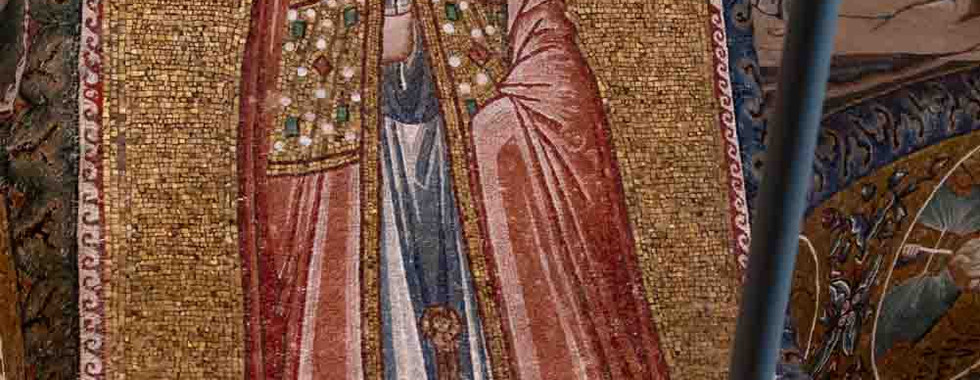
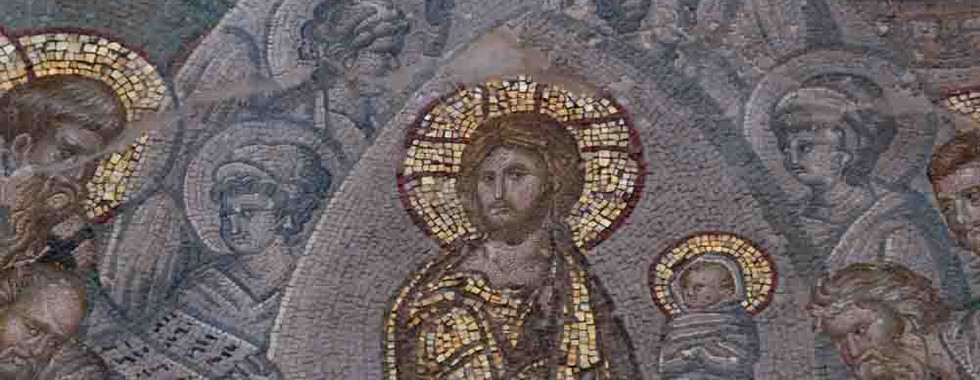
The iconographic apparatus of Saint Savior in Chora represents one of the most self aware and accomplished moments of late Byzantine art, both for the sheer quantitative richness of its imagery and for its conceptual density and stylistic refinement.
In the narthexes, the true fulcrum of the figurative program, an unprecedented narrative cycle unfolds in terms of scope and coherence, dedicated to the Life of the Virgin and the Infancy of Christ. The scenes do not derive solely from the canonical Gospels but draw extensively on apocryphal texts, a sign of the intellectual latitude that distinguishes the Chora from more official contexts. Unlike the hieratic solemnity of Hagia Sophia, the narrative here is dynamic, almost novelistic: figures move through space, interact with painted architecture, and display restrained yet legible emotions. It is painting that thinks in narrative terms rather than merely iconographic ones.
From a stylistic standpoint, the mosaics of the Chora display a technical mastery comparable to the great medieval cycles of the West. The tesserae are minute; the modeling is supple; faces are constructed through subtle chromatic transitions that convey volume and individuality. Yet, in contrast to the luminous classicism of the Ravenna mosaics, the Chora deliberately renounces absolute frontality and symbolic immutability. The result is an imagery that remains profoundly Byzantine while openly engaging with a renewed narrative and psychological sensitivity.
This attitude emerges with particular force in the frescoes of the parekklesion, the funerary chapel annexed to the church. Here the great eschatological theme of the Anastasis, Christ descending into Hell and drawing Adam and Eve from their tombs, achieves a dramatic intensity rarely equaled. It is difficult not to perceive, in this compositional energy, a clear distance from the regal monumentality of the Christ Pantocrator of Monreale Cathedral or the hieratic composure of the Palatine Chapel: there Christ dominates space as cosmic sovereign; here He acts as a salvific force in motion.
The historical significance of the Chora’s iconographic program lies precisely in this capacity to hold together tradition and innovation without ever slipping into rupture. Palaiologan art does not anticipate the Renaissance in any simplistic sense; rather, it critically re elaborates its own past, recovering classical models in drapery, volumetric construction, and the articulation of gesture, and placing them at the service of a complex and sophisticated theology. Unlike the great Norman mosaic cycles of Sicily, which celebrate a political and cultural synthesis between East and West, the Chora is an internal discourse within the Byzantine world, almost an exercise in visual self consciousness in an age of crisis.
Among the few texts I read before visiting the church, I found no reference to what I am about to suggest, which is my own personal interpretation, yet while observing the cycle of frescoes and mosaics at Saint Savior in Chora, I had the impression that their creators had already encountered and assimilated the revolution brought about by Giotto in the Scrovegni Chapel in Padua.
In this sense, the value of the Chora is not merely aesthetic but epistemological. It is one of the very rare places where we can observe Byzantine art reflecting upon itself, experimenting with new forms of narration without abandoning its own symbolic vocabulary.
If you are planning a trip to Istanbul, you may be interested in these posts.
For a complete guide to Istanbul, see the full Istanbul travel guide.









Comments