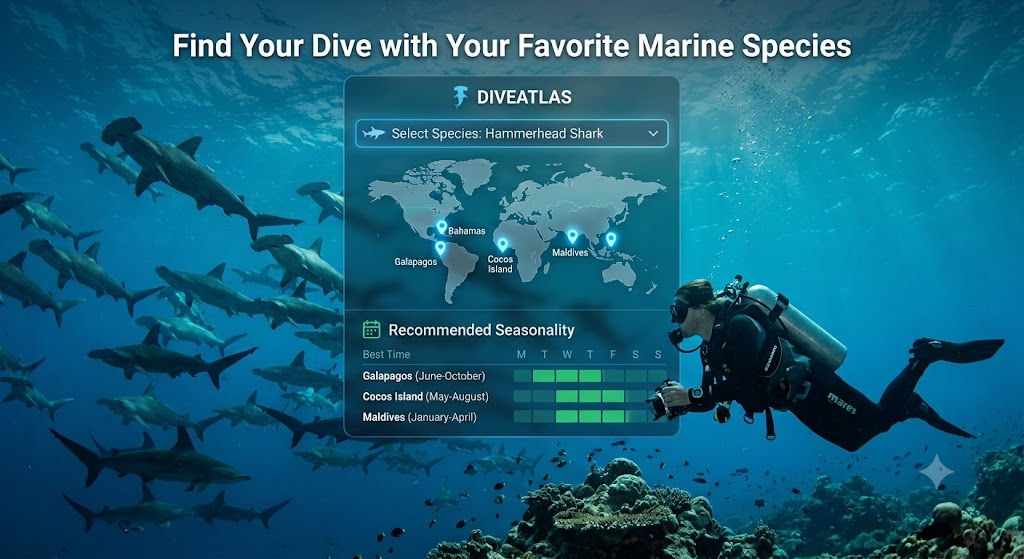
DiveAtlas is a small, free dive destinations database for scuba diving enthusiasts. Other websites offer similar tools, but I could not find one that fully met my needs, so I decided to create my own and make it available to everyone. If you find it useful, you can support my work by using the affiliate links included in the dive-site pages. This may earn me a few dollars or euros, at no additional cost to you.
Why am I not satisfied with the other tools? Most dive destinations databases tell you that a species has been recorded at a site. That is not the same as telling you where to go. A whale shark passed a Maldivian reef once, so the reef appears in the results, and you book a week for nothing. The result is that, if you select “whale shark,” you get hundreds of dive sites where a whale shark may occasionally pass by, but where your actual chances of seeing one are perhaps 1 in 10,000.
With DiveAtlas, I have tried to keep this kind of statistical noise to a minimum. If you search for “oceanic whitetip shark,” you will not get thousands of sites. You will get four, where there is still no guarantee, but where you have a much better chance of seeing the coolest shark in the ocean.
DiveAtlas works the other way round. It lists more than a hundred destinations that divers travel to for one specific thing: manta rays at Hanifaru Bay, whale sharks in Mafia island, oceanic whitetips in the Red Sea. If a place is in here for a species, it is one of the places on Earth for that species. Nothing is listed because a sighting once happened. This makes the tool concise, simple, effective and, I hope, useful.
Search for what you want to see, choose the month you can actually travel and your certification level. The map narrows as you go. If your month is wrong for that encounter, the tool does not hide the destination: it tells you when to go instead.
Why the month matters more than the destination
A dive destination is not good or bad, it is in season or out of season. The same reef that delivers a wall of hammerheads in October can be empty water in February. Manta aggregations, whale shark seasons, humpback migrations and sardine runs all move on a calendar, and most trips that disappoint were booked against that calendar rather than with it.
Every destination here carries a month by month grid, one row per species. It shows at a glance when each encounter is in season and, just as usefully, when two species you want overlap. In the Galapagos, whale sharks and schooling hammerheads peak in different halves of the year. Knowing that before booking is the difference between one trip and two.
What this tool will not tell you
It will not tell you the odds. Nobody can. You can dive Daedalus in October and not see a single hammerhead all week, and you can be in Tonga in August without meeting a humpback. Any percentage you find on a website is invented.
What DiveAtlas records is seasonality and reputation: this is a place people travel to for this animal, and these are the months it is there. The rest is the sea’s decision, and that is part of why we go.
Reading the filters
Level is the only filter that excludes. If you set it to Beginner, advanced destinations disappear entirely rather than sitting at the bottom of the list. Strong current, depth and offshore access are not a matter of taste.
Month is deliberately soft. Destinations that are out of season for your month still appear, in a second block, with the right months shown. A wrong answer is useless, but “not in January, go between March and May” is exactly what you came for.
Search covers marine life, named wrecks, dive types and destinations at once. Type “shark” for every shark in the database, “Thistlegorm” for that one wreck, “wreck” for wreck diving in general, or “Egypt” for a country.