Last visit: February 2026
My rating: 10/10
Price: €7 (from July 2026); free for under-18s and residents of Rome
Address: Piazza della Rotonda, 00186 Rome
Web: https://direzionemuseiroma.cultura.gov.it/en/pantheon/
Visit duration: 30 minutes for the building, an hour and a half with the new route behind it
The most perfect building of antiquity opens with a lie, spelled out in bronze letters you can read from the other side of the square.
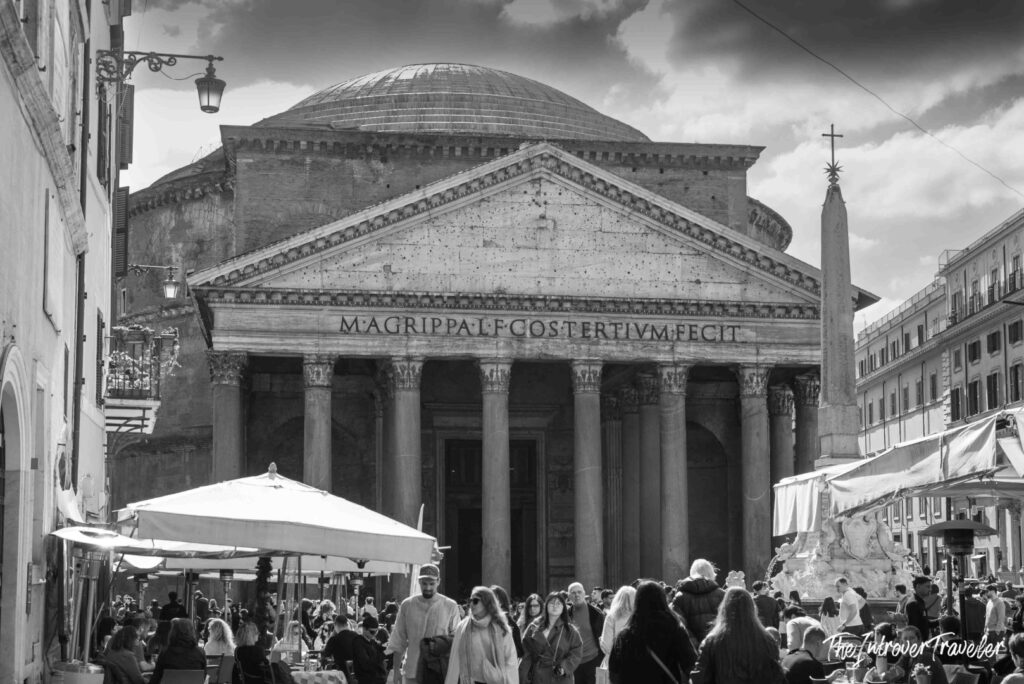
M·AGRIPPA·L·F·COS·TERTIUM·FECIT. Marcus Agrippa, son of Lucius, consul for the third time, made this. Except he did not. Agrippa, Augustus’s right-hand man and son-in-law, did build a Pantheon on this spot, around 25 BC. But that building burned, was patched, burned again, and was swept away. What you are looking at was built more than a century after Agrippa’s death, under the emperors Trajan and Hadrian, and Hadrian, with a modesty that no Roman emperor before or after ever displayed, put the name of the original builder on the front and left his own off entirely. It is the only famous building in the world whose real author spent nineteen centuries as an anonymous ghostwriter.
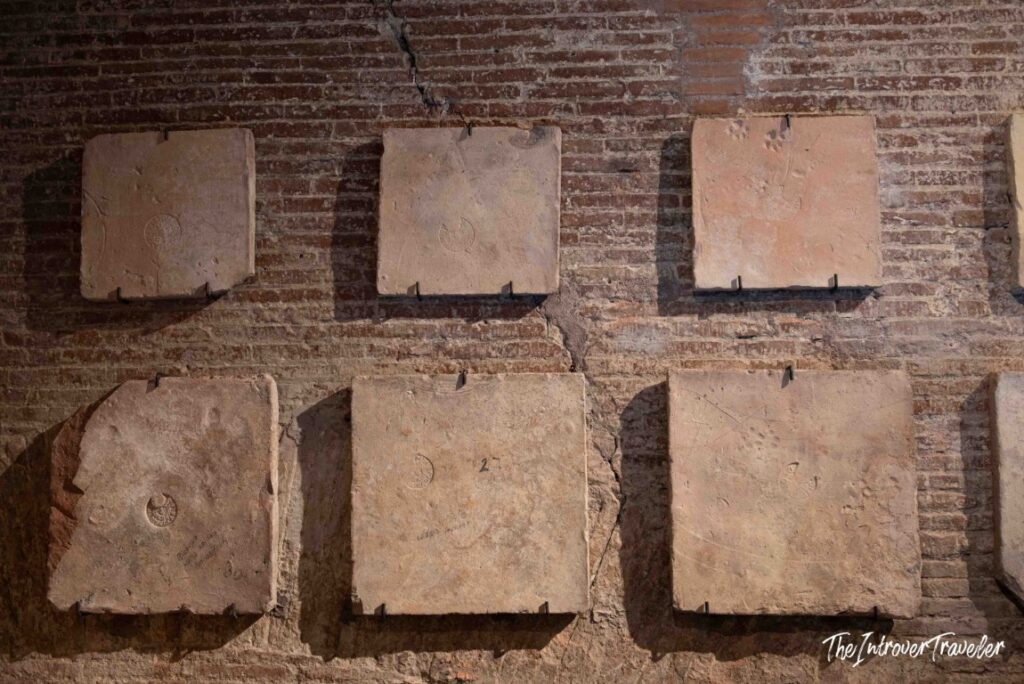
The lie worked so well that until the end of the nineteenth century everybody believed it. Then, in 1892, archaeologists looked at the bricks. Roman brickyards stamped their products with the names of the owners and the consuls of the year, a sort of expiry date in reverse, and the bricks of the Pantheon turned out to be from the second century AD, not the first BC. The building was dated by its own masonry, like a body identified by its dental records.
That is the first thing to know about the Pantheon: it is nothing like what it says it is. It says it is a temple of Agrippa. It is a church of the Virgin Mary. It looks like a Greek temple stuck to a cylinder, and it is in fact the most revolutionary interior space ever built by human beings. It has a gaping hole in the roof, and it has been raining inside for nineteen hundred years. And it is still standing, practically intact, while the rest of imperial Rome lies in pieces around it.
In short: what you need to know in thirty seconds
- What it is: a Roman temple rebuilt under Trajan and Hadrian in the early second century AD, a Catholic church since the seventh century, and the best-preserved building of ancient Rome.
- Why it matters: its concrete dome, 43.3 metres across, is still the largest unreinforced concrete dome in the world, nineteen centuries later.
- The ticket: €7 from 1 July 2026, free for under-18s and residents of Rome. Entry is free during Mass.
- The single most useful tip in this article: look down as well as up. The floor is Roman, the rain falls on it, and the drains are still working.
- Who is buried here: Raphael, Annibale Carracci, the composer Arcangelo Corelli and the first two kings of Italy, among others.
- Who it’s for: everyone. There is no visitor, from the most distracted teenager to the most insufferable architect, who walks in without looking up.
Planning a trip to Rome around the art?
The Pantheon sits at the exact centre of the densest square kilometre of art on earth: three Caravaggios two minutes away in San Luigi dei Francesi, Bernini’s elephant and Michelangelo’s Risen Christ in the next square, the Trevi Fountain ten minutes away. Flâneur builds a personalised Rome art itinerary around the works you actually care about, with real opening hours, church closures, transfer times and meal breaks, and threads the Pantheon into the route between the churches around it, which is how it should be seen: as the heart of the neighbourhood, not as a separate errand.
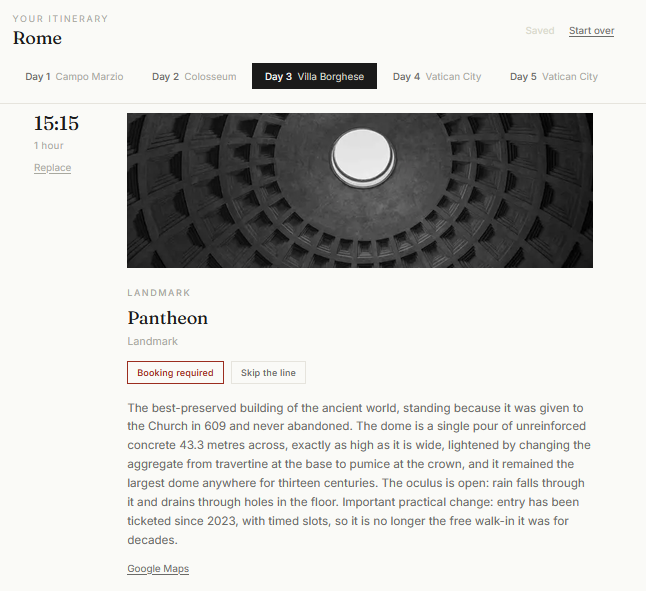
A Flâneur itinerary built around the Pantheon.
The building that signed with someone else’s name
The story starts with Agrippa, the general who won Augustus his empire at Actium and then spent the rest of his life building Rome a new city centre in the Campus Martius, the flat land along the Tiber: baths, gardens, an aqueduct (the same Aqua Virgo that still feeds the Trevi Fountain) and a temple. His Pantheon was finished around 25 BC. We know little about what it looked like.
It did not last. The building was damaged in the great fire of AD 80 and restored by the emperor Domitian; in AD 110, under Trajan, it was hit by lightning and burned again. Work on a completely new building began soon afterwards, probably around 114, still under Trajan, as the brick stamps suggest, and was completed under Hadrian, who reigned from 117. The traditional dates for the building you see today are 118 to 125.
Then Hadrian did his famous act of piety, or of calculated propaganda, which in Rome were often the same thing: he restored Agrippa’s inscription. Hadrian was a new kind of emperor: he came from a family with deep roots in Roman Spain, he reached the throne by adoption, and he was keen to present himself as the heir of Augustus rather than as an upstart. Putting Augustus’s best friend on the façade was a way of saying: nothing has changed, this is still the Rome of the founders. It is the same trick politicians still use when they cut a ribbon on a project begun by someone else, only reversed: Hadrian finished someone else’s project and gave him the credit.
So, to be fair to Hadrian, the “lie” is a lie only to us. The inscription is misleading to modern eyes, but it was probably never meant to deceive Hadrian’s contemporaries, who knew perfectly well who was paying for the building site in the middle of their city. It was a political statement: by honouring Agrippa, Hadrian placed himself within the tradition of Augustus. The letters you see today, incidentally, are not the ancient ones: they are raised bronze letters restored in the nineteenth century and fixed to the entablature, faithful to the original text.
Under the big inscription, if you look closely, there is a smaller one, almost always ignored. It records that in AD 202 the emperors Septimius Severus and Caracalla restored the Pantheon, “corrupted by age”, vetustate corruptum. Eighty years after its completion, the building already needed maintenance. Some things about Rome have never changed.
And what was it for? Nobody knows exactly. The name means “all the gods”, but the historian Cassius Dio, a Roman senator writing a century after Hadrian, was already unsure: he reports that it was called this either because it housed the statues of many gods or, as he preferred to think, because its vaulted roof resembled the heavens. Dio also tells us that Hadrian sometimes used it as a courtroom, sitting there with the leading senators to hear cases. A temple, a cosmic diagram, a throne room: the Pantheon was probably all three, and the ambiguity is part of its charm.
Who designed it?
We do not know that either. The usual suspect is Apollodorus of Damascus, Trajan’s great architect, the man behind Trajan’s Forum and its markets. It is a hypothesis, not a fact. Cassius Dio tells a juicy story about him: when Hadrian, still a young man with architectural ambitions, interrupted a conversation between Trajan and Apollodorus, the architect told him to go away and draw his pumpkins, a sneer at Hadrian’s taste for domes; once Hadrian became emperor, Dio says, he had Apollodorus banished and later killed. Many historians suspect the anecdote is gossip. But the idea that the most beautiful dome in history might have been born from a feud between an emperor and an architect who mocked his drawings is too good not to mention, as long as we label it for what it is.
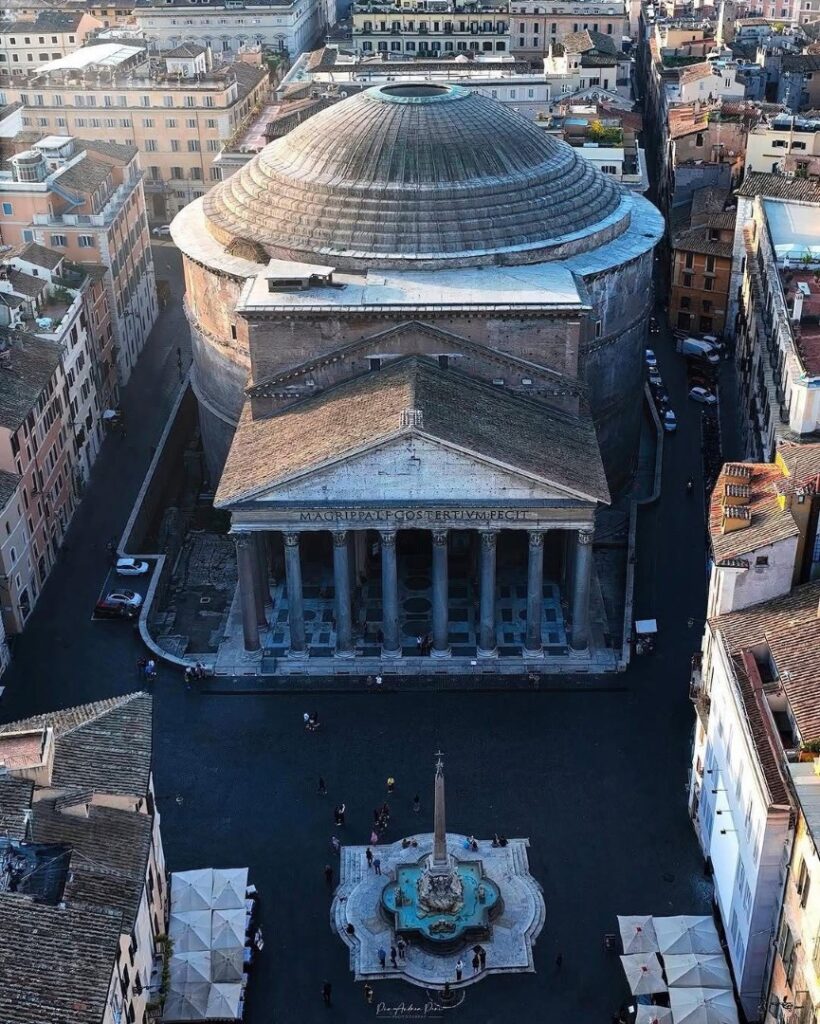
The portico, or the most famous botched job in architecture
Stand in the square and look at the front. Sixteen columns, each a single block of Egyptian granite nearly twelve metres high, quarried in the Eastern Desert and on the Nile, shipped across the Mediterranean and dragged up the Tiber. The eight at the front are grey, from an imperial quarry in the mountains near the Red Sea; the ones behind are pink, probably from the Aswan region. They are among the largest monolithic columns in Rome, and they were cut, transported and raised two thousand years ago without a single engine.
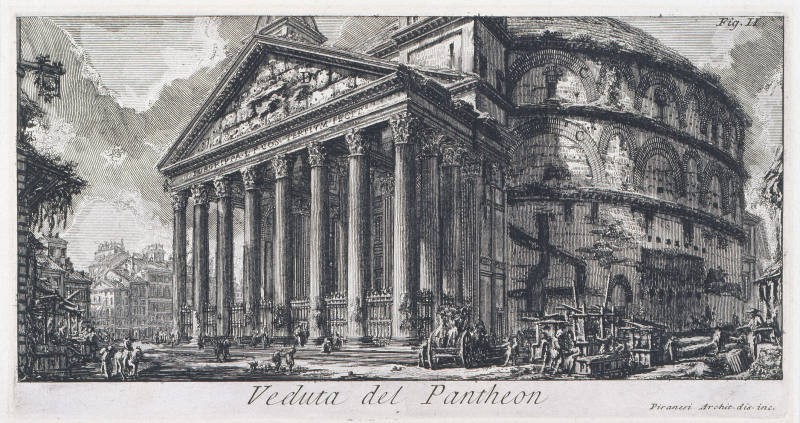
Now look higher, where the triangular pediment meets the rotunda. Something is wrong. Between the portico and the cylinder there is an intermediate block, and on it you can see the outline of a second, higher pediment, which seems to rise above the first and collide with it (see picture above). The two parts of the building do not quite fit, like a suit jacket bought separately from the trousers.
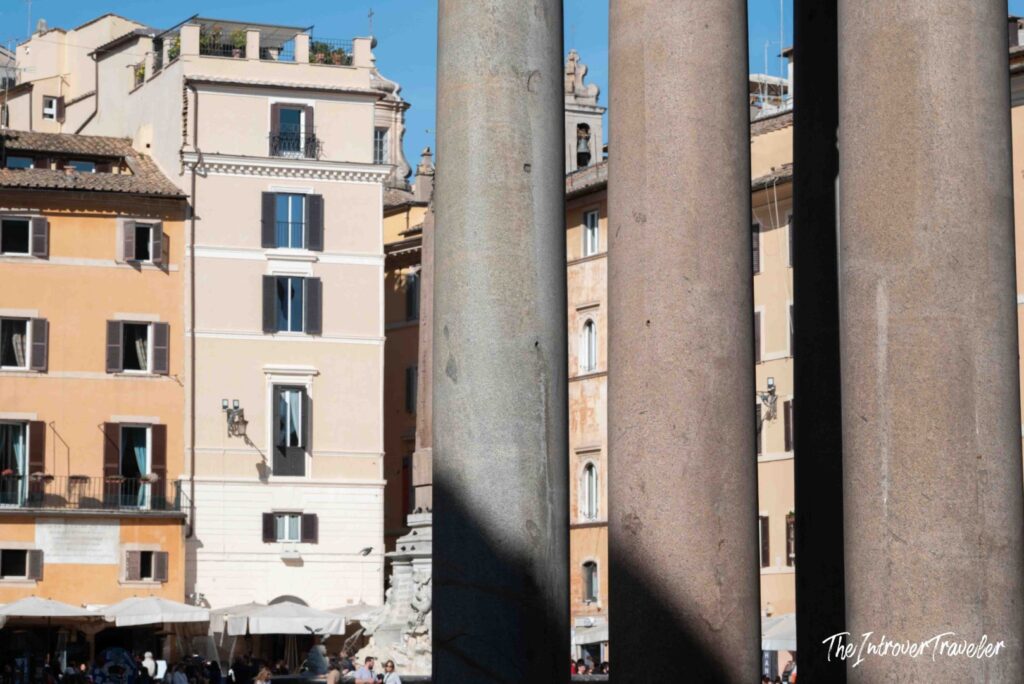
The most widely discussed explanation, put forward by architectural historians who have measured the building in detail, is that the portico was designed for even bigger columns, fifty Roman feet tall instead of the forty actually used. For some reason, perhaps a shipment that never arrived, perhaps a block that cracked in the quarry, those giants never reached Rome, and the builders had to make do with smaller columns and a lower portico, leaving the junction with the rotunda awkwardly unresolved. It is a hypothesis, but it is a convincing one, and it is wonderfully reassuring: even the Pantheon had a supplier problem.
A few of the columns are not even the original ones. The left side of the portico was damaged in the Middle Ages, and in the seventeenth century three columns were replaced with ancient ones recovered elsewhere in Rome: the patching is visible if you know where to look, because the replacements do not quite match the colour of the others.
And look up at the portico ceiling: today it is a wooden roof. Until the seventeenth century it was supported by a truss made entirely of bronze, a unique piece of Roman engineering. We will come back to what happened to it, because the culprit has a name.
The doors
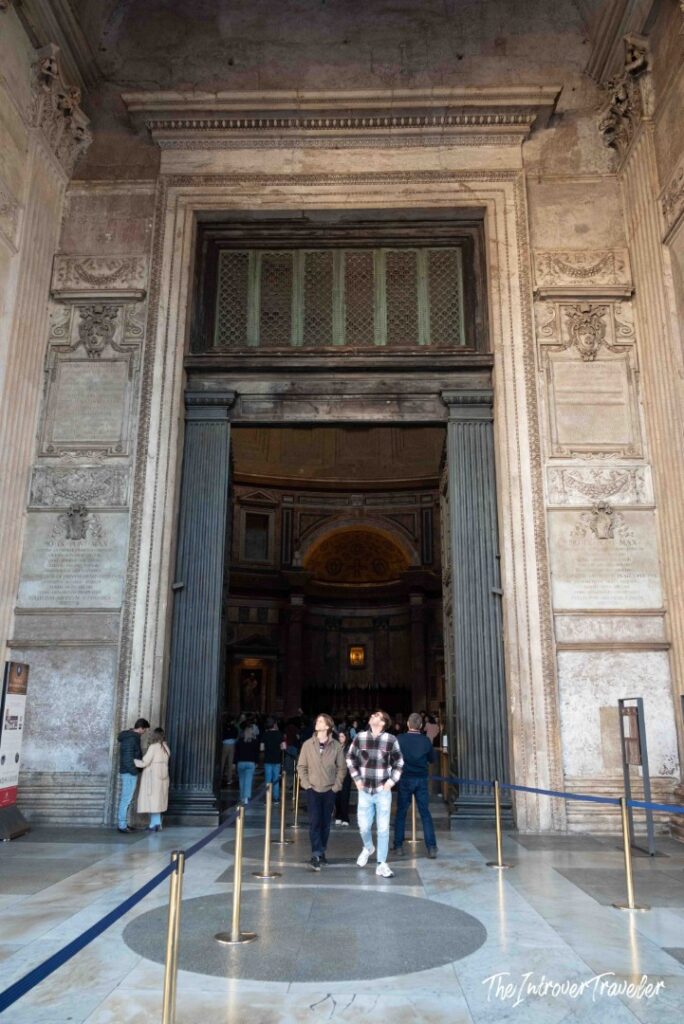
Between the portico and the rotunda stand two enormous bronze doors, 7.53 metres high, each leaf weighing about seven tons. They are usually described as the original Roman doors, and the claim is half true. They are ancient bronze, but most scholars doubt they are the very doors Hadrian hung, and they have been repaired, cleaned and partly remade several times, with substantial restorations in the Renaissance. What can be said with certainty is that they are the oldest large doors still in use in Rome, and that they still swing open every morning, which is more than can be said for many modern ones.
Pause on the threshold for a second before you walk in. The doors were designed to frame the moment you cross them, and what happens next is the whole point of the building.
The dome: the record that nobody has broken
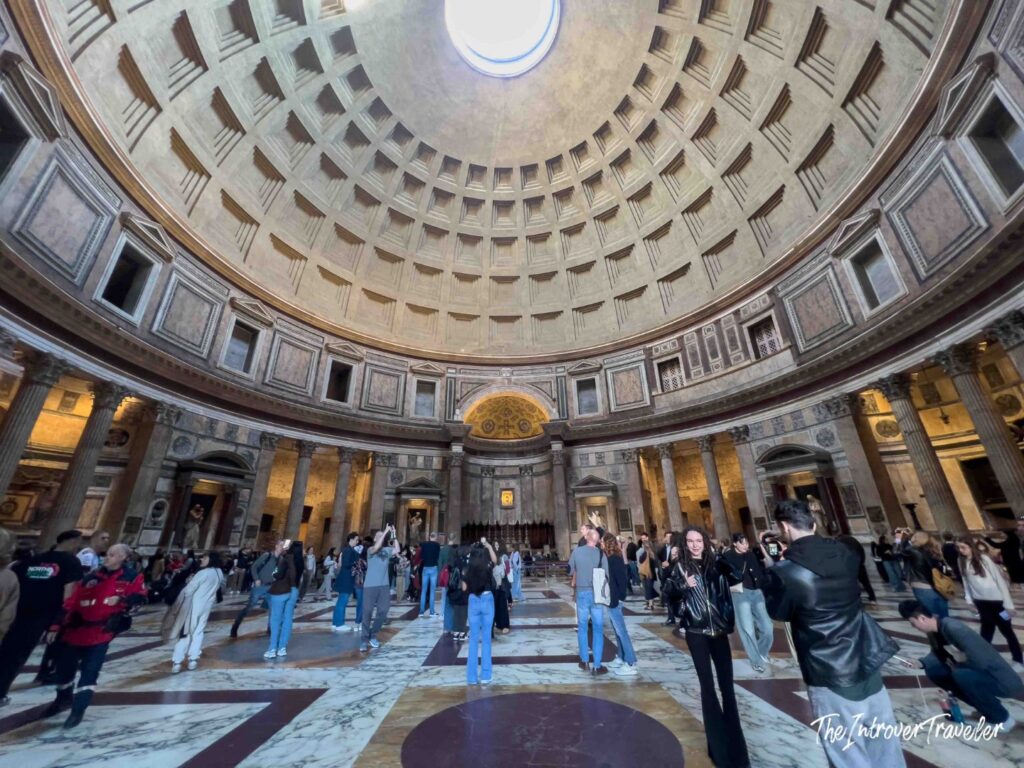
You cross the threshold, and the building takes your breath away. Not metaphorically: everybody, without exception, stops and looks up, and for a few seconds the murmur of the crowd drops.
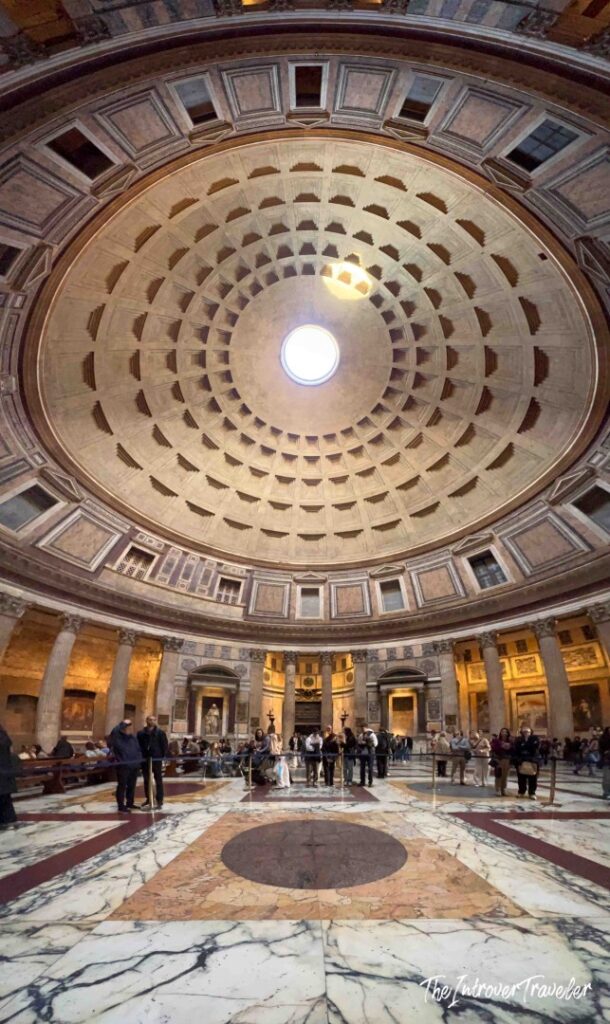
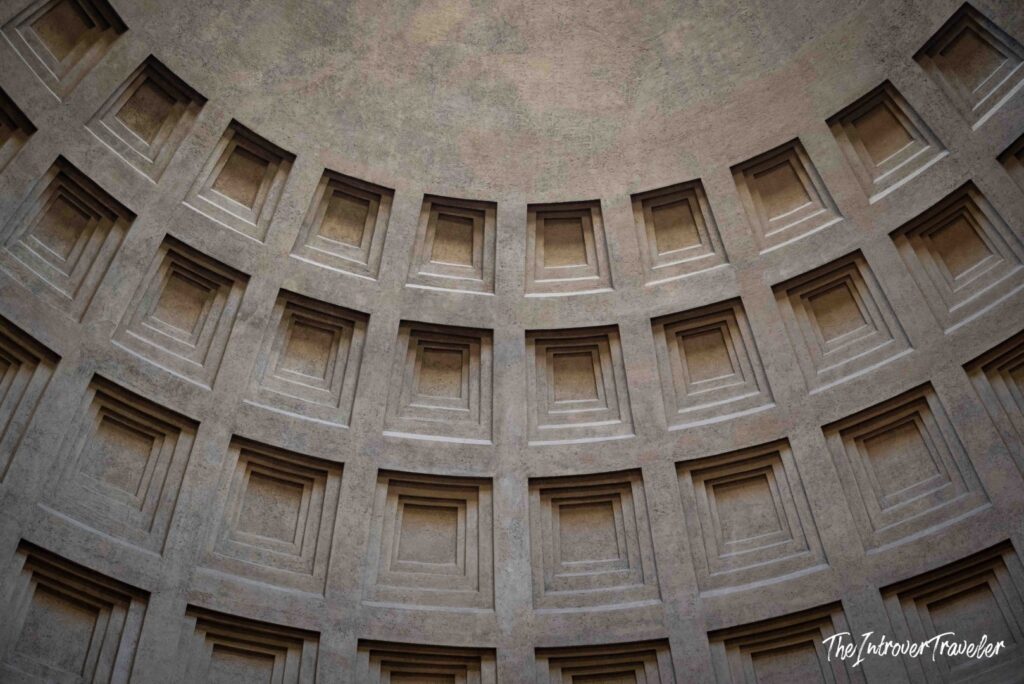
Here are the numbers, which for once are the point. The dome is 43.3 metres across, and the distance from the floor to the top is exactly the same: 43.3 metres. In other words, a perfect sphere would fit inside the building, touching the floor at a single point. The dome is the upper half of that imaginary ball, and the cylinder below is exactly as high as its radius. The whole interior is a geometrical diagram of the cosmos built in concrete, and you are standing inside it.
It is the largest unreinforced concrete dome ever built, and it still holds the record after nineteen centuries. For about thirteen hundred years it was the largest dome of any kind in the world, until Brunelleschi closed the dome of Florence Cathedral in the fifteenth century. The dome of St Peter’s, a century later, is slightly smaller in diameter. Every architect of the Renaissance came here to measure it and draw it, and its descendants are everywhere, from the Panthéon in Paris to Thomas Jefferson’s Rotunda at the University of Virginia to the domes of half the state capitols of America. You have seen copies of the Pantheon all your life, probably without knowing it.
How does it stay up? With three tricks, all brilliant.
The first is the material. Roman concrete was not a uniform mass but a mix of mortar and chunks of stone, and the builders changed the chunks as they went up: heavy travertine at the bottom, then lighter mixtures of tufa and brick, and at the top, around the oculus, a light volcanic stone, pumice and scoria, that is almost foam. The dome gets lighter as it rises, exactly where weight would be most dangerous.
The second is thickness. The walls of the rotunda are more than six metres thick, and the dome thins progressively as it climbs, until it is little more than a metre thick around the opening at the top. All the mass is concentrated at the base, where it holds the thrust of the dome like a ring of muscle.
There is one more reason the dome has lasted, and it is almost a paradox: it has no steel inside. Modern reinforced concrete is stronger, but the steel bars inside it rust, swell and crack the concrete from within, which is why a motorway bridge built in the 1960s can be falling apart today. The Pantheon has nothing to rust. It has cracked over the centuries, been repaired, survived earthquakes, and it is still there. The Romans did not know about corrosion; they simply built something that had nothing in it to corrode.
The oculus, the rain, and a sunbeam that tells the time
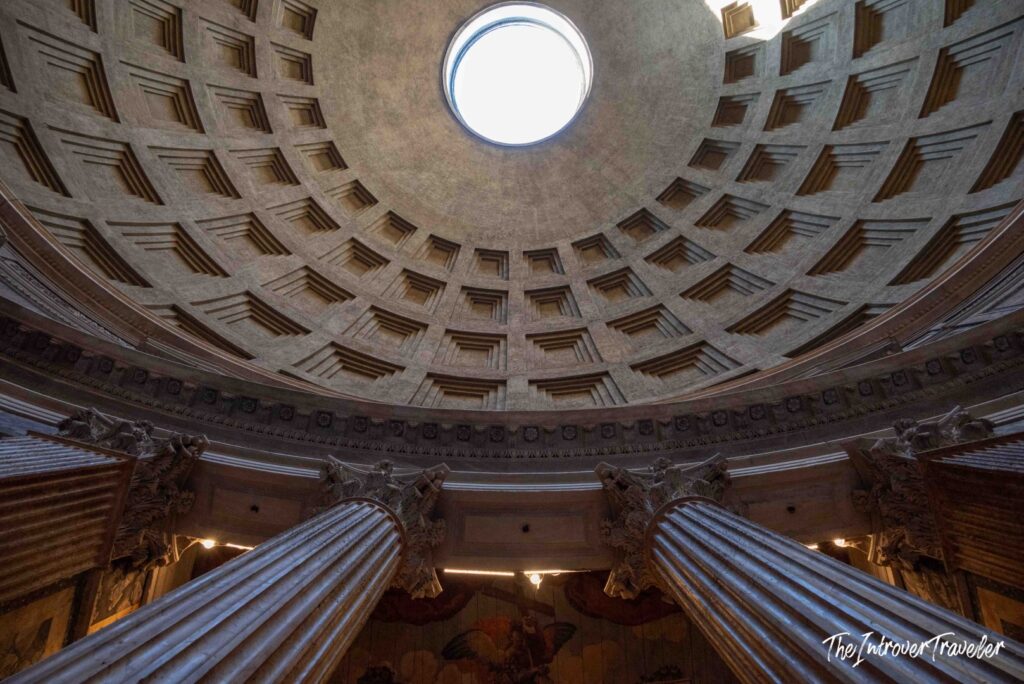
At the top of the dome there is a hole, about nine metres across, open to the sky. No glass, no grille, no cover. It is the only source of natural light in the building apart from the door, and it is one of the most daring ideas in the history of architecture: the summit of the dome, the point where in any other building you would put a keystone, is simply left empty. The ring of the oculus works in compression, like a crown, and the dome stands without a centre.
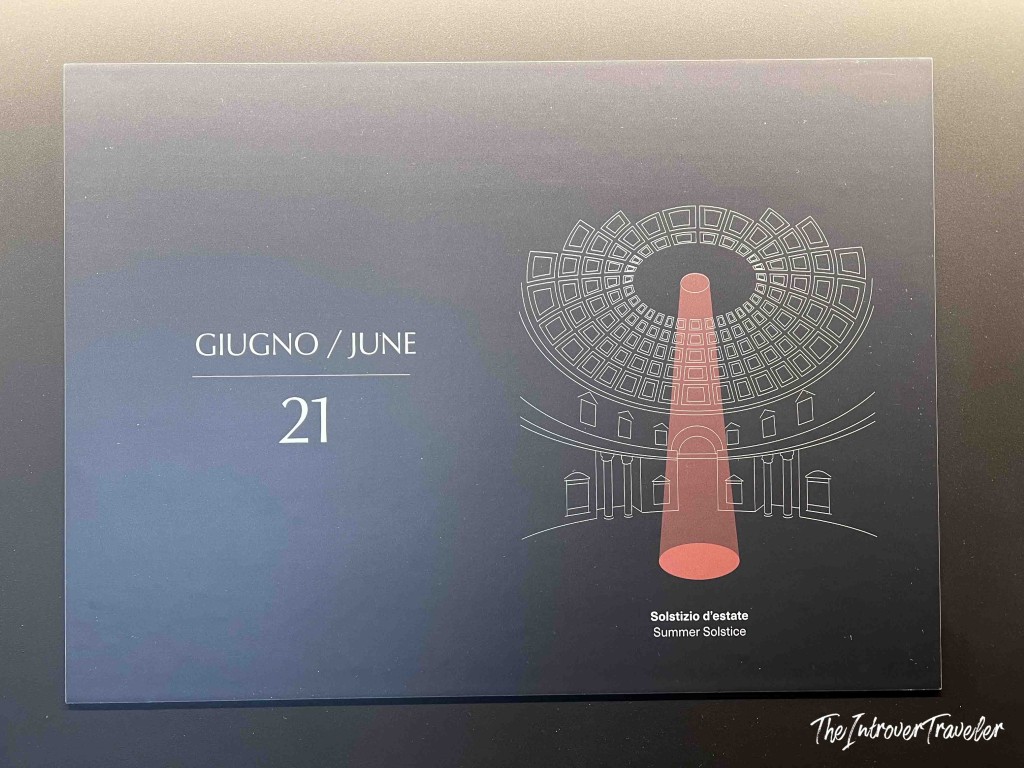
The light that comes through it is not diffuse. It is a disc of sunlight that moves slowly across the coffers and the walls through the day, like the hand of a giant sundial. On a sunny morning you can watch it crawl down the dome, and it is the most beautiful show in Rome, free with your ticket and repeated every clear day for nineteen centuries.
And yes, when it rains, it rains inside. There is a persistent legend that rain does not enter the Pantheon because the warm air rising through the oculus pushes the drops away, the so-called chimney effect. It is nonsense: come on a rainy day and you will see a column of falling water and a wet patch on the marble. The Romans had planned for it. The floor is very slightly convex, sloping gently away from the centre, and right under the oculus there are 22 small drain holes that carry the water away. The system has been working, with repairs, since the reign of Hadrian. Most cities I know cannot keep their storm drains working for a winter.
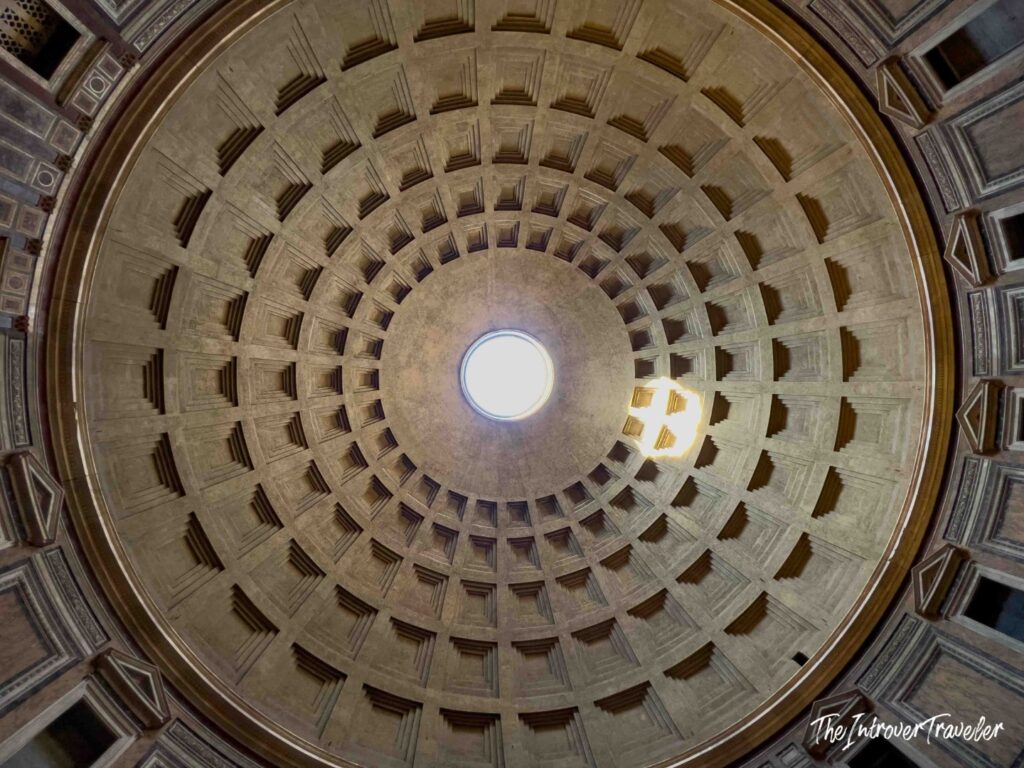
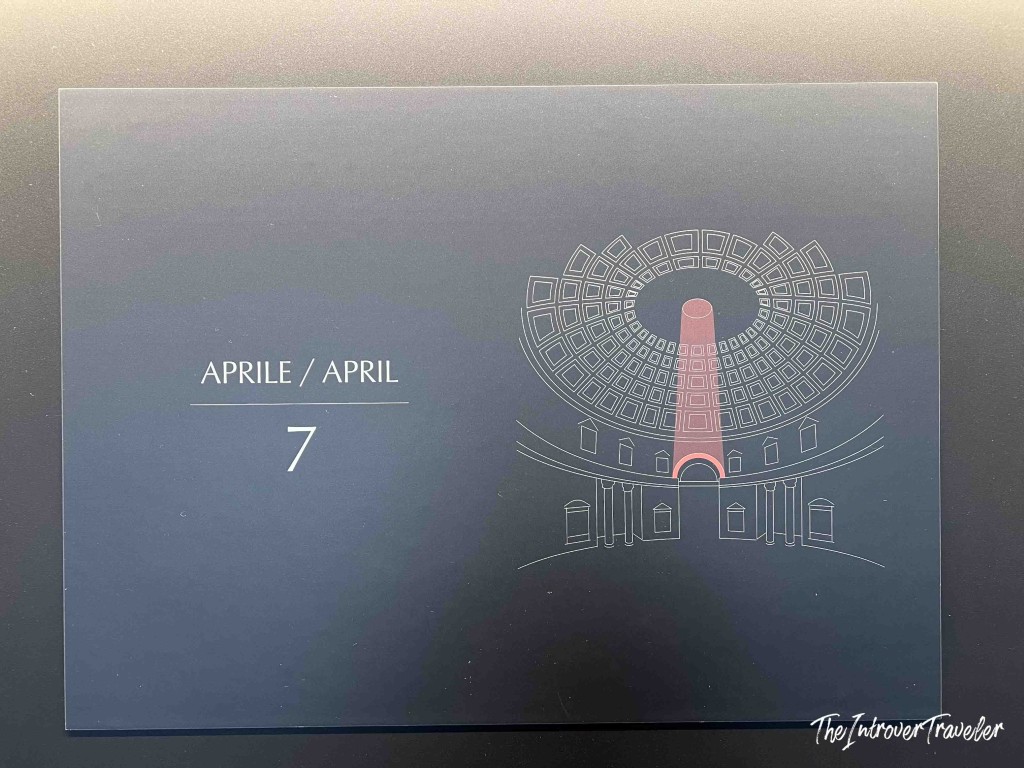
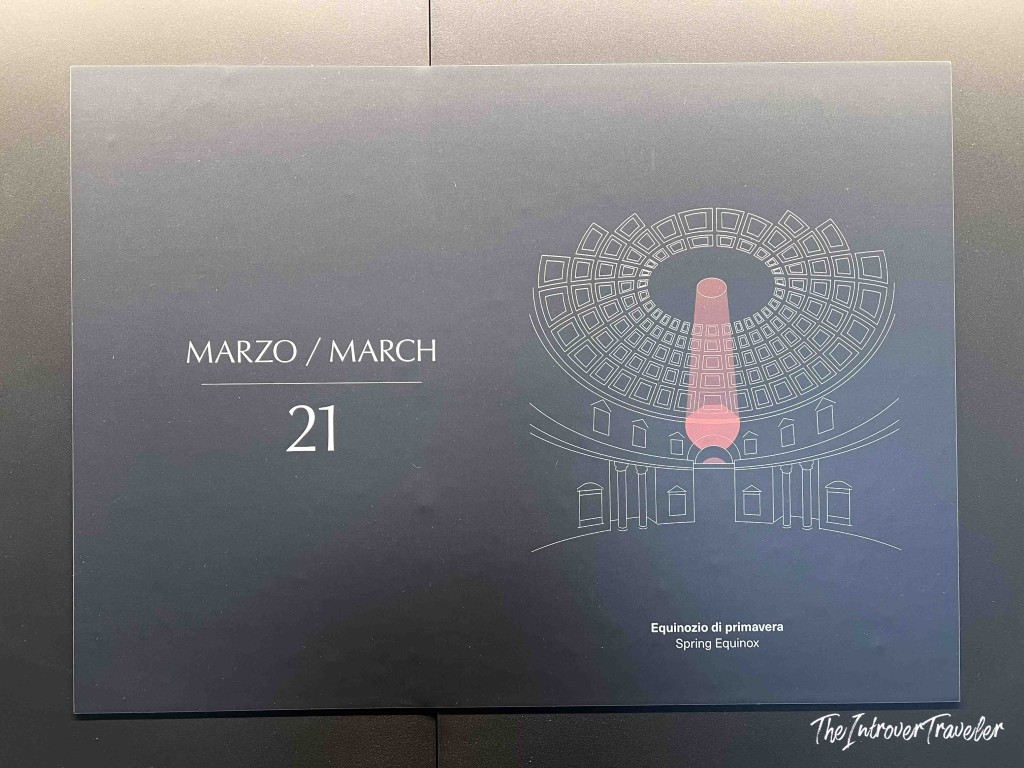
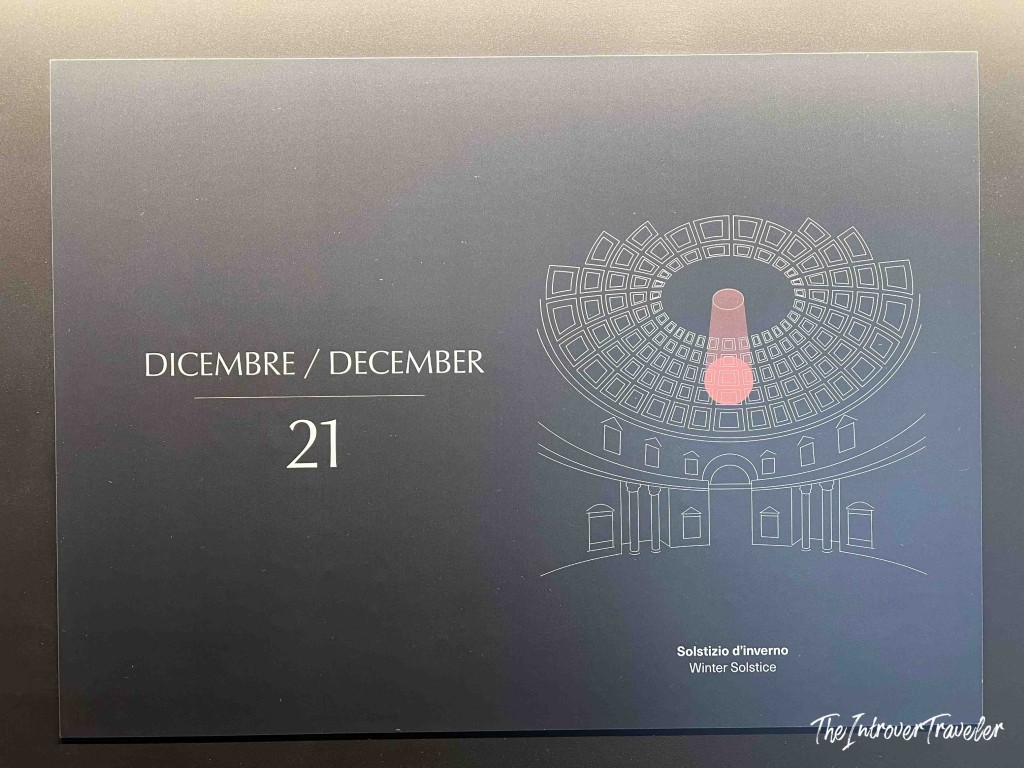
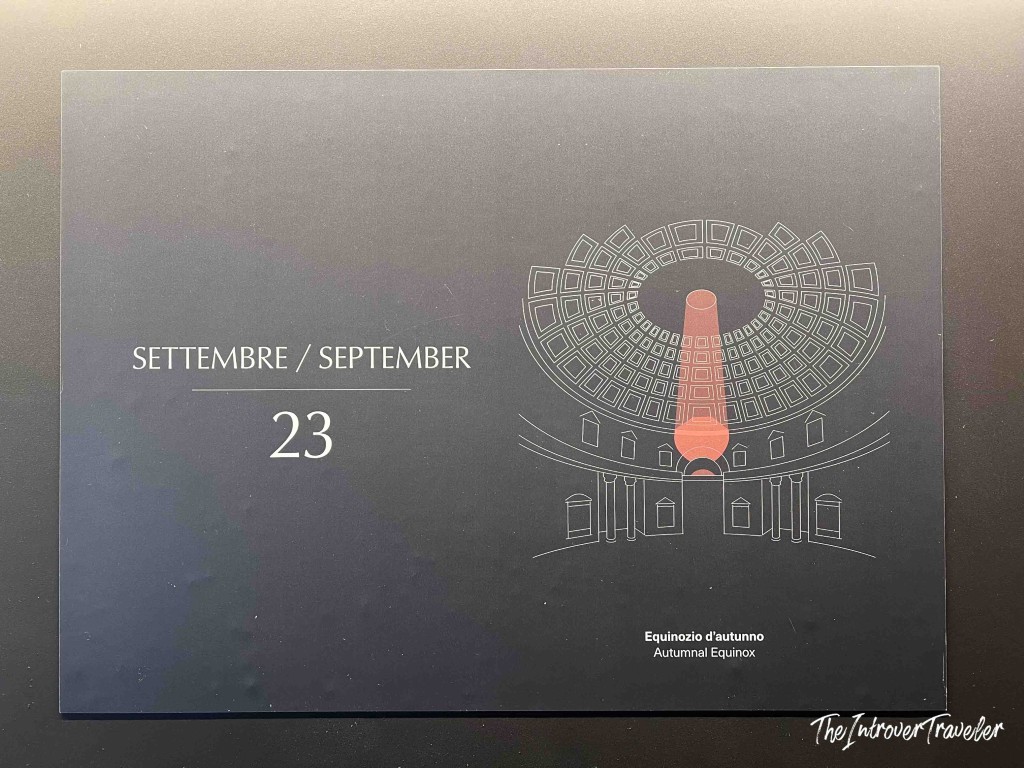
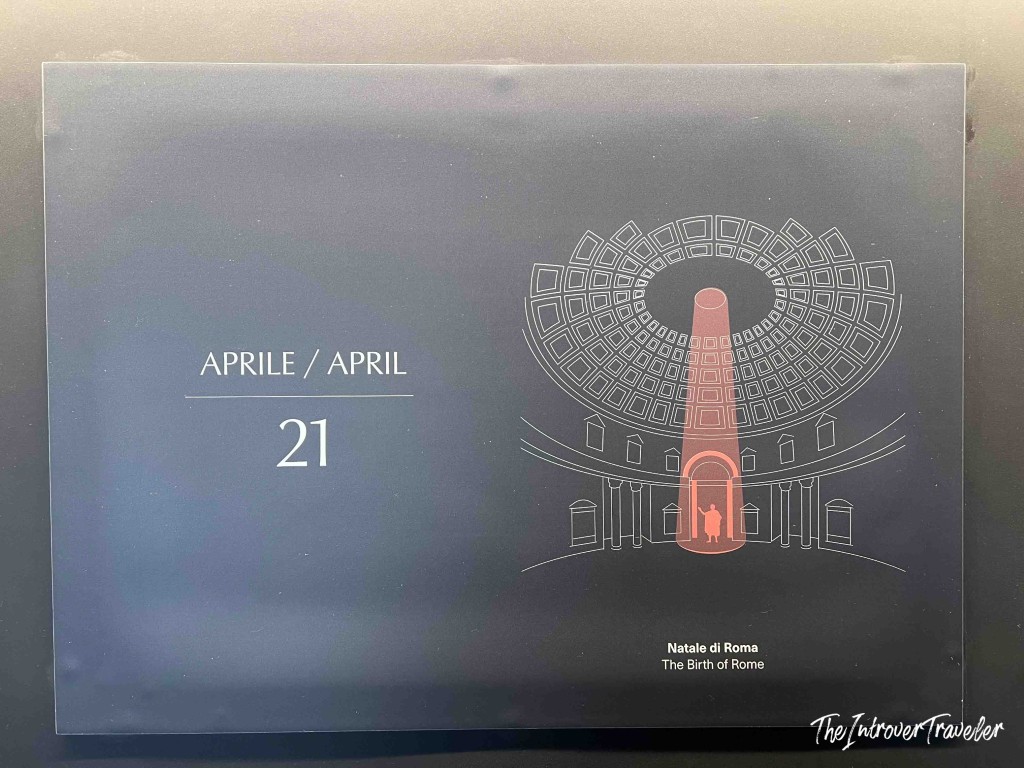
There is a further theory about the light, and it is worth telling because it is plausible and fascinating, as long as we present it as a theory. A classicist and an archaeoastronomer, Robert Hannah and Giulio Magli, have argued that the building was deliberately oriented so that at noon on certain significant days the disc of sunlight would fall on the entrance. One of those days is 21 April, the traditional birthday of Rome: at midday, they calculate, the beam lights up the doorway, so that an emperor entering at that moment would have appeared bathed in light, a living god walking into the house of the gods. Not every scholar is convinced, but the new videomapping in the rooms behind the Pantheon shows exactly how the light falls on those dates, and you can judge for yourself.
One day a year the oculus is used for something else entirely. On Pentecost Sunday, at the end of the midday Mass, the Rome fire brigade climbs onto the roof and drops thousands of red rose petals through the oculus, symbol of the Holy Spirit descending on the apostles. The ritual has early Christian roots and has been celebrated in its current form since the 1990s. It is the only day of the year when it rains roses in a Roman temple, and the queue to get in starts at dawn.
From temple to church: the decision that saved it
Why is the Pantheon intact when the Colosseum is a skeleton, the Forum a field of stumps and the imperial palaces on the Palatine a maze of brick? The answer is a single decision taken at the beginning of the seventh century.
In 609, according to the traditional date, the Byzantine emperor Phocas, who then ruled over what was left of Rome, gave the abandoned temple to Pope Boniface IV, who consecrated it as a church dedicated to the Virgin Mary and all the martyrs: Santa Maria ad Martyres, still its official name. The same emperor Phocas has a monument in the Roman Forum, the Column of Phocas, the last monument ever erected there: the Forum got a column, the Pantheon got a future. Tradition adds that cartloads of martyrs’ bones were brought from the catacombs and placed under the altar, to fill the house of all the gods with the remains of all the saints.
From then on the building was in use, every day, for fourteen centuries. And a building in use is a building someone repairs. Pagan temples that remained pagan were quarried for stone, burned for lime, stripped for metal. The Pantheon became a church, so the roof was mended, the rain was drained, and the masonry was left alone. The Church saved the most perfect pagan building of antiquity by moving into it. There is a lesson in there about heritage conservation that many modern ministries could study: the best way to preserve a monument is to keep using it. But, as we are about to see, being a church was not enough on its own: what really saved the Pantheon was a roof.
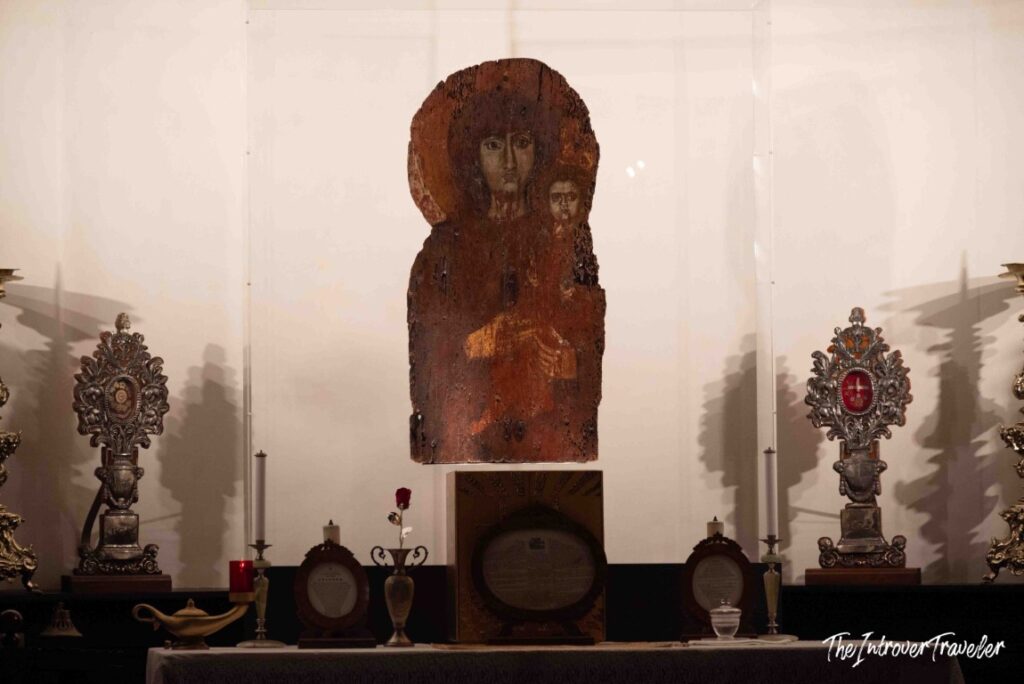
The church also brought with it its most precious object: an icon of the Virgin and Child, painted on elm wood in the seventh century and traditionally linked to the consecration of 609. It is among the oldest Marian icons in the West. It was restored in 2024, the first restoration in more than sixty years, and the original is now kept in a side chapel, the Winter Chapel, for conservation reasons; the one you see above the high altar is a copy.
Not everyone respected the new church. In 663 another Byzantine emperor, Constans II, came to Rome on a visit that was meant to be a show of friendship and turned into a shopping trip: he stripped the gilded bronze tiles from the roof of the Pantheon and took them away with him. It was a Christian emperor, a guest of the pope, and the Barbarians had nothing to do with it. Or rather, they had something to do with it later: according to the medieval sources, the Lombard historian Paul the Deacon and the Liber Pontificalis, the official chronicle of the popes, the loot did not even reach Constantinople. It went with the emperor to Syracuse, where he had moved his court, and after his death it fell into the hands of Arab raiders, who carried it off to Alexandria. The gilded roof of the Pantheon ended up in Egypt, more or less where the granite of its columns had come from. History has a sense of symmetry, if not of justice.
The theft left the dome naked, exposed to rain and frost, and a concrete shell without a protective skin does not last for ever. The building needed a new roof, and it got one in the eighth century: the pontificate of Gregory III, between 731 and 741, is associated with the covering of the dome in lead. It sounds like a footnote, and it is one of the most important events in the building’s history. Mark Wilson Jones, the architectural historian who has studied the Pantheon more closely than anyone, considers that lead roof exceptionally important for the survival of the monument. The conversion into a church gave the Pantheon a reason to be looked after; the lead roof gave it the physical protection to survive the centuries in which nobody looked after much at all. Both were decisive.
Which brings us to the most famous theft of all.
What the Barbarians did not do
In the 1620s Pope Urban VIII Barberini, the same pope who made Bernini the master of Baroque Rome, needed bronze. He found it in the portico of the Pantheon: the great Roman truss that held up the roof, untouched for fifteen hundred years. He had it removed and melted down, around 1625 and 1626, and the metal was used above all to cast cannons for Castel Sant’Angelo, the papal fortress. For centuries it has been said that the bronze also went into Bernini’s great baldachin over the altar of St Peter’s; recent studies suggest that, if any did, it was only a small part.
The Romans’ reaction was immediate and has entered history in the form of a pasquinade, one of the anonymous satirical verses that were stuck at night on the ancient statue of Pasquino near Piazza Navona: Quod non fecerunt barbari, fecerunt Barberini. What the Barbarians did not do, the Barberini did. It is probably the best pun in the Latin language, and certainly the most deserved. (For more on the Barberini and their relationship with Bernini, see Bernini and the Barberinis.)
Urban VIII did not stop there. He also added two bell towers on top of the intermediate block, two little turrets that the Romans immediately nicknamed le orecchie d’asino, the donkey’s ears. For centuries they were blamed on Bernini; more recent research suggests they were designed by Carlo Maderno, the architect of the façade of St Peter’s, with his young assistant Borromini, and Bernini may simply have taken the blame for being the most famous architect in the city. They were finally demolished in the early 1880s, when the Pantheon was cleared of later additions. Look at old engravings and photographs of the building with its ears: you will understand why nobody misses them.
Who is buried in the Pantheon: the most exclusive address in Rome
Walk around the rotunda and you will notice that the Pantheon is also a cemetery, and a very selective one.
The most important tomb is that of Raphael, who died in Rome in 1520, at thirty-seven, and asked to be buried here: he was the first artist to receive the honour, and he chose it himself, even commissioning the statue that stands above his grave, the Madonna del Sasso by Lorenzetto, a sculptor from his own circle. On the sarcophagus is an epitaph attributed to Pietro Bembo, the cardinal and poet who was the arbiter of literary taste in Renaissance Italy. It is two lines of Latin, and they are worth reading in full:
Ille hic est Raphael, timuit quo sospite vinci rerum magna parens et moriente mori.
Here lies Raphael, by whom, while he lived, Nature, the great mother of all things, feared to be outdone; and, when he died, feared to die herself.
It is the most beautiful epitaph ever written for an artist, and probably the most flattering one ever written for anyone.
Beside him is a plaque for Maria Bibbiena, the niece of a powerful cardinal, to whom Raphael was engaged for years without ever getting round to marrying her; she died before him. Even in death he managed to keep her at a convenient distance. And in 1833, to settle a dispute over a skull that an academy of artists claimed was Raphael’s, the tomb was opened: the skeleton was found complete, in the place indicated by the sources. The academy’s skull belonged to someone else.
Raphael set a trend. Over the following century the Pantheon filled up with artists, many of them members of a confraternity of artists, the Virtuosi del Pantheon, who met here: the architect and painter Baldassarre Peruzzi, who designed the Villa Farnesina; Perin del Vaga, one of Raphael’s most gifted pupils; the painter Taddeo Zuccari; Annibale Carracci, the great Bolognese painter of the Farnese Gallery, buried next to Raphael at his own request; and the composer Arcangelo Corelli, the violinist who more or less invented the concerto as we know it. It is a little like a Hall of Fame, without the plaques and with the bodies.
Then, after the unification of Italy, the kings arrived. Vittorio Emanuele II, the first king of united Italy, who died in 1878, has the most imposing tomb, with the inscription “Padre della Patria”. Opposite him lie his son Umberto I, assassinated by an anarchist in Monza in 1900, and Umberto’s wife, Queen Margherita, to whom tradition dedicates the pizza of the same name. Next to the royal tombs you will often find volunteers in dark blazers from an honour guard that has watched over the Savoy tombs since the nineteenth century. Italy has been a republic since 1946, voted out the monarchy in a referendum and exiled the royal family for decades, but the guard of honour is still on duty. Only in Rome could a republic keep a vigil over the kings it got rid of, inside a temple turned into a church that still pretends to have been built by Agrippa.
The rest of the interior
The dome is so overwhelming that most visitors never lower their eyes, which is a mistake.
The floor follows the original Roman pattern of squares and circles in porphyry, granite and coloured marble; much of it has been restored, but the design is the one Hadrian’s builders laid. It is the floor the rain falls on, and the floor that has been walked on, continuously, for longer than any other in Rome.
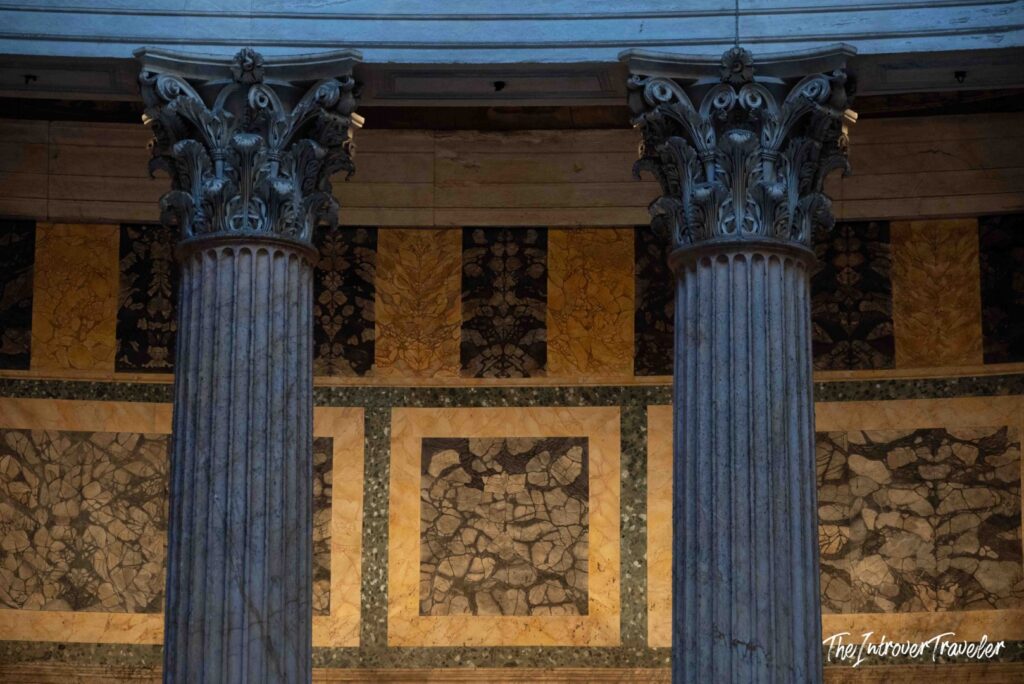
The walls of the rotunda alternate deep niches and shallow aediculae, framed by columns in coloured marble. The band between the columns and the dome, the attic, was redecorated in the eighteenth century by the architect Paolo Posi, who gave it its present sober appearance of windows and panels; in the twentieth century one section was restored to its ancient design, with porphyry and serpentine panels, so that you can compare the two versions side by side.
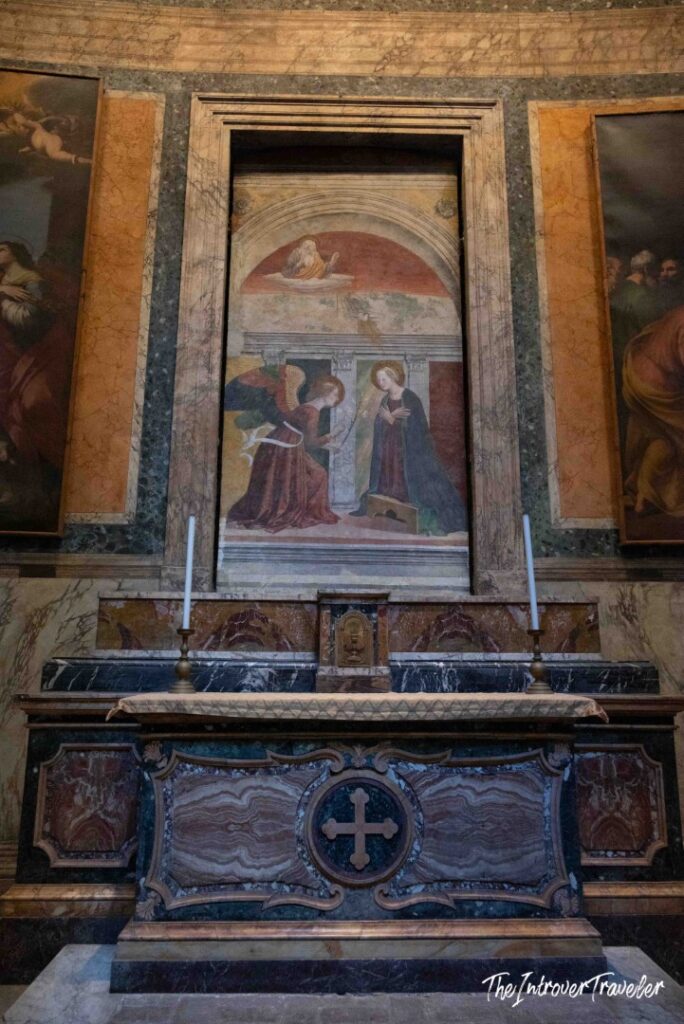
In the chapels there are paintings and sculptures that in any other church would be a reason to visit, and here are background noise. In the first chapel on the right there is a fifteenth-century fresco of the Annunciation, once attributed to Melozzo da Forlì, the painter of the musical angels in the Vatican Pinacoteca, and now more often to Antoniazzo Romano, the most successful painter in Rome in the late fifteenth century. It is a delicate, luminous picture, and nobody looks at it, because three metres away there is a hole in the roof.
Behind the rotunda: the new route
Since November 2025 the Pantheon has had a back room. The route, called Oltre il Pantheon, “Beyond the Pantheon”, opens up the spaces behind the rotunda, on the site of the Basilica of Neptune, a large hall built by Agrippa and rebuilt by Hadrian, which stood right against the back of the temple. You go down into an area several metres below today’s street level, between walls almost sixteen metres high, and follow the history of the building room by room.
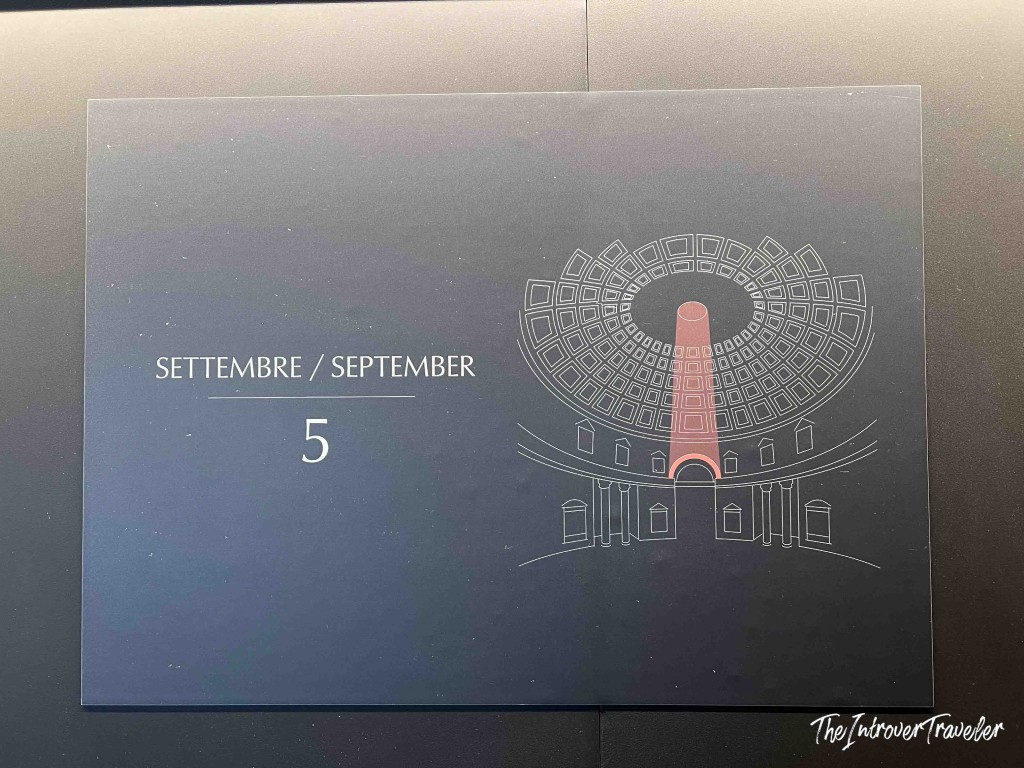
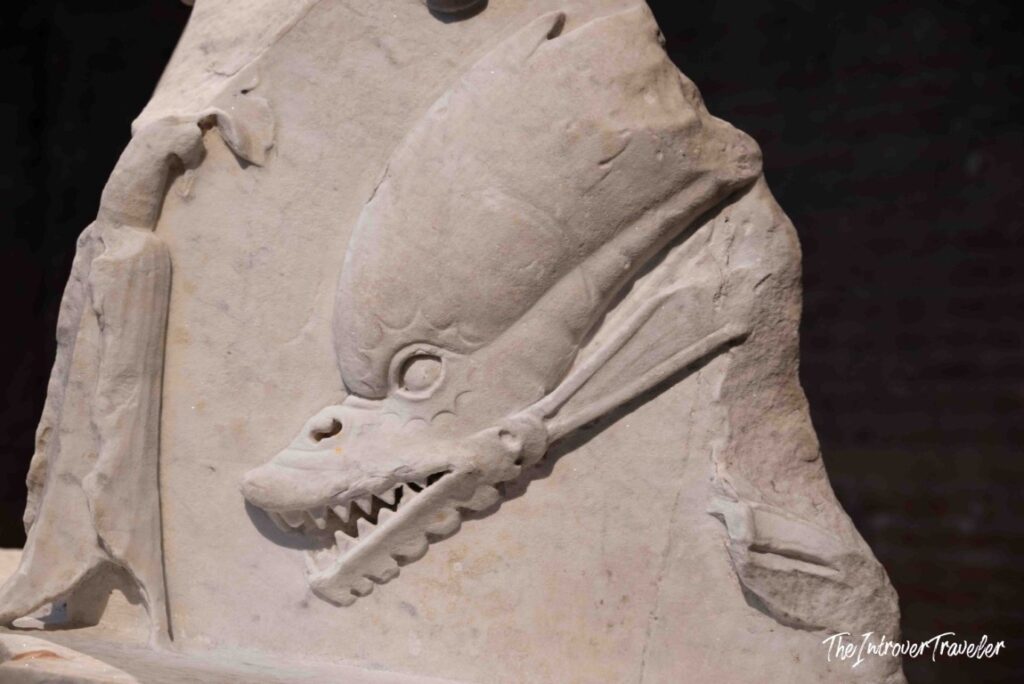
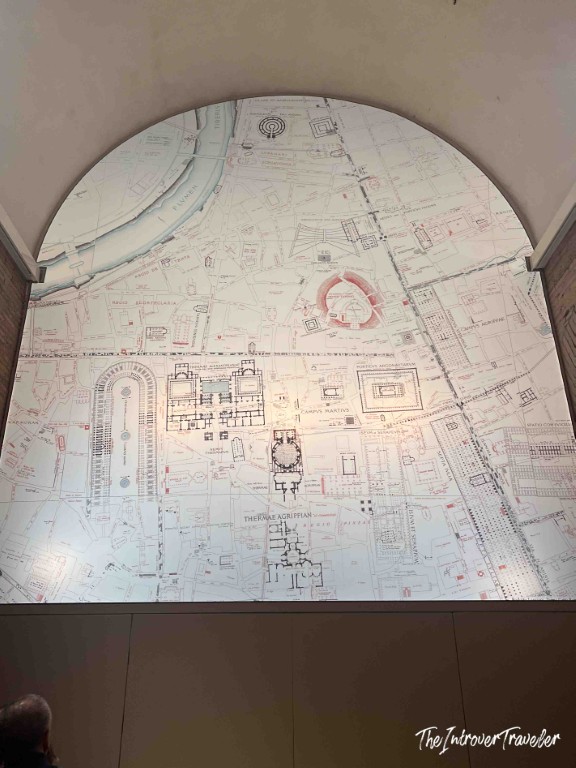
There are bricks with Hadrian’s stamps, the same kind of evidence that unmasked the false inscription. There is a model of the Roman Pantheon in its urban context, and a projection of how the Campus Martius changed over the centuries. There is a partial reconstruction of the Basilica of Neptune, combining original elements with casts, and its decoration of dolphins, shells and tridents. There are fragments of the Christian Pantheon, from the early medieval altar canopy to the reassembled seventeenth-century aedicule that housed the icon of the Madonna until 1960. And there is a videomapping that shows how the disc of light from the oculus falls on the key dates of the year, including 21 April.
The visit is in small groups, with a booked slot through the Musei Italiani app, at an extra cost: when it opened, the special visit cost €10 on top of the standard ticket. It is an interesting route, well put together, and it fills the gaps that the rotunda alone leaves open: how the building was dated, what stood around it, what happened to it after Hadrian. A visit to the Pantheon that skipped this part would be incomplete.
The ticket: from free to €7
For most of its modern history the Pantheon was free. In 2019 it received about 8.9 million visitors, which made it the most visited state monument in Italy, more than the Colosseum. In July 2023 the Ministry of Culture introduced a €5 ticket, with the revenue shared between the state and the Diocese of Rome, which still runs the church. Visitor numbers fell sharply, as everybody expected: in 2025 there were about 4.5 million. From 1 July 2026 the full ticket rises to €7, with the extra two euros going to a fund for libraries in disadvantaged areas.
The ticket caused an outcry in Italy, as if paying to enter a church were a sacrilege invented in Rome in 2023. It is not. Half the great churches of Europe have charged admission for years: Westminster Abbey and St Paul’s in London, the Sagrada Família in Barcelona, Santa Croce in Florence, the cathedrals of Milan and Siena, and nobody organises protests outside them. Mass, the reason a church exists, remains free here too. And seven euros to enter the most perfect building of antiquity, maintained, guarded and cleaned, is a fraction of what you will pay for a mediocre plate of carbonara in the square outside. If there is a scandal in Piazza della Rotonda, it is not the ticket.
Pantheon tickets and opening hours (October 2026)
- Hours (October 2026): every day 9:00 to 19:00, last entry 18:30. Closed on 25 December and 1 January. Extraordinary evening openings are announced from time to time (in August 2026, for example, the Pantheon stayed open until 23:00 except on Thursdays): check the official website, but do not count on them.
- Tickets: €7 full price from 1 July 2026; €2 for EU citizens aged 18 to 25; free for under-18s, residents of Rome, tour guides and everyone on the first Sunday of the month. Buy online on the official channels or on site.
- If the official tickets are sold out: skip-the-line tickets are almost always available on Tiqets, at a slightly higher price: a fast-track ticket with guided tour of the Pantheon, or a skip-the-line combo with Castel Sant’Angelo, which has a certain poetic justice: it lets you visit, on the same day, the portico Urban VIII stripped and the fortress his cannons ended up in. Between paying a couple of euros more and queueing in the sun of Piazza della Rotonda, the choice is easy.
- Mass: entry is free during Mass, at 17:00 on Saturdays and the eves of holy days and at 10:30 on Sundays and holy days. It is a Mass, not a free visit: behave accordingly.
- Oltre il Pantheon: small-group visits booked through the Musei Italiani app, daily except the first Sunday of the month, at an extra cost.
- Dress code: shoulders covered, no very short shorts or skirts. It is a church, whatever the ticket says.
- Accessibility: a ramp on the Via della Minerva side; the new route behind the rotunda has a lift.
- Rules: no food, no drink, no cloakroom, no pets except assistance animals.
- These details change: always check the official website before you go.
Look around
The square in front, Piazza della Rotonda (the Romans still call the Pantheon simply la Rotonda), has a fountain designed in the sixteenth century by Giacomo della Porta, the architect who finished the dome of St Peter’s, topped in the eighteenth century with an Egyptian obelisk of the pharaoh Ramesses II, brought to Rome in antiquity for a temple of Isis. A pharaoh’s obelisk, on a pope’s fountain, in front of an emperor’s temple dedicated to the Virgin Mary: Piazza della Rotonda is a summary of Roman history in a single glance.
Walk round to the back of the building, along Via della Palombella, and you will see the outer walls of the Basilica of Neptune, with fragments of its marble frieze of dolphins and tridents still in place, and the brick mass of the rotunda as it really is: not a perfect cylinder but a gigantic industrial structure, honeycombed with relieving arches. It is the backstage of the most beautiful set in Rome.
Two minutes away, in Piazza della Minerva, stands Bernini’s elephant carrying an obelisk, and inside the church of Santa Maria sopra Minerva there is Michelangelo’s Risen Christ. Three minutes the other way, in San Luigi dei Francesi, there are three of Caravaggio’s greatest paintings. Ten minutes on foot take you to the Trevi Fountain, fed by the same aqueduct that Agrippa built for his baths behind the Pantheon. In this part of Rome everything is connected, and everything is within walking distance.
Verdict: the most perfect room ever built
I have seen a great many famous buildings, and almost all of them, on first contact, were slightly smaller than I had imagined. The Pantheon is the only one that was bigger. Not in its dimensions, which you know before you go, but in its effect: the dome does not look like a ceiling, it looks like a sky, and the disc of light moving across it does not look like a reflection, it looks like time made visible.
And time is the point. Stop for a moment and think about how old this room is. When its dome was closed, Christianity was a small sect that Roman governors were still trying to understand; Hadrian was building his wall across the north of Britain in the same years. The Pantheon was already old when the Goths sacked Rome in 410 and the Vandals in 455. It was there when the Western Empire ended, when the city shrank to a few tens of thousands of people camped among the ruins, when the Byzantines stripped its roof and the popes gave it a new one. It saw the Landsknechts of Charles V sack Rome in 1527, saw Raphael carried in and the Barberini’s men carry the bronze out, saw Napoleon’s soldiers march past its portico, the bersaglieri enter Rome in 1870, the German occupation and the Allied liberation in 1944. Empires, religions, languages, currencies and borders have come and gone around it, and the same doors have opened every morning onto the same disc of light.
Then think about who built it, and with what. No steel, no engines, no computers, no structural calculations as we understand them. Granite columns of more than fifty tons dragged from the Egyptian desert to the Nile, shipped across the Mediterranean and up the Tiber. Thousands of tons of concrete poured by hand, basket after basket, onto a wooden framework more than forty metres across, which had to hold the whole dome until it set, and which some carpenter whose name we will never know had to design without a single drawing ever surviving to tell us how. Cranes powered by men walking inside wheels. And at the end, someone had to give the order to remove the scaffolding from under the largest dome ever built, and wait to see if it would stand. It did. It is still standing.
There is nothing else like it. The great buildings of antiquity are almost all exteriors: temples to be looked at from outside, colonnades, façades, pyramids. The Pantheon is the first great building in history designed from the inside, for the space it encloses rather than for the mass it shows, and nothing quite like it would be built for well over a thousand years. Its plain brick drum, seen from the back, looks like a gasometer; inside, it is the universe. Every architect who has tried to make an interior feel infinite, from Brunelleschi to the present day, has been working in its shadow.
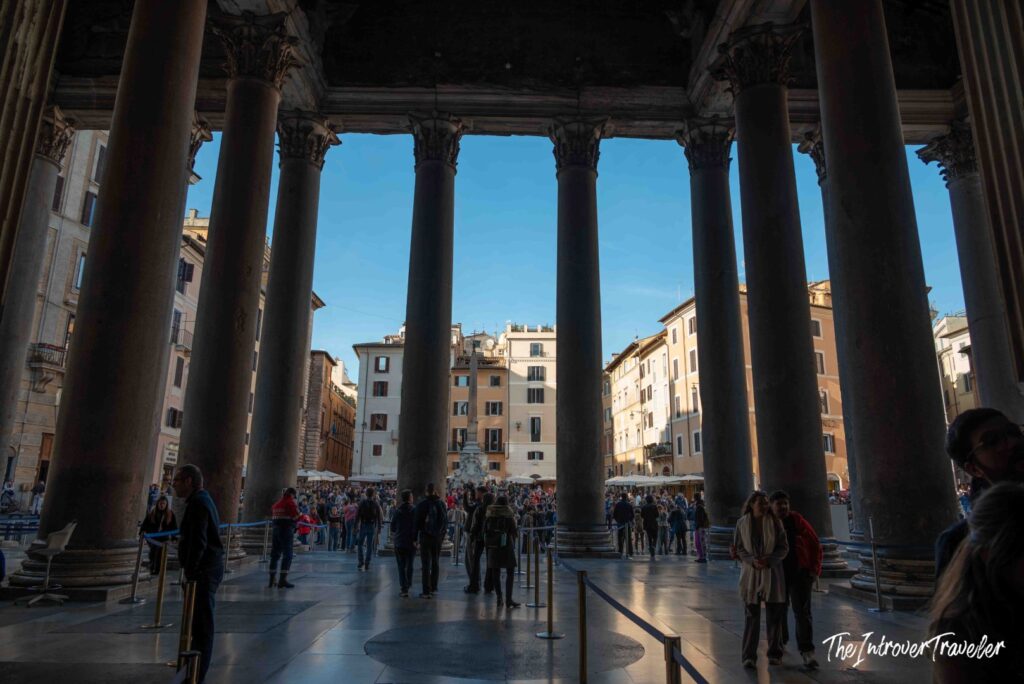
It is not a perfect building. The portico does not quite fit the rotunda, the inscription lies, the bronze was stolen twice, the roof leaks by design. But it is the most perfect room ever built, and one of the very few buildings of imperial Rome whose original architectural space can still be experienced directly, rather than reconstructed through ruins and imagination: a space that works, today, on you.
Ten out of ten, and I would give it more if the scale allowed. Go early, go on a sunny day to watch the light, go on a rainy day to watch the water, go back for the route behind the rotunda. Then sit on a bench in the square, ignore the carbonara, and look at that inscription again. Agrippa did not build it. He would have been proud to.
Piranesi and the Pantheon
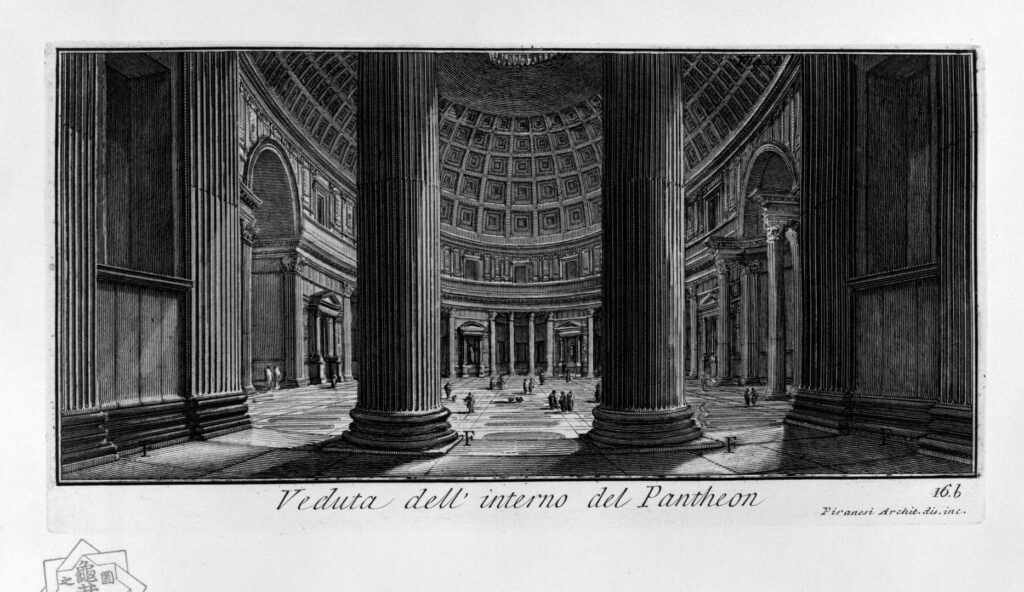
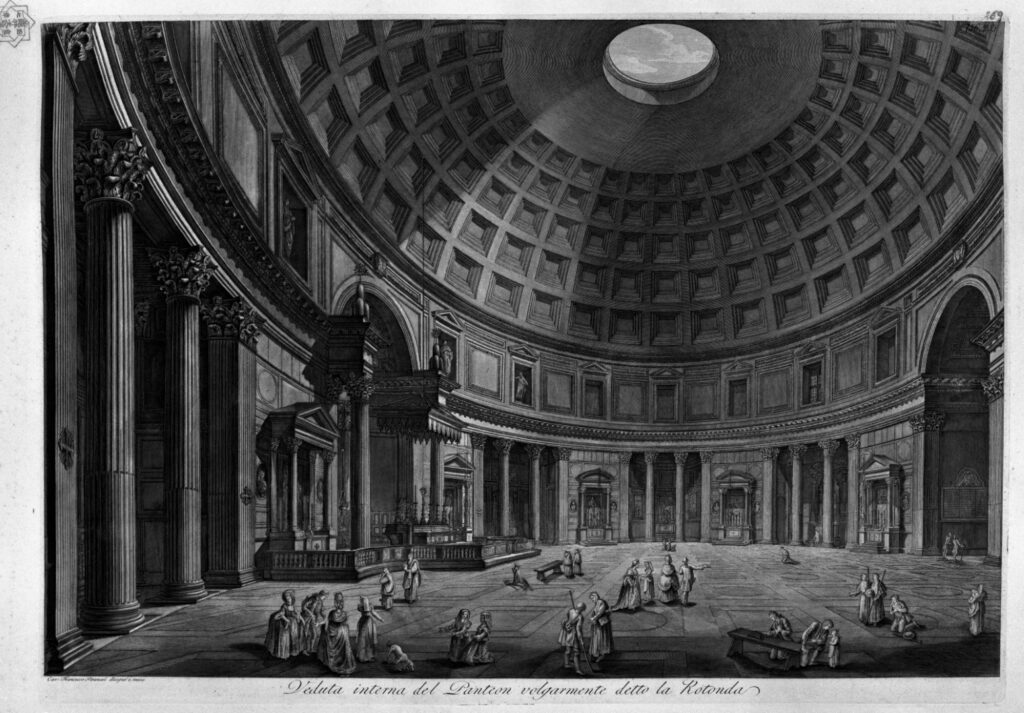
The Pantheon is the quintessence of ancient Rome, and of the particular spell that Rome casts: the sense of standing among the remains of something greater than anything that came after it. And when you talk about the melancholy grandeur of ancient Rome, it is impossible not to think of Giovanni Battista Piranesi, the Venetian architect and engraver who in the eighteenth century turned the ruins of the city into the most sublime images ever printed. His Views of Rome, sold by the hundred to the young gentlemen of the Grand Tour, shaped the way all of Europe imagined Rome for generations, and, as the story goes, many travellers arriving in the city were disappointed to find it smaller than his etchings. Piranesi drew the Pantheon more than once, inside and out, with tiny figures dwarfed by the columns, and with Urban VIII’s donkey’s ears still perched on top, a century before they were pulled down. Look at his plates and you will see the same building you have just walked through, and at the same time a dream of it.
Frequently asked questions
How much does it cost to visit the Pantheon? From 1 July 2026 the full ticket is €7. EU citizens aged 18 to 25 pay €2. Under-18s, residents of Rome and tour guides enter free, and entry is free for everyone on the first Sunday of the month and during Mass.
What are the opening hours? Every day from 9:00 to 19:00, last entry 18:30. Closed on 25 December and 1 January. Extraordinary evening openings are announced occasionally: check the official website before you go.
Do I need to book? Not always, but booking online saves queueing at busy times. If the official tickets are sold out, skip-the-line tickets are almost always available on Tiqets, either as a fast-track ticket with guided tour or as a combo with Castel Sant’Angelo. The new route behind the rotunda, Oltre il Pantheon, must be booked through the Musei Italiani app.
Who built the Pantheon? The building you see was begun under Trajan, probably around AD 114, and completed under Hadrian between about 118 and 125, replacing an earlier temple built by Agrippa around 25 BC. Hadrian kept Agrippa’s name on the façade. The architect is unknown; Apollodorus of Damascus is a popular hypothesis.
How big is the dome? 43.3 metres in diameter, and exactly as high from the floor to the top. It is still the largest unreinforced concrete dome in the world.
Does it rain inside the Pantheon? Yes. The oculus, about nine metres across, has no cover. The floor slopes slightly and 22 small holes under the oculus drain the water away. The story that rain cannot enter because of rising warm air is a myth.
Who is buried in the Pantheon? Raphael, Annibale Carracci, Baldassarre Peruzzi, Perin del Vaga, Taddeo Zuccari, the composer Arcangelo Corelli, King Vittorio Emanuele II, King Umberto I and Queen Margherita, among others.
Is the Pantheon still a church? Yes. Since the seventh century it has been the Basilica of Santa Maria ad Martyres, and Mass is still celebrated there.
What happens at Pentecost? At the end of the midday Mass on Pentecost Sunday, the fire brigade drops thousands of red rose petals through the oculus. Arrive very early.
What is “Oltre il Pantheon”? A route opened in November 2025 in the rooms behind the rotunda, on the site of the Basilica of Neptune, with Hadrian’s brick stamps, models, projections and fragments of the Christian Pantheon. Small groups, booked slot, extra cost.
Is there a dress code? Yes: shoulders covered, no very short shorts or skirts.
How long does a visit take? Thirty minutes for the rotunda and the portico, an hour and a half if you add the route behind it.
How can I find all of Raphael’s works in Rome? Raphael is buried in the Pantheon, but his works are scattered across the city, from the Vatican to the Farnesina. To see where they actually are, continue on ArtAtlas: https://artatlas.it/artists/raphael/raphael-in-rome
How can I plan an art itinerary in Rome? With Flâneur, the art itinerary engine of The Introvert Traveler. You tell it how many days you have and what kind of traveller you are, from curious beginner to seasoned art lover, and it builds a day-by-day route through the city’s museums, churches and masterpieces, with real opening hours and a curated choice of restaurants along the way.