Last visit: October 2026
My rating: 10/10
Price: €18 full price, €12 under 30, plus €2.50 online booking fee (October 2026)
Address: Scuderie del Quirinale, Via XXIV Maggio 16, Rome
Web: https://scuderiequirinale.it/en/exhibition/pontormo/
Date: until 7 February 2027
Visit duration: 2/3 hours
Let me say it right away: Cristina Acidini, curator of the Pontormo exhibition now on at the Scuderie del Quirinale in Rome, must be among the next candidates for the Presidency of the Italian Republic, the Nobel Prize for Art History (to be established ad hoc), the Oscar for Best Cinematography and the Pulitzer Prize, as well as honorary winner of the Palio di Siena and Wimbledon. I can find no other way to express my gratitude for an exhibition devoted to the most gifted, astonishing, indecipherable, glittering, kaleidoscopic, gloomy, talented and mad painter of Italian Mannerism: Jacopo Carucci, known as Pontormo. The Pontormo exhibition is a caress for the heart, a delight for the eyes, and nourishment for the stomach. All his major works are here, from the Deposition of Santa Felicita to the Visitation of Carmignano and the Halberdier flown in from the Getty in Los Angeles. They are displayed in perfect conditions, which is not always possible in their original settings, and with a level of detail you simply cannot get anywhere else. In the Deposition, for instance, beneath the paler layers of paint you can make out the lines of the underdrawing, traced, I believe, in black chalk: I had never noticed them while looking at the painting through the bars of Santa Felicita. Then there is the sheer number of loans, coming not only from the usual giants but also from museums the average tourist could not place on a map, such as Lille and Dijon. There is a first-rate selection of drawings, from the British Museum’s “selfie in underpants” to the preparatory drawing for the Visitation, displayed right beside the painting itself in a pairing you will never see again. There is a squad of splendid Bronzinos, from the Crucifix of Nice to the Lady of Frankfurt. And there are even a few works by a little-known artist born in Caprese, whose name I will not reveal to avoid spoilers. Allow three hours, comfortable shoes and the preemptive surrender of any critical faculty: my rating is 10/10, and I almost never give it.
Planning a trip to Rome around the art?
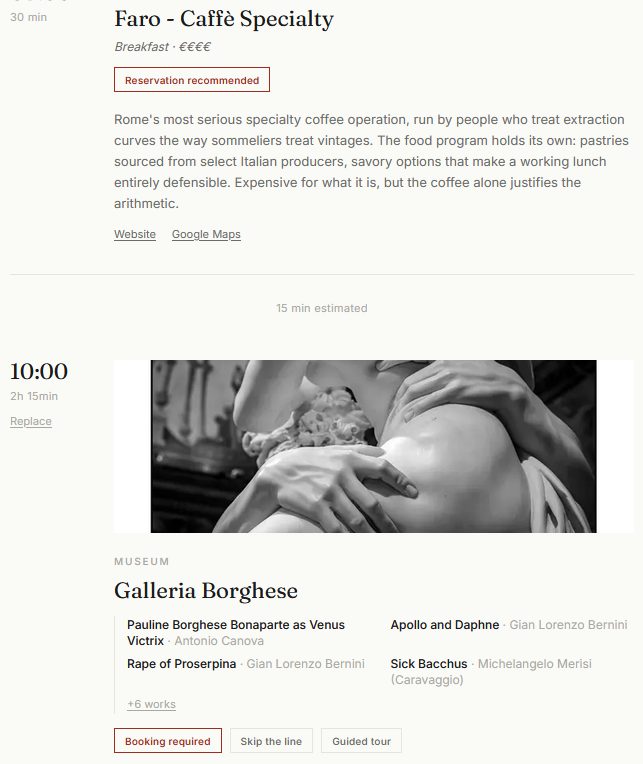
The Borghese Gallery is the clearest example of why a Rome art trip is a logistics problem before it is a taste problem. Entry is by booked slot only, the slots sell out weeks ahead, and the museum sits in a park twenty minutes from the nearest thing you will want to see next. Get the order wrong and you either miss the booking or waste the afternoon.
Flâneur builds a personalised Rome art itinerary around you. Tell it how deep your interest in art runs and what your days should look like, and it maps a route through the art that matters: the Borghese and the Vatican Museums, the Caravaggios scattered through the churches, Bernini’s Rome well beyond this one gallery, and the quieter stops most visitors never reach. Every day comes with real opening hours, church closing times, transfer times, meal breaks, directions and booking links.
Pick the Expert profile and you compose the day yourself, choosing from all the art indexed in the city. This is exactly where a general-purpose AI falls short: an LLM guesses a plausible Baroque itinerary, Flâneur knows which slot to hold, which door is open when, and in which order to walk them.
Build your Rome art itinerary or see every city on flaneur.travel
The dream team of Florentine Mannerism
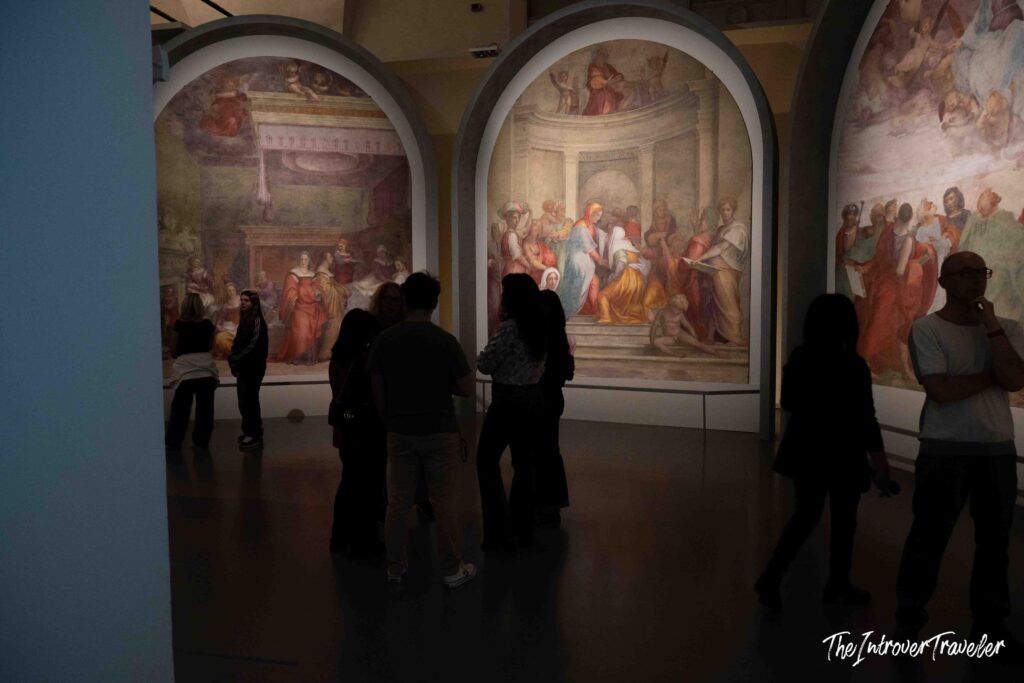
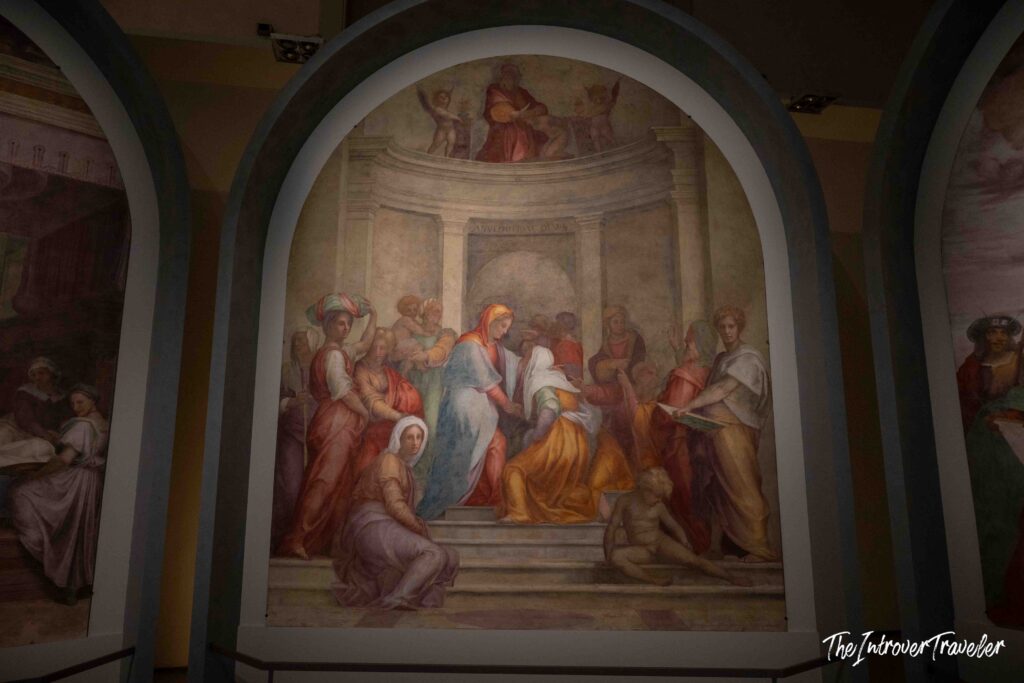
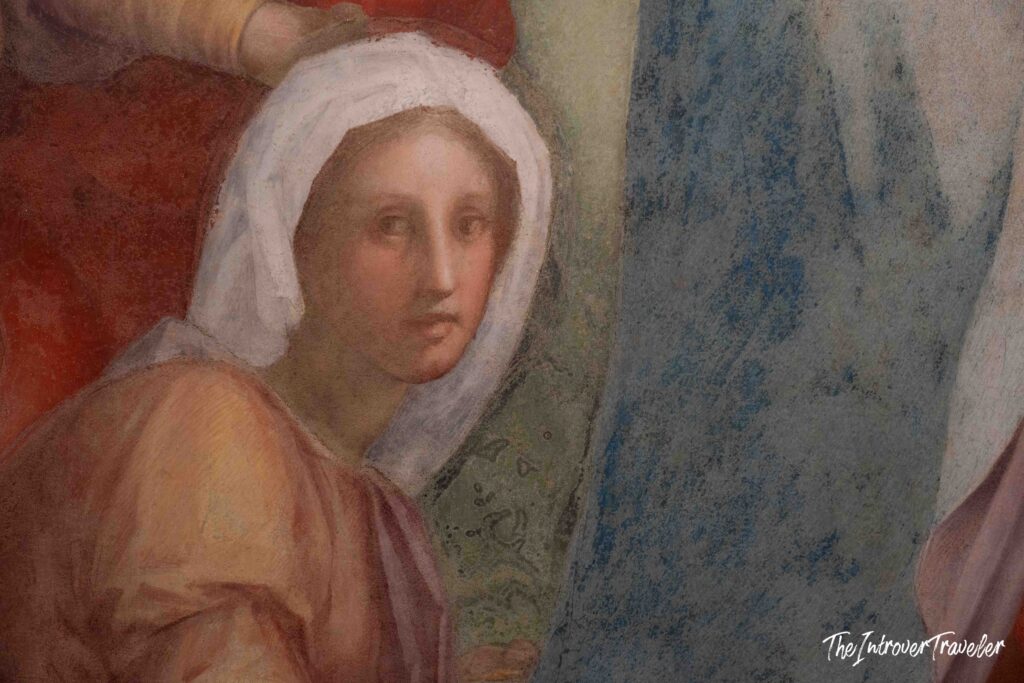
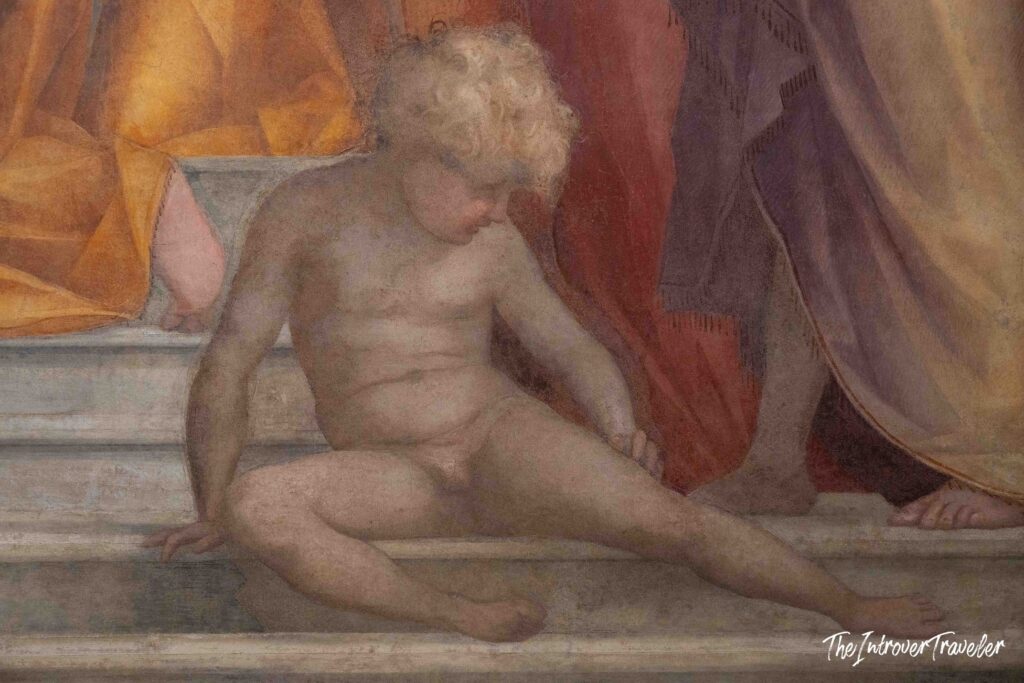
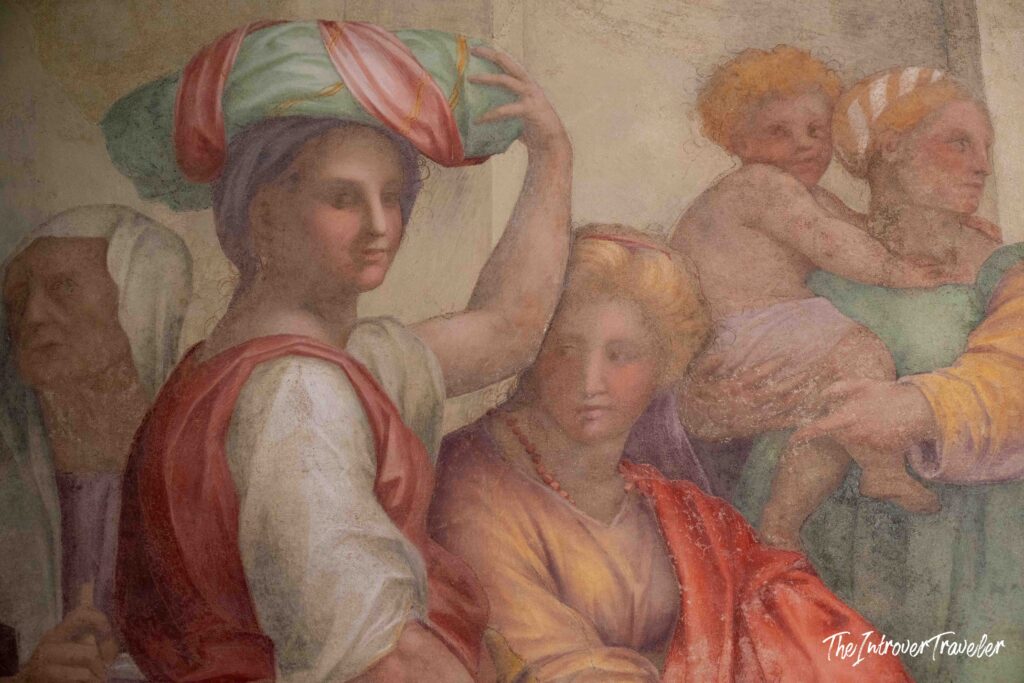
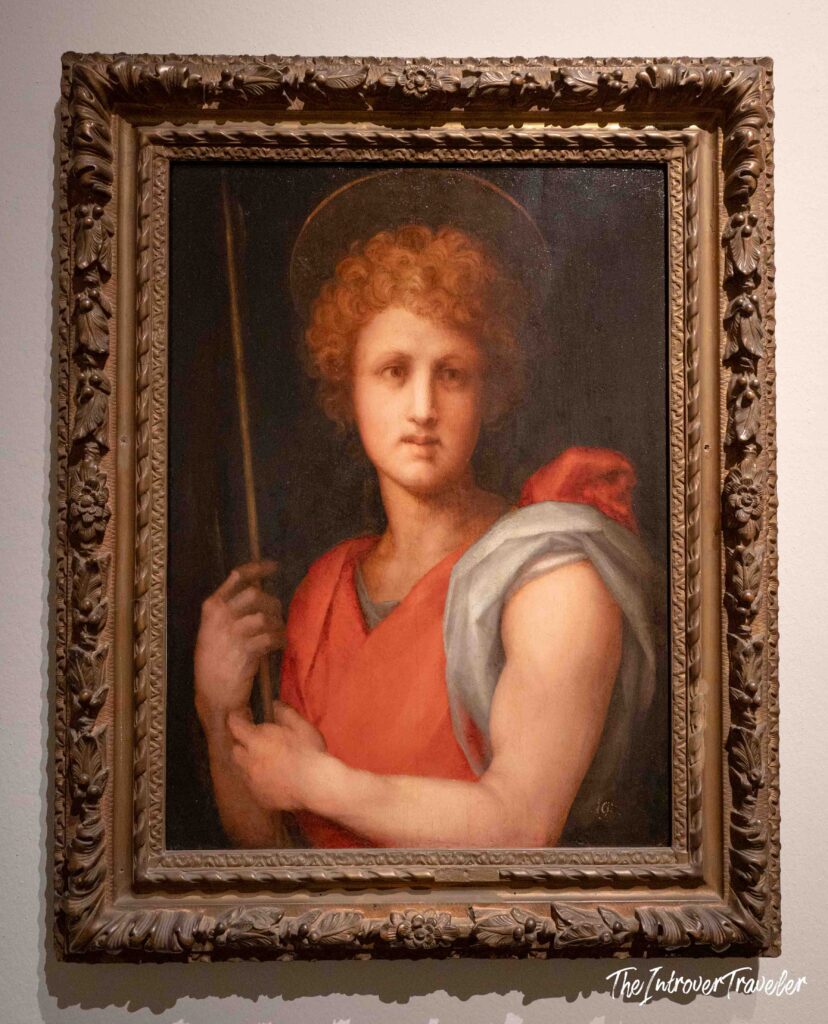
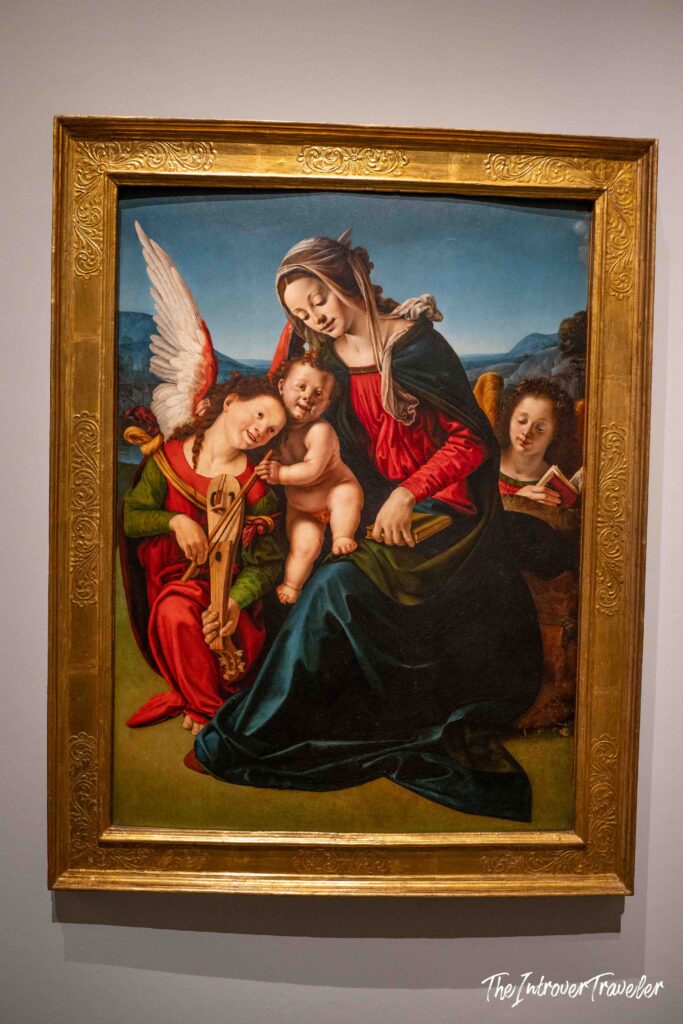
The exhibition starts with a bang, and the first room alone is enough to explain the rating. Here are the three detached frescoes from the Chiostrino dei Voti, the small cloister of the Santissima Annunziata in Florence, side by side: Andrea del Sarto’s Birth of the Virgin, Pontormo’s Visitation and Rosso Fiorentino’s Assumption. The dream team of Florentine Mannerism in full, with the coach on the bench and his two star players still on the same team before each goes his own way. In Florence you would see them in a cloister, high above your head, in whatever light the convent lets through; here they are a few steps away, flawlessly lit, and you can explore them down to the smallest detail. I have a soft spot for Pontormo’s Visitation, painted when he was barely twenty. The figures are still composed and the classical architecture is still standing, but some details already announce what is to come. The veiled woman in the foreground turns to stare at us as if we had walked in without knocking. The naked child sitting on the steps, utterly indifferent to the sacred event taking place behind him, looks ready to move onto the low wall of the Vertumnus and Pomona lunette that Pontormo would fresco a few years later in the Medici villa at Poggio a Caiano. The same luxury treatment is given to the so-called minor works, such as a Saint Sebastian from Dijon that is worth the trip to Rome on its own, at least for anyone with no plans to visit Burgundy. And then there is the great outsider, Piero di Cosimo, with the Madonna and Child with Two Angels lent by Palazzo Cini in Venice: enamelled, luminous, with an angel playing the vielle and a Christ Child laughing as if he had just heard a good joke. According to Vasari, who should always be taken with a pinch of salt, Piero lived like a hermit and fed on hard-boiled eggs, cooked fifty at a time while he boiled his glue. A master who lived on hard-boiled eggs and a spiritual heir who recorded his omelettes in his diary: sixteenth-century Florentine painting clearly had a cholesterol problem.

Like master, like pupil
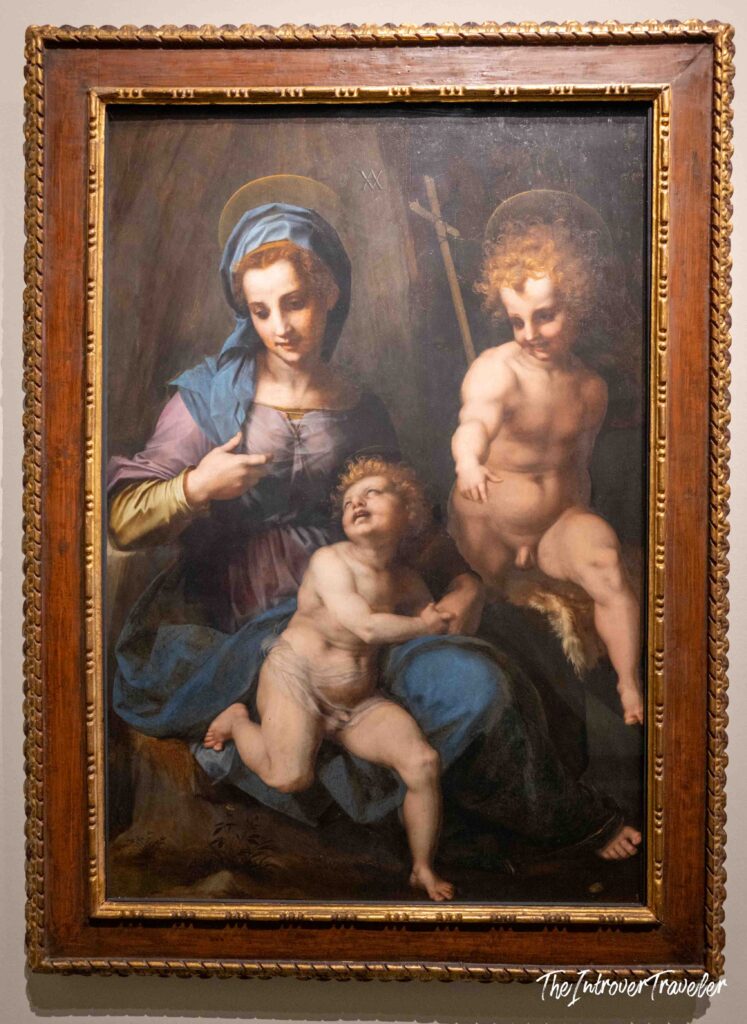
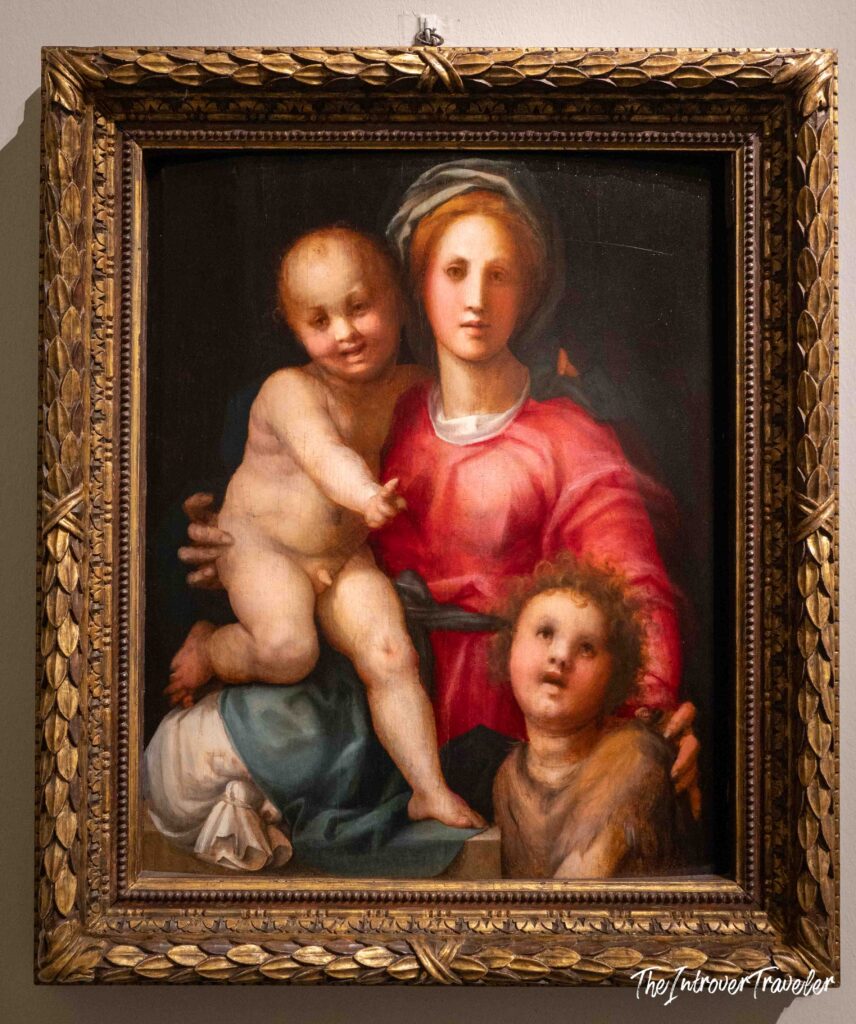
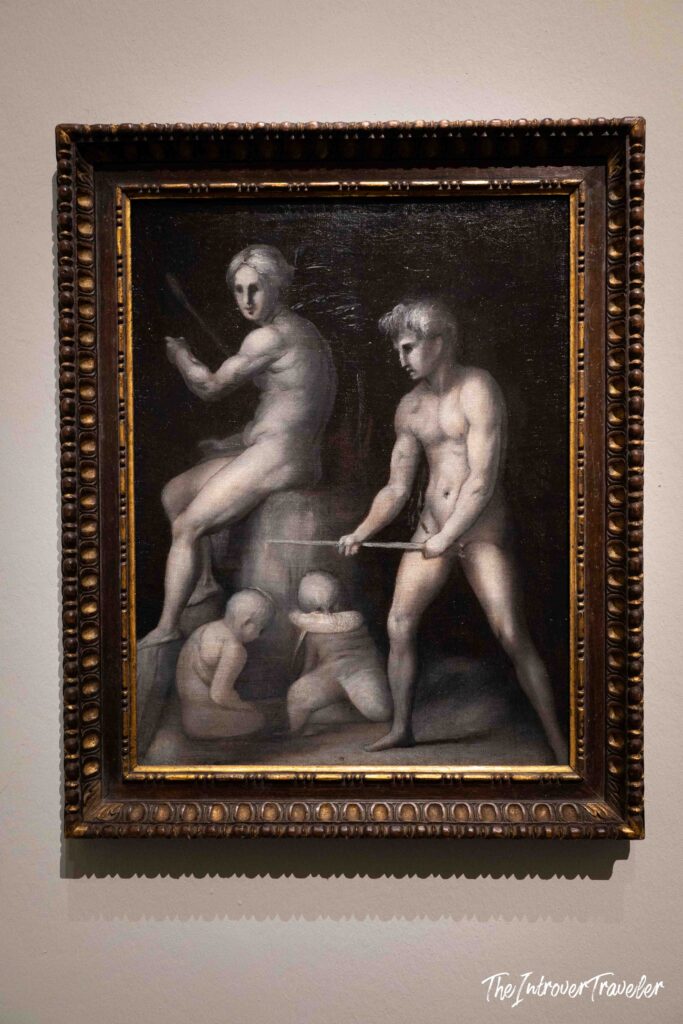
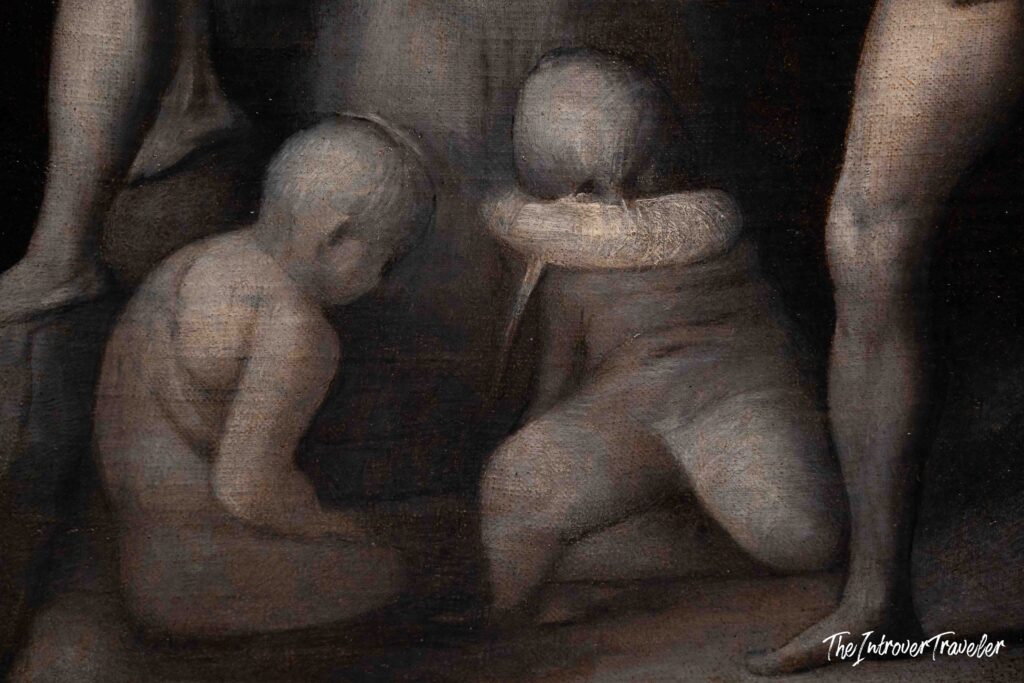
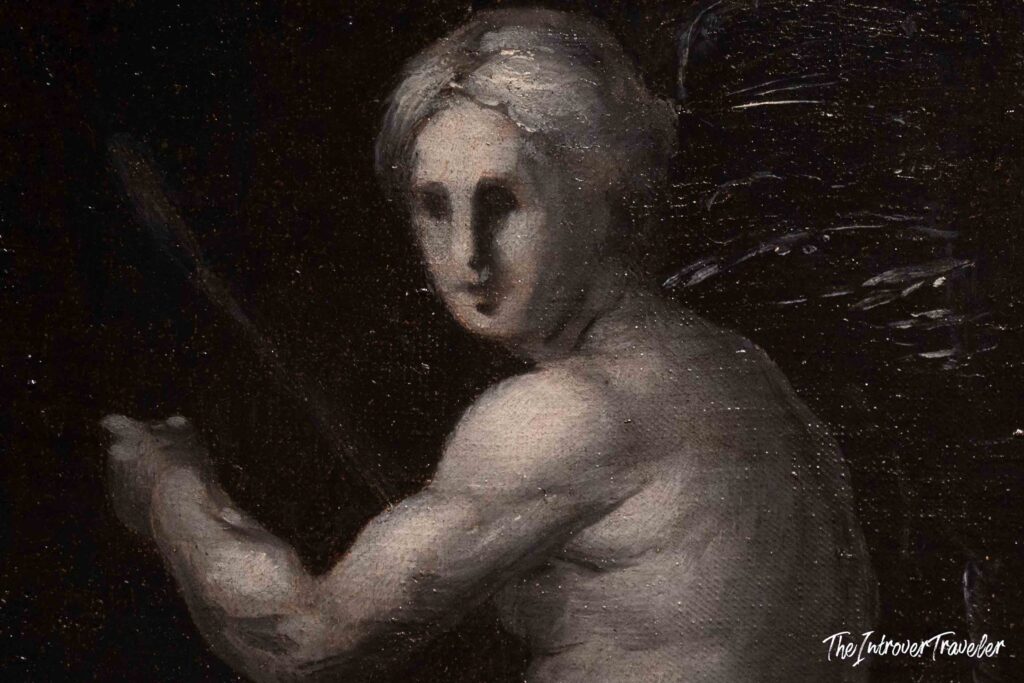
Andrea del Sarto does not limit himself to welcoming guests in the first room. The master returns several times along the way, and rightly so, because seeing his work next to his pupil’s makes it obvious, if proof were needed, how deeply the former shaped the latter. Take the Madonna and Child with the Infant Saint John from the Galleria Borghese. A distracted visitor, at least in the drawing if not in the colours, could easily mistake it for a Pontormo: the same full, rounded anatomies, the same children as muscular as little wrestlers, the same Madonna looking down with the absorbed air of someone already thinking about something else. Luckily Andrea signed it at the top with his monogram, two interlaced As, for the benefit of the distracted. The exhibition also lets you see works that normally stay locked away in the homes of those who can afford them, such as Pontormo’s Madonna and Child with the Infant Saint John, from a private collection, where his debt to the master is once again plain. The Child standing in his mother’s lap and the young Saint John raising his eyes to heaven look as if they came out of the same workshop, because in fact they did. But the Madonna, stiff and frontal, stares at us with a look Andrea would never have painted: she is not a mother posing, she is a woman wondering what on earth we are doing there. Also from a private collection is a small grisaille of Adam and Eve, Cain and Abel, one of those paintings that, once the exhibition closes, will go back to a living room none of us will ever be invited to. Some doubts remain about the attribution, but to me it is unquestionably Pontormo. Just look at Eve’s face, with eye sockets as dark and hollow as a skull’s, a mask more than a face: it is Pontormo’s signature, more reliable than any monogram. At the couple’s feet, the two sons huddle on the ground, one bent over and the other hiding his face in his arms, as if they already knew how it would end. The first murder in history, told as a melancholy afternoon in the family.
Back home: the saints of Pontorme
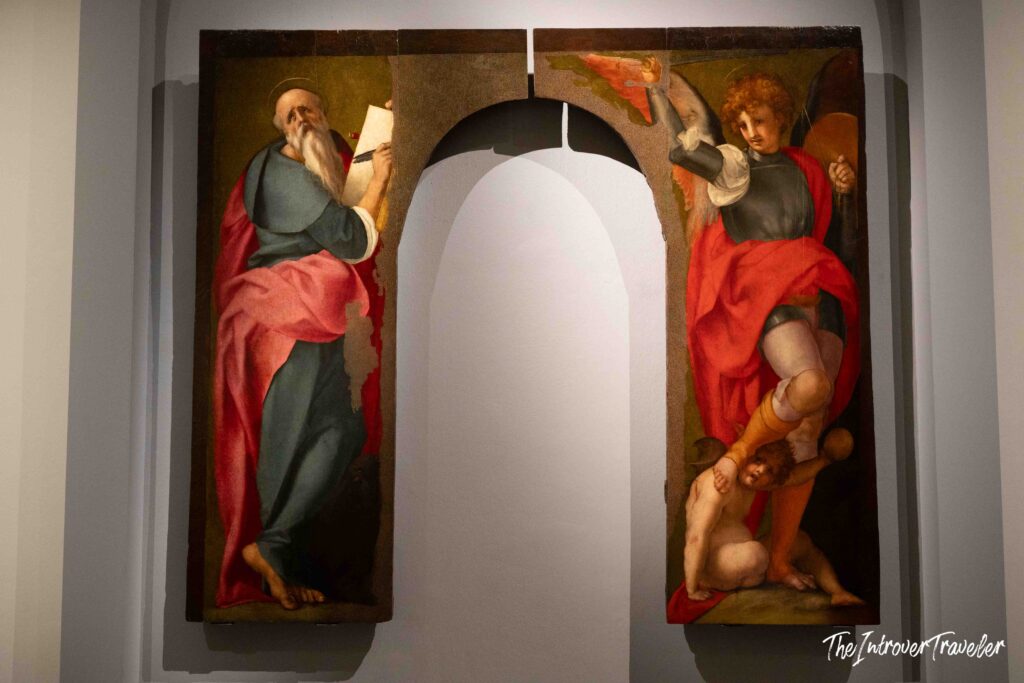
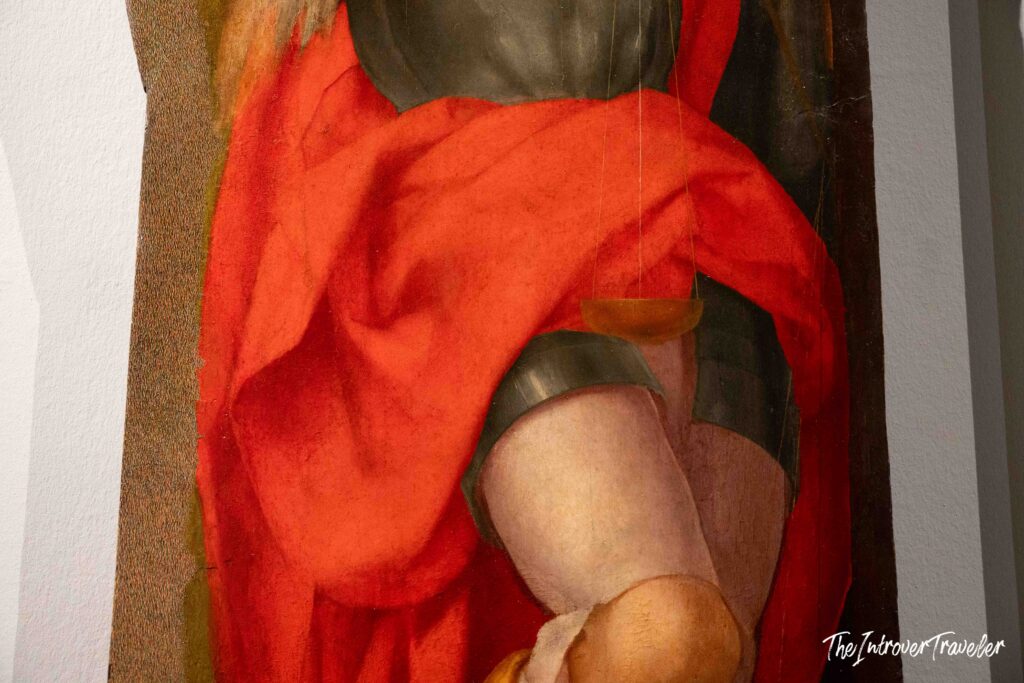
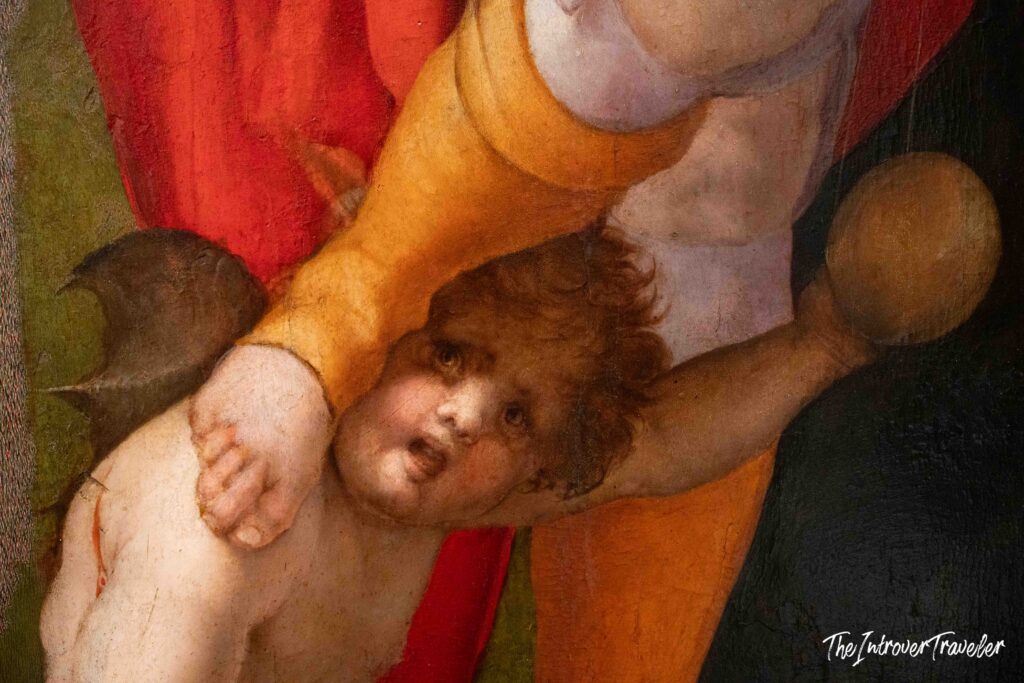
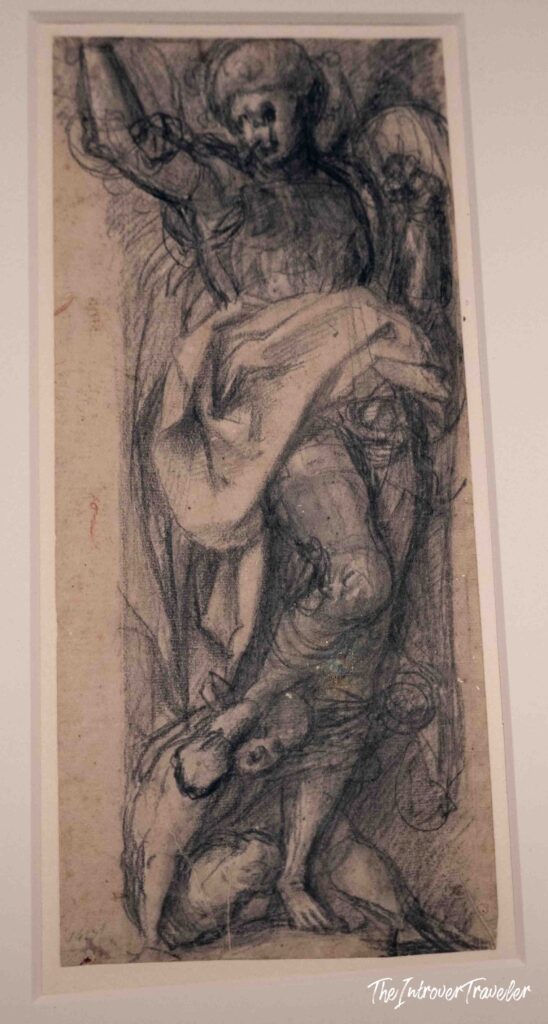
A little further on, there is a homecoming. Saint John the Evangelist and Saint Michael the Archangel are two panels that Pontormo, aged about twenty-five, painted around 1519 for the church of San Michele in his native village, Pontorme, on the outskirts of Empoli. They have arrived in Rome freshly restored and displayed as they originally stood, on either side of an arched opening, as the very shape of the panels reveals. On the left, a Saint John with a flowing white beard writes his Gospel without looking at the page, his eyes turned upwards like someone waiting for dictation, wrapped in a candy-pink cloak that is already, in miniature, the palette of the Deposition. On the right, a Saint Michael in armour, red curls and drawn sword, holds the scales of souls with the grace of a waiter carrying a tray. And under his foot is the devil, and this is where Pontormo gives himself away. The demon is not the usual horned, hairy monster: he is a chubby toddler with bat wings and a club in his hand, pinned to the ground, raising a frightened look and a wailing open mouth towards us. The Prince of Darkness reduced to an infant in distress, with a bloody scratch on his back: today a scene like this would get social services called. But that is precisely the point. Where his colleagues would have painted Evil, the young Pontormo paints fear, and he cannot help feeling a touch of compassion even for the devil. Then take a closer look at the archangel’s legs: the armoured cuisse stopping above a bare, shapely thigh, the uncovered knee, the little orange boot. A warrior saint half dressed, like a model who forgot to finish the costume fitting. It is the first sign that this boy from the provinces has no intention of painting like everyone else.
The first fireworks: drawings
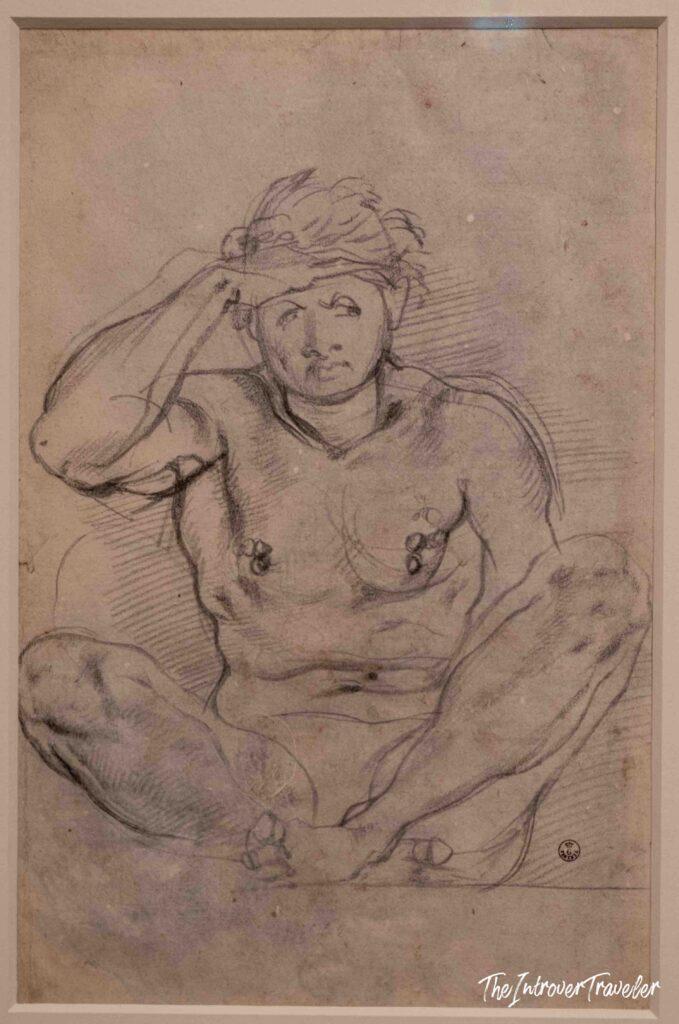
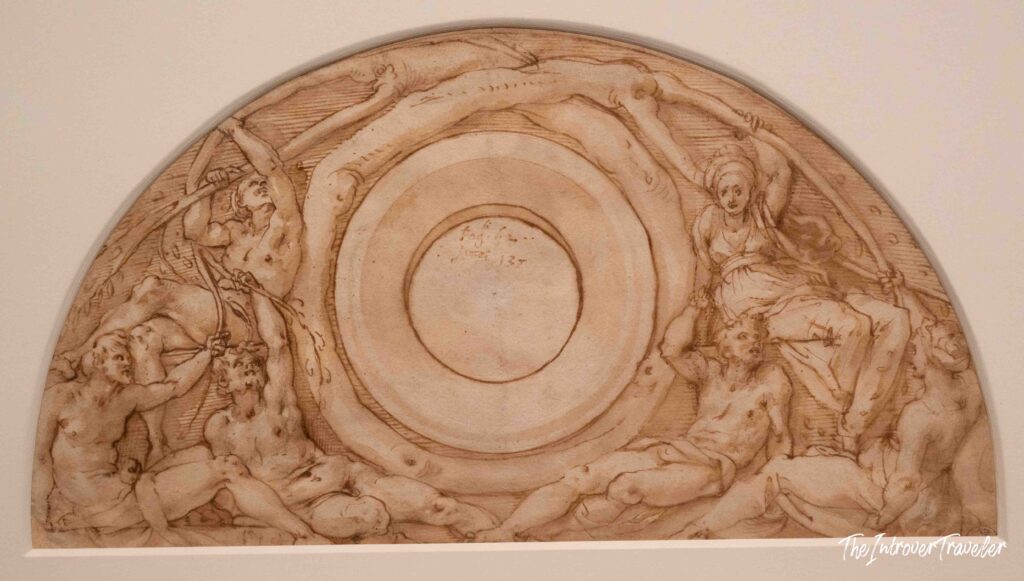
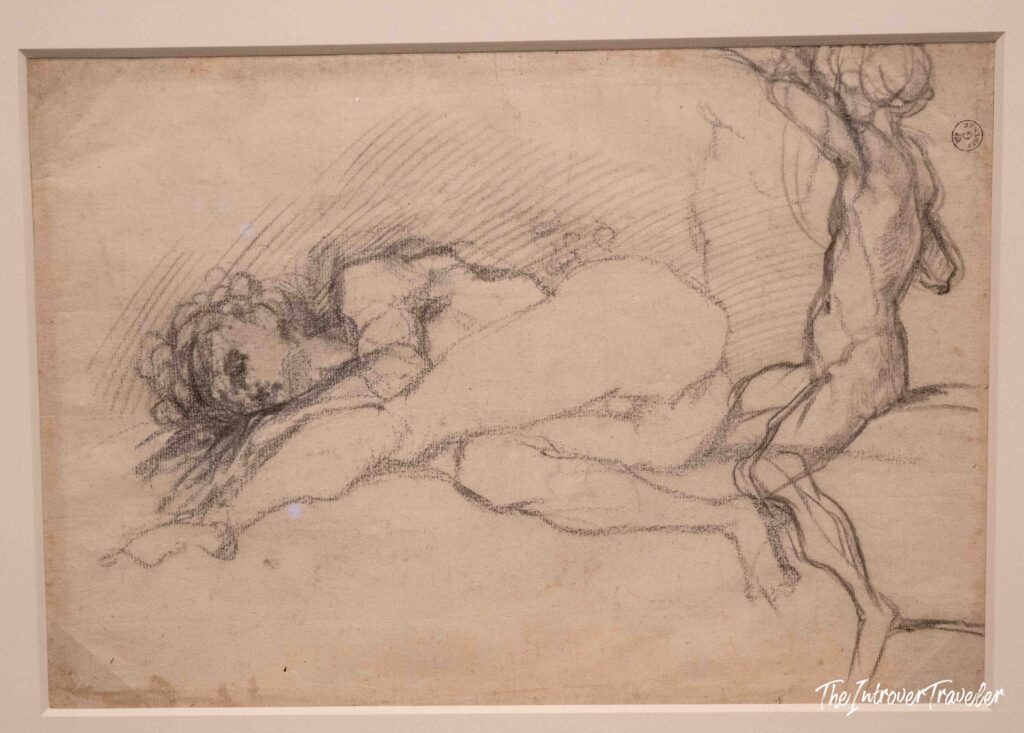
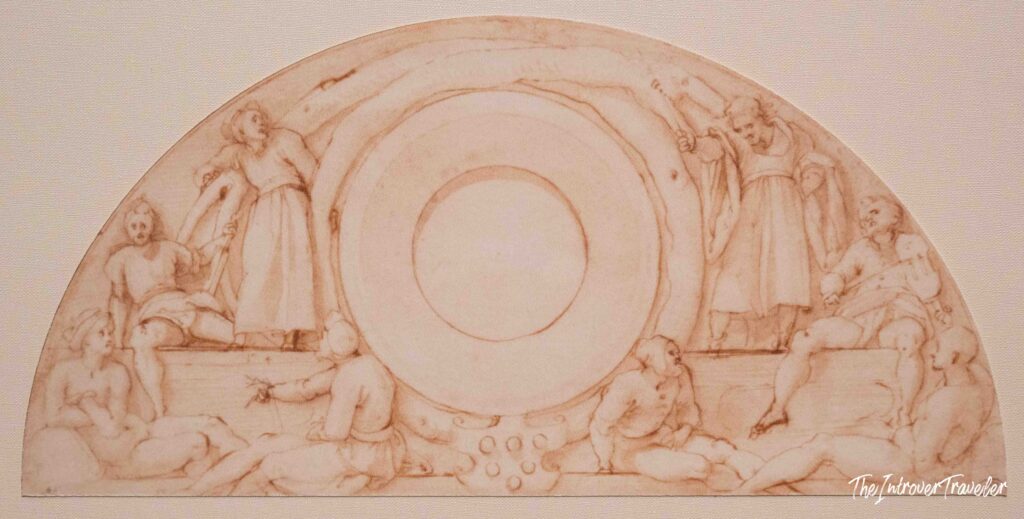
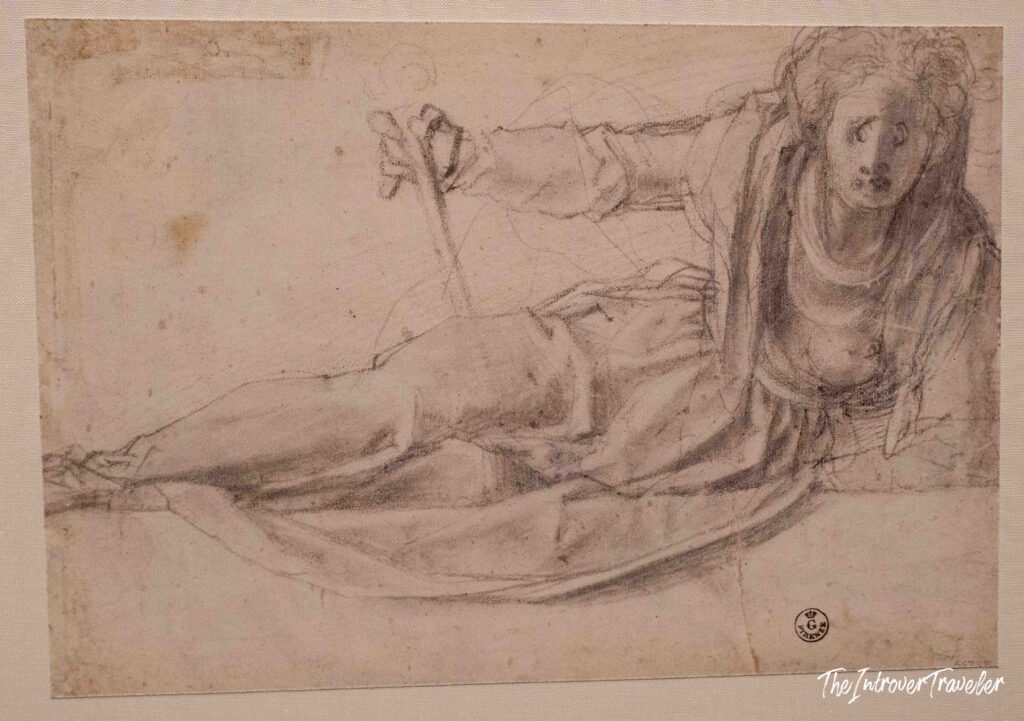
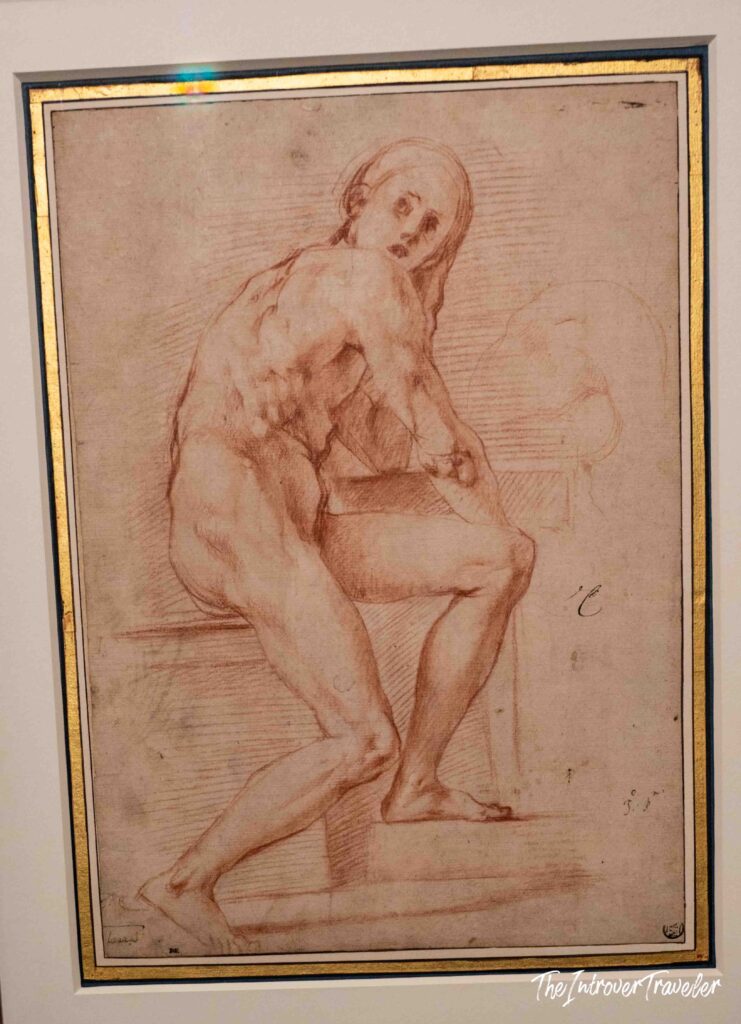
Then the exhibition sets off its first fireworks, and it does so on paper. A series of drawings, among the finest by Pontormo that we know, in which the Tuscan artist shows off all his graphic talent. In my library I jealously keep the catalogue of Pontormo. Dibujos, the exhibition the Fundación Mapfre devoted to his drawings in Madrid in 2014. I leaf through it regularly, and each time I become a little more convinced that Pontormo was one of the most gifted draughtsmen in the entire history of art. This exhibition finally does him justice on this front too, and the first sheets are proof enough. There is a young man in red chalk turning sharply to look at us over his shoulder, with the wide eyes of someone caught in a private moment, which he probably was. There are reclining bodies sketched in a few nervous strokes that nonetheless stand up better than many finished paintings. And above all there are the studies for the lunette in the great hall of the Medici villa at Poggio a Caiano: figures lying, sitting and climbing around the oculus, the big round window that Pontormo had to frame and that was there whether he liked it or not. In one of the sheets, beneath the window, the Medici balls even appear, just to remind everyone who was paying the bill. For the same lunette there is also a naked boy sitting cross-legged, in black chalk, with a hand in his hair and a frown: he looks like a visitor who has just read the price of the catalogue. But look closely at that powerful torso and that twisted pose: he is a close relative of the Ignudi on the Sistine Chapel ceiling. This is where Michelangelo starts to get inside Pontormo’s head, and he will never leave. And there they are, the close relatives of the naked child sitting on the steps of the Annunziata: the same bodies sitting wherever they happen to be, with the same nonchalance, only a little bigger and a little more aware of being watched. In front of these sheets you understand something that the paintings, for all their splendour, sometimes hide: for Pontormo, colour came afterwards. First came the line, and the line never made a mistake.
A wedding chamber and a birth tray
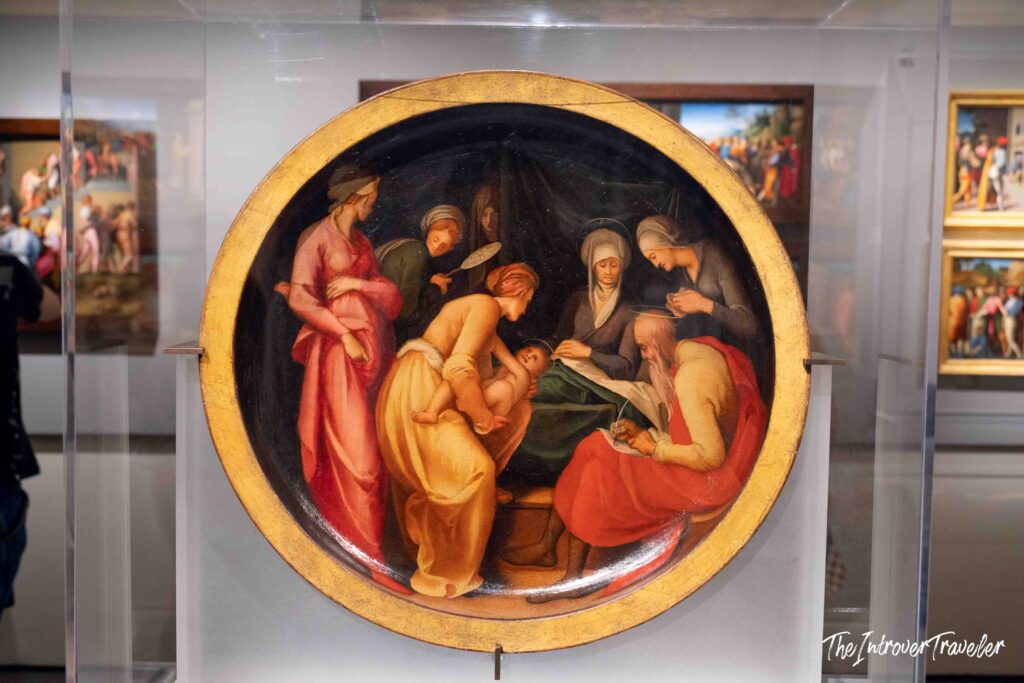
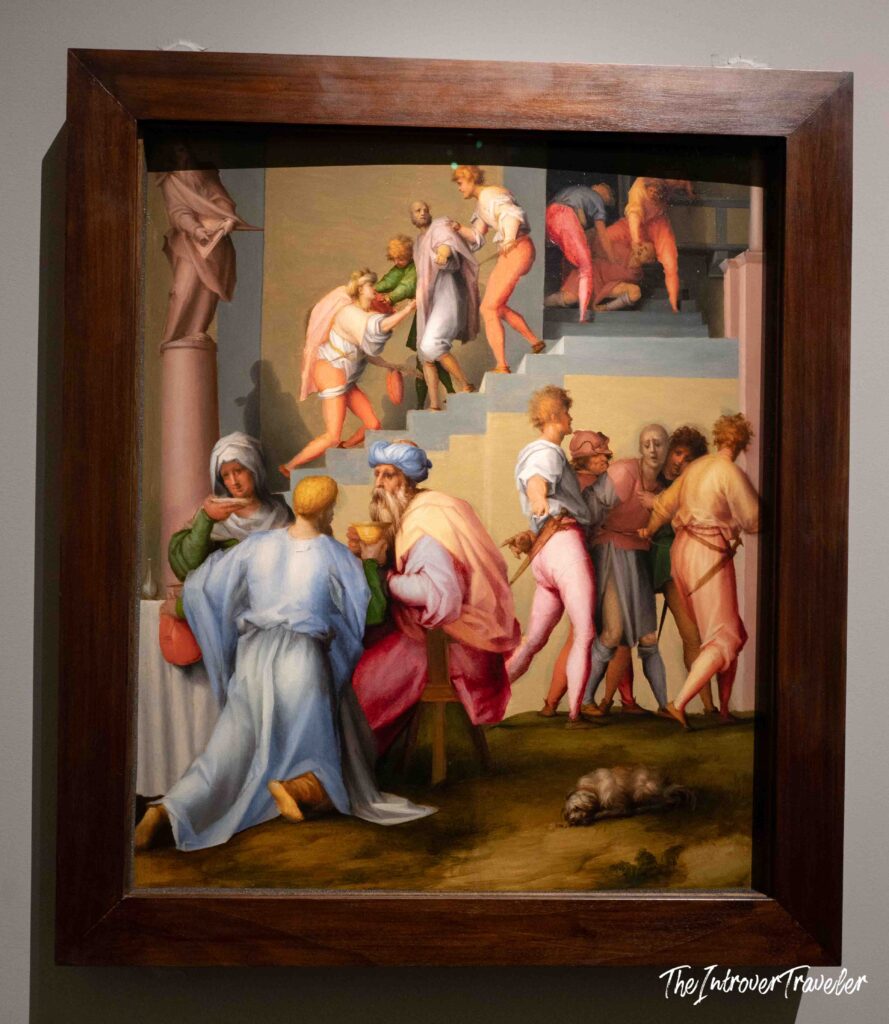
The next room is devoted to furniture, or rather to what wealthy sixteenth-century Florentines hung on it and set into it. The highlight is the bridal chamber of Pierfrancesco Borgherini and Margherita Acciaioli, decorated around 1515 by a small team of talents, Andrea del Sarto, Francesco Granacci, Bachiacca and a Pontormo barely over twenty, with Stories of Joseph painted on panels set into chests, wainscoting and the bed. Over the centuries the room was dismembered and sold off piece by piece, and today the panels are scattered between Florence, London and other museums: the exhibition reunites some of them, which is already a small diplomatic miracle. According to Vasari, as usual to be taken with a pinch of salt, during the siege of Florence an art dealer tried to buy the room to send it as a gift to the King of France, and Margherita threw him out of the house with harsh words, telling him that these were the ornaments of her marriage bed and that she would not part with them as long as she lived. A woman who defends her bedroom against French diplomacy deserves more than a footnote. Pontormo’s panel with Pharaoh with His Butler and Baker tells the whole story in one go: in the foreground the pardoned butler kneels to offer the cup to the turbaned pharaoh, on the right the baker is dragged away, and up the staircase, at the top, his execution takes place. A death sentence painted in pastel pink, blue and yellow, with a little dog sleeping at the foot of the scene, completely indifferent to the baker’s fate: crime news told with the palette of a pastry shop. Next to it, in a case you can walk around, is the birth tray with the Birth of Saint John the Baptist, the painted tray that Florentines gave to women who had just given birth. Elizabeth is in bed, a midwife holds the newborn, Zacharias writes his son’s name, a maid waves a fan and, from the back, a woman stares straight into our eyes with the same unsettling look as the veiled girl at the Annunziata. Pontormo simply cannot paint a scene without placing someone in it to keep an eye on us. Walk around the case: on the back two little monsters hold up the family coat of arms, the Renaissance equivalent of a greeting card with a personal message.
The Certosa del Galluzzo frescoes
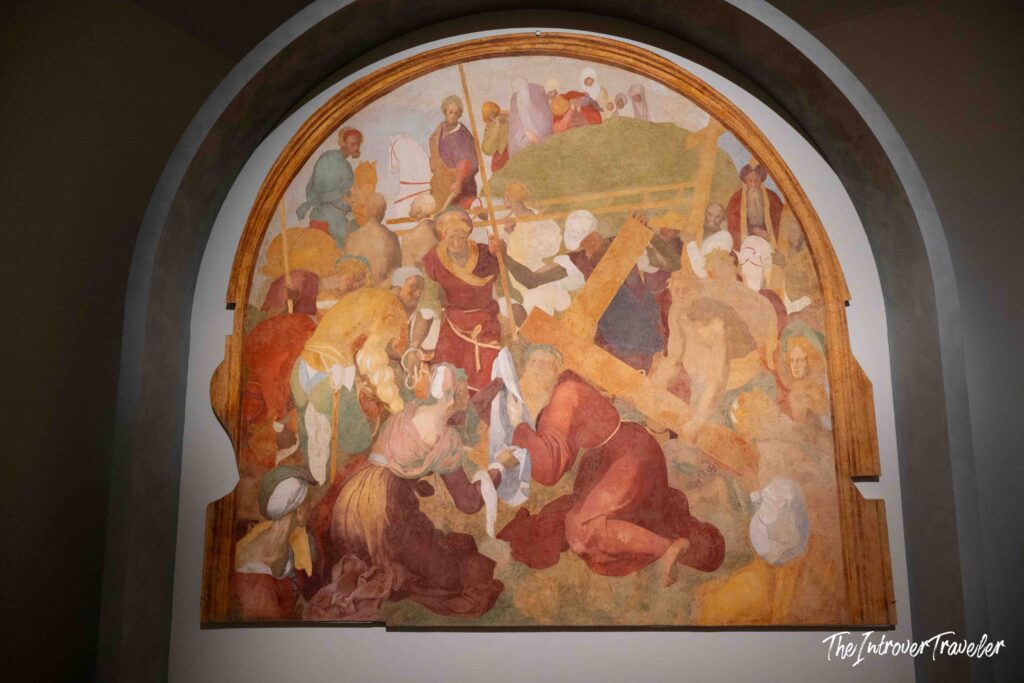
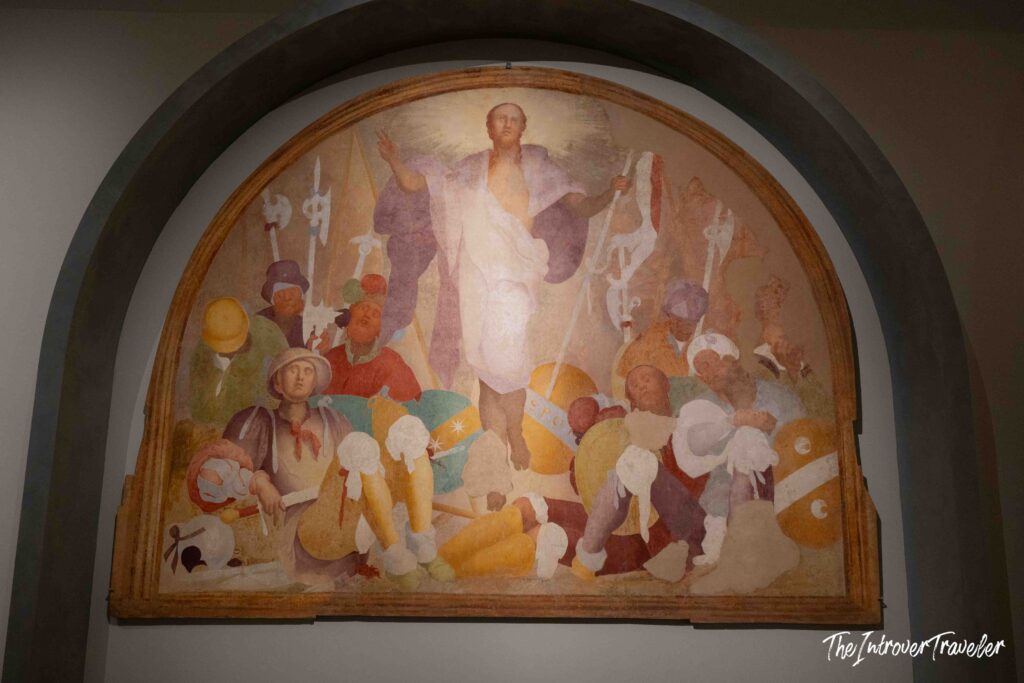
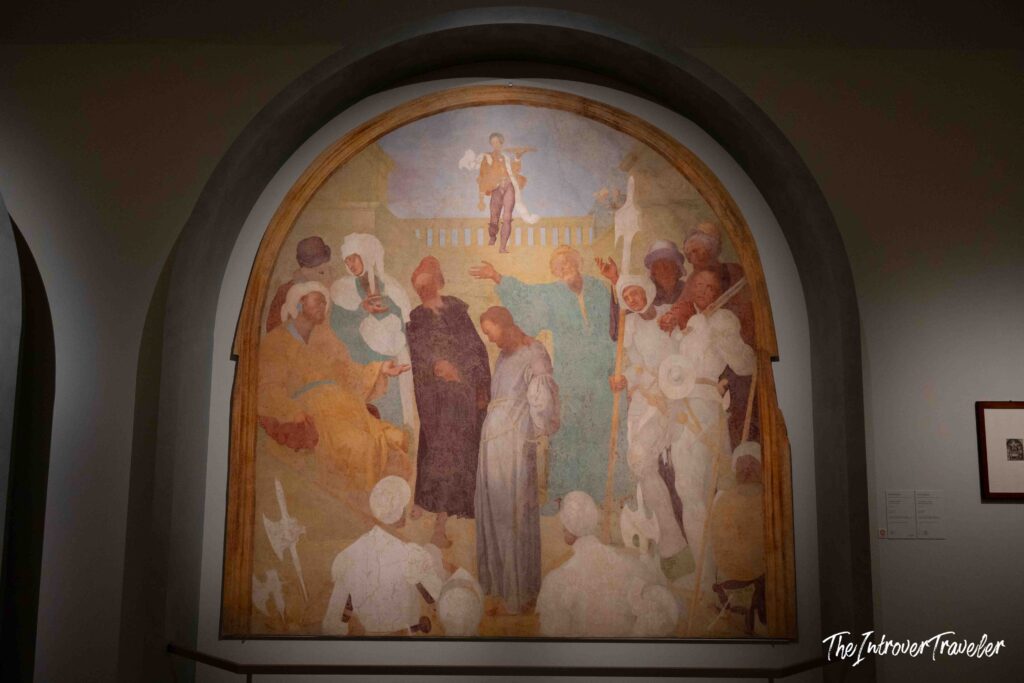
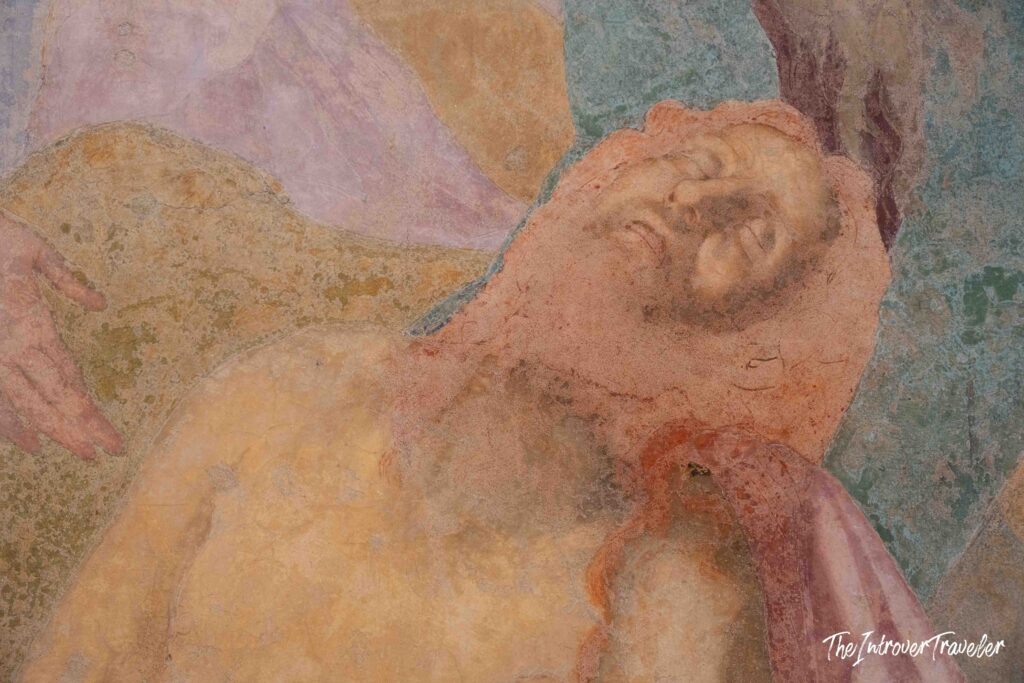
Then you enter the most melancholy room of the exhibition. Here are four of the five great lunettes with the Stories of the Passion that Pontormo frescoed between 1523 and 1525 in the great cloister of the Certosa del Galluzzo, the Carthusian monastery where he took refuge with the young Bronzino to escape the plague that was decimating Florence. Seeing them at home is no small feat. The Certosa lies outside the city, visiting hours are limited and, for anyone who does not live in Florence, it practically takes an organised expedition. Here they are within reach of your gaze, fresh from a restoration that covered all five lunettes. You have to make your peace with one thing, though: centuries of bad weather have reduced them to ghosts of themselves. The colours have been eaten away, whole sections have vanished, and where the plaster was missing white silhouettes remain, as if someone had cut the figures out with scissors. And yet, inside those ruins, a face, a hand or a piece of drapery resurfaces every now and then with breathtaking sharpness. Just look at the dead Christ in the Lamentation, his head thrown back and his mouth half open: a real corpse, with no concession whatsoever to ideal beauty. For these lunettes Pontormo drew on the prints of Albrecht Dürer, which the exhibition displays next to the frescoes. Vasari never forgave him: he accused him of abandoning the beautiful Florentine manner for a “German” style, angular and graceless. It was like telling a Florentine today that his bistecca tastes of frankfurter. In reality, comparing the prints with the lunettes, you realise that Pontormo took his compositions from Dürer and then took them somewhere else entirely. In the Resurrection, Christ does not triumph planted on the ground like an emperor: he lifts off and begins to levitate, while around him the Roman soldiers, complete with SPQR on their shields, sleep like security guards on the third night shift in a row. In Christ before Pilate, at the top of the staircase, a servant comes down with a tray and a jug: it is the water the governor is about to wash his hands with. The fiercest detail of the cycle is entrusted to a waiter. There is also a small biographical irony. A painter whom tradition depicts as solitary and surly, shut away for two years in a monastery of Carthusians, monks devoted to silence: it may well have been the most serene period of his life.

The selfie in underpants
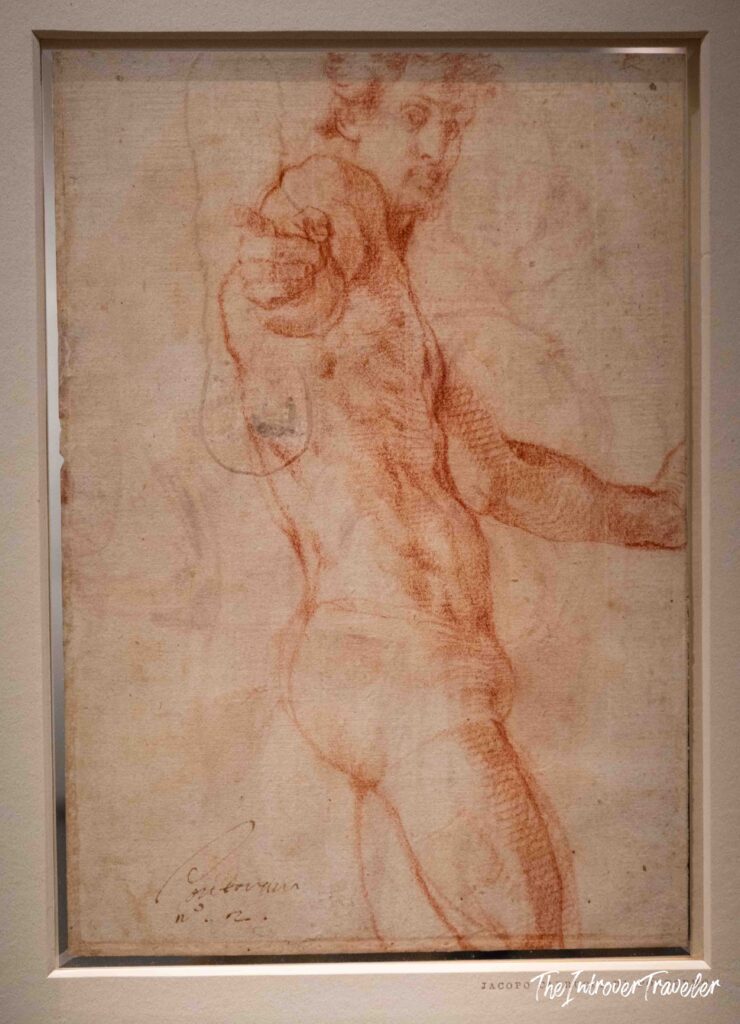
And then there is the selfie in underpants. It is a red chalk sheet lent by the British Museum, dating from around 1525. A thin, nervous young man, barely covered by a pair of underpants, turns three-quarters, looks us straight in the eye and points his outstretched arm at us, with the air of someone who has just caught us red-handed. Scholars have long debated whether it is a self-portrait, and the exhibition prudently leaves the question open. I have decided it is, because the alternative is too boring. Ask yourself who else, in the history of art, has portrayed himself like this. Renaissance artists painted themselves in velvet and gold chains, or slipped into a crowd of saints on the sly, with the demure air of someone who just happened to be there (true… there is a self-portrait by Dürer in which the German artist displays his less visible virtues, but these are times of struggle against the patriarchy, so I will pretend it does not exist). Pontormo does not pose: he makes fun of us. That pointing finger arrives four centuries ahead of Lord Kitchener and Uncle Sam, except the message is not “I want you for my army”. It is something closer to “and what are you looking at?”. To find another piece of cheek like this you have to wait for the twentieth century, Egon Schiele’s naked self-portraits and, later on, the deliberately provocative performances of contemporary art, which usually need a twenty-page theoretical manifesto to get where Pontormo gets with a stick of red chalk and a pair of underpants. There is one more detail that makes the sheet even more delightful: on the back there are two Carthusian monks, drawn perhaps during his stay at the Galluzzo. On one side the monks devoted to silence, on the other the painter in his underpants pointing his finger at us: a single sheet, and the whole of Pontormo is already in it.
The Deposition, without bars
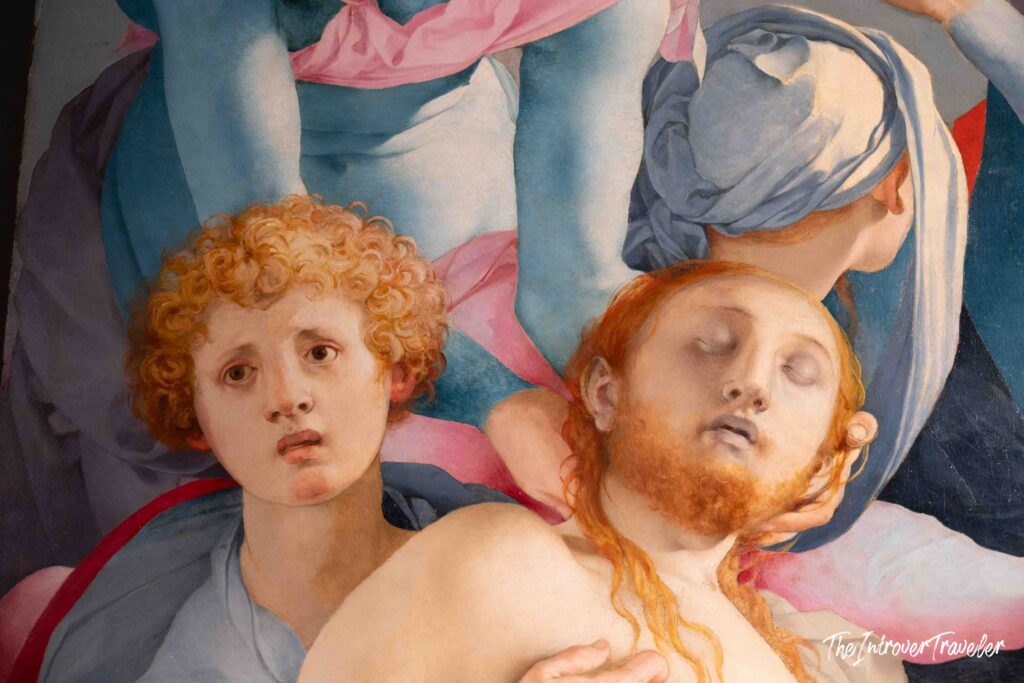
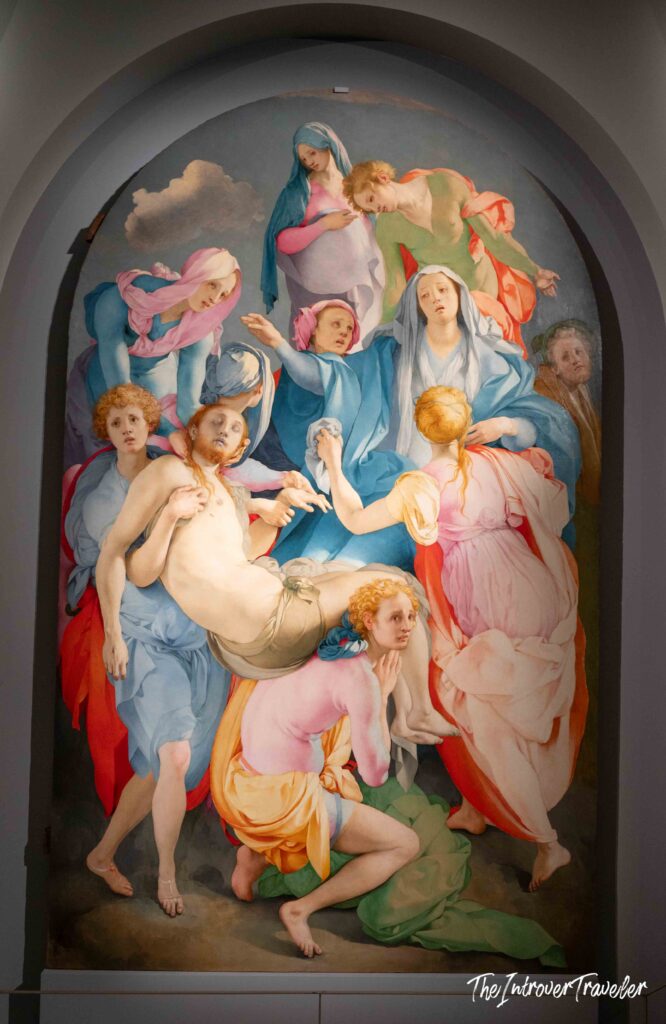
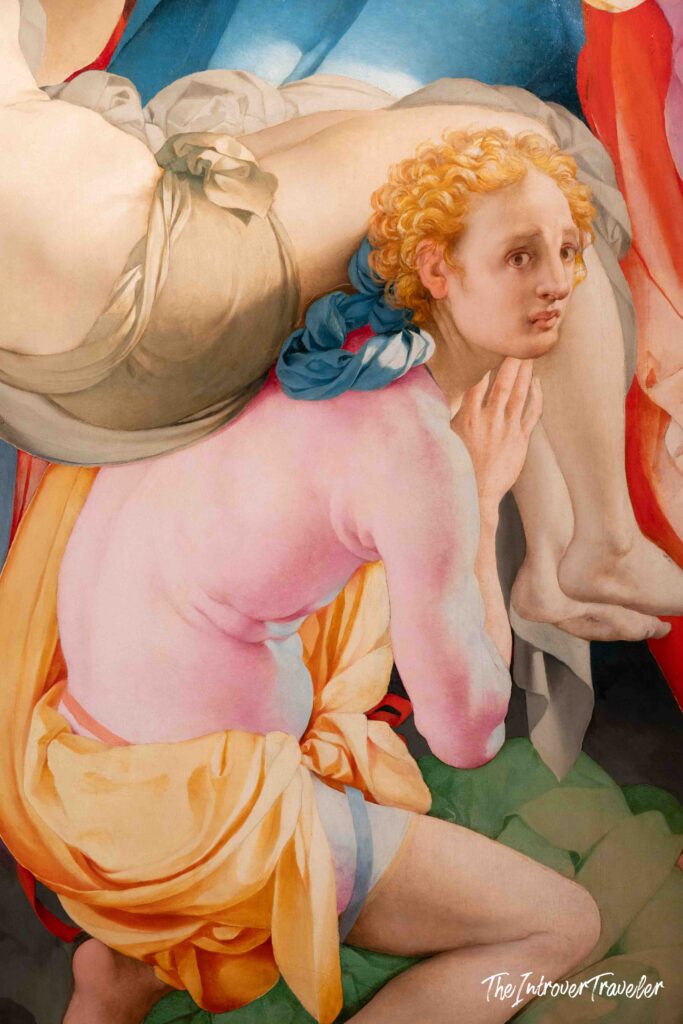
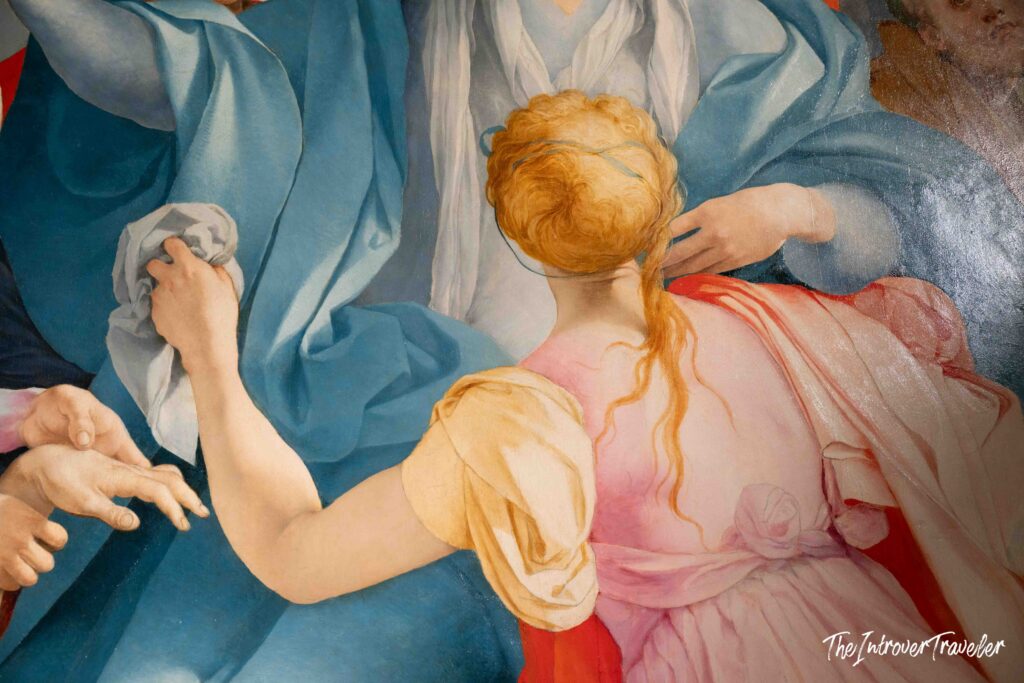
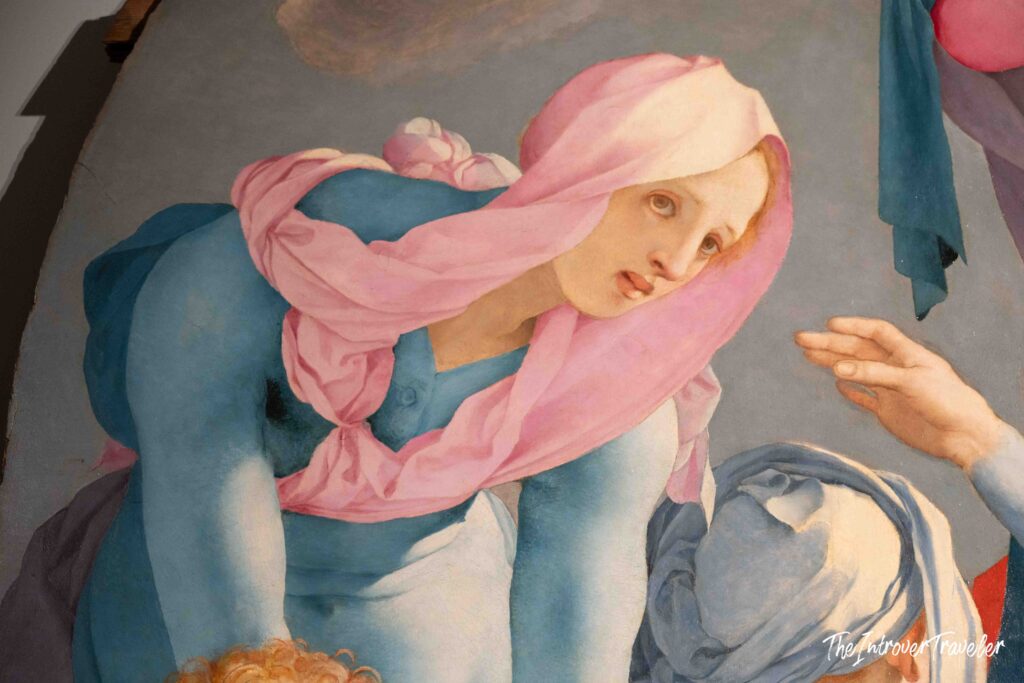
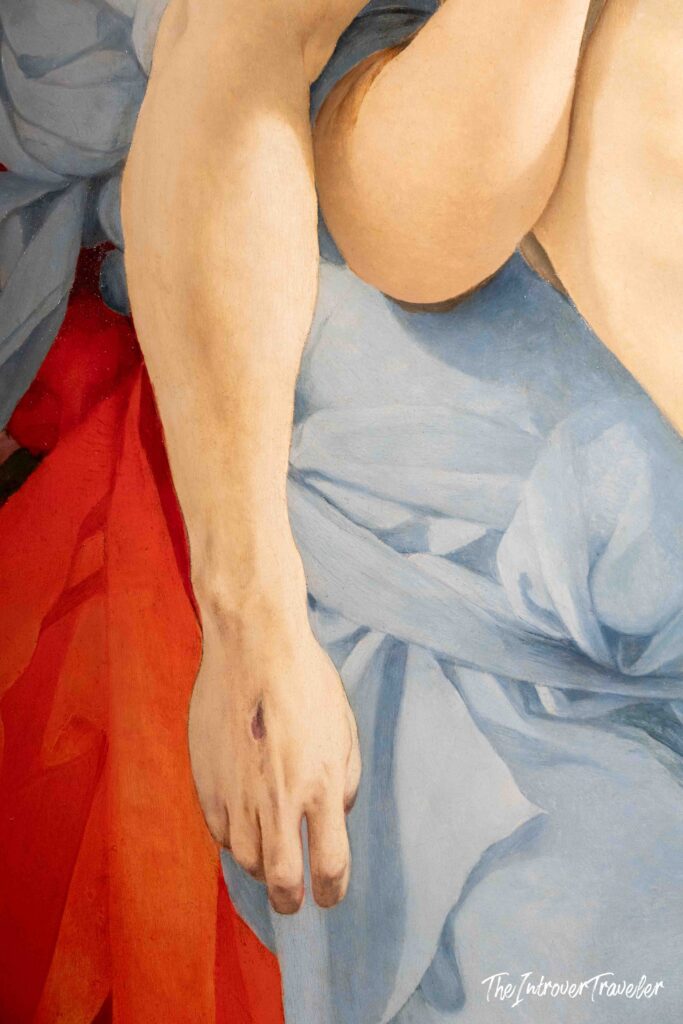
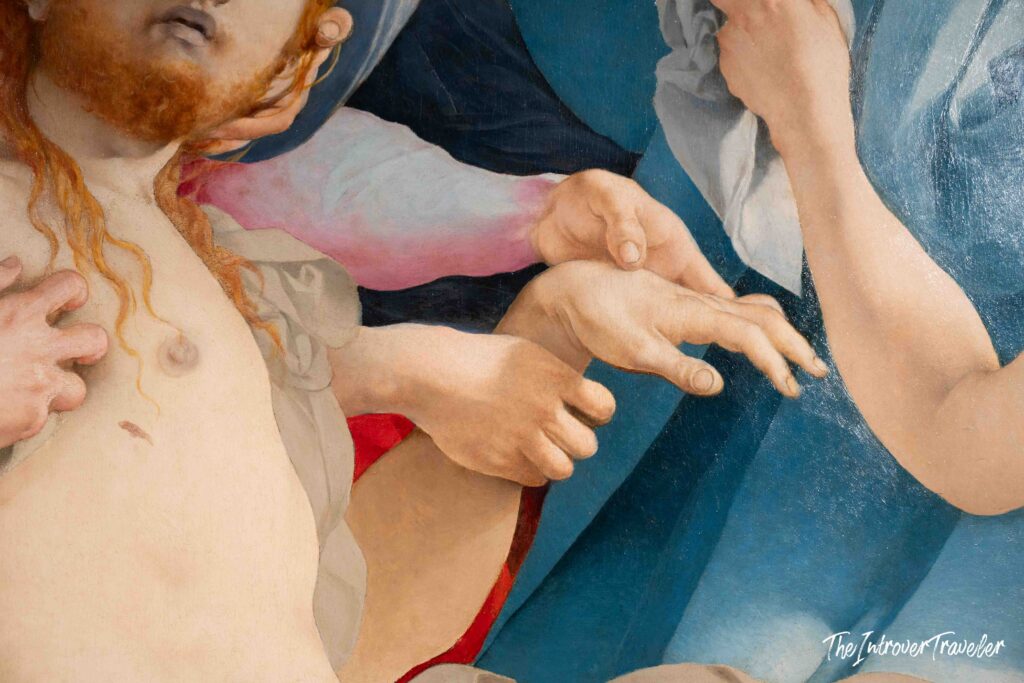
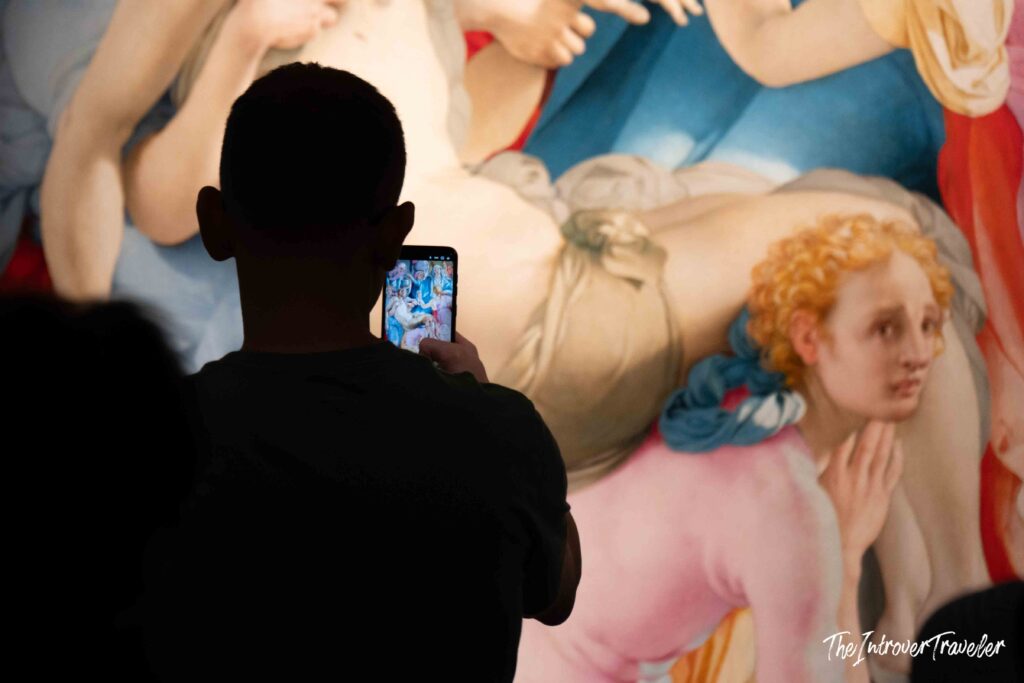
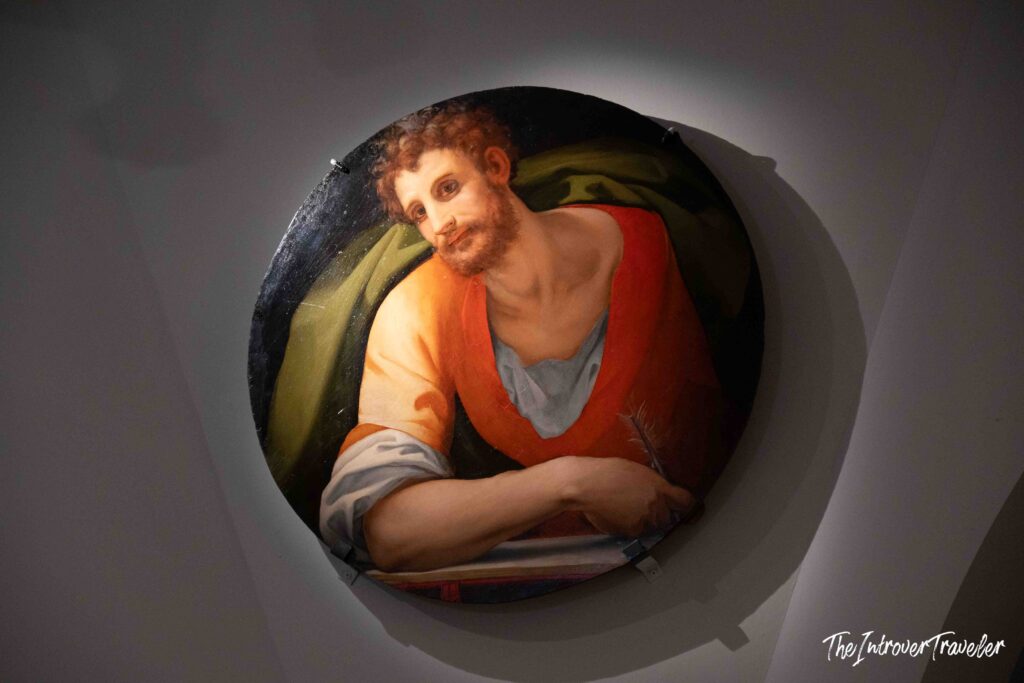
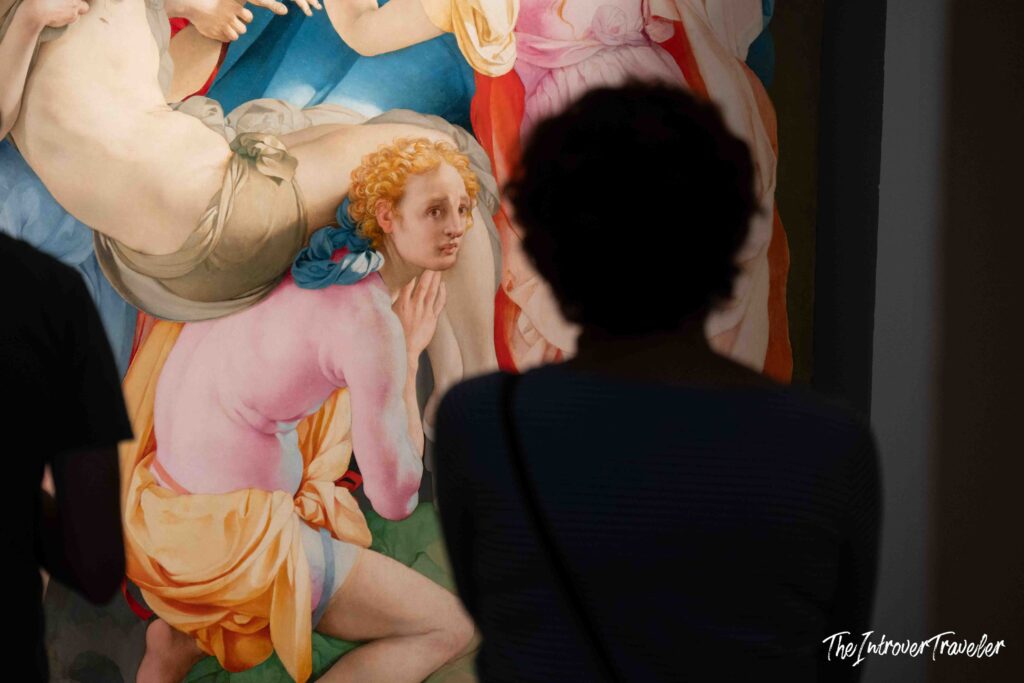
Then comes the thermonuclear detonation of colour. In the middle of the room, inside a reconstruction of the Capponi Chapel with the four tondi of the Evangelists above, stands the Deposition of Santa Felicita, which I have already called, with no beating about the bush, the most beautiful painting in the world. I have not changed my mind; quite the opposite. In Florence, to see it, you cross the Ponte Vecchio, enter a church that tourists heading for Palazzo Pitti walk past without turning their heads, plant yourself in front of a railing and drop a coin into the box that switches on the light for a few minutes. Then the light goes out, you look for another coin, and meanwhile you look at it from a distance, through the bars, like visiting a relative in prison during visiting hours. At the Scuderie there are no bars, the light never goes out and you can get within a millimetre of the panel, or at least until the guard’s look tells you the millimetre is over. And it is an experience that changes your relationship with the painting. Colours that already seemed impossible from afar, the candy pink, the washed-out blue, the acid green, the blazing orange, become almost phosphorescent up close, as if the panel were lit from within. Beneath the paler layers, on the yellow sleeve of the woman seen from behind, the lines of the underdrawing emerge, and for the first time you see Pontormo thinking with chalk in hand before doing so with the brush. You can count the copper curls of the woman turning her back on us, one by one, with the little blue ribbon holding them together.
And then there are the faces. There is no cross, no tomb, no landscape, only a lonely little cloud in an empty sky and eleven figures floating without ever really touching the ground. Christ, with his red beard, closed eyes and half-open mouth, does not look dead: he looks asleep after a very long night. The curly-haired young man holding him by the shoulders stares at us wide-eyed, like someone caught holding something he was not supposed to touch. The Madonna, above, is fainting backwards into the void, and the women around her stretch out their hands without managing to reach her. But the real protagonist is the young man crouching in the foreground, the one in pink, who supports Christ’s legs standing on tiptoe. He turns towards us with an expression of anguish so modern it could be a frame from a Pasolini film. Get closer and look at what he wears under the orange drape: a pair of white briefs. After the British Museum selfie, it is now clear that Pontormo had a very personal relationship with male underwear. On the right, almost hidden at the edge of the scene, a bearded man looks out of the picture: tradition has it that he is the painter himself, a witness who cannot bring himself to step in. Around the panel, meanwhile, a small crowd of visitors photographs it with their phones, without taking their eyes off the screen. It is understandable, but it is a pity. For five hundred years this painting could only be seen from afar, and for a fee, one coin at a time. Now that you can look at it from a millimetre away, the least we can do is actually look at it.
No more bars: the Deposition is free!


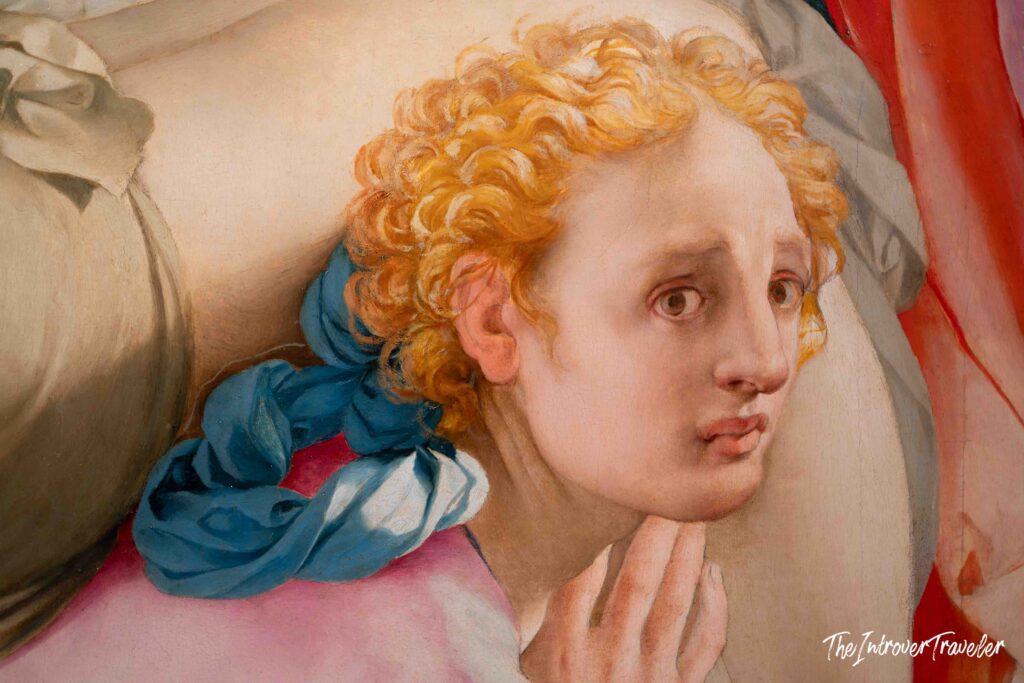
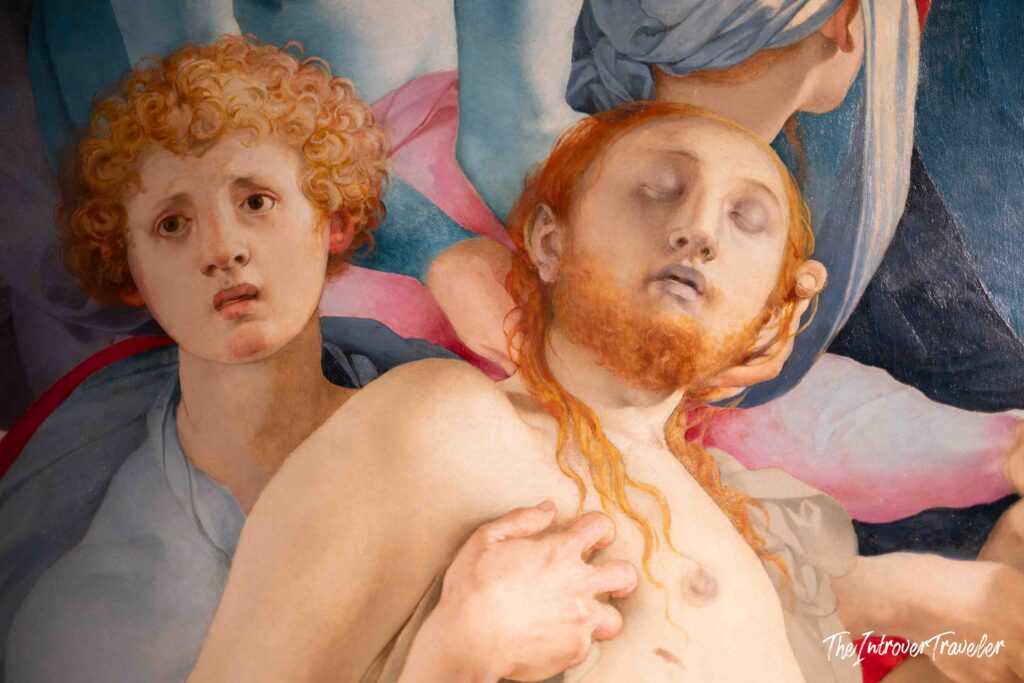
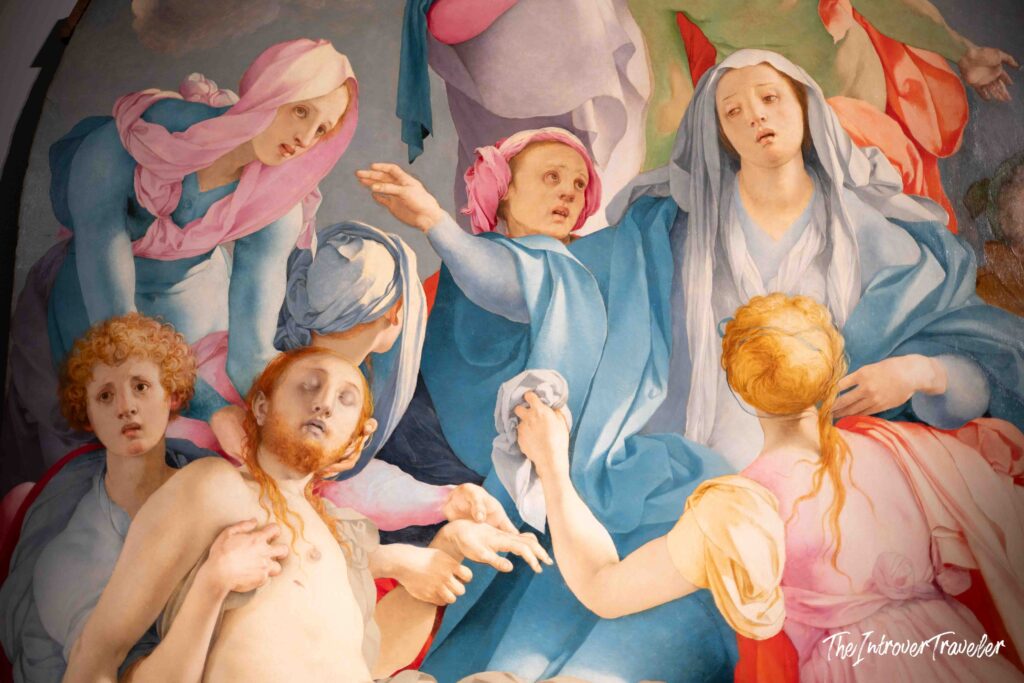
A glitch in the Matrix
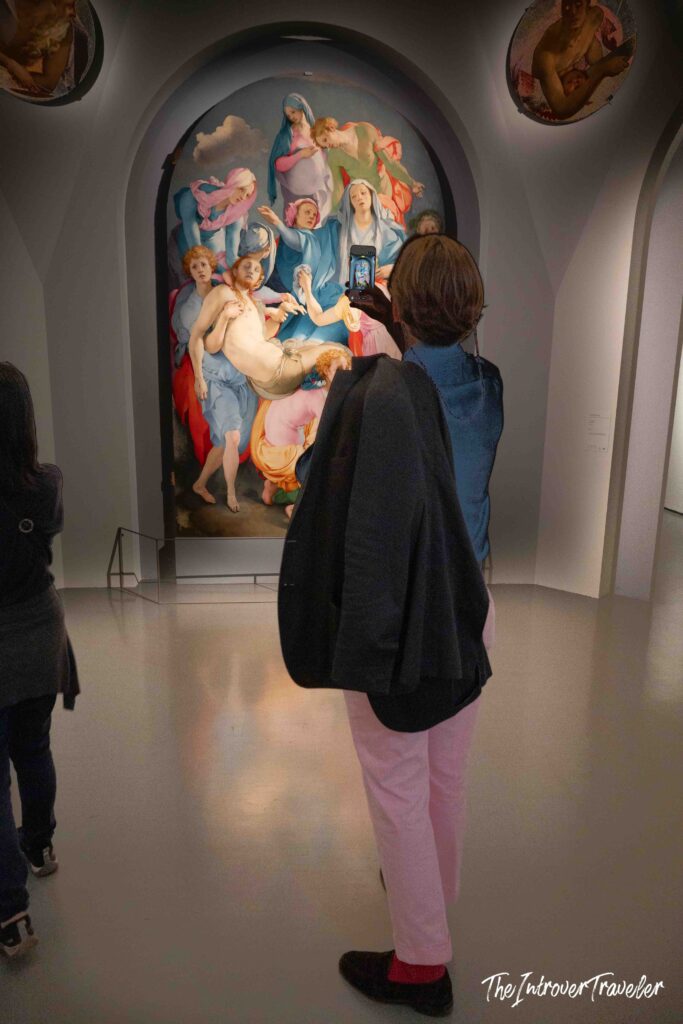
I had barely had time to think of Pasolini’s tableau vivant in La ricotta, the episode of the anthology film Ro.Go.Pa.G. in which a director with the face of Orson Welles recreates on set, in colour inside a black-and-white film, this very Deposition and its twin in Volterra by Rosso Fiorentino. The extras giggle, get distracted and lose their pose, and the sacred collapses under the weight of the ridiculous. And then a glitch opens in the Matrix, an episode of meta-reality, a feat of citation that no curator would have dared to plan. A gentleman in pink trousers and a light blue shirt, in exactly the same hues as the panel, plants himself in front of the Deposition and photographs it with his phone, in an unrivalled performance of mimicry. The pink is that of the young man crouching in the foreground, the blue that of the Madonna’s cloak. To leave nothing to chance, he sports a pair of red socks, the same as the drapes framing the scene. For a moment I wondered whether he had stepped out of the painting, like a character in Woody Allen’s The Purple Rose of Cairo, and was documenting the empty spot he had left in the composition. Pasolini had forced his extras to imitate Pontormo; here it is the audience doing it spontaneously, with no director, no script and without knowing it, or perhaps not. Pontormo has won this one too: five centuries later, it is reality that dresses like his paintings.
Test your eye: Pontormo’s Pantone Guessing Game®
If, after three hours among candy pinks, acid greens and washed-out blues, you are convinced you would recognise a Pontormo from a single shade, it is time to put that conviction to the test. Before the exhibition opened I built Pontormo’s Pantone Guessing Game®, a game in which you have to identify a painting from its colour palette alone. No faces, no figures, no compositions: just swatches. The fewer colours you need to reveal before guessing, the more points you score, which means the paintings that boil down to a single dominant colour are the hardest of all. There are thirteen paintings in total, and many of them are hanging on the walls of the Scuderie right now. Play before your visit and you will walk into the exhibition looking at colour the way Pontormo did; play after and you will find out how much of it actually stuck. Either way, it is the only test in art history where mistaking the Magdalene for a halberdier is considered a perfectly respectable result.
Venus and Cupid, out of the giant’s shadow
Right after the Deposition, Venus and Cupid from the Galleria dell’Accademia in Florence finally gets the attention it deserves. There, poor thing, it is regularly ignored because of the cumbersome marble colossus that shares its room, past which tourists parade with their phones raised without granting it a glance. Here it has a wall all to itself, and it turns out to be one of the most disconcerting works of the sixteenth century. Pontormo painted it in the early 1530s from a cartoon by Michelangelo, during the brief partnership between the two, for the bedroom of Bartolomeo Bettini, a Florentine merchant who dreamed of a room dedicated to the poets of love. He never got it. As soon as it was finished, the painting passed to Duke Alessandro de’ Medici through a sort of forced purchase, the Renaissance way of saying “nice painting, it’s mine now”. The exhibition reassembles the Bettini room for the first time, with the lunettes of Dante and Petrarch painted by Bronzino, which have resurfaced from private collections, and the result is a room more complete than its patron ever saw it. The goddess that emerges is certainly not Botticelli’s ethereal Venus. She is a colossal woman, stretched out on a blue drape, with the shoulders of a shot putter, sculpted abs and the thighs of someone who never skips leg day: the unmistakable mark of Michelangelo’s cartoon, since he drew women starting from male models and added the breasts once the job was done. Cupid kisses her on the mouth with a boldness that today would trigger at least three reports, while she, with her free hand, furtively slips an arrow out of his quiver. In a corner, next to the bow and a vase of roses, two theatrical masks watch us with empty eye sockets: a warning that love is mostly pretence or, more simply, two spectators who did not pay for a ticket. A painting about love in which nobody seems to be in love, painted by a painter who, as far as we know, never was.
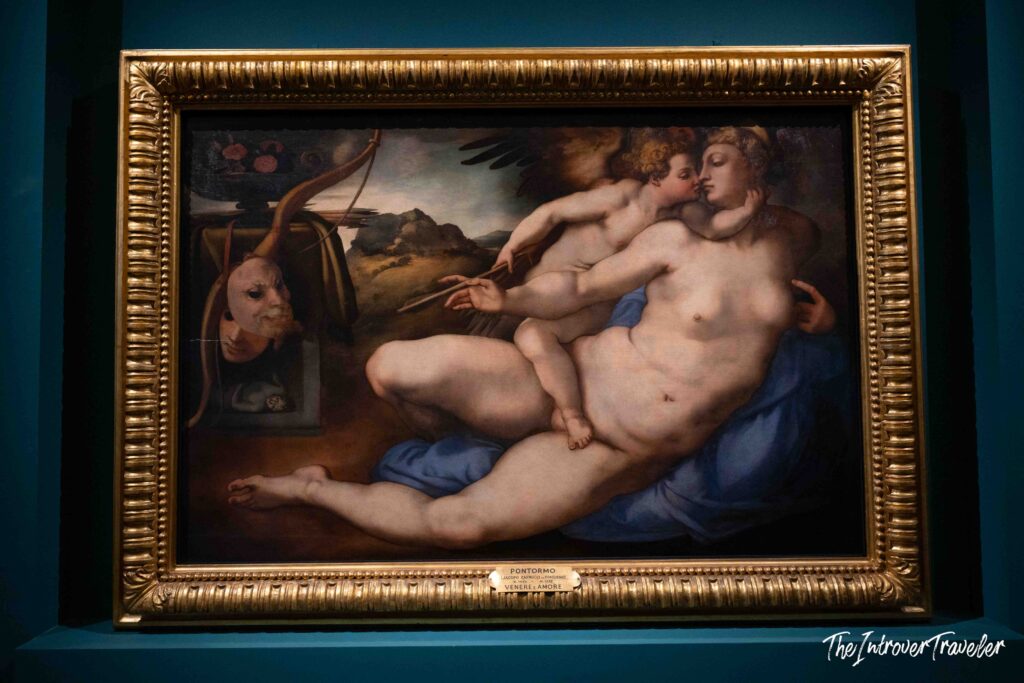
Bronzino steals the show
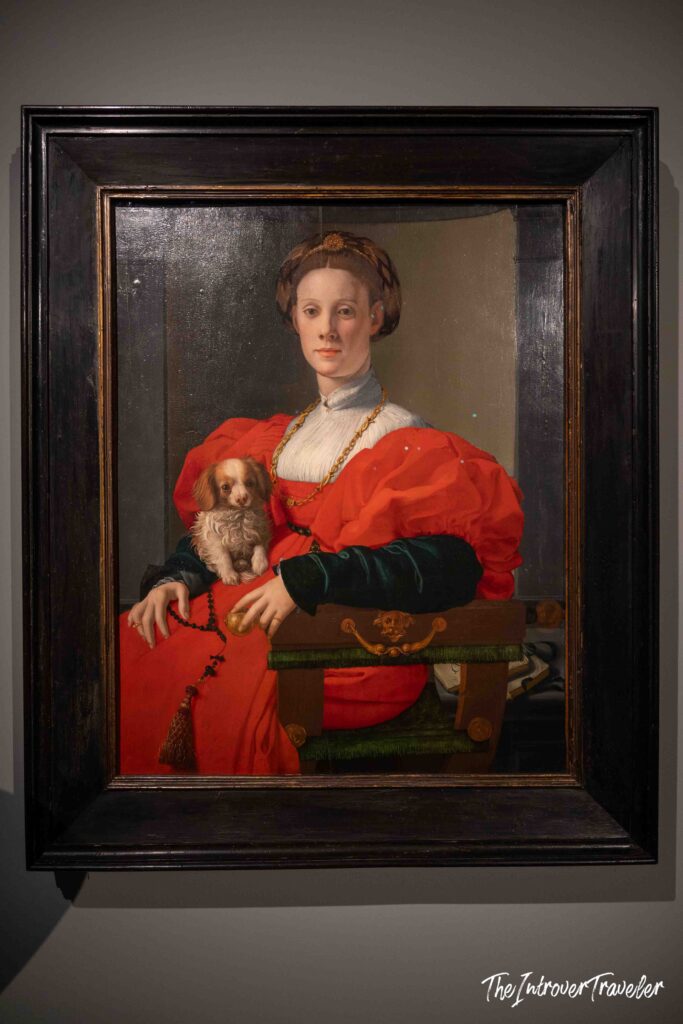
Just as the exhibition documents Pontormo’s debt to Andrea del Sarto, it also tells what Pontormo passed on to his favourite pupil, Agnolo Bronzino. The young Bronzino followed him to the Certosa del Galluzzo, helped him in the Capponi Chapel and ended up becoming the official portraitist of the Medici, the smoothest, coolest and most perfect painter of sixteenth-century Florence. And here the exhibition flexes its muscles, lining up a squad of sensational Bronzinos. I show four of them, and once again I have to do violence to myself not to show you everything. There is the Lady in Red from the Städel in Frankfurt, which until not long ago was attributed to Pontormo himself: that alone tells you how close master and pupil were in those years. She sits bolt upright in a fiery red dress, with sleeves puffed up like hot-air balloons, and looks at us with the expression of someone who has no intention of being understood. The little dog in her lap, on the other hand, is far more communicative than its owner. There is the Saint Michael from Palazzo Madama in Turin, an archangel weighing souls on a pair of scales: on the pans sit two chubby babies, as if at the deli counter, while at his feet a naked man throws his head back. Remember young Pontormo’s Saint Michael from Empoli, with the devil reduced to a frightened toddler? Apparently, in Pontormo’s workshop, the afterlife was populated mostly by infants. There is a Madonna of disarming tenderness, also from a private collection, with the Child grabbing her transparent pink dress and raising his eyes towards her. But if I have to choose, I choose the Crucifix from Nice. For more than a century it sat in the city’s fine arts museum without anyone knowing what it was, until, some twenty years ago, one of the curators of this very exhibition recognised it as the Christ that Bronzino painted for Bartolomeo Panciatichi, described by Vasari and believed lost. It almost looks like a Magritte. There is no Golgotha, no darkening sky, no weeping holy women. Only a cross of polished wood planted inside a grey, deserted architectural niche, and a body as white as porcelain, smooth, intact, with a single drop of blood on the foot. More than a crucifixion, it looks like an object in a shop window, or a dream had in a museum after closing time. All it lacks is a caption in italics reading Ceci n’est pas un crucifix.
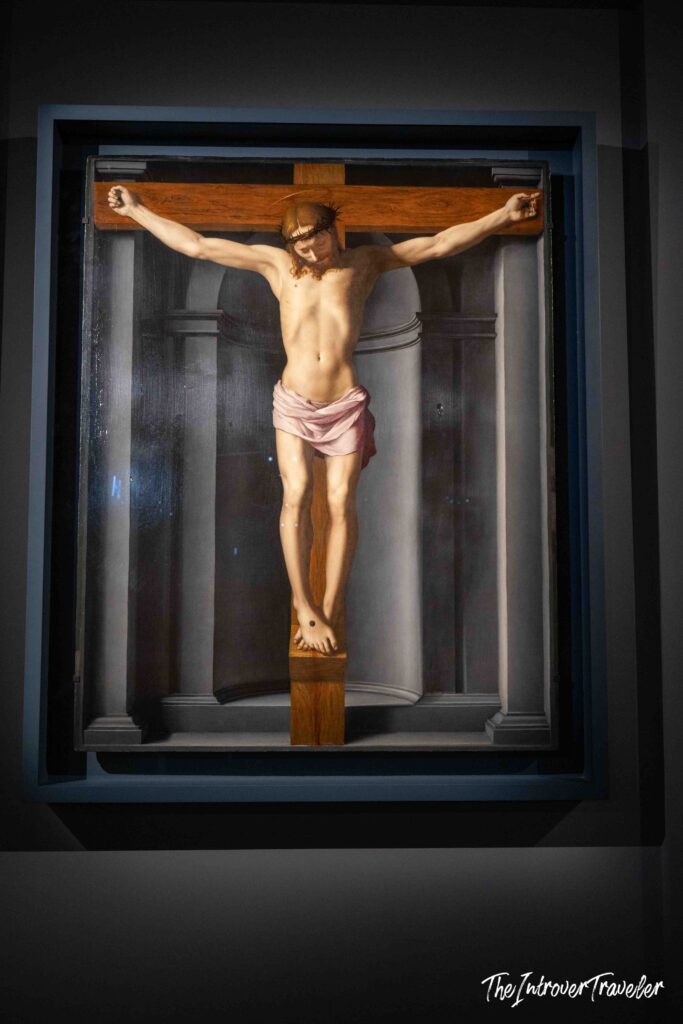
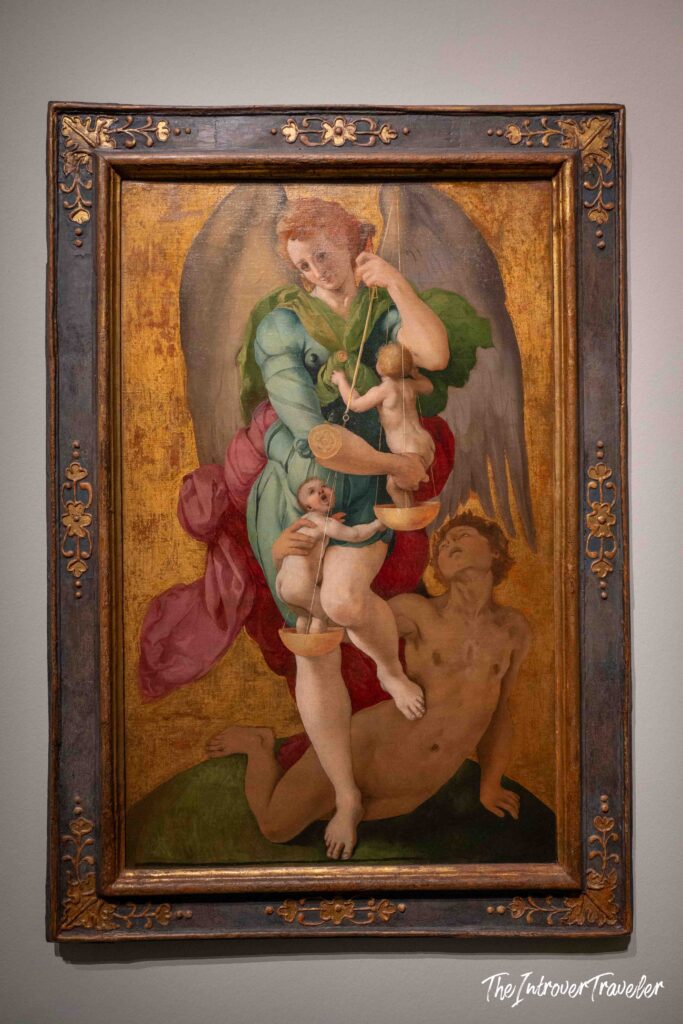
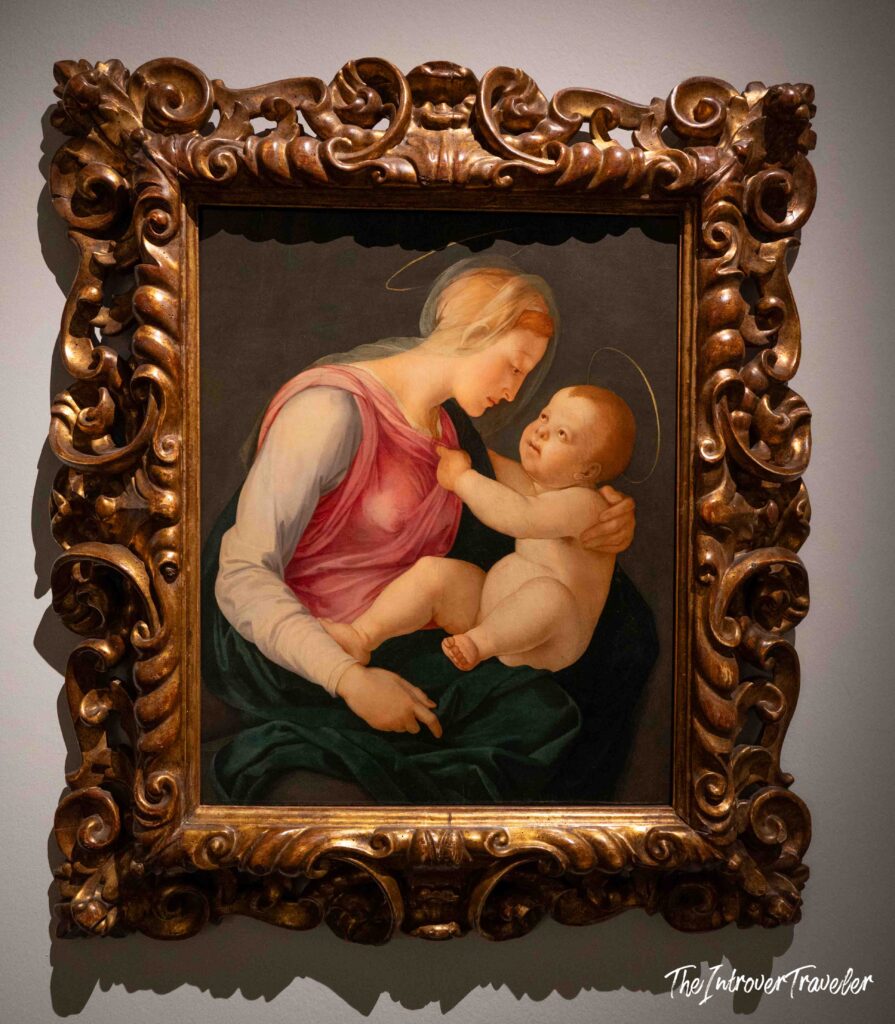
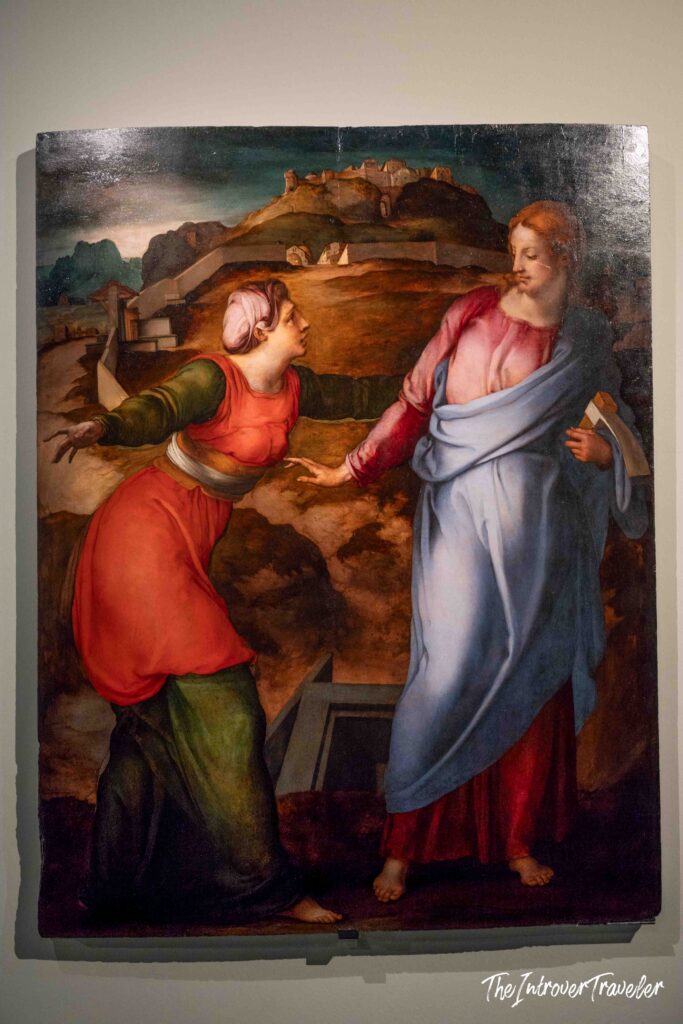
Noli me tangere
The exhibition continues upstairs with Noli me tangere, the second fruit of the partnership with Michelangelo. This painting too was born from one of his cartoons, prepared for a noble Neapolitan patron, and it comes to Rome from a private collection, freshly restored. The catalogue considers only this version autograph and denies Pontormo’s hand in the one at Casa Buonarroti in Florence. I, in my modest way, continue to attribute that one to Pontormo as well on ArtAtlas: if the scholars want to argue, they know where to find me. In any case, we must once again thank the organisers, because here the painting can be seen in all its beauty, whereas the Casa Buonarroti version, because of the reflections of light on its surface, is practically illegible, and you end up looking at it from the side, as you do with your phone screen in the sun. The scene comes from the Gospel of John: on Easter morning Mary Magdalene mistakes the risen Christ for the gardener, recognises him and rushes towards him, and he stops her with that “do not touch me” which for five centuries has also been the unofficial motto of every museum guard. She, in red and green, is a Michelangelesque Magdalene to the core, with the arms of a wrestler and the torso of someone who could lift the tomb on her own. She leans forward with arms wide open and neck stretched out, like someone running to meet a passenger off a train. He, wrapped in a blue cloak, with the gardener’s hoe under his arm, draws back slightly and brushes her with his fingertips, a millimetre away from contact. It is the same empty space between two index fingers that Michelangelo had painted on the Sistine ceiling, only reversed: there the millimetre is the beginning of life, here it is the first documented case of social distancing. Behind them, at the foot of the hill, the empty tomb opens, and at the top a fortified town watches the scene from afar, completely indifferent to the greatest plot twist in Christian history.
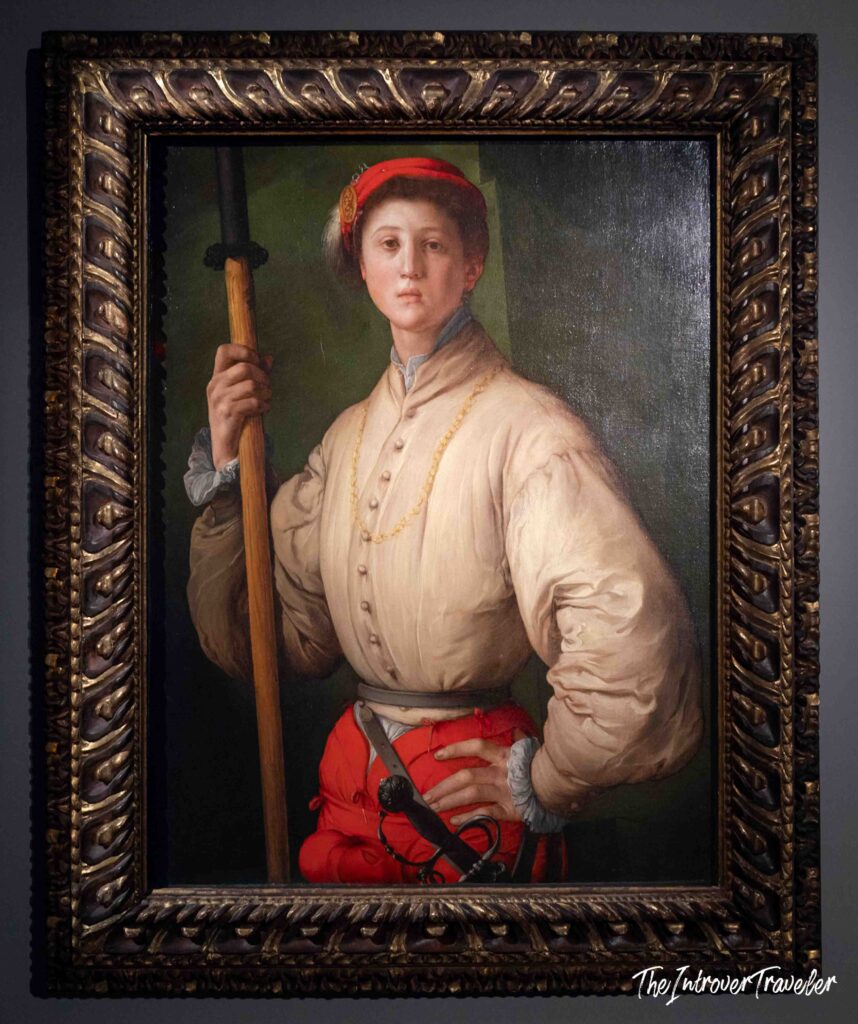
The Getty’s Halberdier
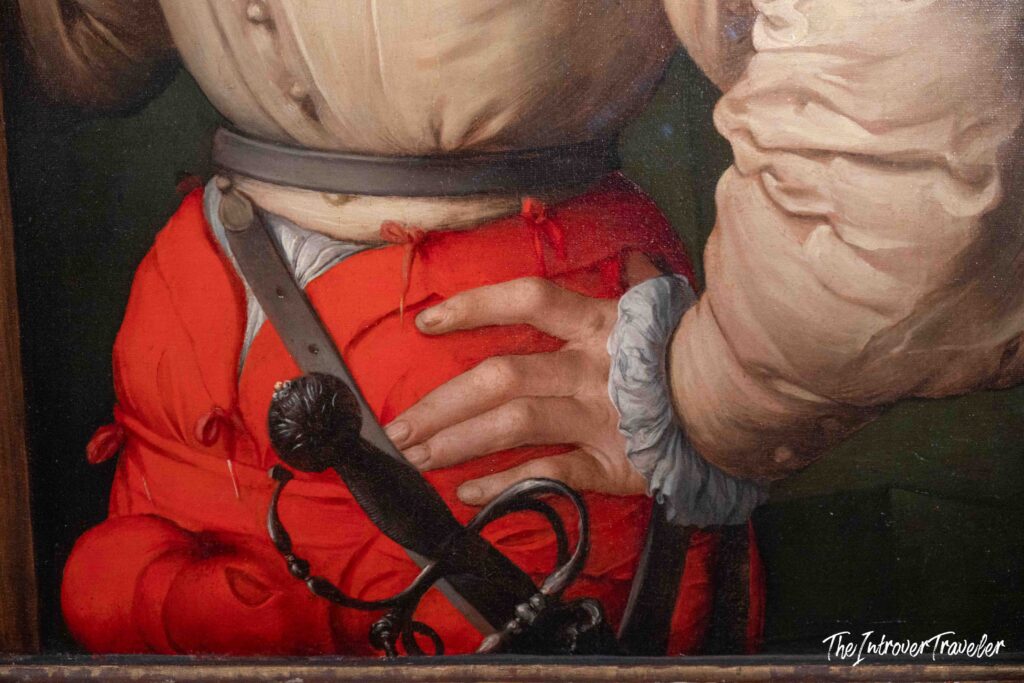
A short stop to see two old acquaintances again. The first is the beautiful Madonna and Child with the Infant Saint John from the Uffizi: a red-haired Madonna holding close two children with decidedly unchildlike expressions. The Child stares into space with glistening eyes, like an adult who has just received bad news, while the young Saint John looks up open-mouthed, as if he had seen something behind us. The second is the tour de force of the Ten Thousand Martyrs from Palazzo Pitti, painted in the very years of the siege of Florence. On a panel little bigger than a wardrobe door, Pontormo crams a battle complete with angels coming to the rescue, a ruler ordering the execution from his throne and, at the top of the hill, a forest of naked bodies crucified on trees. You will not count ten thousand martyrs, but you get the impression that Pontormo really tried, one by one, with the same stubbornness with which he recorded his dinners. And then, in the middle of the next room, the magnificent Halberdier from the Getty shows itself off in all its beauty. A boy in a red cap with a gold medallion, a padded white doublet and fiery red breeches tied with little bows grips the shaft of his halberd with one hand and rests the other on his hip, casually leaning on the hilt of his sword. He looks at us with the bored air of someone who knows he is better looking than we are, and in all likelihood he is. Who he was remains a mystery. Vasari mentions a portrait of the young Francesco Guardi dressed as a soldier, painted during the siege, but some see in him a very young Cosimo I de’ Medici, and the exhibition wisely does not take sides. What is certain is that in 1989 the Getty bought it at auction for about 35 million dollars, at the time the highest price ever paid for an Old Master painting. Not bad for a lad giving himself veteran airs while his city was about to surrender. Get close to the hand on his hip: the slightly reddened knuckles, the sleeve gathering at the cuff, the little red bows of the breeches. It is a tailoring detail, painted with the care of someone who knew that sixteenth-century virility, like today’s, was largely a matter of padding. Seeing it in Rome, one step away, instead of in Los Angeles after a twelve-hour flight, is a gift not to be underestimated.
The second round of drawings
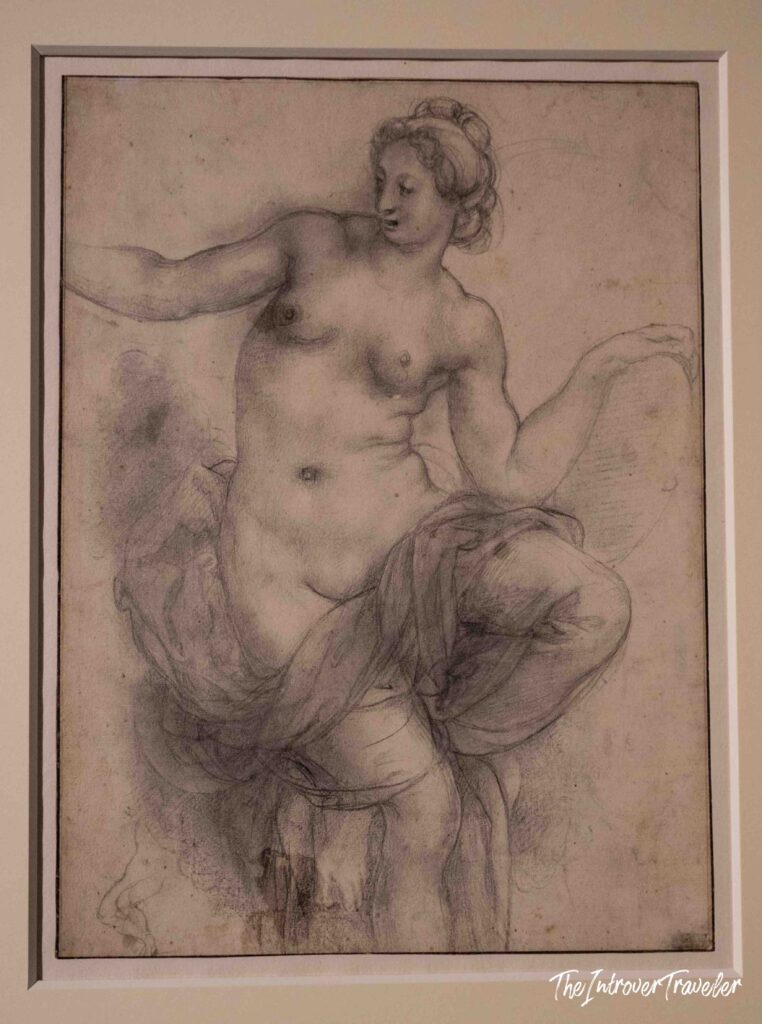
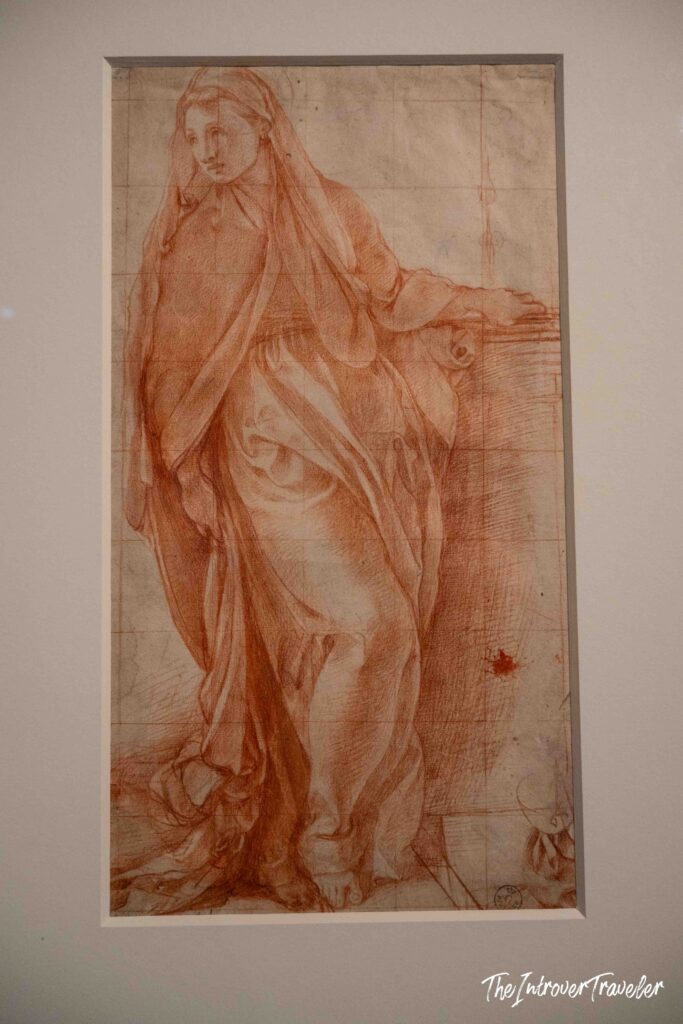
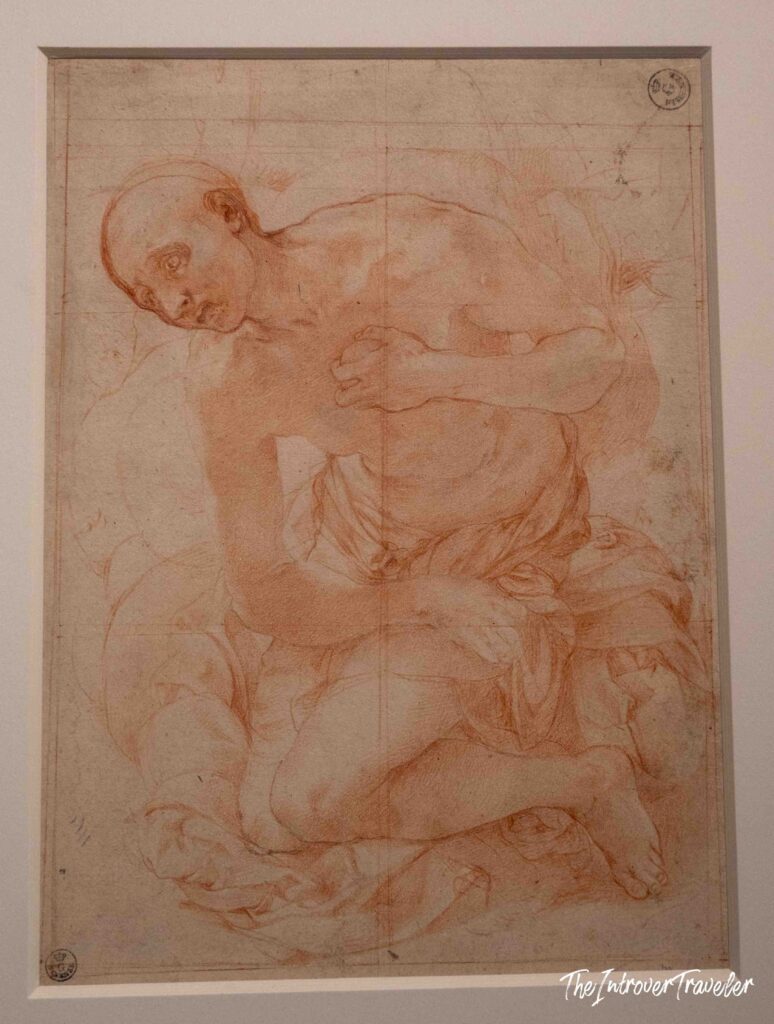
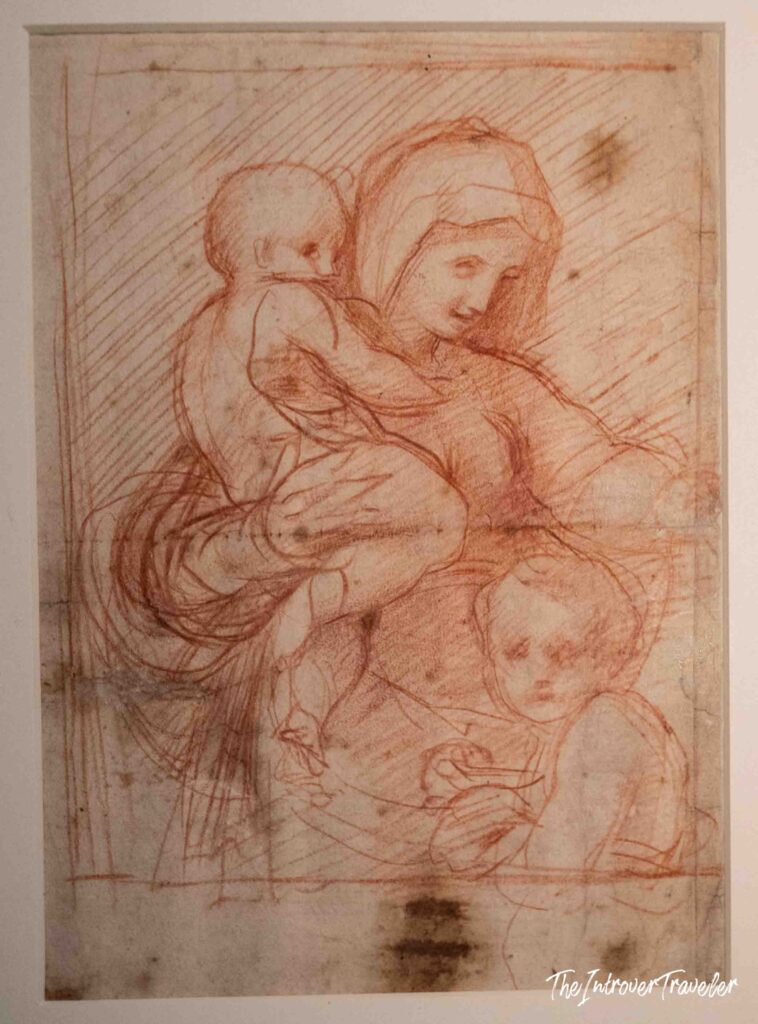
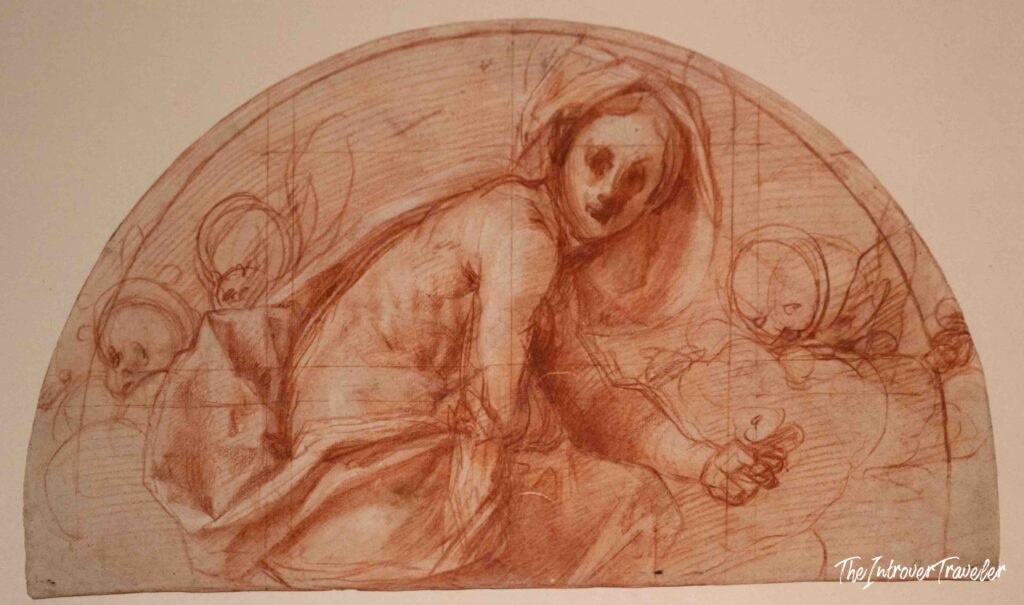
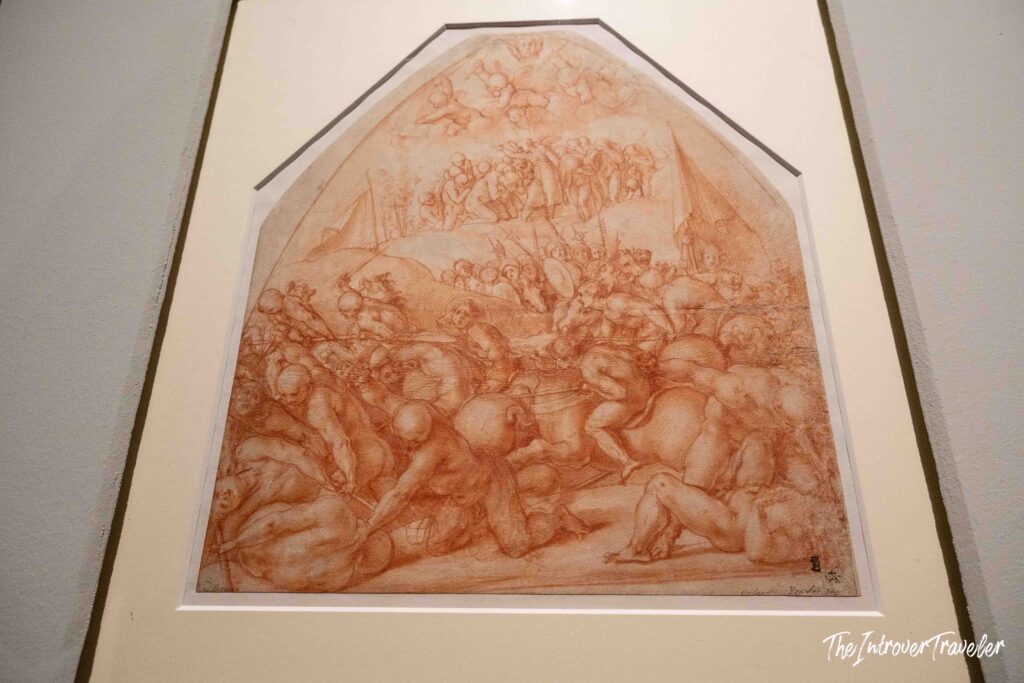
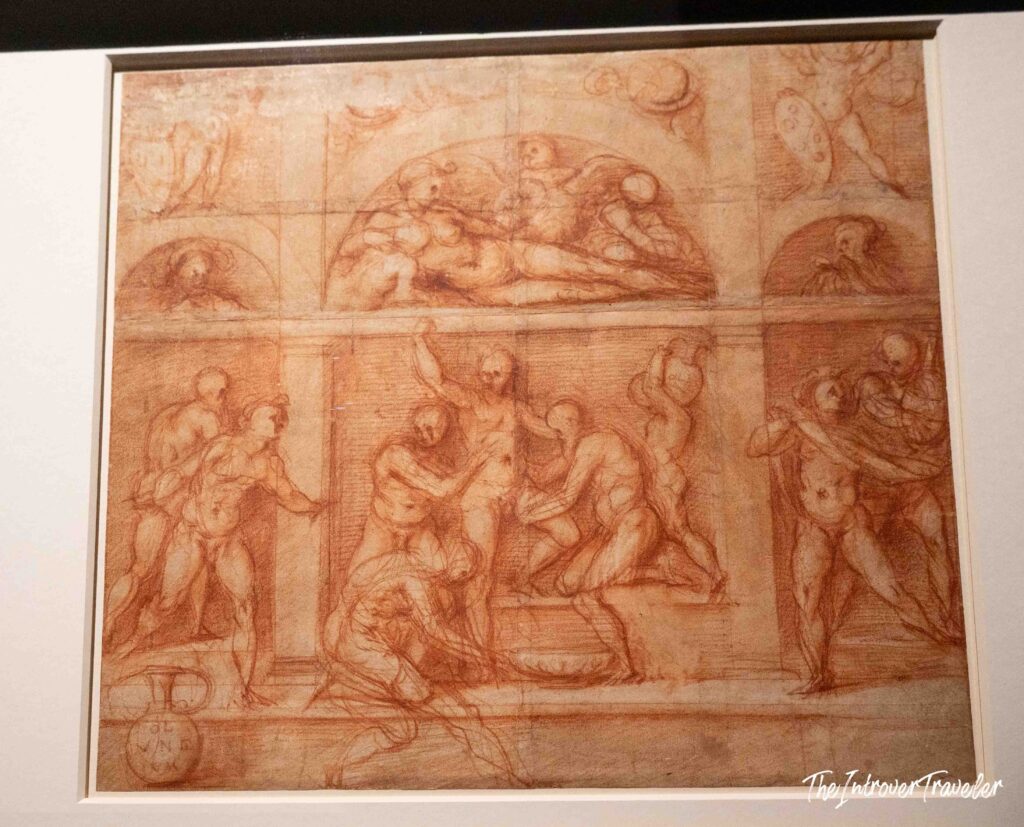
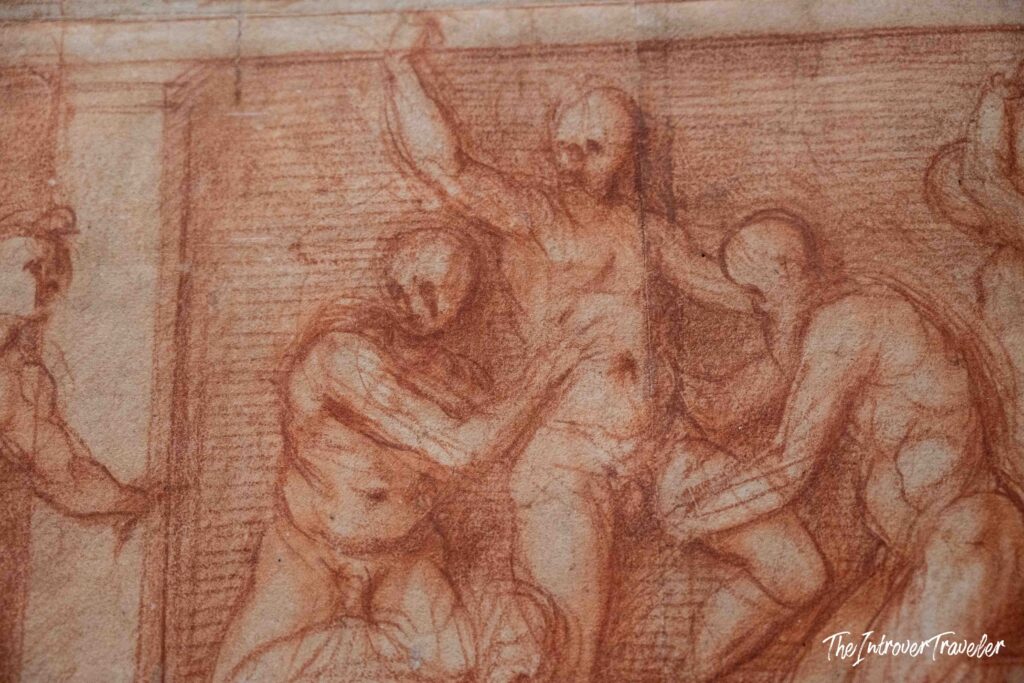
There is no time to catch your breath, though. After the first volley of drawings, each more beautiful than the last, seen downstairs, comes a second one even more sensational, and here Pontormo the draughtsman gives his very best. There is the red chalk study for the lunette of Santa Cecilia in Fiesole: a seated woman, surrounded by barely sketched putti, who turns towards us with a face whose eye sockets are so dark and hollow they look like a skull’s. She is a close relative of the Eve in the grisaille seen at the beginning, and perhaps the most unsettling thing in the whole exhibition, which, in an exhibition on Pontormo, is no small record. There is a female nude in black chalk with a boxer’s torso, broad shoulders and prominent abs, thought to be a study for a Prudence. A completely naked Prudence, which says a lot about how prudent she was. There is the Virgin of the Annunciation frescoed in the Capponi Chapel, a few metres from the Deposition: standing, wrapped in drapery that falls to the ground in very deep folds, covered by a grid of fine lines. That is the squaring used to transfer the drawing at full scale onto the wall, the Renaissance equivalent of copy and paste. There is the bald kneeling man, a study for the Saint Jerome in the Landesmuseum in Hanover, who clasps his hands to his chest and stares at us wide-eyed, like a penitent caught halfway through repenting. There is the quick, almost feverish sketch for the Uffizi Madonna and Child with the Infant Saint John we have just seen: a few strokes of red chalk and the whole composition is already there. There is the black chalk study for the Saint Michael of Pontorme, the one crushing the devil-toddler underfoot, with his sword raised and the demon upside down. And there is a sheet nobody has yet managed to decipher: the design for an entire decorated wall, with lunettes, niches, writhing naked figures and, in a corner, the inevitable coat of arms with the Medici balls, because even on paper you had to remember who was paying. The catalogue, for lack of anything better, calls it Scene of Anointing: if anyone has better ideas, art historians have been listening for five hundred years. And then there is the sheet that closes the circle: the red chalk study for the Ten Thousand Martyrs, with the horses, the banners, the soldiers, the bodies piled up in the foreground and, at the top of the hill, the martyrs kneeling beneath a swarm of angels. We have just seen the painting in the next room, and comparing it with the drawing is like witnessing the birth of an idea: it is already all there, whole, and the brush simply obeyed. I think back to the Madrid catalogue I mentioned: these rooms are its flesh, bones and red chalk version.
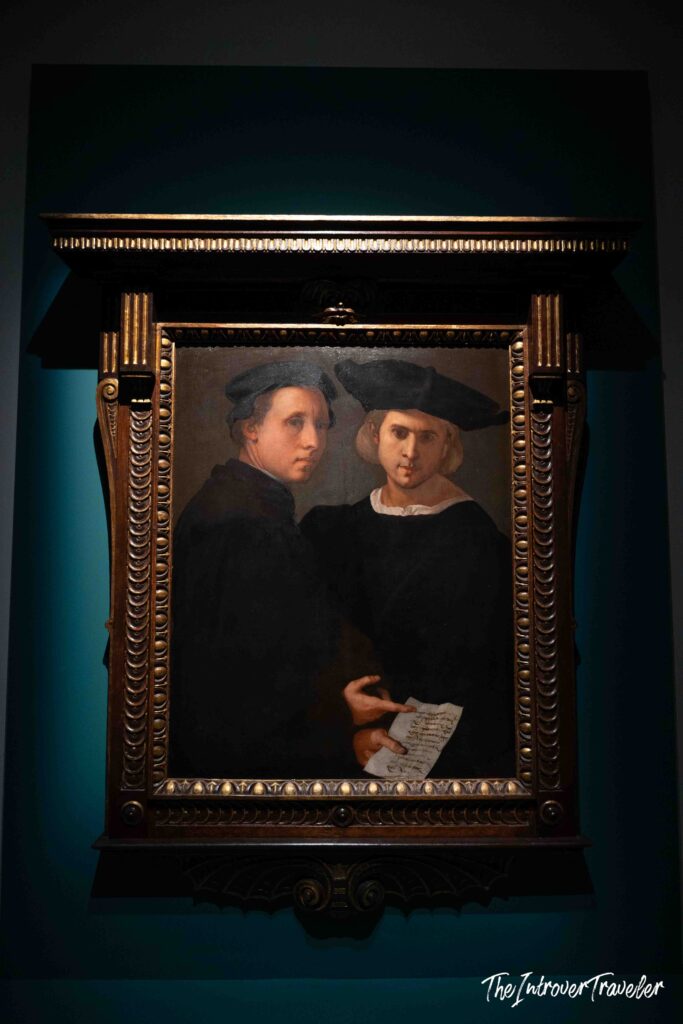
Two Friends
From the gallery of portraits I will mention only one work, particularly dear to me for its charm: the Double Portrait from Palazzo Cini in Venice, known to everyone as Two Friends. Two young men dressed in black, caps pulled down on their heads, pose shoulder to shoulder against a dark background, like a souvenir photo before leaving for military service. The first turns three-quarters and looks at us sideways, with the air of someone deciding whether to trust us. The second stares at us frontally, serious, his eyes slightly red like someone who stayed up too late. At the centre of the composition is a handwritten sheet: one of them holds it, the other points at it. Another pointing finger, after the selfie in underpants: Pontormo must have had a weakness for that gesture. The sheet apparently carries a passage from Cicero’s De amicitia, the treatise on true friendship, the kind founded on virtue rather than interest. Who the two were remains a mystery, and perhaps it is better that way: the painting does not tell the story of two people, it tells the story of a bond. Today some would read who knows what innuendo into it; Pontormo, to dispel any doubt, put Cicero himself on it, with the same ease with which people today quote an Instagram line under a photo with their best friend. No velvets, no jewels, no lapdogs: two black caps, two faces and a piece of paper. And yet it is one of the most intense portraits of the sixteenth century, and one of the few that, five centuries later, you feel like sending to a friend.
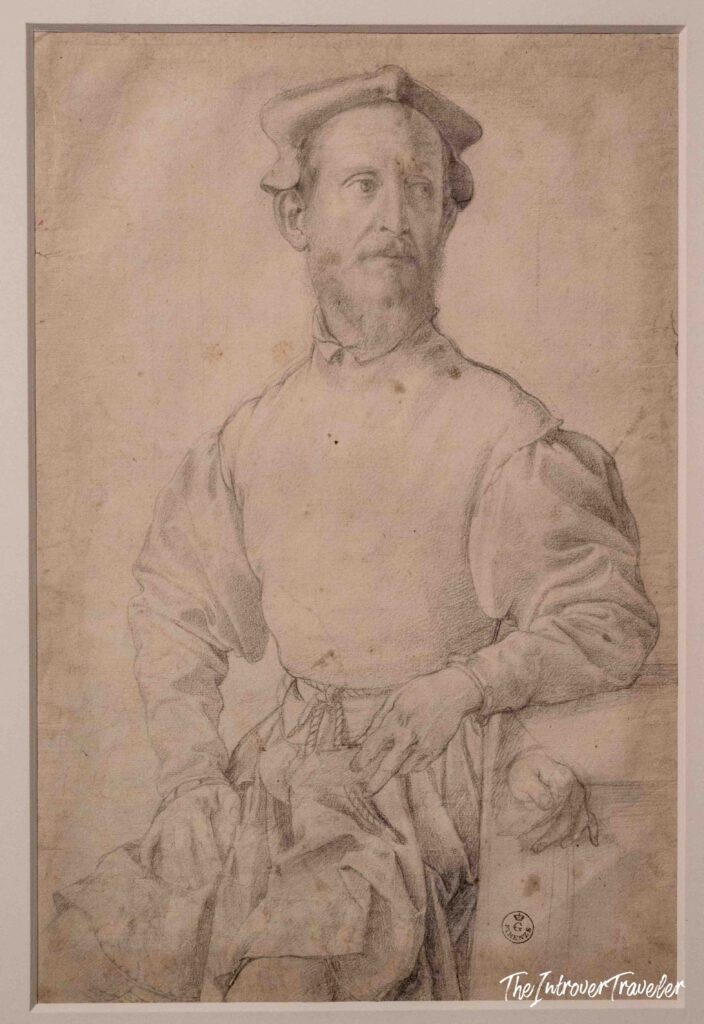
Pontormo, properly dressed
As we head towards the end, a beautiful black chalk drawing by Bronzino stands out among the last sheets. A middle-aged man with a short beard and a floppy cap leans on a parapet and gazes into the distance, past our shoulder, with the thoughtful air of someone who has just remembered leaving the oven on. According to some, it is a portrait of Pontormo, drawn by his pupil with the affection and precision of someone who knew him better than anyone. If it really is him, the comparison with the British Museum selfie is irresistible. Twenty years on, the thin boy in underpants who pointed his finger at us has grown a beard, put on a dignified robe tied at the waist and a respectable citizen’s cap, and stopped making fun of us. This time, in short, Pontormo has turned up properly dressed. But the look has stayed the same: that of someone who, in the middle of a crowd, keeps minding his own business.
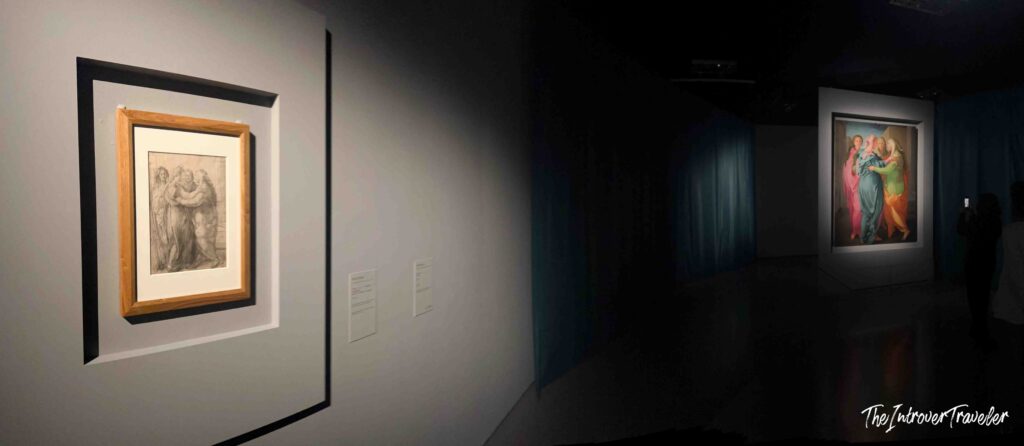
The Visitation and its drawing
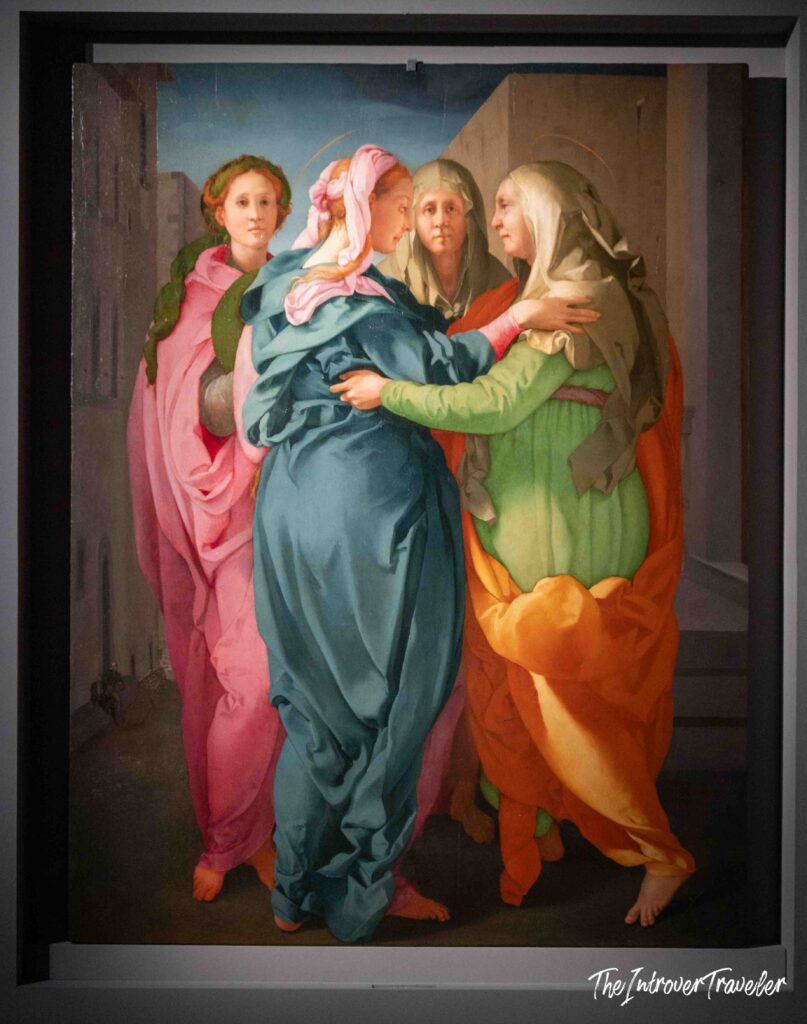
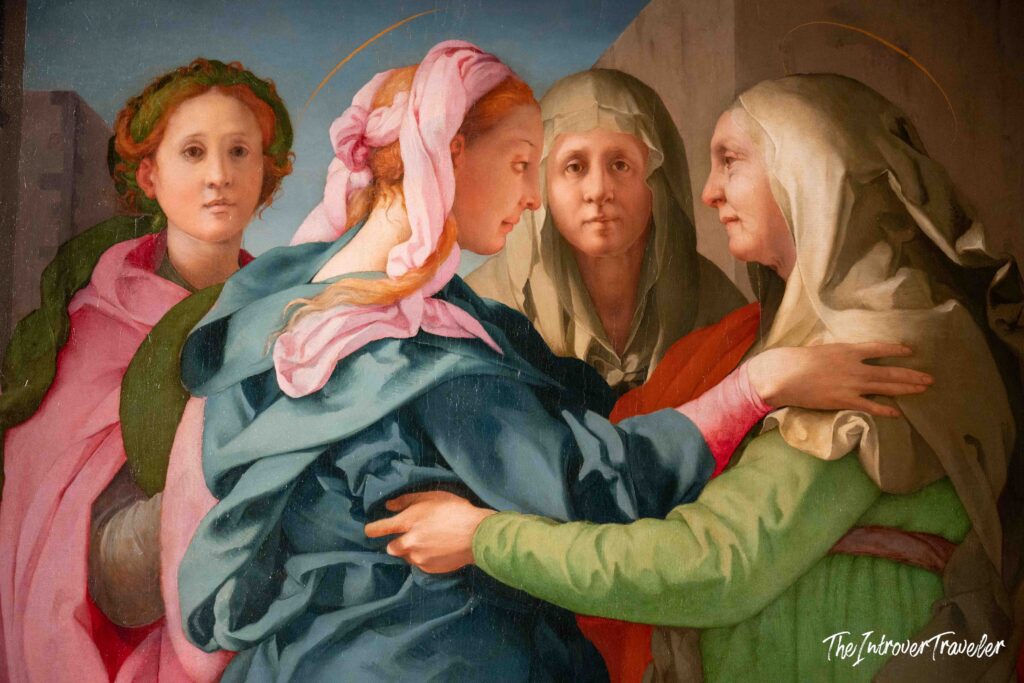
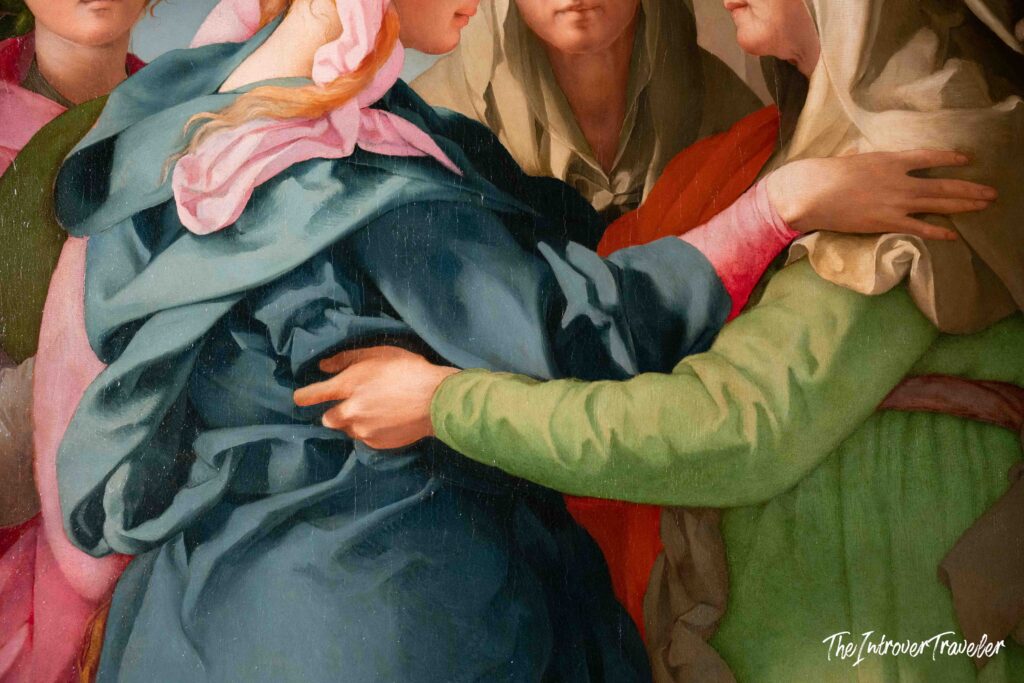
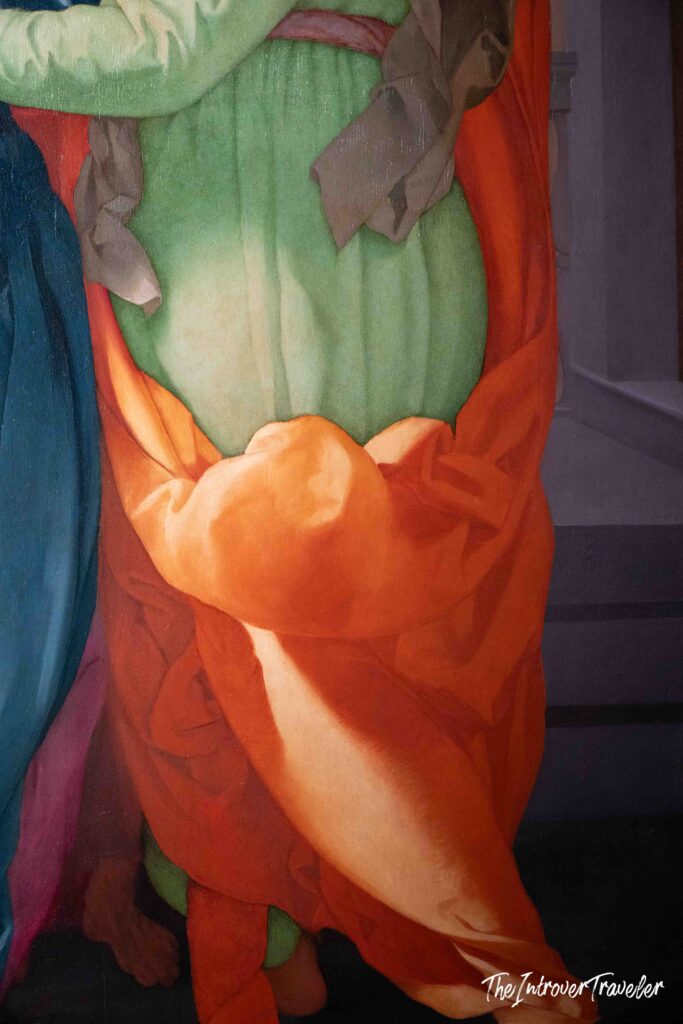
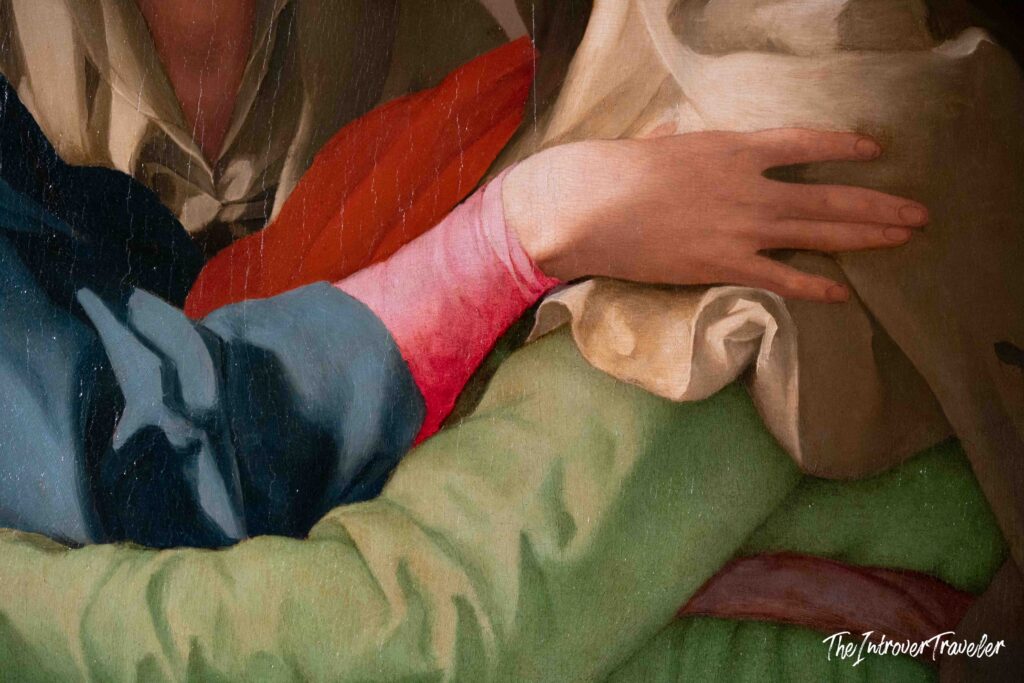
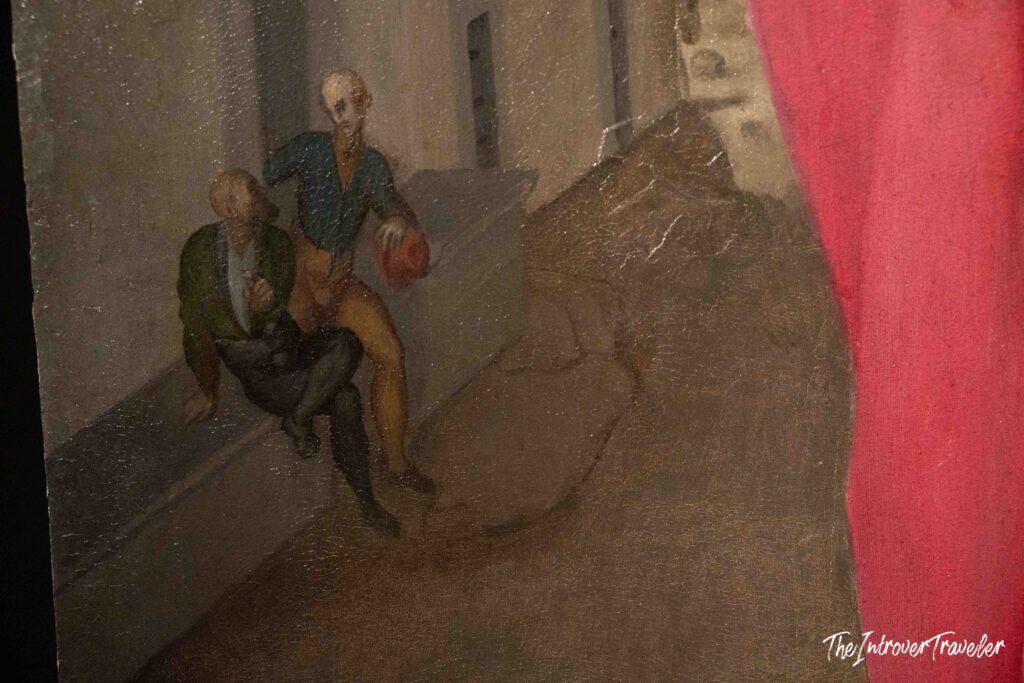
And just as the Deposition of Santa Felicita closed the first floor in the most sensational way, the work that competes with it for the title of Pontormo’s most famous masterpiece closes the exhibition for good: the Visitation of Carmignano. Here too you can admire it in all its splendour, almost close enough to touch. The subject is simple: Mary, pregnant, visits her cousin Elizabeth, also pregnant, and the two women embrace. Pontormo turns it into something halfway between a dance step and a dream. Mary and Elizabeth seek each other’s gaze in profile, wrapped in enormous cloaks, peacock blue for one, acid green and orange for the other, swelling like sails. Behind them two attendants, motionless and frontal, stare straight into our eyes, like the reflection of the protagonists in a mirror. Two women looking at each other, two looking at us, and the awkward feeling of having walked into a private moment without knocking. Up close you discover details that in the church at Carmignano you can only imagine: Mary’s hand resting on Elizabeth’s shoulder, the pink cuff peeping out of the blue sleeve, and the very fine web of cracks running across the panel. In the background opens a deserted city street, with a windowless building that Giorgio de Chirico could have signed four centuries later. At its foot, tiny, two men sitting on a step, they too almost out of de Chirico’s brush, chat to each other, completely indifferent to the supernatural event taking place a few metres away: two pensioners on a bench, as in any Italian village square. But the real treat the organisers give us is something else. Next to the panel hangs the magnificent preparatory drawing in black chalk, covered by the squaring used to transfer the composition to full scale. You look at the sheet, then turn your head towards the painting, then go back to the sheet, and you follow with your own eyes an idea becoming a masterpiece. The composition is already all there, but with one difference that alone is worth the trip. In the drawing the two attendants in the background have wide eyes and the frightened look of someone who has just seen a ghost. In the painting they have calmed down, and that motionless, slightly unsettling stillness is exactly what makes the Visitation so hypnotic. Outside this exhibition the comparison would be impossible: the panel goes back to its church in Carmignano, while the drawing goes back to the Gabinetto dei Disegni e delle Stampe of the Uffizi, where the public does not normally see it. And if you are in the mood for an encore, the Visitation also has a contemporary echo a few kilometres away: until early February, in the church of Santa Maria Antiqua in the Roman Forum, Bill Viola’s The Greeting is on show, the video installation that restages this embrace in slow motion, five centuries later.
When to go (and when not to)
A few final considerations of a practical nature. I visited the exhibition on a Friday, a few days after the opening, with a 3 pm entry. The first round took me two hours, taking all the time I needed; not satisfied, I did a second round in an hour, which explains the three hours in the info box. Between 3 and 5 pm the exhibition was almost empty, which could not make an introvert with a marked misanthropic streak any happier. After 5 pm (it was a working day, after all, even if this is Rome) the rooms started to fill up, while remaining far from the siege of Bernini and the Barberinis, where I would gladly have gone armed with a truncheon. It would be a real shame if attendance did not grow, not least because it would end up granting the wishes of a lady I came across at the entrance. At 1 pm she had tried to get in using a discount for public employees, and had been courteously invited to come back after 5 pm. In front of me, the sole and very fortunate spectator, she then launched into a visceral and virtuoso display of coprolalia: pyrotechnic pairings of Middle Eastern deities with farmyard animals, seasoned with wishes of an ill fate for the exhibition and its organisers. As for me, I had also tried to get in at 1 pm despite having a ticket for 3 pm, and was firmly turned away, even though the rooms were rather empty at the time. A zeal more Swiss than Roman, whose good intentions I nonetheless appreciated, and which, unlike the lady, did not inspire me to combine the sacred with the henhouse. So the advice is simple: a weekday, early afternoon, a booked ticket and your time slot respected to the minute. Pontormo, who recorded in his diary every egg he ate, would have approved.
Where to eat near the Scuderie del Quirinale
If instead, like me, you turn up at the wrong time and are sent back with losses, two minutes’ walk from the Scuderie there is Ristorante Santa Cristina. I have not yet decided whether it deserves a review of its own on this blog and a place in the Flâneur itineraries. The service is anything but impeccable, and the value for money cheerfully borders on usury. But I missed the abbacchio a scottadito the next day, when I put Enzo al 29, one of the most popular restaurants in Trastevere, to the test. Exaggerating a little, it almost reminded me of the lamb you eat in the shadow of Hagia Sophia in Istanbul, which, for a restaurant a stone’s throw from the Quirinale, is no small geopolitical compliment. Add to all this a quiet and pleasant Roman alley, far from the routes of tourists armed with selfie sticks. Pending the final verdict, let’s say it is the right place to console yourself after a refused entry: you leave with a lighter wallet and a decidedly better mood.
While lingering over lunch at Santa Cristina as I waited for my time slot, I shamelessly eavesdropped on two art exhibition professionals sitting at the next table. The two curators were lamenting that over 70% of art exhibition visitors worldwide are now over 70, and that the market is dying. This hardly surprises me, considering that the foul-mouthed public-sector employee whose furious tirade I had witnessed at the exhibition entrance, after she had been denied some privilege she believed herself entitled to, claimed to be an art history teacher. All the more reason to flock to the exhibition: I promise this will be the one time I won’t complain about overtourism.
Related posts:
 Bernini and the Barberinis: Art, Power, and Invention in the Baroque. Review of the exhibition at Palazzo Barberini.
 The Borghese Gallery: a complete guide. What to see, what can fairly be criticised, and why the building is worth as much as the art
 Michelangelo Buonarroti, the total artist (and his real torments)