Vatican City. The Sistine Chapel, the Raphael Rooms, the Laocoön, the Pinacoteca, imperial porphyry and six million people in single file. What is really worth seeing, how long you need, how to get in without booking weeks ahead, and why no other museum on earth can stand the comparison.
Transparency: this post contains Amazon, Viator and Tiqets affiliate links. If you buy a ticket through them I earn a small commission, at no extra cost to you. It doesn’t change my opinions one jot: I actually used them, and if they hadn’t worked I would have told you.
If you are reading this Vatican Museums guide, you are probably about to visit, and your main goal is probably to see the Sistine Chapel. But if you think you are going to the Vatican Museums just to see the Sistine Chapel, you are badly mistaken.
The Vatican Museums are not a museum with the Sistine Chapel inside. They are the largest and most layered collection of art ever amassed by a single institution over five centuries, housed in one of the most sumptuous palaces ever built, and the Sistine Chapel is probably their main chapter, not their summary. The official website lists twenty-six museums, collections and spaces open to visitors: from Egyptian mummies to Francis Bacon, from Assyrian reliefs to celestial globes, from Greek vases found in Etruscan tombs to the private apartments of the most talked-about pope of the Renaissance. It is, quite literally, a museum of museums.
Vatican Museums guide in a nutshell: what you need to know in thirty seconds
- Last visit: February 2026 (my fourth)
- Verdict: MUST SEE. There is no trip to Rome that can afford to skip them.
- Time needed: at least a full day on a first visit. On the fourth visit of my life I took 5 hours, moving more quickly through some sections. To see them properly would take a week, and that is not a figure of speech.
- Opening hours (as of October 2026): Monday to Saturday, 8:00 to 20:00, last admission 18:00. Closed on Sundays, except the last Sunday of the month (9:00 to 14:00, last admission 12:30, free entry).
- Tickets (as of October 2026): €20 full price at the ticket office, €25 with the online “skip the line” booking on the official website; reduced €10 (€15 with booking). Free for under-7s.
- Booking: recommended weeks in advance. If you haven’t booked, there is the trick I used: last-minute Vatican Museums and Sistine Chapel tickets on Tiqets.
- Dress code: shoulders and knees covered. The Sistine is a chapel, not a beach.
- Photography: allowed everywhere except the Sistine Chapel, where the custodians keep watch with commendable zeal.
- Avoid: the last Sunday of the month (free, therefore a stampede) and, if possible, Fridays and Saturdays.
- Who it’s for: everyone. For the novice who wants to see the Sistine Chapel and for the art lover who wants to get lost between a porphyry sarcophagus and a Carolingian ivory.
- Website: museivaticani.va
- Skip the line ticket: Tiqets
- Guided tour: Tiqets
The itinerary, built and verified
Planning a trip to Rome?
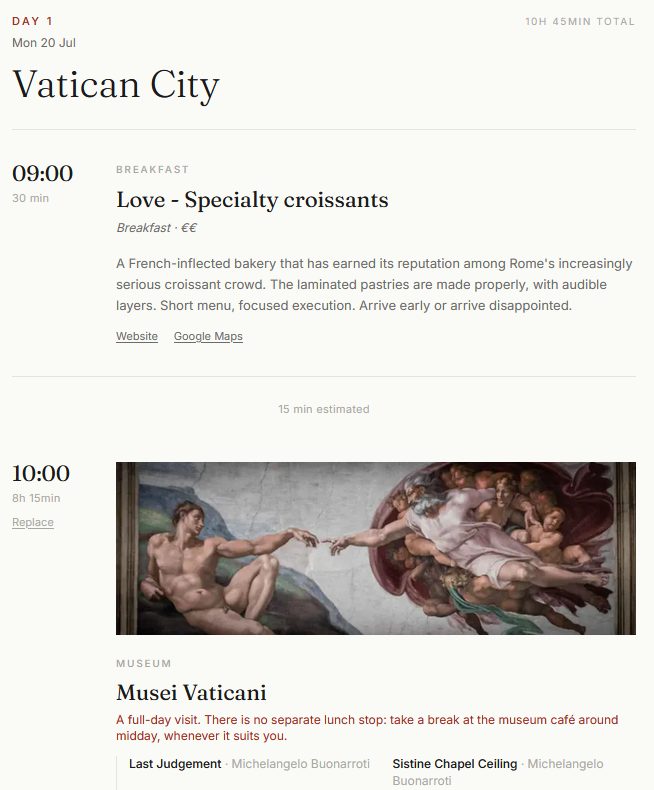
Art is the reason you’re going to Rome? Flâneur is the art itinerary generator built on The Introvert Traveler’s research: every place in the city where art is worth your time, including the minor churches, side chapels and small museums nobody tells you about, organized into an efficient personalized Rome art itinerary. Answer a few questions about how deep your interest runs and what your days should look like, and it maps the route, complete with real opening hours, church closures, transfer times and booking links.
Meals aren’t left to chance either: lunch and dinner breaks come from the restaurants recommended on this blog, not from whoever bought the top spot on a review site. Prefer to compose the day yourself? Pick the Expert profile and choose from every artwork indexed in Rome.
What are the Vatican Museums?
Let’s put it this way. Imagine that for five hundred years the same institution, immensely rich, cultured, obsessed with its own image and endowed with a sense of patronage that no king or emperor ever matched, bought, commissioned, excavated, received as gifts, requisitioned, plundered and accumulated art without ever throwing anything away. Then imagine that it displayed all of this inside its own official residence, a palace that is itself a work of art, frescoed by the greatest painters in history. There you have it: the Vatican Museums.
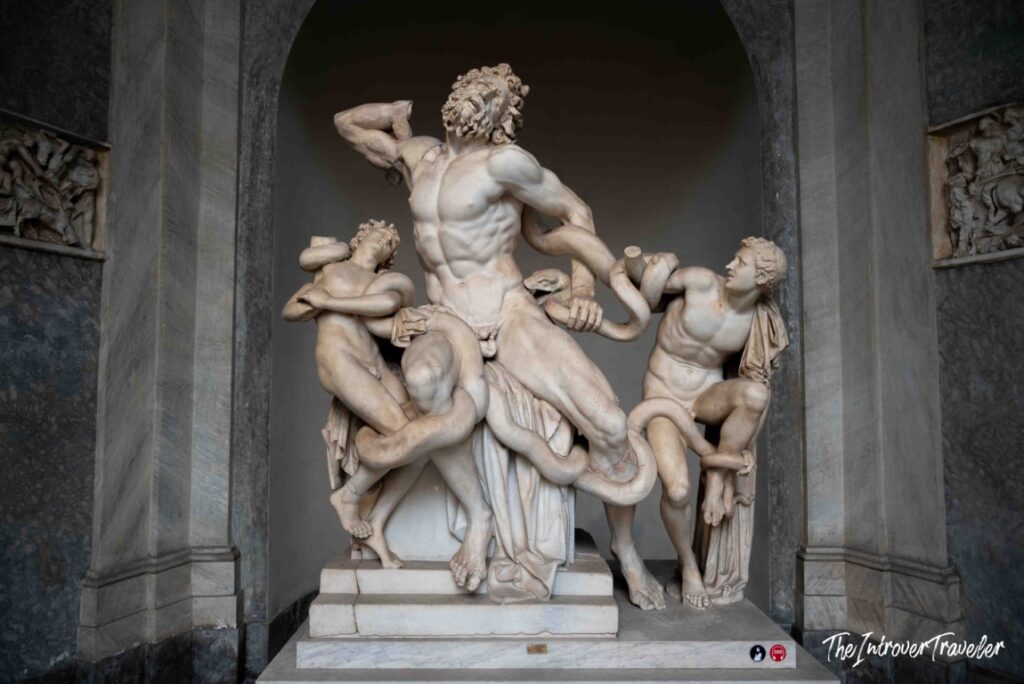
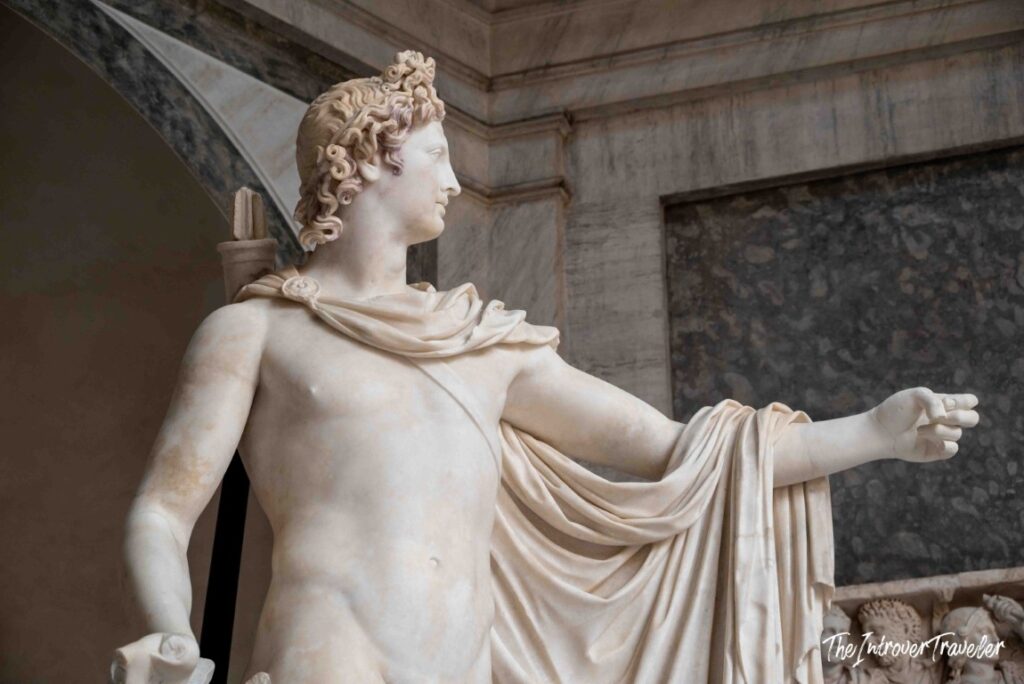
The conventional date of birth is 1506. In January of that year, in a vineyard on the Esquiline Hill, the sculptural group of the Laocoön came to light; Pope Julius II bought it and placed it in the Belvedere courtyard, alongside the Apollo and other ancient statues. And so, in the Octagonal Court, the first nucleus of the Vatican sculpture collection was born (the Octagonal Court is still there, and it is one of the high points of the visit). Over the following centuries every pope added something: Gregory XIII the Gallery of Maps, Clement XIV and Pius VI the Pio-Clementino Museum in the eighteenth century, Pius VII the Chiaramonti Museum and the Braccio Nuovo, Gregory XVI the Etruscan and Egyptian Museums, Pius XI the new Pinacoteca in 1932, Paul VI the modern art collection in 1973.
The result is an encyclopaedia, but an encyclopaedia written by many hands, in different eras, with different tastes, and therefore far more interesting than a museum designed on a drawing board. You will find the Egypt of the pharaohs and the Assyria of the warrior kings, the Greece of black-figure vases and the Etruria of bronzes, the Rome of the emperors and of the martyrs, the Middle Ages of ivories and the Renaissance of Raphael and Michelangelo, the seventeenth century, the nineteenth, the twentieth century of Dalí and Bacon. All of it along a route that, at a normal pace, crosses kilometres of rooms, corridors and galleries.
The figures confirm what experience suggests. In 2025, according to The Art Newspaper’s annual ranking, the Vatican Museums were the second most visited museum in the world with 6,933,822 visitors, behind only the Louvre. Almost seven million people in a year, most of whom, as we shall see, saw very little of what they paid for.
An observation, not an exaggeration: you would need a week
Now my thesis, and I want to be clear that this is not travel-blogger hyperbole. The Vatican Museums alone would require a week. It is a matter of arithmetic.
The Raphael Rooms alone would take a whole day to observe every figure, every secondary character, every frieze, every grisaille on the dado, every face Raphael hid in the crowd. In the Sistine Chapel alone you could easily spend half a day looking at every figure Michelangelo painted on the ceiling, then on the wall of the Last Judgement, and there would still be the frescoes on the side walls by Botticelli, by Perugino, by Ghirlandaio… The sections of Early Christian art, the globes, the Greek vases, the Etruscan bronzes, the Egyptian antiquities would deserve to have every single piece examined carefully, because every single piece is of excellent quality. The Pinacoteca alone is worth the trip to Rome.
The reason is simple: the Vatican Museums concentrate the artistic heritage accumulated by the Papacy over the centuries, and for five hundred years the Papacy was the greatest patron of art on the planet. The vow of poverty, evidently, applied to someone else.
How it compares with the world’s other great museums
To understand what makes the Vatican different, just do an honest exercise with the other great museums of the world, the ones everyone puts in the same category.
In the world’s leading museums, the truly “headline” works, the ones people buy a ticket for, are relatively few. At the Uffizi most visitors go for Botticelli’s Venus and Primavera; add Michelangelo’s Doni Tondo and Leonardo’s Annunciation, and the rest is mostly material for enthusiasts. At the Louvre there is the Mona Lisa, there are Michelangelo’s two Slaves, and then kilometres of masterpieces that the crowd walks past without looking. At the Accademia in Florence there is the David. At the Rijksmuseum there is the Night Watch. I don’t say this to belittle anyone: it is simply how the mass public uses museums, hunting for the icon to photograph.
At the Vatican Museums there are at least four heavyweights, and each one alone would justify the trip:
- The Sistine Chapel, which needs no introduction.
- The Raphael Rooms, one of the absolute peaks of Western painting.
- The Pio-Clementino Museum, with the Laocoön, the Apollo Belvedere and the Belvedere Torso, three ancient sculptures that quite literally invented the Renaissance.
- The Pinacoteca, with Raphael, Leonardo, Bellini, Caravaggio, Crivelli and Melozzo da Forlì.
To these you have to add a fifth element, one no guidebook lists because you can’t hang it on a nail: the magnificence of the palace itself. Floors of polychrome marble, Roman mosaics, frescoed and gilded ceilings, galleries as long as streets. You could visit the Vatican without looking at a single exhibit, gazing only at the walls, ceilings and floors, and still come out dazed.
How the visit works: a one-way route
There is a fundamental difference between the Vatican Museums and almost every other great museum in the world, and you should know it before you go in.
At the Louvre, the Metropolitan or the British Museum you move around freely: you choose a wing, you go back, you skip a floor. Not at the Vatican. The route is largely constrained, you proceed from one room to the next along an essentially fixed itinerary, and going back is difficult and sometimes impossible, not least because you would be swimming against a river of people. In practice everyone sees more or less the same rooms in the same order; the only variable is how much time each person decides to give each work.
This has a few consequences. First of all, you cannot go in, see the Sistine Chapel and leave. Secondly, when people talk about the suggested length of a visit, the time is partly dictated by the physical time needed to walk the whole route: even if you crossed the museum without stopping to look at a single work, I think you would need at least two hours to reach the exit.
My last visit, the fourth, lasted 5 hours. Knowing the route already, I moved more quickly through some sections, concentrating on what I wanted to see again or had neglected on earlier visits. Anyone going for the first time should allow a full day and accept from the outset that they will not see everything with the attention it deserves.
Tickets, queues and the last-minute trick
The Vatican Museums are victims of their own success, and the entrance proves it. Even with a pre-booked ticket there are airport-style security checks, with fairly long queues at peak times. Without a booking, in high season, the queue at the ticket office can become a mystical experience of a different kind.
The golden rule is to book weeks in advance on the official website, the only official channel for online purchases. But what do you do if, as happened to me in February, you find yourself in Rome with a few hours to spare and suddenly decide to go?
I booked with Tiqets while I was walking to the museum. Tiqets holds a “stock” of tickets already purchased, with time slots available even when the official website shows sold out, and resells them at a slight mark-up on the official price. You pay a little more, but you get in. For anyone short of time, or anyone who doesn’t plan trips with the precision of a military operation, it is the most practical solution I know.
Book your Vatican Museums and Sistine Chapel ticket on Tiqets here
If you would rather be accompanied, Tiqets also offers a full guided tour of the Vatican Museums, Sistine Chapel and St Peter’s Basilica.
Two warnings. First: beware of websites with names similar to the official one that sell tickets at inflated prices; the museum itself warns against this. Second: on the last Sunday of the month entry is free, and the result is exactly what you would imagine. If you value your mental health, avoid it.
As I mentioned, this post is based on an unplanned visit I made in February 2026. Finding myself with a free afternoon in Rome and my camera with me, I bought a last-minute ticket through Tiqets and visited the main areas of the museum, skipping those that I consider less essential and that I had already seen on previous visits.
Later in the post, I give the approximate times at which I passed through the various galleries, while bearing in mind that I still devoted plenty of time to places such as the Raphael Rooms, the Octagonal Court and the Sistine Chapel, which, no matter how many times you have seen them, can never simply be rushed through.
The visit, room by room
The Gregorian Egyptian Museum and the Assyrian reliefs: a few minutes, not one mediocre piece
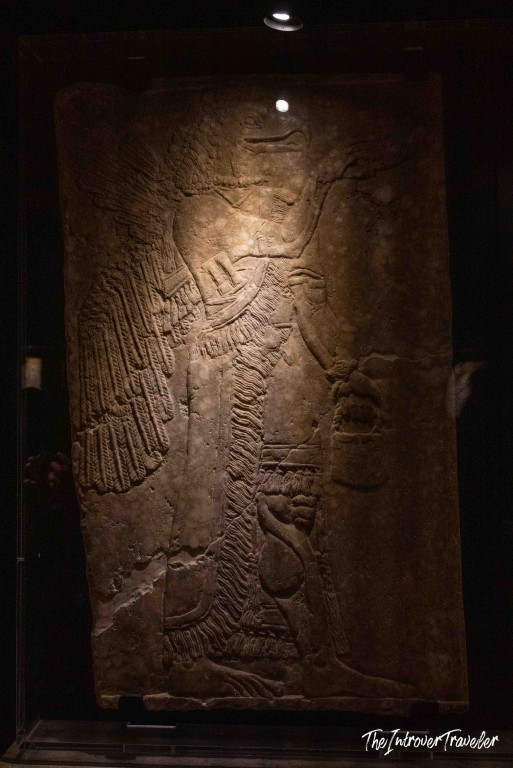
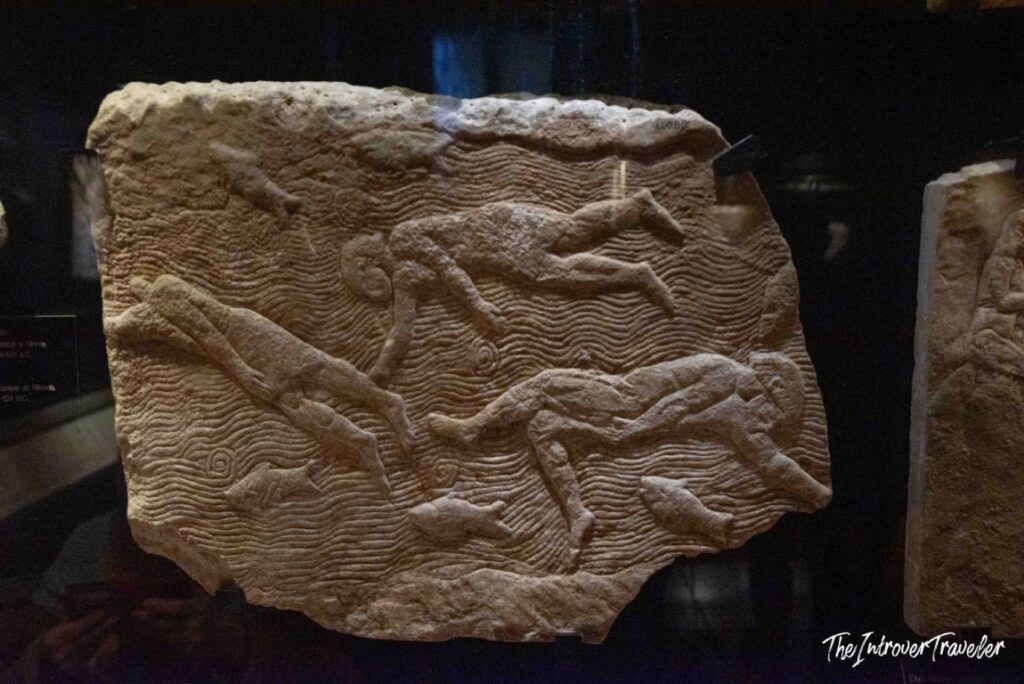
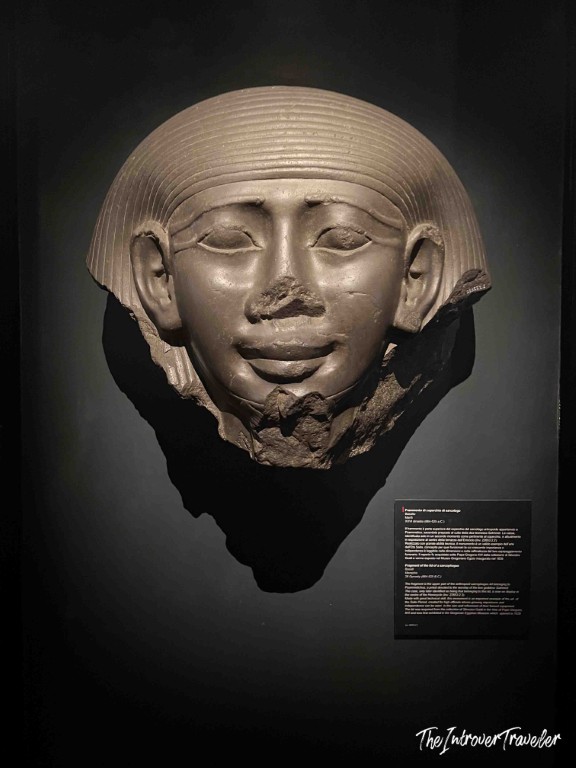
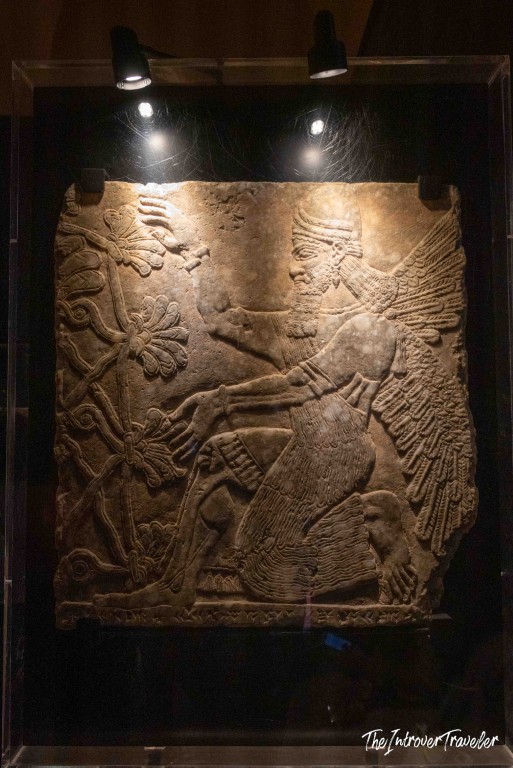
For many, the visit begins with a small wing devoted to Egypt and the ancient Near East. It is a section you cross in a few minutes, and most visitors walk through it with their eyes already fixed on the Sistine Chapel, like someone who walks into a Michelin-starred restaurant and ignores the starters to get to the dessert sooner.
A mistake. And here, for the first time, the trait shared by the whole complex emerges: there are no mediocre works in the Vatican Museums. I was in Egypt recently, I visited both the Egyptian Museum in Tahrir Square and the new Grand Egyptian Museum in Giza, and I can say it with some authority: the pieces on display here have nothing to envy those in Cairo. Of course, Cairo has the quantity, Tutankhamun and an entire civilisation under one roof; but piece for piece, the quality of what the Vatican has chosen to display is the same. The fragment of a sarcophagus lid in dark stone, with its enigmatic smile and the wig carved in regular grooves, is a perfect example.
The same goes for the Assyrian works: a few excellent reliefs, with winged genies, sacred trees and a strikingly lively scene of swimmers among fish, on a par with the wonderful Assyrian reliefs I saw at the British Museum. Few pieces, but all of the very first rank.
Time of visit: 1:30-1:40 p.m.
The Pio-Clementino Museum: where the Renaissance learnt to sculpt
This is where the visit changes pace, and changes for good.
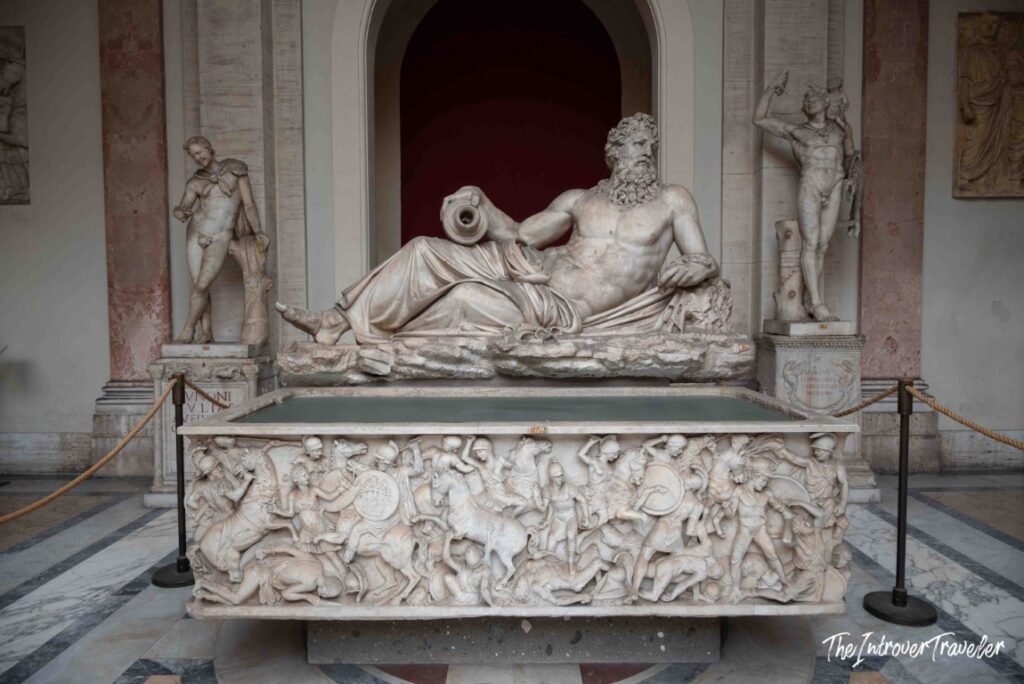
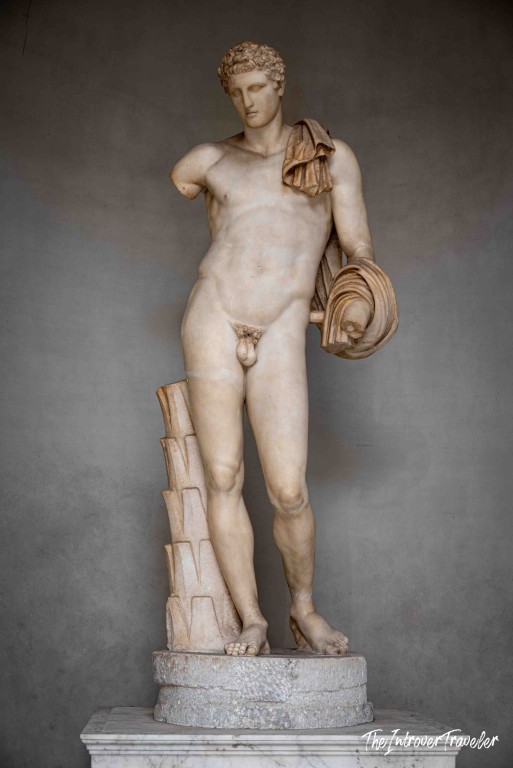
The Octagonal Court is where the Vatican collection was born, and it still holds the sculptures that made the history of Western art. I will devote a dedicated post to each of these works, so here I will only say why they matter and why you cannot afford to rush past them.
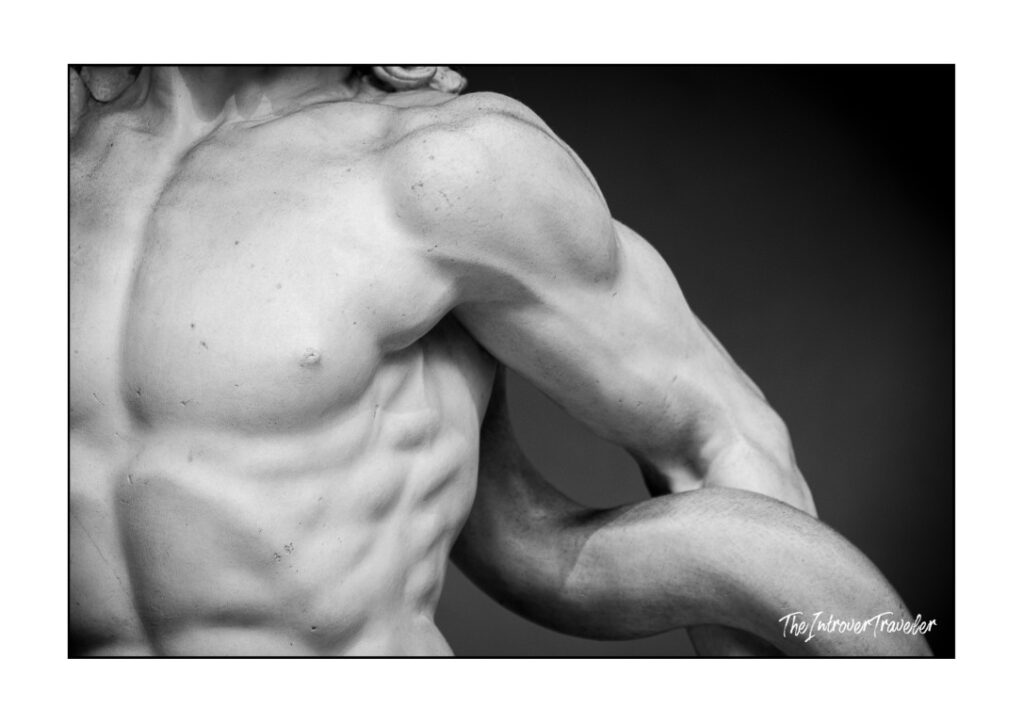
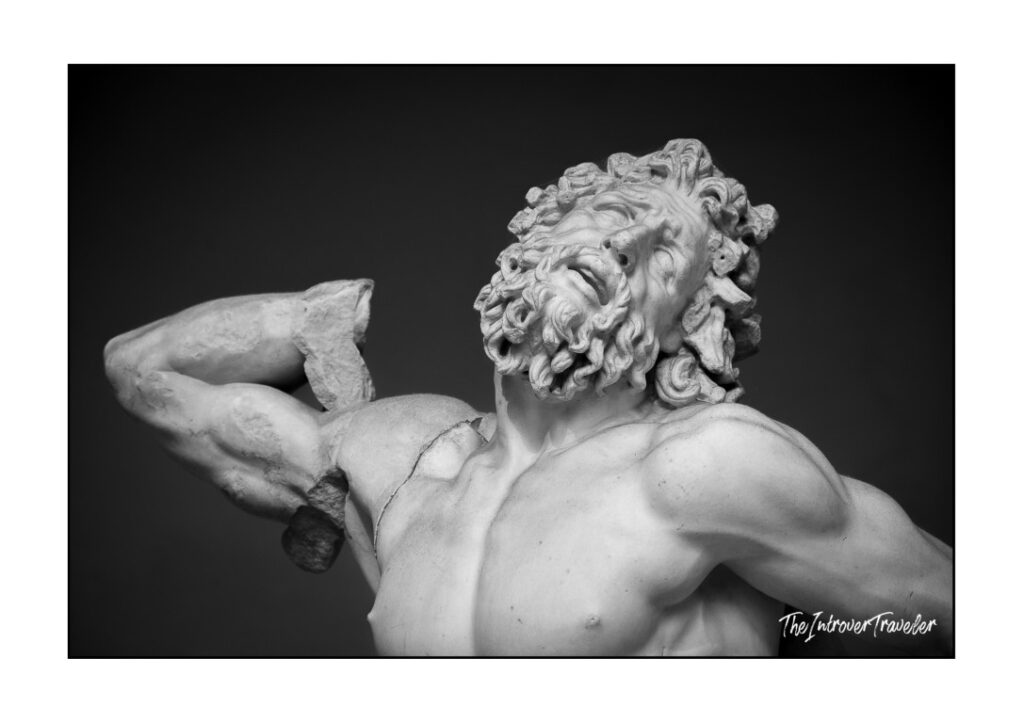
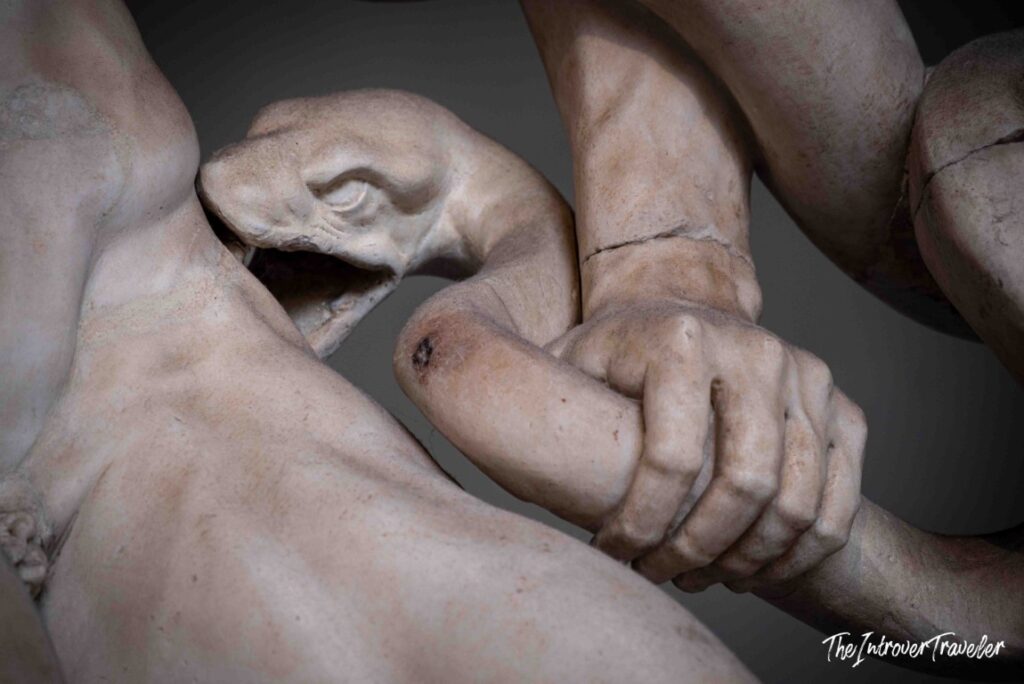
The Laocoön, discovered in 1506, is the sculptural group that showed Renaissance artists what marble could do when it set out to depict pain. Michelangelo was present at its discovery, and without the Laocoön his sculpture, and with it much of the Baroque, would not have been the same. That tangle of bodies crushed by serpents remains one of the most violent and powerful images in the art of any age.
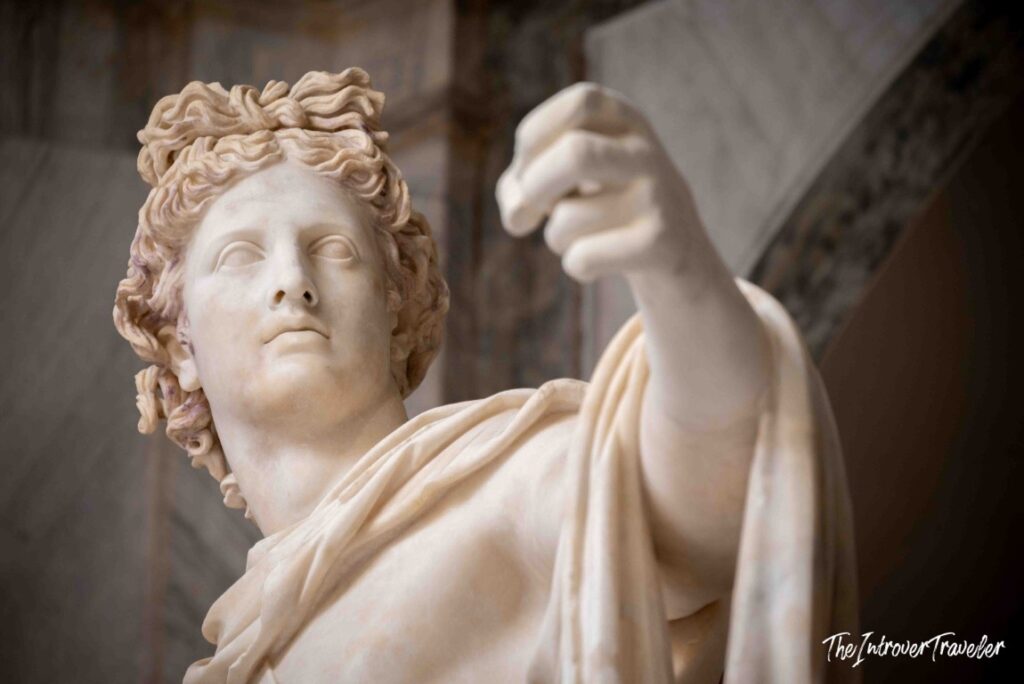
The Apollo Belvedere was for centuries the model of ideal beauty, the work on which Winckelmann built an entire aesthetic and before which generations of Grand Tour travellers were moved to tears. Today it may even seem too perfect, a little cold, but it is impossible to understand Neoclassicism without having seen it.
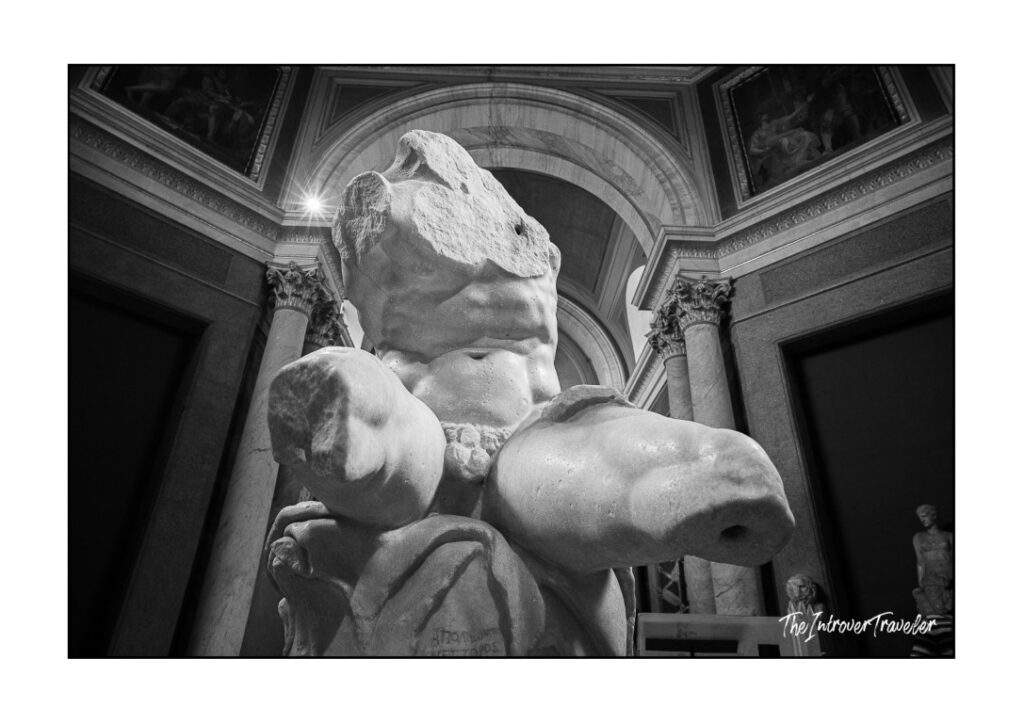
The Belvedere Torso, in the Hall of the Muses, is a fragment: no head, no arms, legs cut off. Yet Michelangelo studied it obsessively, and its musculature resurfaces in the Ignudi of the Sistine ceiling. It is proof that a fragment can hold more energy than many complete statues.
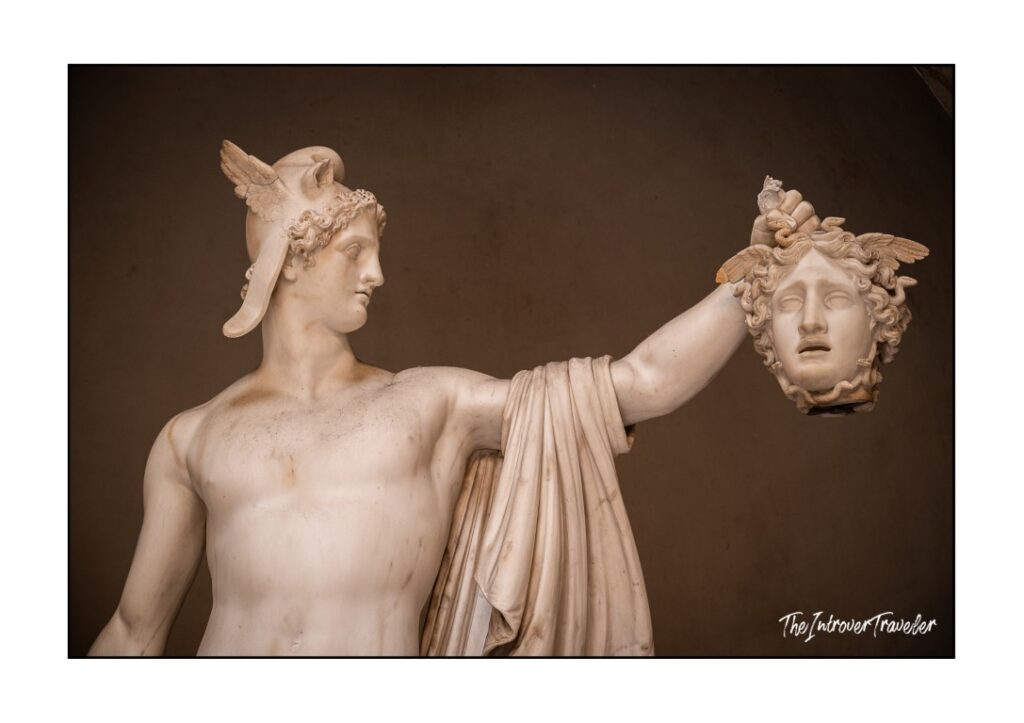
And then there is Canova’s Perseus Triumphant, which has a delightful story. With the Treaty of Tolentino in 1797, Napoleon carried the Vatican’s masterpieces off to Paris, Apollo and Laocoön included. Canova carved the Perseus between late 1800 and early 1801, openly inspired by the Apollo; Pope Pius VII bought it and placed it on the empty pedestal. A substitute, in other words, a reserve Apollo. When, after Napoleon’s fall, the Apollo Belvedere returned to Rome, thanks in part to the diplomatic mission of Canova himself, the Perseus was not evicted: it stayed in the Octagonal Court, where it still stands today. It is probably the only case in history in which the substitute and the first-choice player ended up in the same team.
And here too I am mentioning only the peaks, because the Octagonal Court holds numerous magnificent works of sculpture.
Time of visit: 1:40-2:10 p.m.
The Hall of the Animals: a carved Noah’s Ark, with a few masterly fakes
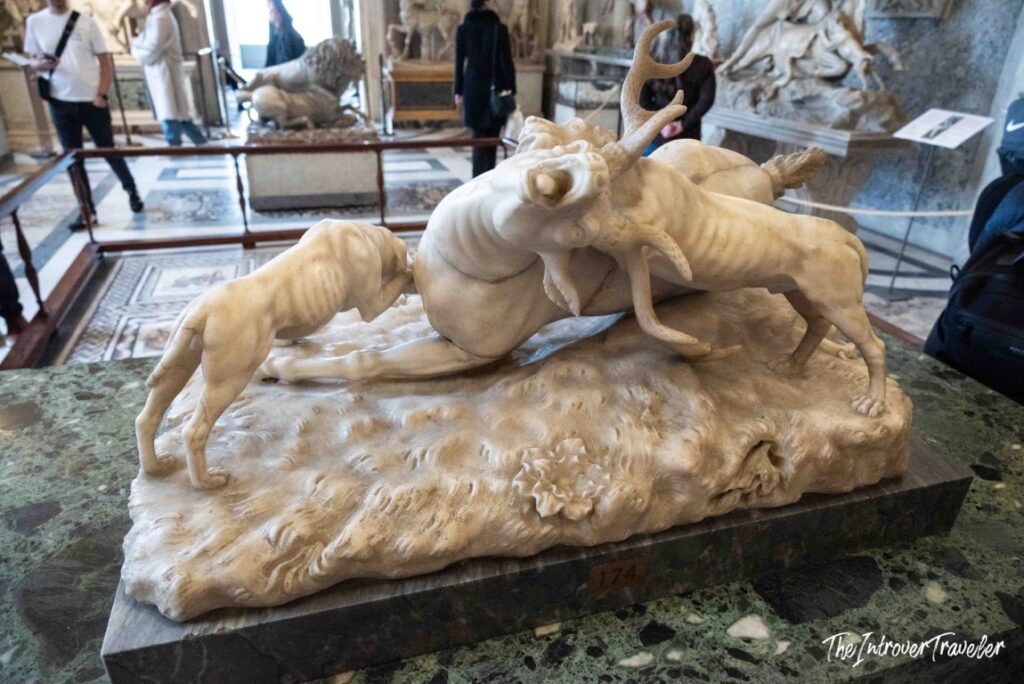
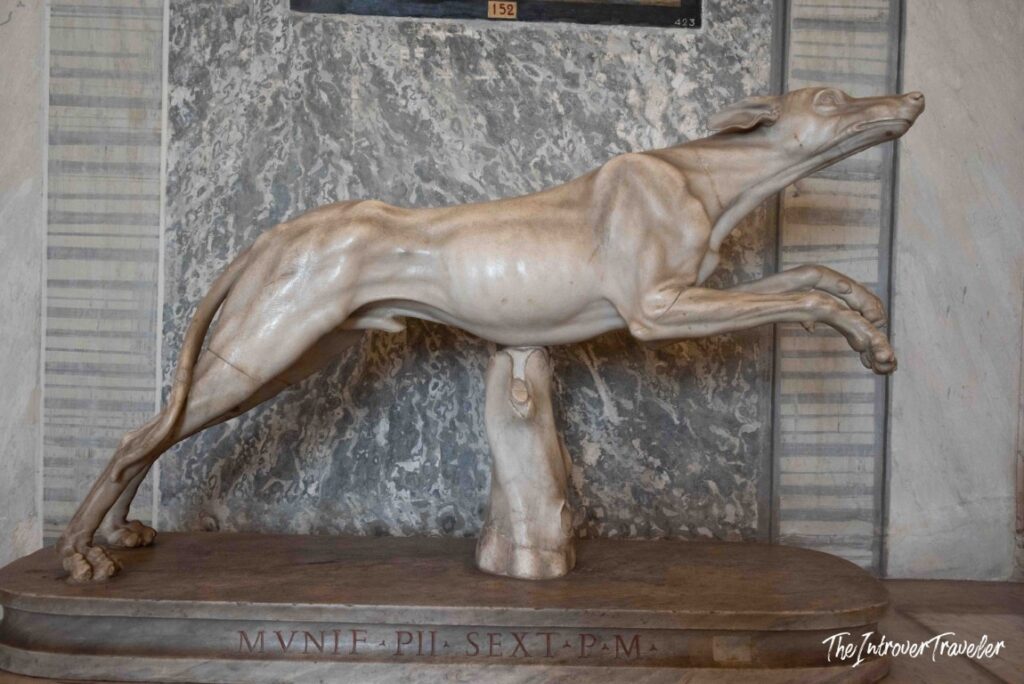
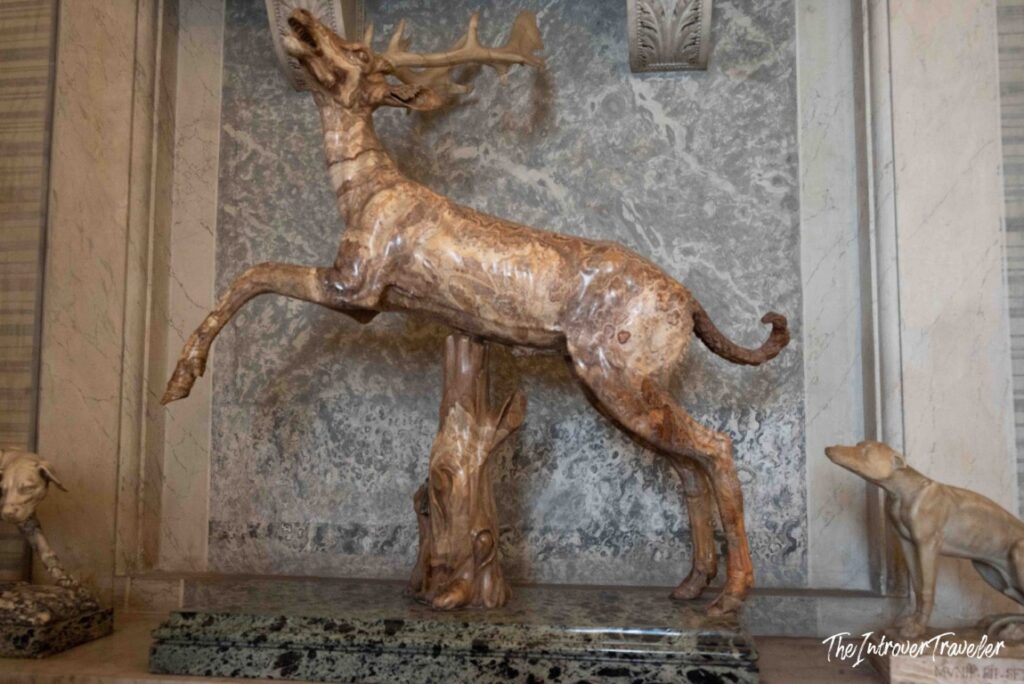
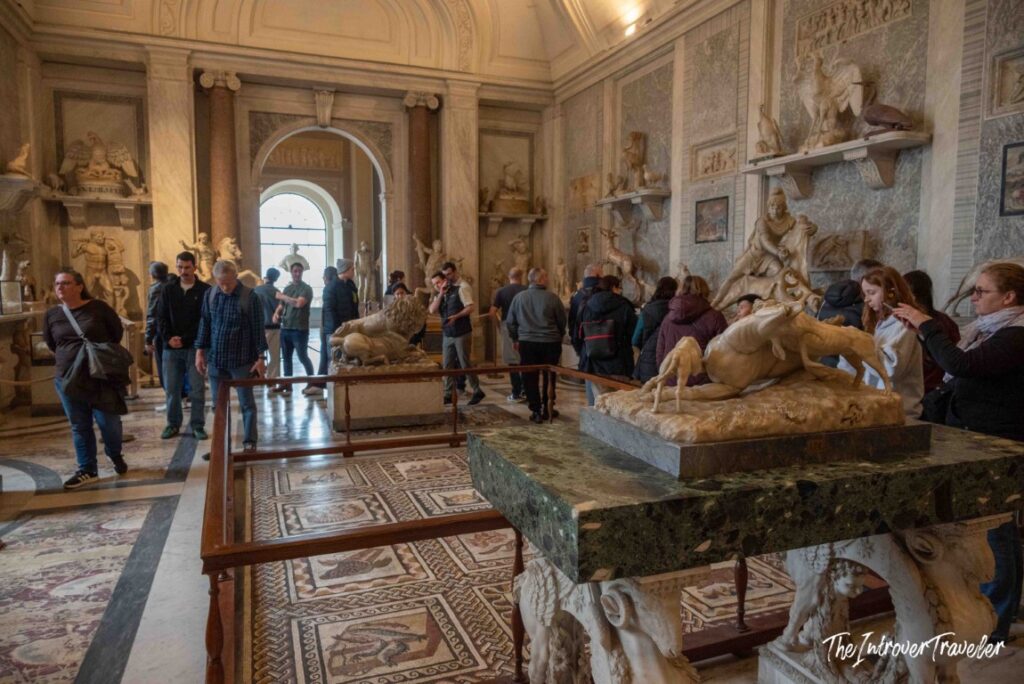
Continuing through the Pio-Clementino you enter the Hall of the Animals, one of those rooms that explain better than any essay what the Vatican Museums are. Deer savaged by hounds, greyhounds in full stride, lions, boars, eagles, crabs, an alabaster stag with incredible veining: an entire marble zoo crowding onto shelves, pedestals and niches, with the density of a cabinet of curiosities.
But look at where you are putting your feet, too: the floor is a Roman mosaic, with animals and hunting scenes, and the walls are clad in precious marbles. The room itself is a work of art containing works of art.
Then there is a detail that makes it all even more entertaining. Many of these animals are partly eighteenth-century creations. The sculptor Francesco Antonio Franzoni, working for Pius VI, restored ancient fragments and supplemented them with new parts, in some cases reconstructing an entire animal from little more than a paw or a head. The inscription on the base of the greyhound, MVNIF PII SEXT P M, “by the munificence of Pius VI, Pontifex Maximus”, is the signature of the patron behind this rather free-and-easy operation, halfway between restoration and creation from scratch. Today a restorer who did something like that would be struck off; back then it was called enhancement.
Time of visit: 2:10-2:20 p.m.
The Greek Cross Room and the Round Room: the opulence of porphyry
If I had to choose one material to represent the Vatican Museums, I would choose red porphyry. It was the stone of the Roman emperors, quarried in a single area of Egypt’s Eastern Desert, extremely hard to work and reserved for supreme power. The quarries have been abandoned for centuries: all the red porphyry you see in Europe is, essentially, ancient porphyry reused.
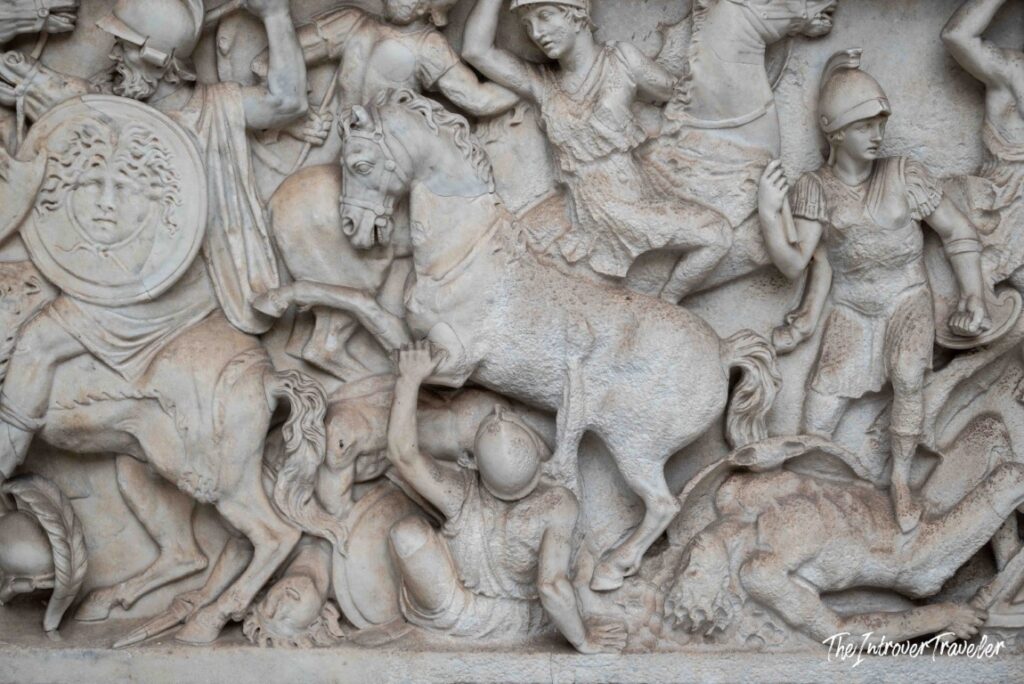
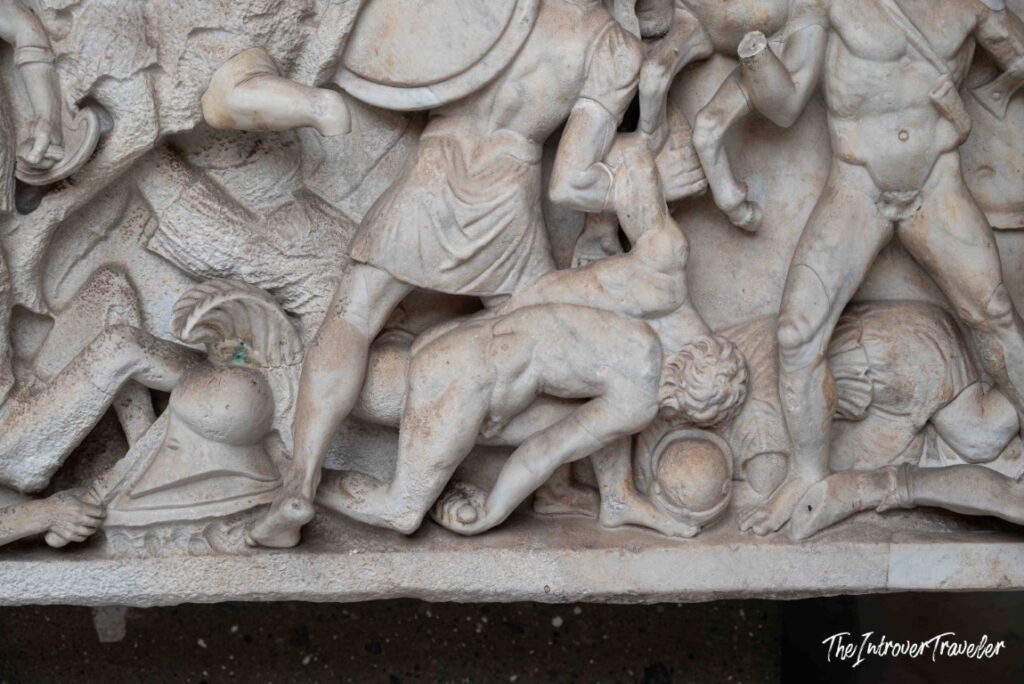
In the Greek Cross Room stand two porphyry sarcophagi of a size and richness that are hard to describe. That of Helena, mother of Constantine, is decorated with Roman horsemen trampling barbarian prisoners: military iconography for a woman the Church venerates as a saint, which says a great deal about fourth-century Rome. That of Constantina, daughter of Constantine, is covered in vine scrolls and harvesting cherubs, a Dionysian motif repurposed as a Christian symbol. These are works of overflowing, almost aggressive opulence, and the effect is exactly the one intended: to crush the viewer under the weight of imperial power.
Then you enter the Round Room, built at the end of the eighteenth century on the model of the Pantheon, and find yourself before a monolithic red porphyry basin so huge it seems impossible it was carved from a single block. Beneath it lies a Roman mosaic from Otricoli with battle scenes between Greeks and centaurs and grotesque masks; around it stand colossal statues of gods and emperors, including a Hercules in gilded bronze. All of it under a coffered dome. Here the palace stops being a frame and becomes the protagonist.
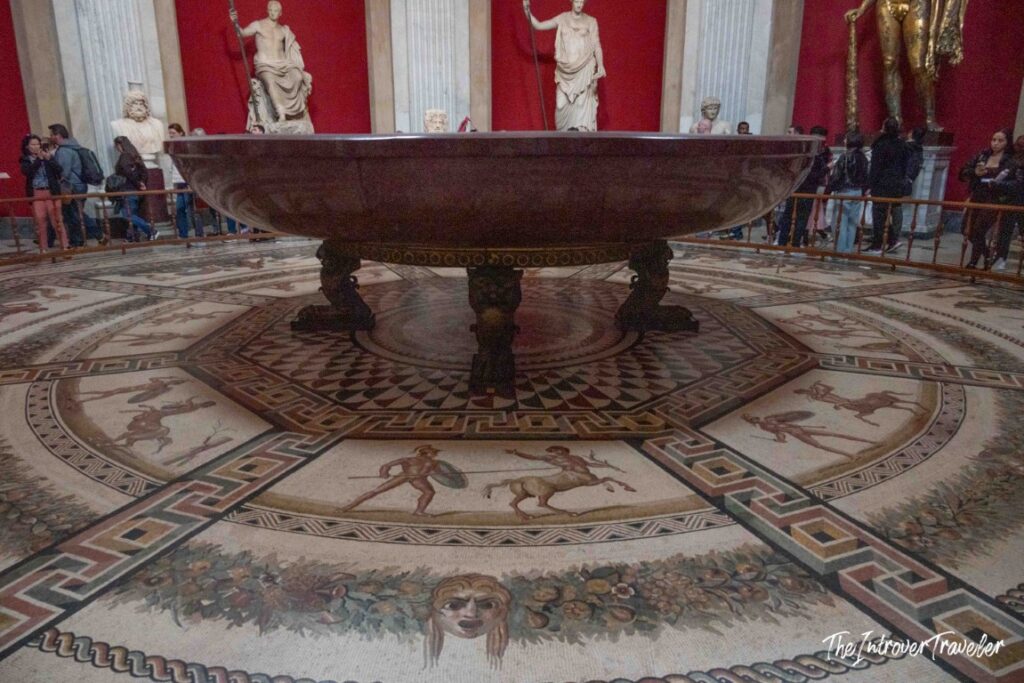
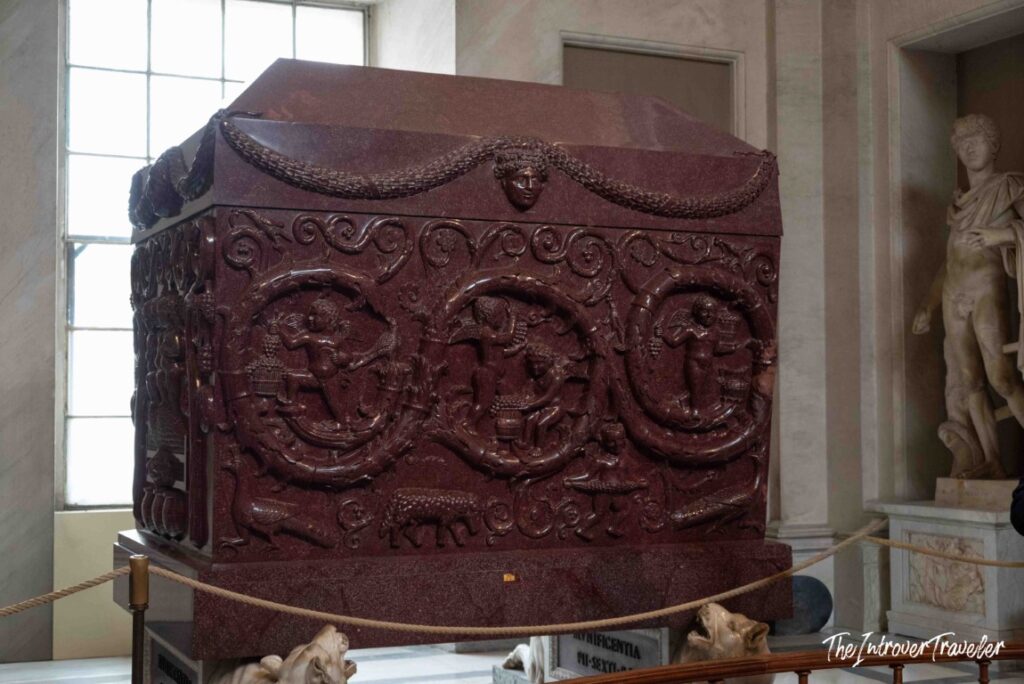
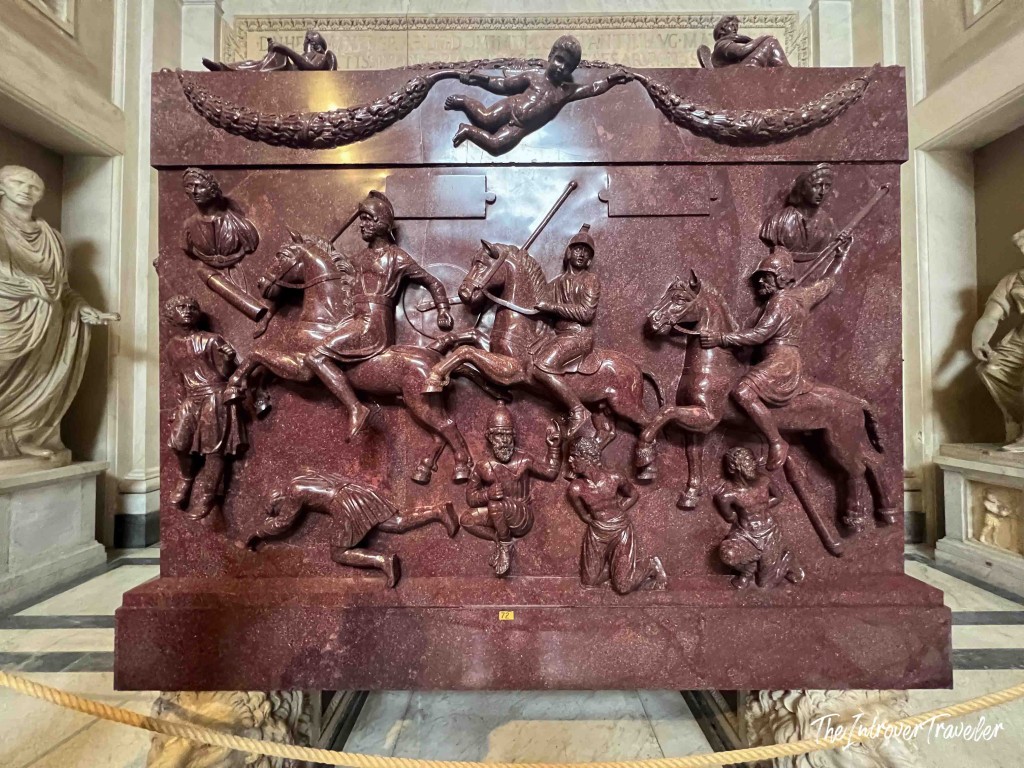
Time of visit: 2:20-2:40 p.m. (Including the Belvedere Torso, which is actually located in this gallery, but which I have included under the Octagonal Court because of its connection with the Laocoön).
The Gregorian Etruscan Museum: bronzes and vases to make Villa Giulia jealous
The Etruscan Museum holds bronzes of the very highest quality. The seated boy with the bulla around his neck, an amulet children wore for protection, has an almost modern freshness; the head with eyes inlaid in pale material has a gaze that follows you round the room. And the Roman half-length bronze, with that gaunt, realistic face of a man who has seen a great many things in life and enjoyed none of them, beside the drapery slipping from his shoulder, is the kind of piece that in any other museum would be the star of the room. Here it goes almost unnoticed, because people are in a hurry.
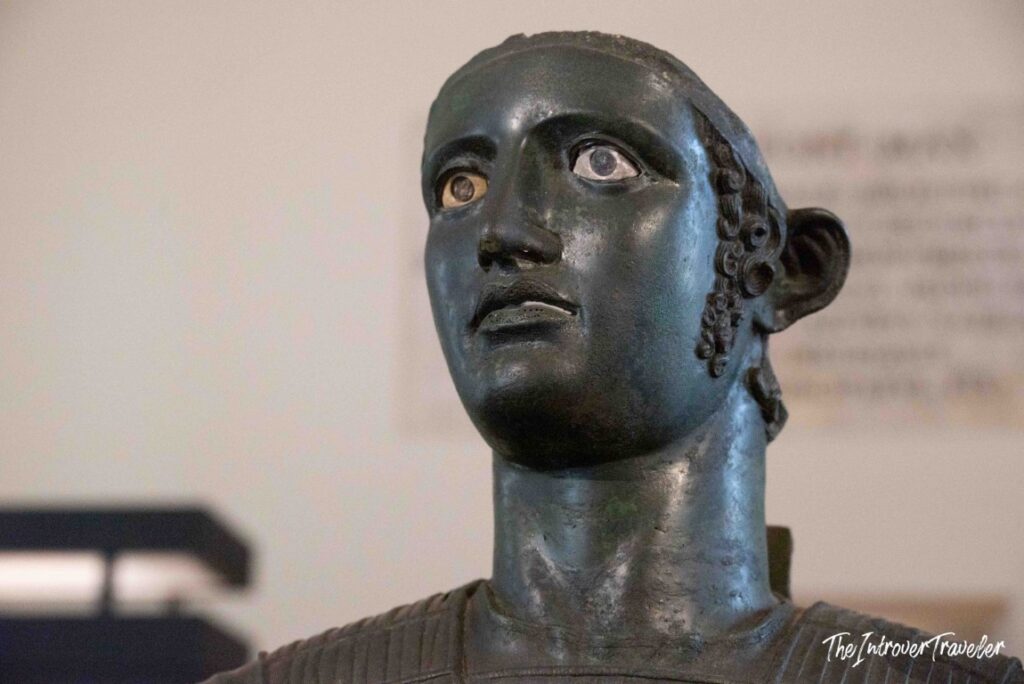
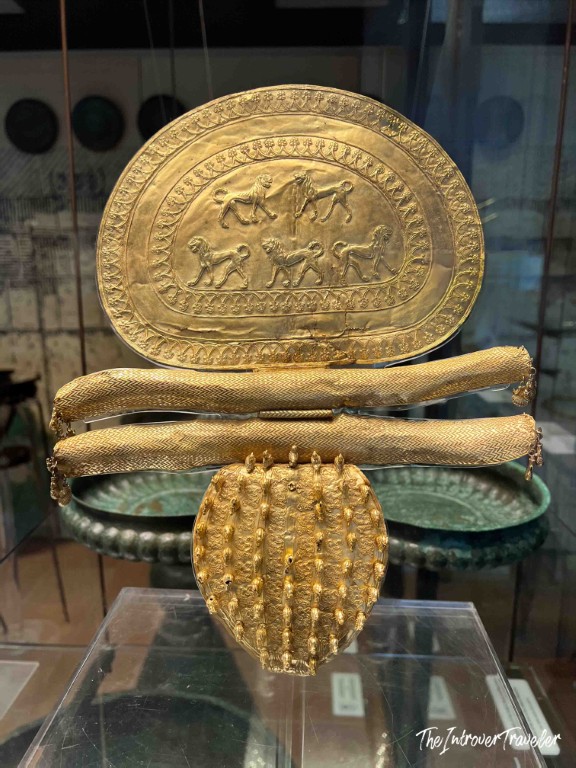
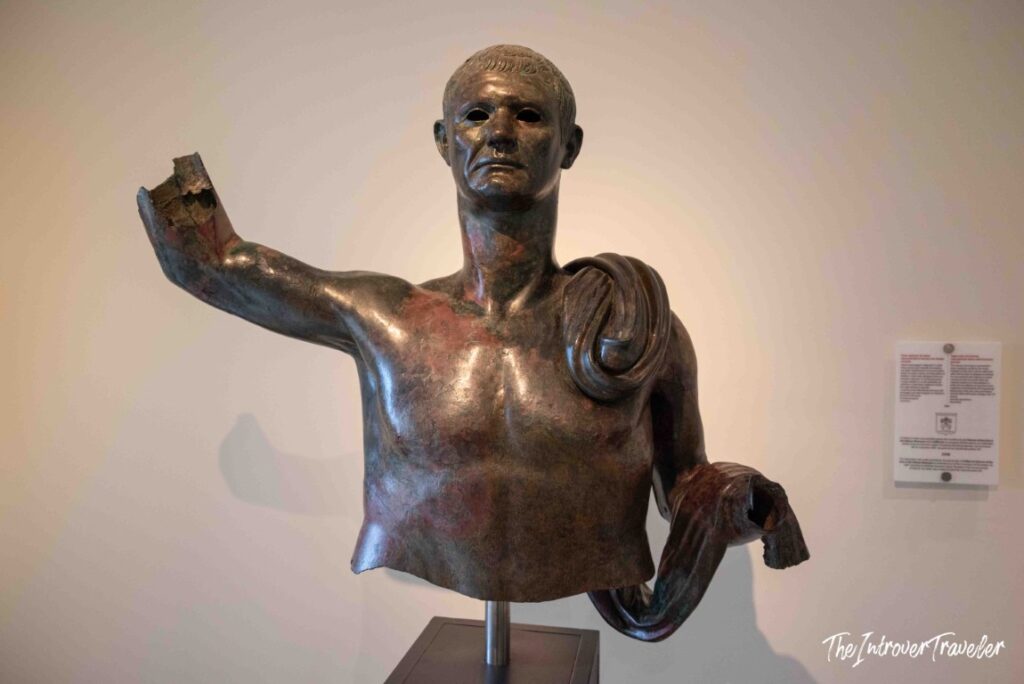
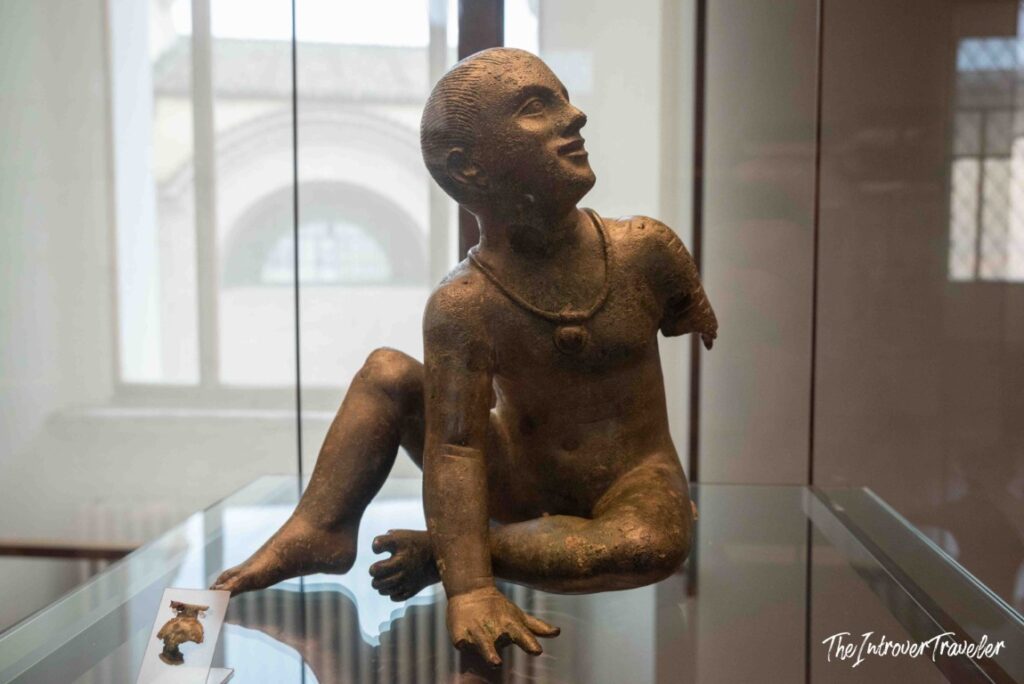
Time of visit: 2:40-2:45 p.m.
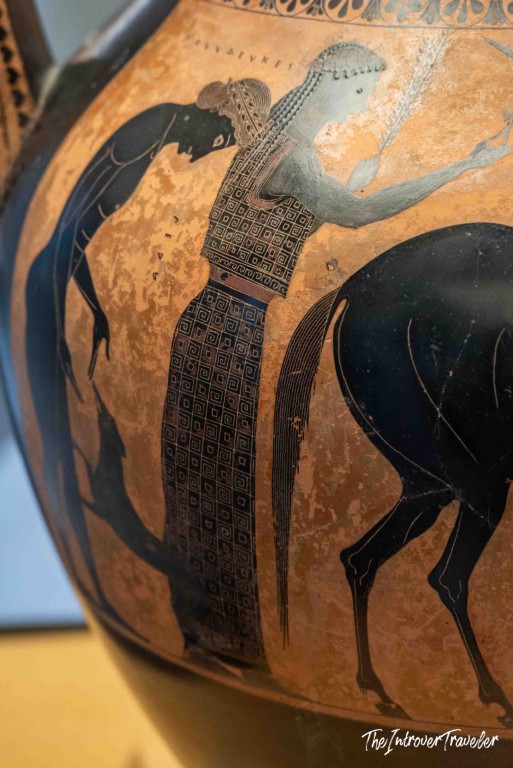
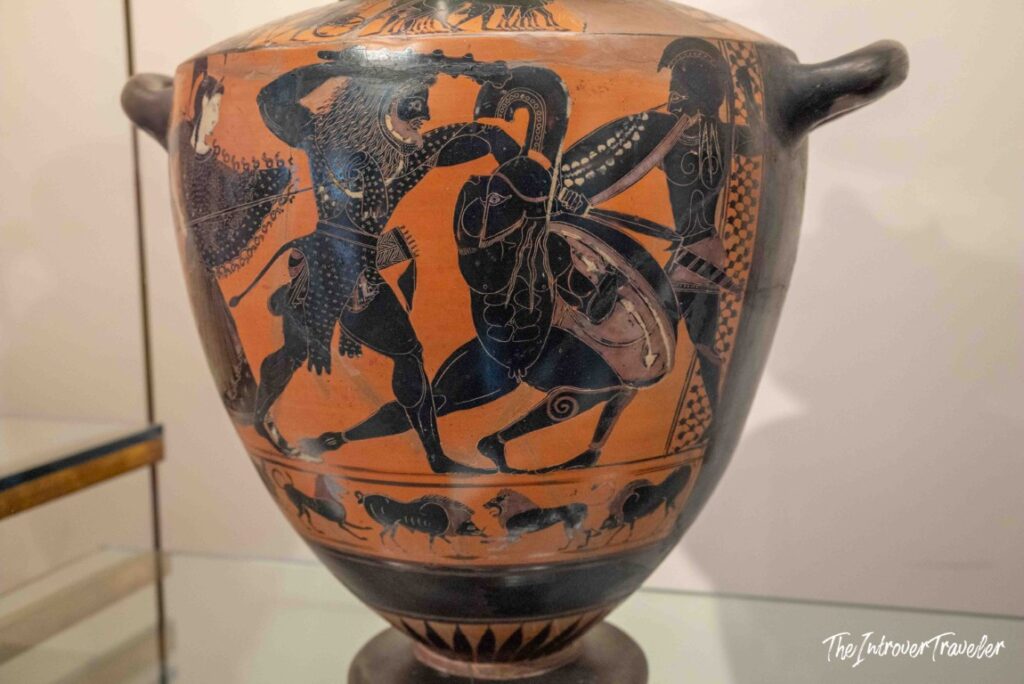
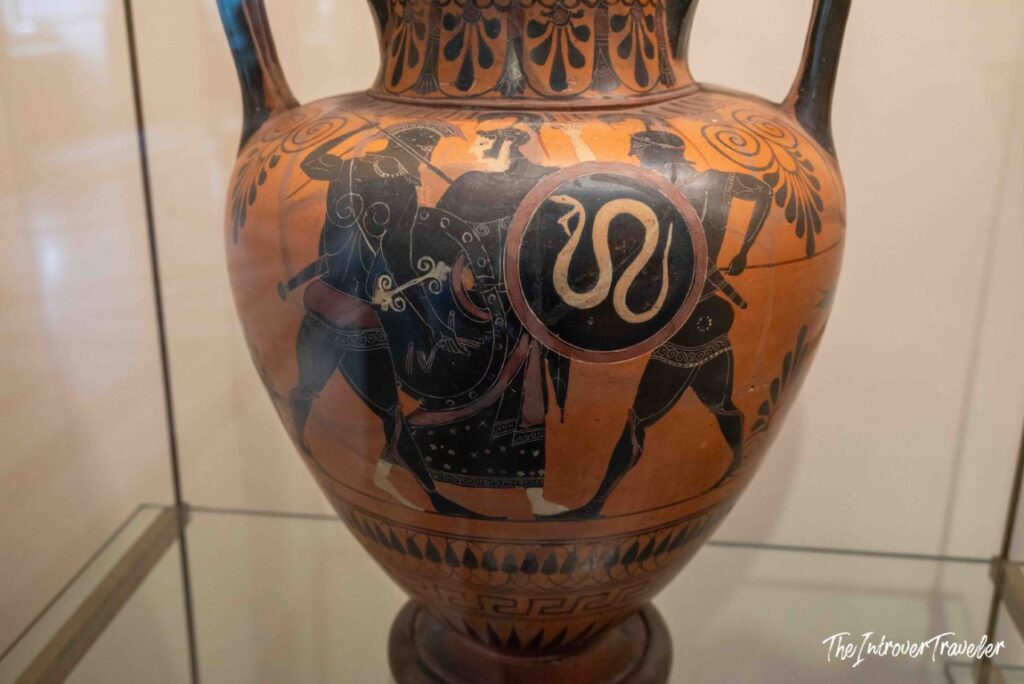
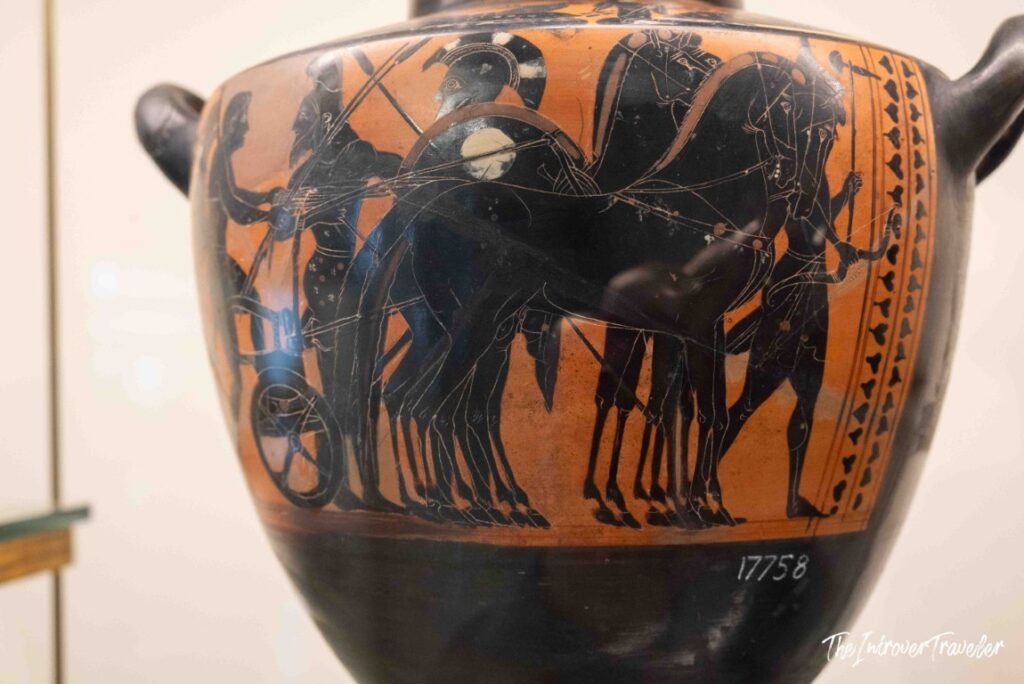
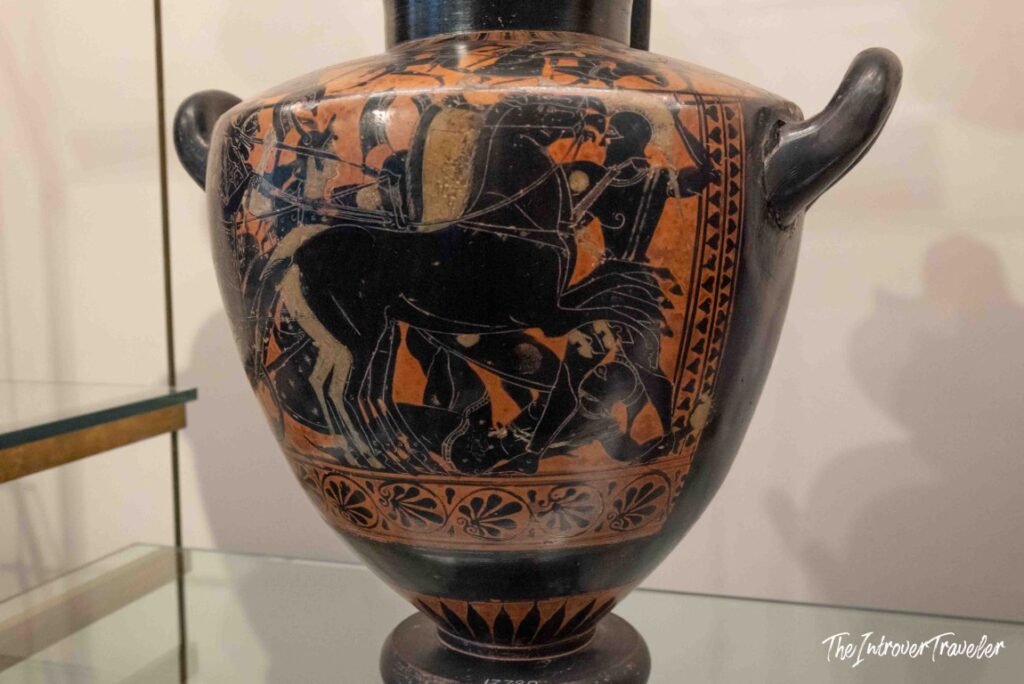
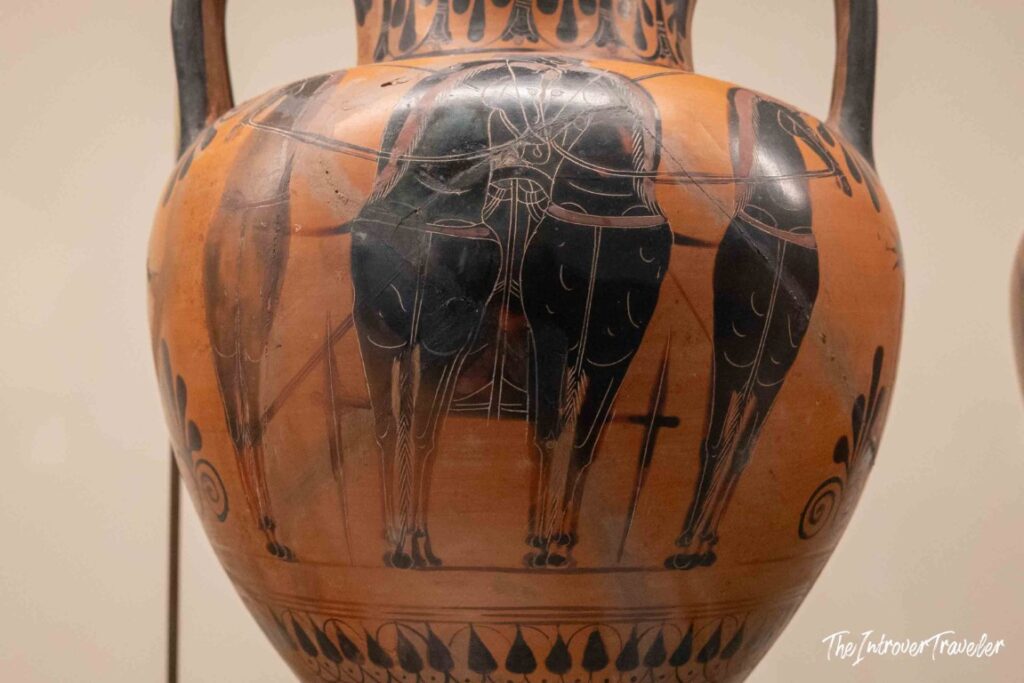
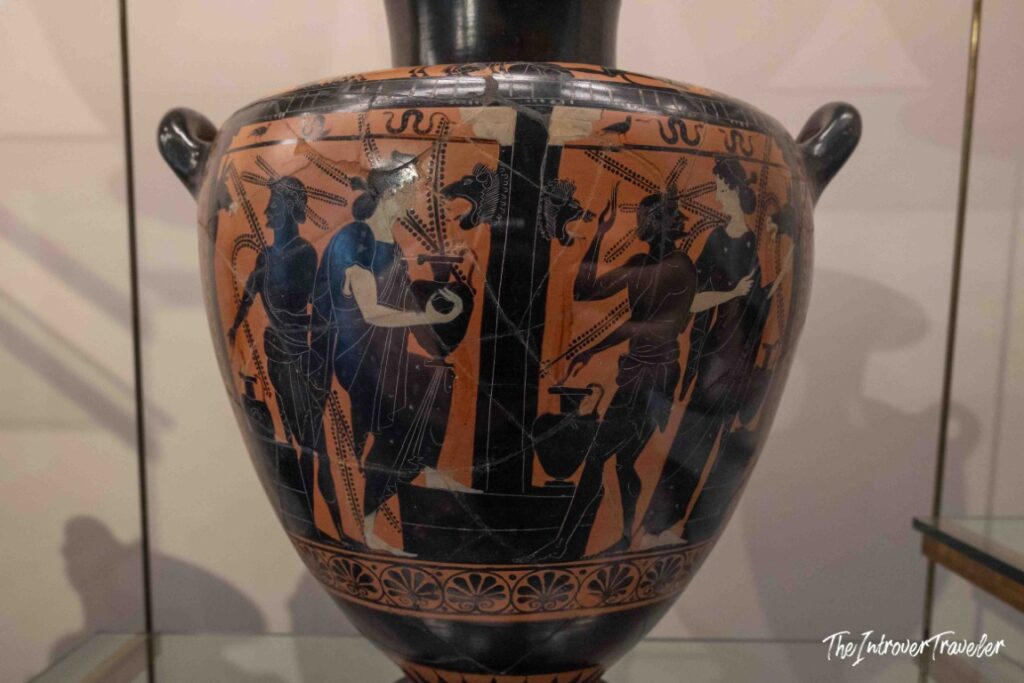
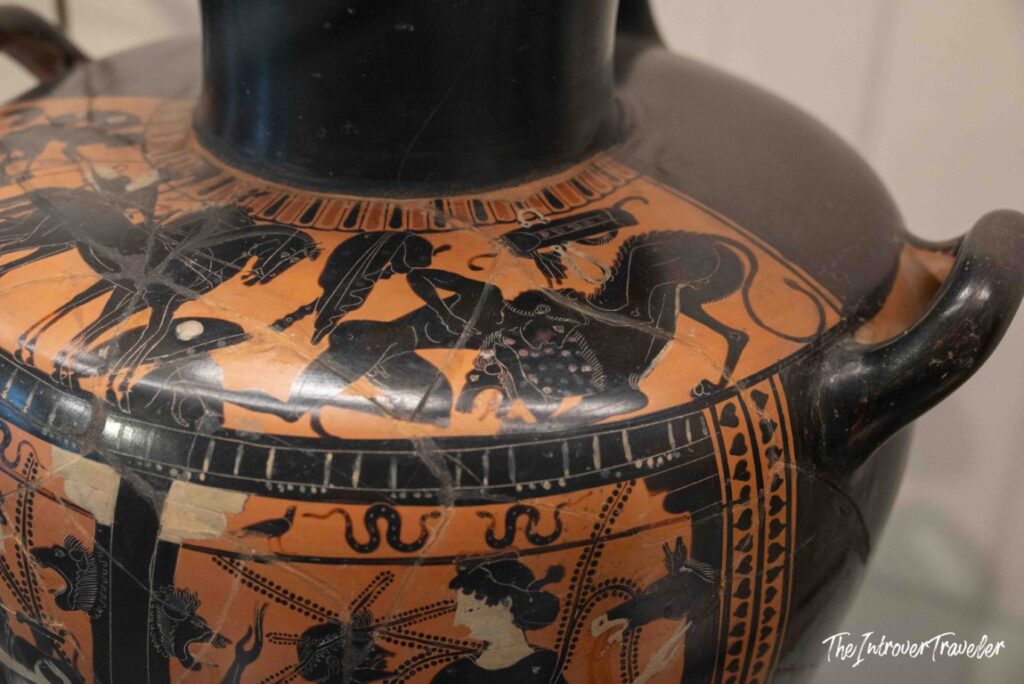
But it is the vase room that deserves the longest stop. A clarification, to avoid confusion: these vases are in the Etruscan Museum and were found largely in Etruscan tombs, above all at Vulci, but the great majority are Greek vases, in particular Attic black-figure ware, made in Athens and imported by the Etruscan aristocracy, who collected them as luxury goods to take with them into the afterlife. It is the same phenomenon you can see at the National Etruscan Museum of Villa Giulia, and the Vatican collection has nothing to envy the Roman one: splendid, magnificent, superb.
The most famous piece is the Exekias amphora, from around 540-530 BC, one of the most celebrated Greek vases in the world. On its best-known side Achilles and Ajax play dice during a lull in the Trojan War; on the other is the homecoming of the Dioscuri, complete with the name of Polydeukes written beside his figure. Look at Leda’s robe: a lattice of minutely incised geometric motifs that seems to have stepped out of a Klimt painting, twenty-five centuries early. And a little further on, the chariot seen head-on, with its stylised, symmetrical horses, has something almost Art Deco about it. These are the moments when you realise that modernity invented far less than it believes.
Time of visit: 2:45-2:55 p.m.
The Gallery of the Candelabra and the human conveyor belt
At this point the visit enters the long galleries that lead towards the Raphael Rooms and the Sistine Chapel, and here we have to talk about the problem.
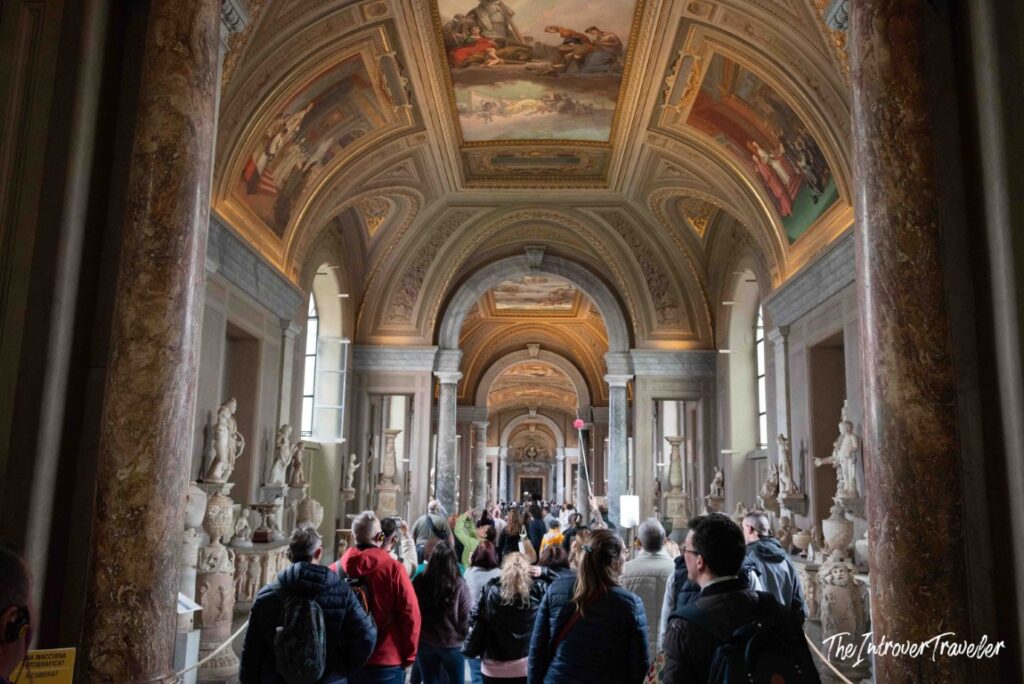
In the Gallery of the Candelabra, among frescoed ceilings, Roman candelabra and ancient sculptures, the crowd compacts into a long snake that moves slowly and relentlessly forward, as if on a conveyor belt. At its head, inevitably, the group leader’s pink flag, hoisted on a pole like a medieval banner. The photos you see were taken on an ordinary Friday in February, in other words in the low season.
The crowding affects the quality of the visit, there’s no point denying it. Stopping to look at a detail means becoming a rock in the current, taking elbows in the ribs, feeling guilty for holding up the traffic. And yet a curious thing happens: the Vatican Museums are so beautiful that you even put up with the crush. It is perhaps the only museum in the world of which I can say this. The practical advice still stands: if you can, go on a weekday, as early as possible in the morning. And if you really can’t stand your fellow human beings, you can console yourself with my Rant on audio guides.
The Gallery of Tapestries and the Gallery of Maps
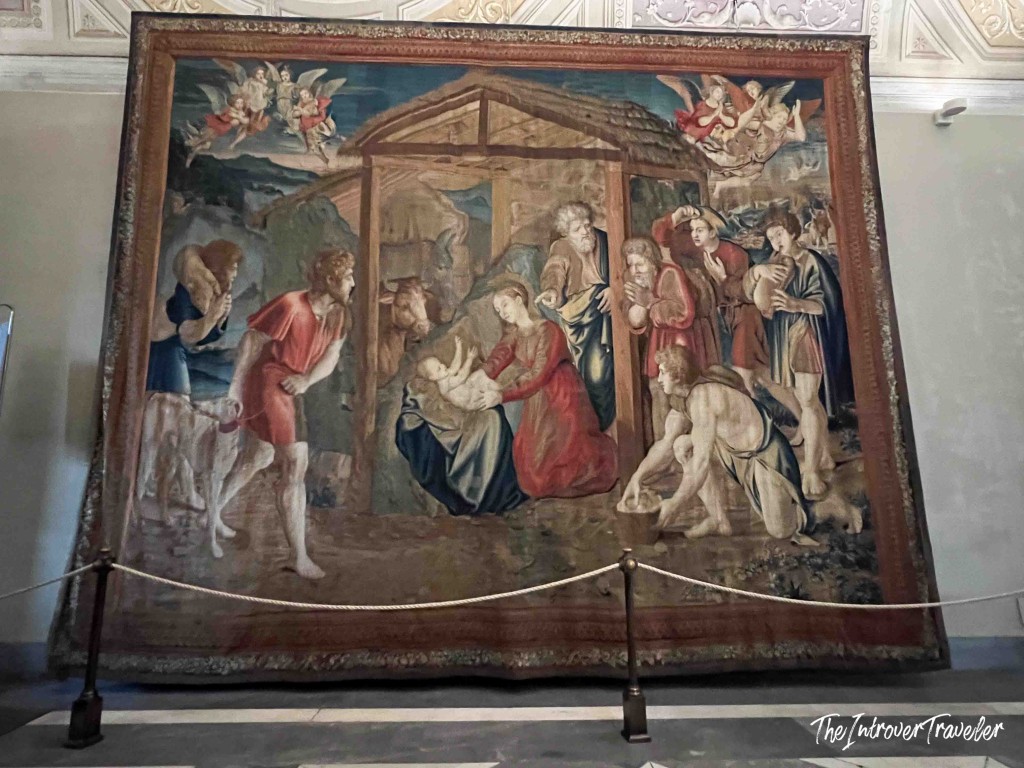
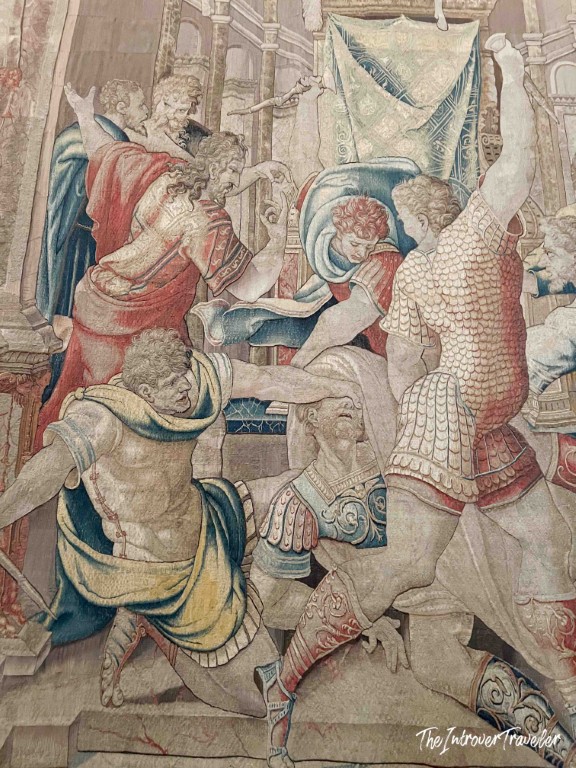
Before the Gallery of Maps you pass through the Gallery of Tapestries, with the large tapestries of the so-called “New School”, woven in Brussels to designs from Raphael’s circle: the Adoration of the Shepherds, the Massacre of the Innocents, scenes of a narrative and chromatic richness that in any other museum would earn a room of their own and half an hour of contemplation. Here they are a corridor to be crossed with your eyes on the ceiling.
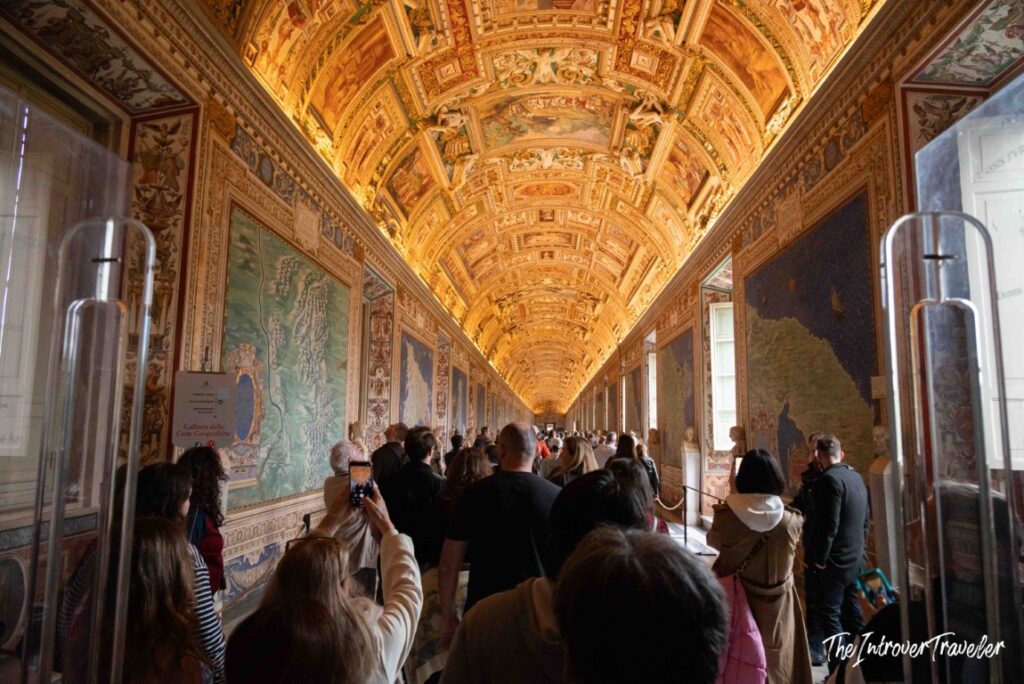
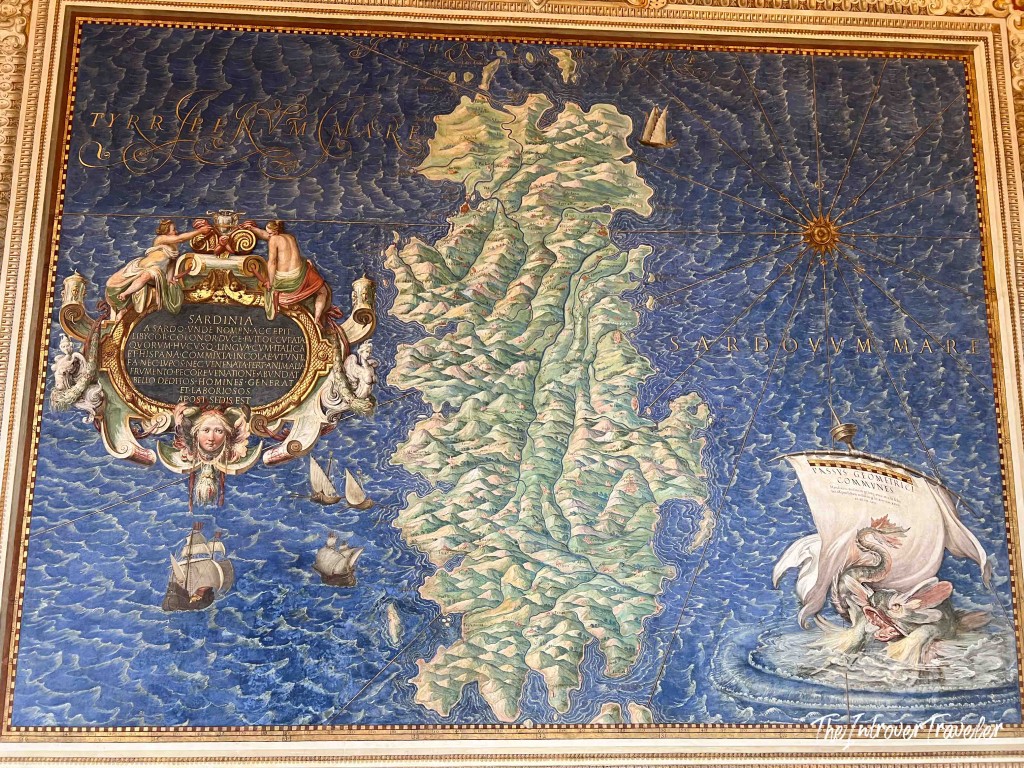
And then the Gallery of Maps, perhaps the place where the palace’s opulence reaches its highest point. Under Gregory XIII, between 1580 and 1585, the walls were frescoed with forty maps of the regions of Italy, designed by the cosmographer Ignazio Danti; above them, a vault gilded with stucco and frescoes that would justify the ticket on its own. You walk inside a depiction of Italy as the sixteenth-century Papacy saw it, that is, as a territory to be contemplated from above.
Lower your gaze to the floors, too: in several rooms the popes had coats of arms made in commesso marble, inlays of coloured marbles of impressive precision. The one in the photo, with the cypress, the comet, the two lilies and the silver band, is the coat of arms of Leo XIII, pope from 1878 to 1903. Which means that even at the end of the nineteenth century, with the Papal States already lost and Rome capital of the Kingdom of Italy, the popes were still adding precious marbles to the palace. Temporal power was over; the taste for opulence was not.
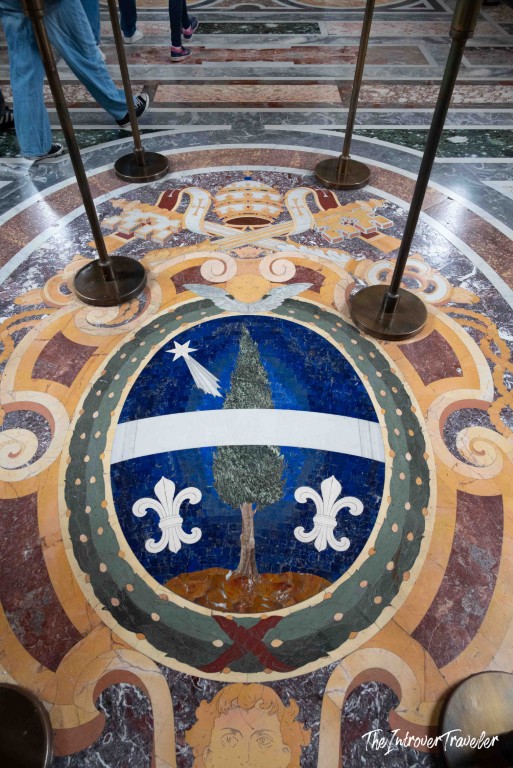
Time of visit: 2:55-3:15 p.m.
The Raphael Rooms: one of the summits of art history
I will devote a dedicated post to the Raphael Rooms, because they deserve far more than a paragraph. But they need some space here too, because they are one of the absolute summits of the visit.
A personal premise. I am not a lover of Raphael in the way I am of Michelangelo or Pontormo, just to name a few: his perfection, his harmony, his ever-controlled grace are not the kind of art that makes me lose my head. And yet, standing in the Rooms, I cannot contain my amazement. They are one of the high points of the Vatican Museums and of the whole history of world art, and that holds even for those who, like me, prefer the tormented ones.
There are four Rooms. The first you encounter, the Hall of Constantine, is monumental in size, but here the eye recognises the hand of Giulio Romano more than that of the master, and it isn’t just an impression: it was largely painted after Raphael’s death in 1520, by the workshop led by Giulio Romano and Giovan Francesco Penni. The other three are smaller, and it is there that Raphael gave the very best of his art, above all in the Room of the Segnatura and the Room of Heliodorus, while in the Room of the Fire in the Borgo the workshop was already doing a great deal of the work. In that room, look up: the ceiling is not by Raphael but by his master Perugino, and according to Vasari Raphael chose to keep it out of respect.
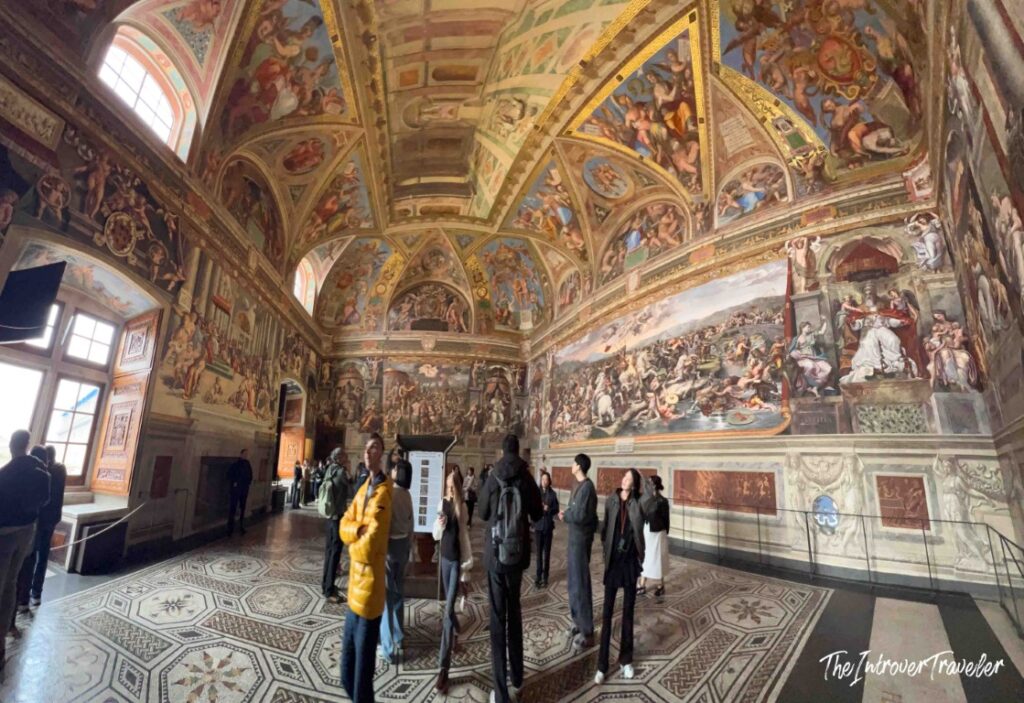
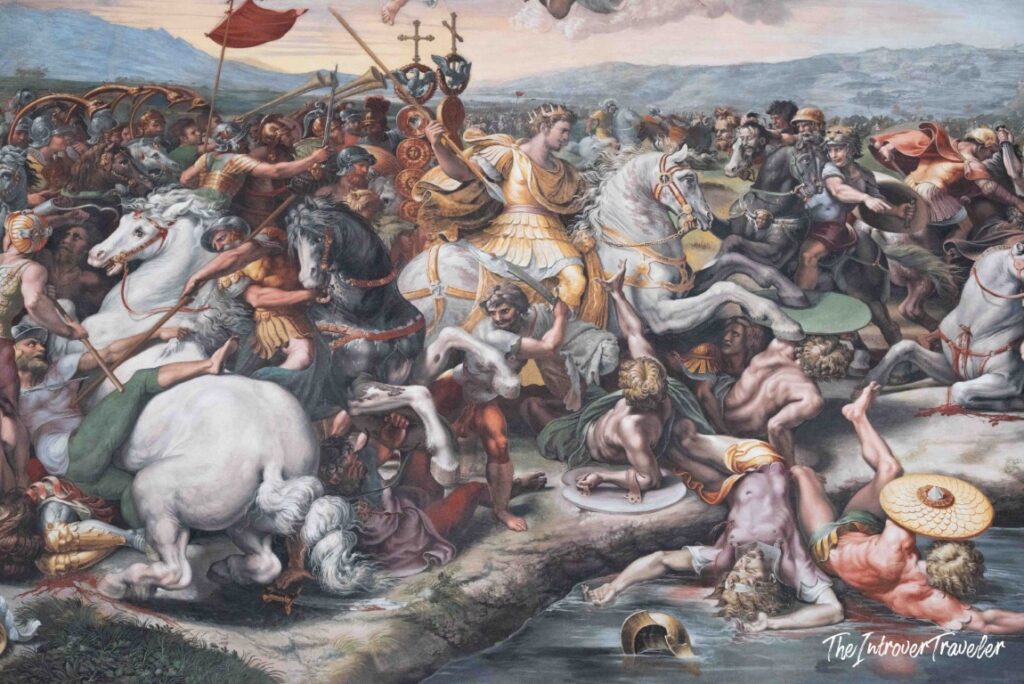
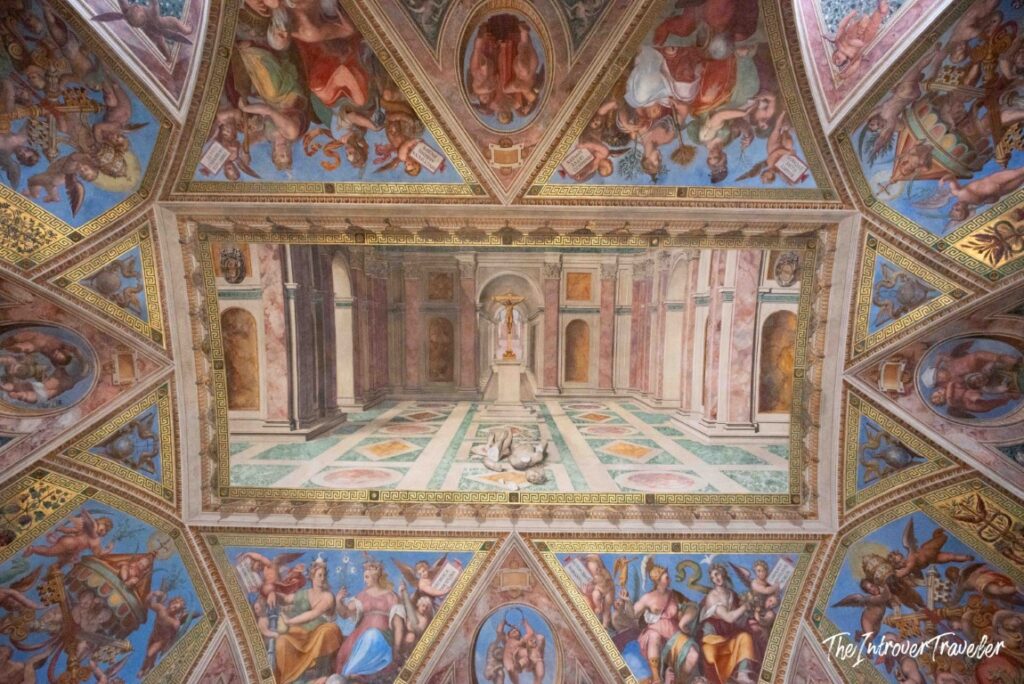
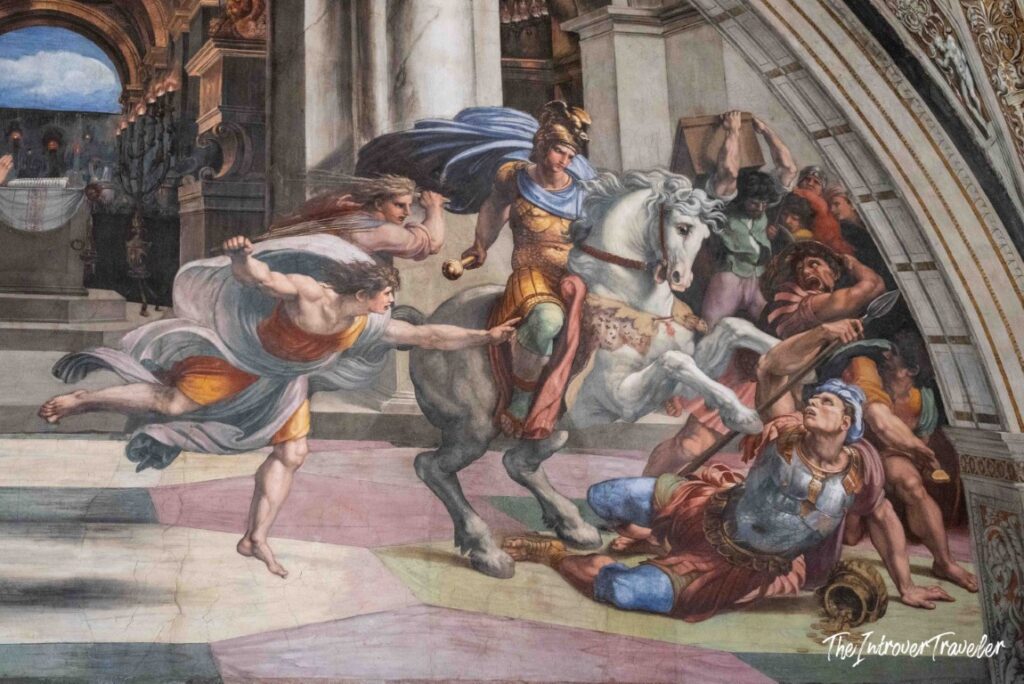
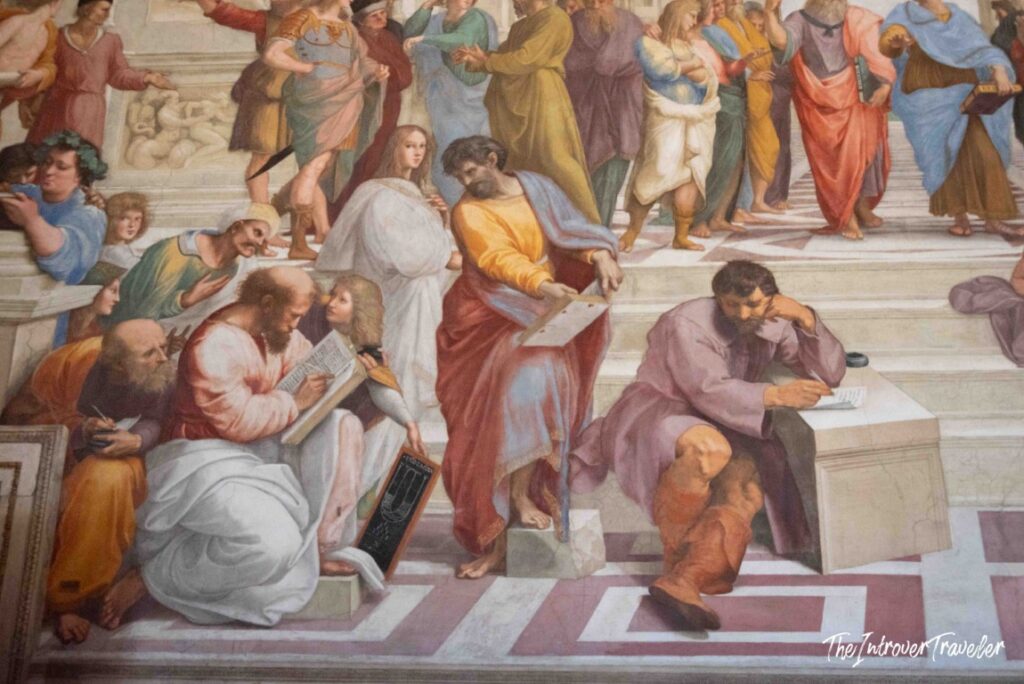
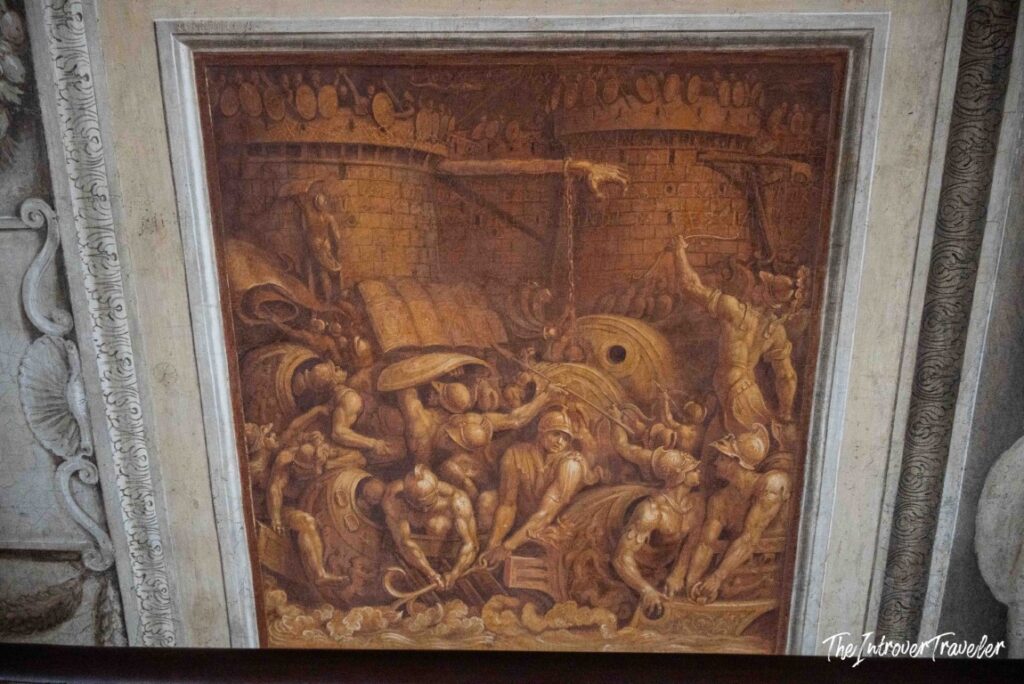
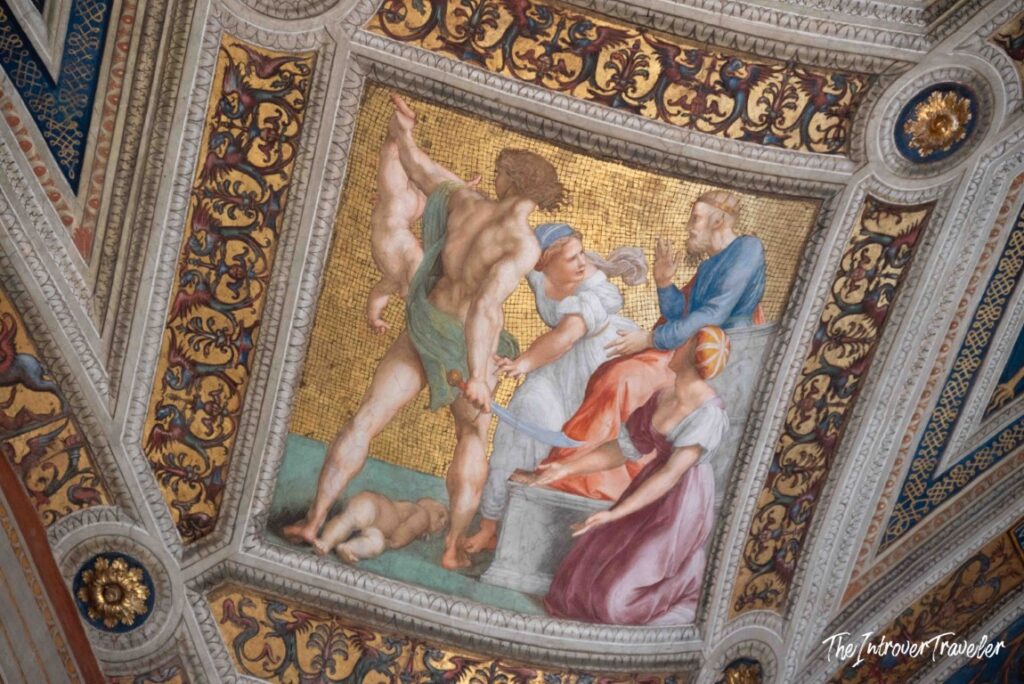
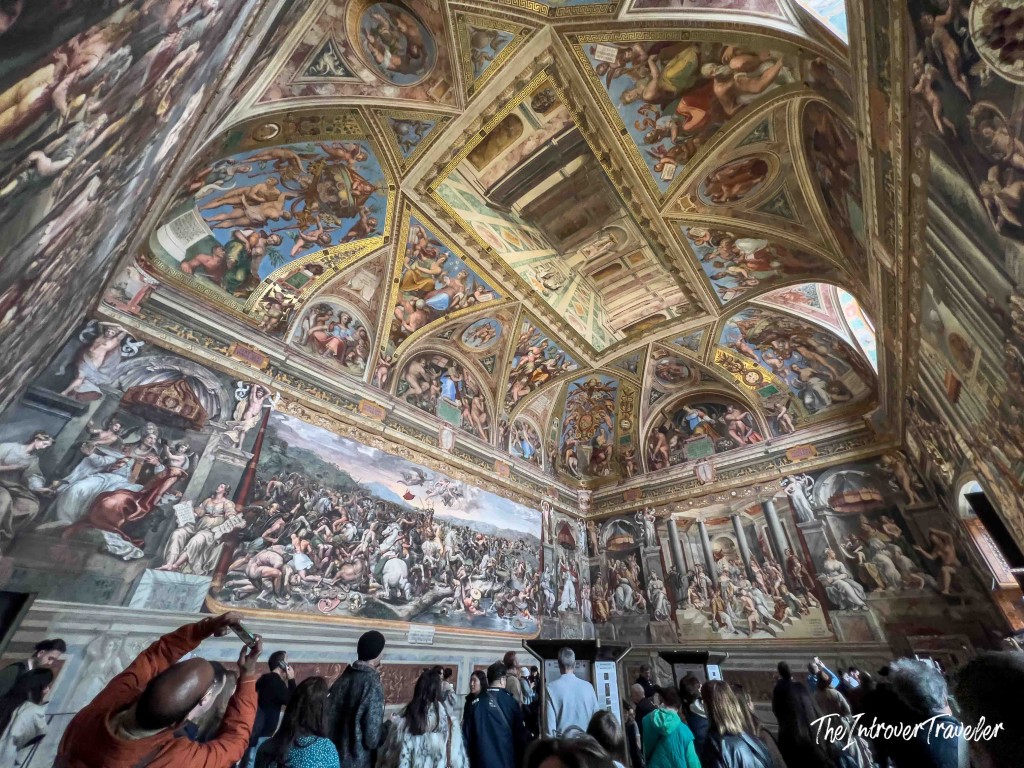
Respect for the master, rivalry with the contemporary. While Raphael was painting the Rooms, a few dozen metres away Michelangelo was frescoing the Sistine ceiling, and the two cordially detested each other. Vasari tells us that Bramante, Raphael’s ally, smuggled him into the Sistine Chapel to see Michelangelo’s work in progress. True or not, the effect is visible: in the School of Athens there is an isolated figure in the foreground, the brooding Heraclitus leaning on a block of marble, added at a later stage, painted with an unmistakably Michelangelesque monumentality and read by many as a portrait of Michelangelo himself; but in many figures in the Rooms Raphael seems to move away from the style he learnt from Perugino and wink at the colours and forms of the genius from Caprese.
My favourite details, for those with time to look for them:
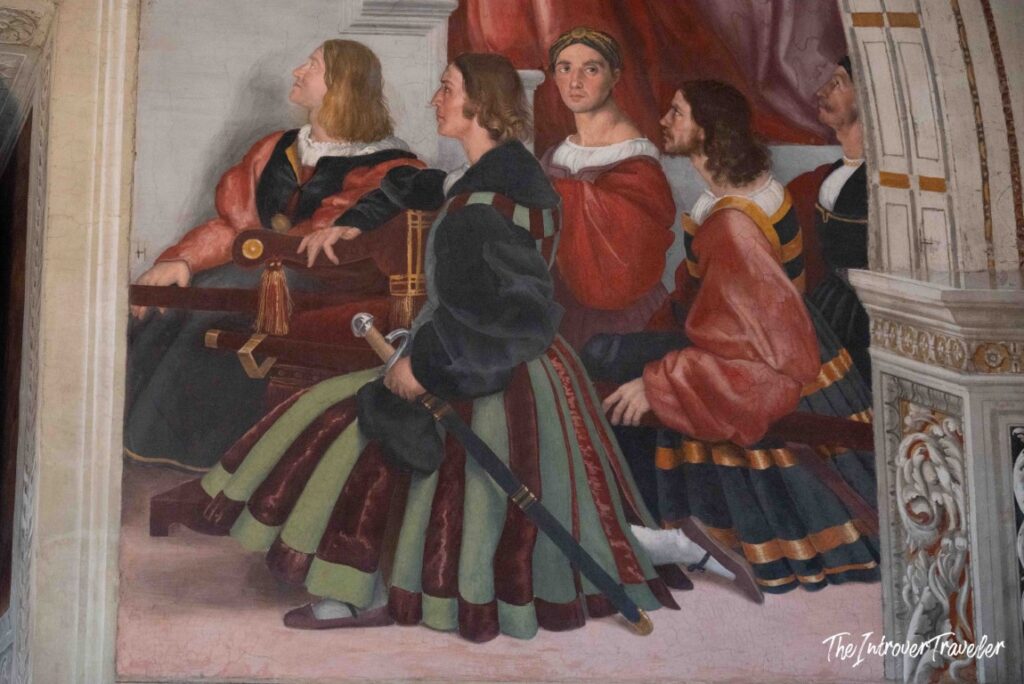
The Mass at Bolsena. You feel as if you are attending in person a ceremony with the great families of the Renaissance in the congregation. The faces, the clothes, the postures of the Swiss Guards and the prelates have a physical truth, almost documentary; standing there in the Rooms you almost feel you are living a costume drama, like Ermanno Olmi’s The Profession of Arms: not a sacred scene, but a slice of court life.
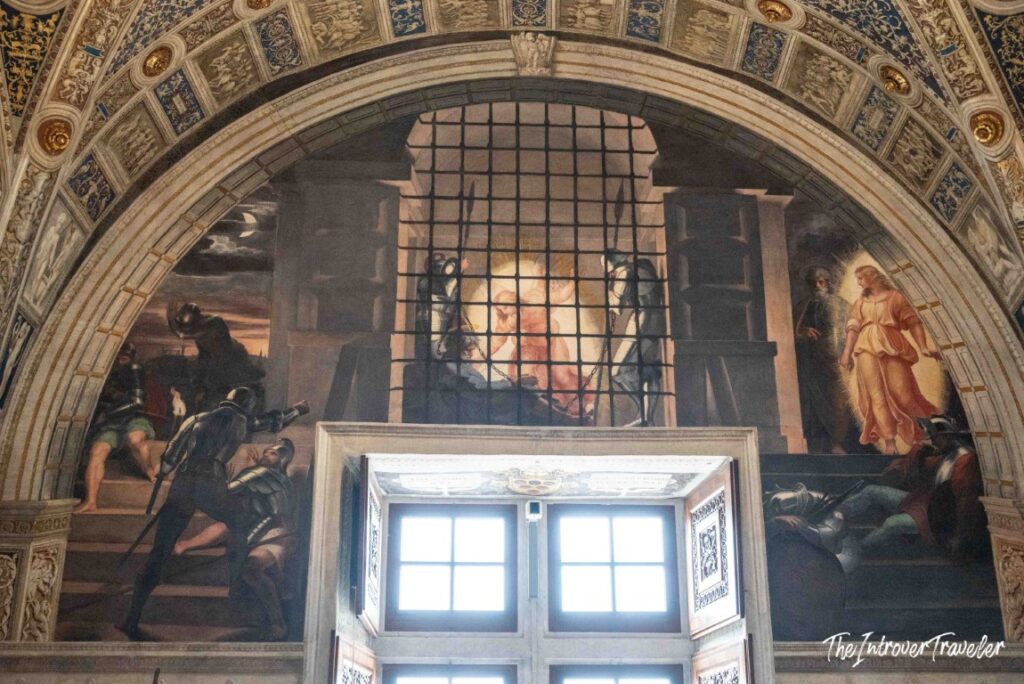
The Liberation of St Peter from Prison. Raphael works with three different light sources, the angel, the moon and the torch, and achieves nocturnal effects worthy of Rembrandt more than a century early.
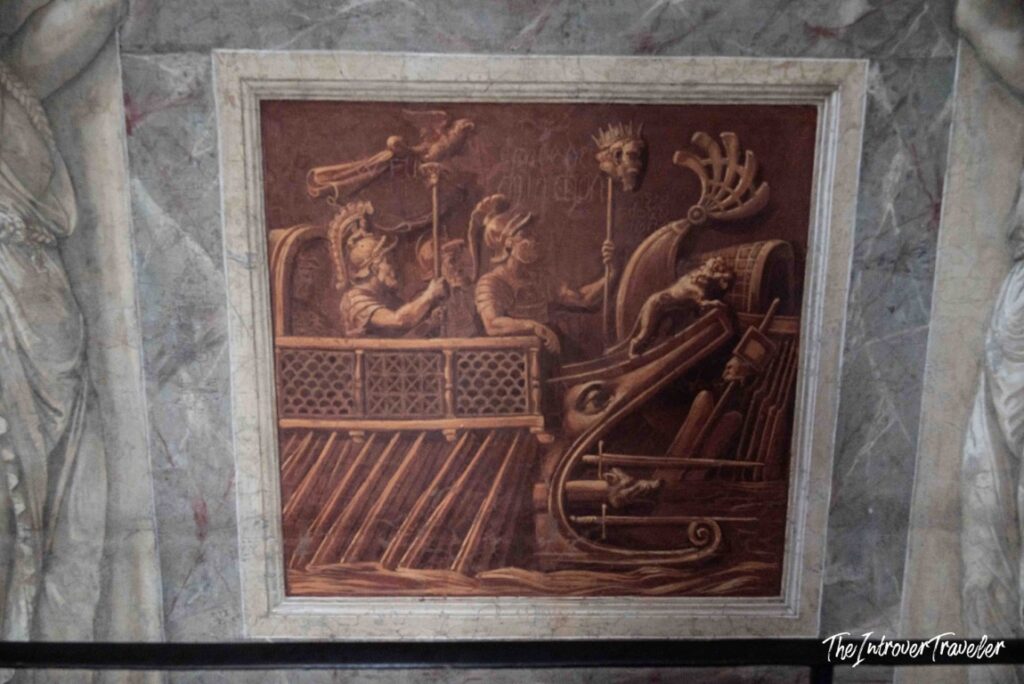
The grisailles on the dado. Beneath the great frescoes run fake monochrome reliefs, narrative scenes that would take hours to examine in every detail. On these surfaces you will also find graffiti scratched into the plaster. It is documented that during the Sack of Rome in 1527 the Landsknechts left inscriptions on the frescoes of the Rooms, the best known of which hails Luther on the Disputation of the Holy Sacrament. But beware: part of the grisaille dado was painted after the Sack, under Paul III, and many surfaces bear graffiti from later periods, signatures and dates left by seventeenth- and eighteenth-century visitors. Vandals are not an invention of mass tourism: they have simply changed tools, from the tip of a pike to the smartphone.
Overall, what leaves you breathless is Raphael’s naturalistic and chromatic virtuosity: the ability to hold dozens of figures together in compositions of absolute clarity, to give every face a character, to use colour as structure rather than decoration.
Time of visit: 3.15-4 p.m.
The surreal spectacle of the zombies
And here we return to the crowd, because it is precisely in the Raphael Rooms that the spectacle becomes truly surreal.
Of all the visitors who pass through the Rooms, perhaps ten per cent stop to admire them. The others carry on without even raising their eyes. The side towards the inner courtyard is systematically crossed by a river of people heading straight for the Sistine Chapel, eyes fixed, steady pace, never turning their heads. It recalls the sequence in Alan Parker’s The Wall, the one with the schoolchildren marching in line towards the meat grinder to the sound of Another Brick in the Wall. In front of the School of Athens, the work that sums up the entire Renaissance, thousands of people walk past every day without stopping, because their only goal is another room, further on, that they have seen on Instagram.
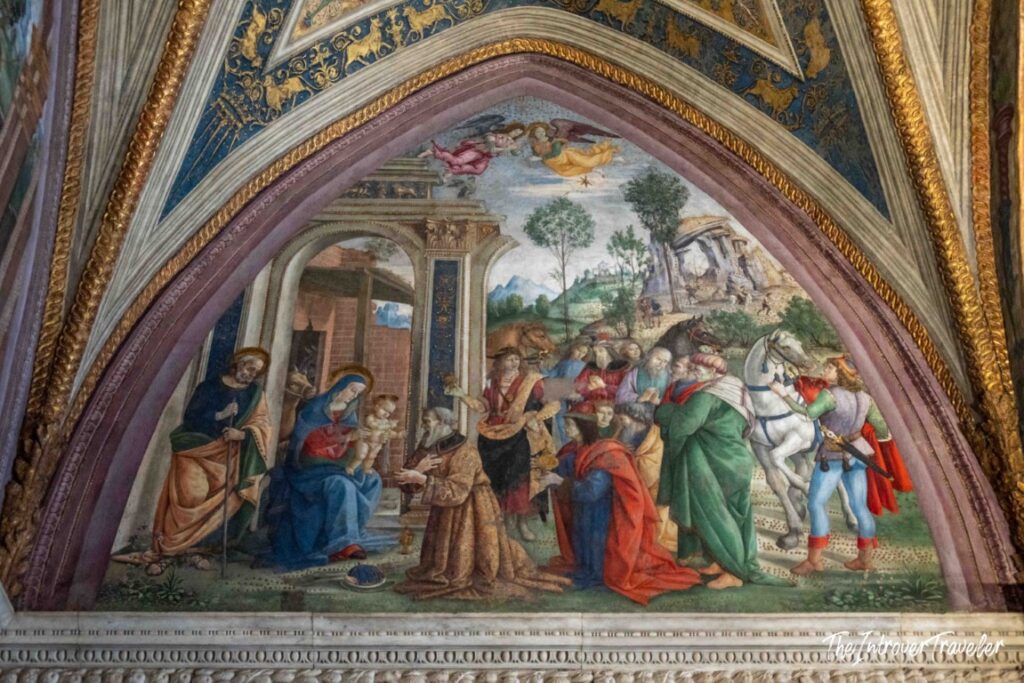
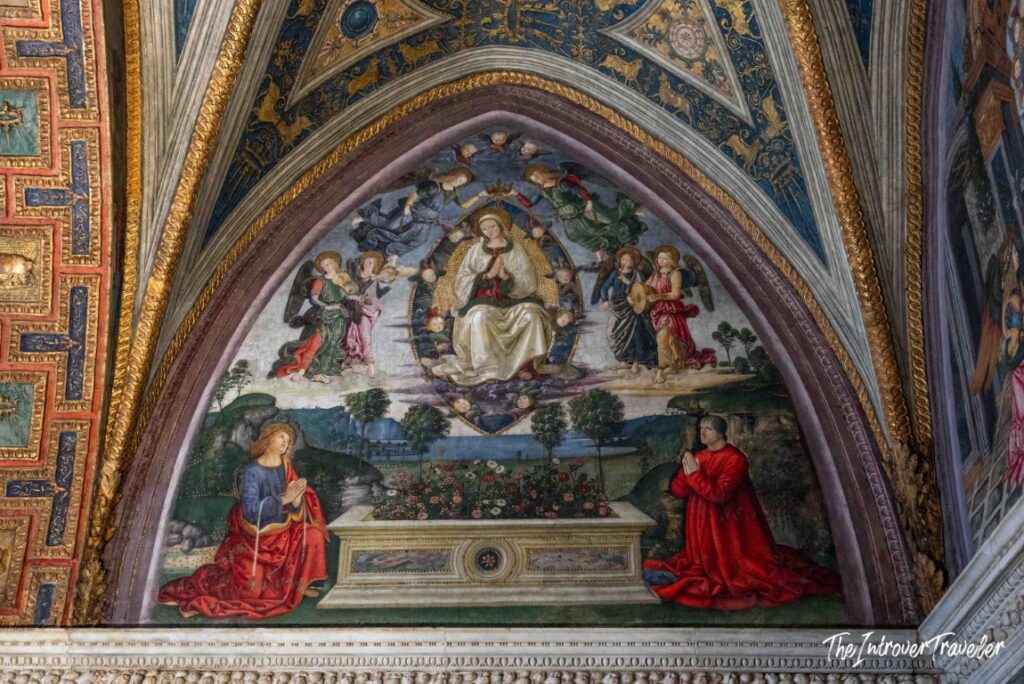
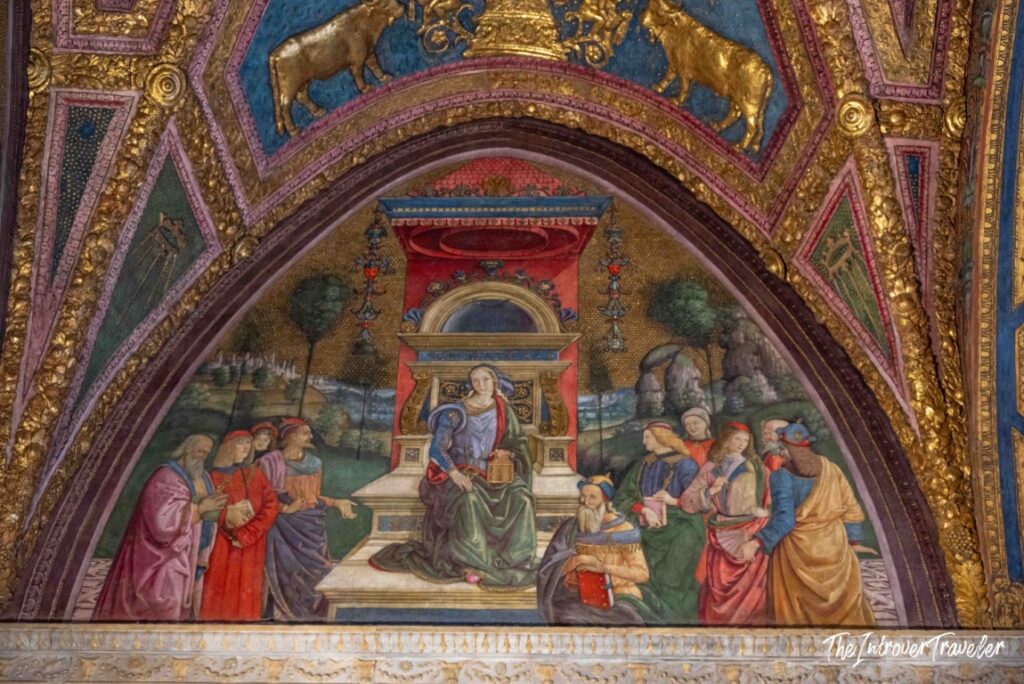
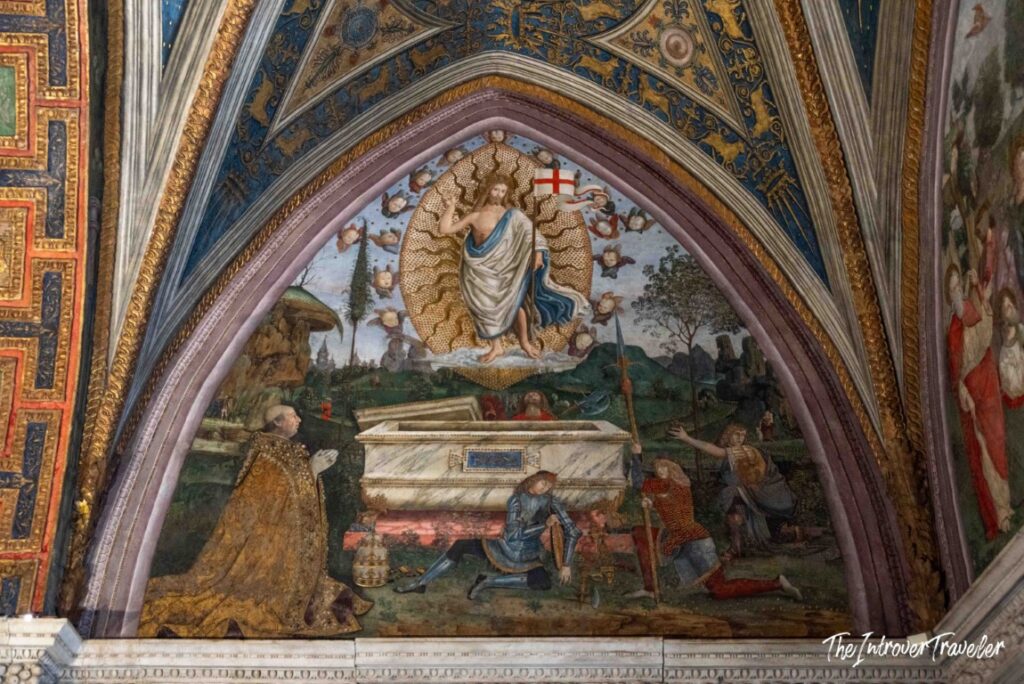
The Borgia Apartment: Pinturicchio, squeezed between two giants
The Borgia Apartment suffers from an awkward position: it lies exactly halfway between Raphael and Michelangelo. It is like playing a set between the Beatles and the Rolling Stones. And yet Pinturicchio’s frescoes, painted for Pope Alexander VI Borgia and completed in 1494, are works of great merit that in any other museum would be the main attraction. Here they are ignored by the flow of visitors: the rooms are almost empty, because the snake doesn’t deviate and carries on towards the Sistine Chapel.
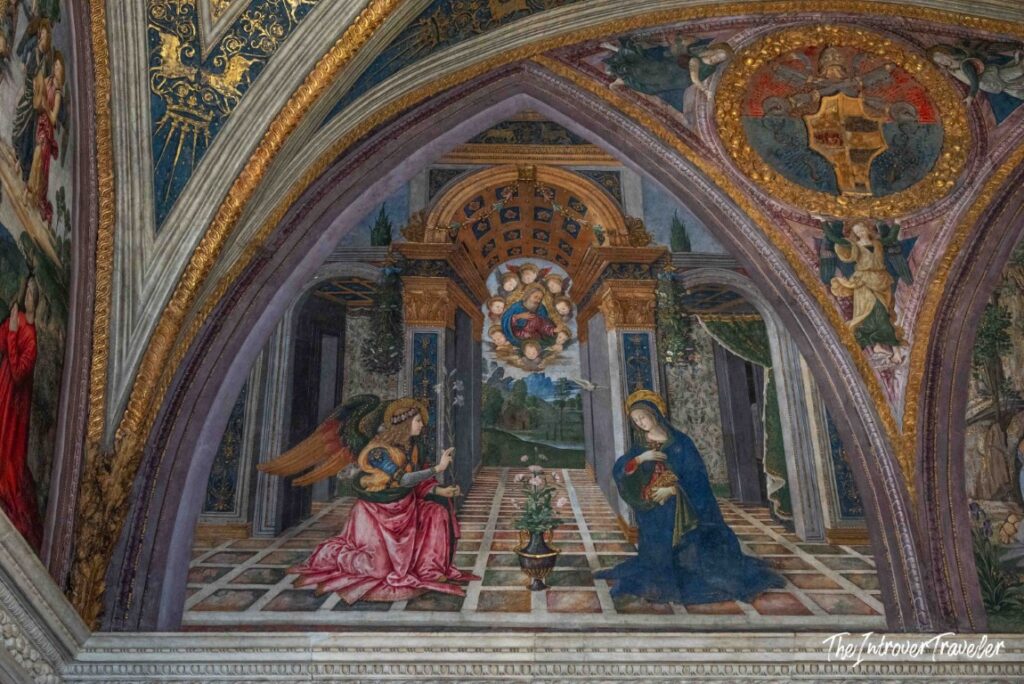
Their loss. The lunettes of the Room of the Mysteries of the Faith, with the Annunciation, the Adoration of the Magi, the Resurrection and the Assumption, are of extraordinary decorative richness: raised gilding, brocades, Umbrian landscapes, fantastical architecture. Golden bulls, emblem of the Borgia family, chase each other across the vaults. And in the Resurrection there is a detail worth the detour on its own: Alexander VI in person, kneeling in a golden cope, utterly devout, before the rising Christ. The most talked-about pope of the Renaissance, the one with the acknowledged children, the real or alleged poisonings and the memorable parties, having himself portrayed in adoration: it is one of the most shameless and most beautiful images in fifteenth-century painting.
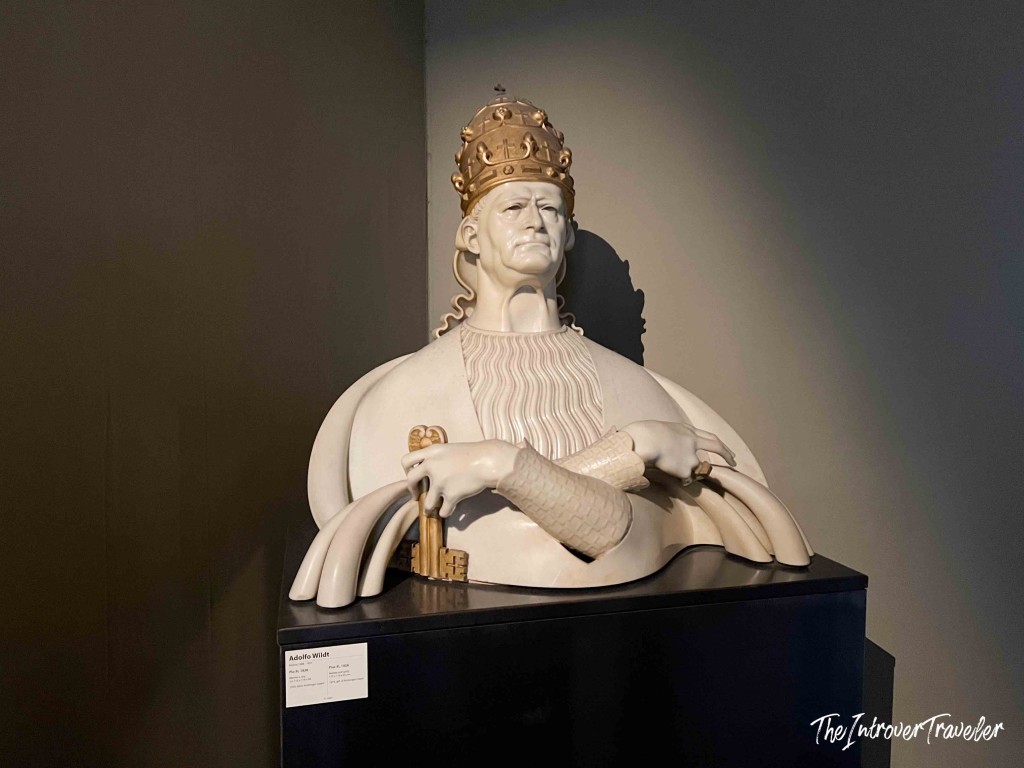
Before entering the apartment, take note of Adolfo Wildt’s bust of Pius XI, from 1926. With those squared-off features and that fixed stare, the pope bears an embarrassing resemblance to Peter Boyle, the monster in Young Frankenstein. Mel Brooks effect aside, it is perhaps not Wildt’s most successful work.
Time of visit: 4-4.10 p.m.
The Collection of Modern and Contemporary Art: Bacon in the Pope’s museum
Continuing on, you pass through the Collection of Modern and Contemporary Art, inaugurated by Paul VI in 1973 and displayed largely in the very rooms of the Borgia Apartment. It is the most unexpected section of the museum, and here too the average quality is astonishing.
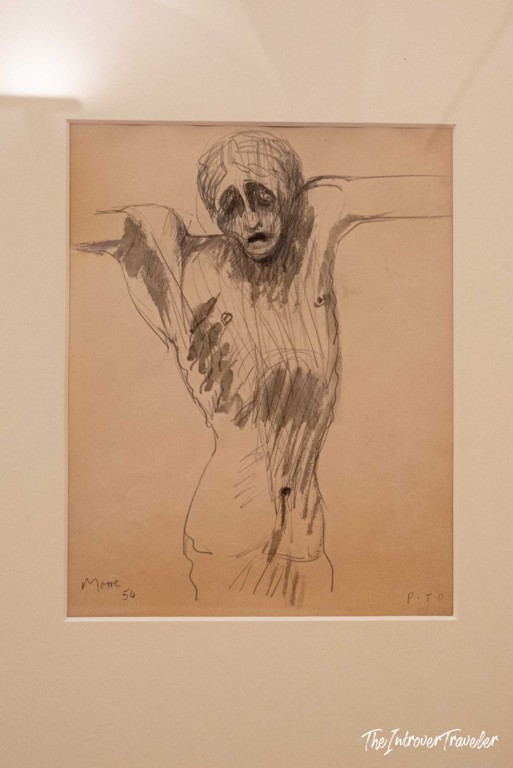
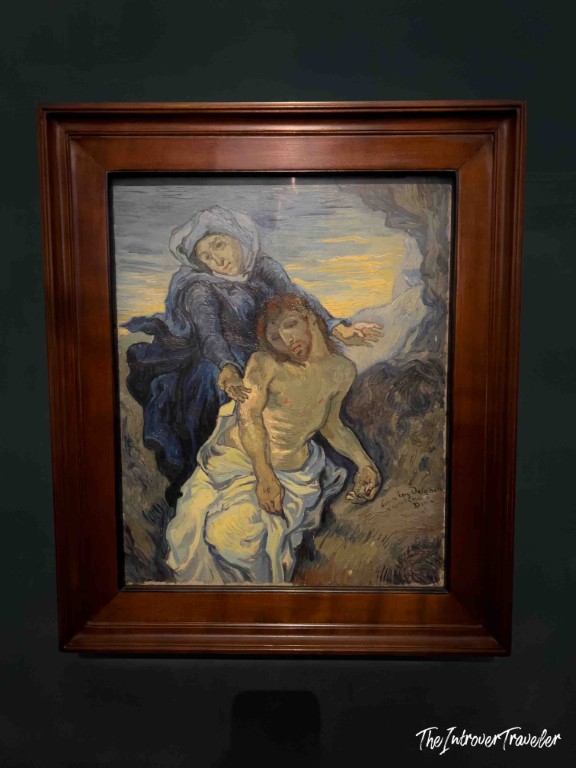
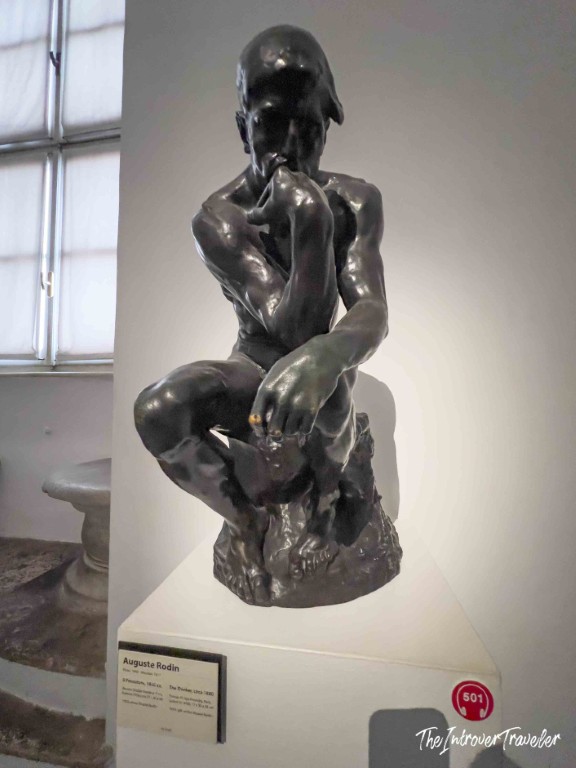
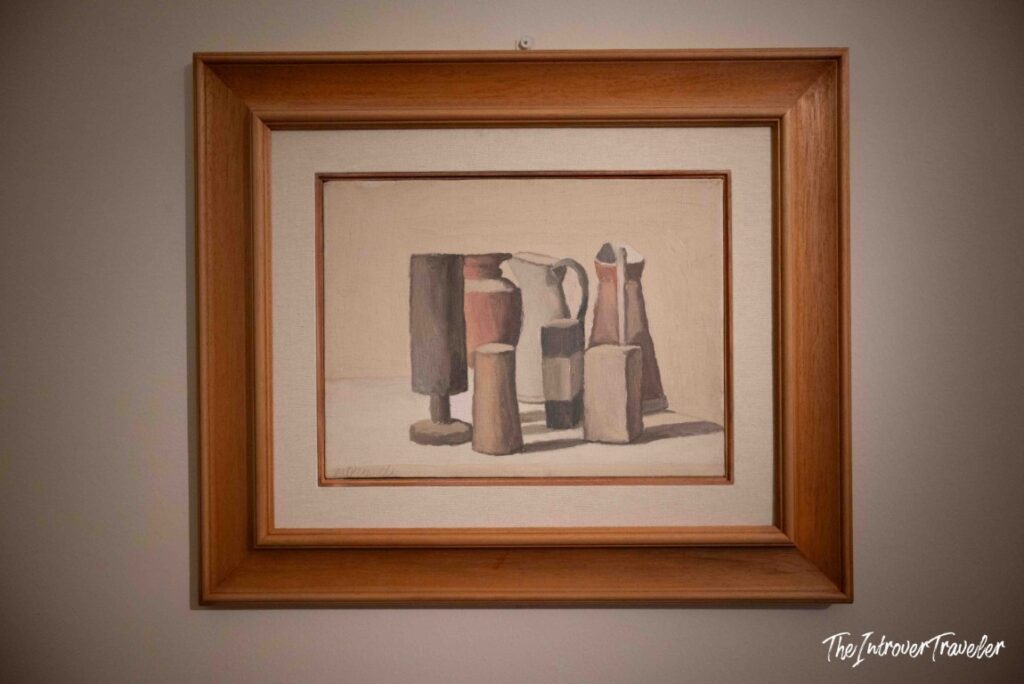
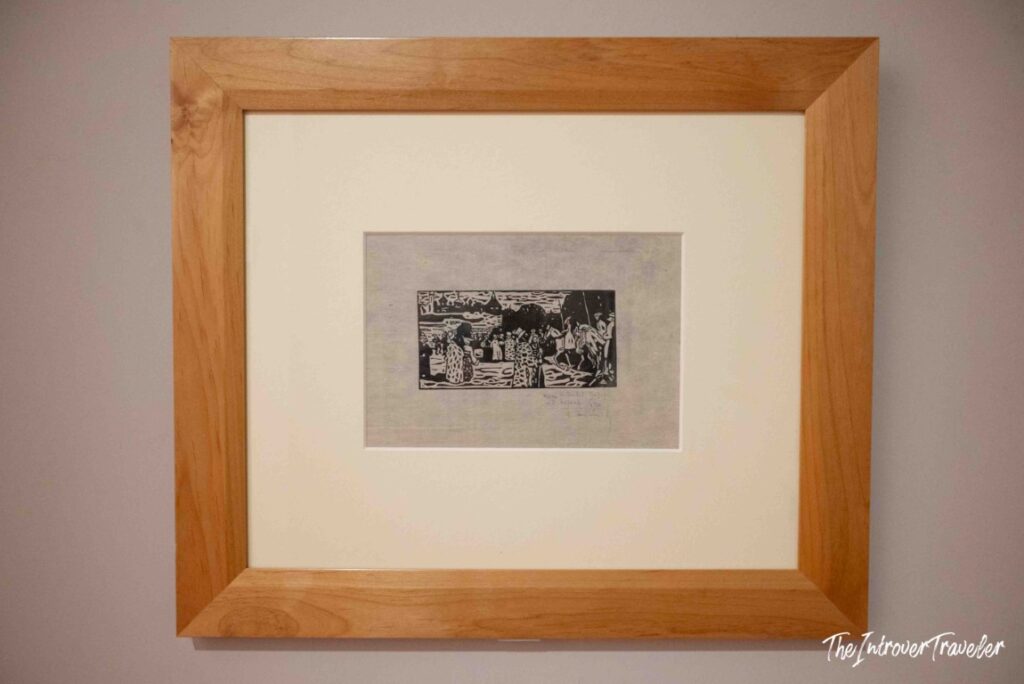
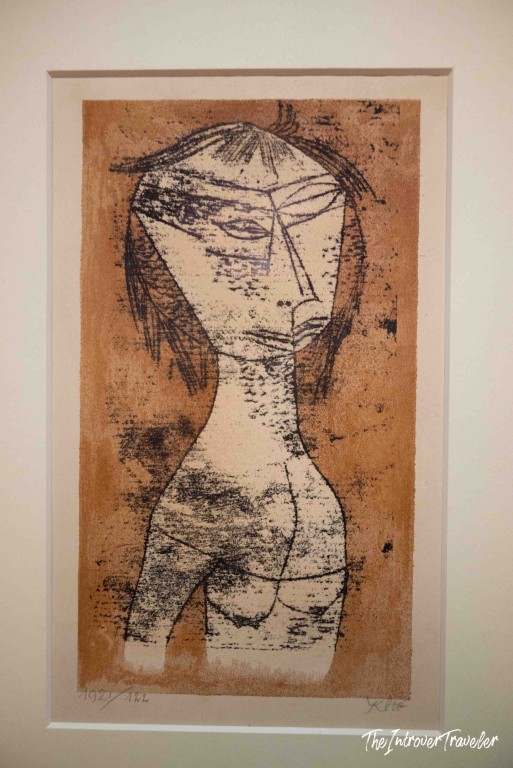
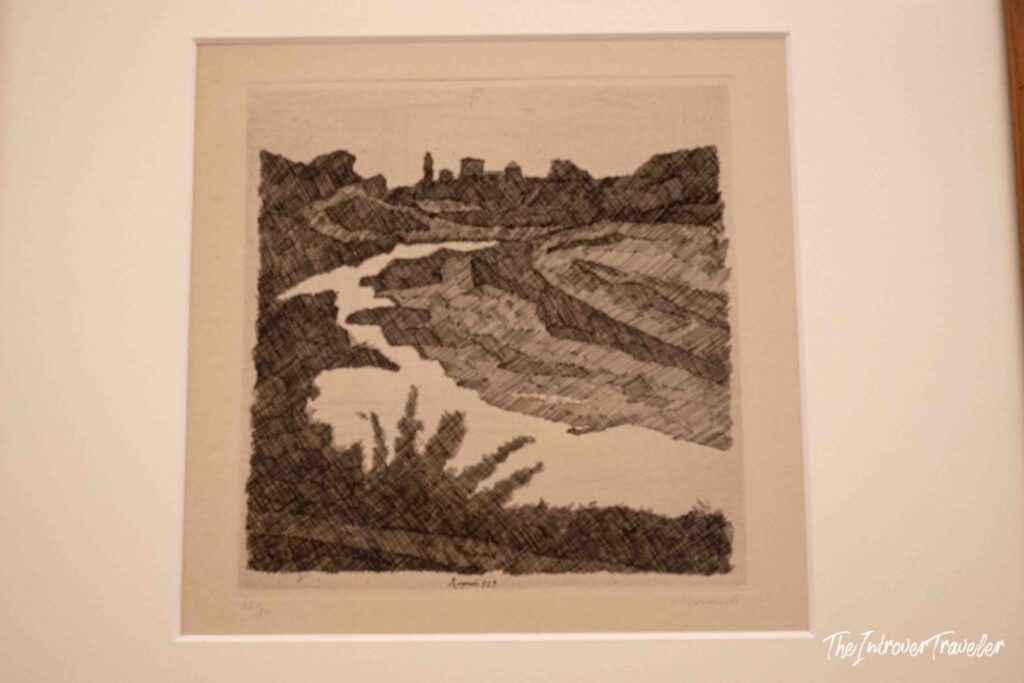
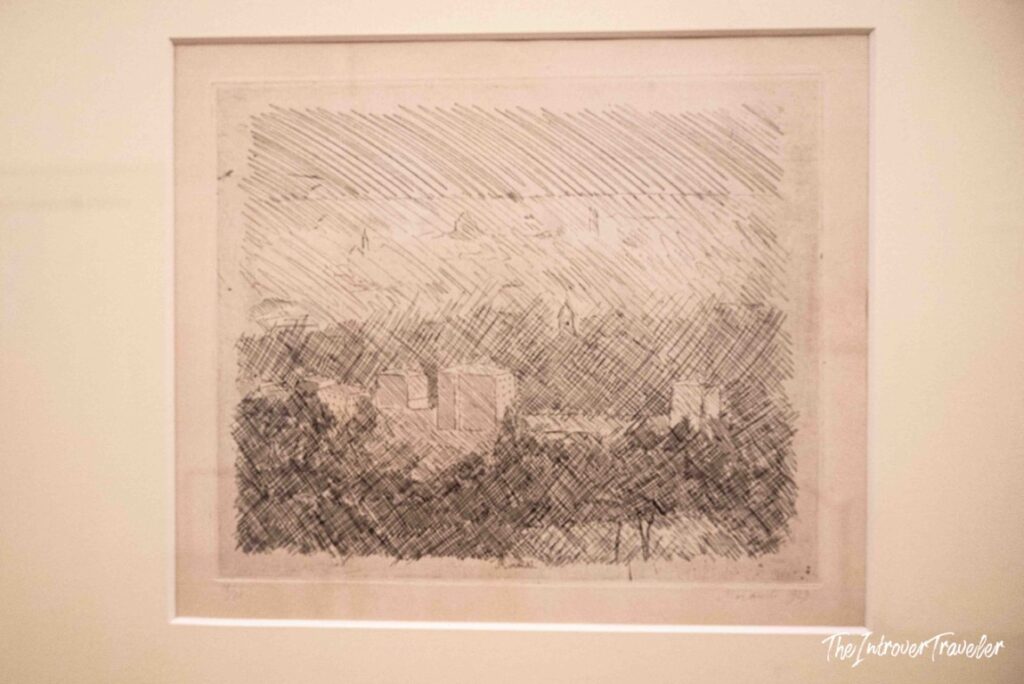
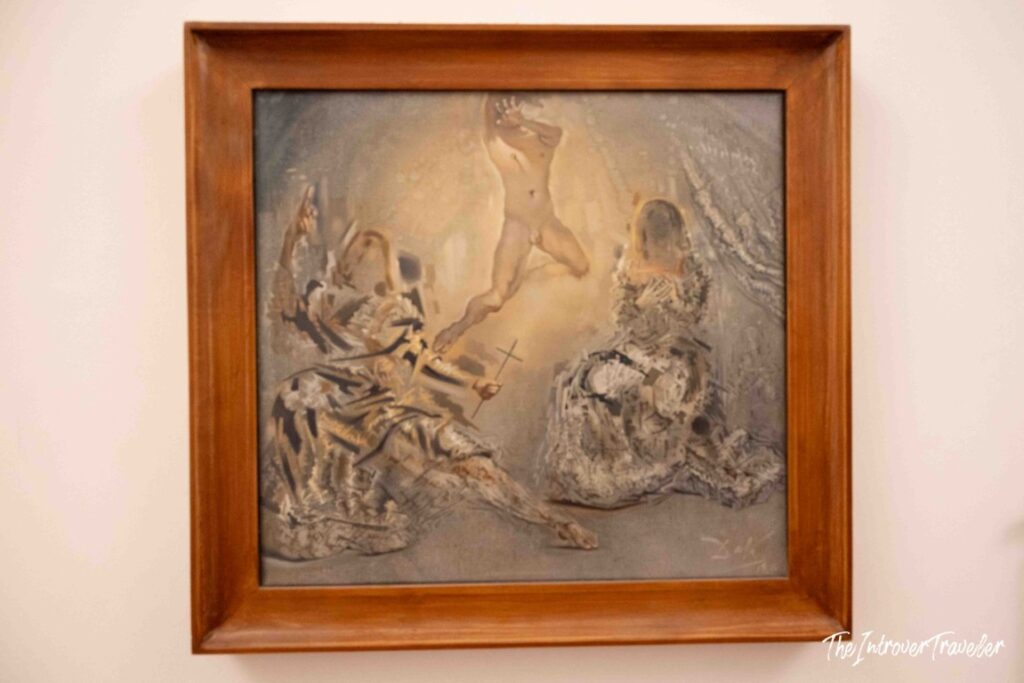
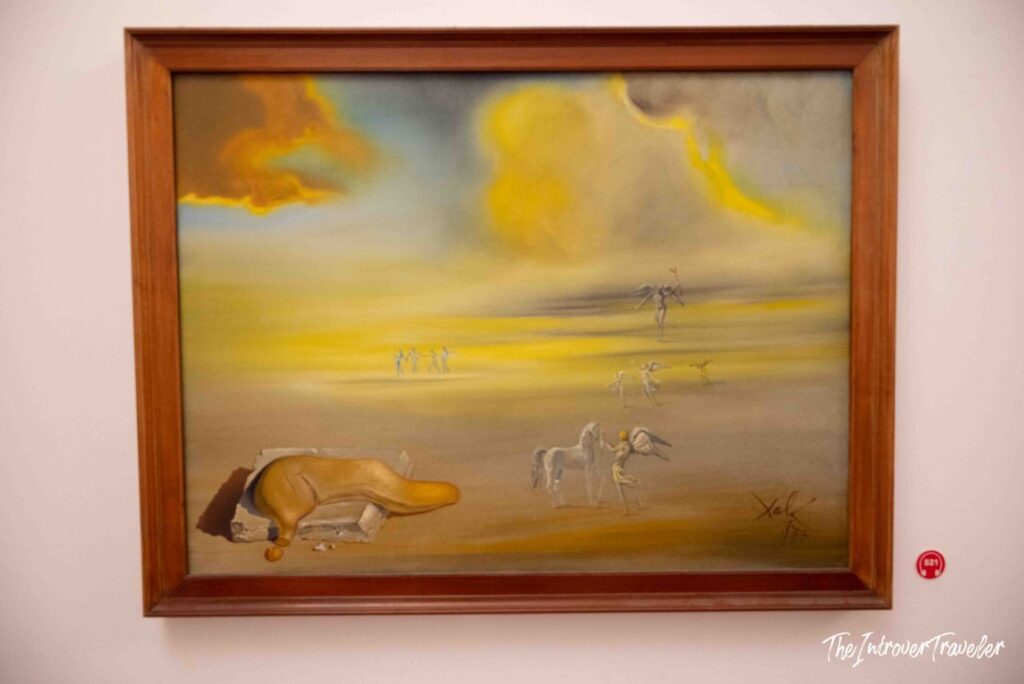
A drawing by Henry Moore, a crucifixion from 1954 traced with a nervous line; Giorgio Morandi, with a still life and two landscape etchings that alone would fill a room in a provincial museum; Paul Klee, with his Saint of Inner Light; a woodcut by Kandinsky; two Dalís; a bronze by Rodin; and Van Gogh’s Pietà of 1890, a free copy after Delacroix painted a few weeks before his death, one of the rare religious subjects in his output.
And then Francis Bacon. The painter who spent twenty years making popes scream inside glass cages, obsessively reworking Velázquez’s Innocent X, hangs in the Pope’s own museum. The Vatican’s is, moreover, one of his most composed popes, which makes the whole thing even more delicious. You have to grant the Vatican a sense of humour, or at least a remarkable capacity for absorption: the Church never throws anything away, not even criticism.
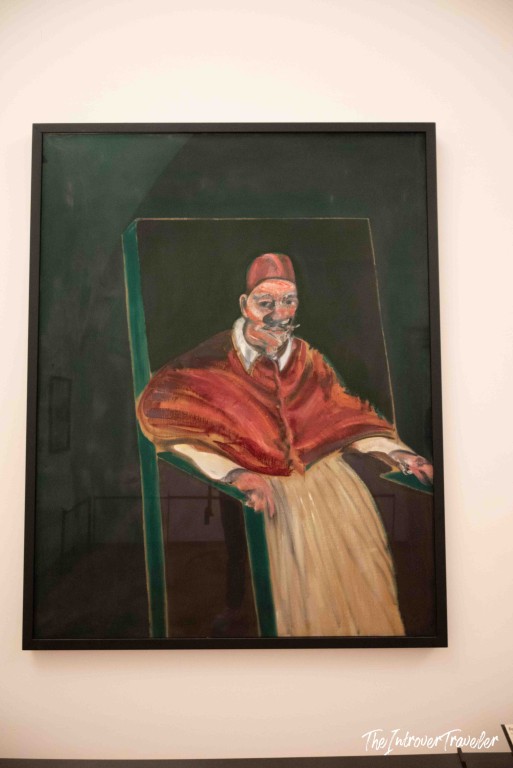
Time of visit: 4.10-4.25 p.m.
The Sistine Chapel: the most astonishing place on the planet
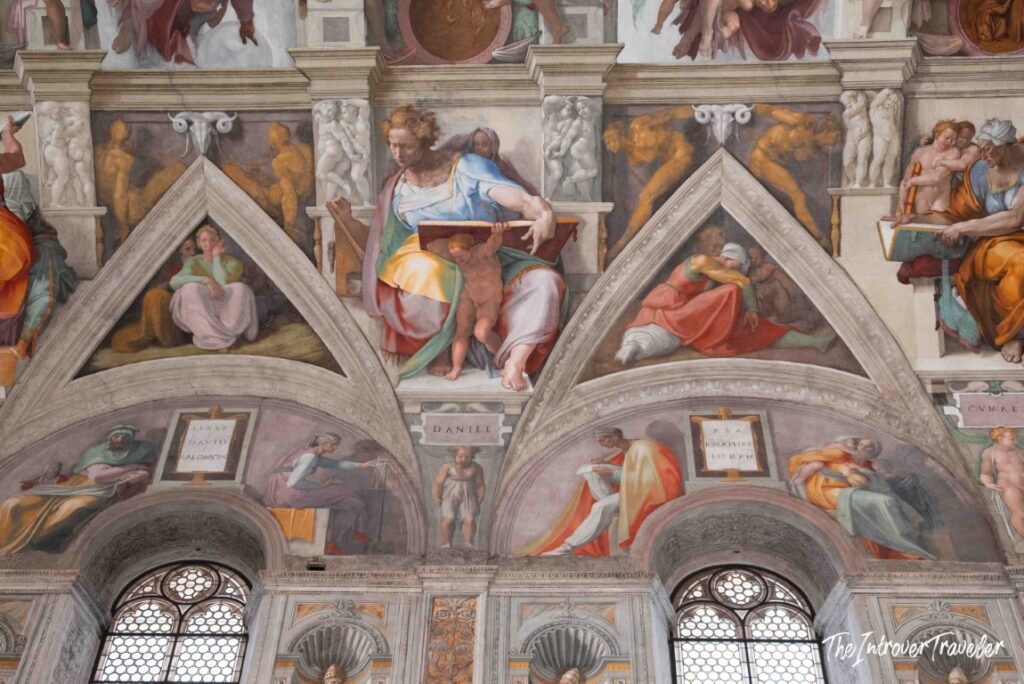
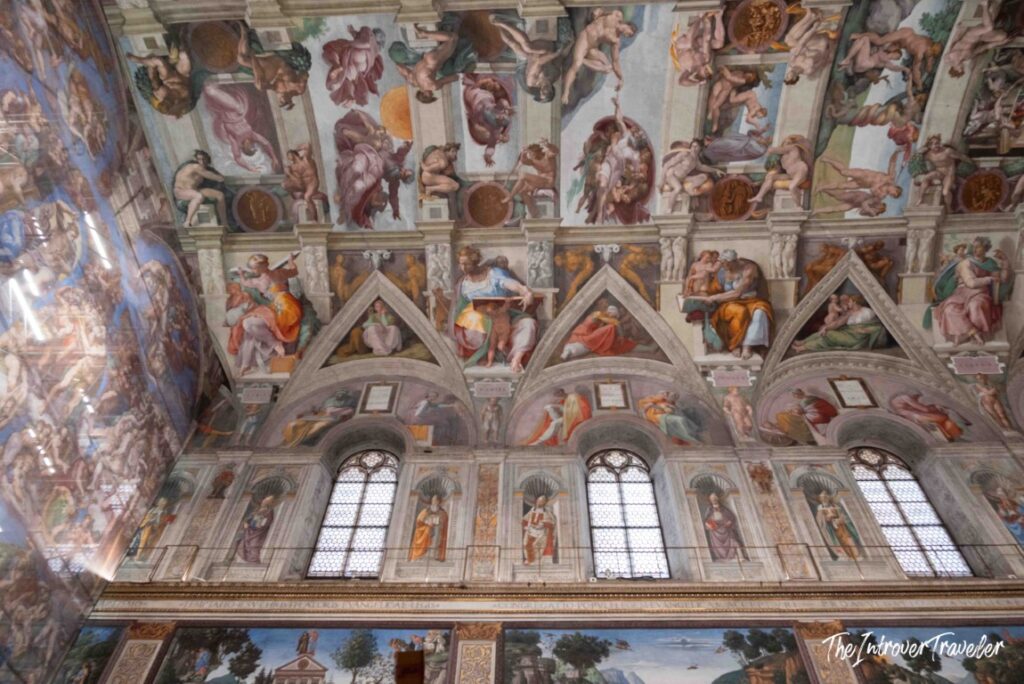
I have already devoted a long post to Michelangelo’s ceiling, to which I refer you for the technique, history and meaning of the frescoes. Here I will limit myself to a few observations.
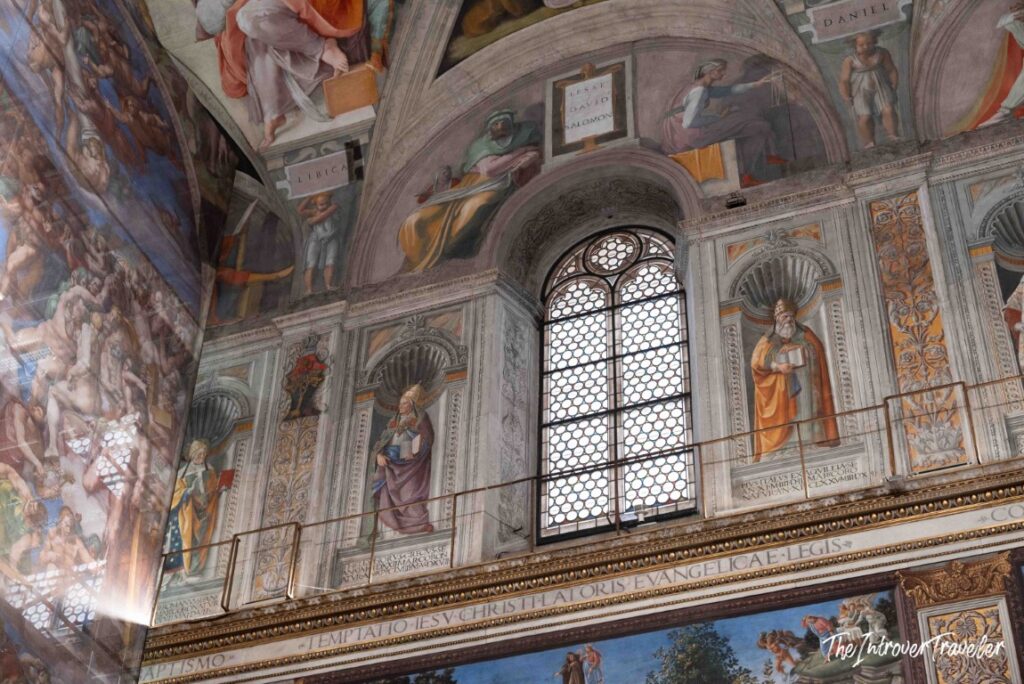
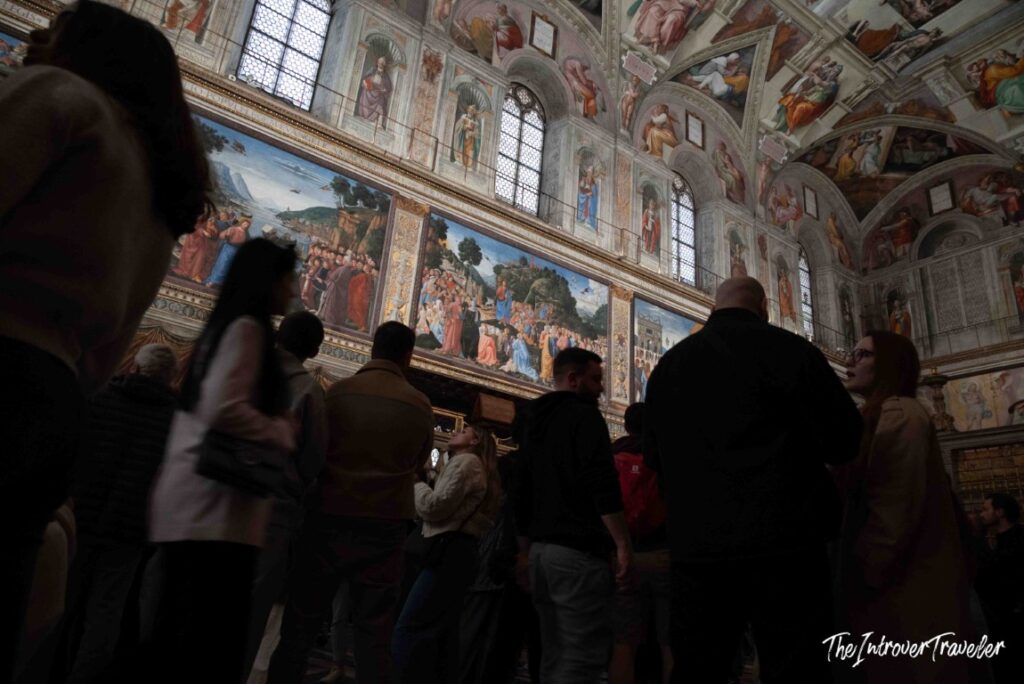
The few photos you see were taken covertly, and they are dreadful. Photography is forbidden in the Sistine Chapel, and the staff are very quick to reprimand anyone who tries. Behind the ban there was originally also a question of rights: the great restoration of the 1980s and 1990s was funded by a Japanese television network, which in return obtained exclusive image rights for a number of years. Those rights expired long ago, and the ban has remained for an entirely sensible reason: to stop a place like the Sistine Chapel turning into a free-for-all of people taking selfies with the Last Judgement in the background. Long may it last. I am publishing the photos anyway, in the probably vain attempt to convey what it feels like to stand in the most astonishing place on the planet and in history.
The Sistine Chapel is not just Michelangelo’s two great frescoes, the ceiling and the Last Judgement. It is also the marvellous Cosmatesque-style floor, which nobody looks at because everyone has their nose in the air. And it is the fifteenth-century cycle on the walls, with the stories of Moses and Christ painted by Perugino, Botticelli, Ghirlandaio, Signorelli and Cosimo Rosselli: a cast of painters who in any other chapel in the world would be the reason for the visit, and who here serve as the frame.
Every time I go, I try to shut out the crowd, the murmur, the custodians repeating “no photo, silence”, and I try to hear the voices of Michelangelo and Julius II talking, or more probably shouting, beneath the scaffolding. The pope asking when it will be finished; Michelangelo replying “when I can”; the pope who, according to the story handed down, raises his stick. Two impossible characters shut in the same room for four years, and out of that forced cohabitation came the greatest thing a human being has ever painted. I like to think that, if you listen carefully, their voices still echo in this space.
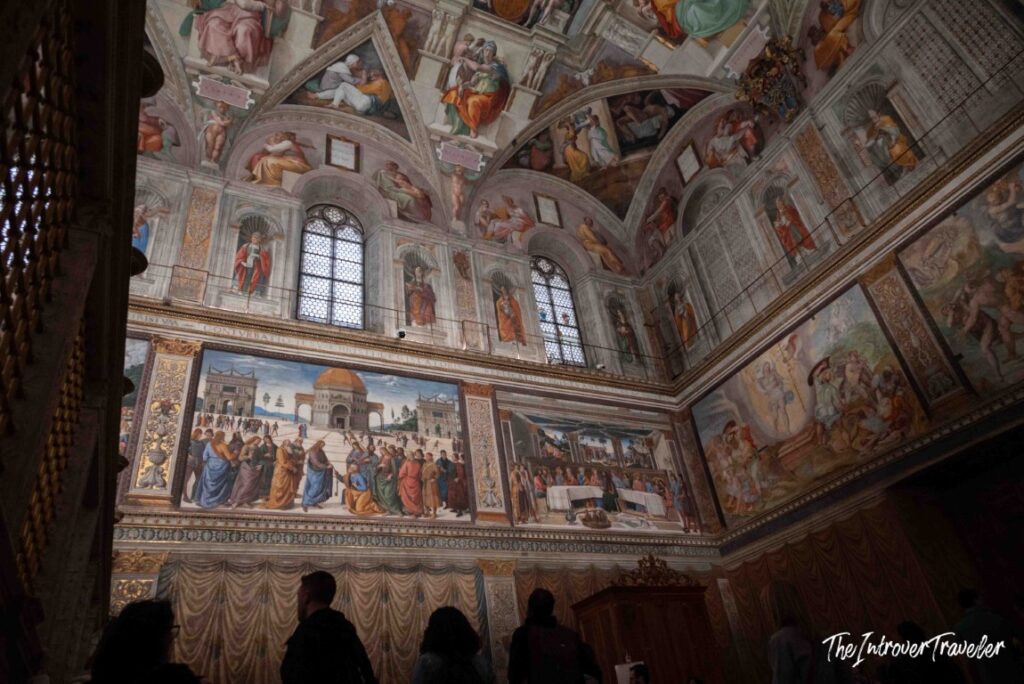
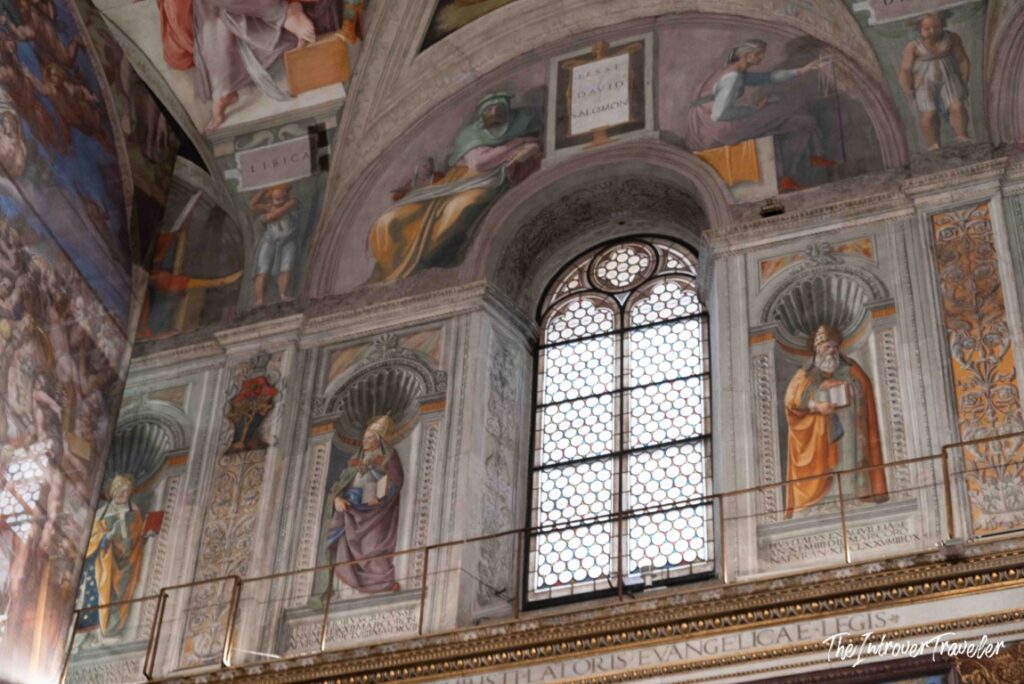
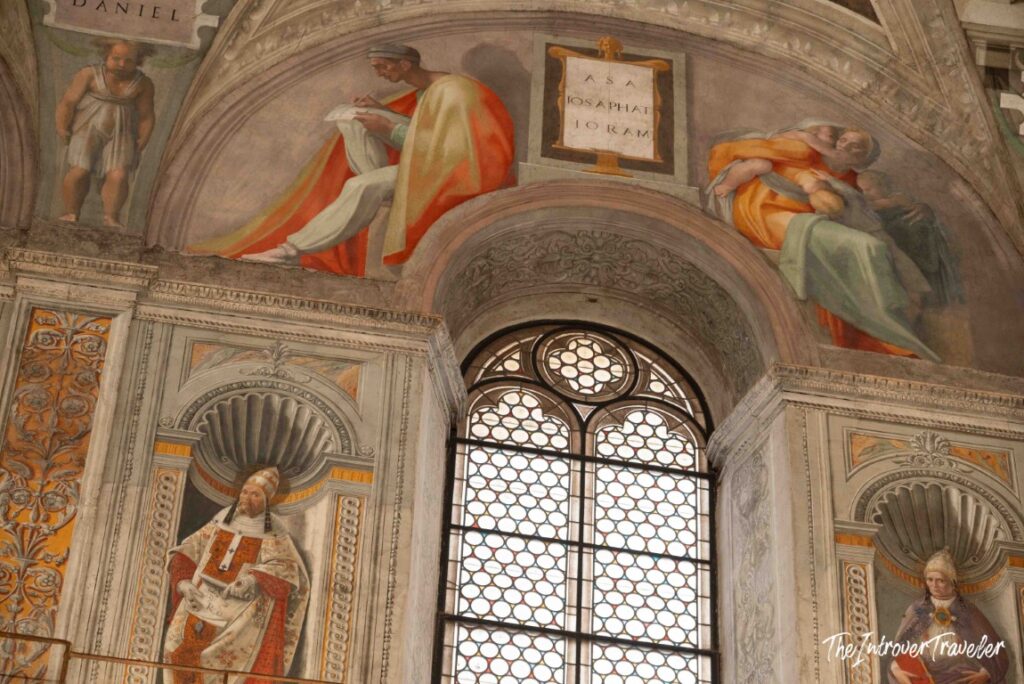
Time of visit: 4.25-5.10 p.m.
The Library gallery: sublime antiquities
Leaving the Sistine Chapel, those who don’t take the shortcut to St Peter’s walk through the long gallery of the Apostolic Library, with the Museo Sacro and a series of display cases full of sublime antiquities: Early Christian objects, ivories, enamels, reliquaries, terrestrial and celestial globes.
I will single out one piece among a thousand: the Rambona Diptych, an ivory carved in central Italy around the year 900. Beneath the Crucifixion is the she-wolf suckling Romulus and Remus, complete with inscription. Pagan Rome, quite literally, at the foot of the cross. It is the image that explains better than any treatise what the Vatican is: an institution that has never thrown anything away, not even its competitors’ mythology.
Unfortunately, or perhaps fortunately, the Vatican Apostolic Library is not open to visitors and is accessible only to scholars.
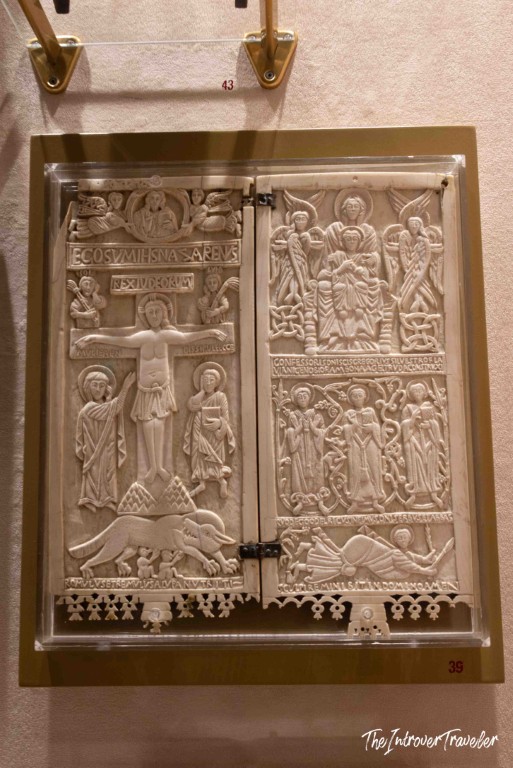
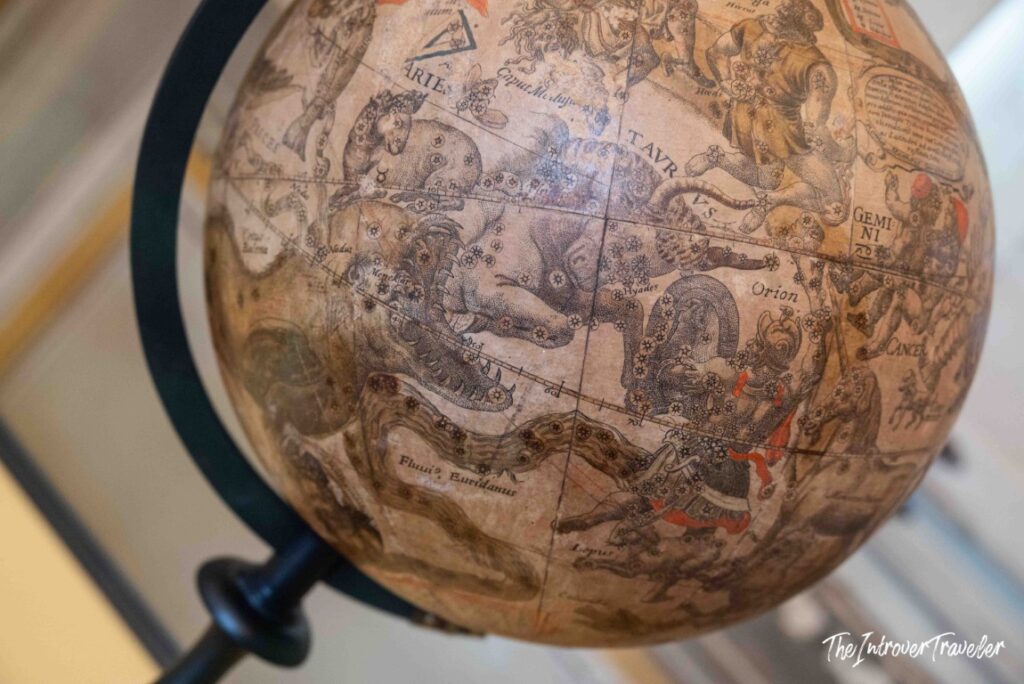
Time of visit: 5.10-5.30 p.m.
The Pinacoteca: the museum within the museum
You reach the Pinacoteca, opened by Pius XI in 1932, with tired legs and a full head. It is a mistake to arrive in that state, because the Pinacoteca alone would rank among the great museums of Europe.
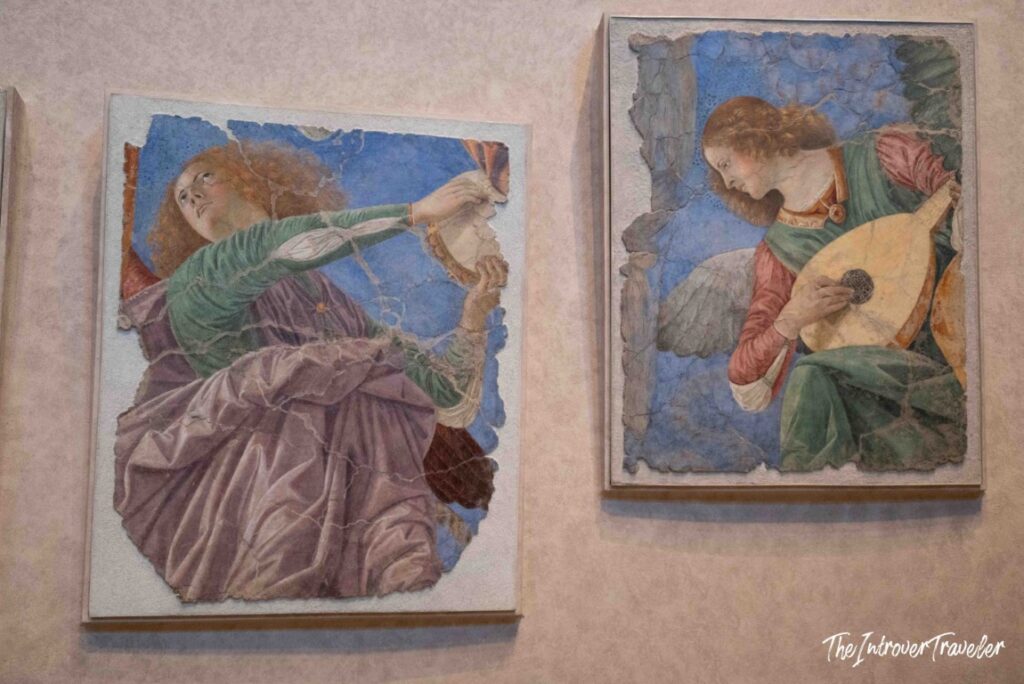
Melozzo da Forlì, the outsider.
Melozzo da Forlì’s music-making angels are fragments of the Ascension fresco that decorated the apse of the basilica of Santi Apostoli in Rome, detached in the eighteenth century when the apse was demolished. They are among the most reproduced images in Italy: you have seen them on Christmas cards, calendars and panettone boxes. And yet almost nobody knows the name of the man who painted them. Fame for the work without fame for the author: the perfect fate for a neglected painter who deserves to be rediscovered.
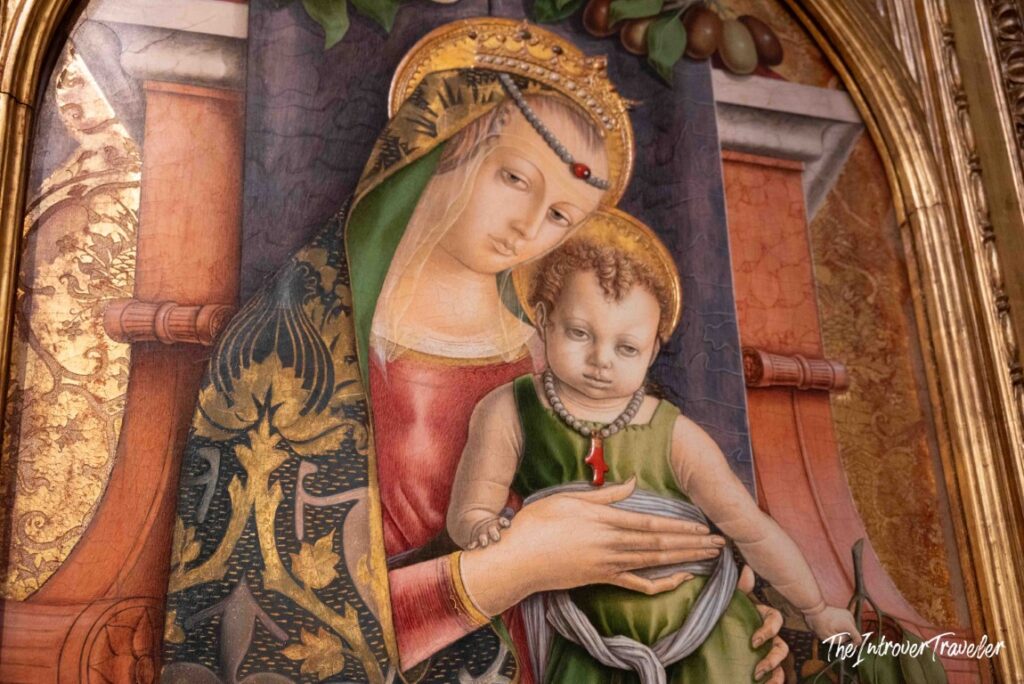
Carlo Crivelli, sublime as ever.
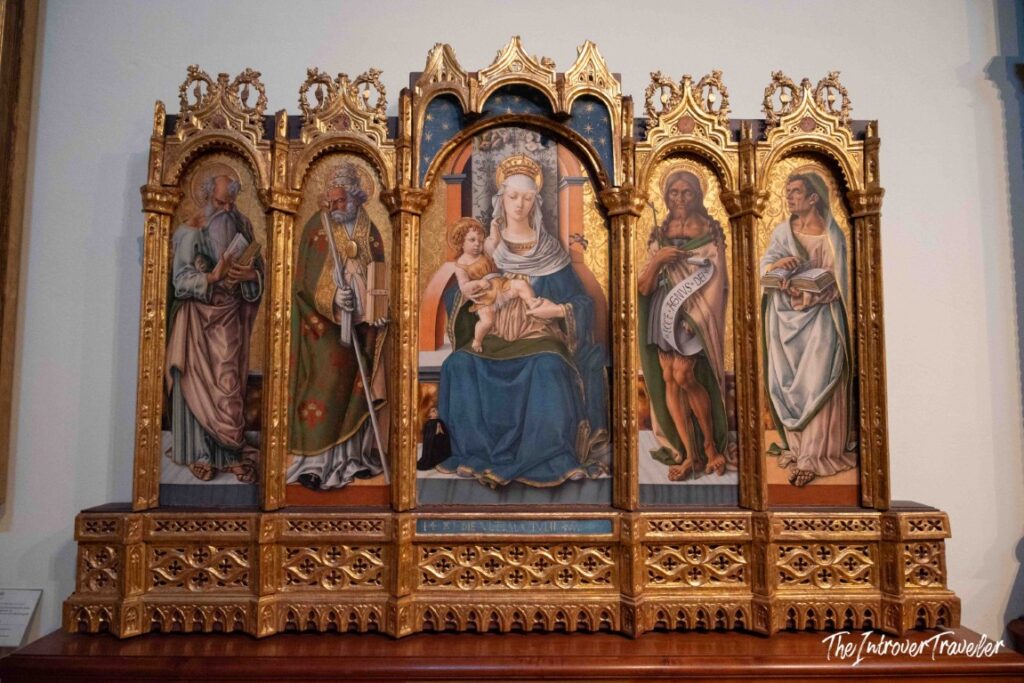
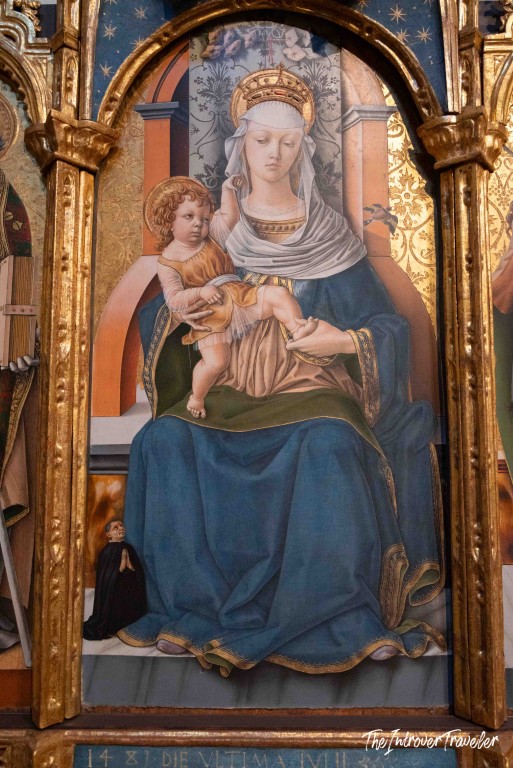
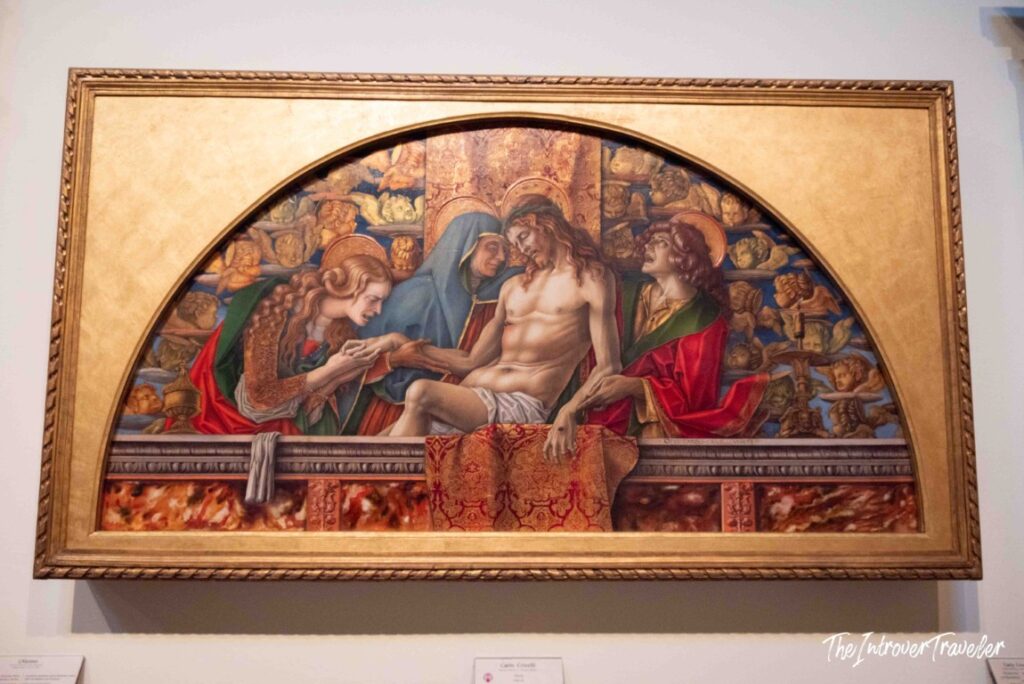
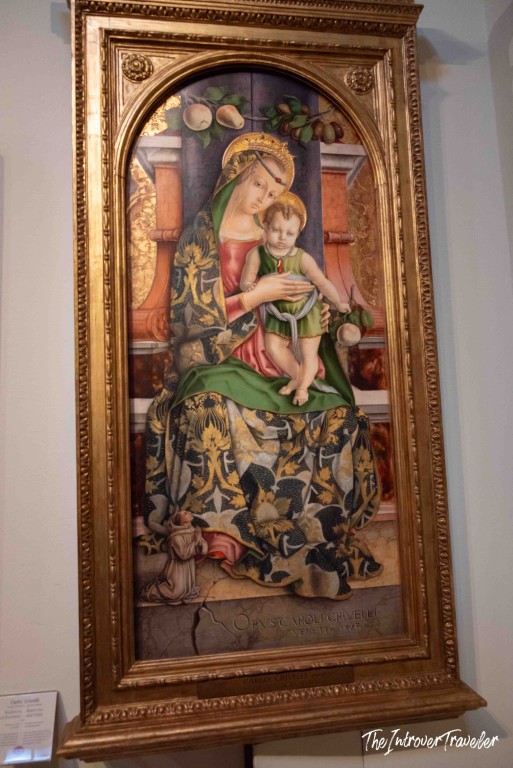
The Pinacoteca holds three works by Carlo Crivelli, which is a rarity: very few collections in the world can boast as many in the same room. The polyptych of the Madonna and Child with Saints is dated on the central step to the last day of July 1481 (some scholars see the hand of his younger brother Vittore executing Carlo’s design, but the museum presents it as Carlo’s work); the Madonna and Child is signed and dated 1482; the lunette of the Pietà dates from 1488-1489.
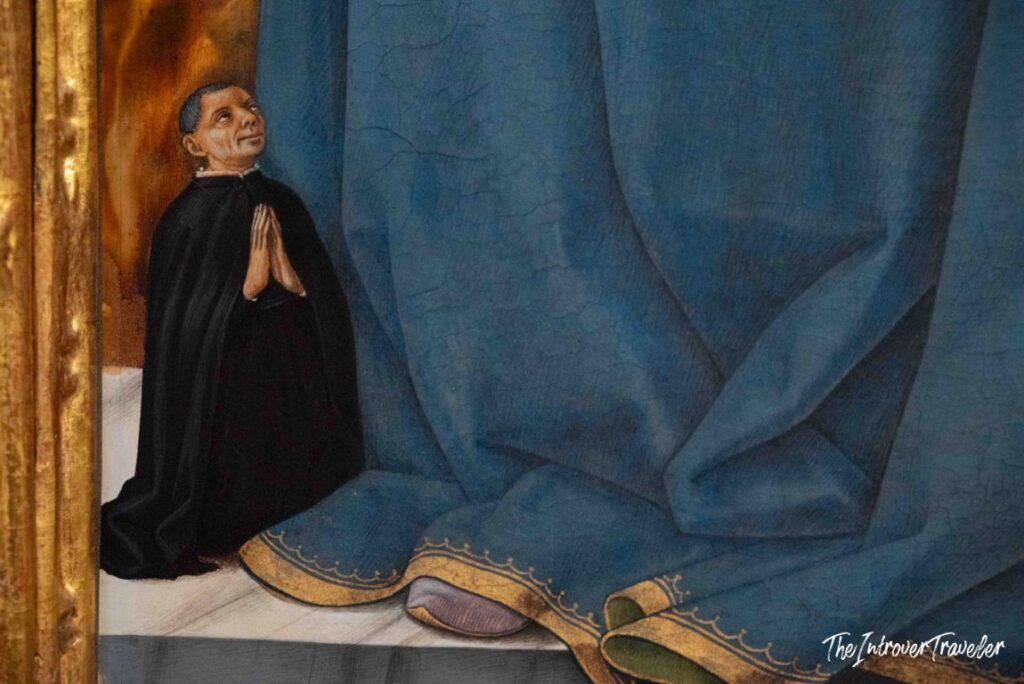
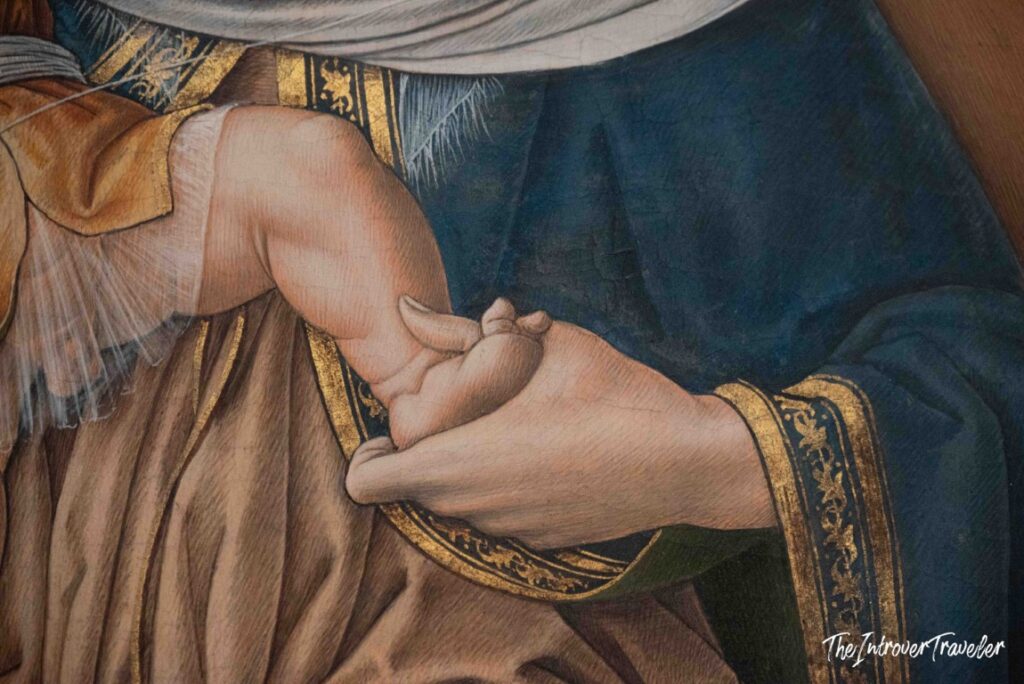
Crivelli is a painter who resembles no one else in the fifteenth century: raised gilding, fruit hanging as in a Flemish still life, brocades painted with a goldsmith’s precision, drapery as hard as stone, a slightly cruel beauty. Go looking for the details. In the polyptych, the Madonna’s hand tenderly holding the Child’s little foot. At her feet, the miniature donor, kneeling in prayer, with the features of Rowan Atkinson. In the 1482 Madonna, the sprig of red coral around the Child’s neck, an amulet against the evil eye, as in Piero della Francesca’s Brera Altarpiece: folk superstition calmly slipped into sacred iconography. And in the Pietà, Mary Magdalene clasping Christ’s hand with an almost expressionist grief, worlds away from Tuscan composure.
Raphael’s tapestries.
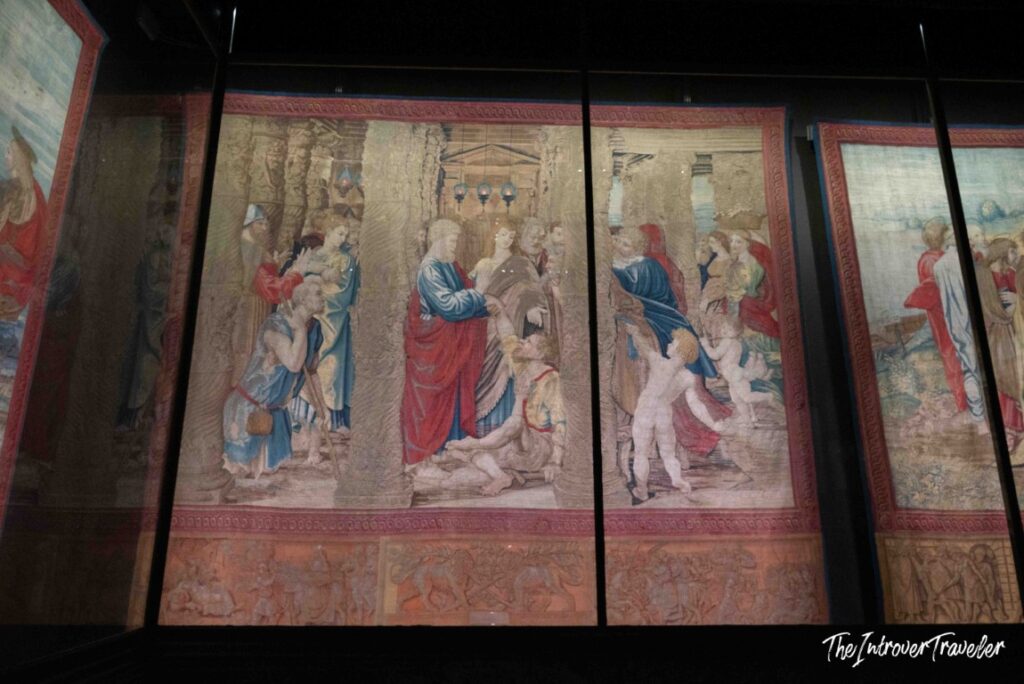
The Raphael room also houses the great tapestries of the Acts of the Apostles, commissioned by Leo X for the Sistine Chapel and woven in Brussels from cartoons by Raphael and his workshop between 1515 and 1521. They are spectacular, but it must be said frankly: partly because of the dim light, necessary for conservation, partly because of their size, they are not easy to read. It is worth stopping for a few minutes and letting your eyes adjust, but even then they are not easy to decipher.
They are still worth it, if only for their history, which reads like the script of an adventure film. During the Sack of Rome in 1527 they were looted and sold off piecemeal; some, it seems, even ended up in the hands of pirates, others may have been destroyed to recover the gold in their threads. One of them, St Paul Preaching in Athens, resurfaced in Constantinople and was returned to the pope in 1554 by the Constable of France, Anne de Montmorency, who before giving it back had his own coat of arms woven onto it: the gentleman who returns the stolen goods and sticks his signature on them. Two and a half centuries later, in 1798, French troops carried them off again, and they were bought back by Pius VII. A nineteenth-century source relates that the dealer who had acquired them burnt one to extract the gold, only to discover it contained too little to be worth the trouble. If true, it is the most expensive bad review in the history of art.
A note for anyone going now: since 4 August 2026 St Paul Preaching in Athens has been on display in the Papal Palace at Castel Gandolfo, so the series in the Pinacoteca is incomplete.
The Transfiguration.
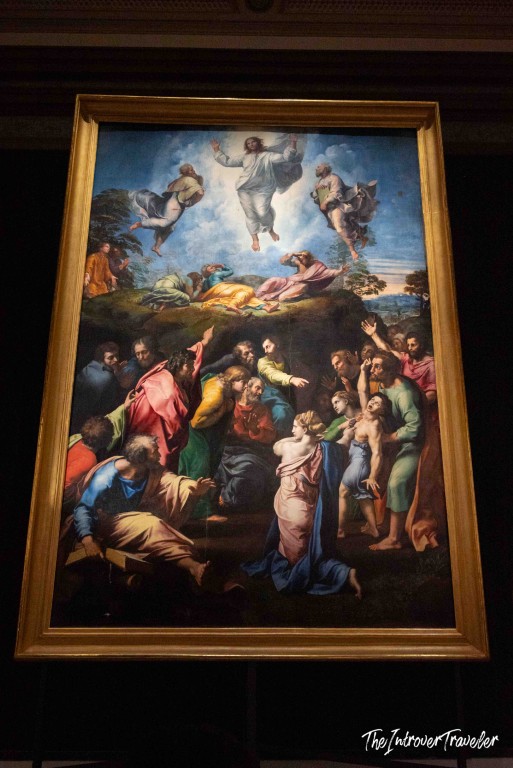
In the same room hangs Raphael’s last work, the Transfiguration, which according to Vasari was displayed beside his body at his funeral in 1520. It is a pictorial testament: in the upper part, Christ suspended in light, serene, perfect; in the lower part, the drama of the possessed boy, a dark and agitated crowd, violent gestures, contrasts of light that seem already to herald the seventeenth century (and which, in my view, are not the ground on which Raphael expresses himself at his best). Some scholars believe parts of the lower half were completed by Giulio Romano, closing the circle opened in the Hall of Constantine; for what it’s worth, while Giulio Romano’s hand is evident in the Rooms, here Raphael’s own authorship seems just as evident to me, despite the reservations I have just expressed. And here too the point about the tapestries applies: because of its size and the dim light it is not easy to read; it is one of those works that is perhaps easier to study in a book.
The Transfiguration also made the journey to Paris with Napoleon and returned after his fall, thanks to Canova’s mission. By now you will have noticed that a visit to the Vatican Museums is also a catalogue of what Napoleon stole and what he was forced to give back.
The Oddi Altarpiece.
Not far away is the Coronation of the Virgin, the so-called Oddi Altarpiece, painted by Raphael for Perugia in the very first years of the sixteenth century, when he was about twenty and still steeped in the manner of his master Perugino: symmetrical figures, sweet faces, an Umbrian landscape between the two registers. Placed beside the Transfiguration, it lets you see almost the entire arc of Raphael’s career in a single room, from the boy painting with someone else’s grammar to the man who, less than twenty years later, overturns everything and opens the way to the Baroque.
Giovanni Bellini, in my opinion his masterpiece.
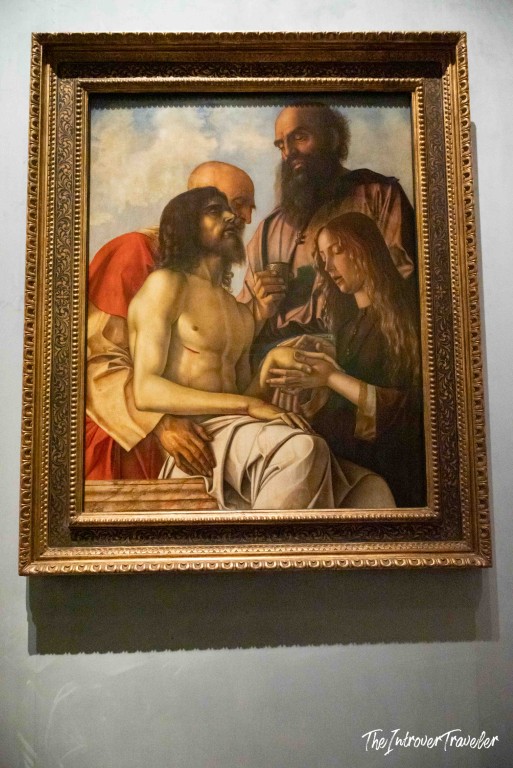
Giovanni Bellini’s Lamentation over the Dead Christ is, in my opinion, his finest work. I know that saying this of a painter who signed the San Zaccaria Altarpiece and the Frick’s St Francis is a bold position to take. But look at the interlacing of the hands of Christ and Mary Magdalene, that abandoned, heavy body, the faces of Joseph of Arimathea and Nicodemus: it is painting of an almost unbearable intensity.
The panel was the crowning section of the Pesaro Altarpiece, painted by Bellini in the 1470s for the church of San Francesco. It was the only element of the altarpiece confiscated by the French after the Treaty of Tolentino; returned to Italy in 1816, it did not go back to Pesaro but ended up in the Vatican Pinacoteca. For more than half a century it was attributed to Mantegna, until in 1871 Crowe and Cavalcaselle recognised it as Bellini’s work and reconnected it to the altarpiece. Today the main altarpiece is in the Musei Civici in Pesaro, its finest part is in the Vatican, and the two have never been reunited. Napoleonic restitutions, evidently, did not always go back to the sender.
Leonardo’s St Jerome, or: works change, we change more.
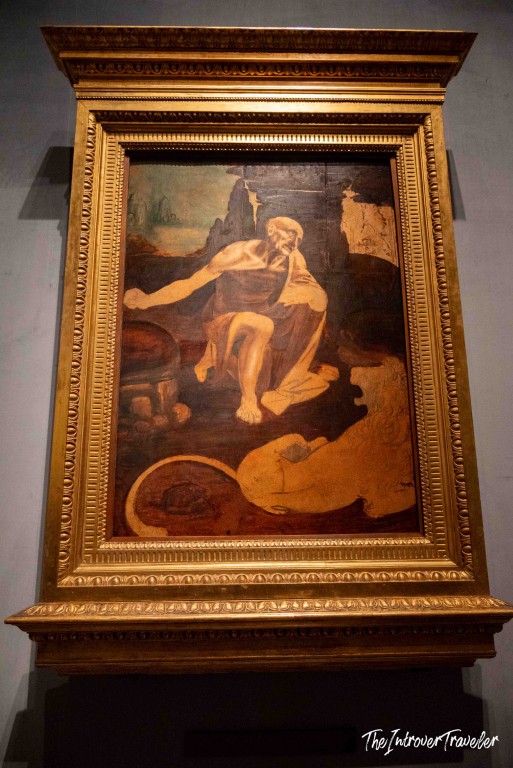
Leonardo’s St Jerome is a work that thrilled me in my youth, when I went through a period of ardent passion for Leonardo. Today, looking at it again, I struggle to remember what thrilled me.
I don’t say this to criticise the work, which remains a precious document of Leonardo’s working method: an unfinished painting, with varying degrees of completion, in which you can see the drawing beneath the paint. Umberto Eco, in The Open Work, argued that a work of art does not have a single, closed meaning but is completed by the interpretation of whoever looks at it. Eco was thinking mainly of the avant-garde, but the concept can be extended: not only are works open, so are we. Mood, age, passing passions, interests that change over the years all condition the way we read art. The same painting, seen at twenty-five and at fifty, is not the same painting. I had a foretaste of this at the Tokyo National Museum, where jet lag knocked half a point off my ability to receive the works; here the variable is not the fatigue of a single day, but twenty years of life.
And the St Jerome is the extreme demonstration of this in its own history, too. According to tradition, Cardinal Joseph Fesch, Napoleon’s uncle, found it divided into two parts: the lower part in a Roman junk dealer’s shop, where it served as the lid of a chest, and the part with the saint’s head at his shoemaker’s, who had used it to make the seat of a stool. However it actually happened, the panel was indeed cut into five pieces. To some it was a Leonardo masterpiece; to others, a piece of wood to sit on. The reading of a work changes not only with the age of the viewer, but with the age itself.
Correggio, and all the rest.
Correggio is another often-overlooked giant, and here he is not represented by his best work: the Christ in Glory, suspended among clouds and cherubs, gives a hint of the painter of the Parma domes, but for the real Correggio you have to go there.
Of course the Vatican Pinacoteca holds many other works, from Titian, with his splendid portrait of Doge Niccolò Marcello wrapped in gold brocade, to Giuseppe Maria Crespi, the Bolognese painter known as “Lo Spagnolo”, with a Holy Family of domestic intimacy. I couldn’t publish all the photos, and in any case the lighting made them come out rather badly, so I have chosen only the main works. But rest assured that even the “minor” rooms of the Pinacoteca are worth, on their own, the ticket to a good provincial museum.
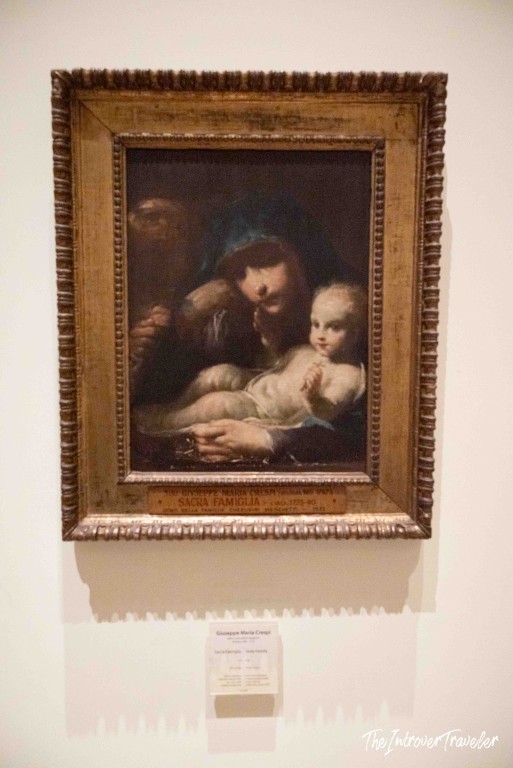
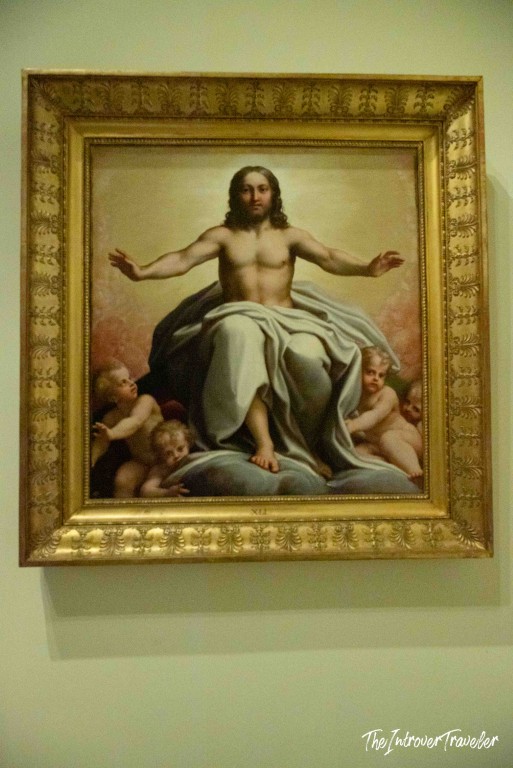
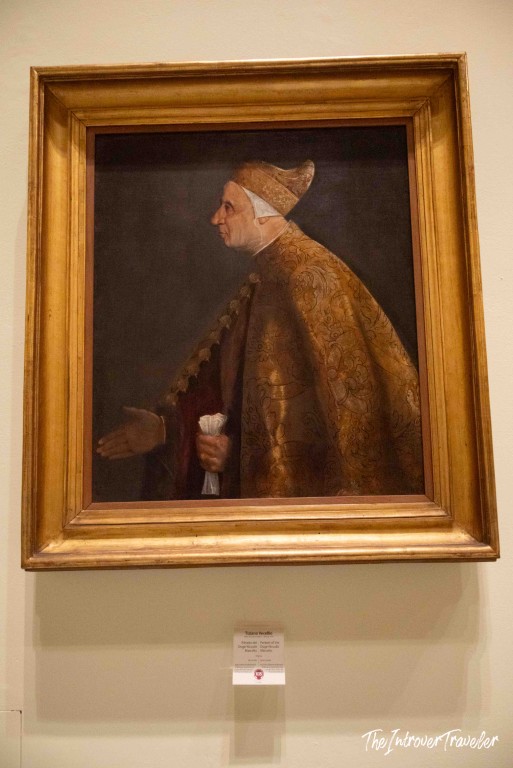
Time of visit: 5.30-6 p.m.
The doors that open for a fee (and the one that stays closed)
The standard route, colossal as it is, does not exhaust the palace. Some spaces normally closed to the public can be seen on paid guided tours that include a special opening, and it is an option worth considering if you are on your second or third visit and want something the snake will never see.
The jewel is the Niccoline Chapel, the private chapel of Pope Nicholas V, in the oldest part of the palace, a stone’s throw from the Raphael Rooms. Between 1447 and 1448 Fra Angelico, assisted by Benozzo Gozzoli, frescoed it with the stories of St Stephen and St Lawrence: a small space of luminous grace which, coming from the Raphael Rooms, lets you see where the Renaissance came from before Raphael took it to its peak. By the same arrangement you can visit the real Bramante Staircase, the one from 1505 that I mention further on, and the Cabinet of the Masks, named after the floor mosaics from Hadrian’s Villa at Tivoli. Outside the museum route, with dedicated tickets on the official website, there are also the Vatican Gardens, the Via Triumphalis Necropolis and the Papal Palace at Castel Gandolfo.
In a museum where, with enough money, almost every door opens, there is one that stays shut, and it is perhaps the most precious. The Pauline Chapel, separated from the Sistine Chapel only by the Sala Regia, holds the last frescoes Michelangelo ever painted, the Conversion of Saul and the Crucifixion of St Peter, executed between 1542 and 1550. It is the private chapel of the pope and the papal household, outside the museum routes and not normally open to the public, at any price. There is a certain irony in the fact that the old Michelangelo, the most tormented and modern one, the one many at the time considered a disappointment, is also the only one the Vatican won’t sell you.
Beyond the gratuitous sarcasm, if you’re planning a visit to the Vatican Museums, including a visit to the Niccoline Chapel could be the perfect way to round out your itinerary.
What I skipped (and you shouldn’t)
On my last visit I skipped two stops that anyone going for the first time should factor in.
The Courtyard of the Pinecone, dominated by a gigantic Roman bronze pinecone that once stood in the atrium of Old St Peter’s and that Dante cites in the Inferno to measure the height of a giant. It is one of the most photographed spaces in the complex, and also the best place to get a breath of air between one gallery and the next.
The Braccio Nuovo, built for Pius VII, with some of the most famous Roman statues in the world, including the Augustus of Prima Porta and the great statue of the Nile surrounded by sixteen cherubs.
And then there are the museums almost nobody visits: the Gregorian Profane Museum, the Pio Christian Museum, the Anima Mundi ethnological museum, the Carriage Pavilion. I mention them not to make you feel guilty, but as further proof of my original thesis: to really see the Vatican Museums you would need a week.
The exit: the dome and the staircase that isn’t by Bramante
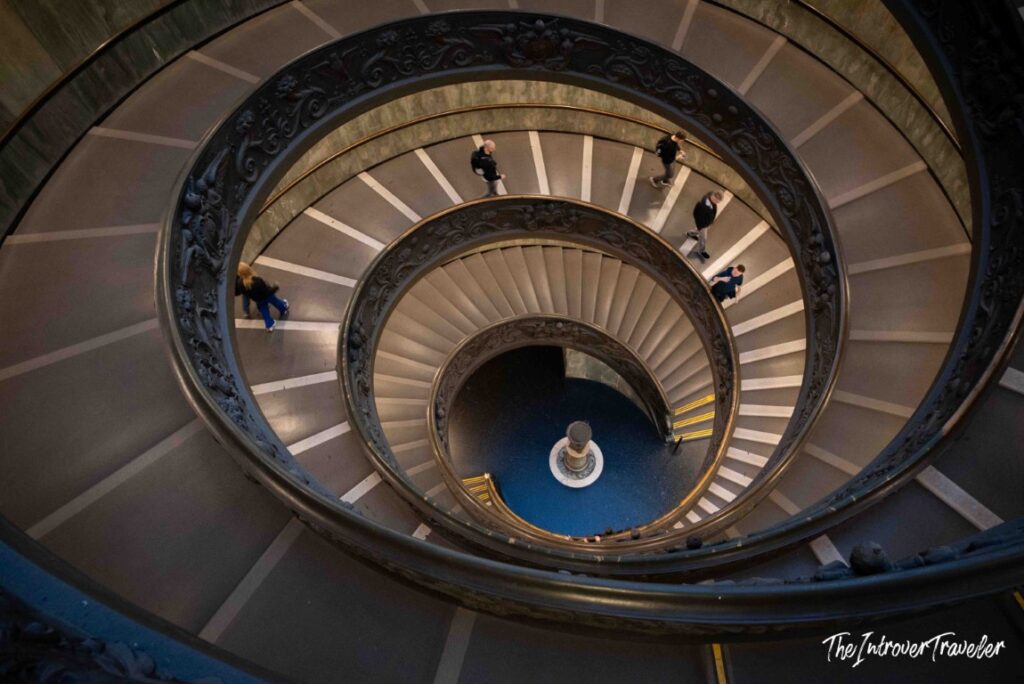
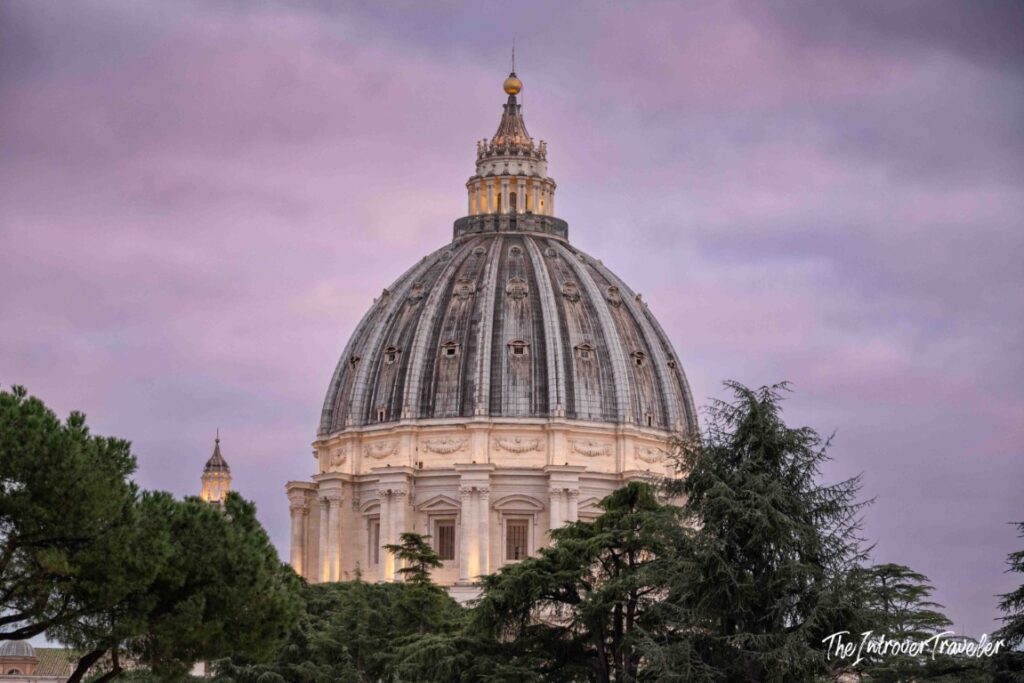
You leave via the Pinacoteca courtyard, which offers one of the finest views of the dome of St Peter’s, and descend the famous spiral staircase, photographed by everyone and almost always called the “Bramante Staircase”. It isn’t. The staircase you walk down on the way out was designed by Giuseppe Momo in 1932, a double helix that lets people go up and down without crossing paths; the real Bramante Staircase, from 1505, is in an area of the palace normally closed to the public and can only be visited on the special openings I described above.
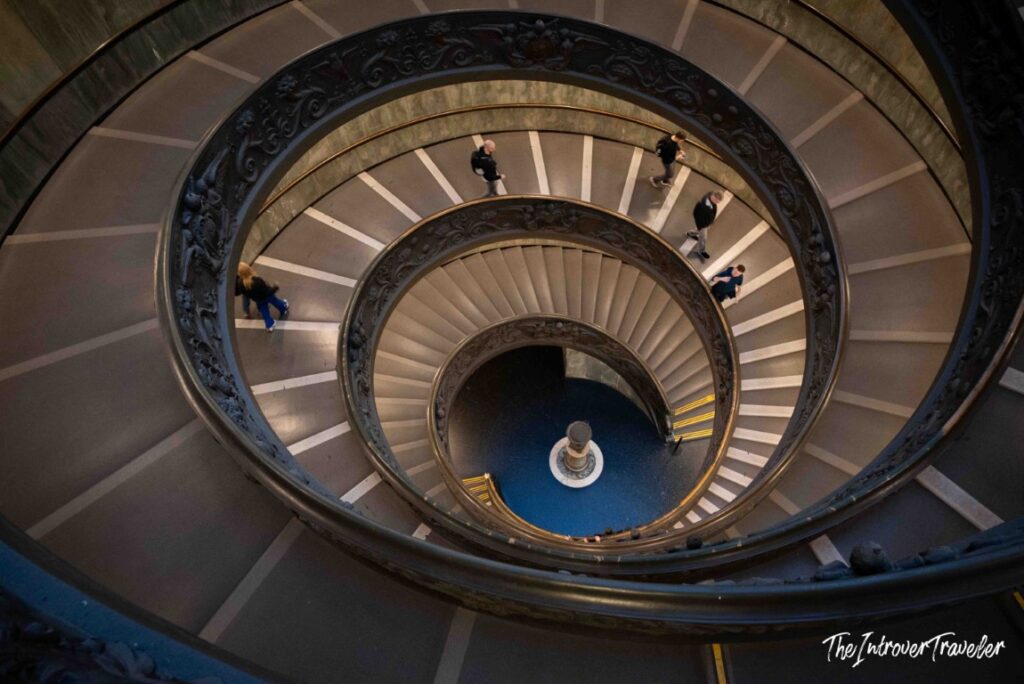
Verdict: MUST SEE, and there is nothing comparable in the world
The Vatican Museums are not a museum. They are the sediment of five centuries of power, faith, ambition, taste and appropriation, displayed inside one of the most beautiful palaces ever built. They contain at least four sections that would each justify a trip on their own, and dozens of works that in any other museum in the world would be the reason for the visit and that here go unnoticed.
They have their flaws, and I have named them: the crowds, the fixed route, the dim light in some rooms, the feeling of being a part on an assembly line. But none of these flaws dents the verdict. The Louvre has more works, the British Museum has more civilisations, the Metropolitan has more variety. None of them has the Sistine Chapel, the Raphael Rooms, the Laocoön, the Transfiguration and the palace that contains them. None of them concentrates such a density of absolute masterpieces along a single route.
Go. Book in good time, or use Tiqets if you are an improviser like me. Go on a weekday, early, with comfortable shoes and covered shoulders. And above all, don’t do what ninety per cent of visitors do: don’t march towards the Sistine Chapel as if towards the meat grinder. The Sistine Chapel is the high note, not the reason for the visit. Stop before you get there. Stop often. And resign yourself from the start to the fact that you will have to come back.
I have already been four times, and I still haven’t finished.
Frequently asked questions
How long does it take to visit the Vatican Museums? On a first visit, a full day. On my fourth, I took 5 hours. To really see them you would need a week.
How much does a ticket cost? (As of October 2026) €20 full price at the ticket office, €25 with online “skip the line” booking on the official website. Reduced tickets cost €10 (€15 with online booking). Free for under-7s and on the last Sunday of the month.
What are the opening hours? (As of October 2026) Monday to Saturday from 8:00 to 20:00, last admission 18:00. On the last Sunday of the month from 9:00 to 14:00, last admission 12:30. Closed on other Sundays and on some public holidays: always check the official calendar.
Can I get in without booking? Yes, but the queues can be long. If the official website is sold out, Tiqets often has tickets available even at the last minute, at a slight mark-up.
Can I take photos? Yes, everywhere except the Sistine Chapel.
What is the dress code? Shoulders and knees covered, especially for entry to the Sistine Chapel.
Can I go straight from the Sistine Chapel to St Peter’s? There is a passage from the Sistine Chapel to the basilica, but it is reserved for guided groups and is not always open. Independent visitors have to leave the Museums and reach St Peter’s Square from outside. In any case, I don’t think it is the best route.
Can I visit the Niccoline Chapel and the Pauline Chapel? The Niccoline Chapel yes, but only on paid guided tours that include a special opening. The Pauline Chapel, with Michelangelo’s last frescoes, is the pope’s private chapel and is not normally open to the public.
Is it worth going on the last Sunday of the month, when entry is free? Only if you love crowds more than art.
Which works should I not miss? The Sistine Chapel, the Raphael Rooms, the Laocoön, the Apollo Belvedere and the Belvedere Torso, Raphael’s Transfiguration, Leonardo’s St Jerome, Bellini’s Lamentation, the Exekias amphora and the porphyry sarcophagi. But the real answer is: everything else, which hardly anyone looks at.
What should I read before visiting the Vatican Museums? Three books, chosen to be as accessible as possible without sacrificing reliability. For the Sistine Chapel, Michelangelo and the Sistine Chapel by Andrew Graham-Dixon, which covers both the ceiling and the Last Judgement. For the Raphael Rooms, Raphael by Roger Jones and Nicholas Penny, whose chapters on the Rooms remain among the clearest in English. For the Laocoön, My Laocoön by Richard Brilliant, the most demanding of the three, which traces how the statue has been read from its discovery in 1506 to the present day.
How can I find all of Michelangelo’s works in Rome? If you want to explore all of Michelangelo’s works in Rome in a practical and visually clear way, continue on ArtAtlas: https://artatlas.it/artists/michelangelo/michelangelo-in-rome.html It is one of the most useful ways to see where Michelangelo’s works are actually located across the city and to build a serious itinerary instead of relying on the usual fragmented lists.
How can I plan an art itinerary in Rome? With Flaneur, the art itinerary engine of The Introvert Traveler. You tell it how many days you have and what kind of traveller you are, from curious beginner to seasoned art lover, and it builds a day-by-day route through the city’s museums, churches and masterpieces, with the same opinionated selection you find on this blog and a curated choice of restaurants along the way. No algorithmic top tens, no tourist traps: just the art worth your time, in an order that makes sense on foot.