Last visit: march 2026
Painted: 1508-1512
Commissioned by: Pope Julius II
Painted surface: 500 sqm
Number of painted figures: ~300
Technique: buon fresco
Location: Vatican Museums, Rome
My rating: MUST SEE
Duration of visit: at least 4 hours (access to the Sistine Chapel is included in the Vatican Museums ticket, in order to get to the Sistine Chapel you have to walk through the whole museum)
Skip the line ticket: https://tiqets.tp.st/wqNM8ygw (Tickets bought through Tiqets cost slightly more than official tickets, but they can often still be available when official tickets have sold out. On my last visit to the Sistine Chapel, I bought one this way just a few minutes before arriving at the entrance.)
Guided tour ticket: https://tiqets.tp.st/KxqK3RxD
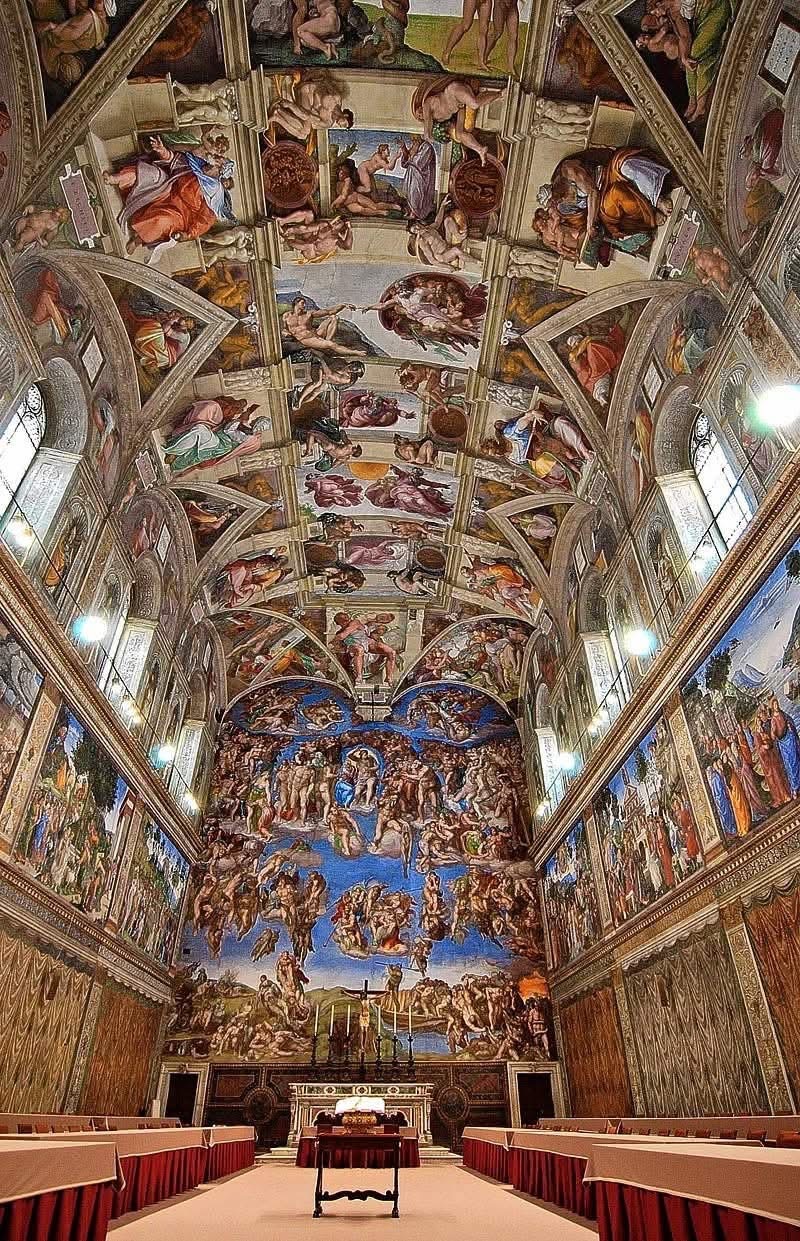
After devoting the space due to great fresco cycles that determined the evolution of fresco painting in Italy between the fourteenth and sixteenth centuries, the time has come to confront the most demanding, the most incommensurable, the most astonishing work of them all: I am obviously referring to Michelangelo’s frescoes on the ceiling of the Sistine Chapel, a visual device with neither equivalents nor direct precedents in the history of Western art, indeed of human art as a whole. The ceiling frescoed by Michelangelo between 1508 and 1512 is not merely an extraordinary pictorial feat, but a radical redefinition of the very possibilities of the image. In a relatively confined architectural space, whose lower register had already been decorated by masters such as Sandro Botticelli and Pietro Perugino, Michelangelo intervenes with an iconographic and formal program that does not merely occupy the available surface, but transforms it into a dynamic, complex, stratified organism, so revolutionary that it profoundly influenced all the art that followed and even the art of its own time, a fact all the more astonishing if one considers the relations of fierce rivalry that typically set the great artists of the age against one another, in perpetual competition to distinguish themselves in the eyes of wealthy patrons.
The itinerary, built and verified
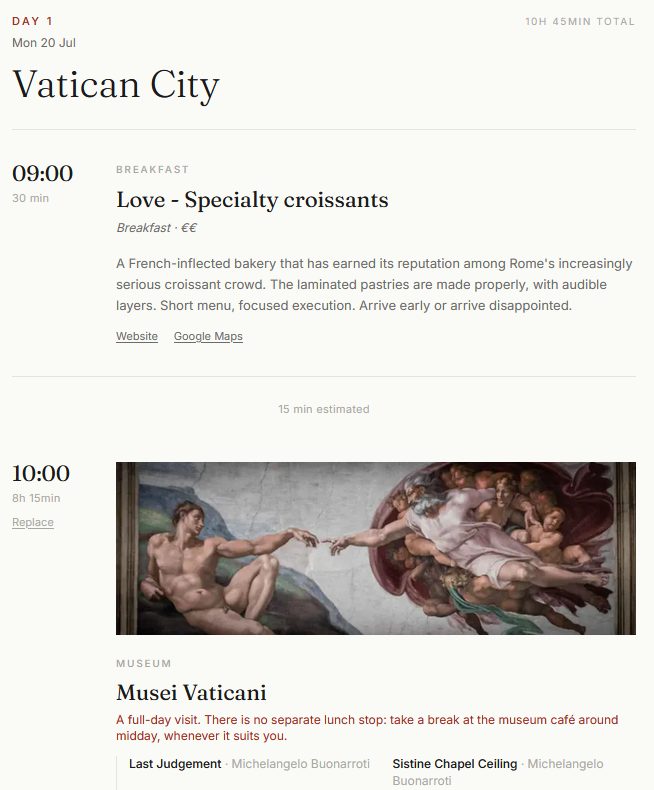
Everyone books the Sistine Chapel. Fewer plan the rest of Michelangelo’s Rome: the Pieta and the dome he raised over St. Peter’s, the Moses at San Pietro in Vincoli a short walk from the Colosseum, the Risen Christ at Santa Maria sopra Minerva beside the Pantheon. Flâneur builds a personalized Rome art itinerary around all of it: answer a few questions about how deep your interest runs and what your days should look like, and it maps the route, complete with real opening hours, church closures, transfer times, meal breaks and booking links.
This is exactly where a general-purpose AI falls short. Michelangelo’s Rome hides in working churches with midday closures and Mass times, while the Vatican needs a timed ticket booked ahead. An LLM guesses a plausible Renaissance itinerary; Flâneur knows which door is open when, and in which order to walk them, according to your interests. Pick the Expert profile and you compose the day yourself, from every Michelangelo indexed in the city, with a depth, flexibility and precision no chatbot can match.
The modern perception of the work is inevitably conditioned by its fame, by photographic reproducibility, and by the overuse of some of its images, particularly the so-called Creation of Adam. Yet the power of the ceiling does not lie in isolated scenes, but in the coherence of a figurative system that articulates the biblical narrative into a sequence of episodes, prophetic figures, ignudi, and illusionistic frames, constructing a visual syntax that fuses sculpture, painting, and architecture into a single language. Michelangelo, who considered himself primarily a sculptor, approaches the painted surface as though it were matter to be modeled, transferring into painting a plastic conception of the human body that has no precedent for intensity and anatomical awareness.
The work was born in a historical context marked by political tensions, dynastic ambitions, and profound transformations in artistic language. The pontificate of Pope Julius II represents one of the moments of greatest concentration of power and symbolic investment in the arts, and the Sistine ceiling forms part of a broader project of self-representation on the part of the Roman Church. Yet reducing the cycle to a mere propagandistic operation would be misleading. Michelangelo works with an intellectual autonomy that allows him to construct a theological and anthropological discourse of extraordinary complexity, in which the theme of creation, the fall, and the human condition is articulated through a sequence of images that oscillate between dramatic tension and formal equilibrium.
In this sense, the Sistine ceiling is a turning point in Western art. After Michelangelo, painting could no longer ignore the question of the body as a vehicle of meaning, nor the possibility of constructing illusionistic spaces that exceed architectural limits; the Renaissance reaches its unsurpassable culmination and its conclusion, and the season of Mannerism begins.
This post is part of my series on the major Italian frescoes.
The Sistine Commission: Rome, 1506
Rome, May 1506. The city seethes with ambitions and building sites, unaware that within a few decades Charles V’s troops will reduce it to rubble and blood. From the belly of the earth the Laocoön has just emerged, wrested from oblivion under the feverish gaze of Michelangelo Buonarroti. Raphael Sanzio moves through the rooms of the powerful with studied grace, amid papal favors and dissipated nights. The scaffolding of the construction sites stands out against the sky: St. Peter’s is preparing to rise over the ruins of the empire. The eternal city is in the iron grip of the most strong-willed Pope, to put it euphemistically, that history remembers: Julius II. The pontiff is seated at a table laden with every delicacy: Genoese macaroni, stuffed squid, fried spinach, sturgeon caviar, grilled oysters, cinnamon cake. Julius bites stubbornly into a roast capon with clove and nutmeg sauce, directing his gloomy gaze toward the back of the monumental room lit by candlelight; at the sides of the table, courtiers, artists, and prelates attend the papal meal in tense silence. Among them are Bramante and Pietro Rosselli, summoned to discuss certain projects. It is in this context that an episode occurs which historiographical tradition, beginning with Giorgio Vasari, has transmitted in almost theatrical tones. The subject is not yet the Sistine Chapel, but something apparently different: the monumental tomb Michelangelo is supposed to make for the Pope (Michelangelo’s moses rings a bell?). The tomb project, conceived in 1505, was on an unprecedented scale. Dozens of statues, a sculptural machine destined to define the memory of the pontiff forever. Michelangelo had been called to Rome precisely for this commission, abandoning work on another monumental fresco that would never be realized: the Battle of Cascina in the Palazzo Vecchio in Florence, to be carried out in direct and heated competition with Leonardo da Vinci. He had spent months in Carrara selecting marble, working with an intensity that already outlined his method: isolation, total control of the process, obsession with the quality of the material. Yet upon his return, something breaks down. Funds are diverted, priorities change, the project stalls. Michelangelo makes a display of his irascible temper and allows himself to slam the door in the face of the most fearsome Pope of all time. It is here that, according to Vasari’s account, Bramante’s intervention enters the picture; Michelangelo is quarreling with the Pope and has left Rome, but Julius II is certainly not the sort to passively accept the ad nutum termination of a commission. The architect, not inclined to favor an artist perceived as overbearing and independent, suggests to Julius II, at least according to Vasari’s version, that Michelangelo be given a task for which he is unprepared: painting the ceiling of the Sistine Chapel. The idea, at least in this version, has a precise logic. To place a sculptor before a surface of more than a thousand square meters to be frescoed meant exposing him to possible public failure. Quite apart from the anecdotal component, which must be treated cautiously, the transition is significant. Around 1505–1506, Michelangelo Buonarroti is already a leading figure in the Italian artistic panorama.
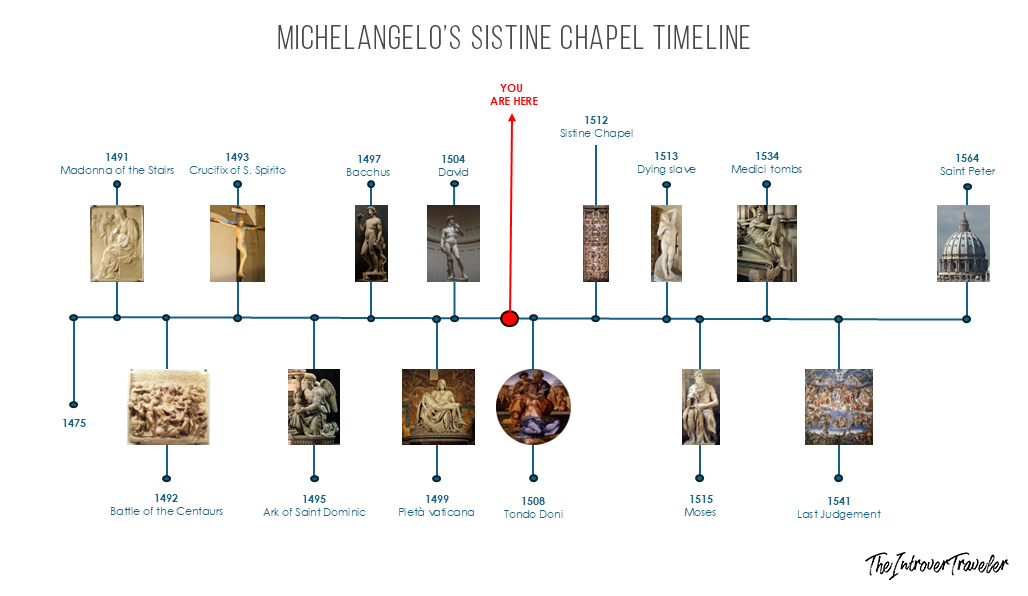
He is not yet the author of the Sistine, but neither is he an emerging artist, quite the opposite. In Florence he has already produced works that place him in a position of absolute excellence: the David, completed in 1504, was immediately perceived as a manifesto of technical and intellectual superiority. The Vatican Pietà, executed between 1498 and 1499, had already demonstrated an unsurpassable capacity to synthesize pathos and formal control. In 1505 Michelangelo is thirty years old. He is in the full maturity of his creative powers, but his path is not linear. He moves between Florence and Rome, oscillating between civic and papal commissions, between personal ambitions and political constraints (if you want to compare what Michelangelo left in Florence and what he left in Rome, you may want to have a look at ArtAtlas). His artistic identity is already defined: he is a sculptor. Painting, though not alien to him, is not his privileged field. He has workshop experience, he has studied drawing with almost obsessive intensity, but he has never tackled a fresco cycle on a scale comparable to the one that will be entrusted to him, having produced for the Battle of Cascina only the preparatory cartoon. His fame, however, does not derive solely from the quality of his works. Michelangelo is already known for his difficult character, for his intransigence toward patrons, for an almost absolute conception of artistic autonomy. This makes him, on the one hand, extremely desirable for a pontiff like Julius II, who seeks greatness and uniqueness; on the other hand, difficult to manage within a court system in which the balance among artists, architects, and officials is delicate. When the tomb project is interrupted and the idea of the Sistine ceiling takes shape, Michelangelo does not greet the commission with enthusiasm. The sources agree in underlining his initial resistance. This is not false modesty, but lucid assessment: painting a ceiling of that size, 500 square meters of surface, using a complex technique such as fresco, represented a real risk to his reputation. But we are speaking of the man who has just sculpted with his own hands a marble colossus more than five meters high, and of a man of boundless ambition, perpetually gnawed by the torment of proving his worth to the world and to posterity. Michelangelo accepts, but he does so on his own terms, transforming a potentially punitive assignment into a field of radical experimentation. In 1508, when the work begins, he is no longer merely the sculptor of the David or the Pietà. He is an artist on the verge of redefining his own language, and with it the very status of monumental painting.
Michelangelo and Julius II: a Conflictual Patronage
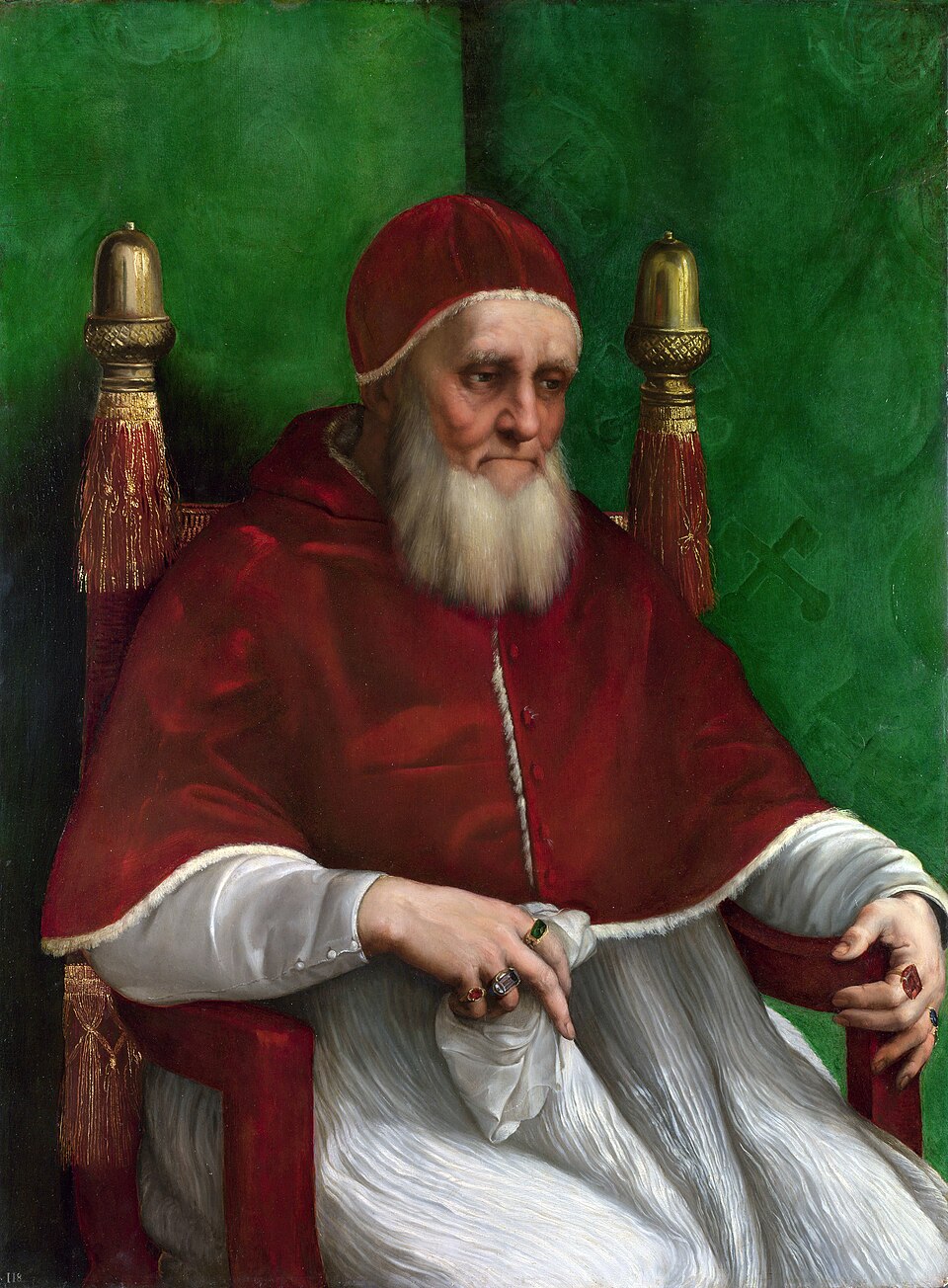
Michelangelo begins working on the Sistine project, but the work is tormented first and foremost by his conflict-ridden relationship with the pontiff. The relationship between Pope Julius II and Michelangelo Buonarroti lies in an ambiguous zone, where personal tension does not attenuate but, on the contrary, intensifies a mutual esteem that finds few parallels in the history of Renaissance artistic patronage. It is not the orderly relationship between patron and executor, nor the later one between a princely patron and a court artist stably integrated into the system. Here we are dealing with two structurally incompatible personalities, both accustomed to exercising control and to recognizing no limits to their authority. Julius II is a pontiff who conceives his role in terms of historical greatness.
His cultural policy is not decorative but programmatic: rebuilding St. Peter’s Basilica, reorganizing Rome, leaving a tangible and lasting mark of his pontificate. Within this framework, Michelangelo is not a mere executor of works, but an instrument through which to give form to an idea of power: the only artist endowed with the immense talent necessary to give form to the ambitions of the Pope. Yet he is an instrument that does not allow itself to be handled easily.The first significant clash takes place precisely around the tomb project. Michelangelo, who had invested an enormous quantity of energy in the project, perceives the suspension of the work as a personal affront. The sources tell of an emblematic episode: after waiting in vain for an audience with the Pope to obtain clarification, Michelangelo abruptly leaves Rome, taking refuge in Florence without authorization. It is not a simple flight, but an act of institutional rupture. In a context in which papal authority also has a political and coercive dimension, withdrawing from the direct command of the Pope amounts to an open challenge. Julius II’s reaction is not immediate vengeance but diplomatic pressure; the most feared and respected man of his time adopts unique cautions with Michelangelo. He writes to the Florentine government and asks that the artist be persuaded to return. This detail is crucial: it indicates that, despite the offense, the pontiff has no intention of renouncing Michelangelo. His position is not that of someone looking for a substitute, but of someone who considers that artist irreplaceable. Michelangelo, for his part, returns to Rome only after obtaining guarantees, and the meeting between the two, according to the testimonies, is anything but pacified. From that moment onward, their relationship takes the form of a continuous negotiation, often bitter. During the work on the Sistine, tensions are frequent. Michelangelo works under extreme conditions, with tight deadlines and constant pressure. Julius II visits the site, demands acceleration, demands results. Michelangelo, by contrast, defends his operational autonomy, rejects interference, and resists any attempt to standardize the process. One of the most frequently cited episodes concerns precisely the Pope’s request to have parts of the ceiling uncovered in advance. Michelangelo opposes this, maintaining that the work should be seen in its entirety. Julius insists. In the end, a portion is shown, and the impact is such as to modify the pontiff’s attitude. It is no longer a matter of checking the progress of the work, but of confronting something that exceeds initial expectations. Moreover, on that same occasion Michelangelo himself has the first opportunity to see his work from the proper perspective, reconsidering and modifying the proportions of the work carried out thereafter. The conflict between artist and pontiff does not express itself only in operational divergences, but also in an almost physical dimension. The sources report episodes of violent verbal clashes, even aggressive gestures on the part of the Pope. Yet reducing these moments to an anecdotal dimension risks trivializing the picture. What emerges is a relationship in which the harshness of the clash is proportional to the importance each attributes to the other. Julius II does not treat Michelangelo as one artist among many, but as a necessary interlocutor. Michelangelo, for his part, while maintaining a critical distance, recognizes in the Pope a figure capable of sustaining projects on an exceptional scale. This dynamic produces a paradoxical effect: conflict becomes a creative engine. Michelangelo works under pressure, but it is precisely this pressure that pushes him beyond the limits of his experience. Julius II, while imposing deadlines and objectives, implicitly accepts that the artist operate according to an internal logic that escapes the direct control of the patron. At the death of Julius II in 1513, the relationship comes to an end, but its consequences extend far beyond it. The tomb project, never realized in its original form, will continue to haunt Michelangelo for decades, becoming a sort of unresolved obsession. The Sistine ceiling, by contrast, remains the most fully accomplished result of this conflict-ridden relationship: a work born of a constant tension between political will and artistic autonomy, and which for that very reason attains a level of complexity difficult to replicate in more harmonious contexts.
The Sistine Revolution in Renaissance Painting
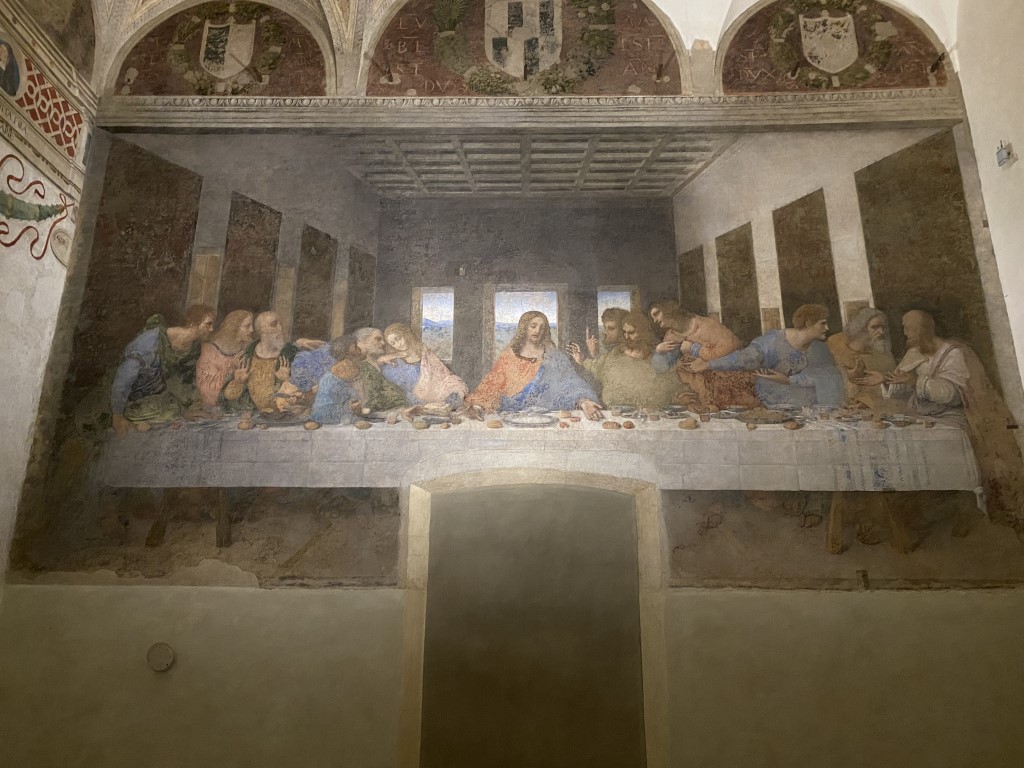
To understand the full scope of Michelangelo Buonarroti’s intervention on the Sistine ceiling, one must place oneself precisely around 1508, that is, at a moment when the Italian Renaissance had already reached an extremely high level of maturity, but not yet that threshold of tension that would lead to Mannerist deformation. It is an extremely sophisticated artistic system, in which certain achievements had by then become acquired and shared: linear perspective, the spatial unity of the scene, the credible anatomical construction of the human body, the use of light as a structuring rather than merely decorative element.Yet precisely because these achievements had been assimilated, the problem facing artists was no longer that of “discovering” tools, but of bringing them to a higher degree of perfection and complexity. The panorama Michelangelo encounters is dominated by certain works which, already for contemporaries, represented standards of excellence difficult to surpass. One of the absolute points of reference is Leonardo da Vinci’s Last Supper in the refectory of Santa Maria delle Grazie, executed between 1495 and 1498. It is not a fresco in the technical sense, but an experiment on the wall combining tempera and oil, and precisely for that reason it deteriorates rapidly. But in 1508 there is no indication that signs of decay had yet appeared on Leonardo’s experimental work, and its cultural impact is enormous. Leonardo constructs a scene in which perspectival space coincides with the real space of the observer, and in which each figure reacts psychologically to the announcement of the betrayal. The problem of the representation of emotions, of the variety of the motions of the soul, is approached with a depth that no previous fresco cycle had reached. At the same time, in Rome, the immediately following generation is developing a different synthesis. Raphael Sanzio, called by Julius II in 1508, is at work on the Vatican Stanze (and it is hard to think of Michelangelo and Raphael working simultaneously on the two fresco cycles just a few meters apart without feeling a shiver). The School of Athens rapidly becomes a paradigm: a perfectly ordered space, a distribution of figures calibrated according to mathematical equilibrium, a capacity to integrate philosophical content and compositional clarity. Raphael represents, at this moment, the path of harmony and measure, in contrast with the more dramatic tension that characterizes Michelangelo. If one looks at the Sistine Chapel before Michelangelo’s intervention, the lower register had already been decorated with a cycle of the highest level, executed in the 1480s by artists such as Pietro Perugino, Sandro Botticelli, Domenico Ghirlandaio, and Cosimo Rosselli. In works such as Perugino’s Delivery of the Keys one finds one of the most complete formulations of Renaissance spatiality: a rigorous perspectival structure, an ordered architectural articulation, a disposition of figures answering to a principle of narrative clarity. In Mantua, a few decades earlier, Andrea Mantegna had already explored the possibility of dissolving architectural limits through painting, in the Camera degli Sposi. The painted oculus on the ceiling introduces an idea of illusionistic breakthrough that will have direct consequences for the conception of the Sistine ceiling. On the Florentine side, works such as Masaccio’s Trinity in Santa Maria Novella had already established, in the early fifteenth century, the principle of unified spatial construction and the monumentality of figures. That lesson, filtered through later generations, had by the beginning of the sixteenth century become common patrimony.If one attempts to summarize, the picture Michelangelo inherits is characterized by three principal directions. On the one hand, Leonardesque research into psychological complexity and the dissolution of contours through sfumato. On the other, Raphaelesque compositional clarity and equilibrium. Finally, a tradition of mural painting that, from Perugino to Ghirlandaio, had codified narrative and decorative modes that were by then stabilized. It is precisely in relation to this system that the Sistine ceiling appears as a rupture. Confronting models that seemed incomparable, Michelangelo does not merely perfect one of these strands, but puts them into tension with one another and, to a large extent, surpasses them. Where Perugino constructs order, Michelangelo introduces structural complexity. Where Raphael seeks equilibrium, Michelangelo intensifies tension and pathos. Where Leonardo investigates interiority, Michelangelo translates drama into bodily terms, entrusting the human body with a true semantic function. In 1508, then, Renaissance art finds itself in a phase that might be defined as unstable equilibrium: it has attained a formal perfection that risks becoming a closed system. Michelangelo’s intervention on the Sistine ceiling does not arise in a vacuum, but in a context already saturated with excellences. And it is precisely this saturation that makes a radical transformation of language both possible and necessary.
How Michelangelo Painted the Sistine Chapel Ceiling: Fresco Technique and Process
Well then, Michelangelo has accepted the commission and is preparing to begin work. But how does it proceed? What does it materially mean to fresco the ceiling of the Sistine Chapel? How does he manage to work up there at a height of 20 meters? What techniques does he use to impress color permanently into the plaster and avoid the deterioration of the work, as would shortly happen to the Last Supper in Santa Maria delle Grazie by his great rival Leonardo? In the Sistine, Michelangelo did not find himself before a neutral surface. The chapel ceiling, previously decorated with a starry sky, had structural problems: a long crack, which had opened in the early years of the sixteenth century, had made an intervention necessary and had, in fact, created the conditions for a radically new decoration. The commission entrusted to him in 1508 therefore did not consist in “embellishing” a space, but in wholly redefining the visual and symbolic perception of one of the most important places in Christendom. The first problem was that of the scaffolding. Michelangelo rejected the solution initially proposed by Donato Bramante, which provided for a structure suspended from above and anchored to the vault, judged unstable and potentially damaging. Instead, he designed an autonomous system, based on wooden platforms attached to the walls and advancing progressively along the chapel. This made it possible to work bay by bay without compromising the wall structure and, above all, allowed visual access to the work to be controlled during execution. The widespread image of Michelangelo painting while lying down is a late simplification. He worked standing, on elevated scaffolding, with his body forced into an unnatural posture: neck bent backward, arm raised for hours, gaze constantly directed upward a few inches from the plaster. The technique adopted was that of buon fresco, which imposes an extremely rigorous discipline of execution. The wall was prepared with several layers of plaster; on the last, still damp layer, the drawing was transferred and water-based pigments were applied. The color does not settle on the surface, but is chemically fixed during the drying of the plaster. This implies a fundamental condition: each portion must be completed before the plaster loses the proper humidity. There is no possibility of endless reconsideration. The unit of work is the giornata, that is, the amount of surface that can be painted in one session. The size of the giornata varies according to the complexity of the image: a complex anatomical figure requires a more minute subdivision than an architectural member or a uniform field. In the early phases of the worksite this organization was not yet perfectly calibrated. Michelangelo, who had no direct experience of monumental fresco cycles, proceeds cautiously. The first scenes, such as the Flood, are constructed through greater fragmentation, with numerous figures of relatively reduced dimensions and a narrative structure still articulated in multiple episodes. It is also the phase in which a serious technical difficulty emerges: the appearance of mold on the plaster, due to a preparation unsuited to the environmental conditions of the chapel. Roman humidity, combined with a mixture that was not correctly balanced, compromises the surface result. Michelangelo is forced to destroy and redo portions already executed. It is a critical moment, because it calls into question not so much inventive capacity as the material soundness of the entire project; they are dramatic months for Michelangelo, who fears for the success of the project and for his own reputation, precisely in the phase of his career in which he is already projected toward becoming the greatest artist of all time; Michelangelo was inclined to complaints, but in the correspondence of this period with his father in Florence there emerges in a particularly clear way all the frustration over the inability to solve the technical problem of correctly determining the mixture necessary for the successful execution of the painting. The reaction is not one of retreat, but of adaptation. Michelangelo modifies the composition of the plaster, refines his control of drying times, acquires increasing familiarity with the behavior of the material. When Michelangelo despaired, incapable of finding a solution to the problem, it was his trusted collaborator Jacopo Torni, trained like him in Ghirlandaio’s workshop, who rescued him from the impasse; Torni devised a new plaster mixture composed of lime and pozzolana, applied over a bed of arriccio made with the same mixture, while in the area of the lunettes marble dust was used, without a layer of arriccio, and the new mixtures, innovative with respect to the traditional solutions of the Florentine school, proved providential. From this point onward, the worksite changes rhythm and quality. Technical security translates into an evident stylistic transformation. The later scenes progressively abandon the narrative complexity of the earlier ones to concentrate on larger, isolated, monumental figures. Readability from a distance becomes a decisive criterion. The ceiling is no longer conceived as a sequence of minute episodes, but as a system of figurative masses capable of imposing themselves within architectural space. As we have seen, there are illustrious names, such as that of Jacopo Torni, to whom the success of the enterprise is owed and who are neglected by history.
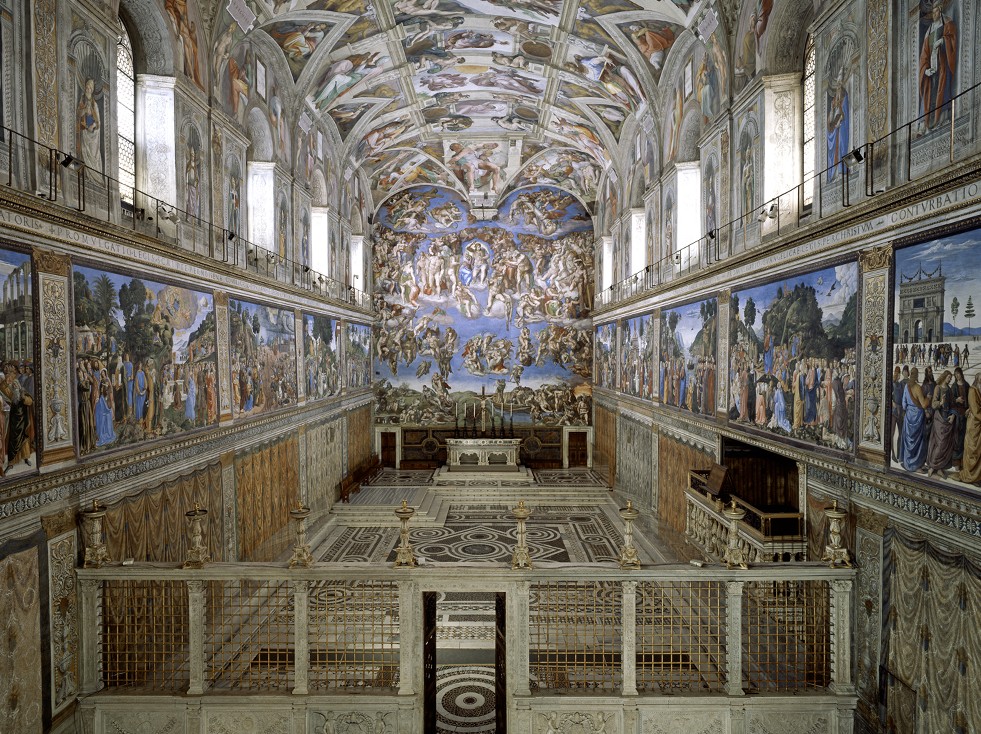
The relationship with the workforce follows an evolution parallel to the progress of the worksite. In the initial phase Michelangelo makes use of several collaborators, for the most part from the Florentine environment, useful above all for the preparation of materials and preliminary operations. Yet their role rapidly diminishes. The quality demanded, together with the will for absolute control over the formal result, leads Michelangelo to limit the intervention of assistants more and more until he works in substantial autonomy; to all this is added Michelangelo’s fierce contentiousness, which progressively leads him to drive from the worksite, one by one, all the collaborators. The Sistine is not a workshop production in the sense that Raphael Sanzio’s Stanze will be. It is a worksite governed by a single artist who uses the workforce as technical support, not as delegated executors. From the physical point of view, the undertaking is extreme. For four years, with a significant pause between 1510 and 1511, Michelangelo works on a curved surface more than twenty meters high, in conditions of imperfect light and in a posture that deforms the body. The fatigue is not episodic but structural: it concerns the very duration of the work, the daily repetition of gestures that stress the same joints over and over, the need to maintain precision and control even under conditions of exhaustion. The famous sonnet in which he describes his body bent and deformed is not a mere literary lament, but the record of a real physical experience. In a passage of the Lives, Vasari mentions Michelangelo’s excellent physical qualities, and this is not surprising, if one considers the productivity with which he carved marble up to the age of ninety, continuing to work on the Rondanini Pietà until a few days before his death, but the work on the Sistine ceiling must have been such a physical trial as to put even his inexhaustible strength to a severe test. To this dimension is added a constant mental tension. Michelangelo is not facing only a technical problem, but an unprecedented responsibility. He must conceive and realize a figurative program occupying more than 500 square meters, maintaining structural coherence and quality of execution across the whole surface. The work does not proceed by simple accumulation. Every new scene must dialogue with those already completed, adapt to the architectural structure, maintain a balance between variety and unity. The progress of the worksite reflects this growth. The first half of the ceiling, closer to the door, completed by 1510, still shows the traces of a process in the course of definition. The second half, closer to the altar, executed after the reopening of the scaffolding and after Michelangelo, once the scaffolding had been removed at Julius II’s request, was finally able to observe the work from the floor of the chapel, reveals a now complete mastery. The figures become broader, the compositions more essential, the plastic tension more concentrated. This is not a simple stylistic evolution, but the direct result of a technical conquest. Michelangelo has learned to master the medium and, once the phase of uncertainty has been overcome, he can push the language toward a more radical synthesis. In this sense, the Sistine ceiling is also the story of a learning process. It does not arise from a fully formed pre-existing competence, but from a progressive confrontation with a medium that is initially hostile. Mold, plaster, drying times, the management of the giornate, physical fatigue: every element that might have compromised the work becomes, over the course of the worksite, part of a controlled system. The final result does not erase these difficulties, but incorporates them. The monumentality of the figures, the clarity of the compositions, the plastic power of the whole are inseparable from the way Michelangelo solved, one after another, the material problems the worksite imposed upon him. Seen from below, the ceiling appears as a perfectly constructed system. But that construction is the product of a process that, at least in its initial phases, was anything but linear. It is precisely this distance between the difficulty of making and the necessity of the result that defines its greatness.
Booking the entry in advance is essential to avoid 2-3 hour queues at the Vatican Museums. Skip-the-line ticket | Guided tour with art historian
The Sistine Ceiling and the Renaissance Apex
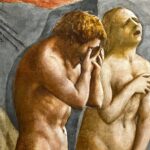
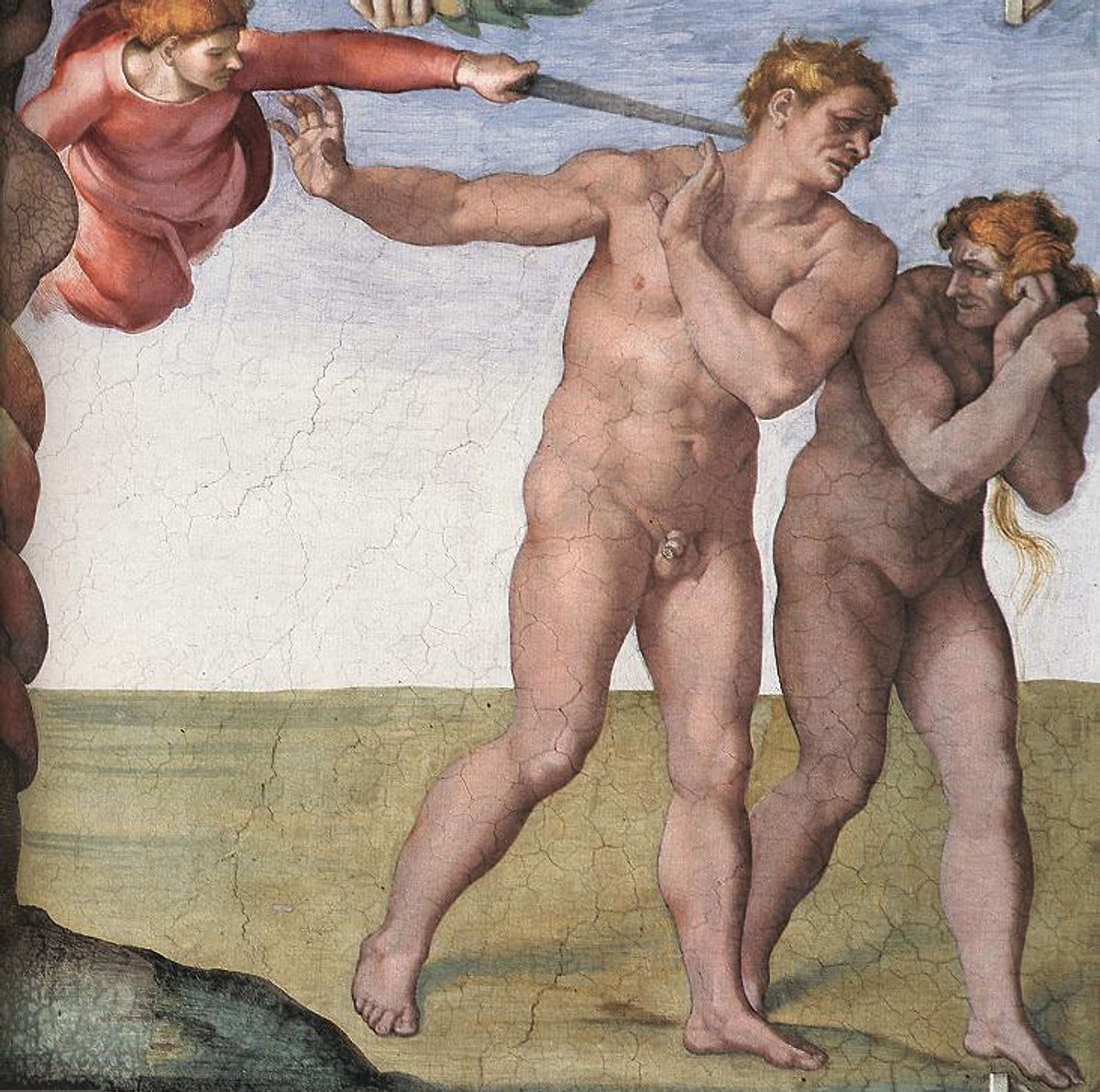
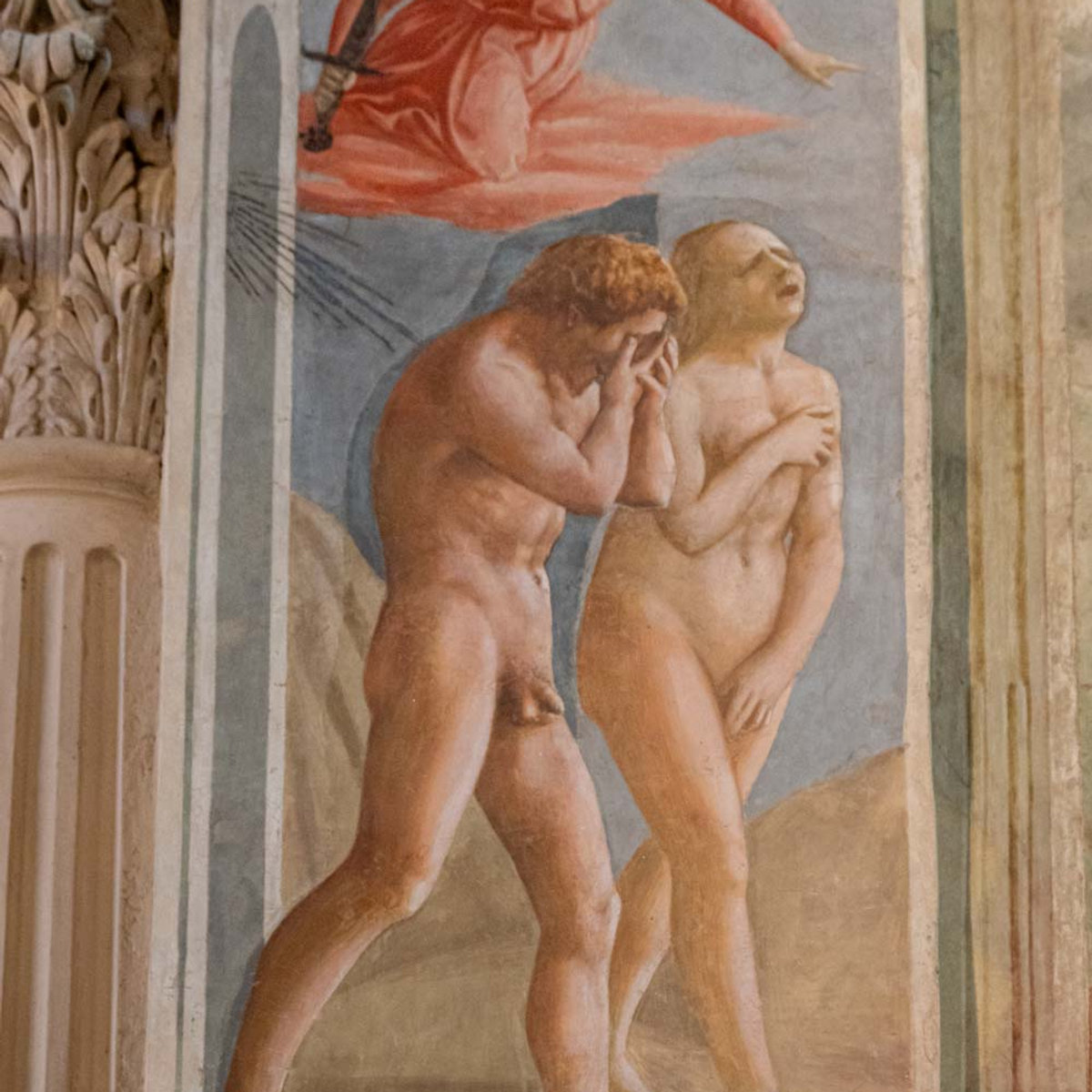
From a strictly pictorial point of view, the ceiling of the Sistine Chapel represents a moment of radical transformation in the language of Michelangelo Buonarroti, in which the technique of fresco is bent to a conception entirely unusual for the quattrocento tradition. Michelangelo certainly uses customary tools for transferring the drawing, including pouncing, especially in the initial phases, when the complexity of the program and his relative inexperience with the medium require rigorous control of the contour; yet, already as one proceeds along the vault, one perceives a progressive emancipation from mechanical procedures, with an increasing reliance on the confidence of a drawing traced directly onto the plaster. This passage is not merely technical, but implies a different relation with the medium: the fresco is no longer a support requiring fidelity to a preparatory cartoon, but a space in which the drawing can be continually redefined according to the final form. The figurative sources are multiple but selected with extreme awareness. The Florentine tradition of Masaccio, whose influence is evident in the citation-laden episode of the Expulsion from Paradise, provides the paradigm of monumentality and volumetric construction, while Luca Signorelli offers a direct precedent for the rendering of the nude body under tension, especially in the cycles at Orvieto; the influence that Jacopo della Quercia’s reliefs on the portal of San Petronio in Bologna had on Michelangelo at the time of his training is amply documented and visible in certain episodes of the Sistine.
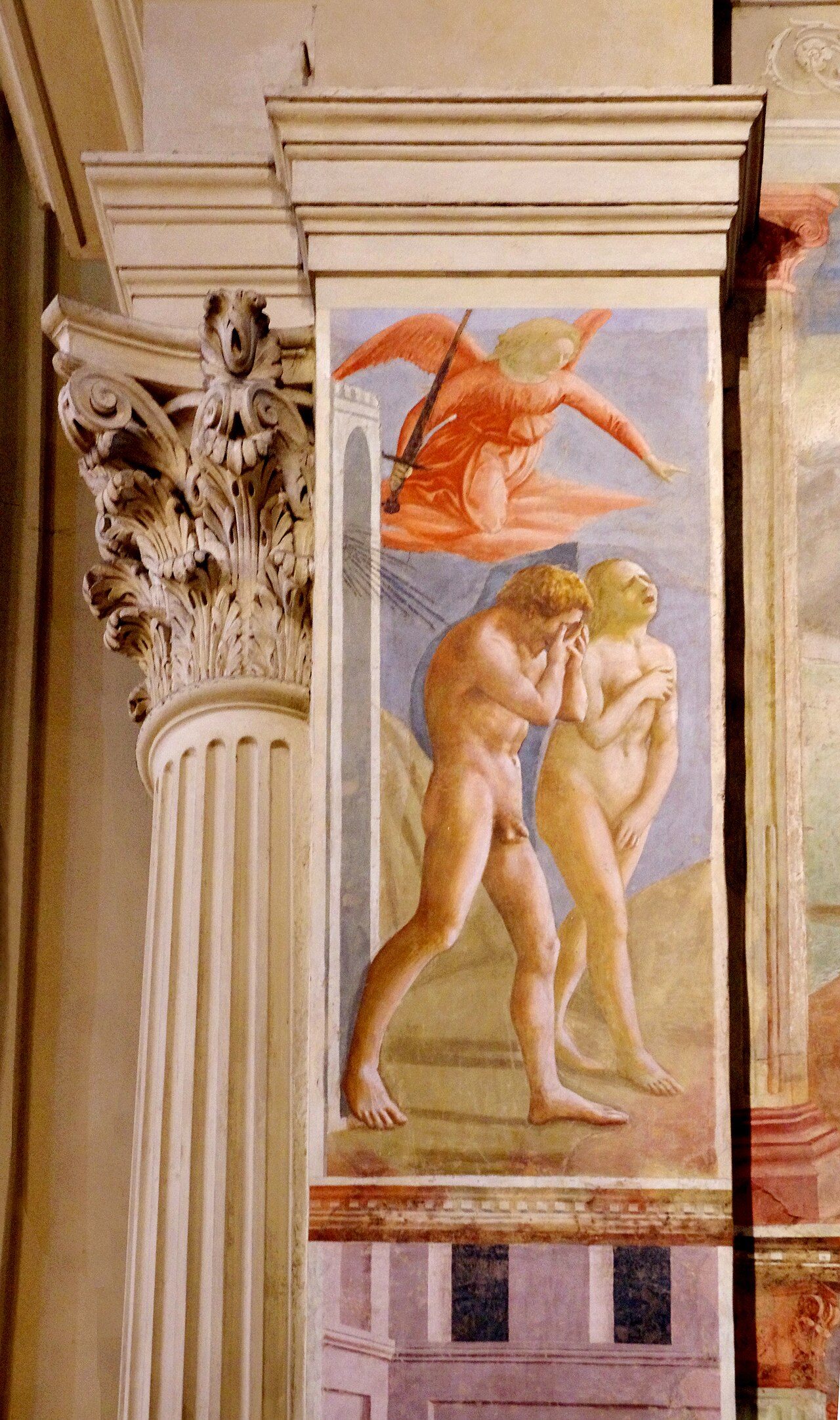
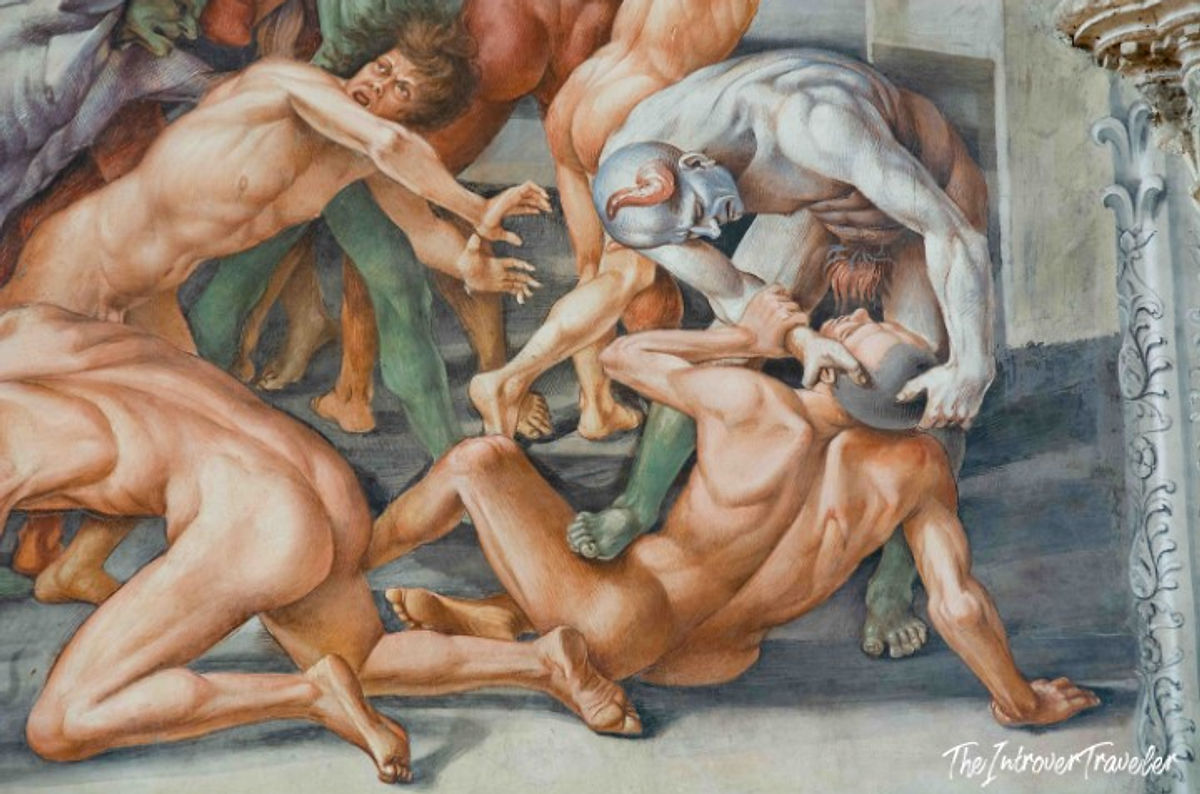
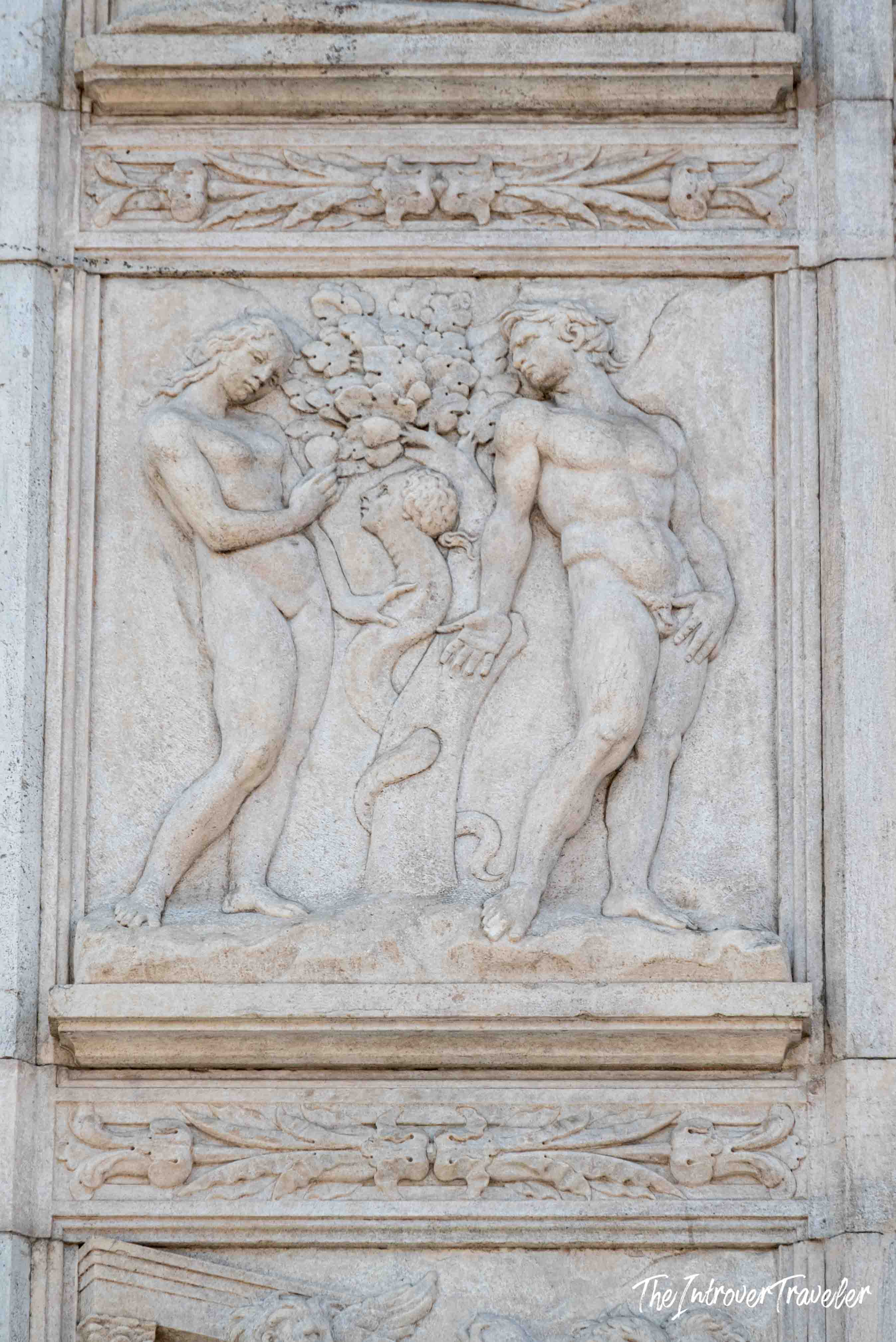
Above: Masaccio, Brancacci Chapel; Luca Signorelli, Cathedral of Orvieto; Jacopo della Quercia, San Petronio, Bologna
To this is added the knowledge of ancient sculpture, in particular Hellenistic models, which Michelangelo assimilates not as an iconographic repertoire but as a dynamic system of torsions and contraposti. Michelangelo had only recently witnessed the discovery of the Laocoön on the Oppian Hill and was strongly influenced by that work. More problematic, yet not absent, is the relation with Leonardo da Vinci, especially in the conception of the body as a unitary organism and in the search for an internal complexity within the figure; whereas the comparison with Raphael Sanzio, active in the Vatican during the same years, plays out on an opposite terrain: compositional clarity and harmony against tension and plastic density. Compared with the Doni Tondo, the Sistine marks a decisive step. In the Tondo, the figure is still enclosed within a defined space, however much already traversed by a strong plastic energy; in the vault, by contrast, the body breaks the constraint of the frame and becomes the structural element of a broader system in which painted architecture and figure interpenetrate. The ignudi, in particular, do not have an immediate narrative function, but act as nodes of visual tension, articulating space and making evident that the true subject of the work is, in the final analysis, the human body as measure and problem. If one looks at the later works, such as the Last Judgment or the frescoes of the Pauline Chapel, the distance is equally significant. There the language becomes more compact, more dramatic, almost contracted upon itself; the articulated clarity of the vault gives way to a figurative density tending to saturate space. In the Sistine, by contrast, there still remains an equilibrium, however unstable, between order and tension. The figures, though charged with energy, are distributed according to a logic that keeps the overall structure legible. It is an equilibrium that will never again be recovered in the same terms. The revolution of the vault does not lie in a single innovative element, but in the redefinition of the relationship between painting and form. Michelangelo introduces a plastic conception of fresco with no precedent in coherence and radicality: color does not construct space, but follows form; light does not dissolve contours, but reinforces them; the figure is not inserted into space, but generates it. In this sense, the Sistine does not represent the culminating point of a tradition, but the moment in which that tradition is surpassed from within. After Michelangelo, monumental painting can no longer limit itself to organizing scenes within a coherent perspectival space: it must confront the possibility, now demonstrated, of transforming the surface into a field of forces in which the human body becomes the primary constructive principle.
Below: Michelangelo compared with Masaccio
The Human Body as Structural Principle
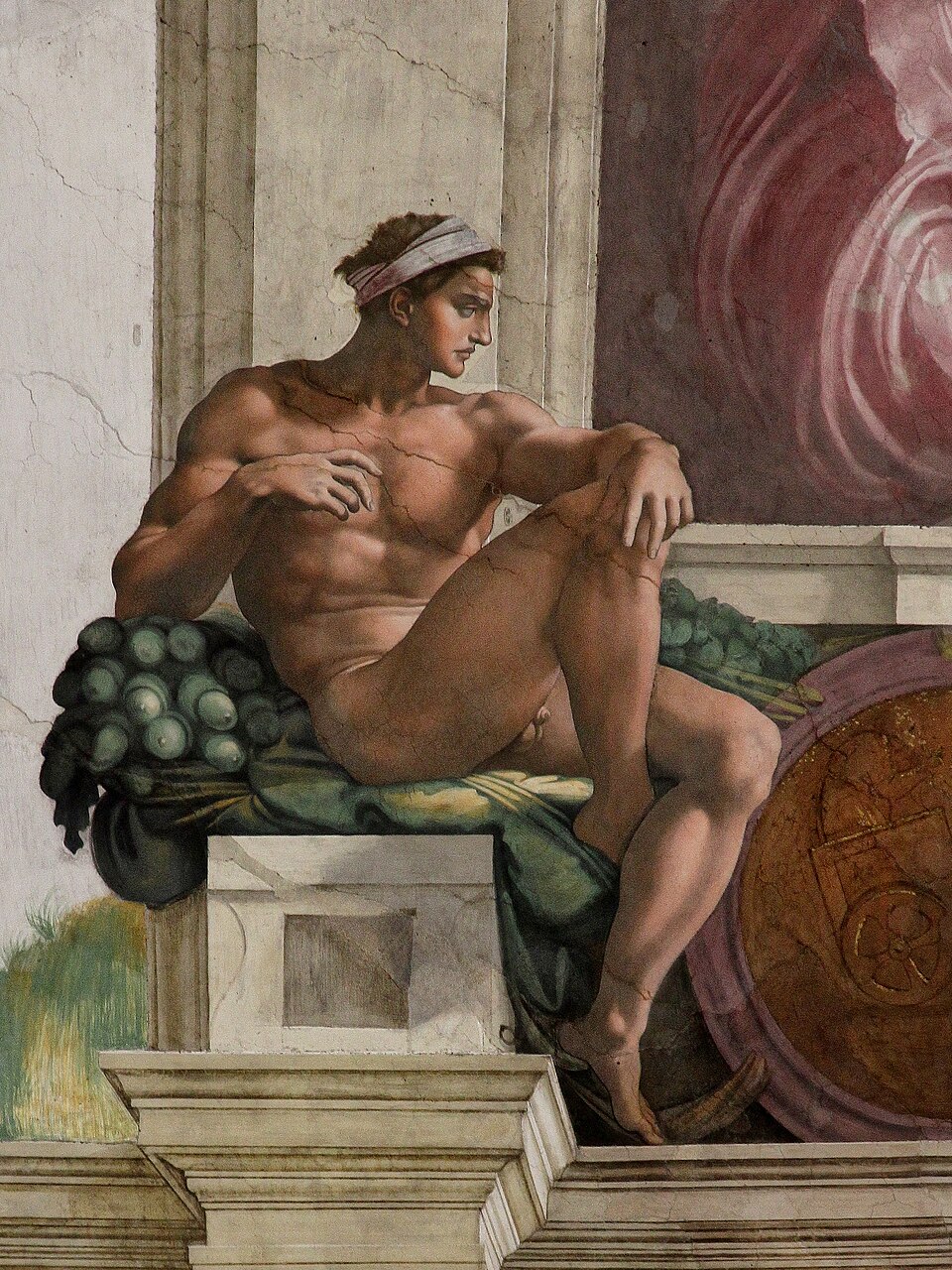
The decisive novelty introduced by Michelangelo Buonarroti in the ceiling of the Sistine Chapel concerns the way the human body is conceived, constructed, and used as the structural principle of the image. It is not simply a matter of increased anatomical precision, nor of a greater expressive force than that of his predecessors. The transformation is deeper: the body is no longer an element contained within pictorial space, but becomes the device through which space itself is generated and articulated. In quattrocento tradition, even in its most advanced outcomes, the human figure is inserted into a perspectival system that precedes and governs it. In Masaccio or Pietro Perugino, the construction of architectural space defines the field within which figures are arranged. Michelangelo overturns this relationship.
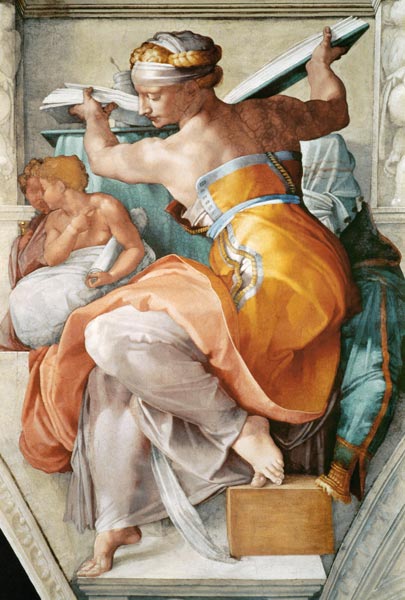
In the Sistine, painted architecture is not a neutral container, but an elastic grid that adapts to the figures, frames them, and, ultimately, derives from them. The ignudi, the sibyls, the prophets do not “inhabit” a space: they stretch it, compress it, expand it. The painted architectural members function almost like elements of resistance against which the bodies lean or deform themselves. This outcome is inseparable from Michelangelo’s training as a sculptor. Unlike painters such as Leonardo da Vinci, for whom the figure is the result of a process of tonal modulation and dissolution of contours, Michelangelo thinks of the body as mass, as volume that occupies space and defines it through its physical presence. The line is never purely graphic, but coincides with the limit of a three-dimensional form. Light does not construct atmosphere, but cuts into volume, making perceptible the inner tension of the muscles, the torsion of the limbs, the resistance of the flesh. The comparison with sculpture is explicit and constant. The figures of the Sistine can be read as pictorial transpositions of plastic models: not in the sense of a simple imitation of ancient sculpture, but as the application of a method. Michelangelo proceeds as though he were “excavating” form, even when he works on a flat surface. The body is conceived so as to be seen from multiple angles simultaneously, and this generates those complex torsions, those extreme contraposti that characterize, for example, the Libyan Sibyl or the ignudi. Painting thus assumes an almost sculptural quality, in which color is subordinated to the definition of volume. A crucial element is the figure’s internal tension. In Michelangelo’s bodies, whether sculpted or painted, there is never a completely neutral posture. Even when apparently at rest, the figures are traversed by compressed energy, ready to manifest itself. This derives from a conception of the body not as a simple representation of nature, but as an ideal construction, capable of expressing moral and intellectual states through physical form. The body becomes language, and its controlled deformation, the elongation of a limb, the accentuation of a torsion, is not error, but expressive choice. The distance from previous painting becomes particularly clear if one considers the treatment of the nude. In the fifteenth century, the nude is often justified by a precise narrative or symbolic context. In the Sistine, by contrast, the ignudi have no direct narrative function. They are autonomous presences, existing to show the body in its formal potentiality. This autonomy is a strong sign: the human body is no longer subordinate to narrative, but becomes itself the center of visual discourse. Michelangelo’s training as a sculptor also influences the relationship with the time of the image. Sculpture implies a continuous vision, not bound to a single point of view. Michelangelo transfers this idea into painting, constructing figures that seem to change under the eye, as though they contained multiple moments simultaneously. This contributes to the feeling of controlled instability that runs throughout the vault. In this sense, the Michelangelesque revolution does not consist in having made the body more “realistic,” but in having made it the fulcrum of a new visual system. The body becomes structure, energy, measure, and language. Through it, painting ceases to be a window onto the world and becomes a field of forces, in which form does not simply describe reality, but recreates it according to an internal logic. After the Sistine, the problem of the body can no longer be approached in the same terms: every artist will have to confront this new centrality, which transforms anatomical representation into a question not only technical, but ontological.
Color in the Sistine Chapel Ceiling
From the chromatic point of view, the ceiling of the Sistine Chapel represents a singular case in the panorama of the early sixteenth century, because color is not used according to the dominant logics of contemporary painting, but is subordinated to a structural conception of form that completely redefines its function. In Michelangelo, color does not construct space through softened gradations, as it does in Leonardo da Vinci, nor does it organize itself according to a search for tonal balance and diffused harmony, as in Raphael Sanzio. On the contrary, it acts through clear-cut fields, often juxtaposed with a decisiveness that may appear almost anti-naturalistic, and that responds to demands of legibility and plastic definition more than to verisimilitude. Michelangelo’s palette in the Sistine is surprisingly bright and saturated. The bodies are modeled through a chromatic modulation that always remains subordinate to drawing, but avoids the dissolution of contours: the passages between light and shadow are sharp, at times abrupt, and contribute to making the figure compact, almost sculpted. Flesh tones do not seek an illusionistic epidermal rendering, but construct volume through calibrated contrasts, in which color becomes an instrument of incisiveness rather than softness.Particularly significant is the management of color in the draperies and accessory elements. The sibyls and prophets are wrapped in draperies of intense colors, acid greens, saturated oranges, deep violets, limpid blues, that do not merely describe the material of the fabric, but function as autonomous chromatic masses, capable of balancing and rhythmically structuring the composition. These colors are not chosen to imitate reality, but to construct a visual system in which each figure stands out clearly even from a great distance. In a high and relatively dark space such as the chapel, the need for legibility imposes a simplification and an intensification of color that becomes an integral part of the language. The relation between color and painted architecture is equally relevant. The illusionistic members are not treated with neutral monochromy, but participate actively in the chromatic system, contributing both to separate and to connect the different scenes. Color, in this sense, is not a coating, but an organizational element that articulates the overall surface, guiding the gaze through the complexity of the vault. Compared with earlier works such as the Doni Tondo, one perceives a continuity in the use of bright colors and in the tendency to avoid sfumato, but in the Sistine this choice is carried to a completely new scale and coherence. Compared with later works such as the Last Judgment, the difference is equally significant: there color tends to become more compact, more uniform, with cool dominants, subordinated to an overall dramatic quality that reduces tonal variety; in the vault, by contrast, there remains a chromatic plurality that contributes to maintaining the legibility of the complex articulation of the figurative system.The true innovation lies in the redefinition of the role of color within the image. Michelangelo removes it from the function of imitating reality and integrates it into a system dominated by drawing and volume. Color becomes a means of making the structure of form visible, of separating and organizing masses, of guaranteeing clarity within a complex space. In this sense, the ceiling of the Sistine marks a turning point: it shows that color can be powerful not when it dissolves form, but when it supports and sharpens it, contributing to transforming painting into a language that approaches sculpture in force and presence. And it is surprising to reflect on the fact that this formal and pictorial revolution was achieved by a sculptor who was essentially confronting a major pictorial work for the first time.
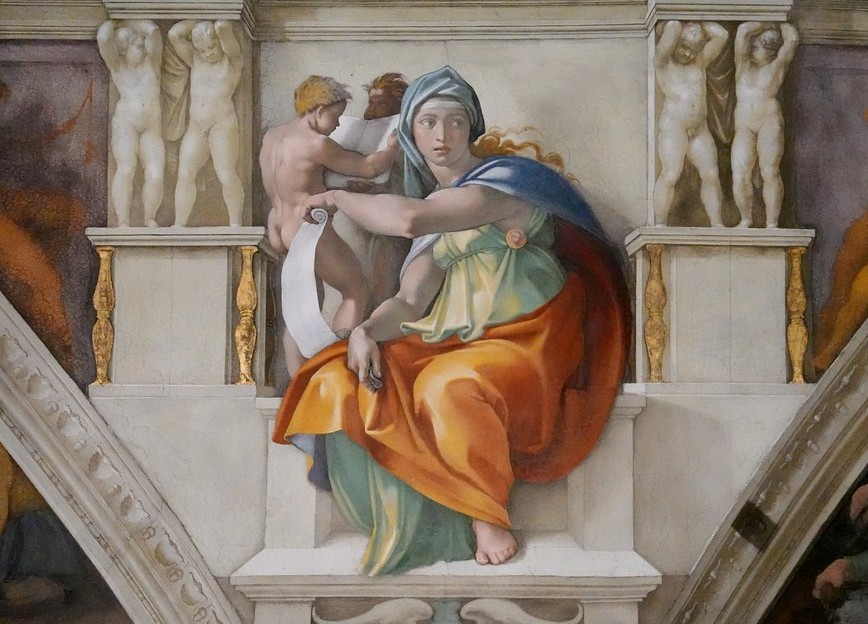
Although the Sistine frescoes appear particularly innovative in terms of color, the chromatic quality of the work does not depend on an exotic “secret” or on exceptional pigments in any absolute sense, but on an extremely conscious combination of traditional materials, fresco technique, and control of drawing. Michelangelo Buonarroti does not introduce a radically new palette compared with his contemporaries; what changes is the way these pigments are selected, juxtaposed, and used as a function of form. In buon fresco, the principal constraint is chemical. Pigments must be compatible with fresh plaster, that is, capable of withstanding the alkalinity of the lime during the carbonation process. This excludes many brilliant colors usable instead in dry painting and obliges the artist to work with a relatively limited but stable range: natural earths, yellow ochre, red ochre, iron oxides, carbon blacks, lime whites, greens derived from earths or copper compounds, blues such as azurite. The brilliance of the Sistine is born precisely from the mastery of this apparently restrictive range.The case of blue is emblematic. The most precious pigment, lapis lazuli, ultramarine, is not suited to buon fresco because it alters on contact with lime and is therefore generally applied a secco, over dry plaster. Michelangelo uses it very sparingly, privileging azurite instead for large fields. This is not a limitation but a choice coherent with the logic of the work: azurite, though less costly and less intense than ultramarine, guarantees greater stability over time and a better integration with the structure of the fresco. Similarly, the greens do not derive from a single substance but from different combinations, often obtained through superimpositions or tonal variations of compatible pigments. The reds and oranges derive from iron oxides or cinnabar, the latter more delicate and often reserved for a secco interventions, while yellows and warm tones are constructed on a base of natural earths. It is not a “rich” palette in the modern sense, but a calibrated system in which each pigment is chosen for its response to light, distance, and the structure of the body. There is no direct documentation attesting to a systematic theoretical reflection on pigments by Michelangelo, as occurs, for example, in fifteenth-century technical treatises. Yet the material evidence of the work and indirect sources clearly show a rigorous control of the process. Michelangelo does not delegate chromatic choices to assistants, but integrates them into the overall design. Color is not applied to fill a form already defined: it is born together with the form, follows its tensions, reinforces its volumes. A decisive element is the purity of the fields. Michelangelo avoids excessive mixtures and privileges relatively “pure” colors, juxtaposed in a clear-cut way. This increases legibility from a distance and prevents the figures from dissolving into space. In a high and relatively dark environment such as the chapel, the choice of saturated and contrasting colors is not only aesthetic but functional: it allows the figures to emerge clearly even from the ground. Finally, the relation between color and light is constructed in a non-atmospheric but plastic manner. Light is not suggested through progressive veils, but through calibrated contrasts between illuminated and shaded zones. Color follows this logic, helping to make the tridimensionality of the body perceptible. In this sense, the chromatic spectacularity of the Sistine does not derive from the exceptionality of the pigments, but from their subordination to a system in which drawing, volume, and light work together to produce an effect of extraordinary visual presence.
The Influence of the Sistine on Later Art
The impact of the ceiling of the Sistine Chapel on the pictorial language of the sixteenth century was immediate and profound, to the point of redefining the very parameters of monumental decoration. Already in the years following its unveiling, painters active in Rome and Florence confronted the Michelangelesque model directly, not so much on the iconographic plane as on the structural one. Raphael Sanzio, who nonetheless represents an alternative line founded on equilibrium and clarity, and who was not on good personal terms with Michelangelo, quickly absorbs the lesson of the Sistine in the monumentalization of figures and in the greater plastic tension visible in works such as the Isaiah of Sant’Agostino. Yet it is above all in the following generation that Michelangelo Buonarroti’s legacy manifests itself systematically. Mannerism arises to a large extent as a response to the difficulty of confronting a model perceived as unsurpassable. Artists such as Pontormo, Rosso Fiorentino, and Parmigianino assimilate the Michelangelesque lesson, carrying some of its elements to their extreme consequences: torsion of the body, compositional instability, elongation of proportions, chromatic innovation.
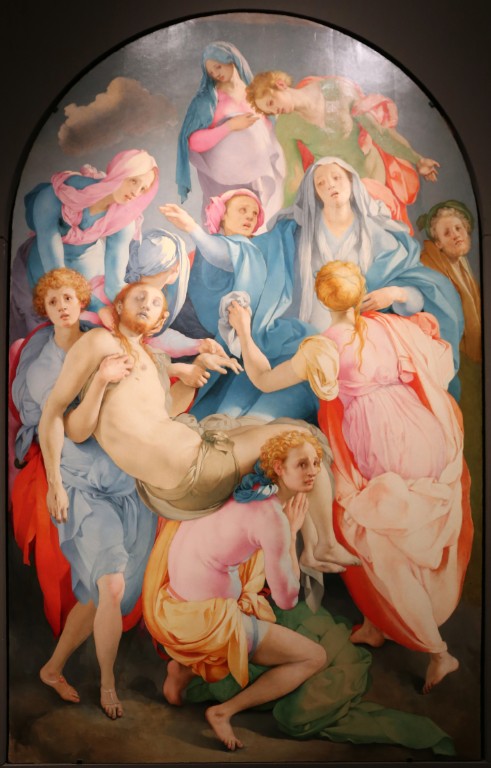
Yet what in Michelangelo is controlled tension often becomes, in the Mannerists, an autonomous stylistic system, at times detached from the structural necessity that had generated it. The body continues to be the center of visual discourse, but loses that total constructive function it had in the Sistine, transforming itself into a hallmark, a stylistic signature. At the same time, the lesson of the vault also asserts itself in the field of large-scale fresco decoration. Giorgio Vasari, albeit with a more narrative and less radical language, organizes complex cycles inspired by the articulated structure of the Sistine, while in the late sixteenth and early seventeenth centuries artists such as Annibale Carracci rework the Michelangelesque model by integrating it with a new narrative and illusionistic sensitivity. The Farnese Gallery represents, in this sense, a synthesis: the monumentality of the figures derives from Michelangelo, but is inserted into a more fluid decorative system that foreshadows the Baroque. The critical fortune of the work follows an equally significant path. Over the course of the sixteenth century, the Sistine rapidly becomes an indispensable point of reference. Vasari interprets it as the culmination of modern art, a work that definitively surpasses previous models and establishes a new canon. This reading, despite its inevitable simplifications, has enormous weight in constructing Michelangelo’s reputation as the supreme artist, capable of excelling in multiple disciplines and of bringing them to a level never before attained. In the centuries that follow, judgments on the work fluctuate, but awareness of its centrality never disappears. Even when taste changes and privileges other models, Raphaelesque grace, Caravaggesque naturalism, Baroque theatricality, the Sistine remains an obligatory term of comparison. It is not a work that can simply be imitated or surpassed; it is a system with which every new generation of artists must measure itself, whether by adhesion or by reaction. In this sense, its influence is not exhausted in a series of citations or stylistic derivations, but operates at a deeper level: it imposes a new idea of what monumental painting can be. After Michelangelo, the problem is no longer only that of representing a story or decorating a space, but of constructing a language capable of sustaining comparison with a model that has already explored, with unprecedented radicality, the possibilities of the body, form, and pictorial space.
Épater les bourgeois
It is not difficult to understand how, in the immediate aftermath of the unveiling of the vault, some of the figures most exposed to the reaction of contemporaries were not so much the prophets or the scenes of Genesis, as those ignudi who populate the painted architectural structure without an immediately justifiable narrative role. Their presence, for those moving within a rigorous idea of the function of sacred imagery, appeared problematic: nude bodies, energetic, often in complex and sometimes ambiguous poses, inserted into a space destined for liturgy and lacking a direct textual reference that might legitimize their presence.
It was not simply a matter of decorum, but of a subtler issue, one touching on the relationship between the visibility of the body and religious meaning. In the early sixteenth century, before normative definitions had become systematically rigid, there already existed a sensitivity attentive to delimiting what was considered appropriate in sacred space. In this context, Michelangelo Buonarroti’s ignudi appeared as an element difficult to assimilate: they were neither sinful bodies nor glorified bodies in the traditional sense, but suspended, autonomous figures that seemed to affirm the centrality of the body outside any explicit moral justification. It was precisely this ambiguity that made them suspect in the eyes of part of the clergy and of circles more attentive to orthodoxy, for whom the image had to remain subordinate to a clearly defined and controllable content. The criticisms do not immediately take the form of an official condemnation, but circulate in the form of reservations, observations concerning decorum, perplexities about the propriety of such an exposure of the nude in a liturgical context. It is significant that the objections concentrate less on artistic quality, which was hardly contestable, and more on the legitimacy of the language adopted. In other words, what is called into question is not Michelangelo’s skill, but the perimeter within which such skill may be exercised without crossing a threshold deemed dangerous. In this climate, the body becomes a terrain of tension. On the one hand, the humanistic tradition and the rediscovery of antiquity had restored to the nude a very high formal dignity; on the other, part of the religious milieu tended to bring the image back within more supervised limits, in which the visibility of the body was always accompanied by an unequivocal function. The Sistine ignudi escape both categories: they are neither antiquarian citations nor simple ornaments, but presences that impose their own evidence without offering a univocal interpretive key. This ambivalence explains why, in the years that follow, and above all in a climate progressively more attentive to the control of images, their presence continues to provoke discomfort in certain quarters. Not because they were “excessive” in quantitative terms, but because they made visible something not easily disciplinable: a body that does not ask permission to exist in sacred space, and that for that very reason forces the observer to confront a dimension of the image less docile than what those who would have preferred a painting more clearly aligned with a pre-established order had expected. But then, every age has its own fanatics of orthodoxy.
The Sistine Chapel Restorations (1980-1994)
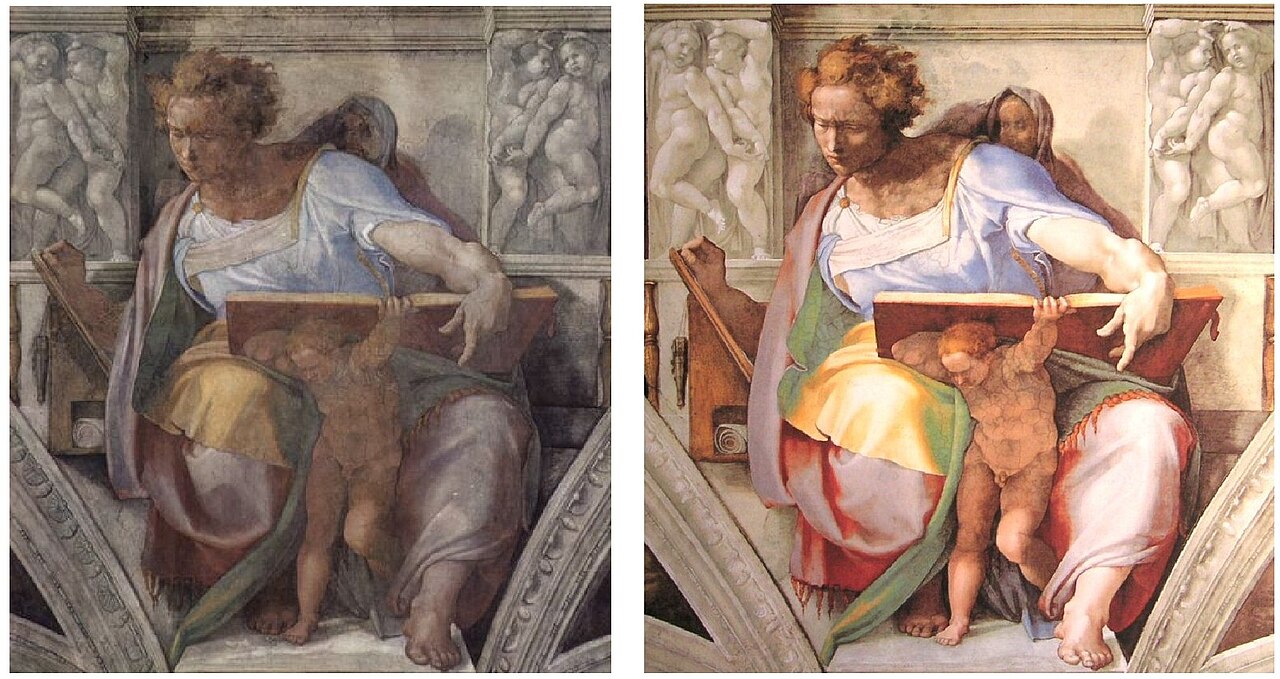
The obtuseness of the custodians of orthodoxy, paradoxically, did not express itself only when the frescoes were first revealed to the whole world, provoking scandal in limited minds, but also, centuries later, when the centuries and the elements had indirectly veiled those forms and colors that others in past centuries would have liked to veil. For centuries, in fact, the ceiling of the Sistine Chapel was observed through a veil that did not belong to Michelangelo. Deposits of soot, accumulated over time because of liturgical use and illumination by candles, had progressively darkened the surface; to this were added stratified restoration interventions, often invasive, which altered tonal relationships, weighed down the contours, and flattened the shadows. The result was a compressed, gloomy image, dominated by browns and grays that seemed to confirm a reading of Michelangelo as a “sculptural” painter even in color, almost indifferent to the chromatic dimension; too many interpreters, clouded by habit and incapable of asking themselves why there were differences between the stylistic appearance of the Sistine and that, for example, of the Doni Tondo, believed that Michelangelo had intended to represent muted and lugubrious colors. When, between 1980 and 1994, a systematic restoration of the ceiling was undertaken, the removal of these layers restored a chromatic range unexpected by many observers: bright, saturated colors, sharp contrasts, a luminosity that radically altered the perception of the whole. The reaction was not unanimous and many cried scandal, incapable of reading history through a scrupulous interpretation of the sources. Alongside enthusiasm for the rediscovery of a surface closer to its original state, a significant resistance emerged on the part of those who had internalized for decades, at times for generations, the darkened image as authentic. The idea that Michelangelo had to be “dramatic” even in color, that tonal gravity was an integral part of his language, had settled to the point of becoming a criterion of judgment. The cleaning was therefore perceived, in certain circles, not as restoration but as alteration, as if the patina accumulated over time were a stylistic quality rather than a material superimposition. This episode is instructive because it shows how historically conditioned the perception of a work of art is and how easy it is to mistake for intention what is instead the result of processes of degradation or of later interventions. “Visual tradition” is not a neutral datum: it can crystallize erroneous interpretations and defend them with a force that derives not from evidence but from habit and obtuse orthodoxy. In the case of the Sistine, resistance to restoration did not arise from a deeper knowledge of the work, but from the identification of memory with truth. The affair also brings to light the intrinsic precariousness of artistic heritage. A fresco is not a stable object: it is a surface exposed to chemical, environmental, and cultural transformations. Every conservation intervention is situated in a delicate equilibrium between removal and loss, between restitution and risk. There is no “neutral” state to which one can return without mediation, because every choice implies an interpretation of what is considered original and what is considered accessory. In this sense, conservation is not a purely technical operation, but a critical act requiring historical awareness and responsibility. The lesson of the Sistine lies not only in the quality of the final result, but in the fact that it has made evident how fragile the boundary is between the work and its transformations. What today appears as evidence, the luminosity of the colors, the sharpness of the fields, remained invisible for a long time, and might have continued to do so had it not been decided to intervene. The material history of works is not background noise to be eliminated, but an essential component of their understanding. To ignore it means accepting as given what is in reality the contingent product of time, use, and human intervention.
For those interested in the conservation of frescoes, I have already covered the topic here and here; I also attach the proceedings of a 2014 conference with interesting data on the conservation of the Sistine Chapel:
Sistine Chapel Ceiling Explained: Genesis, Prophets, Sibyls and the Iconographic Program
I have already written a great deal, certainly too much, and still I have not described the content of the work. But since I amuse myself with art, not with theology, I will limit myself to a hasty summary, referring those who wish to explore this topic further to other sources.
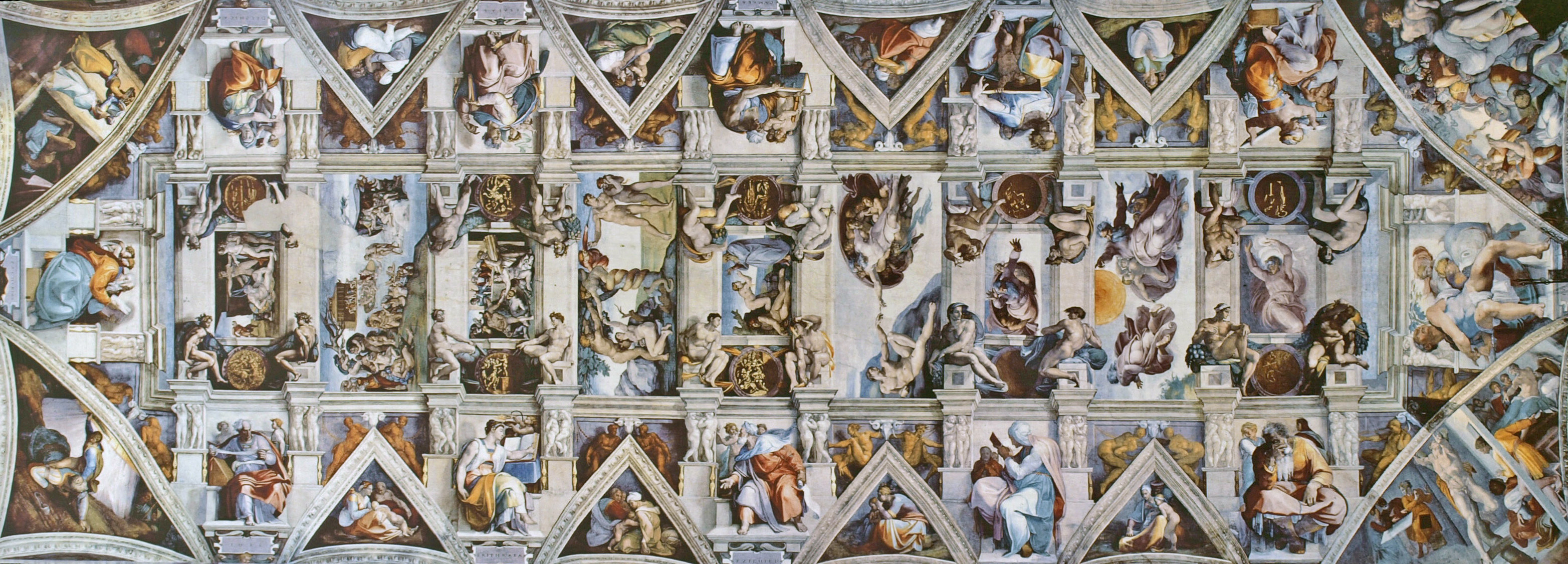
[Wikipedia mode on]. The iconographic program of the ceiling of the Sistine Chapel is articulated around the opening chapters of Genesis, but its construction is anything but linear or merely narrative. At the center runs a sequence of nine episodes, from the Separation of Light from Darkness to the Drunkenness of Noah, organized according to a progression that relates creation, fall, and the human condition. Around this principal axis are arranged prophets and sibyls, together with the ancestors of Christ in the lunettes and spandrels, creating a structure that connects the Old Testament narrative with the history of salvation as a whole. The initial project, simpler in conception, envisaged a decoration with apostles; it was Michelangelo Buonarroti himself who proposed a radical expansion of the program, transforming the ceiling into a complex theological system in which the theme of creation is not only the origin of the world but also a reflection on the nature of man and his destiny. In this sense, the subject is not simply “biblical,” but constructed as a visual synthesis intertwining sacred history, prophecy, and genealogy, coherent with the intellectual and political ambitions of the pontificate of Pope Julius II [Wikipedia mode off].
This, more or less, is the explanation you will find in the main reference works, from the Vatican’s official guide to Wikipedia. However, I have never found this interpretation entirely convincing. There is a little too much Old Testament, and far too little New Testament, for what is supposed to be the holiest place in Christendom. In this regard, I would like to draw your attention to The Sistine Secrets: Michelangelo’s Forbidden Messages in the Heart of the Vatican by Benjamin Blech and Roy Doliner. In my view, the book suffers from a rather obvious bias: the authors, both experts in Jewish history, go to considerable lengths to demonstrate that Michelangelo loved the Jews and hated the Pope, and that he therefore filled the Sistine Chapel ceiling with esoteric messages reflecting these sentiments. However, if we set aside these reservations, the book does present some fairly compelling arguments, beginning with Michelangelo’s intellectual upbringing at the Medici court, where he was exposed to the teachings of figures such as Pico della Mirandola and Marsilio Ficino. There is not enough space here to explore the resulting interpretation of the Sistine Chapel frescoes in any depth. I will probably devote a separate post to the subject, but in the meantime, I recommend the book, which is both accessible and thoroughly engaging.
A brief atypical guide to reading the work
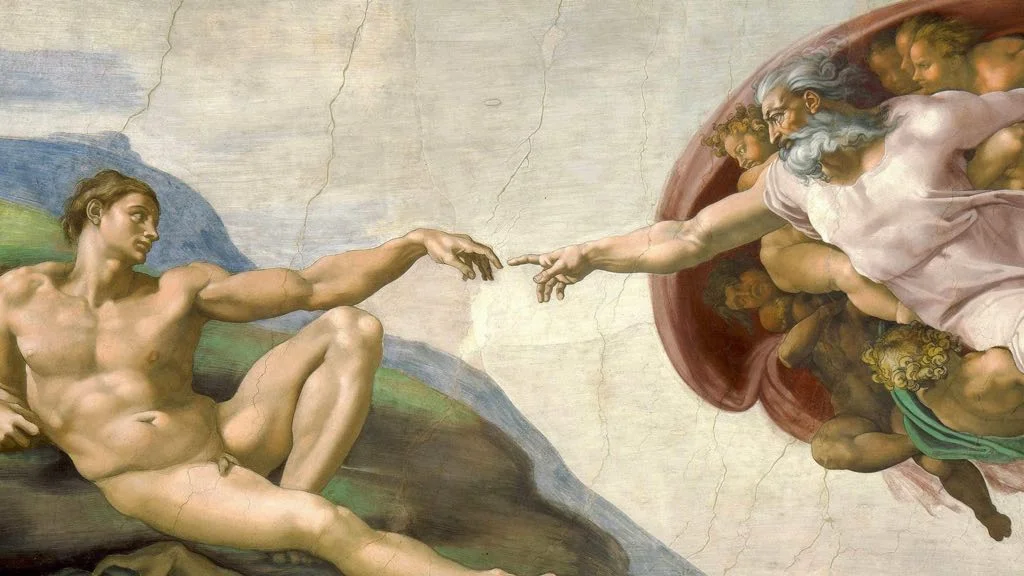
The Sistine Chapel is an immense work not only because of its artistic value but also because of its physical dimensions; when Michelangelo wanted to prove to the world that he was the greatest of them all, he did not go about it subtly. Describing the main episodes and subjects in detail would require another mile-long post that would test the patience of readers, and who knows, perhaps one day I shall do it; for now I will limit myself to pointing out some of my favorite subjects, in the hope that this may serve as a cue to study this work analytically, without limiting oneself to the detail of God’s finger grazing that of Adam in the Creation episode.
My top 12 chart of the Sistine Chapel is therefore:
- The Libyan Sibyl: a lysergic explosion of acid colors, an anatomical study on plaster 20 meters above the ground, the soft blond braids, supreme beauty made concrete and eternal in one of the places of maximum abjection and political and moral corruption, the Vatican. Every time I look at her I think of Pontormo’s Deposition and of how shaken poor Jacopo must have been by contemplating the Sistine.
- The spandrel with the episode of David and Goliath: one of the most dynamic and effective representations of the very well-known biblical episode; after having represented David as an Apollo-like god, Michelangelo rewrites himself and represents him as a hobbit ante litteram, to be compared with the same subject represented by Daniele da Volterra, now in Palazzo Barberini.
- The woman with the blue veil, at lower left in the scene of the Flood, for a citation game with Night in the Medici Chapels and to ask oneself why Michelangelo represented the male body divinely and went after the female body so harshly. Was he perhaps a patriarchal and misogynistic supremacist?
- The ignudi, because each one is more perfect than the other and one could spend hours scrutinizing their beauty without ever being sated.
- E.T. phone home: all right, I do not want to play the anticonformist at all costs; the detail of the meeting of the fingers in the Creation is Art at its highest state, no denying it, but…
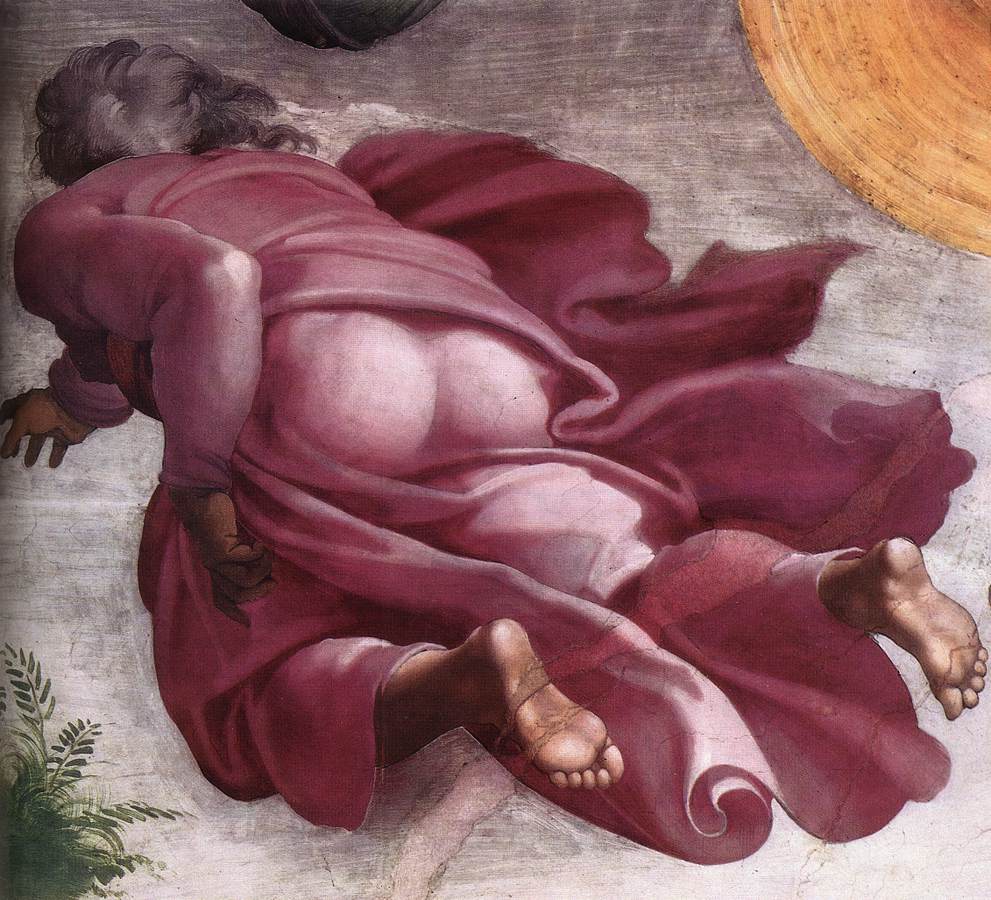
- God’s ass: what are we to say of the only artist in the world who, besides filling the “most sacred place in Christianity” with dicks, dared to depict God’s ass?
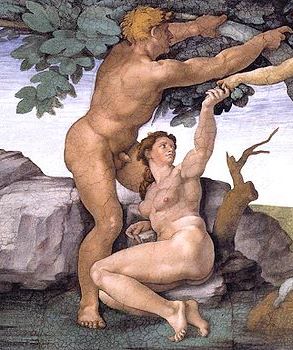
- The Expulsion from Paradise: because Michelangelo had a high opinion of himself and did not spare fierce criticism of his competitors, but he knew how to recognize merit, and here he evidently recognizes it in Masaccio. Note the beauty of the figures of Adam and Eve during the Temptation, also to note that no, Michelangelo did not persecute female figures, and knew how to represent a beautiful female body when he wished.
- The putti telamons dancing the Aserejé behind the prophet Daniel.
- The tangle of bodies in the spandrel of the Brazen Serpent, for a citation game with the Battle of the Centaurs.
- The lunette of Aminadab, with the drag queen waking up after a night of excess (on the left) and another case of Michelangelo’s beautiful representation of a female figure, the woman combing her hair (on the right).
- The lunette of Jacob and Joseph, with Joseph evidently the victim of domestic violence at the hands of Mary.
- The lunette of Hezekiah, with the enchanting detail of the woman rocking the newborn.
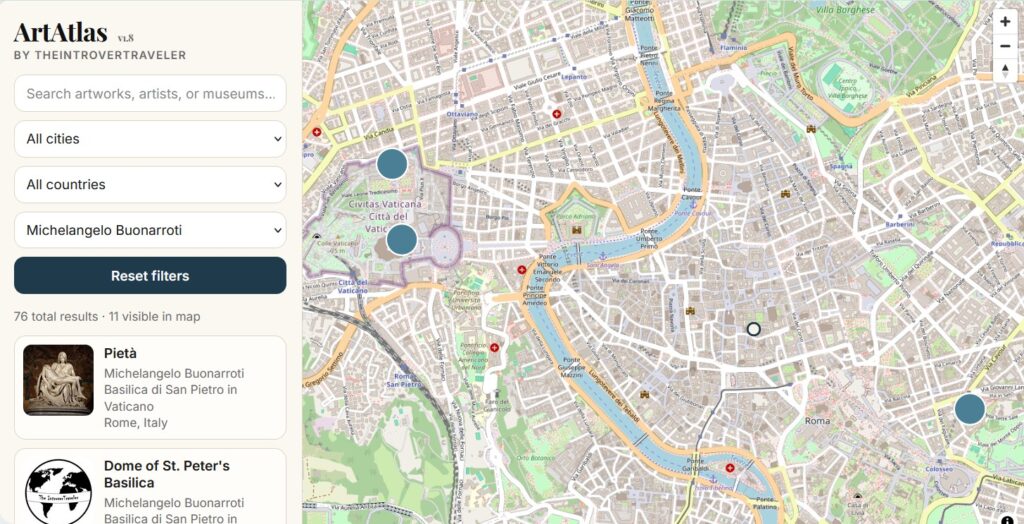
If you want to explore all of Michelangelo’s works in Rome, you can continue on this page on ArtAtlas.
If you are planning a trip to Rome, you may be interested in these posts.
For the rest of the Michelangelo story, I’ve written a long-form guide: Michelangelo Buonarroti, the total artist (and his real torments).
Books and movies
It is all too easy to mention the film The Agony and the Ecstasy (1965), starring Charlton Heston, based on the 1961 novel by Irving Stone (both, in my view, somewhat overly fictionalized), but the film I strongly recommend is Sin by Andrei Konchalovsky, which I believe renders Michelangelo’s personality with great care, as it emerges from reading his correspondence, and also devotes space to the execution of the frescoes of the Sistine Chapel.
The books I consider indispensable for a deeper understanding of the Sistine Chapel frescoes, both for their first-rate iconographic apparatus and for the quality of their texts, are:
- Frank Zollner, Michelangelo: The Complete Works. Paintings, Sculptures, Architecture, Taschen
- Horst Bredekamp, Michelangelo (German Edition) (Italian Edition)
- Anja Grebe, Vatican: All the Paintings: The Complete Collection of Old Masters, Plus More than 300 Sculptures, Maps, Tapestries, and other Artifacts, Black Dog & Leventhal
- The Sistine Secrets: Michelangelo’s Forbidden Messages in the Heart of the Vatican by Benjamin Blech and Roy Doliner
The Sistine Chapel by Antonio Forcellino is an enjoyable introductory read to the Sistine Chapel.
I also note, for the sake of completeness, although I have not read them:
- William E. Wallace, Michelangelo: The Complete Sculpture, Painting, Architecture, Rizzoli Universe
- Andrew Graham Dixon, Michelangelo and the Sistine Chapel, Skyhorse
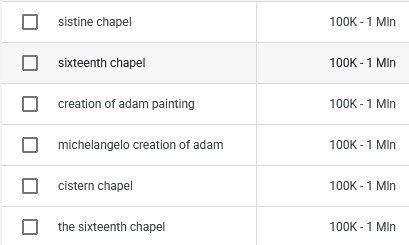
The “Sixteenth Chapel” and Other Search Curiosities
I was already puzzled to discover that thousands of people every month search for a “Prada Museum” in Madrid on Google Keywords… but this is even worse:
Plan your Sistine Chapel visit
- 🎟️ Vatican Museums + Sistine Chapel skip-the-line (essential)
- 🎨 Guided tour with art historian (recommended)
- 🌅 Early access before opening hours (premium experience)
- 🗺️ Flâneur.travel (art itinerary engine for Rome by TheIntroverTraveler)
Other things to book in Rome
Already in Rome? You may want to book the following tickets:
Vatican Museums, Sistine Chapel & St. Peter’s Basilica Tour
Vatican Museums, Sistine Chapel & Gardens Golf Cart tour
Castel Sant’Angelo skip-the-line
Colosseum + Roman Forum, guided tour
or you can use Flaneur to plan your own art itinerary in Rome.
FAQ
Who commissioned Michelangelo to paint the Sistine Chapel ceiling?
Michelangelo was commissioned by Pope Julius II, one of the most ambitious and forceful patrons of the High Renaissance. What began as a difficult and conflict-ridden commission became one of the defining monuments of Western art.
What do the frescoes of the Sistine Chapel ceiling represent?
The ceiling centers on scenes from the Book of Genesis, from the Separation of Light from Darkness to the Drunkenness of Noah. Around this central sequence Michelangelo placed prophets, sibyls, ignudi, and the ancestors of Christ, creating a far more complex structure than a simple biblical narrative.
Why is the Sistine Chapel ceiling considered revolutionary?
Because Michelangelo did not simply decorate a vault: he reinvented the possibilities of monumental painting. He made the human body the core of the visual system, fused painting with sculpture and architecture, and pushed Renaissance art to a point from which it could no longer return unchanged.
How did Michelangelo paint the Sistine Chapel ceiling?
He painted it using the buon fresco technique, working on fresh plaster in carefully planned daily sections known as giornate. He worked on scaffolding at great height, in physically punishing conditions, and had to solve major technical problems before fully mastering the medium.
Where is the Sistine Chapel located?
The Sistine Chapel is part of the Vatican Museums in Vatican City. Access is included in the standard Vatican Museums ticket.
How long does it take to visit the Sistine Chapel?
A meaningful visit to the Sistine Chapel requires at least 30-45 minutes inside the chapel itself, but the Vatican Museums route leading to it typically takes no less than 3-4 hours (usually more than that). Plan accordingly and consider a skip-the-line ticket to avoid the longest queues. You may want to read my Vatican Museums guide.
How can I find all of Michelangelo’s works in Rome?
If you want to explore all of Michelangelo’s works in Rome in a practical and visually clear way, continue on ArtAtlas: https://artatlas.it/artists/michelangelo/michelangelo-in-rome.html It is one of the most useful ways to see where Michelangelo’s works are actually located across the city and to build a serious itinerary instead of relying on the usual fragmented lists.
How can I plan an art itinerary in Rome?
With Flaneur, the itinerary engine of The Introvert Traveler. You tell it how many days you have and what kind of traveller you are, from curious beginner to seasoned art lover, and it builds a day-by-day route through the city’s museums, churches and masterpieces, with the same opinionated selection you find on this blog and a curated choice of restaurants along the way. No algorithmic top tens, no tourist traps: just the art worth your time, in an order that makes sense on foot.
Map
A few days ago, my son, who was about to go on a school trip to Rome, came to me complaining about the teachers’ choice. The gist of his complaint was: “What is there even to see in Rome?” When I replied, “I don’t know, for example the Sistine Chapel?” he went pale and, after a moment of hesitation, found the courage to confess: “I thought it was in Florence.” If you don’t want to be like my son, you may also find useful the Google Maps map that I embed below.