Last visit: Febraury 2026
My rating: 9/10
Price: free from the square; €2 to walk down to the basin (October 2026)
Address: Piazza di Trevi, 00187 Rome
Web: https://www.fontanaditrevi.roma.it
Visit duration: allow 30 minutes
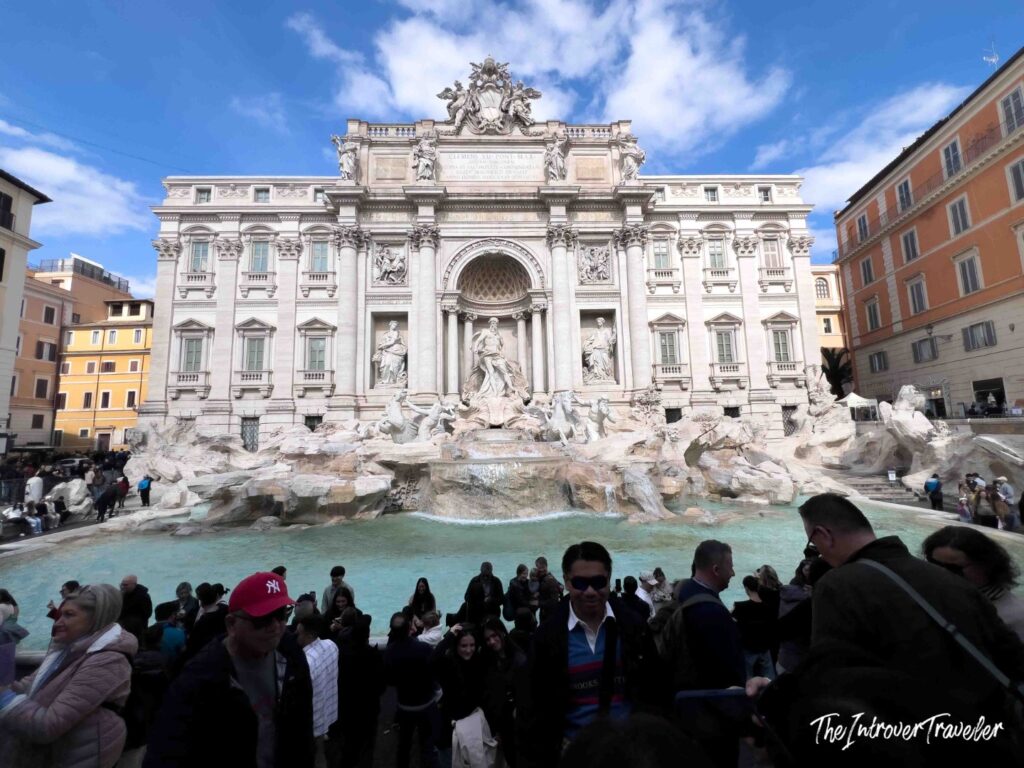
In the twelve months between December 2024 and December 2025, while the city of Rome was testing a new system to manage the crowds, more than ten million people walked into Piazza di Trevi. An average of thirty thousand a day, with peaks of seventy thousand. To put that in perspective: in the same year, the Vatican Museums, the largest collection of art ever assembled by a single institution, received fewer than seven million. More people go to see a fountain than to see the Sistine Chapel.
And most of them, at the decisive moment, turn their backs on it.
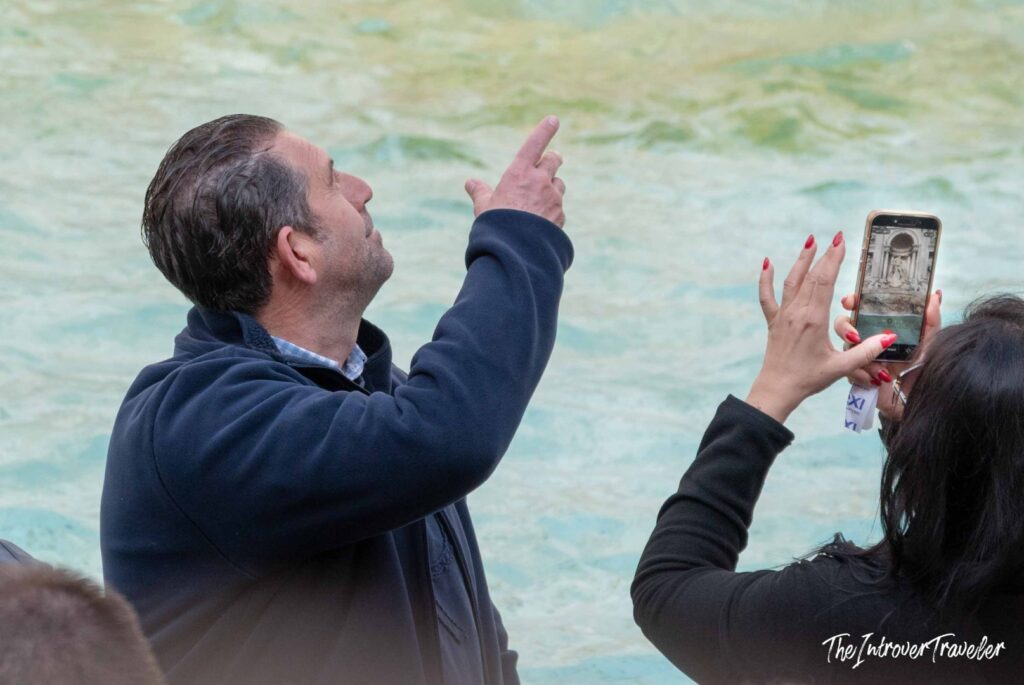
That is the rule of the ritual: you stand with the fountain behind you, take a coin in your right hand and toss it over your left shoulder. The Trevi Fountain is probably the only masterpiece in the world whose standard visiting procedure requires you not to look at it. The selfie, which follows immediately afterwards, confirms the principle: the fountain is behind you, again, as a backdrop for your face.
This is a pity, because the Trevi Fountain is a genuine masterpiece. Not the masterpiece everybody thinks it is, and not for the reasons everybody thinks. It is not a great piece of sculpture. It is something rarer: a piece of urban theatre so perfectly designed that two and a half centuries later it still works exactly as intended, on an audience of ten million people a year. It was designed for an audience of a few hundred. It copes with the extra ten million rather well.
In short: what you need to know in thirty seconds
- What it is: the monumental outlet of an ancient Roman aqueduct, rebuilt in the eighteenth century as a stone stage set leaning against the side of a palace.
- The ticket: since 2 February 2026, walking down the steps to the basin costs €2 for non-residents. The square above is free, at any hour.
- The single most useful tip in this article: see it twice. Once at midday, in the crush, as the pop icon it has become; once at dawn or late at night, almost empty, as it was conceived.
- The statue in the middle is probably not Neptune. Most sources call him Oceanus, and he has no trident. Ten million people a year disagree.
- The coins: well over €1.5 million a year, swept out and handed to Caritas, the Catholic charity of Rome.
- Who it’s for: everyone. Including, and perhaps especially, the people taking selfies.
Planning a trip to Rome around the art?
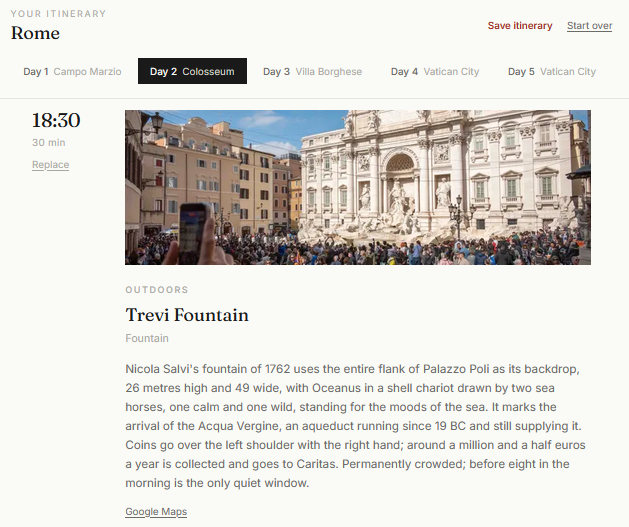
The Trevi Fountain is a five-minute walk from Palazzo Barberini, ten from the Pantheon and fifteen from the Spanish Steps, which means it ends up on every itinerary, usually by accident and in the wrong order. Flâneur builds a personalised Rome art itinerary around the works you actually care about, with real opening hours, transfer times and meal breaks, and it slots the fountain in along the route, between one museum and the next, which is exactly where a fountain belongs: on your way somewhere.
Before the fountain, the water
To understand the Trevi Fountain you have to start with what comes out of it.
In 19 BC Marcus Agrippa, Augustus’s son-in-law and right-hand man (the same Agrippa whose name is still written across the front of the Pantheon), inaugurated a new aqueduct to supply his baths in the Campus Martius. It was called the Aqua Virgo, the Virgin Water, and it ran for more than twenty kilometres, almost entirely underground, from springs east of the city. According to the Roman writer Frontinus, who was in charge of the city’s water supply at the end of the first century, the aqueduct owed its name to a young girl who showed Roman soldiers where to find its springs. Other ancient explanations associate the name with the water’s exceptional purity.
Of the eleven great aqueducts of ancient Rome, the Aqua Virgo is the only one that has never stopped working. Two thousand years later it still feeds the fountains of Piazza Navona, the Barcaccia in Piazza di Spagna and the Trevi. This changes the way you look at the monument: the Trevi is not a fountain with an aqueduct behind it. It is an aqueduct with a façade in front of it. The baroque spectacle is the full stop at the end of a sentence that began under Augustus.
For most of its history, the end of the Aqua Virgo was a simple affair: a few basins at the meeting point of three streets, the trivium from which the name Trevi probably derives. In the fifteenth century Pope Nicholas V had it rearranged into a single long basin, a design traditionally attributed to Leon Battista Alberti, the humanist architect who more or less wrote the Renaissance rulebook on how buildings should be designed. Useful, decent, unspectacular. Then the Baroque arrived.
Bernini was here, and left
Around 1640 Pope Urban VIII Barberini, the same pope who turned Bernini into the official set designer of papal Rome, asked him to rethink the fountain. Bernini reshaped the square and started work on a new display of water. Then the pope died, the money dried up, and the project was abandoned half-finished.
It is one of the very few places in Rome where Bernini started something and did not finish it, and the experience must have been instructive for him: popes die, and a fountain that depends on one pope dies with him. (What happened to Bernini under the Barberini, and after them, is told in Bernini and the Barberinis.)
But the seventeenth century left an idea on the table, and it is the idea that makes the Trevi what it is: to stop treating the fountain as an object placed in front of a building, and to fuse the two. The building becomes the fountain. The intuition is credited to the painter and architect Pietro da Cortona, one of Bernini’s great rivals in the business of decorating Baroque Rome (Borromini, the other, had a far worse temper). It would take almost a century, and a lottery, to make it real.
Thirty years, three popes and a lottery
In 1730 a seventy-eight-year-old Florentine cardinal was elected pope as Clement XII, a compromise candidate whom everybody expected to die quickly. He lived for another ten years, went blind, and in the meantime reorganised the finances of the Papal States. Among his first moves: he reintroduced the public lottery, which his predecessor had abolished on moral grounds. The lottery brought in a great deal of money, and the money paid for buildings, including the Trevi.
Let us pause on this for a second. The most romantic fountain in the world was paid for, in part, by the poor of Rome betting their savings on numbers. Today it is paid for, again in part, by tourists betting a coin that they will come back. Two hundred and ninety years of gambling, and the house has always won.
In 1732 Clement XII held a competition and chose the design of Nicola Salvi, a Roman architect who, before this commission, was better known as a man of letters and theory than as a builder. Salvi spent the rest of his life on it. Work dragged on through interruptions, cost overruns and changes of plan, and when Salvi died in 1751 the fountain was still unfinished. It was completed by Giuseppe Pannini, an architect who took over the site and modified the scheme, and inaugurated on 22 May 1762, under Clement XIII. Thirty years for a fountain.
Salvi gets the glory, and deserves most of it, but the Trevi is a team effort, and two more names belong on the credits. The central group, Oceanus with his sea horses and tritons, was invented by Giovanni Battista Maini, a Lombard sculptor who was among the most sought-after in Rome under Clement XII: from the 1730s he produced the drawings and the full-scale stucco models that stood in the niche for years. Maini died in 1752, a year after Salvi, without ever seeing his figures in marble. They were carved, following his models, by Pietro Bracci, one of the leading marble specialists of mid-eighteenth-century Rome, the man you called when a papal tomb or a monumental statue needed doing. The fountain, in other words, outlived its architect and its sculptor, and was finished by the men who inherited their drawings.
The best way to grasp the comedy of those thirty years is to read the inscriptions, which are in plain sight and which nobody reads. On the attic at the top, Clement XII signs the work with the date 1735, when the fountain was little more than a building site. On the frieze below, Benedict XIV declares that he completed it, PERFECIT, at a time when the great central statue had not even been carved yet. Inside the central niche, Clement XIII records that the work was finished in 1762, statues and reliefs included. Three popes, three signatures, one fountain. The papal equivalent of everyone in the office signing the birthday card, including the one who joined last week.
How to read it: a theatre with the audience included
Stand in the square and look at the whole thing before you look at any detail.
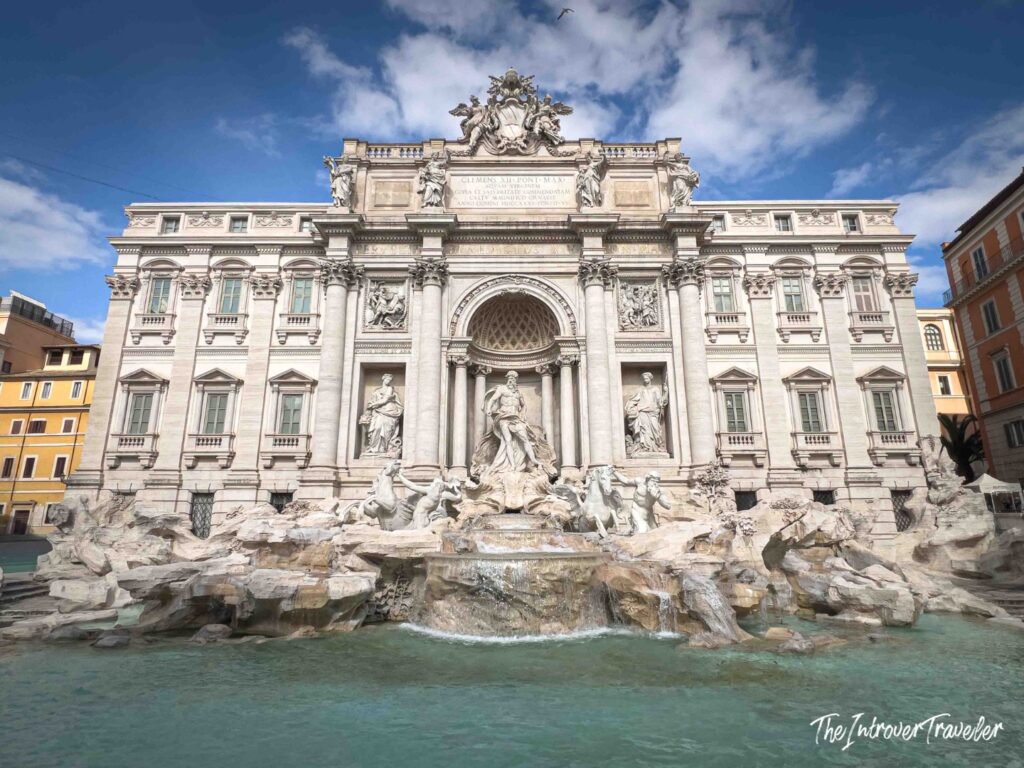
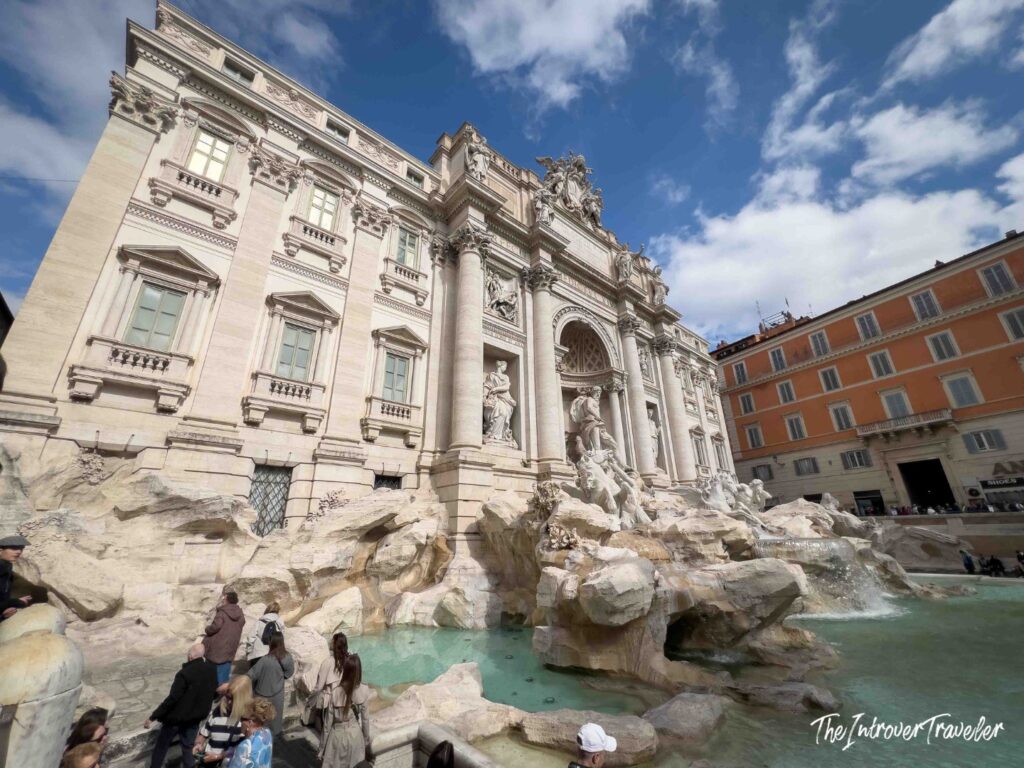
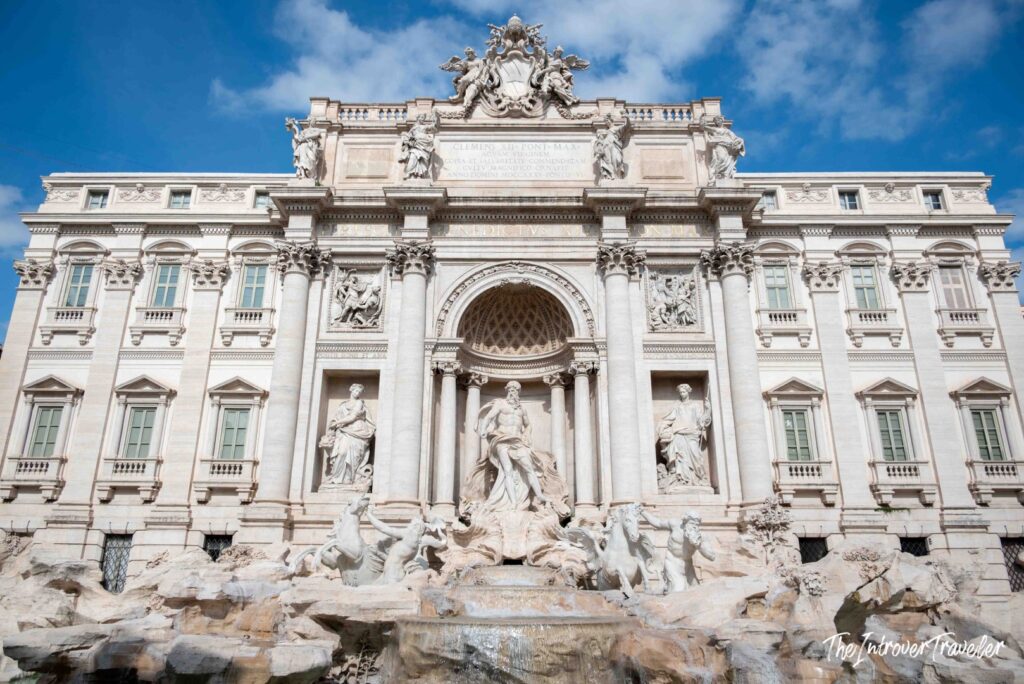
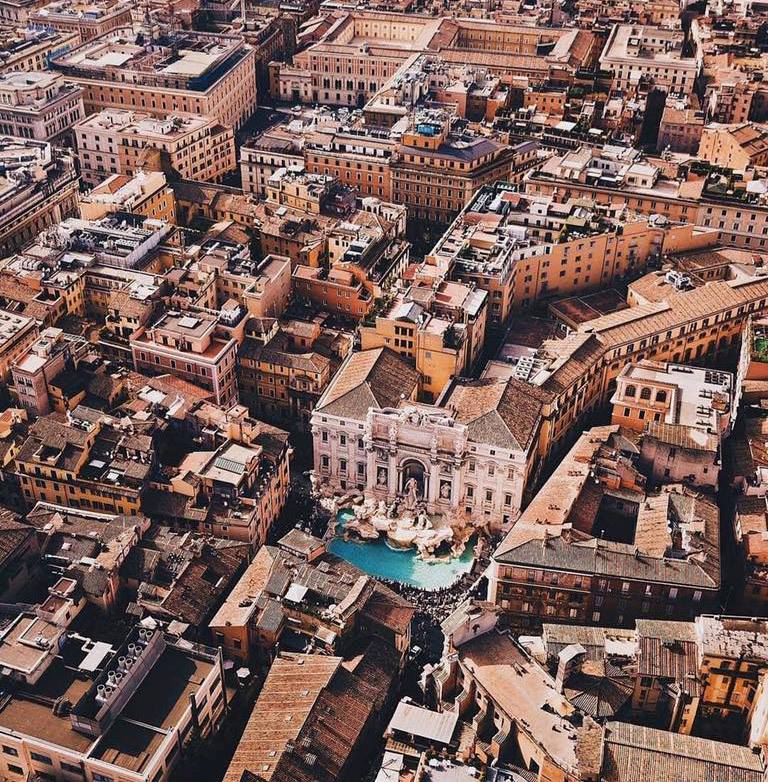
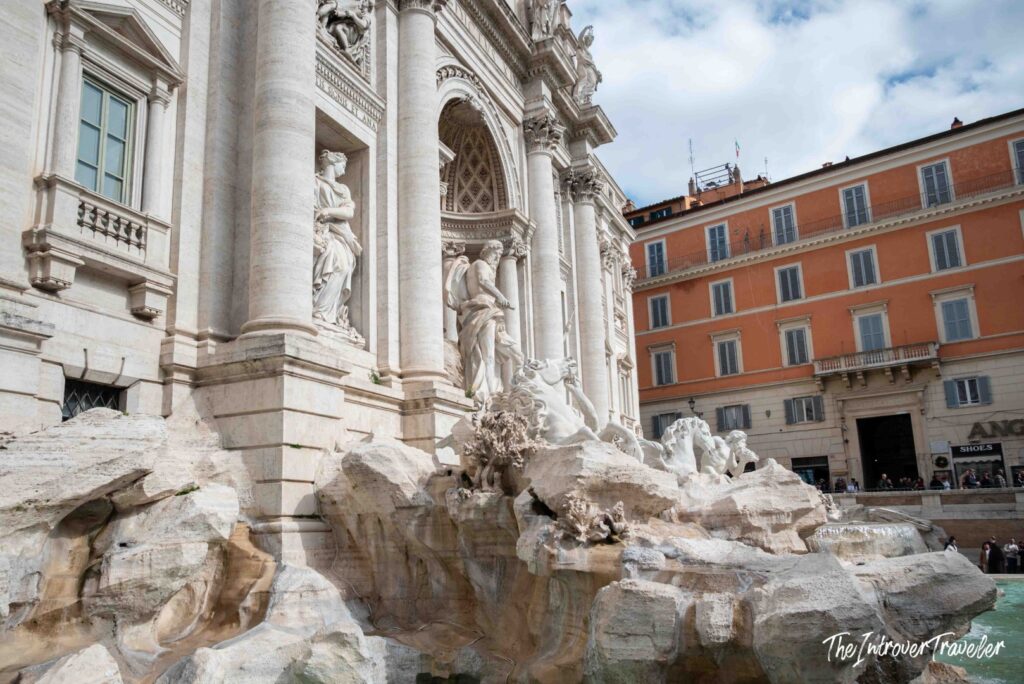
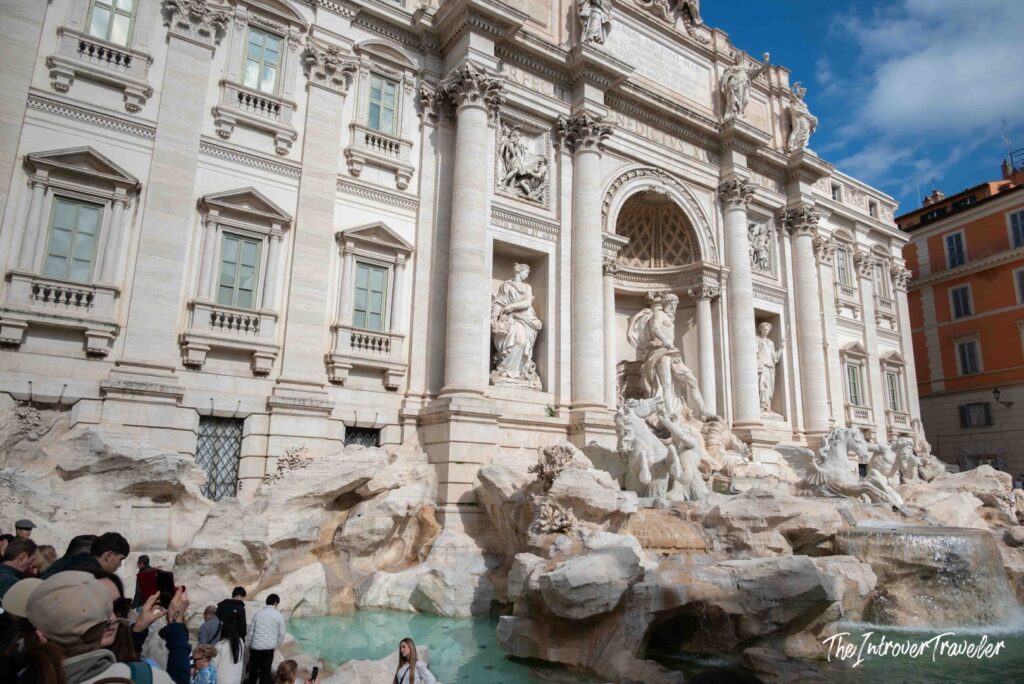
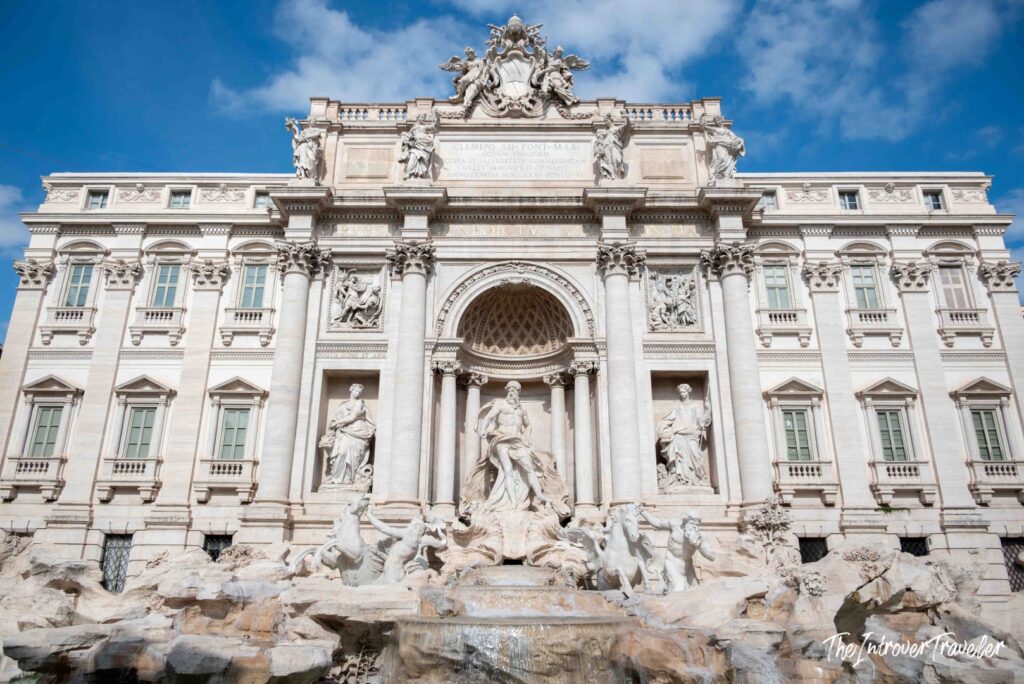
The back wall is not a backdrop: it is the side of Palazzo Poli, a real palace with real windows, absorbed into the composition. At its centre Salvi inserted a triumphal arch, with Corinthian columns. In front of the arch, instead of the usual basin, he built a reef: an enormous artificial cliff of travertine that seems to burst out of the foundations of the palace, carved with rocks, plants, stalactites and dripping vegetation, over which the water falls into a basin at a level lower than the street. The real genius of the Trevi is in that collision: on the top half, order, architecture, the language of power; on the bottom half, nature breaking through it. The palace is civilisation, the reef is the sea, and the water runs from one into the other.
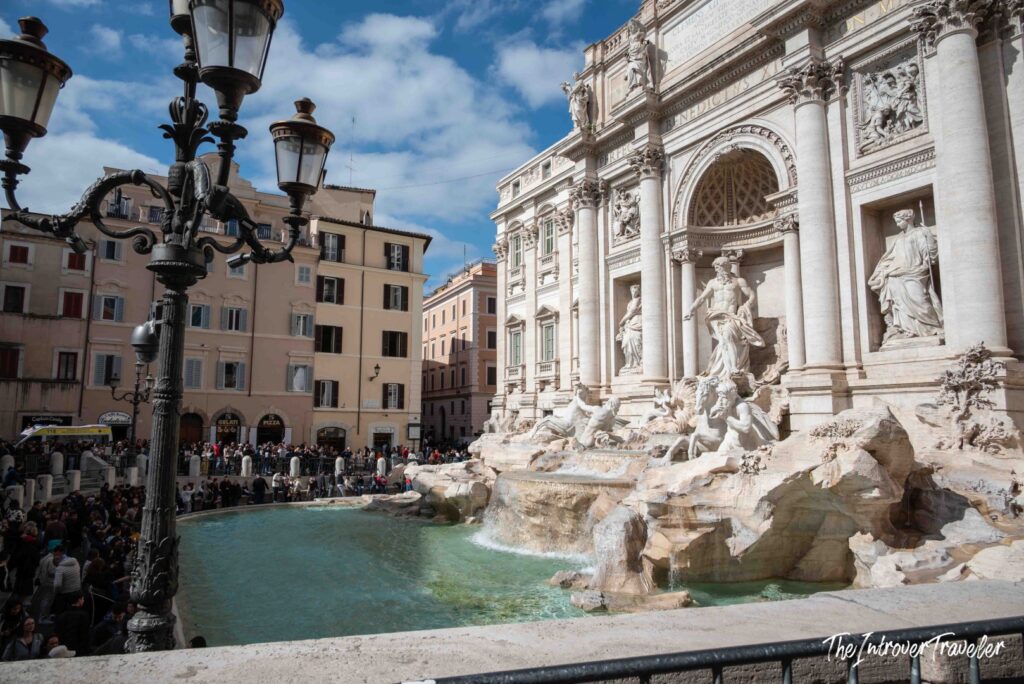
Then there is the space, which is the part photographs never capture. Piazza di Trevi is small, and you reach it through narrow streets where you see nothing until the last few metres. The fountain does not appear in the distance, as a monument should: it ambushes you. You turn a corner and it is on top of you, enormous (about twenty-six metres high and nearly fifty wide), filling the whole field of vision, with the noise of the water arriving a moment before the image. It is a stage effect, calculated and devastating, and it is the reason the Trevi has never stopped working on people, even people who know nothing about the Baroque. Especially them.
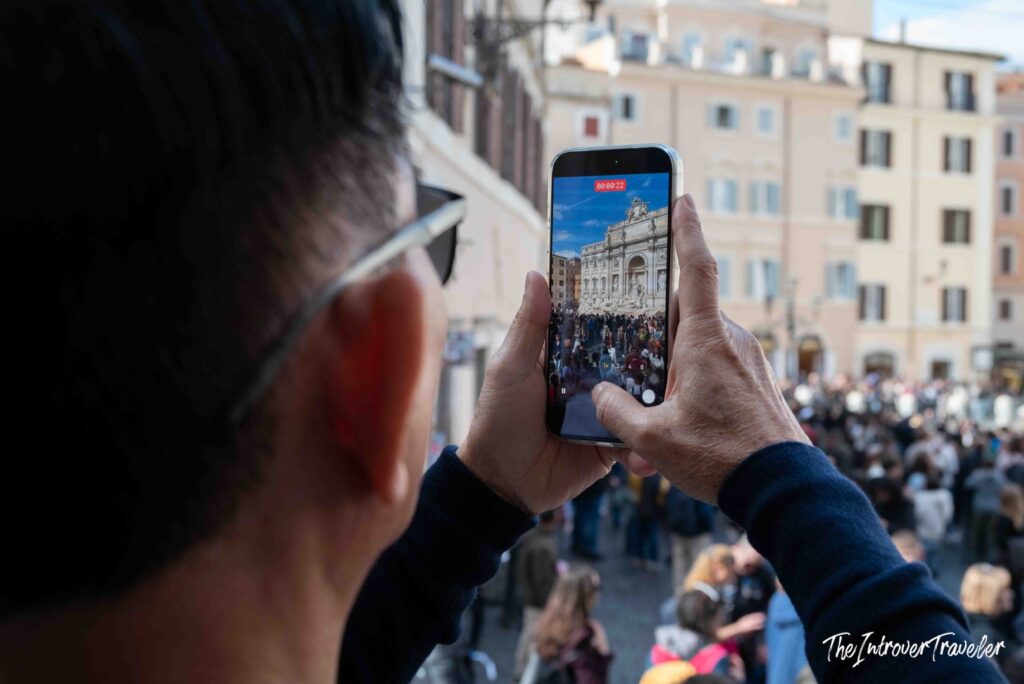
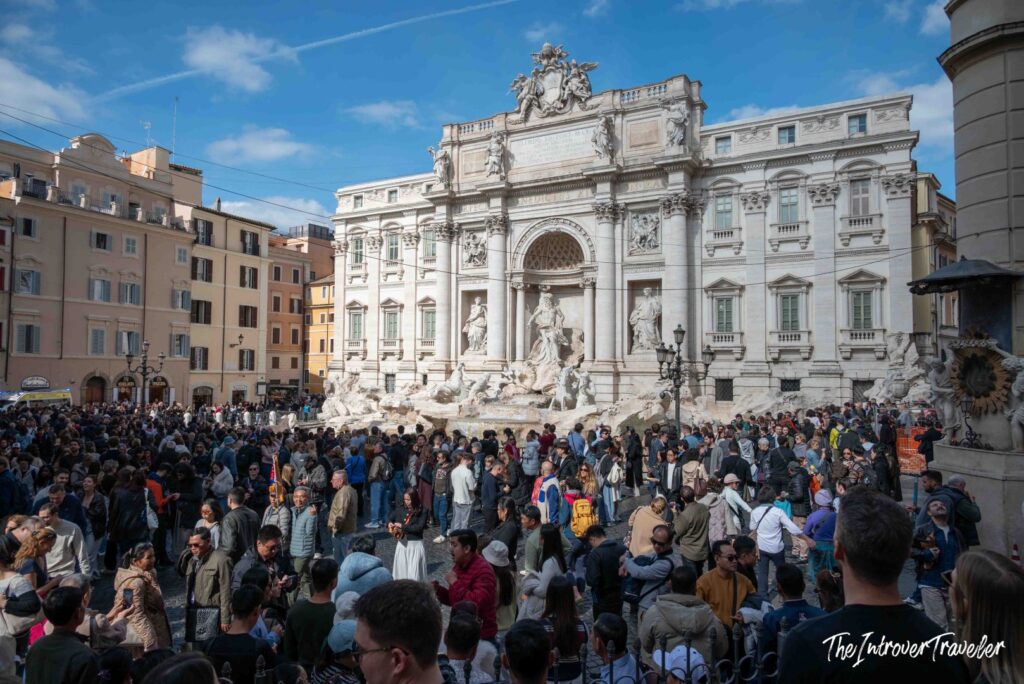
And yes, it is true: today Piazza di Trevi is a bedlam, a square under siege, the poster child of every article ever written about overtourism. It makes no difference. Exactly as happens to Anita Ekberg in the film, wandering through the dark alleys of Rome until she turns the corner and finds it in front of her, the spectacle fills your eyes, the blood freezes in your veins, and for a few seconds the crowd simply disappears. The noise of the water swallows the chatter, the white of the travertine swallows the phones, and you find yourself standing still with your mouth open, exactly like the thousands of people around you, and for once you do not mind being one of them. It lasts a moment, then someone elbows you in the ribs to get a better angle for a selfie. But that moment is worth the trip, and no photograph, not even the best of the ten million taken every year, will ever give it back to you.
The square, finally, slopes down towards the basin in steps, exactly like the seats of a theatre. Salvi designed an auditorium. He simply did not foresee the size of the audience.
The cast
In the central niche, on a chariot shaped like a shell, stands the protagonist. Most sources, from the Touring Club to the Encyclopaedia Britannica, identify him as Oceanus, the Titan who personified the great river encircling the world in Greek myth; a minority, and a good half of the selfies posted from this square, call him Neptune, god of the sea. The question is genuinely debated, but the case for Oceanus has one simple argument on its side: Neptune never goes anywhere without his trident, and this figure does not have one.
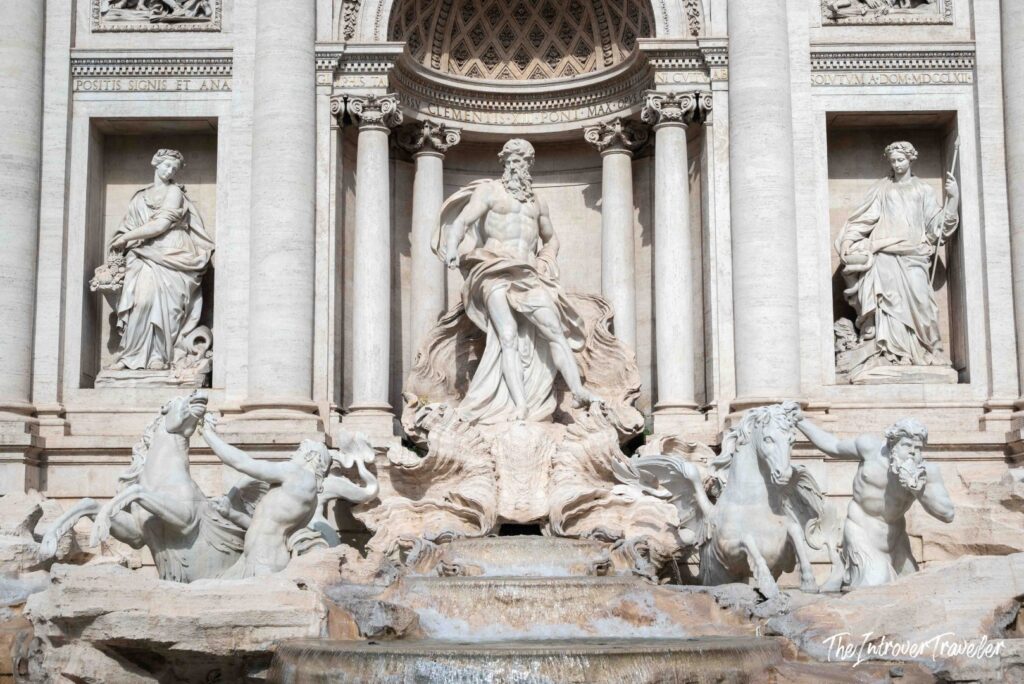
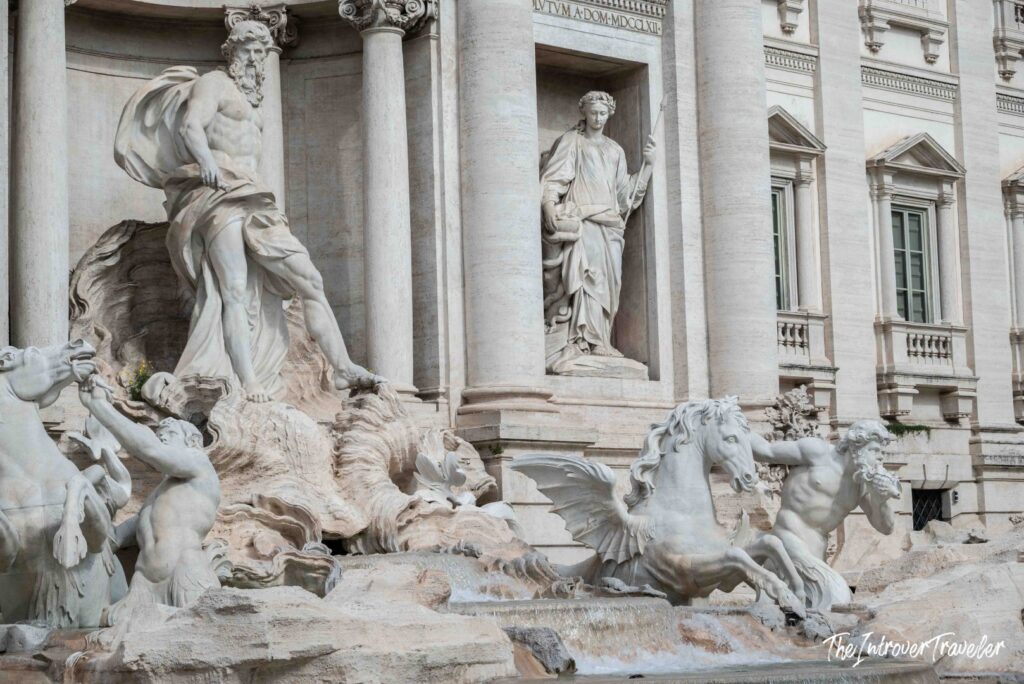
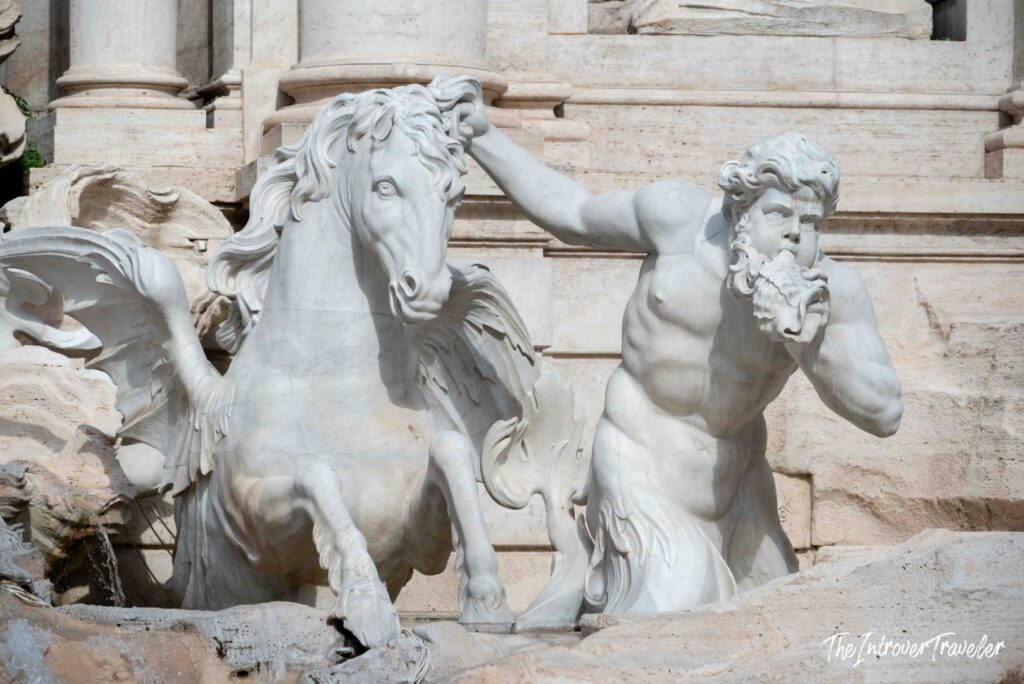
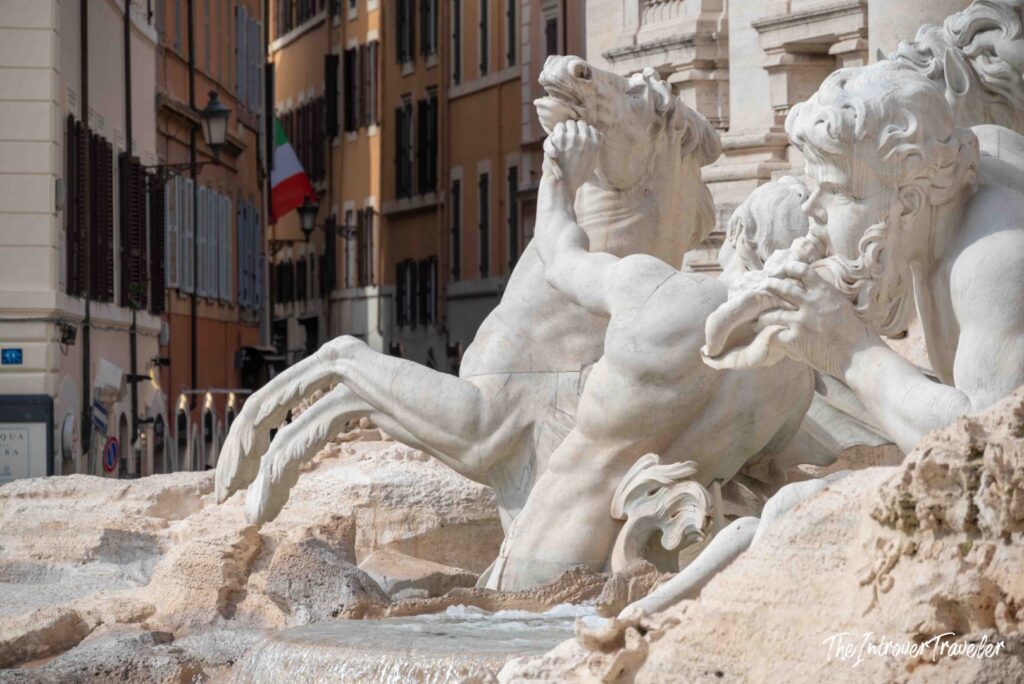
The chariot is pulled by two winged sea horses, each held by a triton. Look at them carefully, because they are the most intelligent idea in the whole sculptural programme: the horse on the left rears, wild, while the one on the right advances calm and steady, and the triton beside it blows into a conch. They are the two moods of the sea, the storm and the calm, and if you have ever spent time on a boat you will know that the sea switches from one to the other with exactly that lack of warning.
In the side niches stand two female figures, Abundance on the left, with her horn of plenty, and Health on the right, with the cup from which a snake drinks, both by the sculptor Filippo della Valle, a refined Florentine-trained artist working in Rome in those decades. Above them, two reliefs tell the story of the water: on the left Agrippa approving the plans of the aqueduct, on the right the young girl showing the soldiers where the springs are.
Then raise your eyes to the very top, which almost nobody does. On the attic, above the columns, stand four more allegorical statues, by four different sculptors of the day, devoted to what the water gives the land: the abundance of fruit, the fertility of the fields, the gifts of autumn, the pleasantness of the meadows. Above them all, the coat of arms of Clement XII, held up by two figures of Fame. Read from top to bottom, the fountain is an educational programme, almost a public information poster: this is where the water comes from, this is what it gives you, this is who to thank. The pope, obviously, is the one at the top.
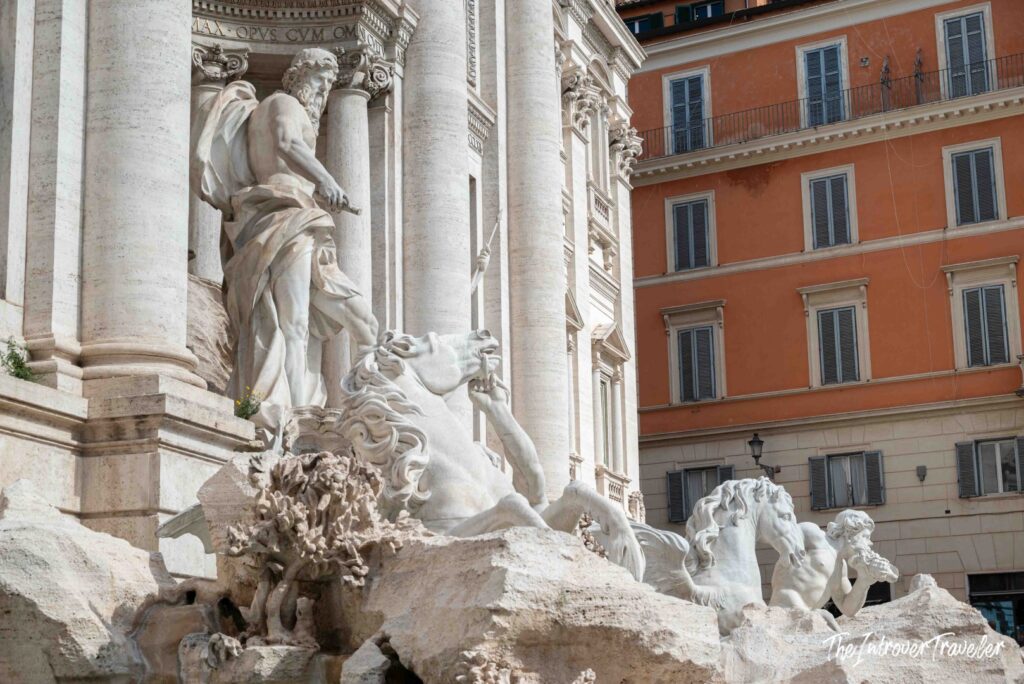
A small detail, visible in my photographs: real plants grow in the cracks of the carved reef, and on my visit a few yellow flowers had sprouted from the travertine right at Oceanus’s feet. The sculptors carved stone vegetation; nature, unprompted, added the real thing. It is the best possible commentary on a fountain built around the idea of nature breaking through architecture.
The honest part
Here comes the judgement that will earn me a few indignant emails. Taken one by one, the statues of the Trevi are good, not great. Oceanus has the right presence and the right scale, but he is a competent late-Baroque figure, a little theatrical and a little generic, the kind of muscular old god that the workshops of Rome could produce on request. Put him next to the river gods of Bernini’s Four Rivers Fountain in Piazza Navona and the difference is the difference between an actor playing a god and a god. Even the Encyclopaedia Britannica, not usually given to provocation, notes that he is less dramatic and less masterfully executed than Bernini’s sculpture. I agree, and I would go further: nobody has ever crossed a continent to look at Oceanus.
But nobody needs to. The Trevi is not a work of sculpture with an architectural frame. It is a work of architecture, water and space in which the sculptures are actors in costume, and you do not judge a theatre production by the quality of the costumes. As a total work, as a machine for astonishment, it is one of the greatest things the eighteenth century built anywhere in Europe. As a sculpture gallery, it is a decent one. The two judgements coexist, and the second does nothing to diminish the first.
The barber and the Ace of Cups
On the right-hand side of the fountain, on the balustrade, sits a large travertine vase, which Romans have nicknamed the Asso di Coppe, the Ace of Cups, after the playing card it resembles.
The story attached to it, which I report as an anecdote and nothing more, is that a barber with a shop on that side of the square spent years loudly criticising Salvi’s work while it was under construction, and that the architect, exasperated, placed the vase exactly in front of the shop to block his view of the fountain for ever. There is no documentary proof that I know of, and the vase has perfectly good compositional reasons to be there. But it is a story so Roman, a professional dispute settled by a block of travertine and a grudge, that I would not want it to be false.
The coin, and the most efficient charity in Rome
The rule, as mentioned, is right hand, left shoulder, back to the fountain. One coin guarantees you will return to Rome; tradition, endlessly embroidered since, adds that two bring love and three a wedding. The ritual is old, but its global fame comes from cinema, in particular the 1954 Hollywood film Three Coins in the Fountain, which turned a local custom into an international obligation.
The result, in 2023, was €1.6 million, well over four thousand euros a day, and the figure keeps rising. Since the early 2000s the money has gone to Caritas, the Catholic charity of the diocese of Rome, which uses it for soup kitchens, solidarity supermarkets and families in difficulty, and spends only a small fraction of it on the cost of sorting and counting coins from every country in the world. Periodically the city has toyed with the idea of keeping the money for itself; each time, after a public outcry, it has backed down.
Let us appreciate the beauty of the system. A superstition with a vaguely pagan flavour, involving offerings to a water deity (Oceanus, or Neptune, depending on whom you ask), finances one of the most important Catholic charities in the city. As I wrote about the Vatican, the Church never throws anything away. Here it does not even need to bend down: the municipal water company sweeps the coins up and delivers them. And Rome has finally found the only tax that tourists pay happily and in cash: one they believe is magic.
The coins have also had their unofficial collectors. For years, until his death in 2013, a local character nicknamed D’Artagnan used to wade into the fountain at dawn and help himself, going so far as to stage a protest in which he described coin-collecting as his profession. Taking the coins is a crime. Swimming in the fountain is also forbidden, and the fines are not symbolic: in 2016 two young American tourists paid €450 each for imitating Anita Ekberg.
Fellini, a black drape and black water
Which brings us to the other reason the Trevi is famous: Federico Fellini’s La Dolce Vita (1960), and Anita Ekberg wading into the basin in a black evening dress, calling Marcello Mastroianni to join her.
Watch it again, and forget for a moment that it has been parodied, quoted and reduced to a postcard. Fellini’s black and white is not an absence of colour: it is moonlight turned into a material, the travertine glowing like silver, the water falling like liquid mercury, the night of Rome as nobody had ever filmed it and nobody has filmed it since. Ekberg, the Swedish star, overflowing with a sensuality so excessive that it becomes innocent, stands under the cascade as if the fountain had been built for her and had waited two hundred years for her to arrive. And Mastroianni walks in after her, fully dressed, with that bewildered, spellbound face of his, looking at her as one looks at a porcelain doll, too precious to touch: he raises his hands towards her face and stops them in mid-air, a few centimetres away, and in that suspended gesture there is all the longing and all the paralysis of a generation. Then the water stops, as if someone had turned off the dream, and the dawn finds them standing there, soaked and silent. It is one of the most famous scenes in the history of cinema, and with it Fellini did something no pope, no architect and no sculptor had managed: he made the fountain immortal, weightless, a place you visit in your sleep before you visit it awake. Every tourist who dips a hand in the water, despite the signs, is quoting him without knowing it.
When Mastroianni died in December 1996, Rome paid tribute to him in the most eloquent way available: the Trevi was switched off and draped in black. A city that silences its most famous fountain for an actor has its priorities in an order I find entirely admirable.
The fountain went black again in May 2023, for a different reason: climate activists poured diluted vegetable charcoal into the water as a protest. Two black fountains in thirty years, one for grief and one for anger. The Trevi has become a screen on which Rome projects whatever it needs to say to the world, because it knows the world is always watching.
Marcello!! Come here!
A gesture of love, with a logo
By the early 2010s the Trevi was in poor condition: after a harsh winter, fragments of the decoration had started to come away from the façade. The restoration, completed in November 2015, cost €2.18 million and was paid for entirely by the Roman fashion house Fendi, which presented it as a gesture of love towards the city. In exchange, the company obtained the right to place a plaque with its name near the fountain for four years. The following summer, for its ninetieth anniversary, Fendi held a fashion show on a transparent catwalk laid over the basin, so that the models appeared to walk on water.
I have no moral objection to private money saving public monuments, in a country that spends on its heritage roughly what it spends on traffic cones. But it is worth noting the progression: in the eighteenth century the Trevi was paid for by a pope and a lottery, in the twenty-first by a luxury brand and a plaque. The patrons change; the logic of the deal does not. Clement XII also wanted his name on it, in bigger letters. In any case: thank you, Fendi.
The €2 ticket, and why the crowd is part of the show
Since 2 February 2026, tourists and non-residents pay €2 to walk down the steps into the area right around the basin. The square above remains free at every hour. Residents of Rome, children under six, people with disabilities and their companions do not pay. The city expects around €6.5 million a year, to be spent on maintenance and crowd management.
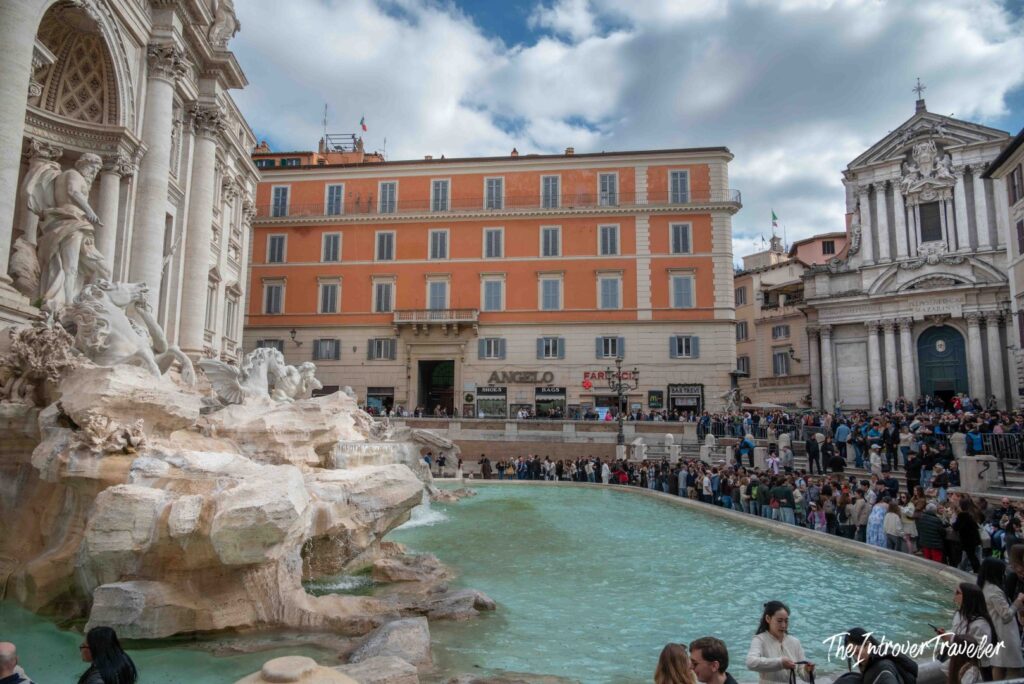
Let us be clear about what the ticket does and does not do. Two euros will not deter a single person who has flown across the world to throw a coin into this fountain. It is not a barrier: it is a turnstile. It turns a chaotic crush into an orderly queue, keeps people off the edge of the basin, pays for stewards and cleaning, and in that sense it works. What it does not do, and cannot do, is empty the square. At midday, with or without a ticket, you will see the Trevi exactly as you see it in my first photograph: as the backdrop to a sea of heads and raised phones.
And here I have to confess something unexpected. I went prepared to sneer at the crowd, and I could not quite manage it. Yes, it is a mob of people taking selfies with their backs to a masterpiece. But there is something almost touching in that collective, slightly idiotic enthusiasm: it is the most tangible demonstration of the love that the whole world, without exception, feels for Rome. Thirty thousand people a day, from every continent, all trying to do the same small, absurd thing: make sure they come back. No other city on earth can stage a spectacle like this, and the crowd is part of it.
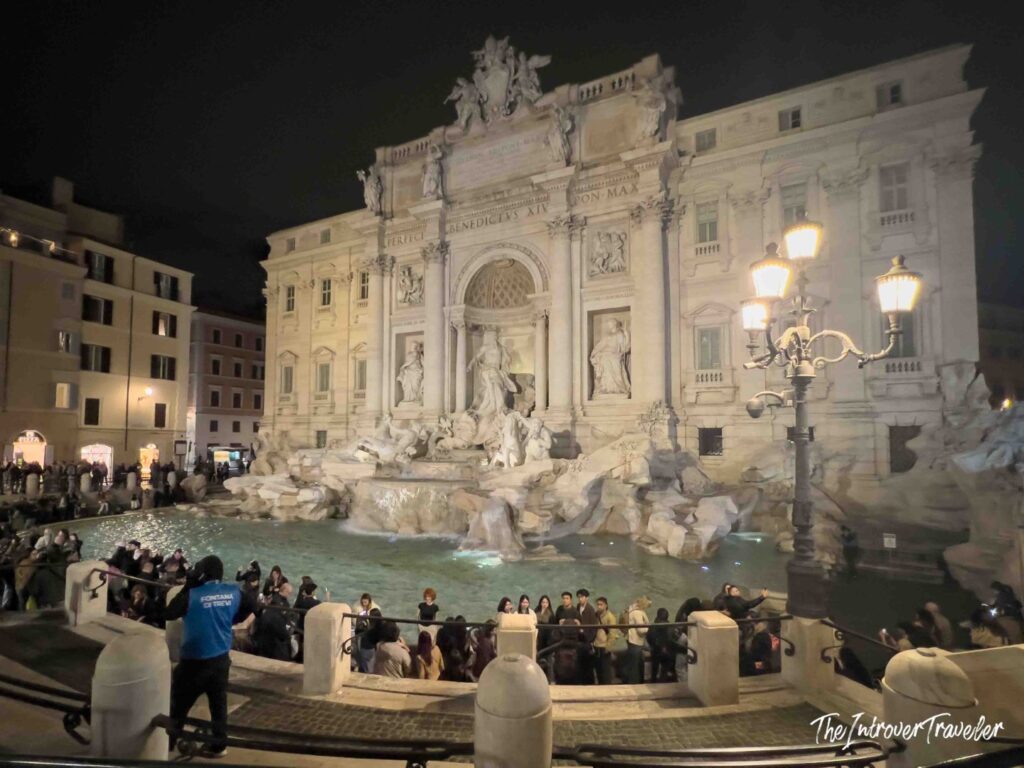
So my advice is not to avoid the crowd, but to see the fountain twice. Once in the middle of the day, in the crush, in its role as a global pop icon, the most famous backdrop on the planet. And once in the hours when it is almost empty, at dawn, when the light falls on the travertine from the side and the noise of the water fills the whole square, or late at night, when the lighting turns the reef into a cave: that is when you see it as Salvi conceived it. The two visits do not cancel each other out. They are the two halves of the same monument.
Practical information
- Hours of the ticketed area (October 2026): Monday and Friday 11:30 to 22:00, the other days 9:00 to 22:00. Last entry at 21:00 every day.
- Variations: on some Mondays entry starts at 14:00, to allow the coins to be collected and the fountain to be cleaned, and opening times can change for maintenance or public order. These details change often: always check the official website, fontanaditrevi.roma.it, before you go.
- After closing time: the fountain remains visible free of charge from the square.
- Tickets: online on the official website, at the civic museums and tourist infopoints, or at the entrance in Via della Stamperia, where only cards are accepted. The exit is on Via dei Crociferi.
- Rules: no eating, drinking, smoking or sitting on the edge of the basin. Bathing costs €450, and so does dipping a bottle in the water.
Look sideways
Once you have finished with Oceanus, turn around.
Opposite the fountain, on the right as you face it, stands the church of Santi Vincenzo e Anastasio, with a theatrical façade crowded with columns that would be famous anywhere else and is ignored here. It holds a macabre record: for centuries it was the parish of the popes who lived in the nearby Quirinal Palace, and it preserves in urns the internal organs of a long line of them, removed during embalming. Ten million people a year photograph a fountain dedicated to water and health, with their backs to a church full of papal viscera. Rome has a sense of humour that no writer would dare to invent.
A few minutes away, in Via del Nazareno, you can see one of the few stretches of the Aqua Virgo still visible above ground: massive arches of grey stone, half buried, ignored by everyone. It is the same water you have just seen falling over the reef, two thousand years earlier. And if you have time and patience, Rome’s art is all around: Palazzo Barberini, the Pantheon and the Borghese Gallery are all within reach on foot.
Verdict: a masterpiece of urban theatre, at any hour
The Trevi Fountain deserves its fame, and this is the first thing to say, because cynicism about famous places is as lazy as enthusiasm. It is a brilliant idea, brilliantly executed: a palace turned into a stage, a square turned into an auditorium, an ancient aqueduct turned into a show that has been running without interruption since 1762. Its sculptures are not on the level of Bernini’s, and they do not need to be. As a piece of urban scenery it has no rivals, in Rome or anywhere else.
That is why the rating is 9, and it stays 9 at any hour of the day. At dawn, nearly empty, it is the fountain Salvi designed. At midday, buried under a crowd of selfie-takers, it is something he could never have imagined and would probably have enjoyed: proof that a monument built to celebrate the water of Rome has ended up celebrating Rome itself, in the hearts of people who may never set foot in a museum.
So go, and go twice. Look at the reef before you look at the gods, raise your eyes to the attic, read the three papal signatures, check that Oceanus has no trident. Then, if you like, turn your back and throw the coin. You will be helping a soup kitchen, which is more than most rituals can claim.
Frequently asked questions
Do you have to pay to see the Trevi Fountain?
No, not to see it. The square is free at any hour. Since 2 February 2026 non-residents pay €2 only to walk down to the area around the basin. Residents of Rome, children under six, people with disabilities and their companions are exempt.
What are the opening hours of the ticketed area?
As of October 2026: Monday and Friday 11:30 to 22:00, the other days 9:00 to 22:00, last entry at 21:00. Hours can vary for maintenance, coin collection or public order: check fontanaditrevi.roma.it before you go.
Can you go down to the basin after 10 p.m.?
Do not count on it. After closing time the official website only says that the fountain remains visible free of charge, which means from the square.
Where do you buy the ticket?
On the official website, at tourist infopoints and civic museums, or at the entrance in Via della Stamperia, by card only.
What is the best time to visit?
Both the worst and the best. Go once in the middle of the day, to see the fountain as the pop icon it has become, and once early in the morning or late in the evening, when it is almost empty and you can see it as it was designed.
Who is the statue in the middle?
Most sources identify him as Oceanus, the Titan who personified the great river surrounding the world; some call him Neptune. He was designed by Giovanni Battista Maini and carved in marble by Pietro Bracci. The absence of a trident argues for Oceanus.
Who designed the Trevi Fountain?
The architect Nicola Salvi, who won the papal competition in 1732. He died in 1751 and the fountain was completed by Giuseppe Pannini and inaugurated in 1762. The central group was designed by Maini and carved by Bracci.
What happens to the coins?
They are collected regularly and donated to Caritas of Rome, which uses them for its charitable projects: €1.6 million in 2023.
How do you throw the coin?
With your back to the fountain, right hand, over your left shoulder. One coin, according to tradition, guarantees your return to Rome.
Can you drink the water?
Not from the main basin, and you must not sit on the edge, eat or put your feet in. There is a small drinking fountain on the right side of the basin, a few steps down, linked by tradition to lovers.
Can you swim in the Trevi Fountain, like in La Dolce Vita?
No. It is forbidden, and the fine is €450.
How long does a visit take?
Ten minutes for the coin and the photo. Forty minutes if you want to read the fountain properly, look at the details and walk around the square.
How can I find all of Bernini’s works in Rome?
The Trevi is one of the few places in Rome where Bernini started and did not finish. To see where his finished works actually are, continue on ArtAtlas: https://artatlas.it/artists/bernini/bernini-in-rome
How can I plan an art itinerary in Rome?
With Flâneur, the art itinerary engine of The Introvert Traveler. You tell it how many days you have and what kind of traveller you are, from curious beginner to seasoned art lover, and it builds a day-by-day route through the city’s museums, churches and masterpieces, with real opening hours and a curated choice of restaurants along the way.
Related posts:
 The Borghese Gallery: a complete guide. What to see, what can fairly be criticised, and why the building is worth as much as the art
 Bernini and the Barberinis: Art, Power, and Invention in the Baroque. Review of the exhibition at Palazzo Barberini.
 Apollo and Daphne by Gian Lorenzo Bernini (Borghese Gallery, Rome): marble on the verge of the impossible