If you love art, or travel for culture, and you visit cities like Florence, Rome, New York, Paris or London, planning the trip can turn into a demanding job: hours, sometimes days of work, with the risk of losing along the way many of the places you care about, perhaps walking past them a few metres away without ever knowing. In Italian art cities, even the smaller ones like Mantua, Padua, Ferrara or Siena, the problem grows out of all proportion, because virtually every church and palazzo holds works that deserve attention.
Flâneur is the itinerary generator of this blog.
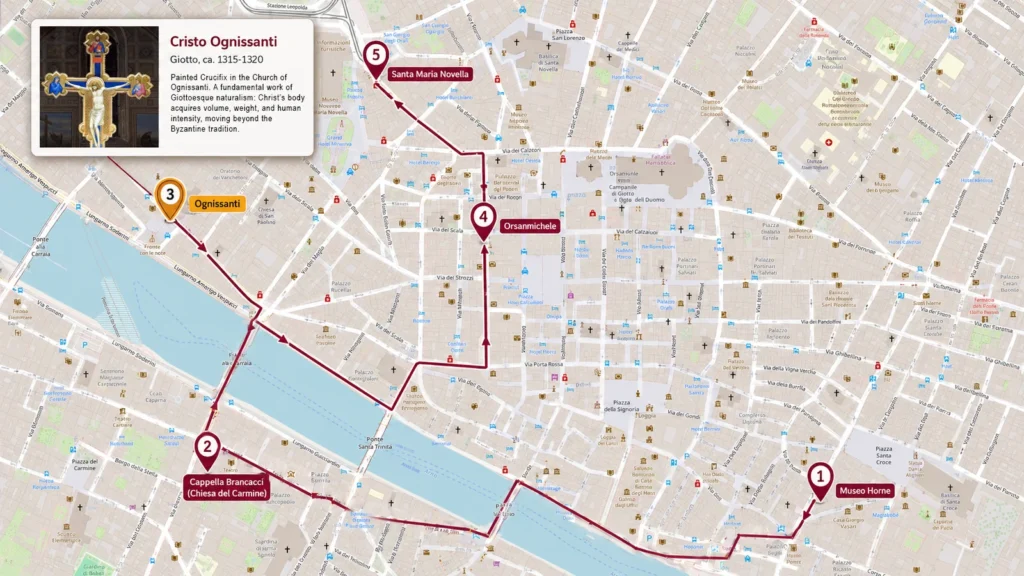
For years I travelled to art cities with the same routine: weeks of reading, a list of works I absolutely had to see, a notebook full of opening hours. And for years I came home to discover that the thing I had wanted to see most was hanging two streets from my hotel, or that I had turned up at the museum on the one morning it stayed shut. The information always existed. What did not exist was something that put together what I cared about, where I was in the city and when that particular door was open.
So I built it. Flaneur saves you those days of planning for the price of a pizza and a beer.
What it does
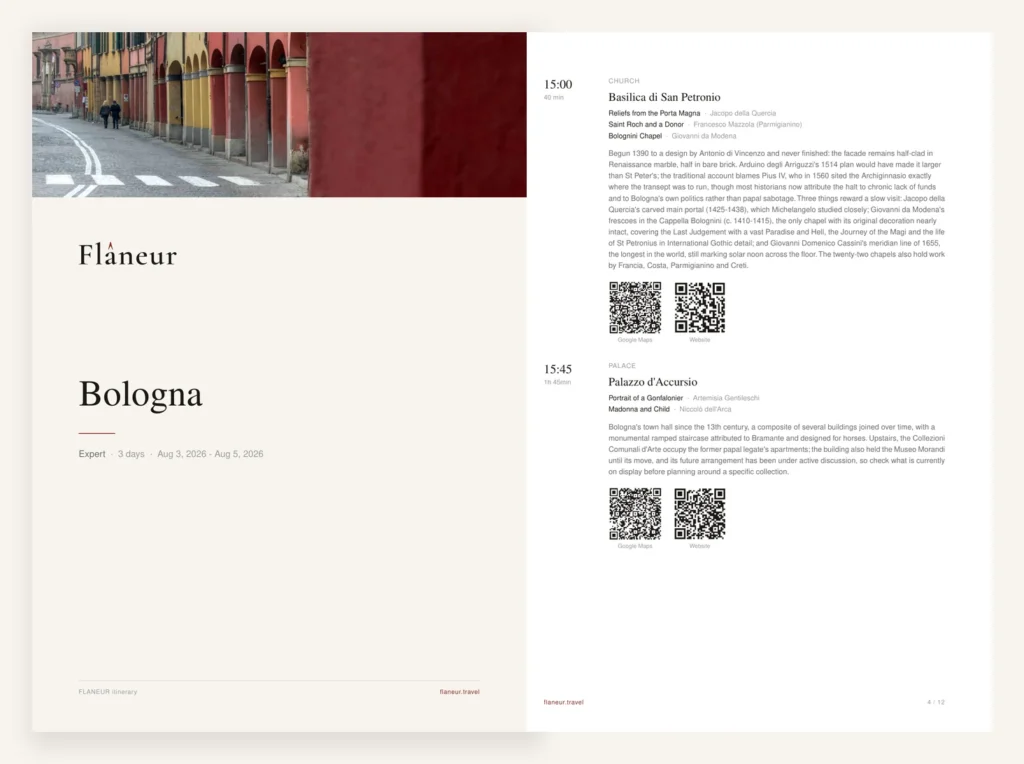
You choose a city, your dates and how deep you want to go. Flâneur gives you back a day-by-day, hour-by-hour itinerary: the works you will actually stand in front of, in an order that makes geographical sense, timed against opening hours checked for your exact dates, including the museums, monuments, and works of art you didn’t even know you wanted to see. Monday closures and seasonal exceptions are dealt with before you leave, not at the door. Where a ticket must be booked, the link is there. Where you will be hungry, there is a restaurant.
It is a web app, so there is nothing to download. You pay once per itinerary, however many days it covers, and you receive it in English. Five minutes of questions; the rest of the trip is yours.
Where the knowledge comes from
Flâneur runs on ArtAtlas, the map of more than 25,000 geolocated artworks you can browse on this site, each one classified by period, discipline and importance. Nobody scraped it from travel forums: I built it, city by city, over years of visits and reading.
The restaurants come from the same place as the reviews on this blog. Some I have eaten in and written about, with the usual lack of diplomacy. The rest were chosen after cross-checked research and with a single non-negotiable rule: no tourist traps.
Why not just ask ChatGPT?
You can, and for a city you do not much care about it will do. But a language model has read about Florence; it has never been there. It averages what millions of people have written, sends you with great confidence to the masterpieces everybody already knows, and when it does not know something it invents it, fluently. It will never suggest a minor panel by Francesco Francia, because statistically it does not matter. If you happen to love Francesco Francia and write a specific prompt, a language model might even put together an itinerary just for you. But the approach has two problems: first, you need to know which artist to ask about, and there are potentially hundreds of them; second, the risk of hallucination remains.
In Flâneur nothing is conjured out of thin air. Every venue, every opening hour and every work comes from the database, and you are the one choosing from it, the way you choose from a menu.
In any case, the experience is of a different kind altogether. With a language model you passively accept its choices. Flâneur is a vertical, specialist tool: it shows you at a glance all the art available in the city and lets you build the itinerary around what you need.
Restaurants are another story entirely. On TripAdvisor or Google even the most mediocre places sit at 4.5 out of 5. An AI is conditioned by that background noise and will recommend a dreadful restaurant with exactly the same confidence as an excellent one. The restaurants in Flâneur are chosen carefully, one by one.
When you book a flight you can choose Economy or Business: different prices, different quality, and each has its own market. You can plan a cultural trip for free with an AI or, if you are more demanding, choose Flâneur.
Three appetites
At the start you pick a profile. The Curious answers three questions and lets the engine choose the essentials, with days paced for a long lunch and an idle hour in a piazza. The Enthusiast browses the artists active in the city and pins the ones that matter. The Expert filters by period and discipline, goes through the whole catalogue work by work, and gets days built to spend as much time as possible inside museums and as little as possible between them. Same engine, different hunger.
Where it works
Florence, Rome, Venice, Naples, Bologna, Milan, Siena, Lucca, Paris, London and Madrid. Mantua, Padua, Ferrara, Amsterdam, Vienna and New York are next, and will arrive soon. Others will follow, slowly: each city takes the same work as the first, and I would rather cover a few properly than fifty badly.
What it costs
The price depends on two things: the city and how deep you want to go. A city is priced on the density of its art, which is another way of saying on the amount of work it took to map it. Florence, Rome and Venice, where you could spend a lifetime and still miss a chapel, cost more than Lucca or Siena. The profile does the rest: the Expert gets the whole catalogue and a day built work by work, and pays accordingly.
| City | Curious | Enthusiast | Expert |
|---|---|---|---|
| Florence | €10 | €20 | €30 |
| Rome | €10 | €20 | €30 |
| Venice | €10 | €20 | €30 |
| Paris | €5 | €10 | €25 |
| London | €5 | €10 | €25 |
| Madrid | €5 | €10 | €25 |
| Milan | €5 | €10 | €20 |
| Naples | €5 | €10 | €20 |
| Bologna | €5 | €10 | €15 |
| Lucca | €5 | €7.50 | €10 |
| Siena | €5 | €7.50 | €10 |
Prices include VAT. You pay once, by card, and a single payment covers the whole itinerary, however many days your trip lasts. You see the price before you pay, never after.
Is it worth it? It depends on the trip. If you are spending a few thousand euros on flights, hotels and museum passes to stand in front of paintings, the itinerary is not the place to economise. If you are not, the free version from your favourite chatbot will do just fine, and I mean that.
Sample
You can download below a 3 day art itinerary for Bologna made with Flaneur.