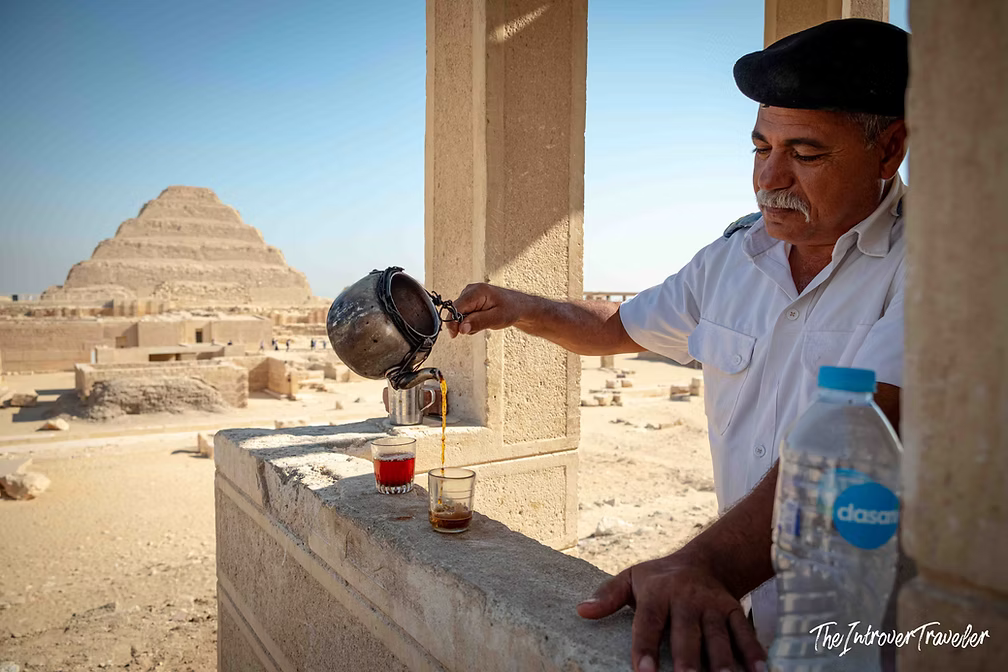
Date of visit: August 2025
Date of construction: c. 2650 BC, approximately two millennia before the foundation of Rome
Height: 62 meters (originally; currently approximately 60 meters due to erosion)
Base dimensions: 125 x 109 meters
Volume: approximately 330,000 cubic meters
Construction time: estimated 19 years, during the reign of Djoser
My rating: 7/10
Visit duration: 5 hours (included round trip from Cairo, visit to the Necropolis, Djoser pyramid, Red pyramid, Memphis museum)
If your interest in Egypt goes beyond the checklist, beyond the obligatory photo in front of Khufu’s pyramid and the equally obligatory visit to the Egyptian Museum, then Saqqara is not an optional detour: it is, in many ways, the place where the story of the pyramids actually begins. Giza is the destination that everyone knows; Saqqara is the premise without which Giza is only half comprehensible. And yet it receives a fraction of the visitors, appears in a fraction of the itineraries, and occupies a fraction of the space in the average tourist’s imagination. This post is, among other things, an attempt to correct that imbalance.
I. The first stone in history: Djoser and the step toward the sky
To understand the pyramids of Giza, one must make a radical conceptual adjustment, the kind the post on Giza itself already suggested: those three colossal polyhedrons on the plateau, for all their four and a half millennia of age, are not primitive objects. They are the sophisticated product of a long process of technical and ideological refinement, the last act of a story that had already been unfolding for a century when Khufu ordered the first block of his pyramid to be laid. That story begins at Saqqara.
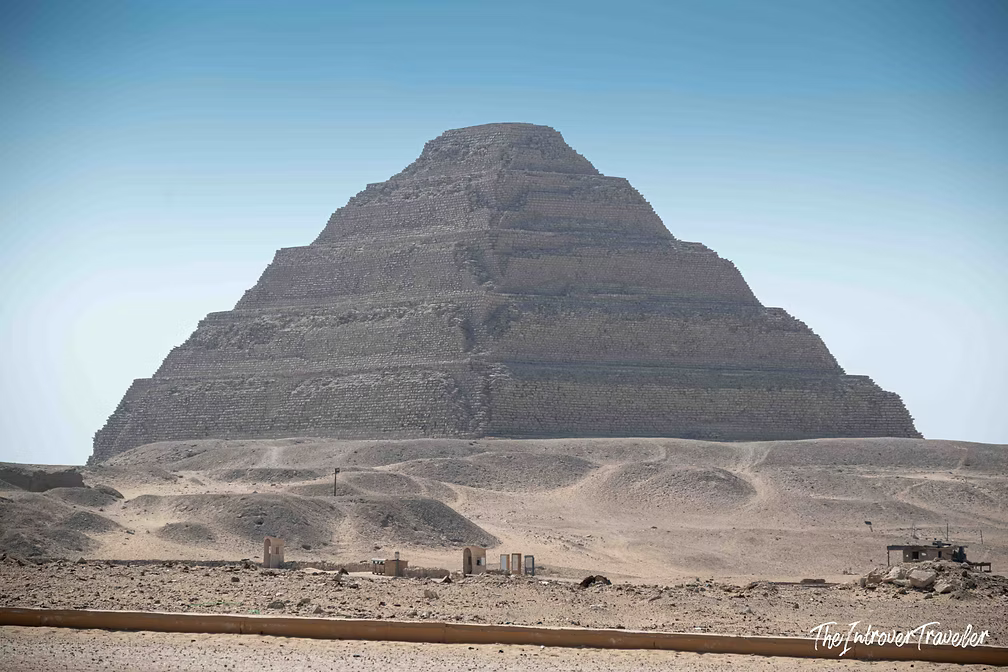
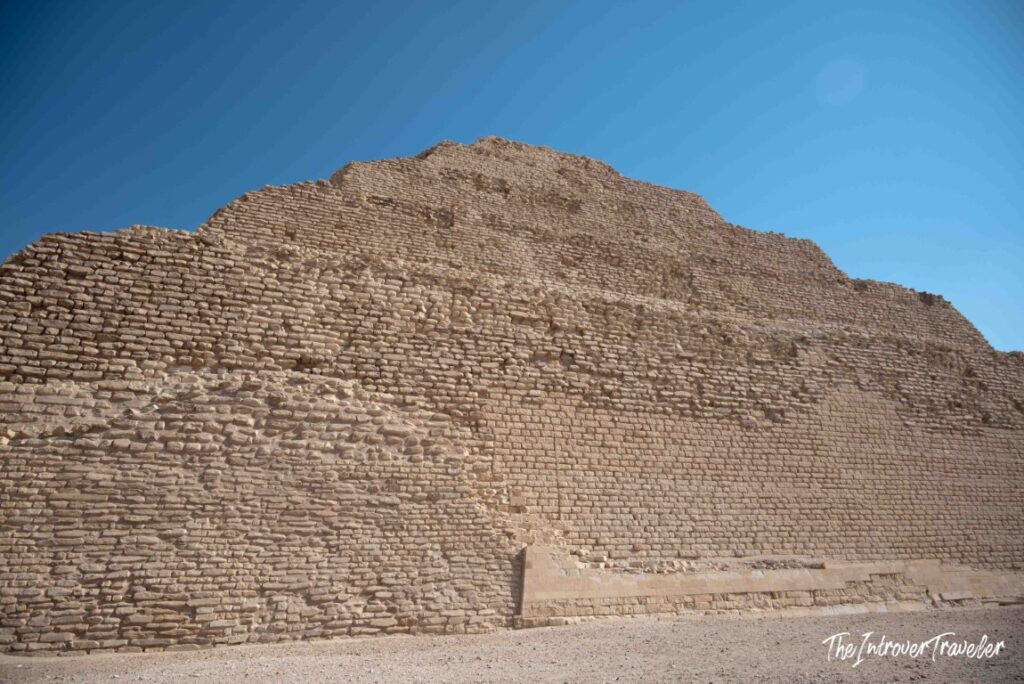
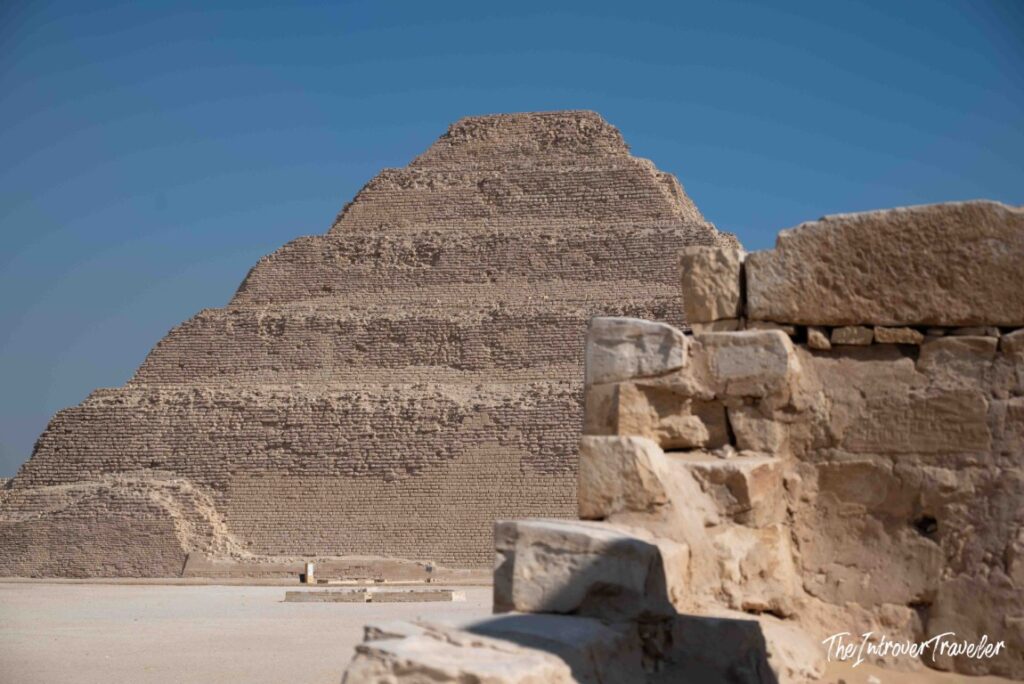
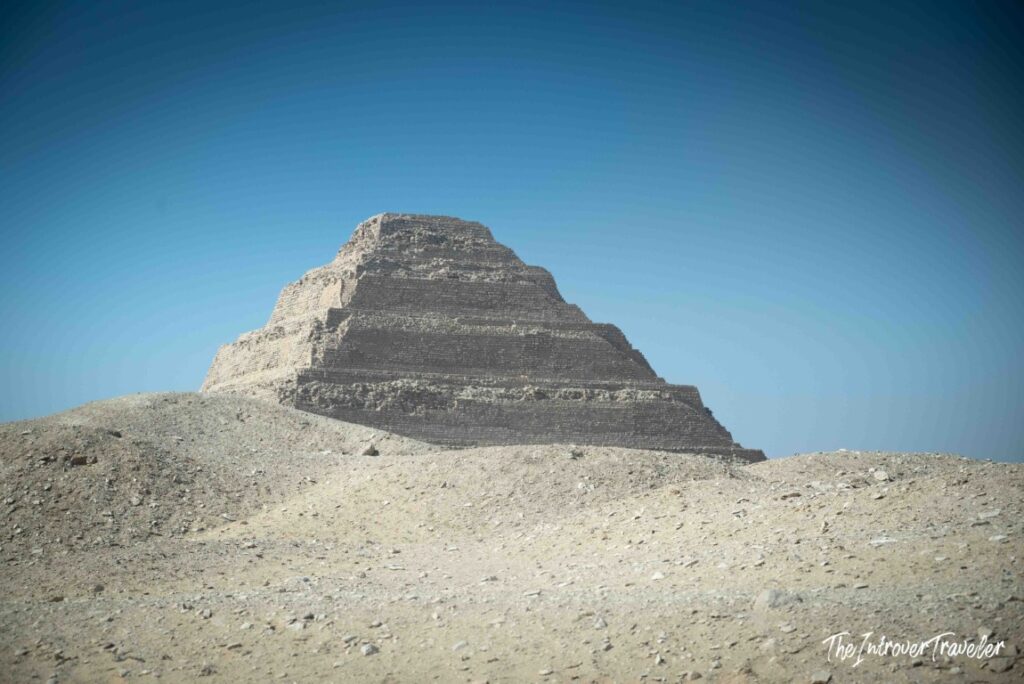
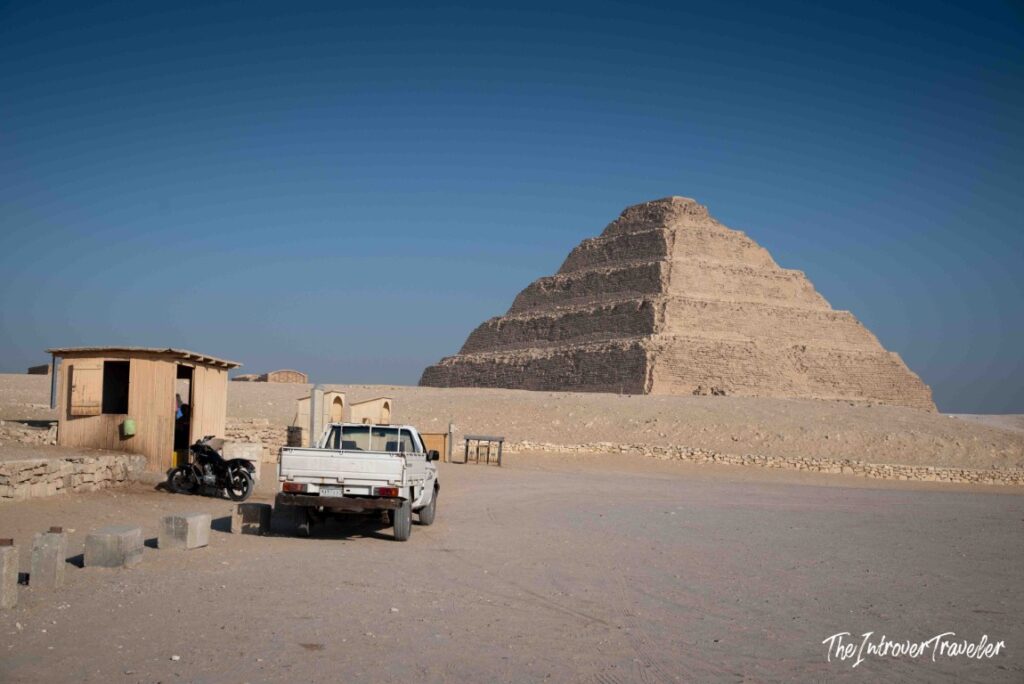
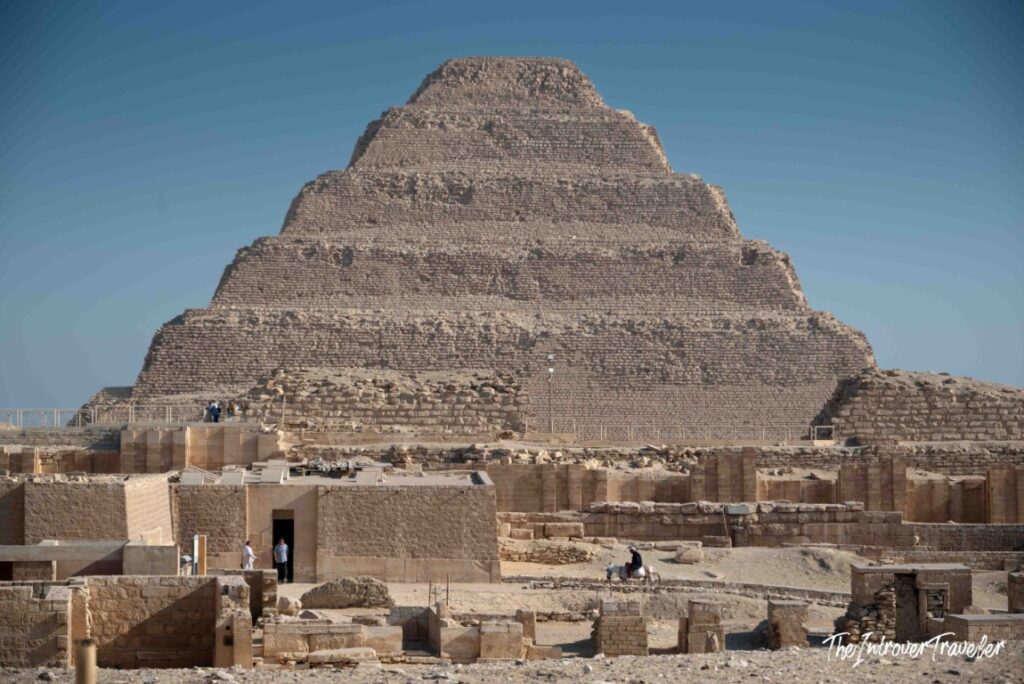
Around 2650 BC, the pharaoh Djoser, second ruler of the Third Dynasty, commissioned from his architect Imhotep a funerary complex that would be without precedent in human history. Not because of its size, which is considerable but not exceptional by the standards of what came after, but because of a single, decisive detail: for the first time, a monumental structure was built entirely in stone. Before Djoser, the great tombs of the pharaohs and the Egyptian elite were mastabas, flat rectangular structures in mudbrick, solid and austere, reminiscent of overturned bunkers. Imhotep started from a mastaba and, step by step, literally, placed one on top of another, until the structure reached six stepped terraces and a height of 62 meters. The Step Pyramid of Djoser was born: the first large stone building in the history of humanity.
It is worth pausing here, because what Imhotep did was not simply an act of engineering. It was a conceptual leap. To build in stone means to think in centuries, in millennia; it means accepting that the present moment can be fixed in a permanence that surpasses any individual human life, any dynasty, any civilization. The mastaba in mud brick is a provisional statement. The stone pyramid is a declaration of eternity. And this is precisely what Egyptian civilization was: a civilization structured around the idea that death was not an end but a transition, and that architecture was the instrument through which that transition could be guaranteed and celebrated. Imhotep understood all of this, and translated it into stone.
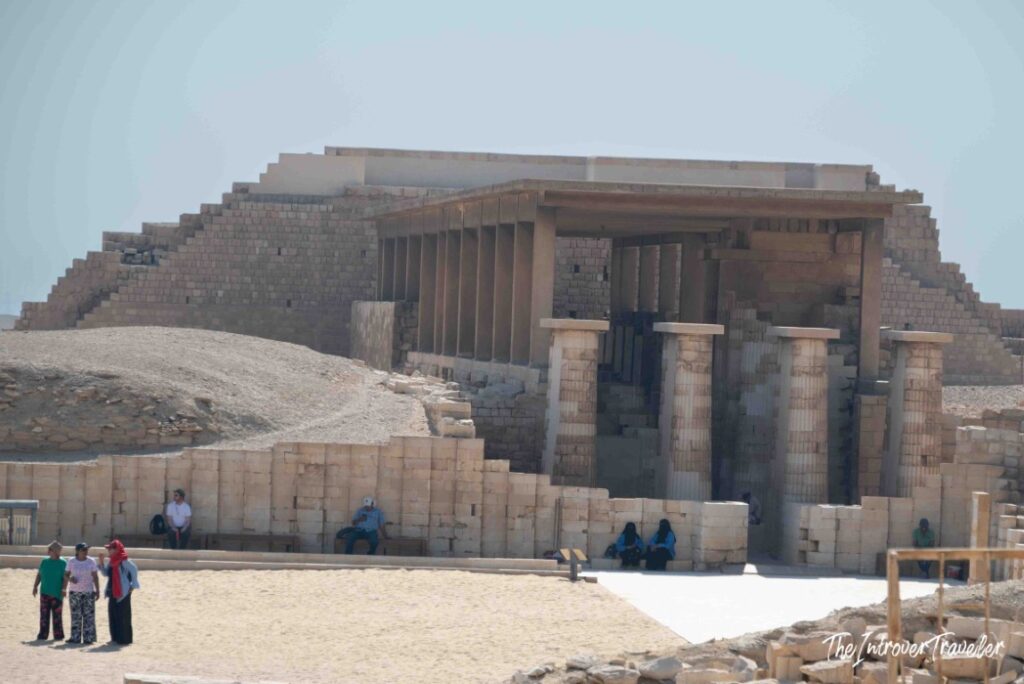
The complex surrounding the Step Pyramid is remarkable in its own right: a vast enclosure wall of white Tura limestone, originally about 1,645 meters long, enclosed a network of dummy buildings, ceremonial courtyards, and subsidiary structures that served the pharaoh’s afterlife cult. Most of these buildings had no interiors, or only minimal interiors: they were architectural representations of the ceremonies of state, frozen in stone for eternity, so that the dead king could continue to perform them. The concept is almost hallucinatory in its abstraction: an entire symbolic city, built not for the living but for a dead man’s ritual life.
II. From the step to the smooth face: the long road to Giza
Djoser’s pyramid was a revolutionary achievement, but it was still a step pyramid. The idea of the true pyramid, with smooth inclined sides converging toward an apex, required another generation, another pharaoh, and a series of engineering failures that are almost endearing in their honesty, failures that tell us more about Egyptian civilization than any triumphant inscription ever could.
The transition from step pyramid to smooth pyramid occurs at Dahshur, a necropolis about 10 kilometers south of Saqqara, during the reign of Sneferu, founder of the Fourth Dynasty and father of Khufu. Sneferu is, from a purely architectural standpoint, one of the most interesting figures in Egyptian history: under his reign, at least three pyramids were built, and each one records the learning curve of an entire civilization trying to master a form it had never achieved before.
The first attempt is the pyramid known today as the Meidum pyramid, originally built as a step pyramid and later modified to give it smooth sides, possibly under Sneferu himself. At some point, probably not during Sneferu’s lifetime, the outer casing collapsed catastrophically, leaving the bizarre structure visible today: a tower of naked masonry rising from an enormous pile of its own debris. The reasons for the collapse are still debated, but the lesson was clear: building a smooth-sided pyramid is not simply a matter of adding an external casing. The internal structure, the angle of inclination, the distribution of forces, all of this must be correctly understood from the outset, or the whole thing falls.
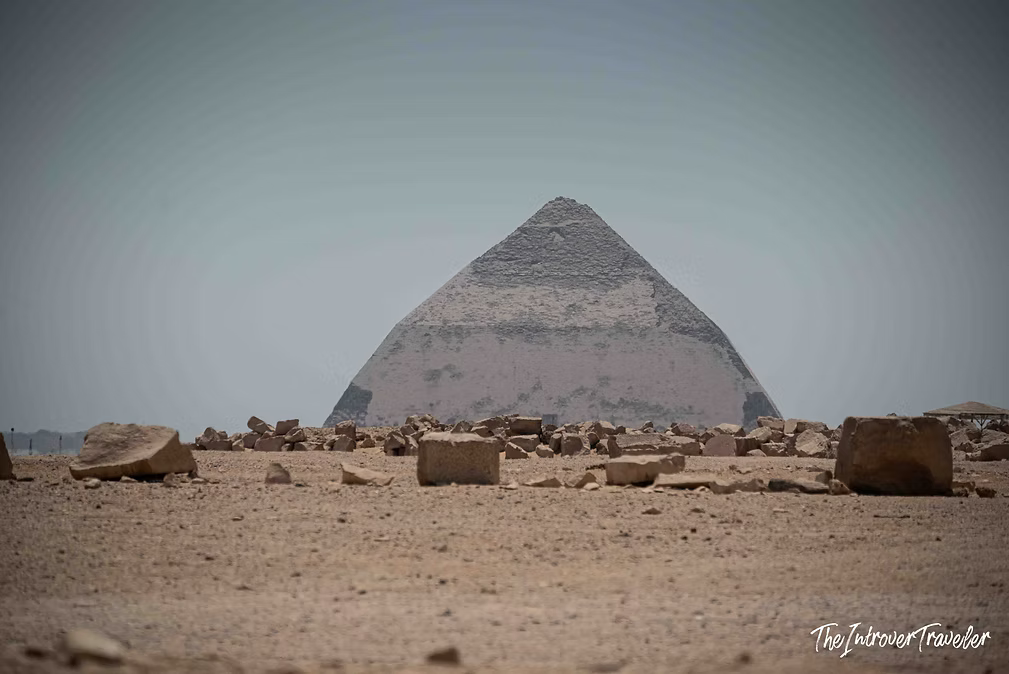
The second attempt is the Bent Pyramid, and it is an extraordinary document of a problem discovered in real time. As already recounted in detail in the Giza post, the pyramid was started at an angle of 54 degrees; partway through construction, cracks began to appear in the casing and in the inner corridors, a sign that the substrate could not support the load at that inclination. The engineers, in what must have been a moment of considerable panic, reduced the angle to 43 degrees for the upper portion, resulting in the characteristic bent profile that gives the pyramid its name. The Bent Pyramid is visually unique, and for this very reason fascinating: it is a monument to the gap between intention and capability, a record of a problem and its desperate solution written in stone, two hundred meters wide and 100 meters tall, visible from a great distance. One could say it is the only pyramid in Egypt that shows its own construction difficulties on its face.
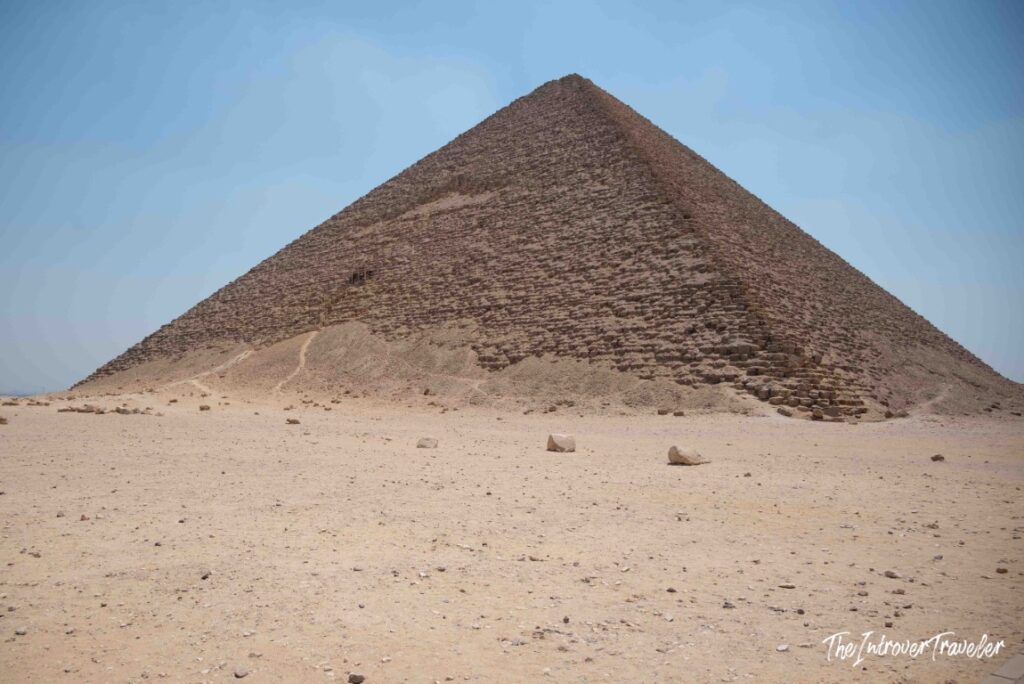
The third attempt is the Red Pyramid, also at Dahshur, started at an angle of 43 degrees from the outset, having learned the lesson of the Bent Pyramid, and completed successfully. The Red Pyramid is considered the first true smooth-sided pyramid ever brought to completion in Egypt. It is enormous, the third largest pyramid ever built, and it represents the moment in which Egyptian engineering finally had the pyramid problem under control.
All of this is to say that the majesty of Giza is not the origin of anything: it is a destination. The pyramids of Giza are the final result of a process of trial, failure, correction, and refinement that lasted more than a century, a process in which dozens of architects and thousands of workers developed, step by step, the knowledge needed to raise those perfect forms. To visit Giza without Saqqara in mind is like admiring a Stradivarius without knowing what a violin was before Stradivari. The instrument has the same name. But it is not the same thing.
III. Why building a pyramid was not simply stacking stones
The post on the pyramids of Giza discussed at some length the construction problems faced at Dahshur, drawing on the vivid account in Toby Wilkinson’s The Rise and Fall of Ancient Egypt. It is worth deepening the subject here, because Saqqara, as the origin of the whole tradition, is precisely the right place to reflect on the nature of these difficulties.
The first problem is geological. A pyramid is an object of extraordinary mass concentrated over a limited surface area. The Great Pyramid of Khufu weighs an estimated 5.9 million tonnes. That weight must rest on a substrate that is capable of bearing it indefinitely, not just for a year or a decade, but for millennia. The Egyptians did not have modern geotechnical surveys at their disposal. They had to learn by looking, by probing the rock, by observing where previous structures had subsided or cracked. The choice of the Giza plateau as the site for the Fourth Dynasty pyramids was not random: the plateau is composed of a solid layer of limestone that begins just below the surface. It is, geologically speaking, one of the most suitable locations in the entire Nile valley for a structure of that weight. This is not a coincidence. It is the result of accumulated knowledge, learned in part by building on the wrong substrates, like at Dahshur, and observing what happened.
The second problem is structural. A pyramid, counterintuitively, cannot be built simply by piling up stones in any arrangement. The forces at play inside a massive stone structure are complex: compression, shear, tension in the foundations, differential settling of the substrate. The angle of inclination is crucial: too steep, and the pyramid risks collapsing inward under its own weight; too shallow, and the structure is stable but requires an enormous quantity of material for relatively little height. The specific inclination of approximately 51 degrees adopted at Giza is not a choice that fell from the sky. It is a value that was reached through experience, through the experiments at Meidum and Dahshur, and which represents a balance between structural efficiency and symbolic height, while also embodying, as discussed in the Giza post, that striking proportional relationship with the number π.
The third problem concerns the internal chambers and corridors. A pyramid is not a solid object: inside it there are rooms, ventilation shafts, access passages, galleries. Designing and building these interior spaces within an ever-growing mass of stone requires extraordinary engineering foresight, because many of these elements must be constructed before the superimposed layers reach them, and any structural error discovered at an advanced stage of work is, for all practical purposes, irreparable. The system of chambers inside the pyramid of Khufu, with the so-called King’s Chamber built in the heart of the structure at a height of approximately 40 meters, protected above by a series of “relieving chambers” designed to distribute the weight of the overlying masonry, is an engineering solution of elegant sophistication, worked out in practice and not in theory, by an empirical civilization that did not have structural calculation software at its disposal.
The fourth problem, often underestimated, is logistical. The construction of a large pyramid required the simultaneous management of thousands of workers, dozens of quarries, continuous supply chains for food and materials, a system of ramps, sleds, and levers that had to function in a coordinated fashion every day for years, sometimes for decades. The organizational capacity implied by these construction sites is staggering: it is not just a matter of muscle and stone, but of planning, supervision, coordination, record-keeping. The papyri of Wadi al-Jarf, discovered in 2013 and dating to the reign of Khufu, contain what are currently the oldest papyri in Egypt: they are logistical registers, tallies of deliveries of materials, worker rosters, records of the transport of limestone blocks from the quarries of Tura to Giza. Administrative documents. The pyramid of Khufu was also, and perhaps above all, a colossal administrative project.
IV. The necropolis of Saqqara: a world beyond the pyramid
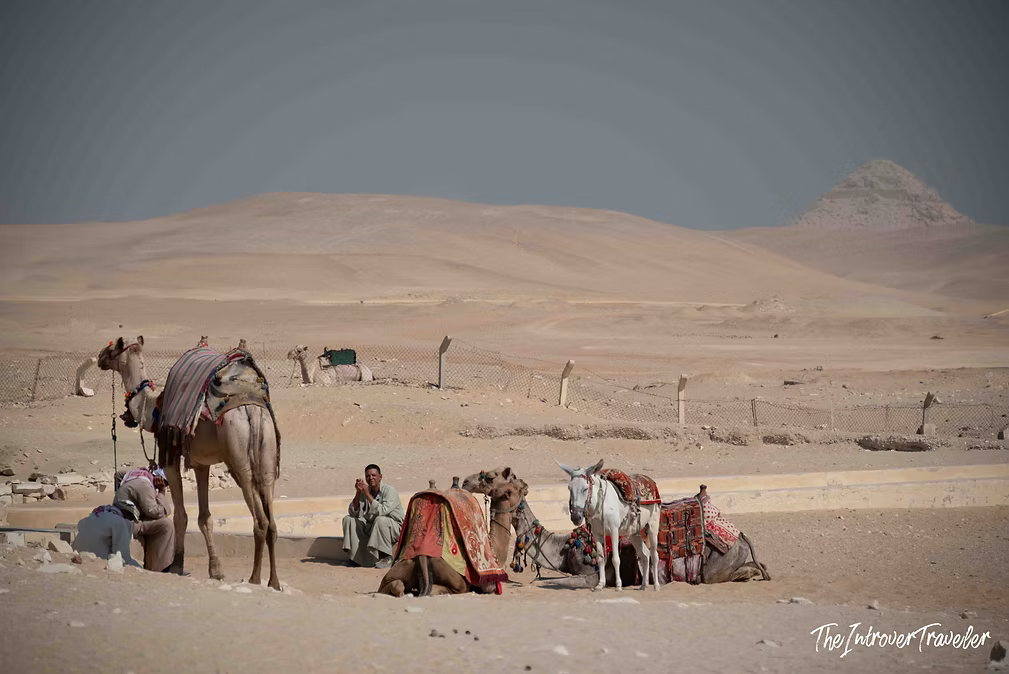
It would be a mistake to think of Saqqara solely as the site of the Step Pyramid. The Step Pyramid is the monument that dominates every photograph and every itinerary, and understandably so; but reducing Saqqara to Djoser’s pyramid is a bit like visiting Rome and seeing only the Colosseum. Saqqara is one of the largest and most complex ancient cemeteries in the world, used continuously from the First Dynasty all the way through to the Ptolemaic period, a span of roughly three thousand years. Archaeologists are still making major discoveries here in the twenty-first century: this is not a site that has been fully mapped and catalogued. It is, in the most literal sense, still being uncovered.
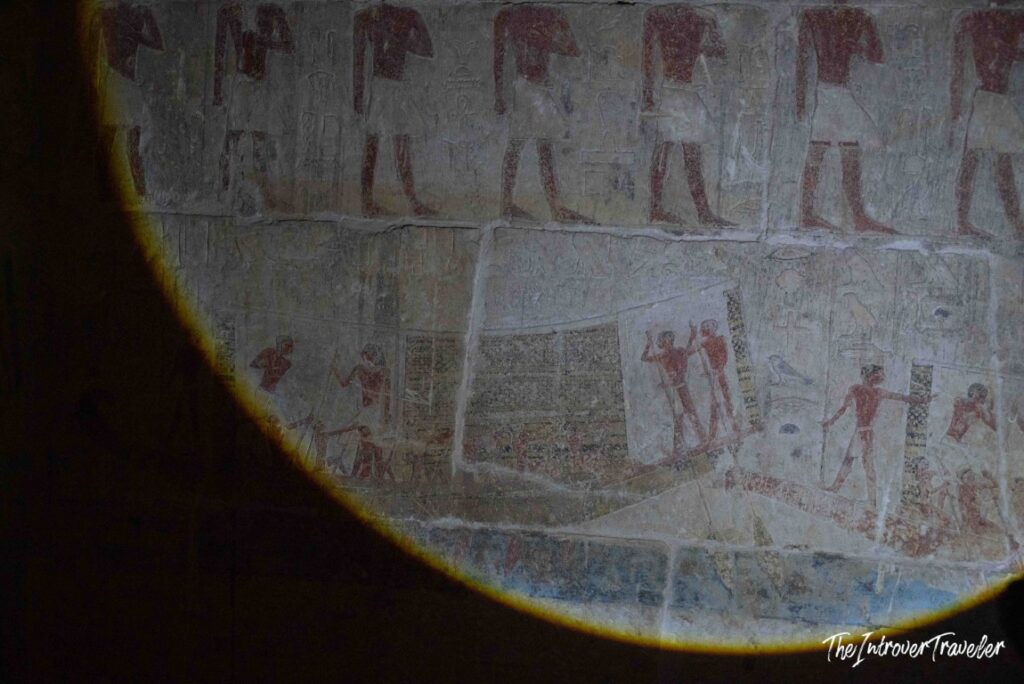
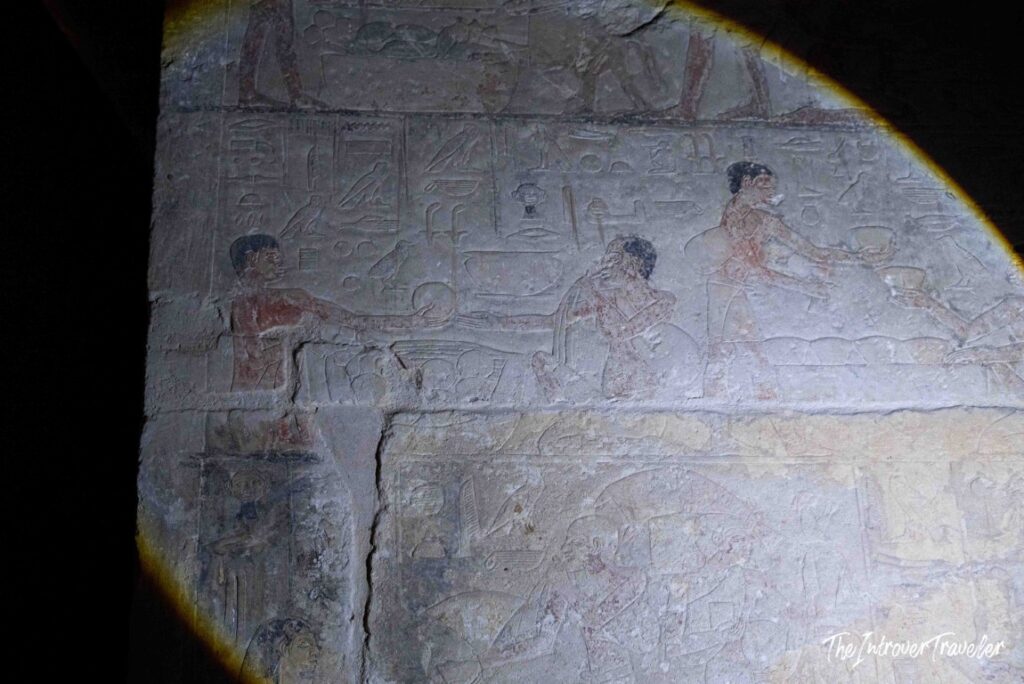
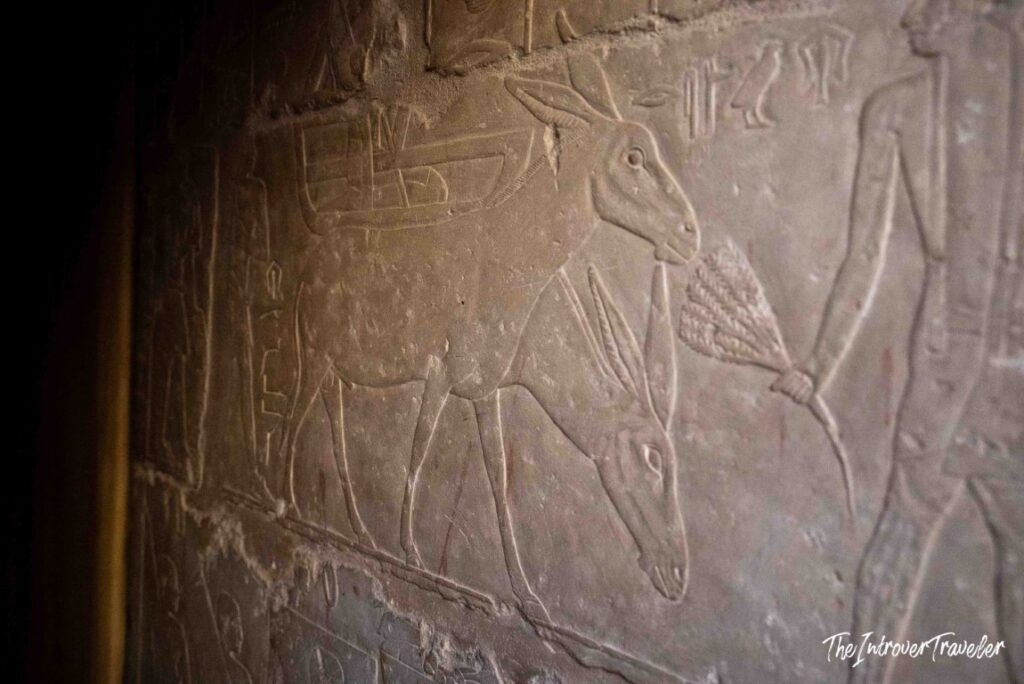
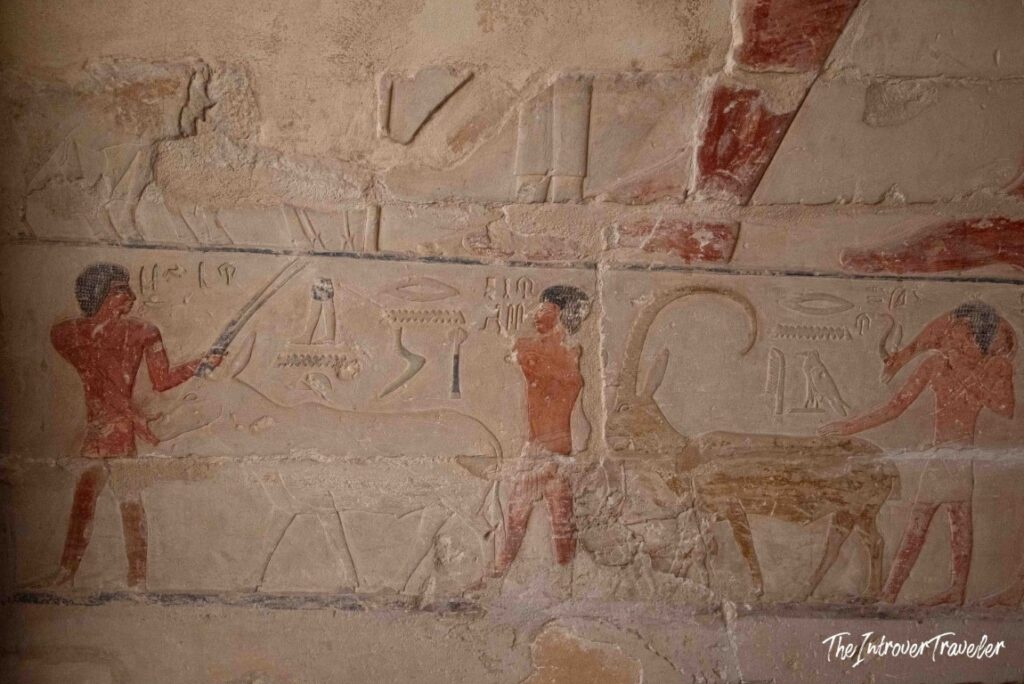
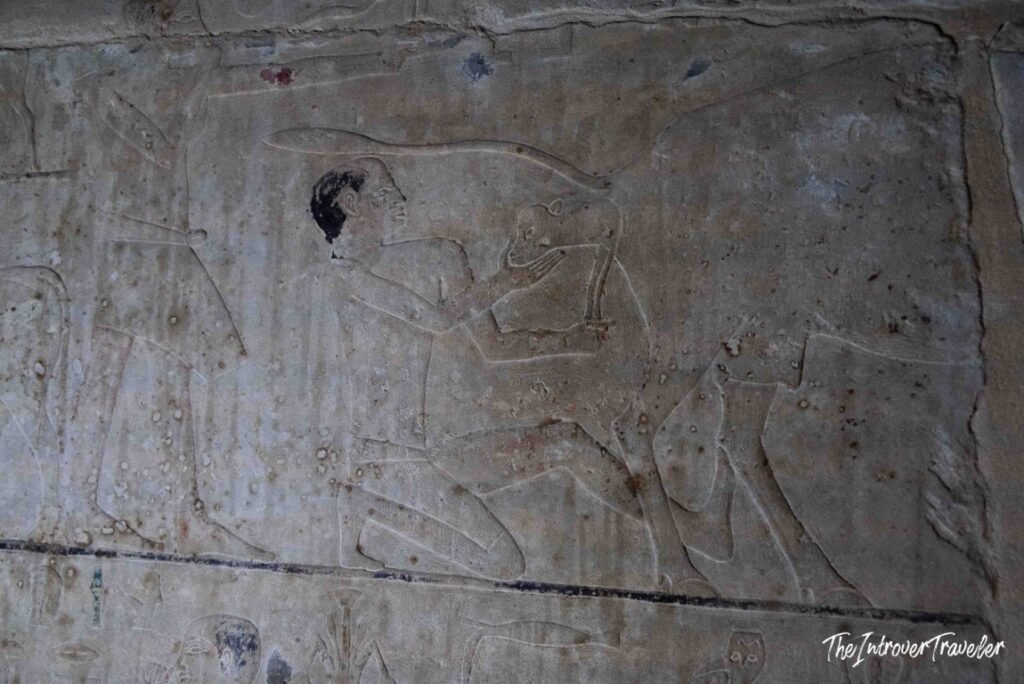
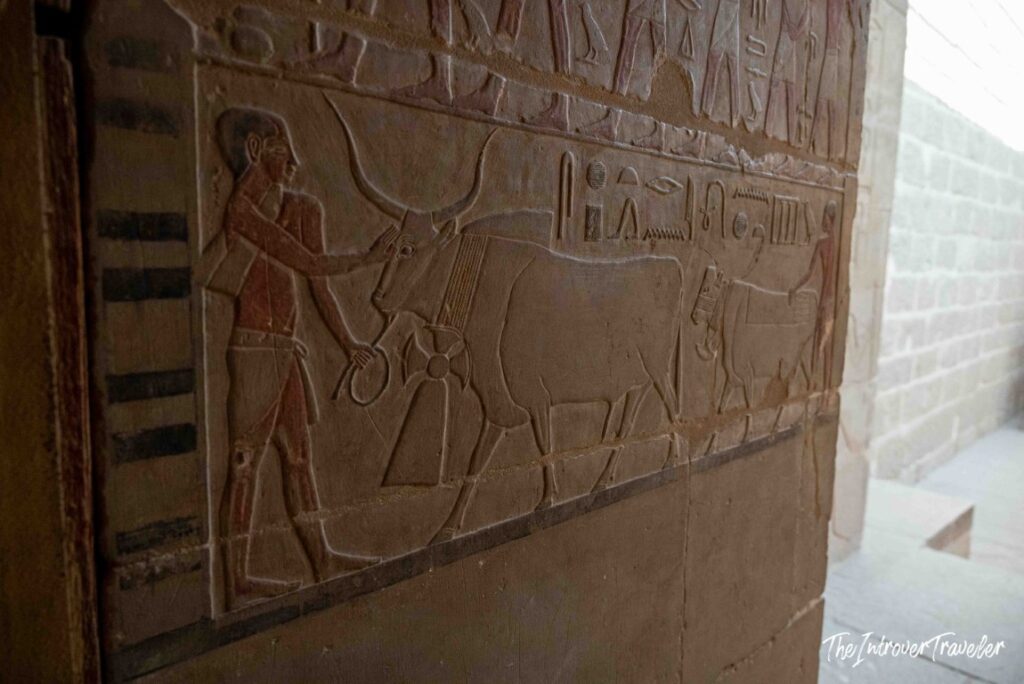
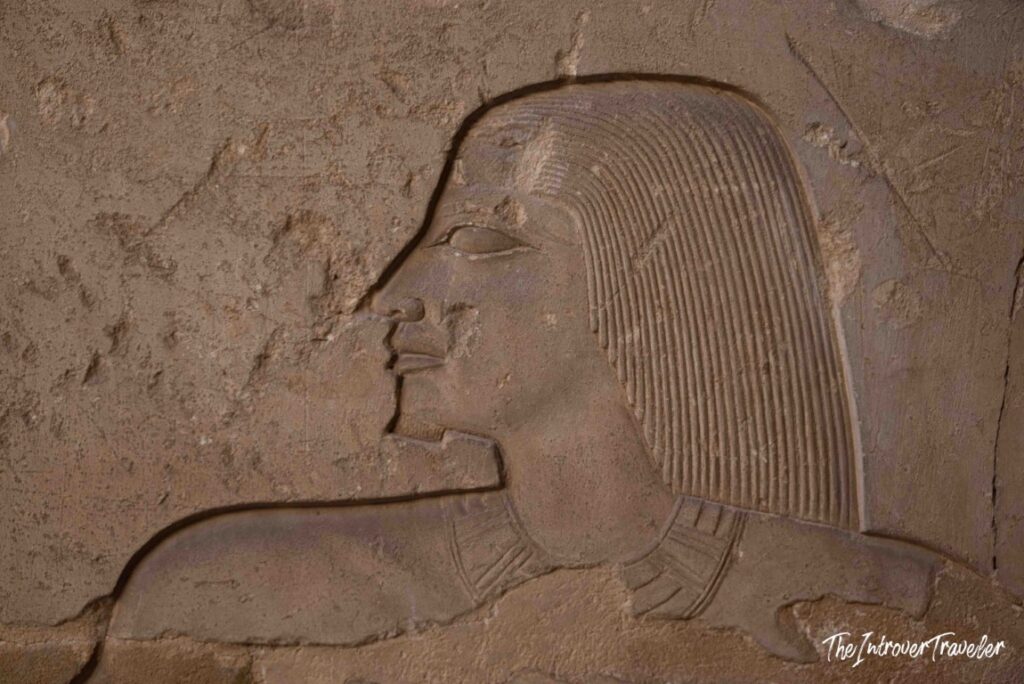
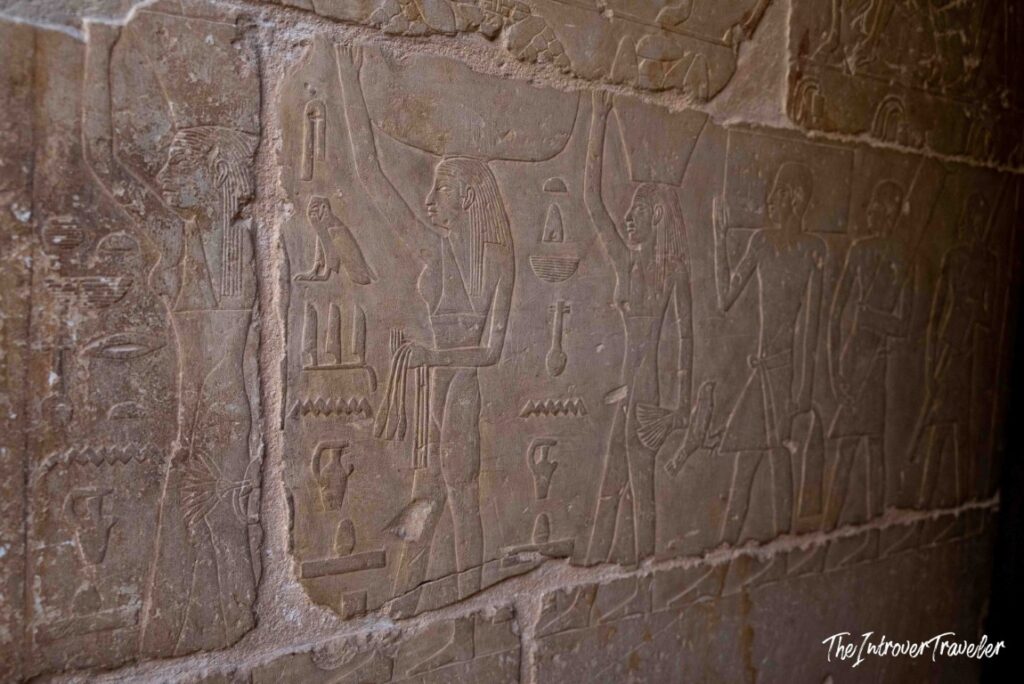
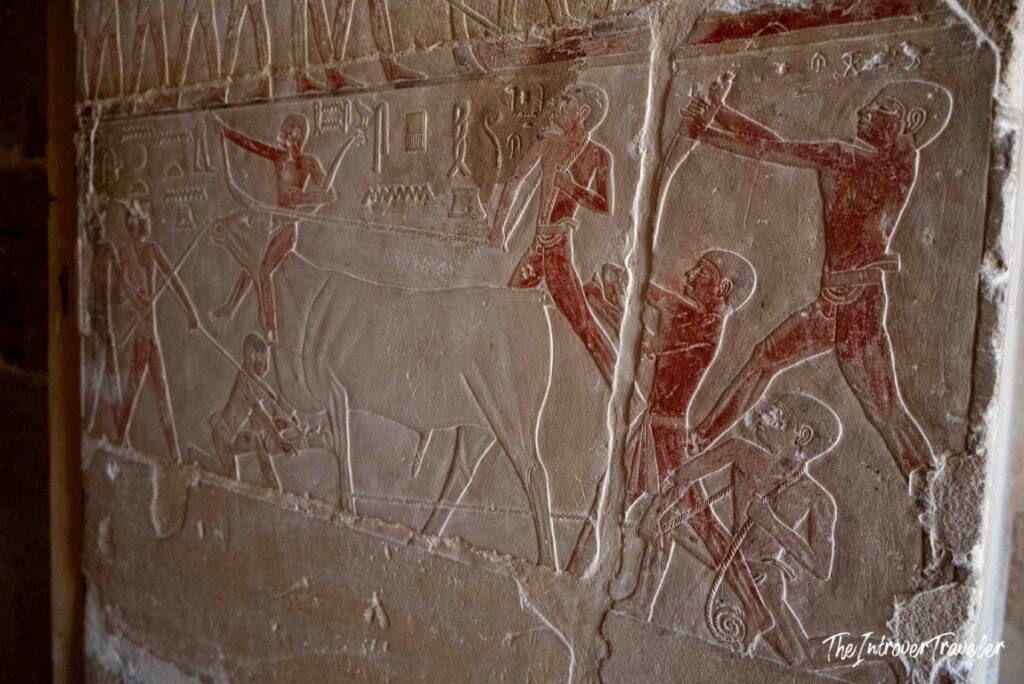
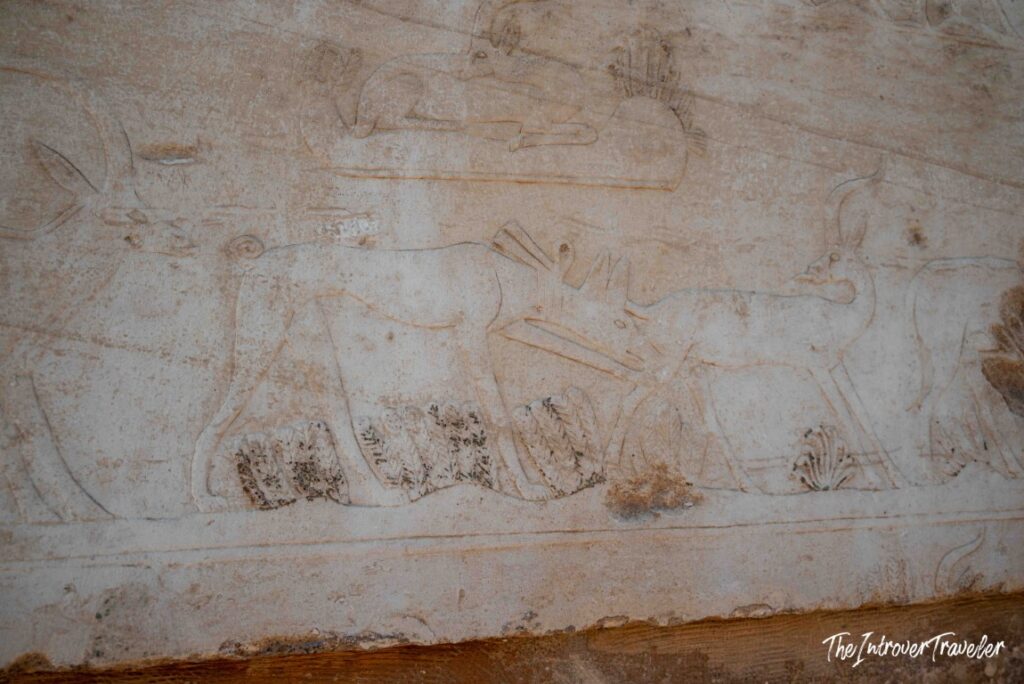
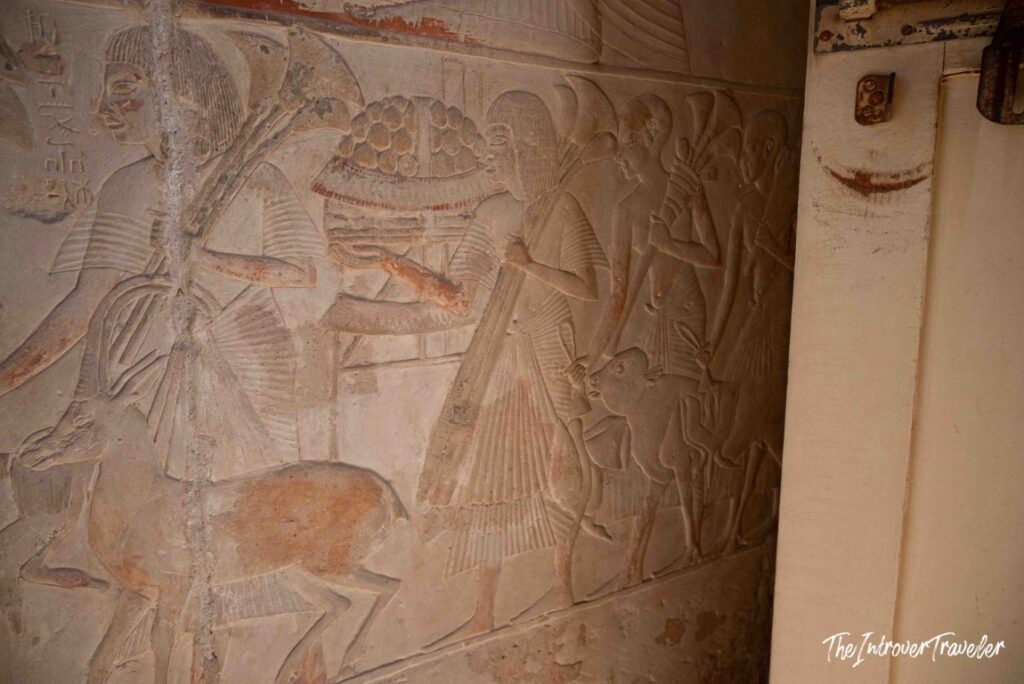
Among the elements of greatest interest, for the visitor willing to go beyond the obligatory circuit, are the mastabas of high officials from the Old Kingdom. These rectangular funerary structures, built above ground in limestone around the pyramids of the pharaohs they served, are not simply tombs: they are archives. Their interior walls are covered in painted reliefs depicting, with extraordinary documentary precision, the daily life of the Old Kingdom elite: agricultural scenes, hunting in the marshes, fishing on the Nile, carpentry, goldsmithing, animal husbandry. The mastaba of Mereruka, vizier to Pharaoh Teti of the Sixth Dynasty, is the largest and most elaborate non-royal tomb in all of Saqqara, with thirty-three chambers covering an area of roughly 23 by 41 meters. Its reliefs are among the finest examples of Old Kingdom art anywhere in Egypt. In one famously tender scene, Mereruka and his wife are depicted hand in hand, fingers interlaced: an image that has crossed four and a half millennia and is still, quite simply, moving. At the heart of the complex, a life-size statue of Mereruka steps forward from a recessed false door, as if caught in the act of emerging from the world of the dead into the world of the living. The mastaba of Ti is considered by many Egyptologists to be the most beautifully decorated in the entire necropolis; that of Kagemni is notable for exceptional bird-hunting scenes and a naturalistic sensitivity in its animal representations that is not always characteristic of official Egyptian art.
What these tombs share, beyond their documentary value, is a quality of human attention absent from the great religious monuments. The temples and pyramids speak the language of eternity and power. The mastabas speak the language of the world as it was: concrete, inhabited, observed. The man who commissioned these reliefs wanted to carry into the afterlife not the abstract grandeur of divine authority, but the specific pleasures of his actual existence. The fisherman on the papyrus boat. The craftsman bending over his work. The wife playing a harp. These images are not decorative filler: they are a theory of what makes a life worth living, expressed in stone and pigment by an extinct civilization, and still, miraculously, legible.
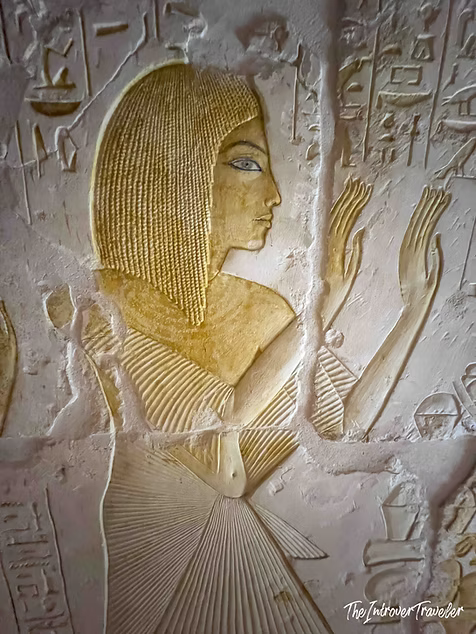
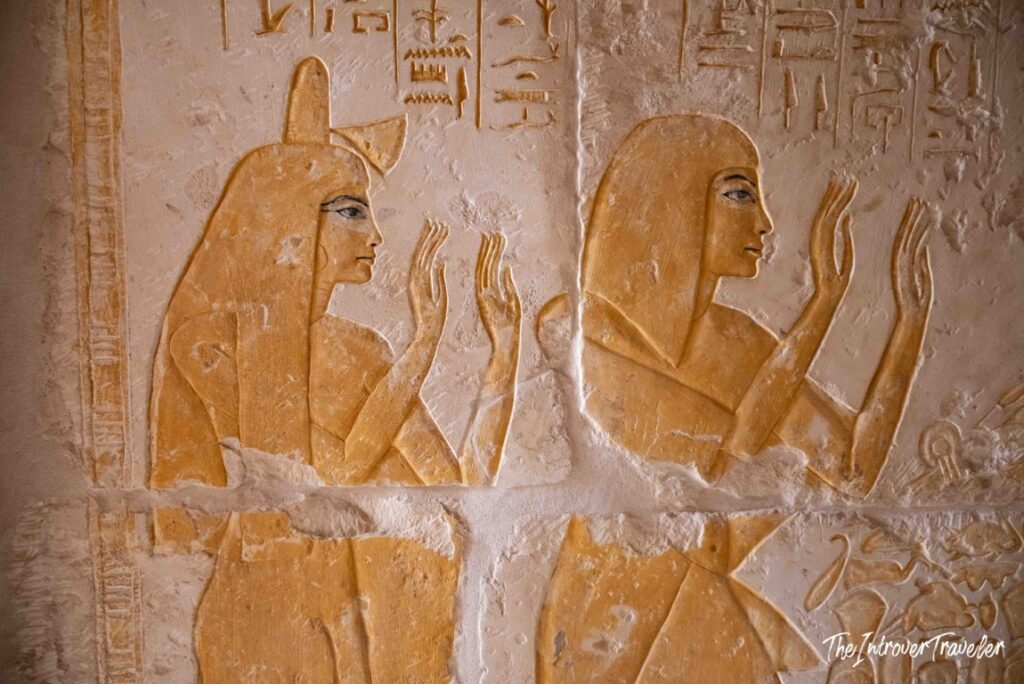
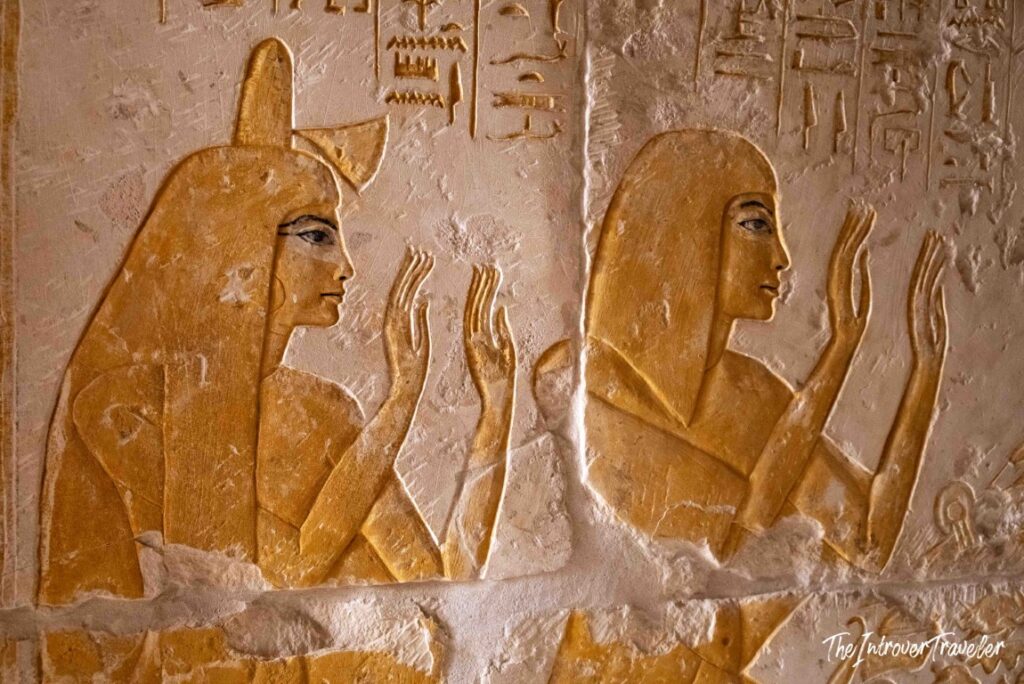
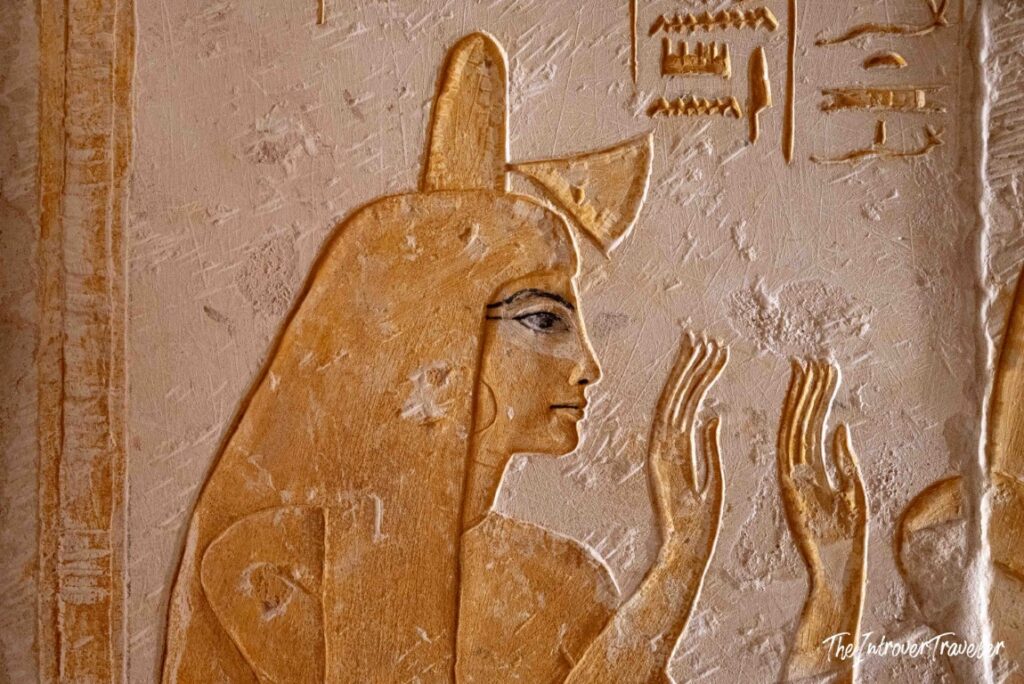
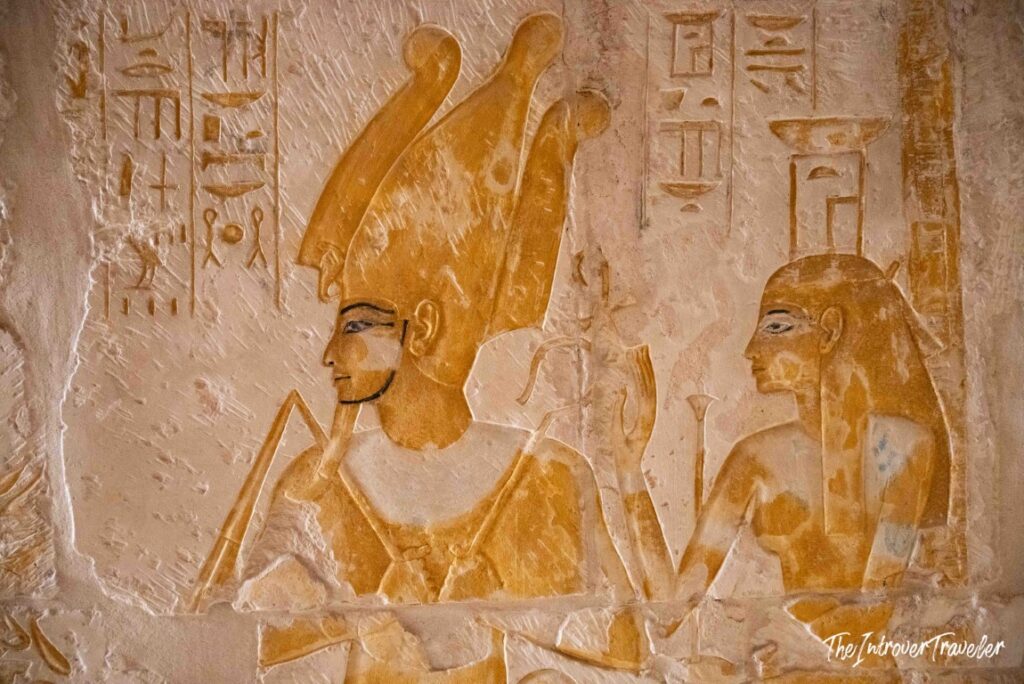
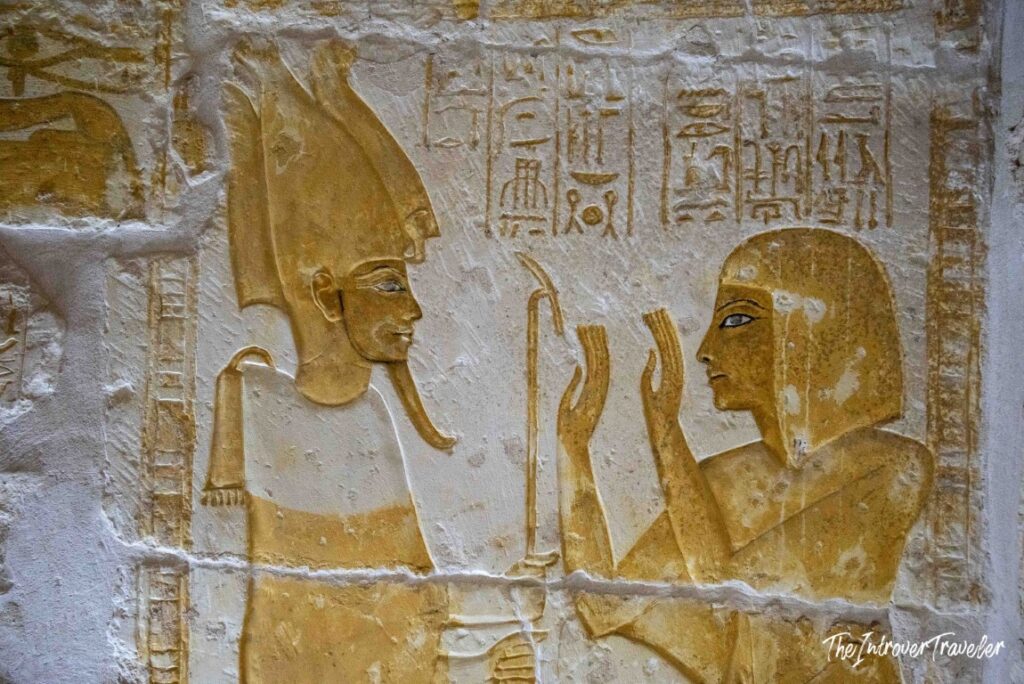
Among the New Kingdom tombs at Saqqara, located to the south of the causeway of the pyramid of Unas, the tomb of Maya stands in a class of its own. Maya was the Overseer of the Treasury under Tutankhamun, Ay, and Horemheb, and as “chief of the works in the necropolis” he also supervised the preparation and maintenance of royal burials. Inscriptions in the tomb of Thutmose IV record that it was Maya who restored that king’s violated burial: an ancient official performing the same work of protective conservation that we still consider a modern calling. The tomb was identified by Lepsius in 1843, then swallowed by the desert sand and lost for over a century, until a joint expedition of the Egypt Exploration Society and the Rijksmuseum van Oudheden rediscovered it on 6 February 1986.
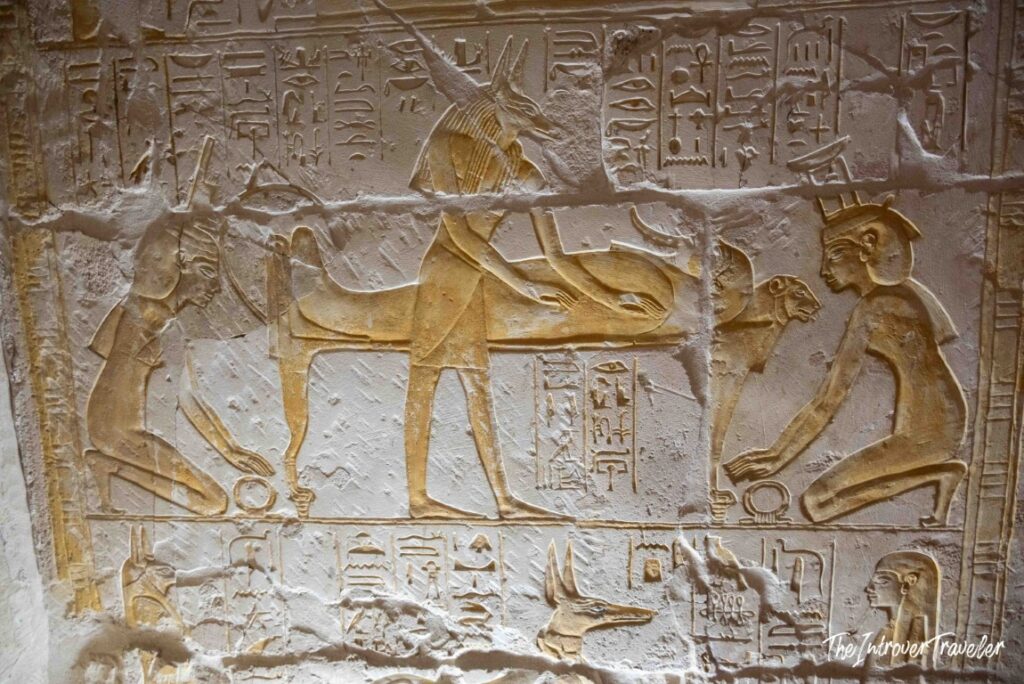
The reliefs of the inner courtyard and entrance gateway are of exceptional quality, the figures of Maya and his wife Meryt executed in a limestone relief that represents New Kingdom art at its most refined. The subterranean burial chambers, unique in the entire New Kingdom necropolis of Saqqara, show Maya and Meryt in the presence of the gods of the afterlife, the figures painted in luminous golden yellow with details in blue and black, a chromatic choice that gives the underground spaces an almost spectral quality. A double-seated statue of the couple, found face-down in the courtyard during the excavation, is now among the masterpieces of the Rijksmuseum van Oudheden in Leiden.
Nearby, the tomb of Horemheb, begun when its owner was still a general under Tutankhamun and abandoned when he unexpectedly became pharaoh, was completed for the burial of his wife Mutnodjmet. It contains reliefs in Amarna-influenced style and one remarkable detail: the royal uraeus was added to the existing portrait reliefs after Horemheb’s accession, as if to retroactively confirm in stone a destiny that history had not yet announced.
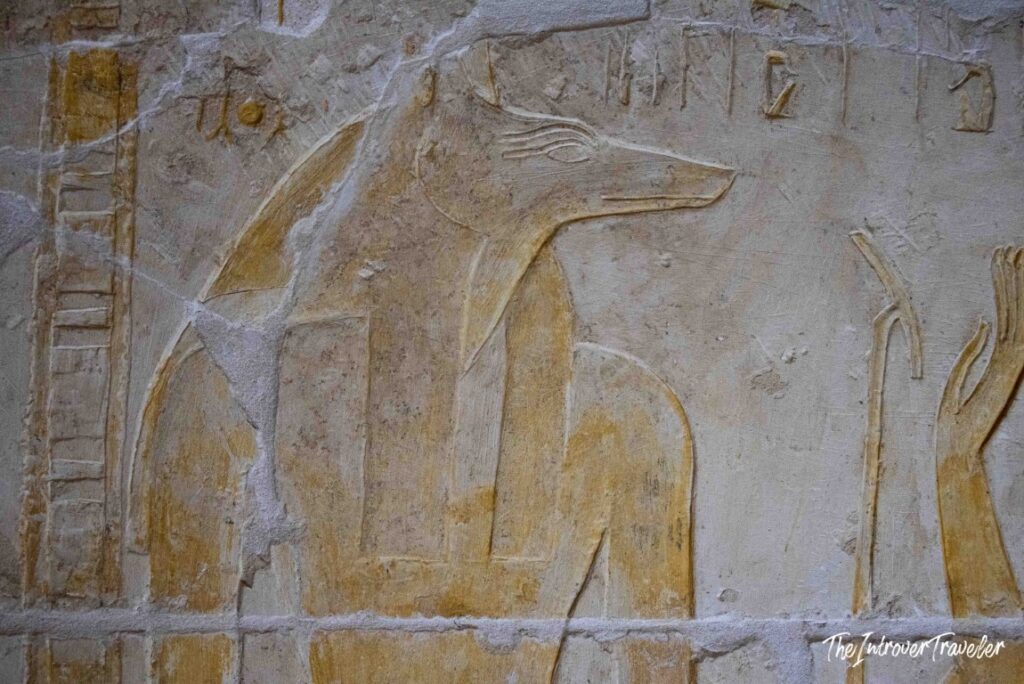
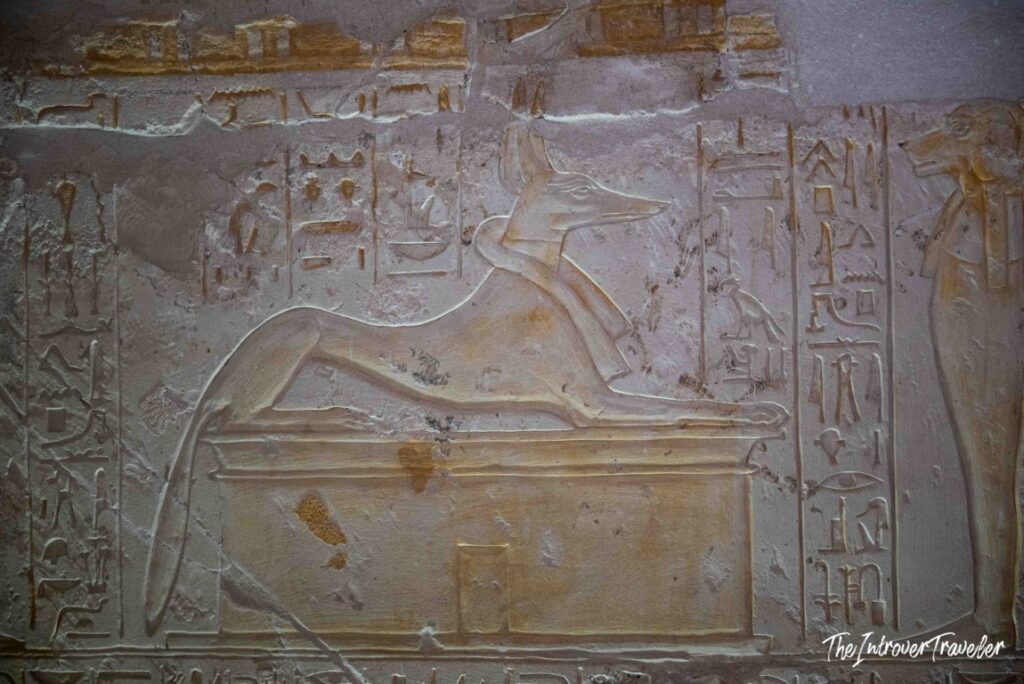
The Serapeum, finally, represents a completely different register of experience. This vast underground complex served from the New Kingdom onwards as the burial site of the Apis bulls, the sacred animals considered to be the living manifestation of the god Ptah. Each bull was interred in an enormous sarcophagus carved from a single block of granite or basalt, weighing approximately 70 tonnes; there are twenty-four of them, arranged in niches along the gallery walls. Entering the Serapeum is an experience of disorientation unlike anything else at Saqqara: the scale of the containers is so far in excess of any functional necessity, the darkness so absolute, the conceptual distance between the object in front of you and the civilization that produced it so considerable, that the mind tends to stumble rather than glide. This was built for a bull. An extremely important bull, the incarnation of a god, but a bull. And the sarcophagus holding it is larger than most modern living rooms.
V. The visit: a morning with Rami
We visited Saqqara with Rami, a local guide who accompanied us for the entire excursion. The tour lasted approximately five hours, departing at 7AM and returning comfortably before lunch. Given the August heat, the timing was not a minor logistical detail.
The itinerary began, as it should, with the complex of Djoser. Standing at the base of the Step Pyramid and looking up at the six stepped terraces, you feel something that the photographs entirely fail to convey: the sheer physical presence of an object that is simultaneously ancient beyond easy comprehension and geometrically, almost defiantly, precise.
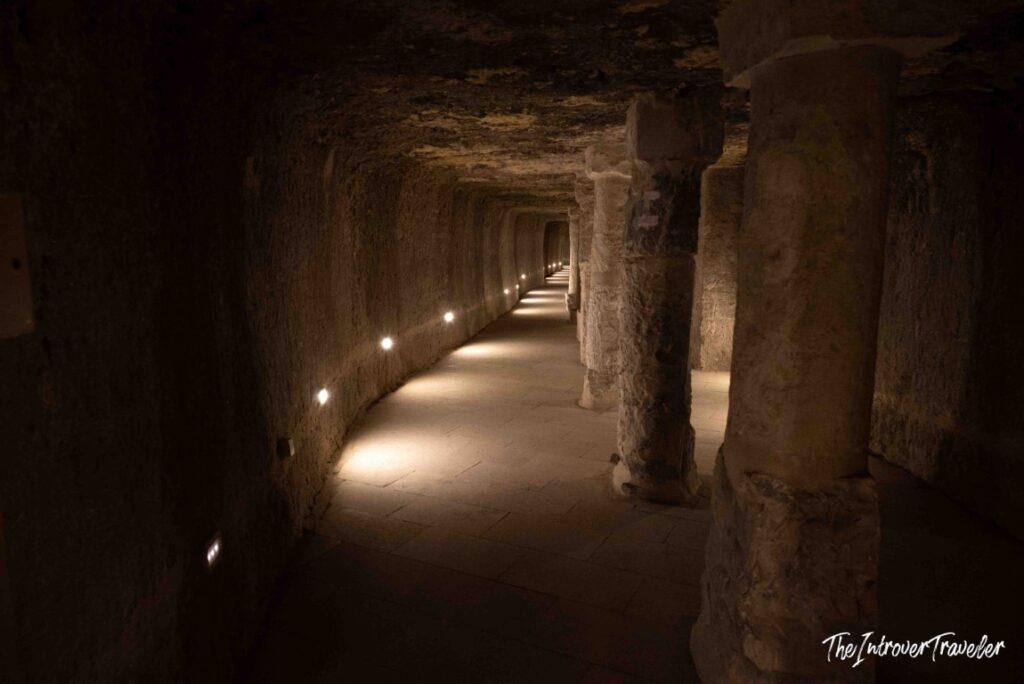
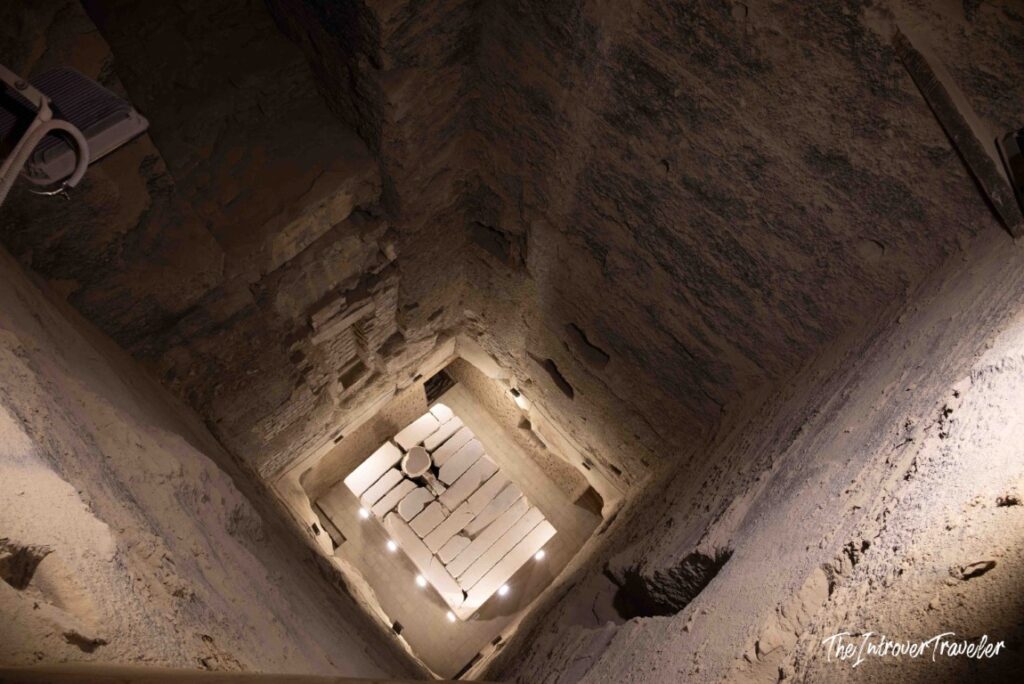
Of all the pyramids we entered during our time in Egypt, the pyramid of Djoser offers the most physically straightforward access. A corridor along which one walks fully upright, without the hunched and sweat-drenched contortions required at Khufu, leads to the burial chamber. At the center of the chamber floor, a shaft descends roughly ten meters to where the sarcophagus lies, visible from above in the darkness below but not directly accessible. The experience is spatially simple, and for precisely this reason more available to contemplation than the more physically demanding pyramids: there is nothing to distract you, no narrow passage to navigate, no cramp in your lower back to manage. Just the stone, the shaft, the darkness below, and the thought that this space has been here for four thousand six hundred years. And, in August, practically no one else.
The real revelation of the first two hours, however, was the necropolis: the mastabas, the New Kingdom tombs, the tomb of Maya described at length above. With Rami as a guide, these monuments became intelligible not just as objects to look at but as documents to read; without that layer of interpretation, I suspect many visitors pass through them without fully registering what they contain. The quality of the painted reliefs in some of these tombs, in particular the tomb of Maya, is extraordinary by any standard. I have already discussed this in detail in the previous section. I will only add that the experience of standing inside these chambers, in the near-total absence of other visitors, in a silence broken only by Rami’s explanations and the very occasional footstep on sand, is one of the most genuinely affecting things I encountered in Egypt. Not because of any manufactured atmosphere or mystical feeling, but simply because the works are, objectively, of a beauty and a quality that demands attention, and in the absence of noise and crowds, the attention becomes possible.
The entrance to the pyramid accessible at Saqqara is, of all the pyramids we visited, the most physically straightforward: a corridor along which one walks upright, without the hunched and sweat-drenched contortions required at Khufu, leads to the burial chamber. At the bottom of the chamber, a shaft descends roughly ten meters to where the sarcophagus lies, visible from above but not directly accessible. The experience is brief, spatially simple, and for precisely this reason, strangely more available to contemplation than the more physically demanding pyramids: there is nothing to distract you, no narrow passage to navigate, no cramp in your lower back to manage. Just the stone, the shaft, the darkness below, and the thought that this space has been here for four thousand six hundred years.
After the necropolis, a brief visit to the Imhotep Museum, housed in a modern building near the site entrance, rounded off the morning at Saqqara. The museum contains some genuinely interesting objects, including architectural fragments from the Step Pyramid complex and artifacts from the ongoing excavations. It is, however, a modest collection, and ten minutes is probably sufficient unless you have a specific scholarly interest in the material. Rami, with admirable professional honesty, said as much before we went in.
VI. The Red Pyramid: silence as an archaeological experience
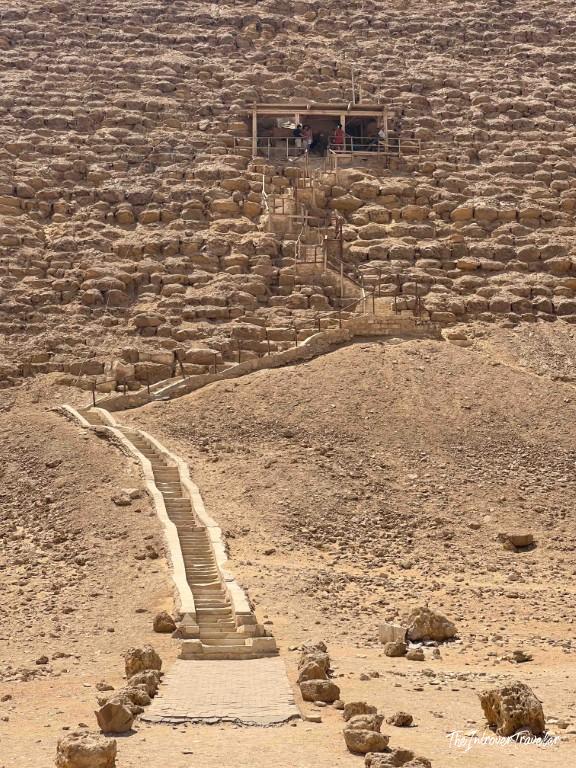
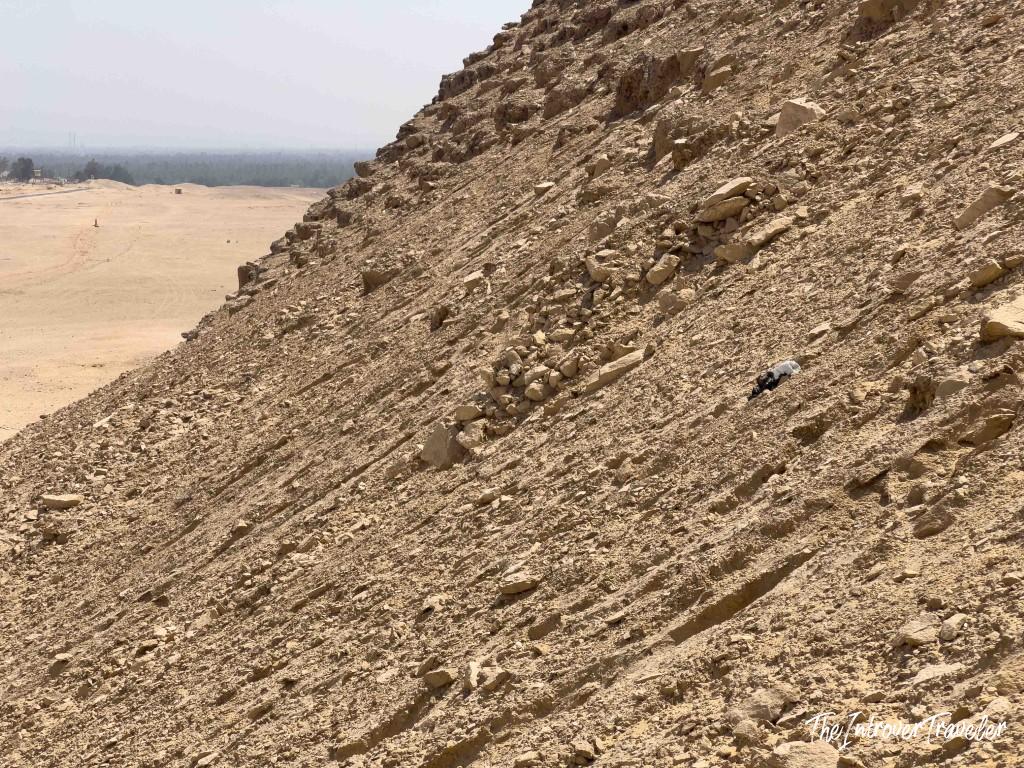
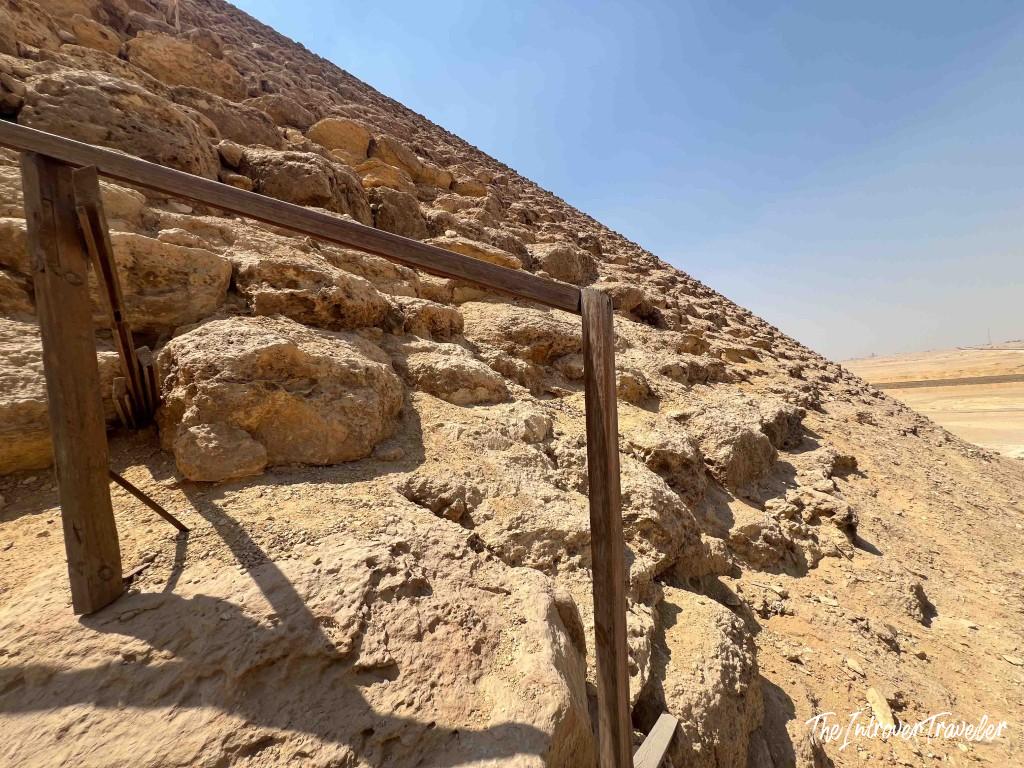
From Saqqara, we proceeded south to Dahshur, and specifically to the Red Pyramid, the third largest pyramid ever built and the first true smooth-sided pyramid in history, as described in section II above. The name derives from the reddish hue of the local limestone used in its construction, visible now that the original white casing has been stripped away by centuries of quarrying.
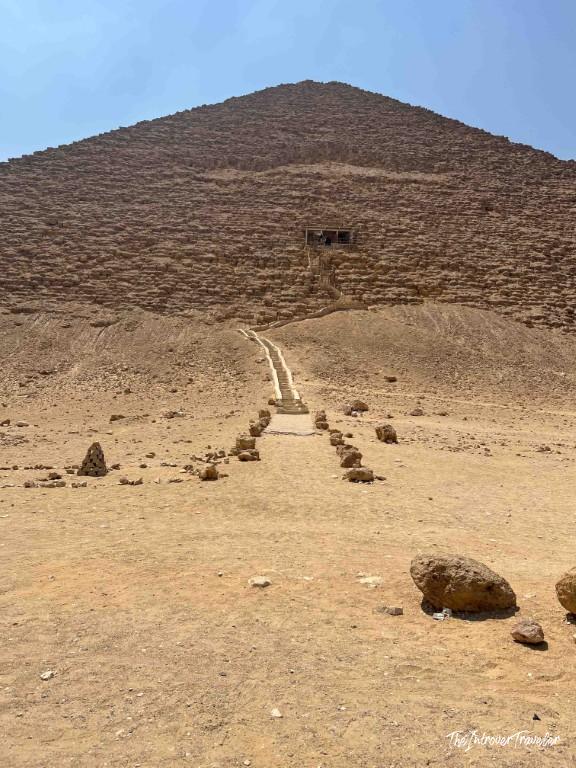
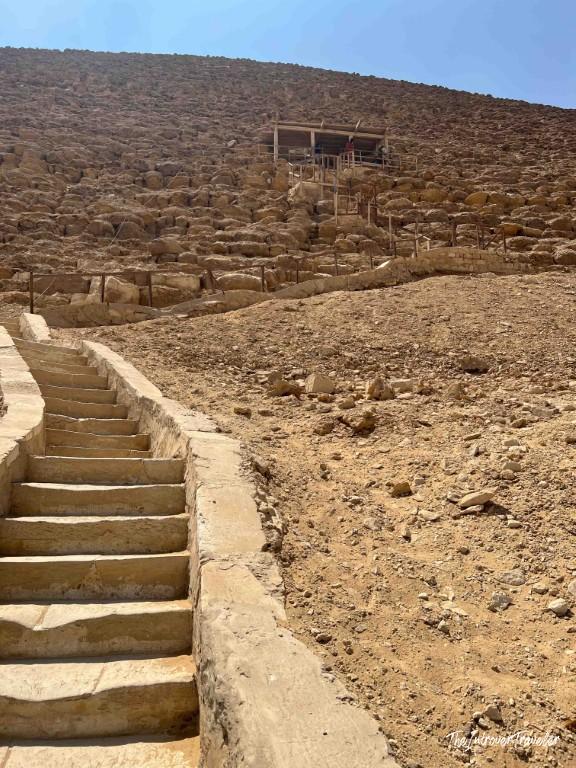
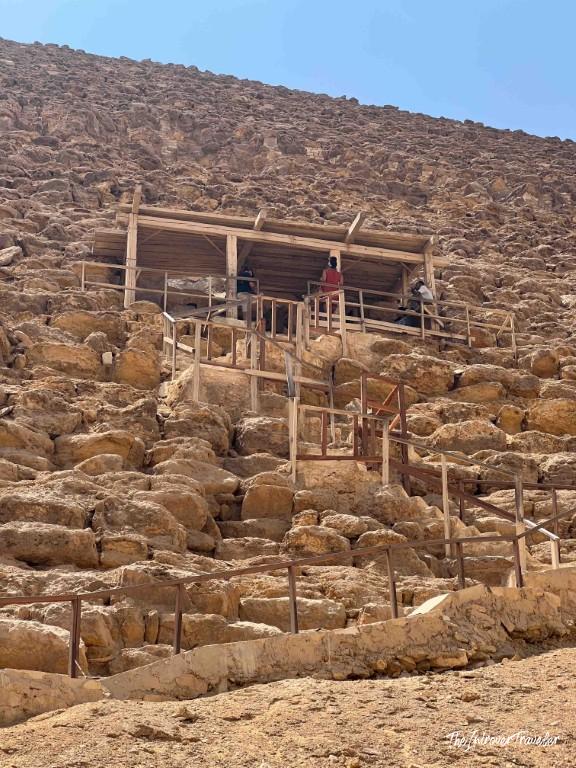
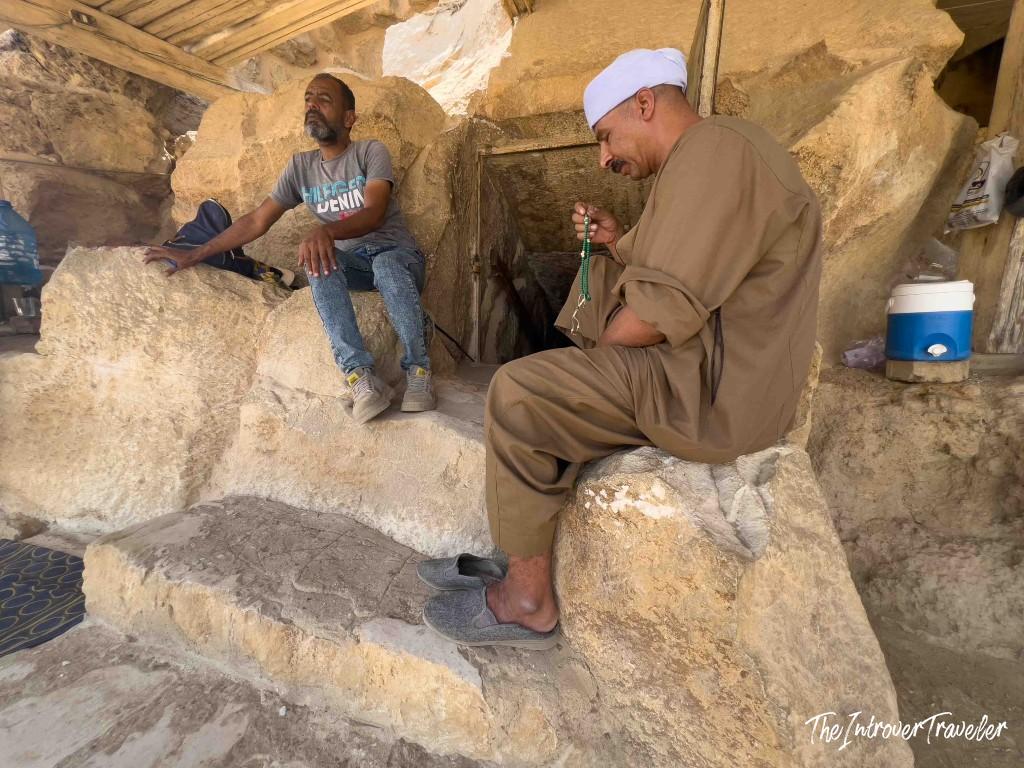
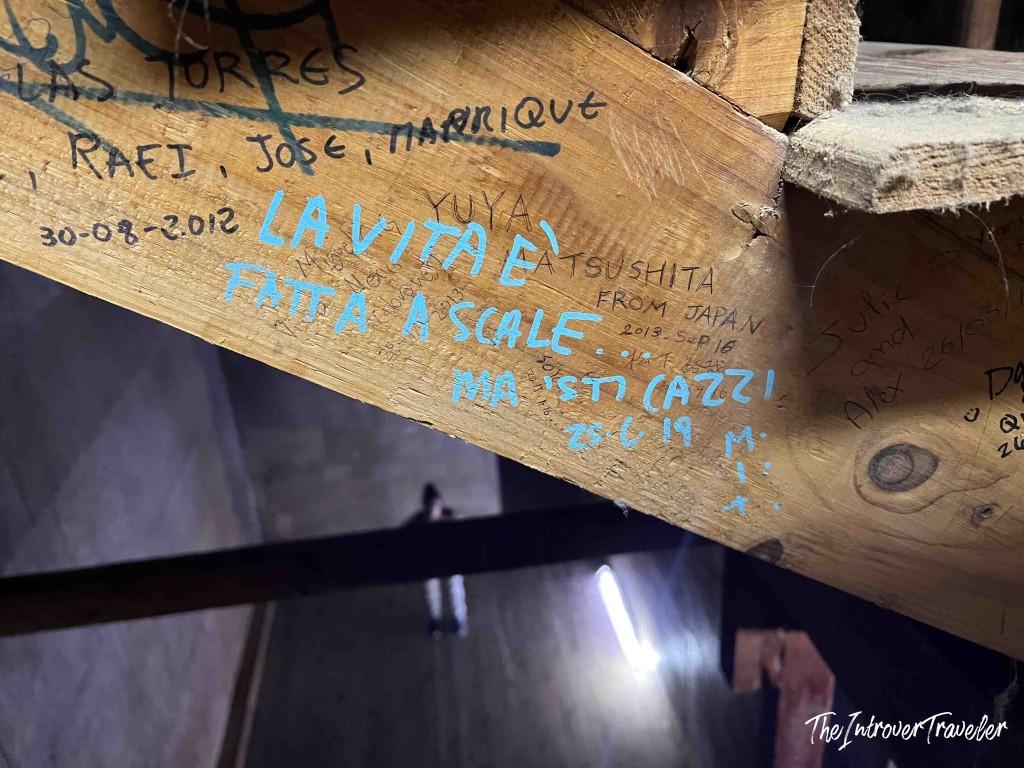
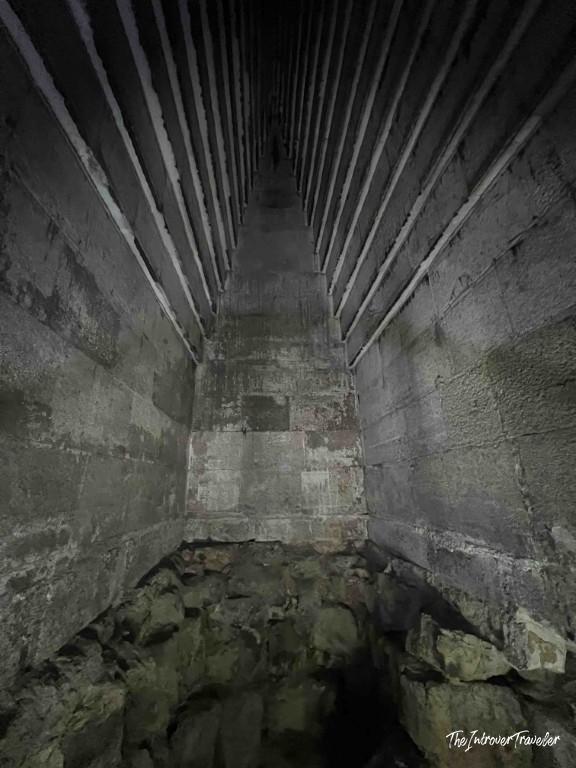
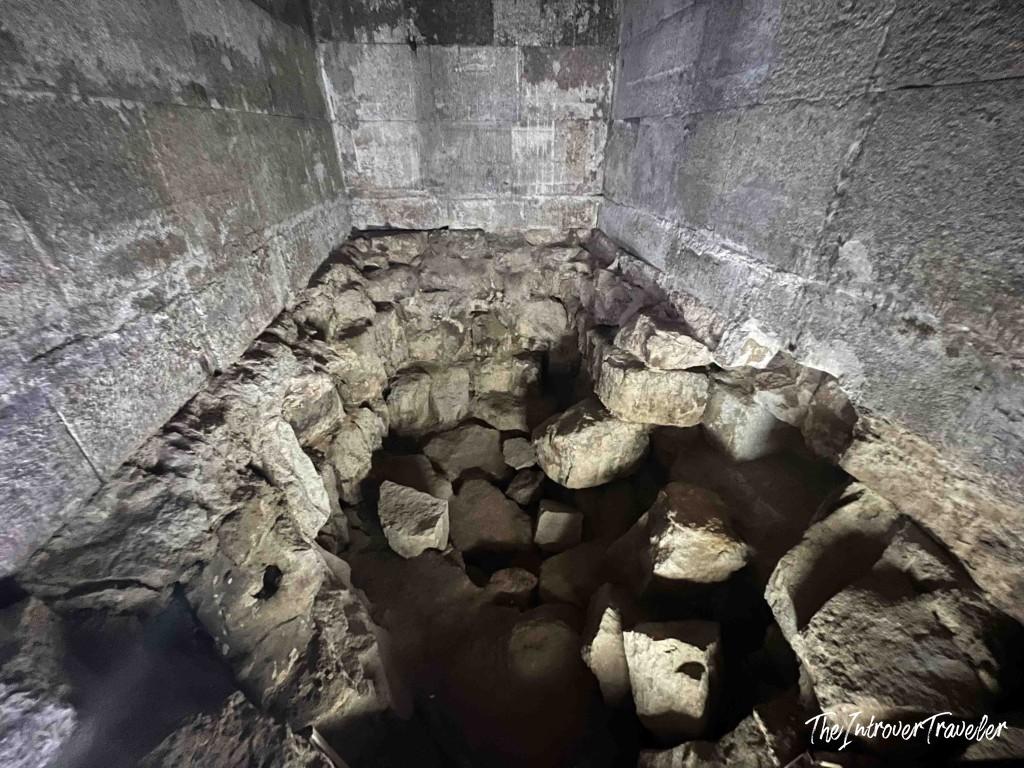
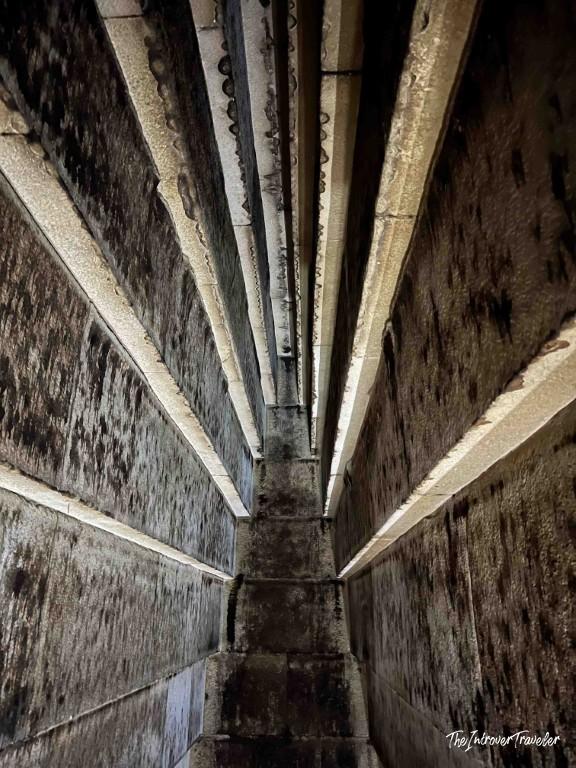
The entry to the Red Pyramid is structurally similar to that of the pyramid of Khufu: a corridor descending at a steep angle, of some tens of meters in length, along which one proceeds crouched, back bent, hands sometimes finding the walls for support. It is more physically demanding than the Saqqara pyramid, less so than the most strenuous section of Khufu. At the bottom, a short horizontal passage leads into a sequence of corbelled antechambers and finally into the burial chamber: a tall, narrow space in which the corbelled ceiling rises in stepped limestone courses to a height of several meters, the stones slightly reddish in the artificial light, the air heavy and still.
There was no one else there.
This is what needs to be said about the Red Pyramid, and it cannot be said often enough or with sufficient emphasis. After the chaos of Khufu’s interior at Giza, crowded with tourists who treat the burial chamber of one of history’s greatest monuments as the background for a selfie, the Red Pyramid offers something that has become, in the age of overtourism, almost impossible to find at a major Egyptian site: silence. Real silence. The kind in which you can hear your own breathing and, if you allow the thought, the accumulated weight of four thousand six hundred years pressing in from above.
I described in the Giza post how the experience inside Khufu’s pyramid is substantially diminished by the behavior of its visitors, and how what should be an encounter with deep time is instead a test of tolerance for collective noise and inconsiderateness. The Red Pyramid is the correction of that experience. The burial chamber at the base of the Red Pyramid, empty and bare, lit by a single artificial source, is not a spectacular room: there are no reliefs, no inscriptions, no decoration of any kind. It is just stone, corbelled with extraordinary precision, enclosing a volume of air that has been sealed since before the birth of the Roman Empire. To stand there, in the silence, without being jostled or deafened, is to have the experience that the pyramid of Khufu should theoretically offer and practically cannot. It takes about thirty minutes. It is worth every one of them.
VII. The Bent Pyramid: admired, not entered
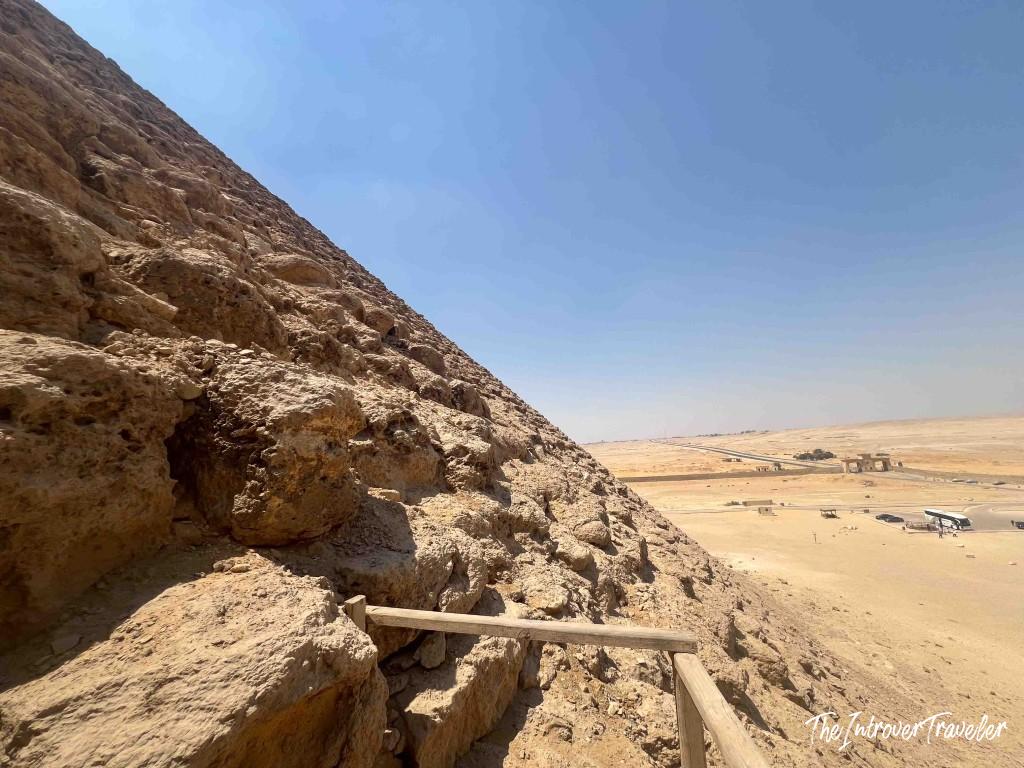
Visible from the Red Pyramid and only a short distance away, the Bent Pyramid of Sneferu requires no separate journey. We drove to its base and spent some time looking at it: a remarkable object, its double inclination more dramatic in person than in photographs, the lower portion of its original white limestone casing still largely intact and gleaming in a way that gives some idea of what all the pyramids must have looked like before the stripping of their outer cladding. As described in section II, it is the only pyramid in Egypt that carries the evidence of its own structural crisis visibly on its face, and for this reason it is perhaps the most historically eloquent of all of them: more than any text, it tells you what the Egyptians were up against.
We had already been told, by a group of tourists we met at Saqqara who were in considerably better physical condition than us, that the interior of the Bent Pyramid is significantly more demanding than either the Saqqara pyramid or the Red Pyramid: the access corridor is longer, narrower, and in places requires crawling, in conditions of heat and poor ventilation that, in August, become genuinely punishing. Having already visited two pyramids and being, to be precise about it, two fifty-year-olds whose relationship with athletic effort is best described as theoretical, we decided without great internal conflict to admire the Bent Pyramid from the outside and leave the interior to those with more youthful knees and a higher threshold for confined spaces.
No regrets. The exterior is extraordinary enough.
VIII. Memphis: a brief and slightly anticlimactic coda
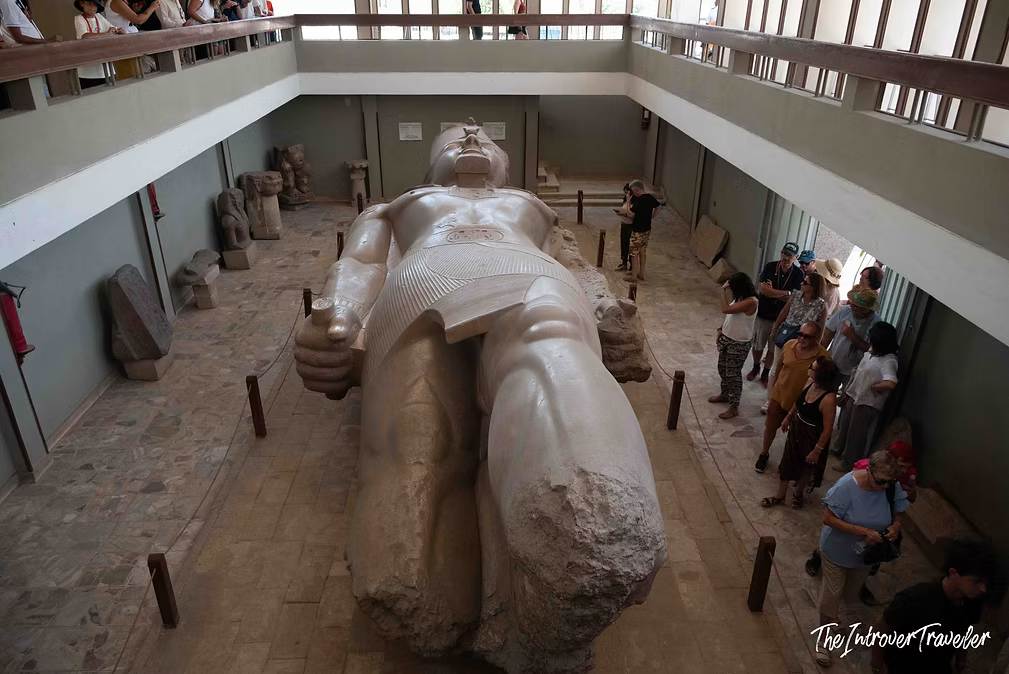
The final stop of the excursion was Memphis, the ancient capital of the Old Kingdom, a few kilometers from Saqqara. What remains of Memphis today is a small open-air museum containing, most notably, a colossal recumbent limestone statue of Ramesses II, impressive in its dimensions and in the quality of its carving, displayed horizontally in a purpose-built shelter because it lacks the feet necessary to stand it upright. There is also an alabaster sphinx of some antiquity. The museum is modest, the visit takes roughly ten minutes, and the emotional impact, after the morning spent at Saqqara and inside the Red Pyramid, is not high. Memphis was once one of the greatest cities in the ancient world; what remains of it is a pale and slightly melancholy shadow of that history. It is worth stopping, but worth calibrating expectations accordingly.
The excursion concluded, after the obligatory visit to some local craftsmen with whom Rami had pre-existing arrangements, with a return to Cairo in time for lunch. This part of the program, the artisans, is a standard feature of guided excursions in Egypt and one that travelers learn to accept with good grace.
If you are planning a trip to Egypt you may be interested in these posts.
IX. Practical notes
The full excursion from Cairo covers Saqqara, Dahshur, and Memphis and takes approximately five hours if departures are early and the pace is reasonably brisk. Starting by 7:00 am is advisable both to manage the heat and to reach the sites before the midday sun makes the open areas genuinely unpleasant. In August, this is not a theoretical concern.
I strongly recommend getting in touch with Rami for this excursion. Rami is, in the most literal sense of the word, a Renaissance man: Egyptologist, entrepreneur, botanist, HR manager, philosopher, builder, and hotelier, a combination of competences that would be implausible if the man himself were not standing in front of you demonstrating all of them simultaneously. As a guide, he is excellent: knowledgeable, precise, and capable of making the necropolis legible in a way that transforms its monuments from curiosities into documents. What I have not yet mentioned, and which deserves equal billing, is that at his home we ate, without any hesitation, the best meal of local cuisine of our entire week in Egypt: a level of quality that no restaurant we visited came close to matching.
On the question of physical effort: the Saqqara pyramid is accessible to anyone. The Red Pyramid requires a moderate level of fitness and a tolerance for enclosed spaces, but nothing that should deter a reasonably healthy adult. The Bent Pyramid is, by all accounts, in a different category, and should be approached with honest self-assessment.
Ticket prices vary and are updated periodically; the advice to check current rates on-site or through a reliable recent source remains the most honest recommendation one can make.
Saqqara is not a stop to tick off. It is the place where the idea of the pyramid was born, where the first stone was placed that would lead, a century and several catastrophic failures later, to the apex of Giza. To stand in front of the Step Pyramid of Djoser and understand its place in that story is to understand Egypt in a way that Giza, with all its spectacular grandeur, cannot give you: not the finale of the symphony, glorious and overwhelming, but the first note, tentative and already carrying within it the entire theme.