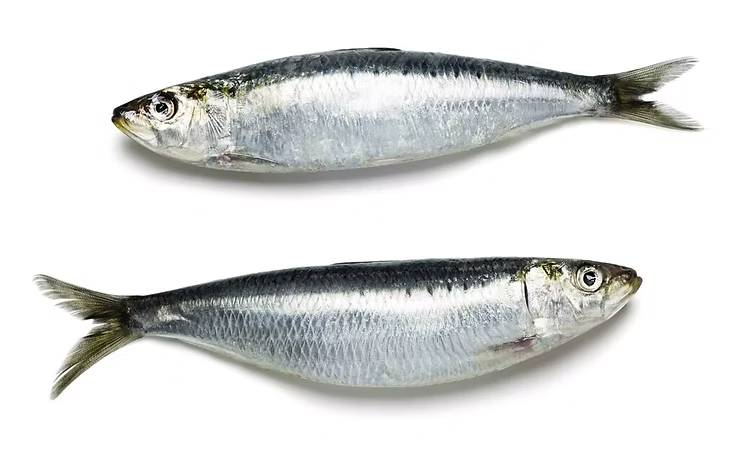
Author and title: Bill François, The Eloquence of the Sardine: Extraordinary Encounters Beneath the Sea
Summary: A pleasant and engaging work of scientific popularization that, through anecdotes and ethological observations, explores the complexity of marine life and its systems of communication.
Recommended for: Anyone who loves the sea and marine life and simply cannot stop reading books about the ocean.
My rating: 4 / 5
The Eloquence of the Sardine is one of those science-popularization books that successfully occupies a middle ground that is not always easy to achieve: rigorous enough to interest readers already familiar with the marine world, yet sufficiently narrative to be read as light leisure literature or natural travel writing.
It is not an academic marine biology manual, nor an essay structured according to a systematic scientific progression. Instead, the book unfolds through episodes, observations, and short narratives connected by a common thread: the behaviour of marine organisms and, above all, the ways in which humans communicate, or believe they communicate, with the sea.
The author, trained as a marine biologist, builds the narrative by alternating personal experience, scientific research, and ethological curiosities. The result is a fluid and often surprising read that offers a more complex perception of underwater life than the stereotypical image of silent fish inhabiting static environments.
One of the book’s main strengths lies in dismantling a deeply rooted misconception: the idea that the ocean is a realm dominated by silence. As clearly demonstrated in chapters devoted to fish, crustaceans, and cetaceans, the sea is in fact an acoustically dense environment.
The sardines that give the book its title become a narrative gateway to broader themes: collective behaviour, coordination within fish schools, anti-predator strategies, and the emergent dynamics typical of complex biological systems. The synchronized movement of thousands of individuals is presented not as mere visual spectacle, but as an extraordinarily efficient evolutionary solution. For scuba divers in particular, many descriptions feel immediately familiar: the sudden directional shifts of a schooling fish, defensive compaction in the presence of predators, or the almost physical sensation of being surrounded by a collective organism rather than individual animals.
The tone remains deliberately accessible and popular in style. Much of the reading pleasure derives from anecdotes: curious experiments, field observations, episodes from the history of marine biology, or seemingly marginal animal behaviours that reveal important scientific insights.
The narrative moves from fish capable of producing sounds through their swim bladder to crustaceans communicating via vibrations, and from shark sensory strategies to electrical perception in marine environments. Not every section carries the same scientific depth, yet the book works precisely because it avoids excessive theoretical density.
Rather than pursuing academic demonstration, the book privileges informed wonder. This approach may leave readers seeking quantitative analysis or systematic ecological discussion somewhat unsatisfied, but it is likely the most effective choice for a general audience of ocean enthusiasts.
A particularly successful aspect is the author’s ability to translate complex biological phenomena into understandable sensory experiences. The reader does not merely acquire information but is encouraged to reinterpret what they see, or might see, underwater. In this sense, the book functions almost as an informal introduction to marine ethology. After reading it, observing a school of fish without wondering about the invisible signals governing its movement becomes difficult.
The Eloquence of the Sardine is therefore not a specialist text, nor does it claim to be. For those who love the marine environment, it represents a collection of intelligent and often surprising stories, reminding us how little we still know about ocean ecosystems and how sophisticated the evolutionary strategies of marine organisms truly are.
It is not a book destined to revolutionize scientific popularization, nor a reference work for professional biologists. It is, however, an enjoyable, well-written read filled with fascinating insights, capable of conveying enthusiasm and curiosity for marine life without slipping into environmental rhetoric or easy anthropomorphism.
Ultimately, it makes excellent company for anyone who considers the sea not merely a place to visit, but a living system to observe more carefully and understand more deeply.
You can find the book on Amazon here.

As an Amazon Associate, I may earn a small commission from qualifying purchases made through the links in this article, at no additional cost to the reader.