Date of visit: August 2025
Date of construction: 1900 B.C. approx. (1200 years before the foundation of Rome)
My rating: 8/10
Visit duration: 1,5 hour (minimum; see notes)
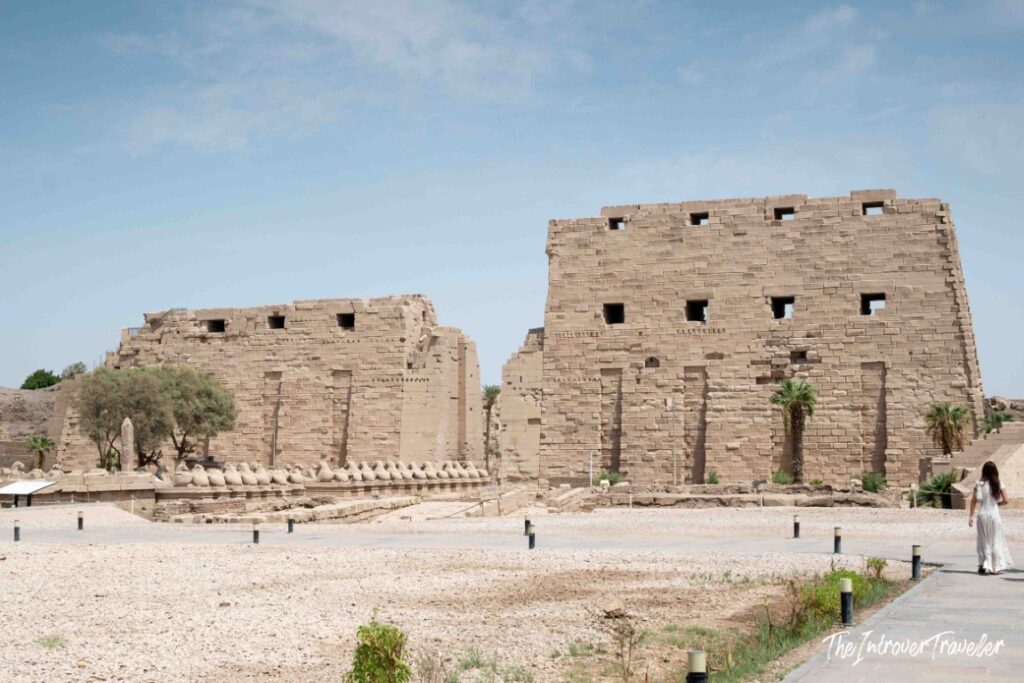
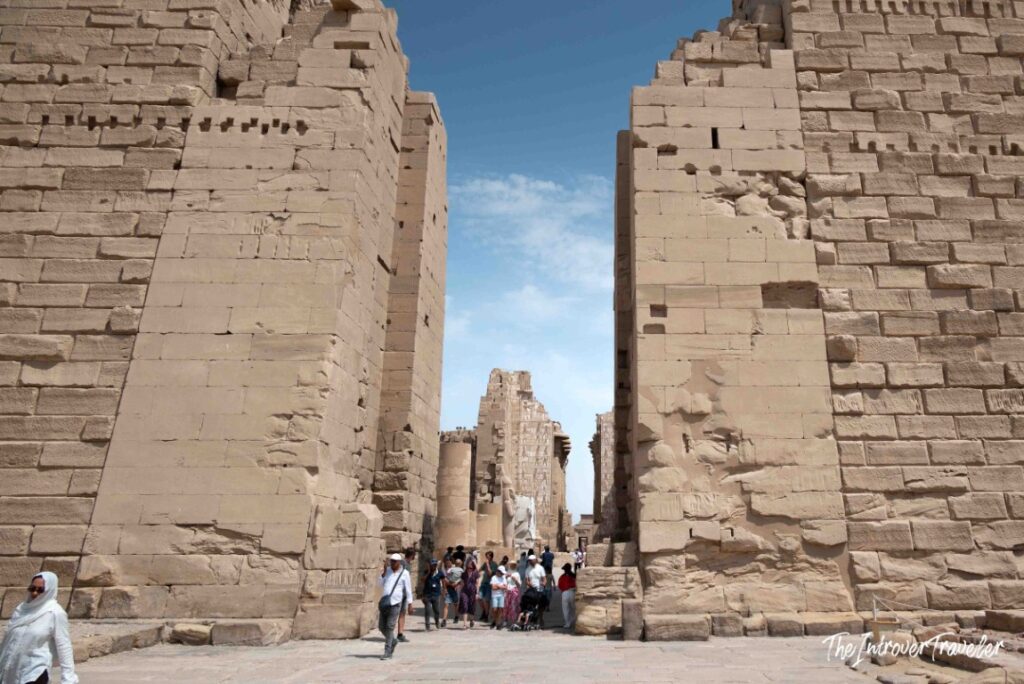
There are monuments that impress you with their age, others with their precision, others still with the audacity of a single vision imposed on an uncooperative landscape. Karnak impresses you with its accumulation. Not the accumulation of stones, though the quantity of stone here is staggering, but the accumulation of time: two thousand years of continuous construction, expansion, demolition, rebuilding, and addition by generation after generation of pharaohs, each determined to leave a mark on the most important religious complex in Egypt, and therefore, by the theological logic of the time, in the world. The result is not a temple. It is a city, or the fossilized skeleton of one: a sprawling, labyrinthine, partially ruined organism that covers over two square kilometers and that no single visit, and arguably no single lifetime of study, can fully exhaust.
I. What Karnak is, and how it came to be
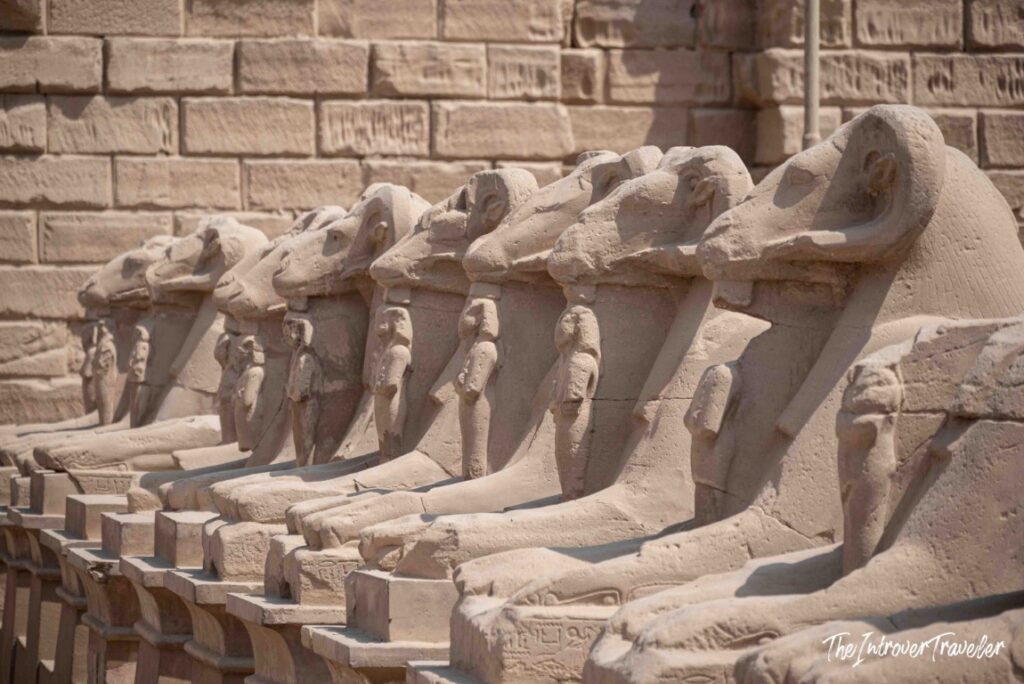
Karnak is not one temple but a complex of temples, chapels, pylons, obelisks, sacred lakes, and auxiliary structures accumulated over a period stretching from the Middle Kingdom, around 2000 BC, to the Ptolemaic period, around 30 BC, with the most intensive phase of construction occurring during the New Kingdom, between approximately 1550 and 1070 BC. It is the largest religious complex ever built in the ancient world, and by some measures the largest in human history. The site covers approximately 200 hectares, of which the main precinct dedicated to Amun, the Ipet-isut or “most select of places,” is itself larger than many European cathedrals combined.
The god to whom Karnak was primarily dedicated was Amun, or more precisely Amun-Ra, the synthesis of the local Theban deity Amun with the solar god Ra that became, during the New Kingdom, the supreme deity of the Egyptian pantheon and the ideological foundation of pharaonic power. The relationship between Karnak and the pharaoh was not merely devotional: it was political. To build at Karnak was to declare legitimate authority. To be recognized by Amun’s priests at Karnak was to have one’s kingship confirmed by the most powerful religious institution in Egypt. Conversely, to control Karnak’s enormous wealth, which at its height included vast landholdings, herds, workshops, and a workforce of tens of thousands of priests and servants, was to control a significant portion of the Egyptian economy. The temple and the state were not separate entities; they were aspects of the same organism.
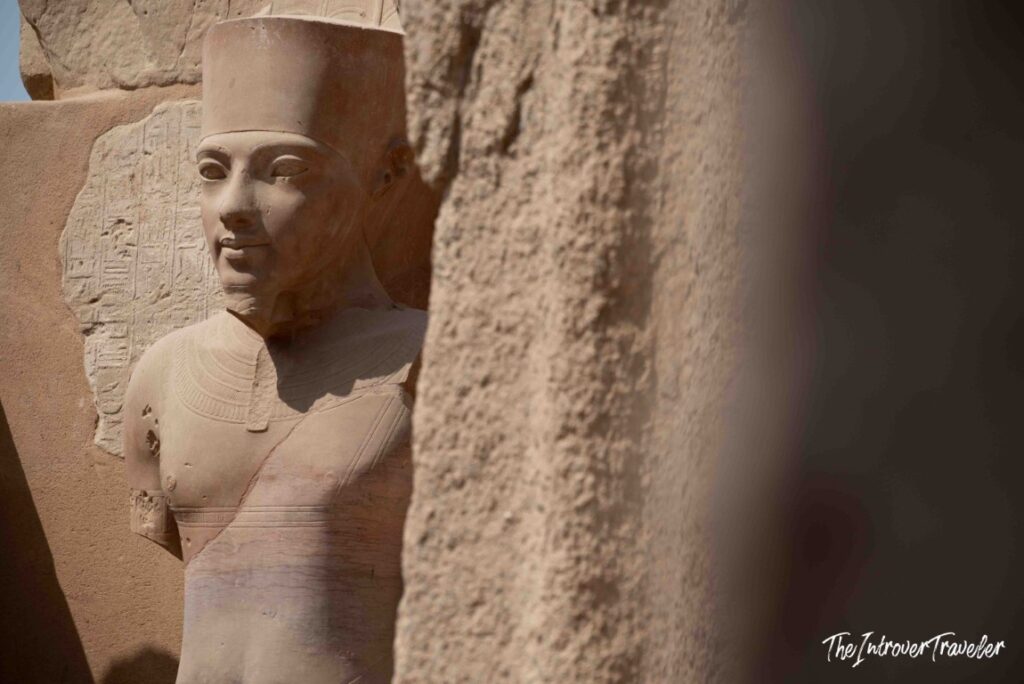
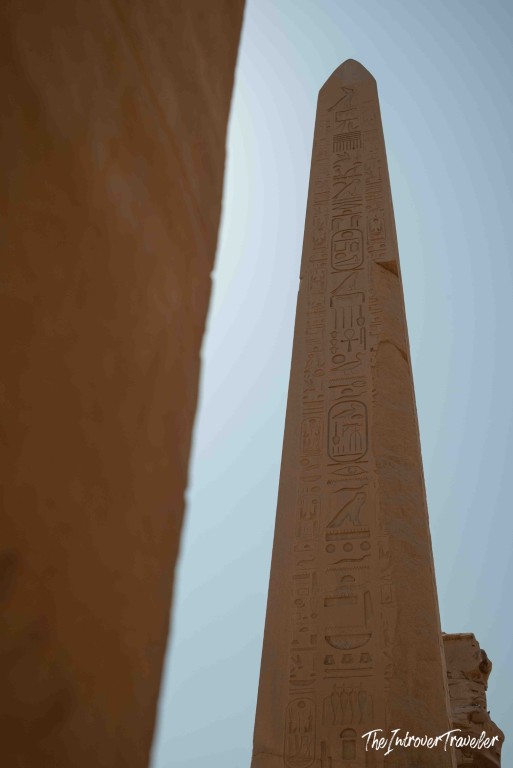
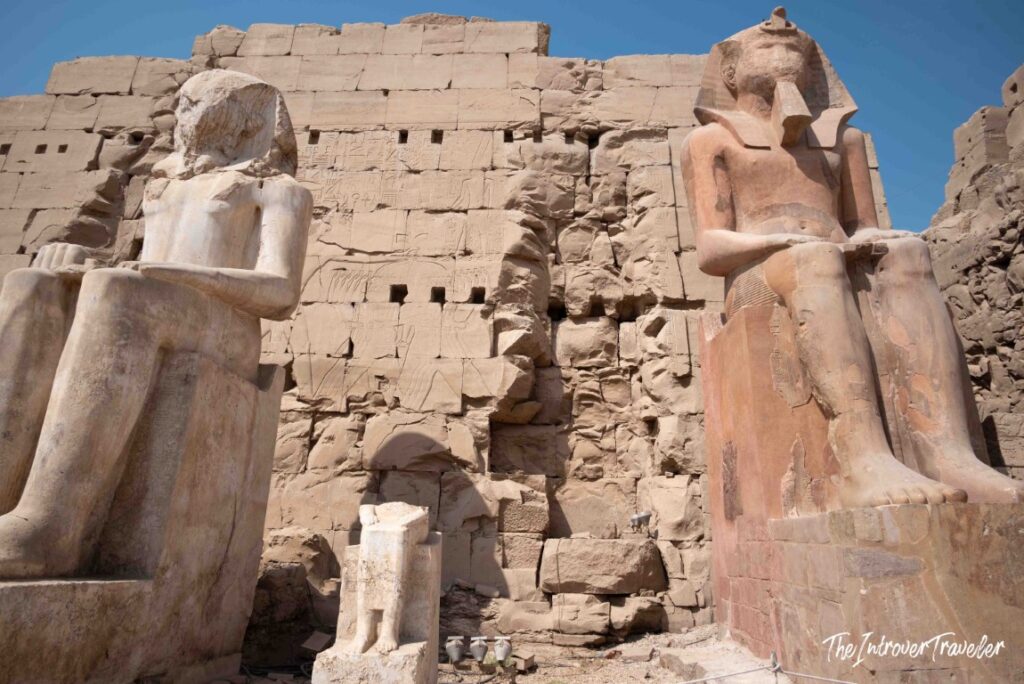
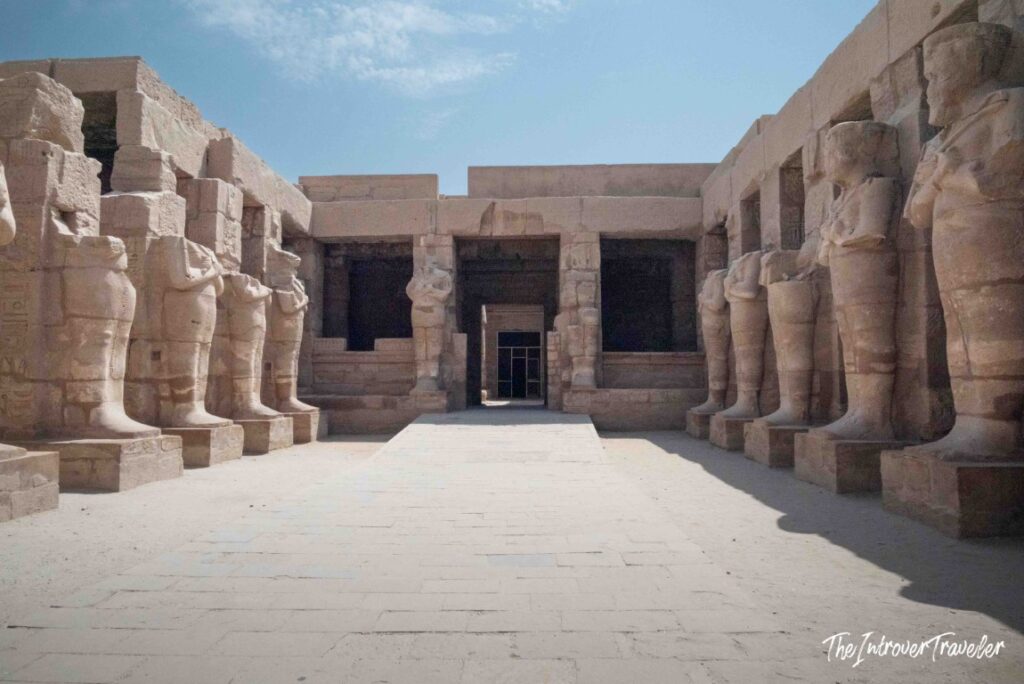
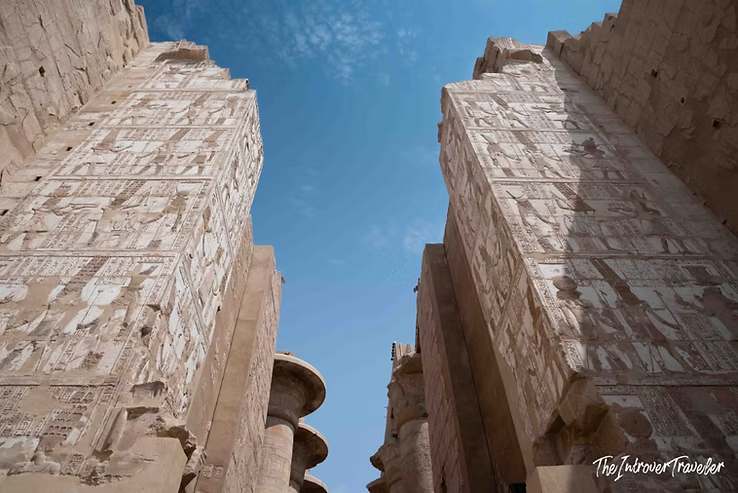
Every pharaoh of consequence added something to Karnak. Thutmose I built the first great pylons and raised obelisks. Hatshepsut added two more obelisks, the tallest in Egypt, one of which still stands at 29 meters. Thutmose III, in one of history’s more petty acts of architectural vandalism, walled in Hatshepsut’s obelisks after her death rather than demolish them, a decision that inadvertently preserved the lower portions of their gilded tips. Amenhotep III built the third pylon and added a colonnade of extraordinary ambition. Ramesses II, as was his habit everywhere in Egypt, left his name on every available surface and added colossal statues of himself at the entrance. The Ptolemies, Macedonian Greeks ruling an Egyptian state, added chapels in a hybrid style that tried with varying success to speak simultaneously the languages of two civilizations.
The result of twenty centuries of this process is a place that defies easy description and resists the kind of unified reading that a monument conceived and built by a single patron invites. Karnak is not a statement; it is a palimpsest, a surface written and rewritten so many times that the individual layers are difficult to separate and the overall text is, in the most productive sense of the word, illegible.
II. The Hypostyle Hall: a forest of stone
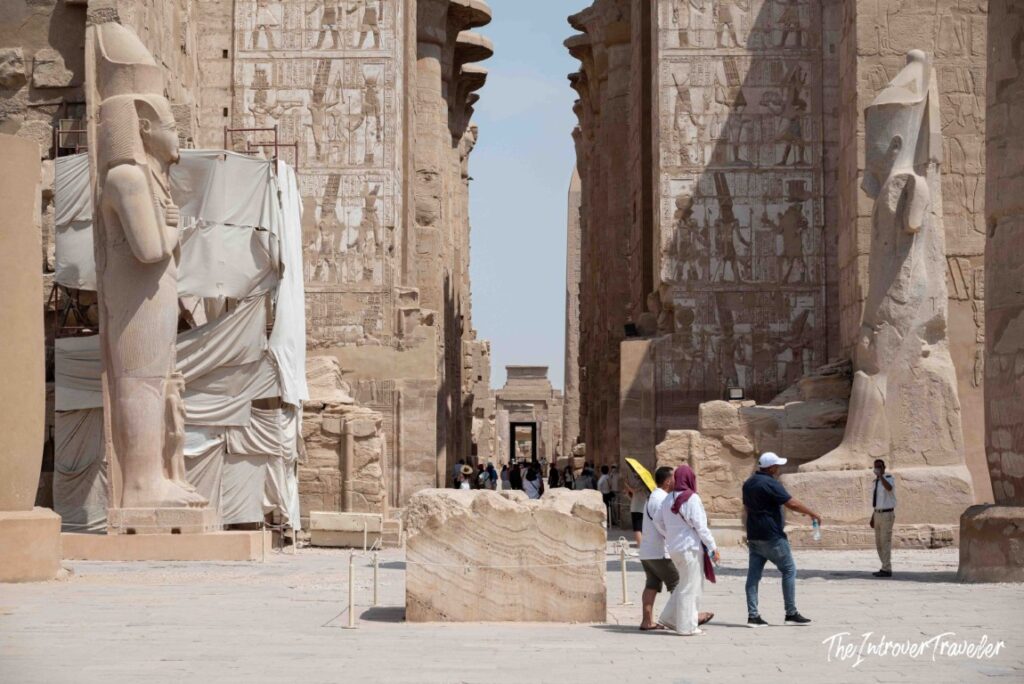
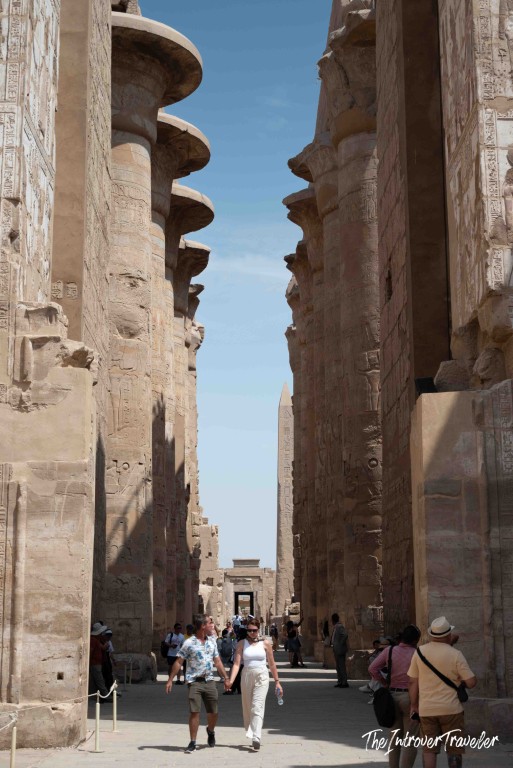
Within the overwhelming complexity of Karnak, one space stops every visitor regardless of preparation or expectation: the Great Hypostyle Hall, built primarily during the reigns of Seti I and Ramesses II in the Nineteenth Dynasty, around 1290-1224 BC, and still, after three thousand years and in a state of considerable ruin, one of the most spatially extraordinary interiors ever created by human hands.
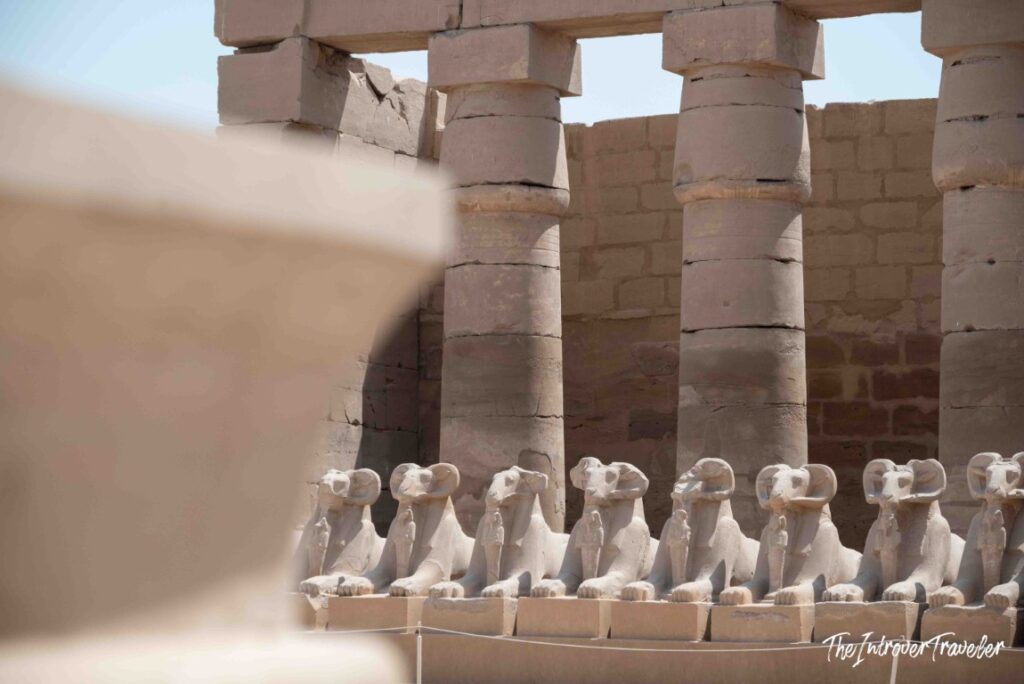
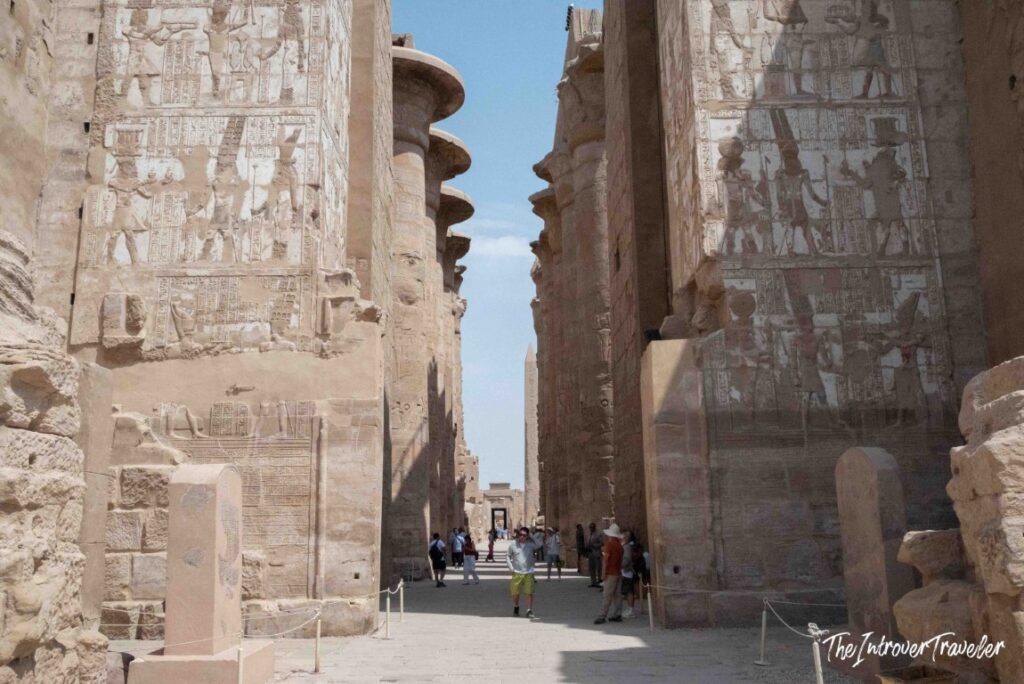
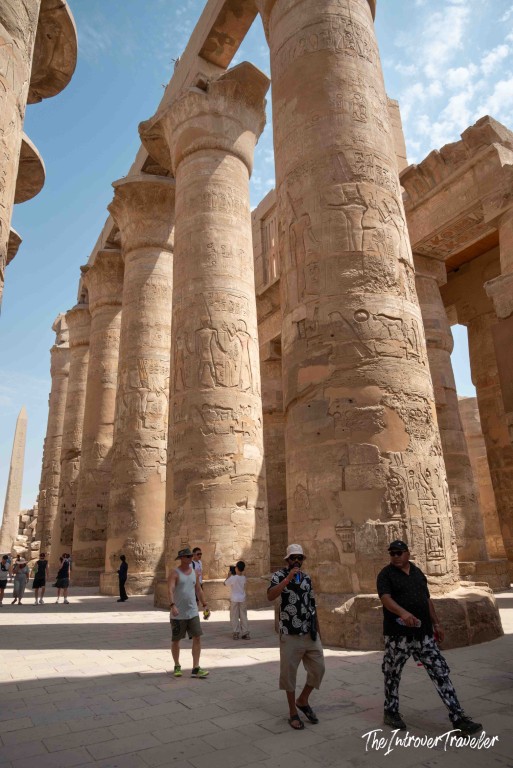
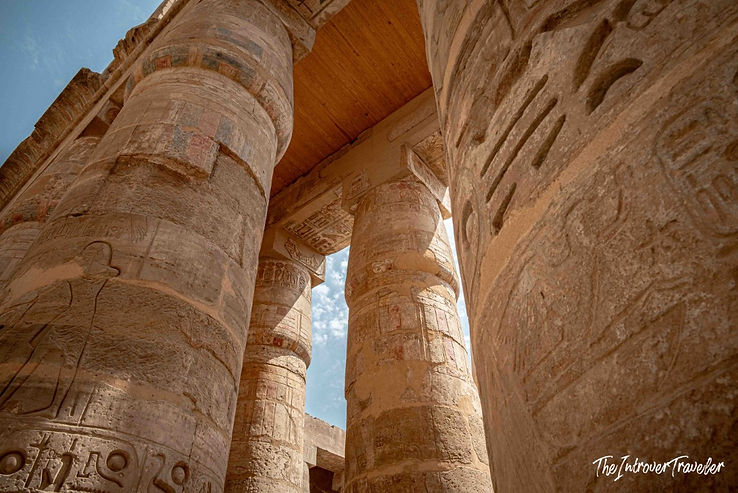
The numbers are necessary, because without them the space is difficult to visualize in advance: 134 columns arranged in 16 rows, covering an area of approximately 5,000 square meters. The twelve central columns, which formed the main processional axis, stand 21 meters tall with a diameter of over 3 meters at the base, each capital in the form of an open papyrus flower large enough for a person to stand on. The outer columns are slightly smaller, 13 meters, with closed bud capitals, and they are packed closely enough that the spaces between them are more corridor than aisle, the light filtering down in shafts between the stone in a way that, even at midday in August under a sky of incandescent white, produces an effect of controlled shadow that must have been, with the original painted surfaces intact and the ritual activity of the temple in full operation, overwhelming.
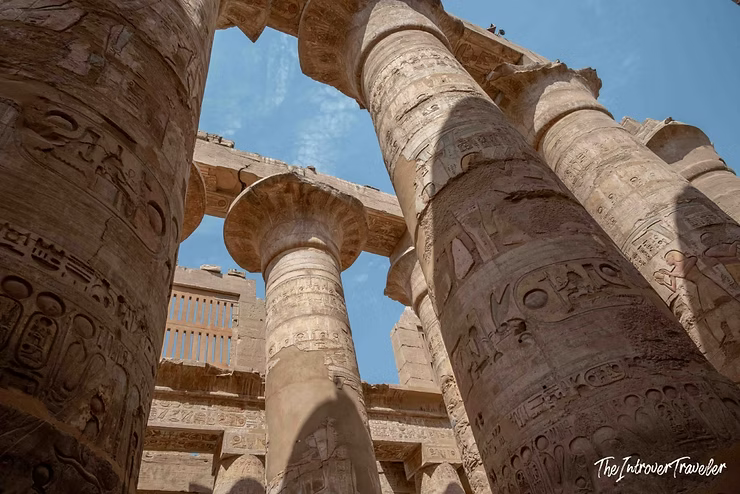
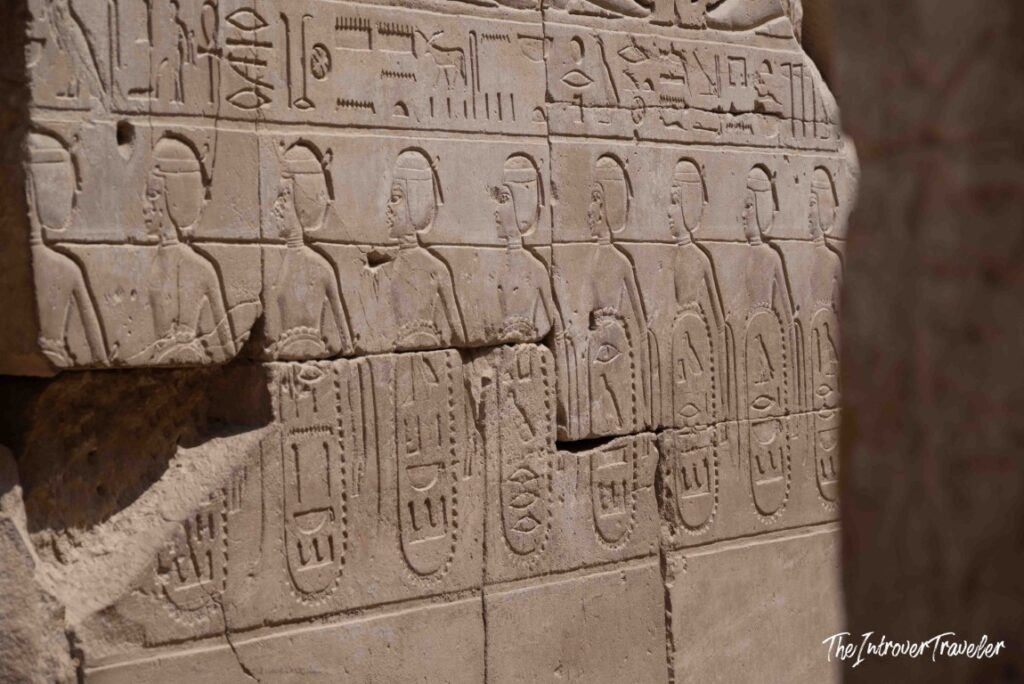
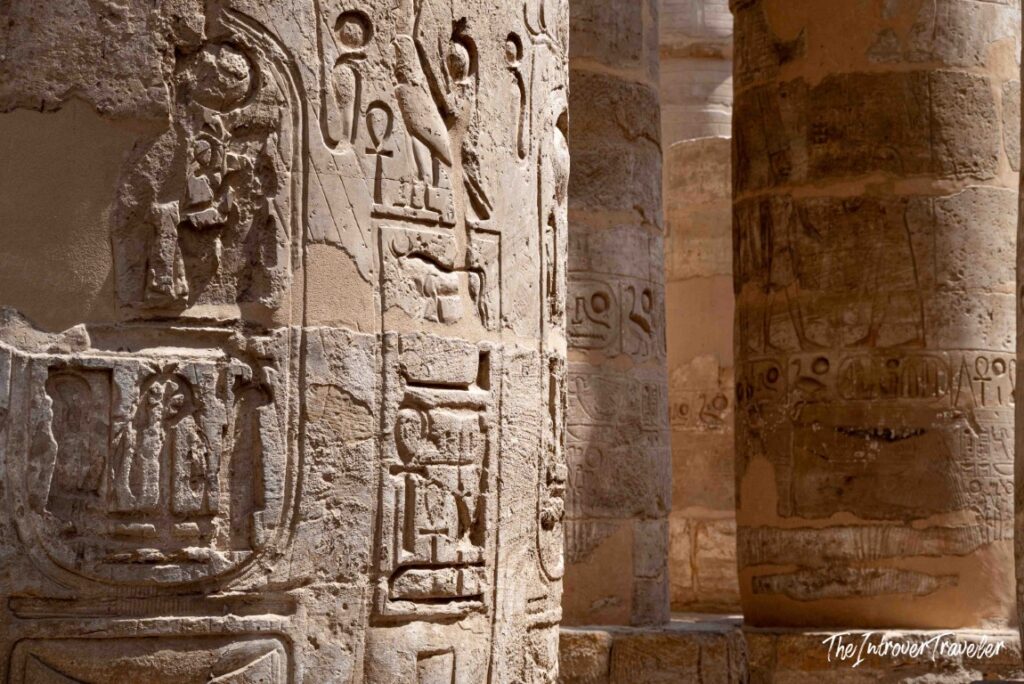
Because the surfaces were painted. This requires emphasis, because what you see today is bare stone in shades of grey and sand, corroded by millennia of weather and human contact. What the Egyptians built and decorated was a chromatic object of violent intensity: every column, every wall, every surface was covered in painted relief, in the blues and reds and yellows and greens of the Egyptian palette, the hieroglyphic texts and figural scenes covering every centimeter of available stone from floor to ceiling. Traces of this original color survive in the upper portions of some columns, protected from weathering by their height, and they are enough to give a sense of the difference between what we see and what was. The Great Hypostyle Hall as it originally stood was not a space of austere grey monumentality. It was a space of saturated, almost aggressive visual richness, every surface carrying information, every column a text, the whole thing amounting to an encyclopedia of theological and political claims pressed upon the worshipper from every direction simultaneously.
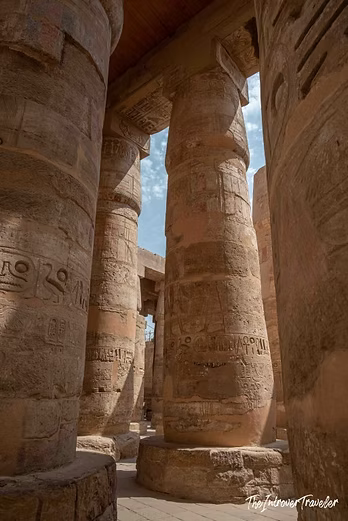
Even stripped of its color and its roof and much of its original height, the Hypostyle Hall is the most viscerally impressive interior I encountered in Egypt. Not the most moving, not the most ancient, not the most historically significant: but the most physically overwhelming. Walking into it from the courtyard, with the columns rising on every side and the scale refusing to resolve itself into anything the eye can comfortably measure, produces a sensation that I can only describe as architectural vertigo: the sudden and vertiginous awareness that the space you are in was designed, with complete intentionality, to make you feel exactly this small. This, of course, was the point. The Hypostyle Hall was not a space for congregational worship in the modern sense: ordinary Egyptians did not enter it. It was a space for the ritual movement of priests and the symbolic passage of the pharaoh, a transitional zone between the profane world and the inner sanctum where the god resided. Its scale was addressed not to the human body but to the divine presence it was designed to honor and contain. The columns are not too big for people: they are the right size for gods.
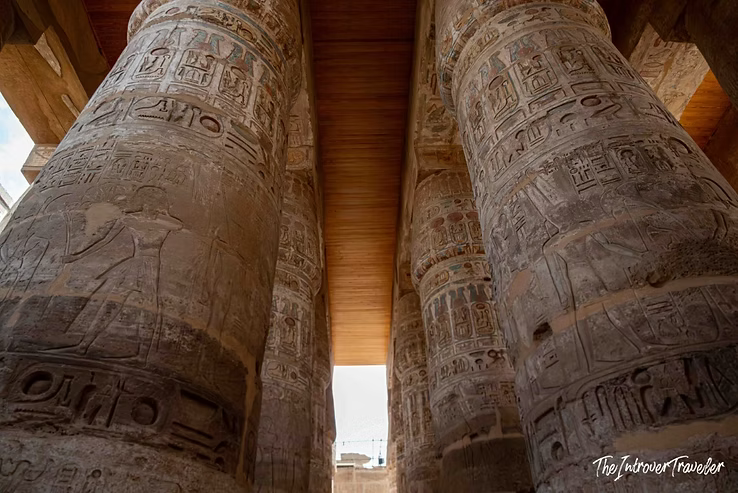
III. The problem of heat, and the problem of time
I visited Karnak in August, at a temperature that a thermometer in the sun would have registered at close to fifty degrees Celsius. I want to say something about this, not as a practical complaint, which it also is, but as an observation about how extreme heat changes the phenomenology of visiting an ancient site.
At fifty degrees, sustained attention becomes physiologically difficult. The body’s resources are increasingly directed toward temperature regulation, and what remains for contemplation and observation is noticeably reduced. You move faster than you want to, driven by the instinct to find shade; you spend time calculating the distance to the next shadow rather than reading the reliefs in front of you. The monuments recede slightly from the foreground of experience, and the experience of the body moves to the center. This is not entirely without interest, because it is a reminder that the people who built and used these monuments also lived in this climate, that the heat was not a hostile intrusion into their world but a permanent condition of it, that the thick walls and the forest of columns and the deep shadows of the hypostyle halls were not merely aesthetic choices but thermal ones. But it is also a genuine limitation, and one that a single hour at Karnak in August does not overcome.
Karnak deserves more than an hour. I am aware that my visit was constrained by a demanding itinerary that included, on the same day, the Valley of the Kings, the Valley of the Queens, and the temple of Hatshepsut, which is a reasonable day’s work in temperate conditions and a heroic one in August. The honest recommend
ation is to allow at minimum two hours for Karnak, three if the temperature permits sustained walking, and to arrive at opening time, both to avoid the worst of the heat and to experience the quality of the early morning light on the stone, which by all accounts transforms the site.
IV. Two thousand years of ambition in two square kilometers
Beyond the Hypostyle Hall, which tends to dominate every account of Karnak for obvious reasons, the complex rewards the visitor who is willing to walk further and look more carefully. The Sacred Lake, a large rectangular body of water used for ritual purification and still intact, provides a rare moment of horizontal calm in a site that is otherwise relentlessly vertical and crowded. The obelisks of Hatshepsut and Thutmose I, still standing after three and a half millennia, are among the most elegant objects in Egypt: the proportions of an Egyptian obelisk, tapering from a substantial base to the gilded pyramidion at the apex, have a formal refinement that makes them look almost impossibly slender from a distance, as if the stone had been drawn upward rather than cut. The open-air museum to the north of the main precinct contains architectural fragments reassembled from structures demolished by later pharaohs to fill the cores of their own buildings, including the White Chapel of Sesostris I, a Middle Kingdom structure of extraordinary delicacy reconstructed from blocks found inside the third pylon.
The precinct of Mut, the consort of Amun, to the south of the main complex, contains the ruins of her temple and a horseshoe-shaped sacred lake, and was once populated by hundreds of black granite statues of the lioness goddess Sekhmet, many of which survive. The precinct of Montu, the war god, to the north, is less visited and less well preserved, but for the visitor with sufficient time and inclination it adds another layer to the understanding of what Karnak was: not a single cult center but a theological city, housing the major deities of the state pantheon in a network of sanctuaries whose spatial relationships were themselves cosmologically meaningful.
What Karnak communicates, more than any other site in Egypt, is the sheer organizational and economic scale of Egyptian religion at its height. This was not a place of private devotion or quiet contemplation. It was a machine: a machine for the production of divine favor, for the maintenance of cosmic order, for the legitimation of political power, and for the employment and enrichment of a priestly class whose influence on Egyptian society was, at certain periods, comparable to that of the pharaoh himself. Walking through its ruins, even in their current state of considerable incompleteness, you feel the weight of that institutional ambition in a way that is different from anything the pyramids or the rock-cut tombs offer. The pyramids are the statement of an individual will projected against eternity. Karnak is the statement of a civilization projected against itself, generation after generation, each adding its voice to a conversation that lasted two thousand years and that we can still, imperfectly and partially, hear.
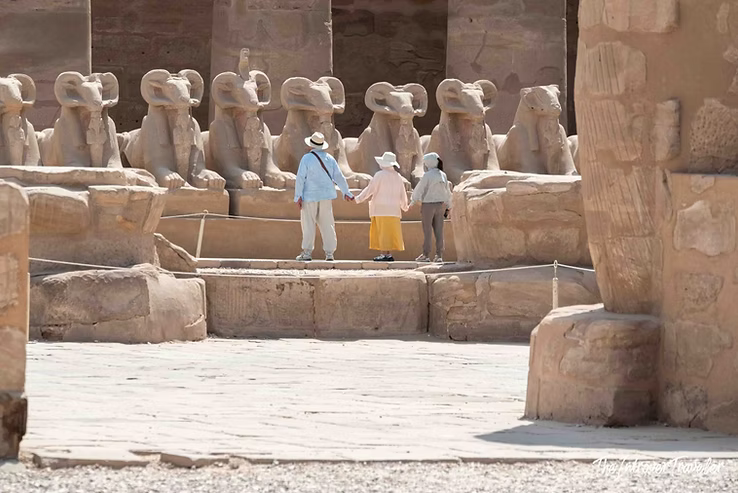
V. Temple of Karnak: Practical notes
Karnak is located on the east bank of Luxor, approximately three kilometers north of Luxor Temple, and is easily reachable by taxi, calèche, or on foot along the Nile corniche. The site opens at 6:00 am, and arriving at or shortly after opening is strongly recommended, particularly in summer: the difference in temperature between 6:00 am and 9:00 am is significant, and the difference in crowd density is even more so.
The main visitor circuit covers the precinct of Amun and takes between one and two hours at a moderate pace. A thorough visit including the precincts of Mut and Montu, the open-air museum, and the more peripheral structures requires a full half-day. Given the size of the site and the absence of shade in many areas, water is not optional.
The son et lumière show held in the evenings, which narrates the history of the site with dramatic lighting over the Sacred Lake, is a well-established attraction that many visitors combine with a daytime visit. I did not attend it on this occasion and cannot offer a direct assessment, though the setting is clearly well suited to the format.
Ticket prices are subject to revision and should be verified locally.
Personally, I visited the site after returning from a week of diving in the Red Sea, relying on the services of Dive UK Hurghada, which, in addition to competently assisting divers with dives in Hurghada and the surrounding area, also organizes trips to the archaeological sites of southern Egypt. The itinerary, departing at 5 a.m. from Hurghada, included, for the sake of giving a sense of reasonably sustainable travel times: one day in Luxor with visits to the Karnak Temple, the Valley of the Kings, the Valley of the Queens, and the Mortuary Temple of Hatshepsut, an overnight stay in Luxor, followed by a 5 a.m. departure for Abu Simbel, visit to the temple and return to Hurghada by dinner time.