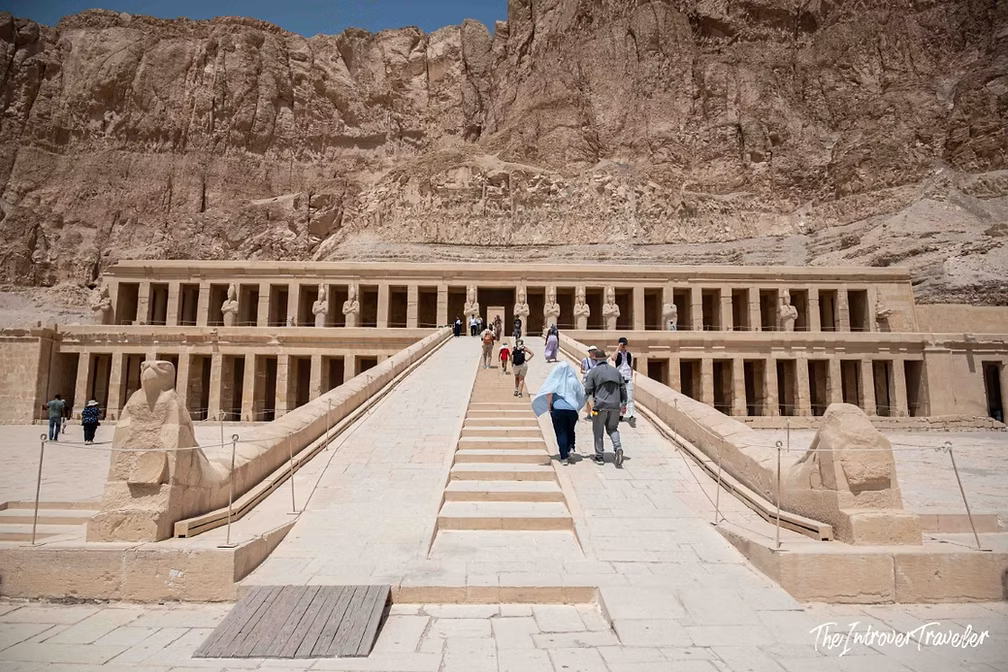
Date of visit: August 2025
My rating: 6/10
Visit duration: 45 minutes
Date: 1460 B.C. (700 years before the foundation of Rome)
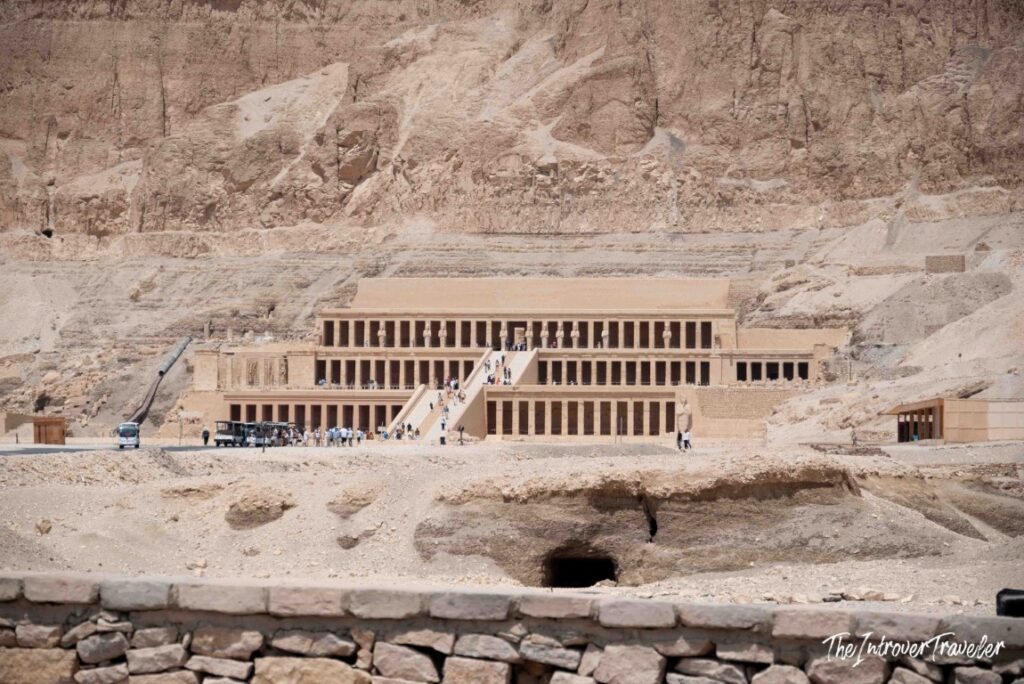
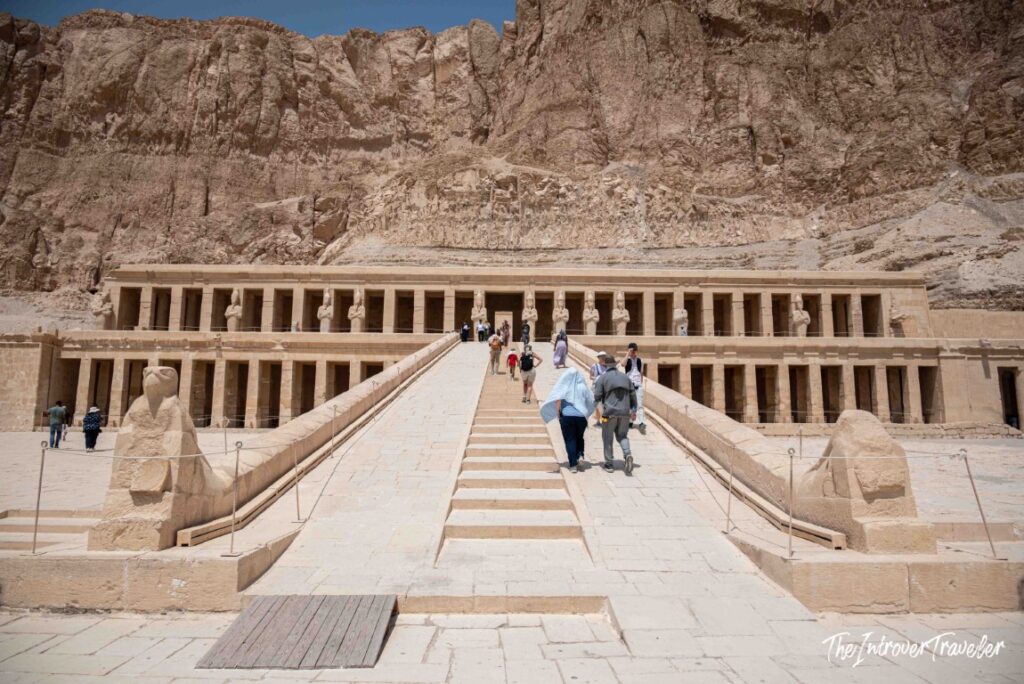
There are places in Egypt that overwhelm you with their scale, their darkness, or their silence. The temple of Hatshepsut does none of these things: it overwhelms you with its setting. The three colonnaded terraces rising against the sheer face of the Theban cliffs, the geometry of the structure in dialogue with the natural geometry of the rock behind it, the quality of the light in the early morning when the shadows are still long and the stone is still cool: this is, without question, one of the most dramatically situated monuments in Egypt, and possibly in the world. Whether the monument itself, as it stands today, fully justifies the setting is a more complicated question, and one I will return to.
I. Hatshepsut: the woman who was pharaoh
We live in times in which ideological narratives prevail over study, in-depth inquiry, and knowledge, making it easy to indulge in the stereotype that Ancient Egypt was a straightforward succession of male rulers. It was not, and Hatshepsut is the proof.
Hatshepsut was the daughter of Thutmose I, one of the most successful military pharaohs of the early Eighteenth Dynasty, and the wife of his successor Thutmose II, her half-brother, as was standard practice in a dynasty that treated royal blood as a commodity too precious to dilute through marriage outside the family. When Thutmose II died, around 1479 BC, the heir to the throne was Thutmose III, his son by a secondary wife: a child, and therefore unable to rule. Hatshepsut, as the principal royal wife and daughter of a pharaoh, became regent. So far, this was not unusual: Egyptian history records several women who held power in similar circumstances. What was unusual, and what makes Hatshepsut one of the most remarkable figures in the history of the ancient world, is what she did next. Within a few years of assuming the regency, she declared herself pharaoh. Not queen, not regent: pharaoh, with the full titulary, the double crown, and, in official representations, the false beard.
She ruled for approximately twenty years, from around 1473 to 1458 BC, and by any measure she ruled well. Trade expeditions were sent to the land of Punt, on the Horn of Africa, returning with myrrh trees, ebony, ivory, and exotic animals, a feat commemorated in the reliefs of her temple in such vivid detail that Egyptologists have used them to identify the species of fish in Punt’s coastal waters. Obelisks were erected at Karnak, two of which still stand, among the tallest ever raised in Egypt. Building projects were undertaken across the country. The empire was not expanded, but it was consolidated and administered with evident competence.
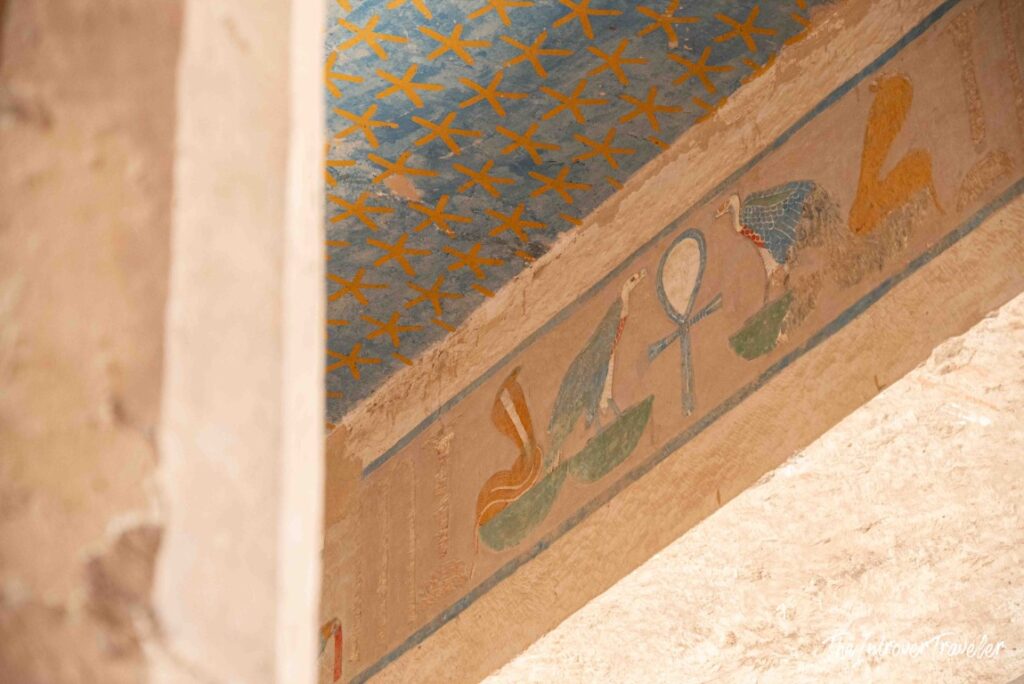
Her legitimacy, however, was always ideologically precarious. A woman exercising full pharaonic power was, in Egyptian political theology, an anomaly that required constant justification. The temple of Deir el-Bahari is, among other things, a machine for producing that justification. Its walls carry a programmatic narrative of Hatshepsut’s divine birth: her mother, the queen Ahmose, is visited by the god Amun in the guise of her husband, and from this union Hatshepsut is conceived. The message is explicit and cannot be misread: she is not a woman who seized power by accident of circumstance. She is the daughter of a god, chosen before her birth to rule Egypt, her authority underwritten by divine will rather than by the mere accident of gender. It is propaganda of the highest order, executed in stone and paint with the full resources of the Egyptian state, designed to last forever.
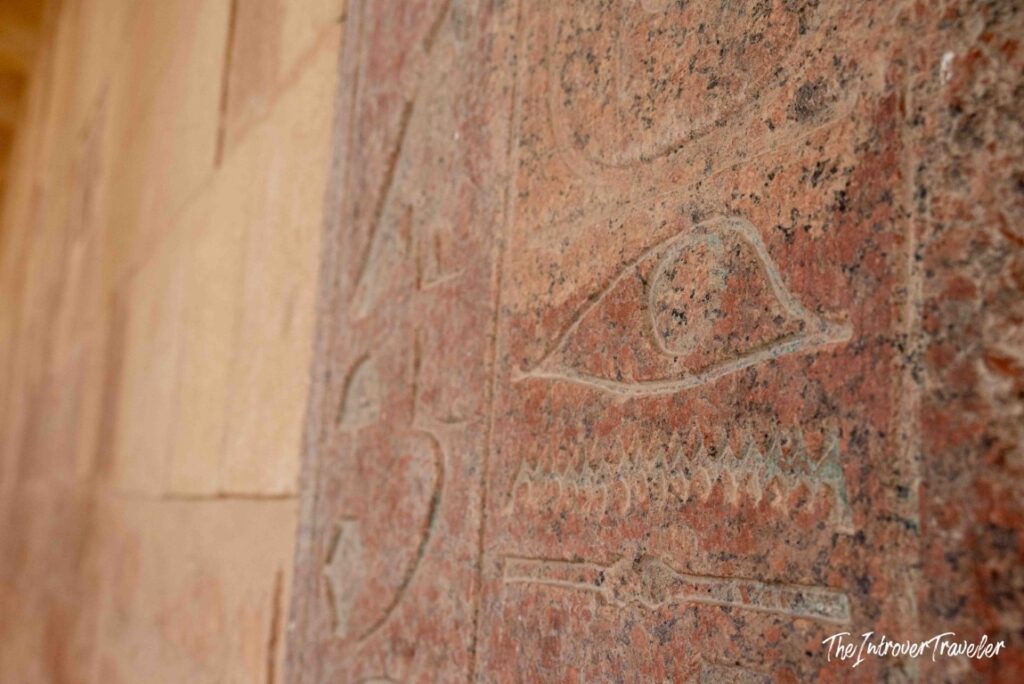
After her death, Thutmose III, who had been co-ruler throughout her reign and who now ruled alone, undertook a systematic campaign to erase her from history. Her images were defaced, her cartouches chiseled out, her statues smashed and buried. For centuries, she was forgotten. It was not until the nineteenth century that Egyptologists began to piece together the evidence and identify the female pharaoh whose existence the historical record had so methodically suppressed. The reasons for Thutmose III’s erasure campaign are still debated: personal animosity, political calculation, the desire to restore an unambiguous male succession, or simply a posthumous tidying of the ideological record. Whatever the motive, the attempt ultimately failed. Hatshepsut survived, in the stones of her temple and in the buried fragments of her statues, reassembled painstakingly by the Metropolitan Museum of Art from thousands of pieces found in a pit at Deir el-Bahari, and now among the masterpieces of Egyptian art in New York.
II. The temple of Hatshepsut: architecture as argument
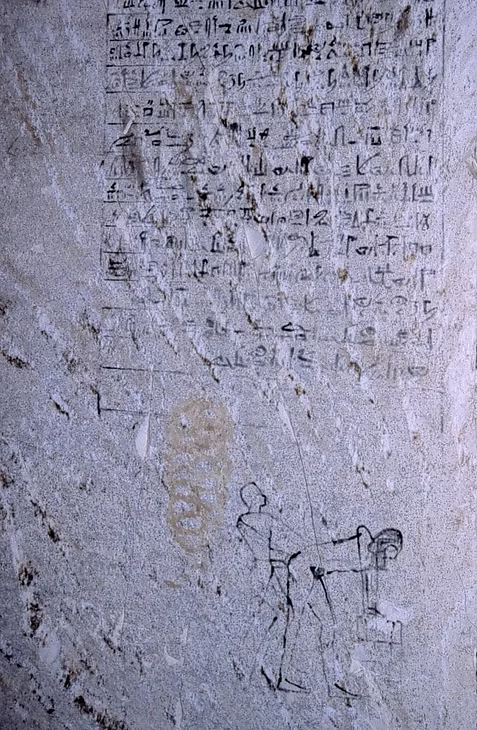
The temple of Deir el-Bahari, known in antiquity as Djeser-Djeseru, “the Holiest of Holies,” was designed by Hatshepsut’s chief steward and probable closest advisor, Senenmut, one of those figures in Egyptian history whose proximity to power invites speculation that the evidence neither confirms nor entirely refutes (there has been much speculation about a graffito found in a cave at Deir el-Bahari, depicting a woman with royal attributes being penetrated from behind by a man whom some have identified as Senenmut; for those wishing to explore the issue further, I point to this article, whose arguments, however, do not always strike me as convincing: https://mediterraneoantico.it/articoli/sui-graffiti-erotici-di-deir-el-bahari/).
The temple was built over a period of roughly fifteen years, beginning in the early years of Hatshepsut’s reign as pharaoh, and it was conceived from the outset not merely as a funerary temple, which is what it formally was, but as a comprehensive ideological statement.
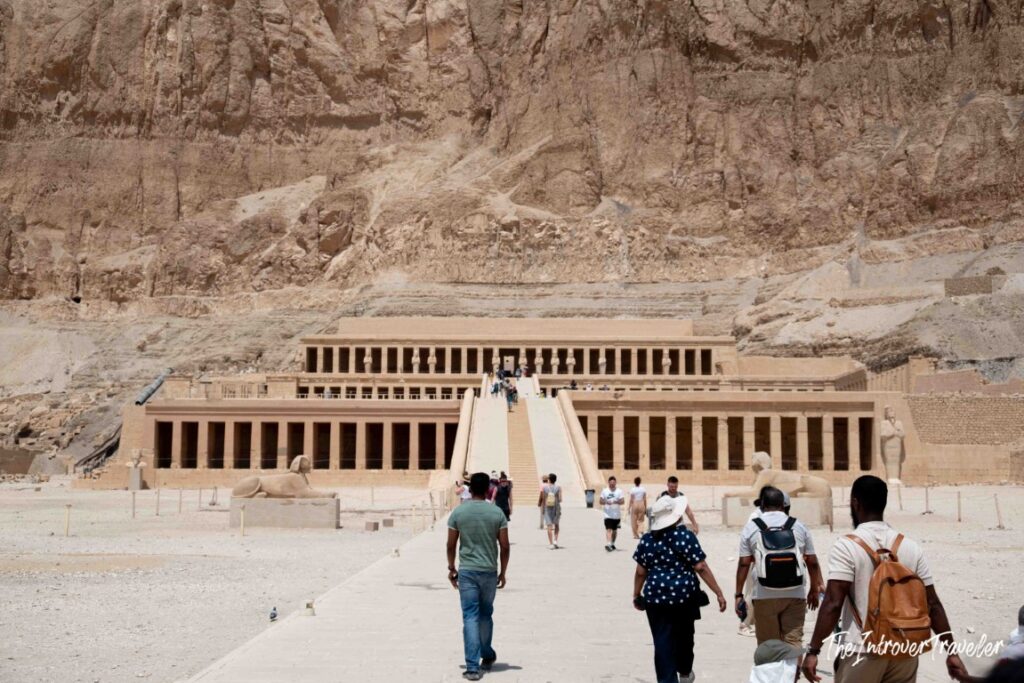
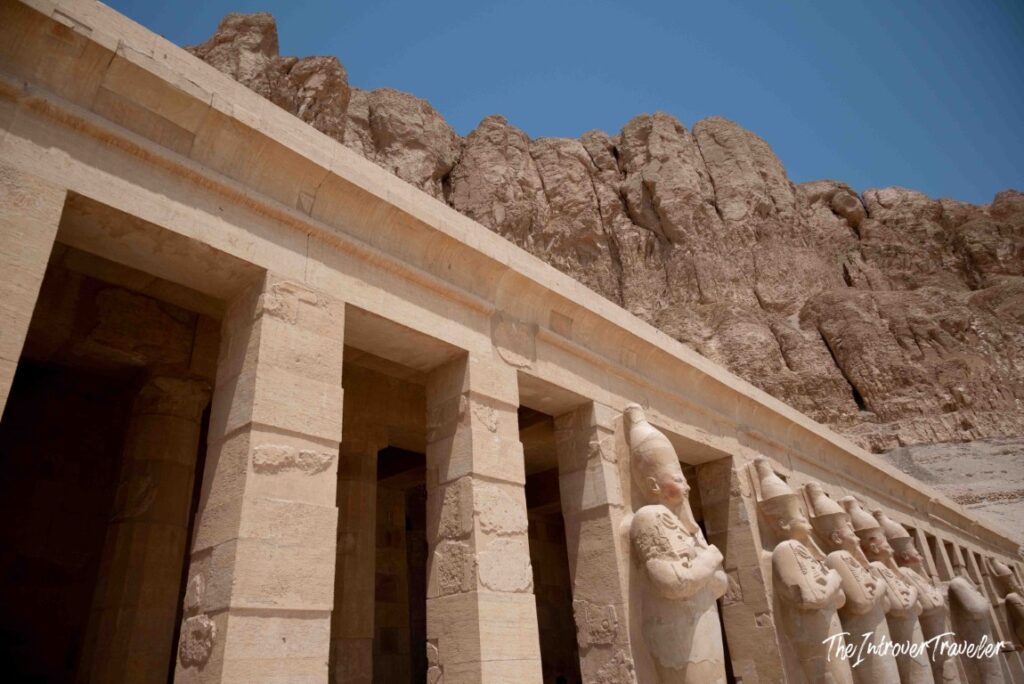
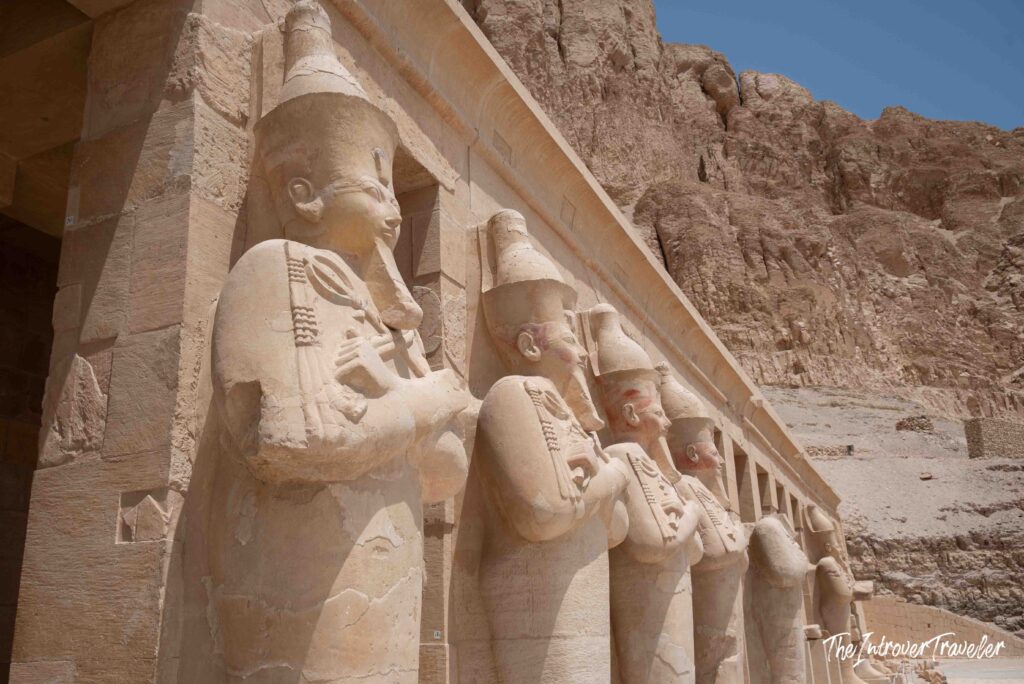
The structure consists of three colonnaded terraces connected by ramps, cut partially into the cliff face and partially built out from it, in a design that is unique in Egyptian architecture: not a forest of columns like Karnak, not a rock-cut sanctuary like Abu Simbel, but something that negotiates between the built and the natural in a way that feels almost modern in its spatial intelligence. The cliff of the Theban massif functions as the temple’s back wall and crowning element simultaneously: the architecture does not fight the landscape but incorporates it, making the mountain itself part of the monument’s rhetoric.
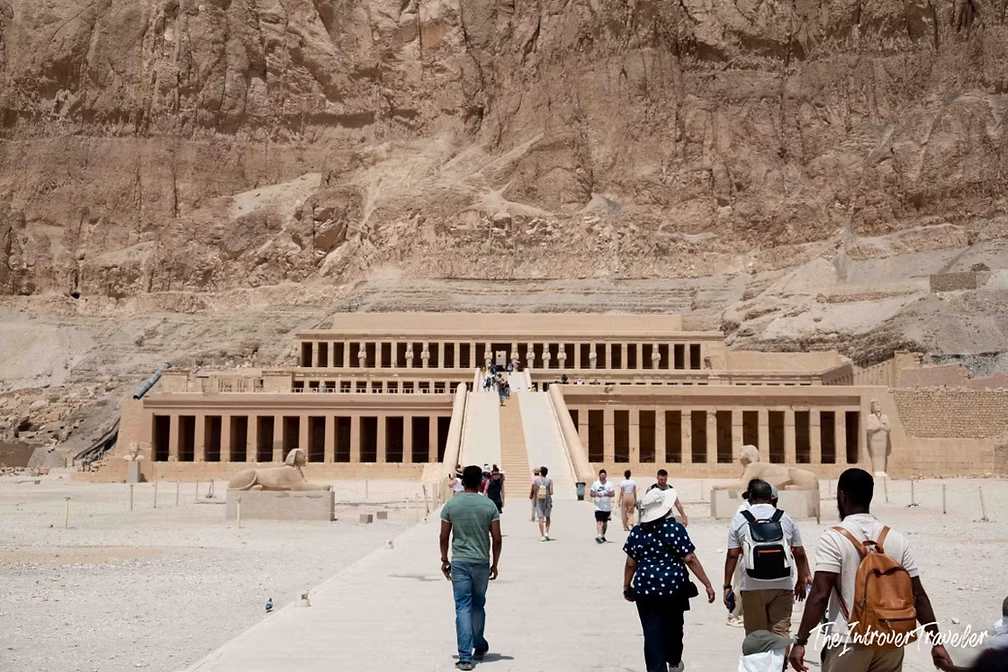
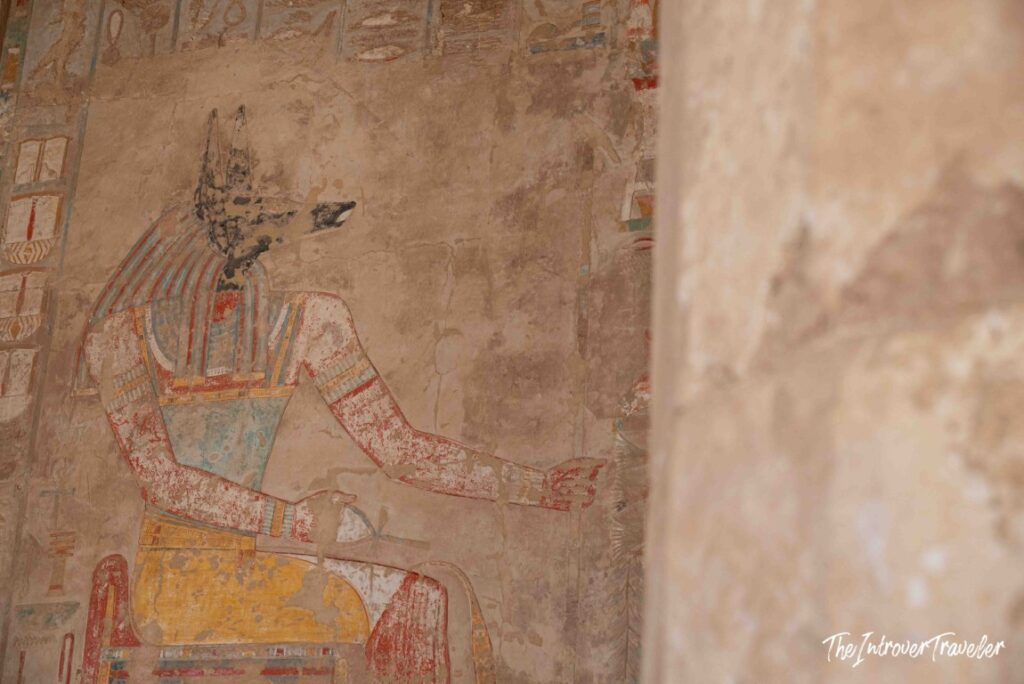
The sanctuary at the upper level was dedicated primarily to Amun, the state god whose divine paternity of Hatshepsut is proclaimed throughout the temple’s decoration. There were also chapels dedicated to Hathor and Anubis, and a solar chapel aligned to receive the light of the rising sun on specific dates. The colonnades of the middle terrace carried the reliefs depicting the expedition to Punt and the divine birth cycle, the two narrative programs that together constitute the temple’s political and religious argument: divine origin above, worldly achievement below, the combination amounting to a complete portrait of legitimate sovereignty.
The temple was not built in isolation: it stood beside an earlier structure, the funerary temple of Mentuhotep II of the Eleventh Dynasty, which had occupied the same bay in the cliffs for five centuries before Hatshepsut chose this location for her own monument. The choice was deliberate: by building next to one of the founders of the Middle Kingdom, Hatshepsut was inserting herself into a specific lineage of royal achievement, claiming a connection to the great tradition of Theban kingship that reinforced her own contested legitimacy.
III. November 1997
On 17 November 1997, a group of six militants from the organization Al-Gama’a al-Islamiyya entered the temple of Deir el-Bahari at around nine in the morning, armed with automatic weapons and knives, and spent approximately forty-five minutes killing tourists. Sixty-two people died, among them a five-year-old child and four couples on their honeymoon. The majority of the victims were Swiss, Japanese, German, and British. The attackers had disguised themselves as members of the security forces. Several of the victims were mutilated. The attack ended when the militants were cornered and killed by police in a nearby canyon.
It was, at the time, the deadliest terrorist attack in Egyptian history, and one of the deadliest attacks on tourists anywhere in the world in the twentieth century. It effectively destroyed Egyptian tourism for several years, and its psychological impact on the country’s relationship with its own heritage sites was lasting.
I am writing this because, visiting the temple in August 2025, I found it impossible not to think about it. The site has the quality that many open spaces in Egypt share: it is large, exposed, and in the morning hours, before the tour groups arrive, almost eerily quiet. The ramps, the colonnades, the open terraces offering long sight lines across the plain: it is easy, too easy, to reconstruct in the mind the geometry of that morning, the positions, the directions, the absence of cover. This is an uncomfortable thought, and I am not sure it is a thought one should suppress. The sixty-two people who were killed here were doing exactly what I was doing: visiting a monument on a tourist itinerary, in the reasonable expectation that the greatest risk of the morning was sunstroke. The fact that one cannot close a UNESCO World Heritage Site for eternity does not mean that walking its terraces is a neutral experience. For me, it was not.
I recommend reading The Looming Tower: Al-Qaeda and the Road to 9/11 by Lawrence Wright; a large part of the book is devoted to illustrating how, precisely in Egypt, the fanaticism of radical Islam emerged and developed from the 1950s onward, and how this ideology came into being, as ideologies often do, by deliberately constructing an enemy in order to fuel a radical drift that previously had no substantial reason to exist. This is not to suggest that American foreign policy is free from blame, quite the opposite, nor that reading a single book, which inevitably reflects the perspective of its author, is sufficient to develop real expertise on the subject, but rather to point out yet another confirmation that ideologies typically arise to reiterate the old pattern of divide et impera.
IV. The reconstruction: a temple almost entirely rebuilt
There is a second discomfort at Deir el-Bahari, less acute than the first but intellectually more nagging, and it concerns what you are actually looking at when you look at the temple.
The impression the site gives, particularly from a distance, is of a monument in an exceptional state of preservation: the three terraces intact, the colonnades complete, the overall form clear and legible. This impression is false, or at least profoundly misleading. The temple of Hatshepsut was, when archaeological work began in the nineteenth century, a ruin of considerable severity. Centuries of use as a Coptic monastery, systematic spoliation of its stones, the defacement campaigns of Thutmose III and later of Akhenaten, the effects of time and flood and earthquake, had reduced it to a state in which a substantial portion of what stood was rubble and what remained standing was fragmentary.
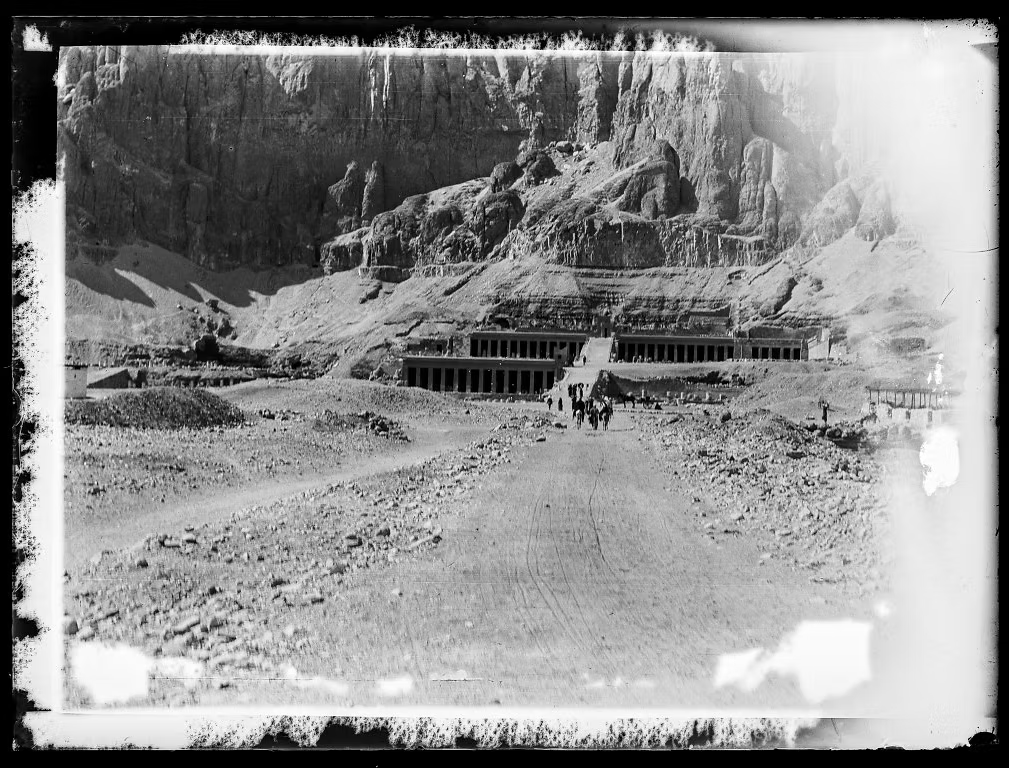
The reconstruction carried out primarily by Polish archaeologists from the 1960s onwards, under the auspices of the Polish Centre of Mediterranean Archaeology, was extensive by any standard: walls rebuilt, columns re-erected, surfaces restored, ramps reconstructed. What stands today is, in large part, a twentieth-century building occupying the footprint and following the design of an ancient one.
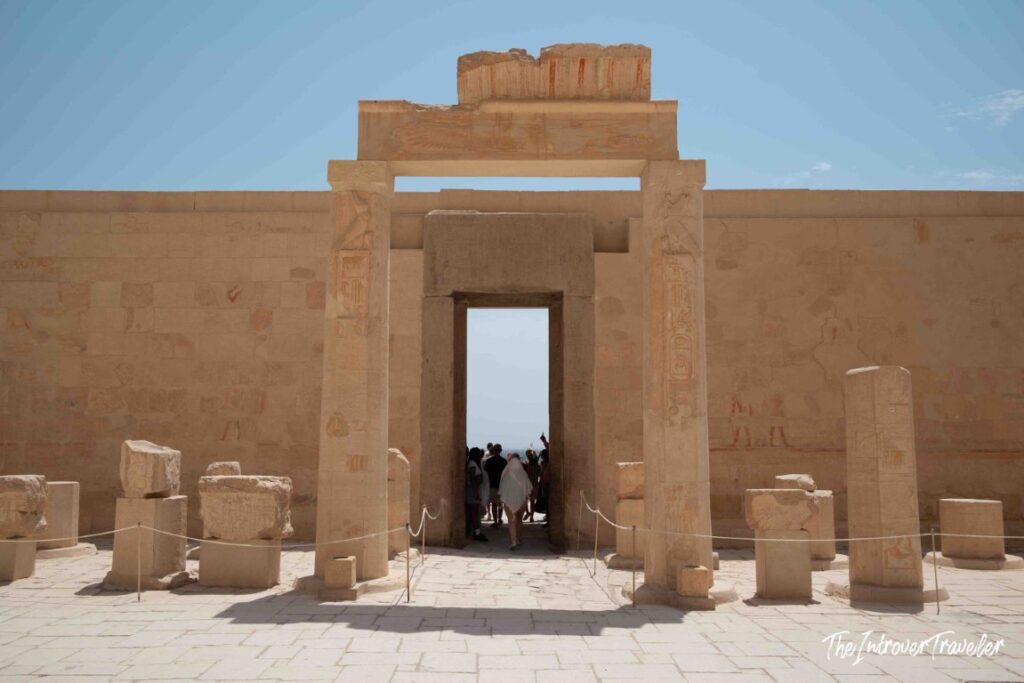
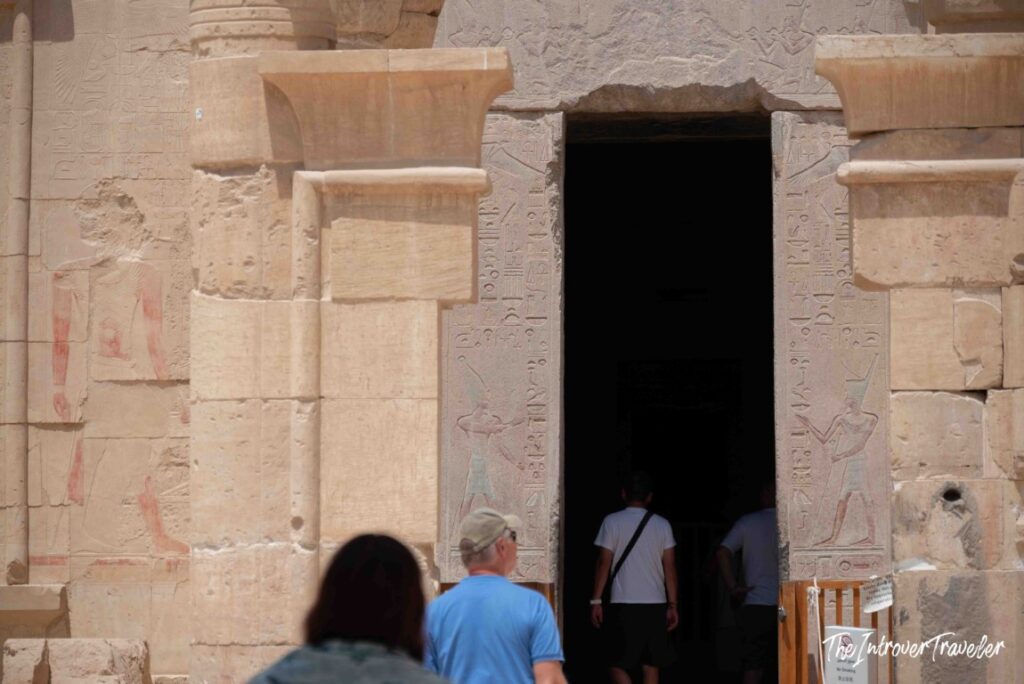
I want to be clear that I am not questioning the scholarship or the competence of the work, which by all accounts has been conducted with rigor and care. I am questioning a philosophy of restoration. When a monument has been reconstructed to the degree that Deir el-Bahari has, the visitor deserves to know, visibly and unmistakably, what is ancient and what is new. The standard adopted at some sites, of using a slightly different material or finish for restored elements, of marking the boundary between original and reconstruction in a way that is legible without being intrusive, seems to me not merely preferable but ethically necessary. At Deir el-Bahari, the distinction is not readily apparent to the non-specialist. You walk through a space that presents itself as ancient and is largely modern, and you are not told this unless you have done your reading in advance.
The effect, for someone who has done that reading, is a persistent unease: the nagging awareness that the column you are looking at, the wall against which you are resting your hand, the ramp you are climbing, may or may not have been stood here three and a half thousand years ago, and that the monument is not offering you the means to tell the difference. There is something almost theatrical about it, and not entirely in a good sense.
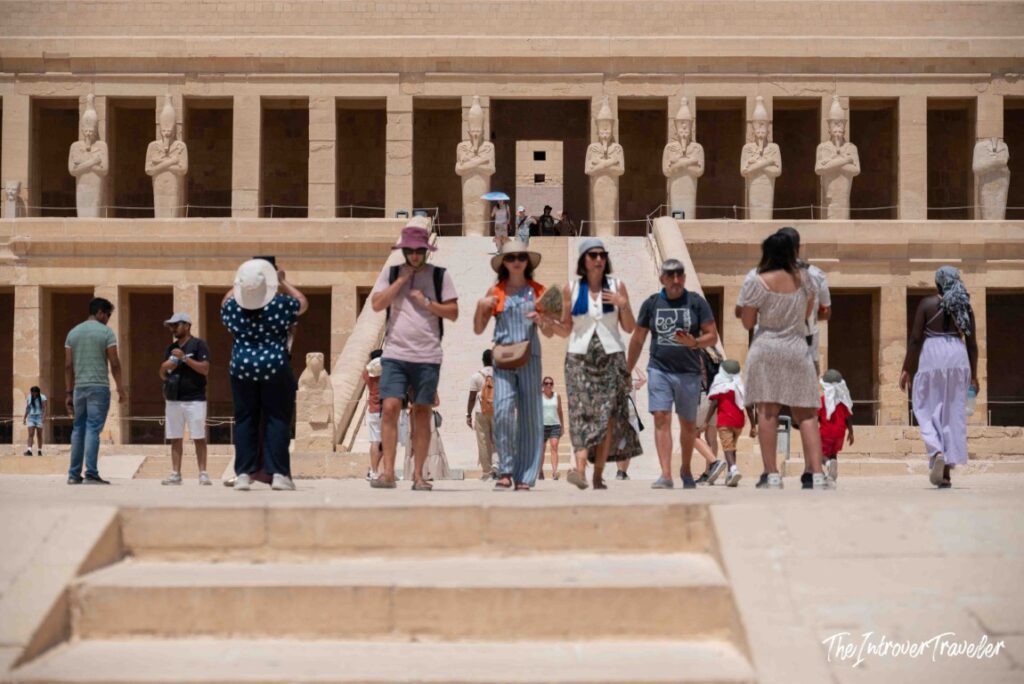
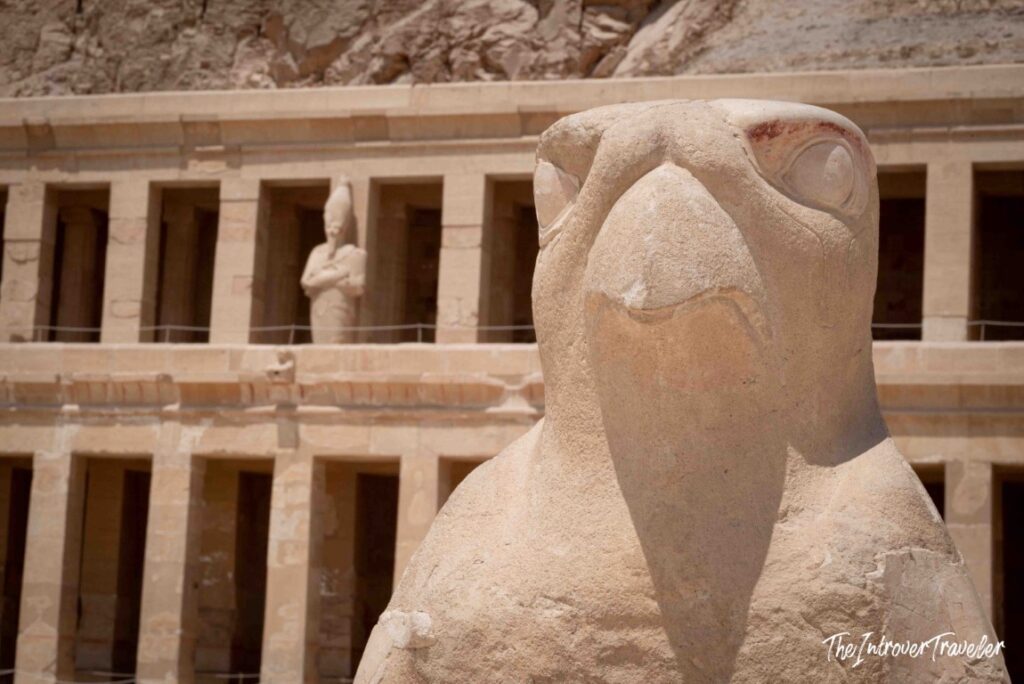
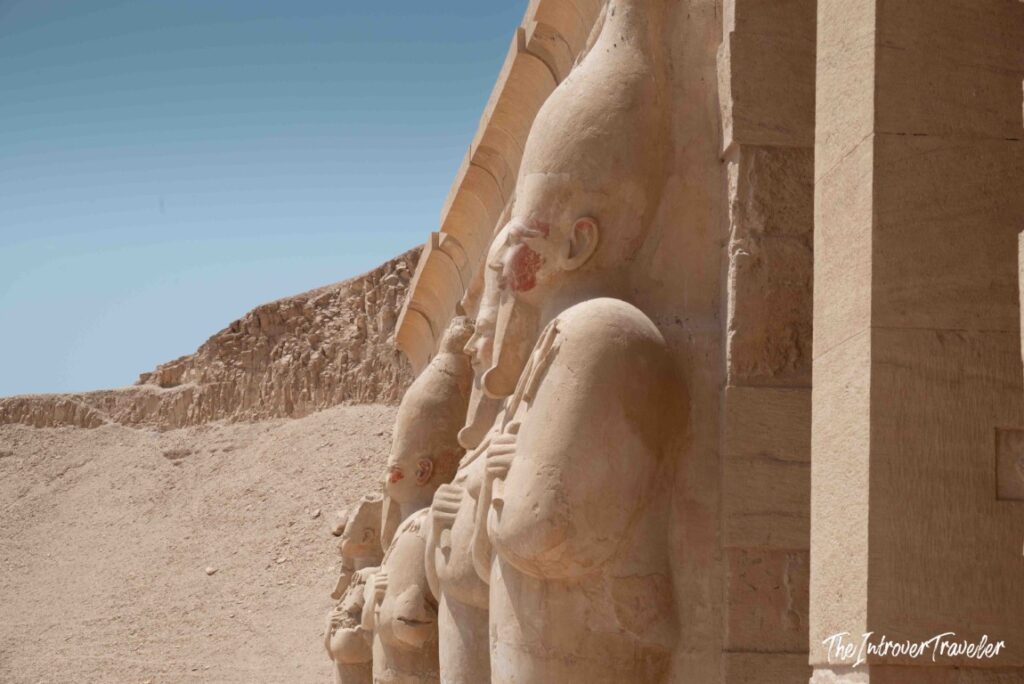
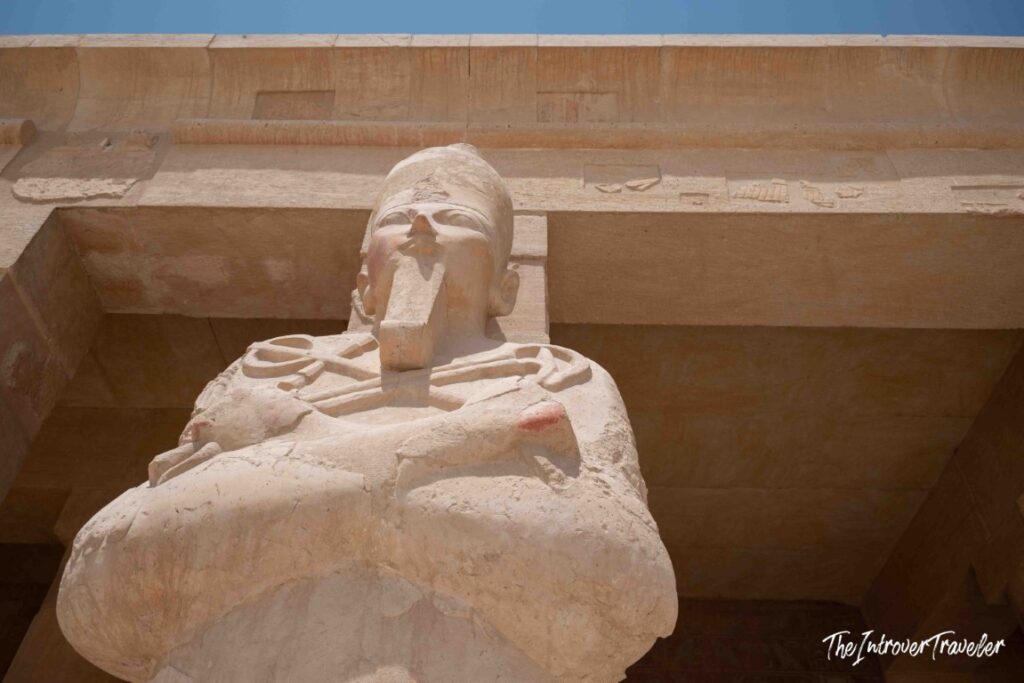
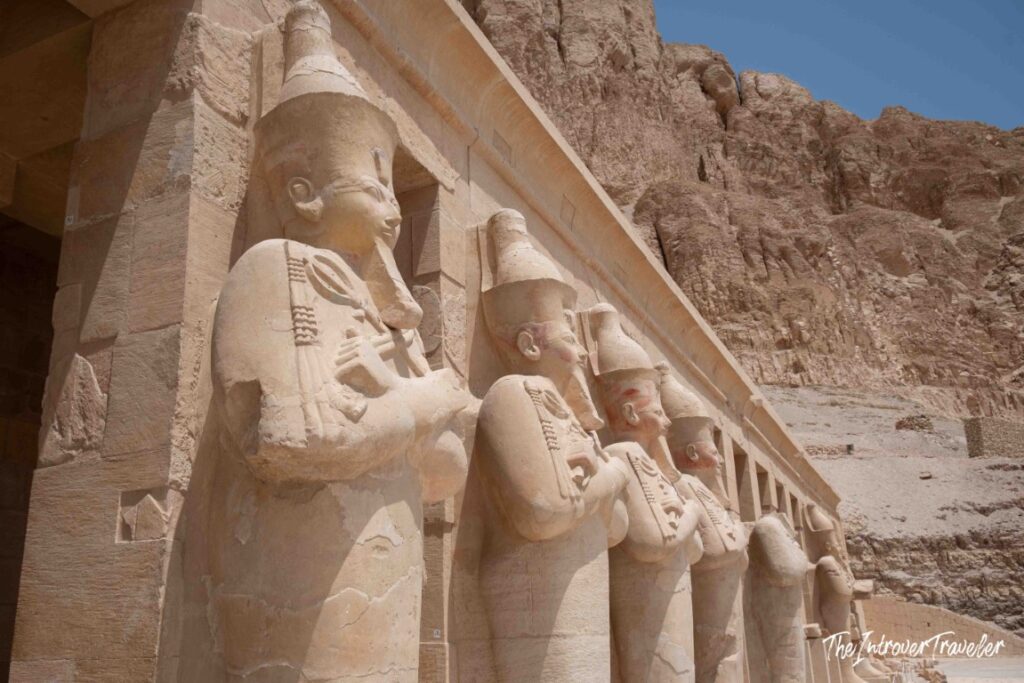
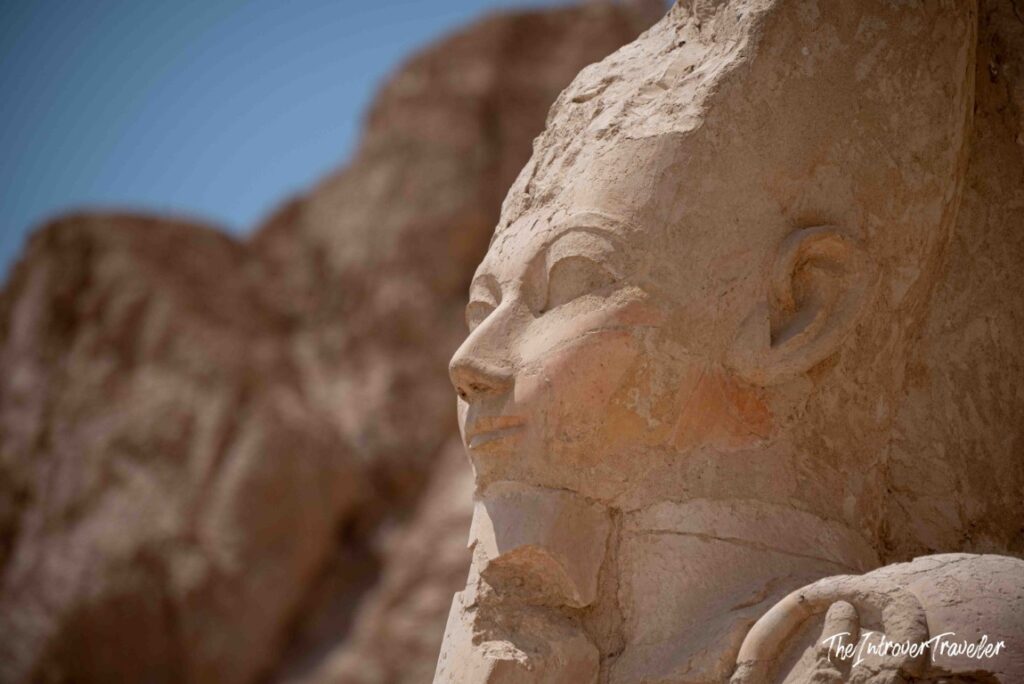
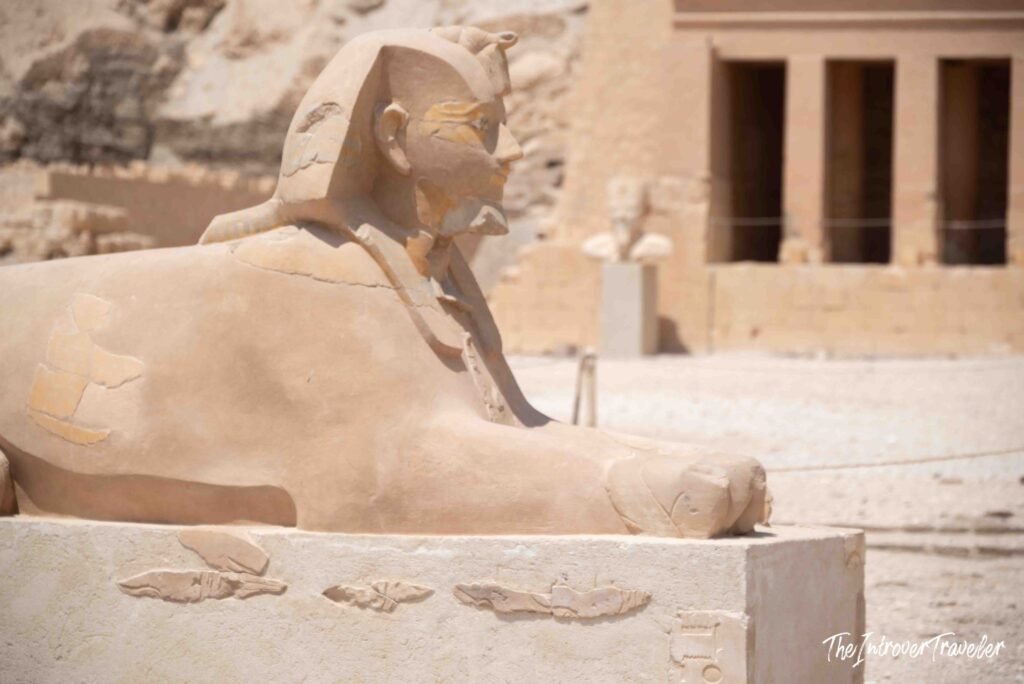
In the gallery below there are two photographs of statues from which, upon close inspection, it becomes clear that only a very small number of minimal fragments are original; it seems evident to me that the “mimetic” choice of materials for the reconstruction was conditioned by the scarcity of available ancient remains. Using, for instance, white lime to clearly distinguish the restoration from the original would have produced aesthetically unpleasant results, but once one becomes aware of how little of what is visible is actually authentic, the whole takes on a rather contrived appearance.
V. The experience: a magnificent setting, a complicated monument
Setting aside these two discomforts, what does the temple of Hatshepsut offer the visitor?
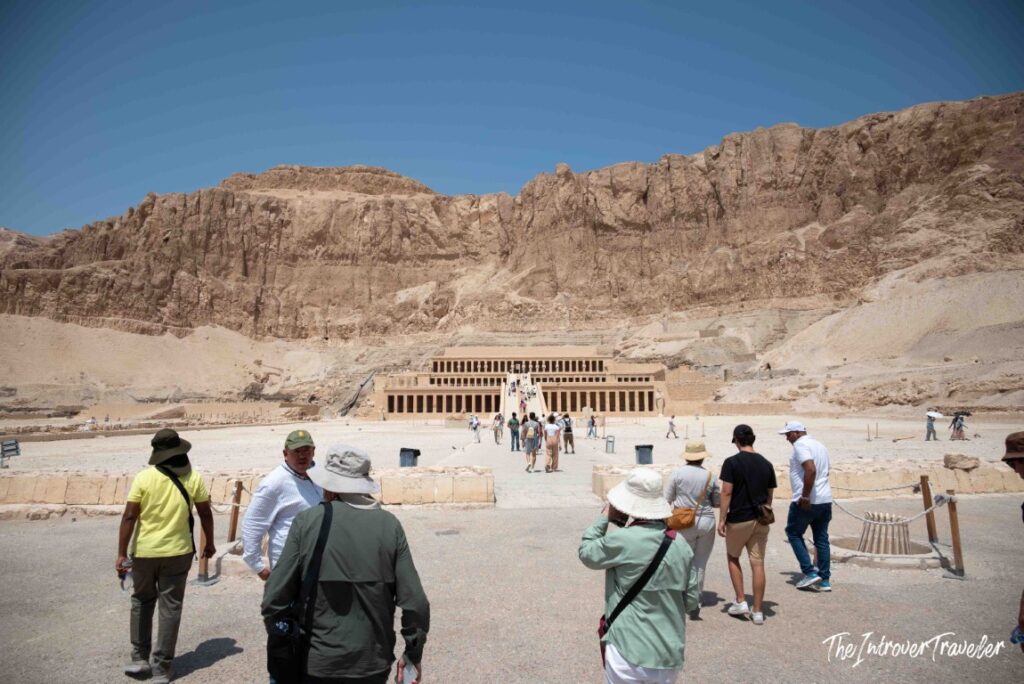
The answer, primarily, is the setting. The bay of the Theban cliffs that frames the monument is one of the great natural theatres of the ancient world, and the relationship between the horizontal geometry of the terraces and the vertical drama of the rock face behind them is something that photographs approximate but do not capture. At certain hours of the morning, before the heat becomes punishing and before the tour groups arrive in force, the site has a quality of austere grandeur that is genuinely affecting. The scale of the landscape, the color of the stone, the silence: these things work, and they work powerfully.
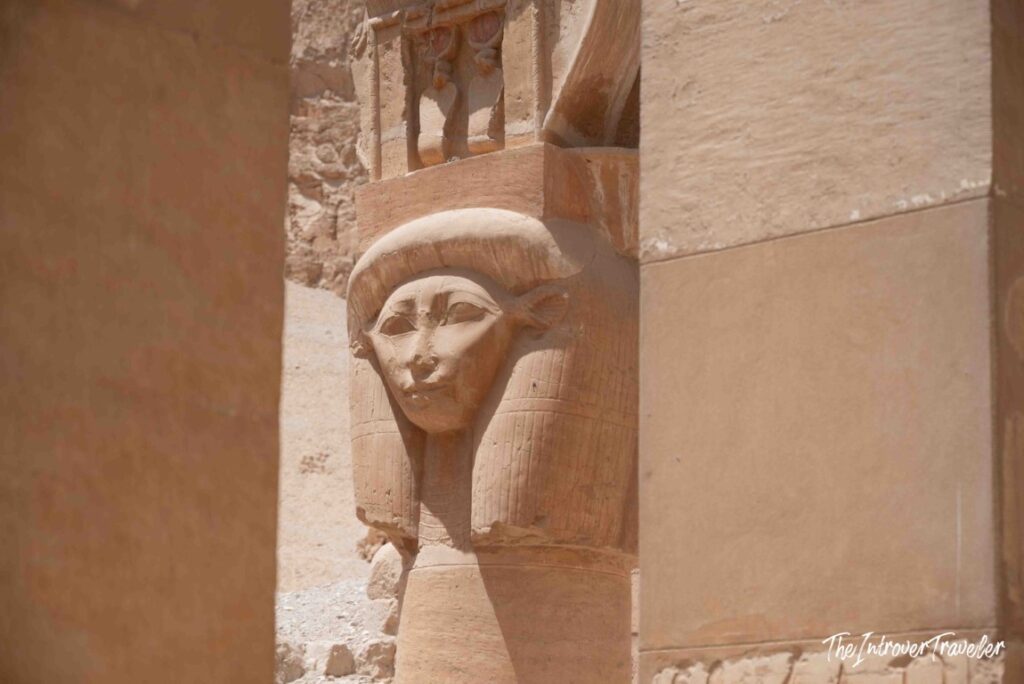
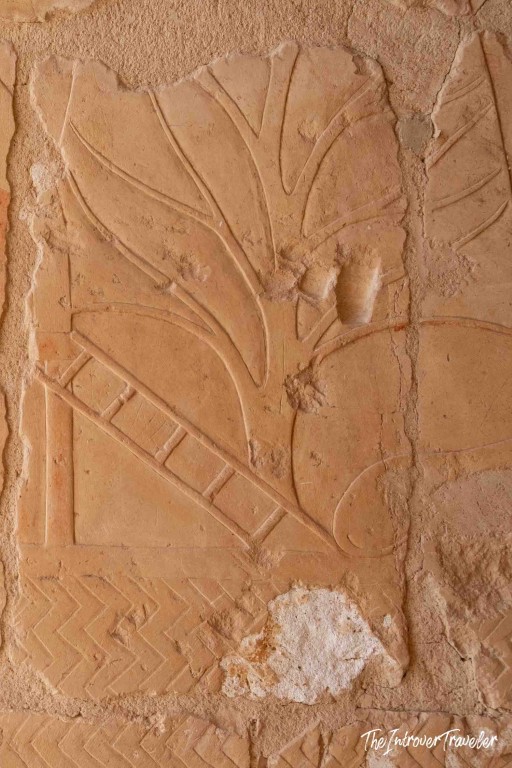
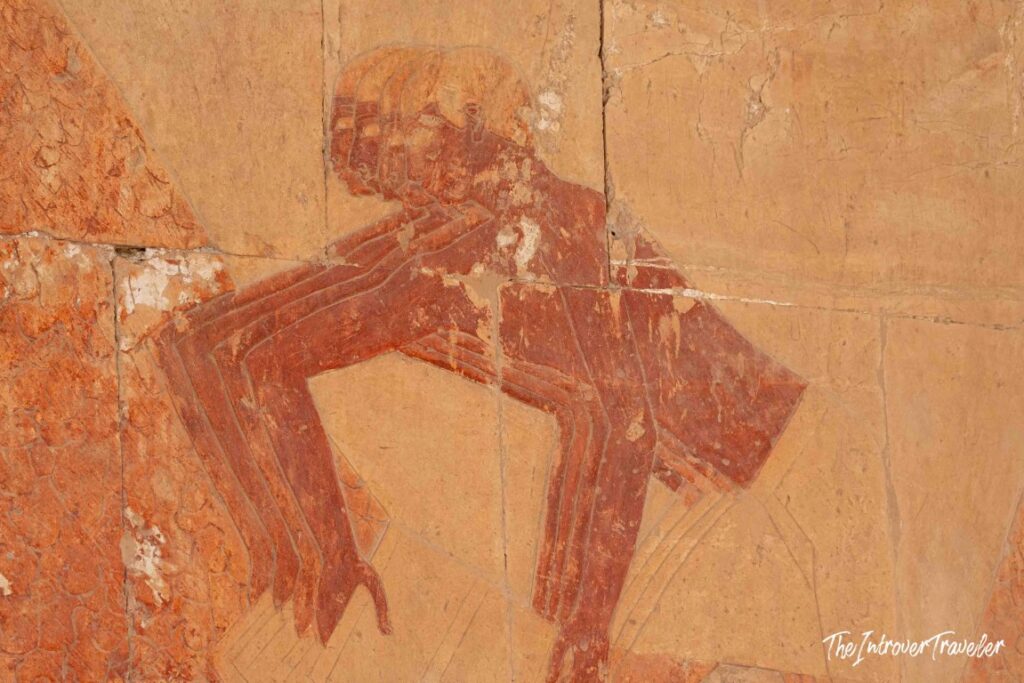
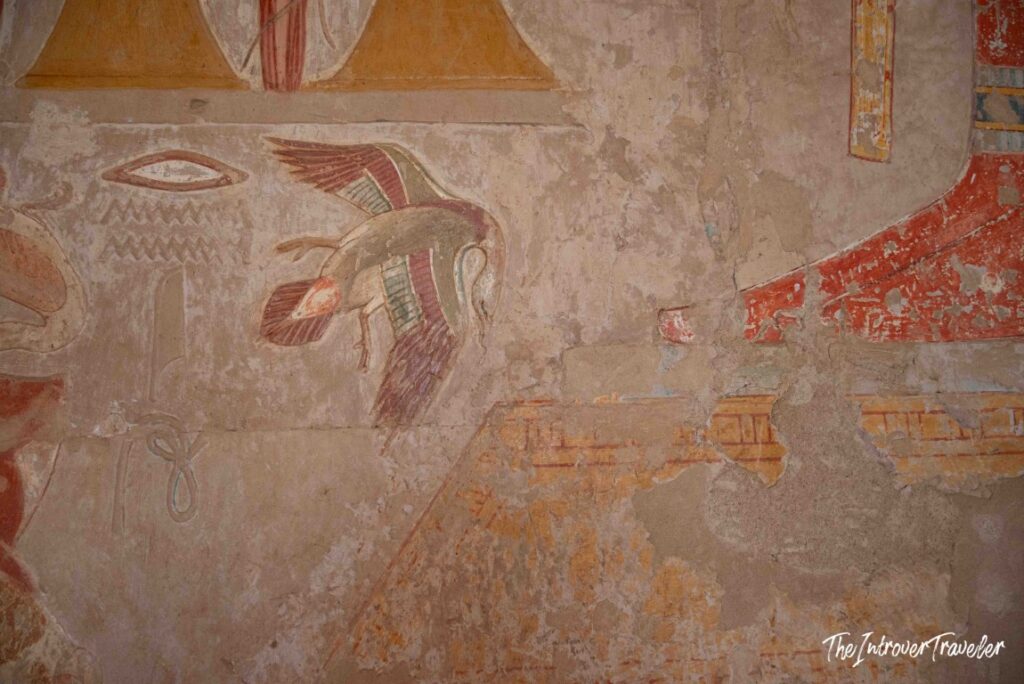
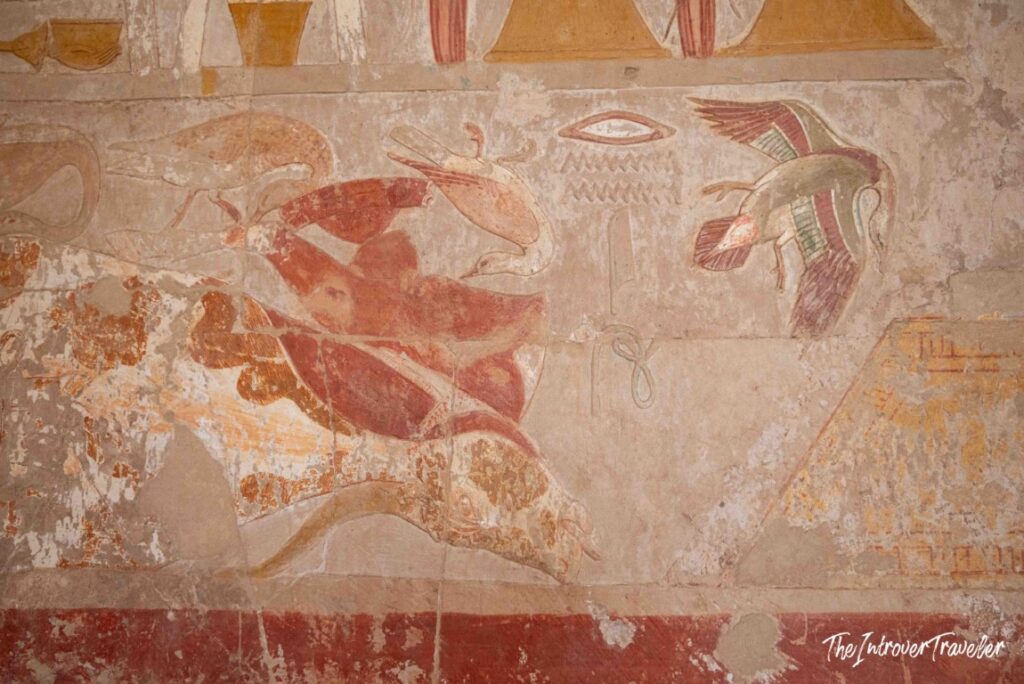
The monument itself is interesting rather than overwhelming. The surviving reliefs, where they are original and legible, are of high quality; the Punt expedition scenes on the middle terrace are among the most documentary and visually engaging reliefs in Egypt, full of observed detail and narrative energy. The divine birth cycle, though largely restored, retains enough of its original character to give a sense of the ideological program it was designed to serve. The Hathor chapel, with its characteristic column capitals in the form of the goddess’s face, has an intimate quality that the open terraces do not.
But I will be honest: measured against the standard that Egypt sets for itself, the temple of Hatshepsut is not among the sites that stopped my breath. It did not do to me what the pyramids did, or Abu Simbel, or the Valley of the Kings, or the hypostyle hall at Karnak. It is a monument of great historical significance, in a setting of extraordinary natural beauty, compromised by a violent history that cannot be set aside and by a restoration so thorough that it raises questions the site does not answer. Worth visiting, certainly. Worth visiting with preparation and reflection, absolutely. But not, in my experience, the transcendent encounter that the setting promises and that the history deserves.
The mountain behind it is magnificent. It always was. Hatshepsut knew what she was doing when she chose this place.
VI. Practical notes
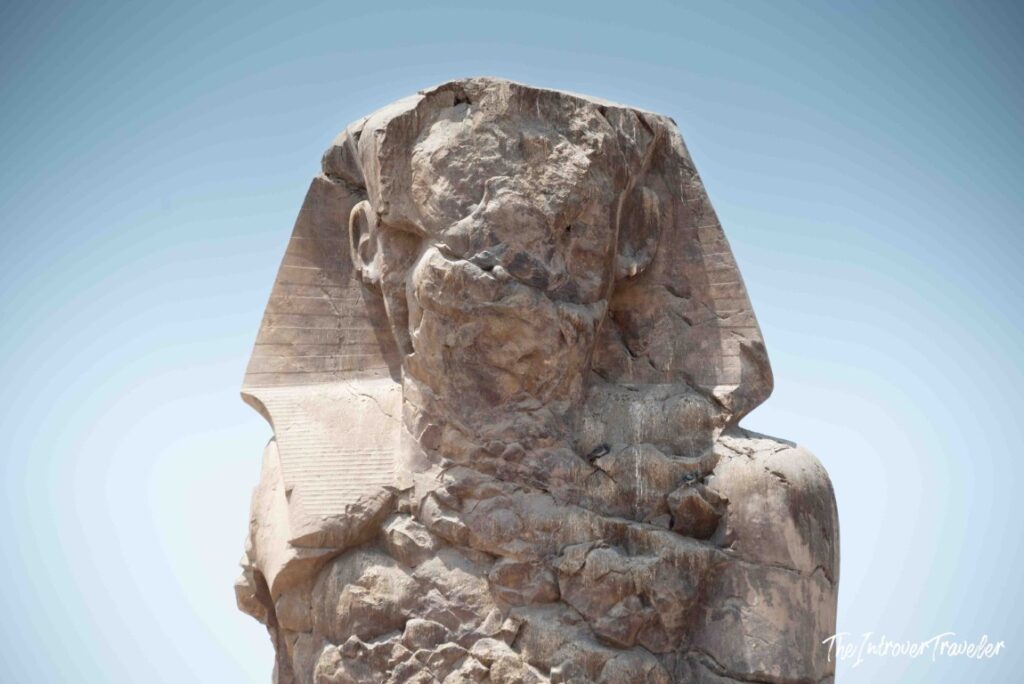
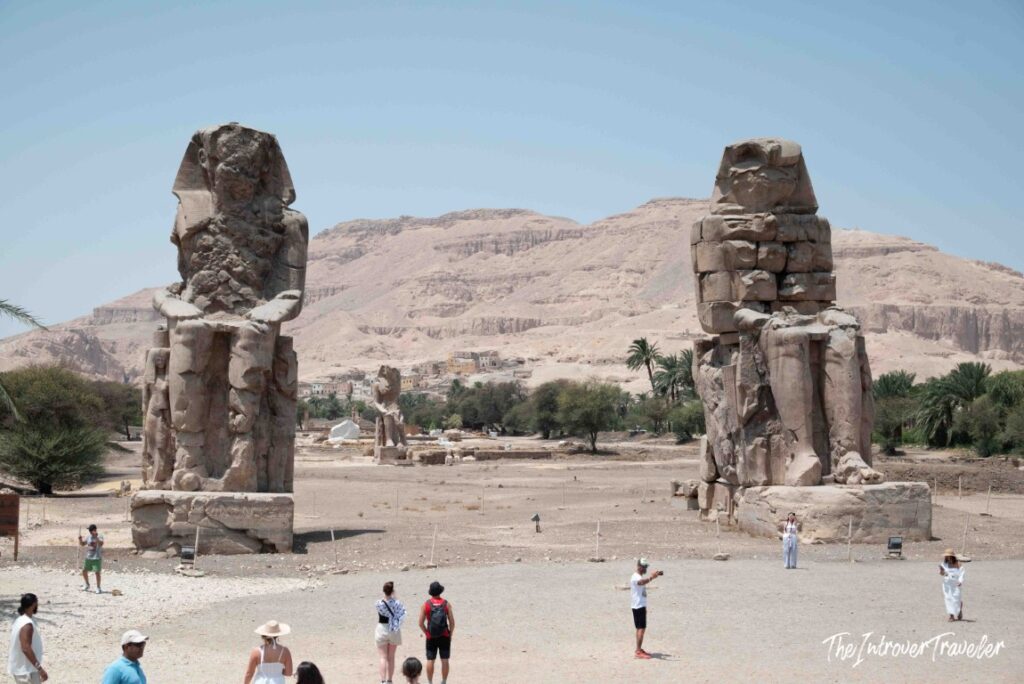
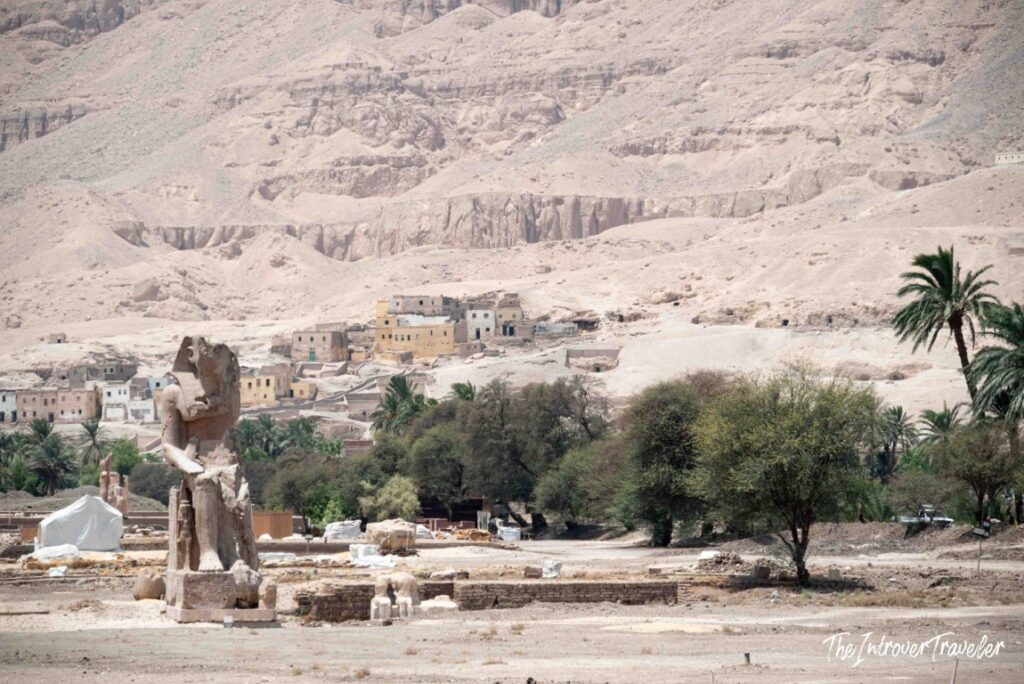
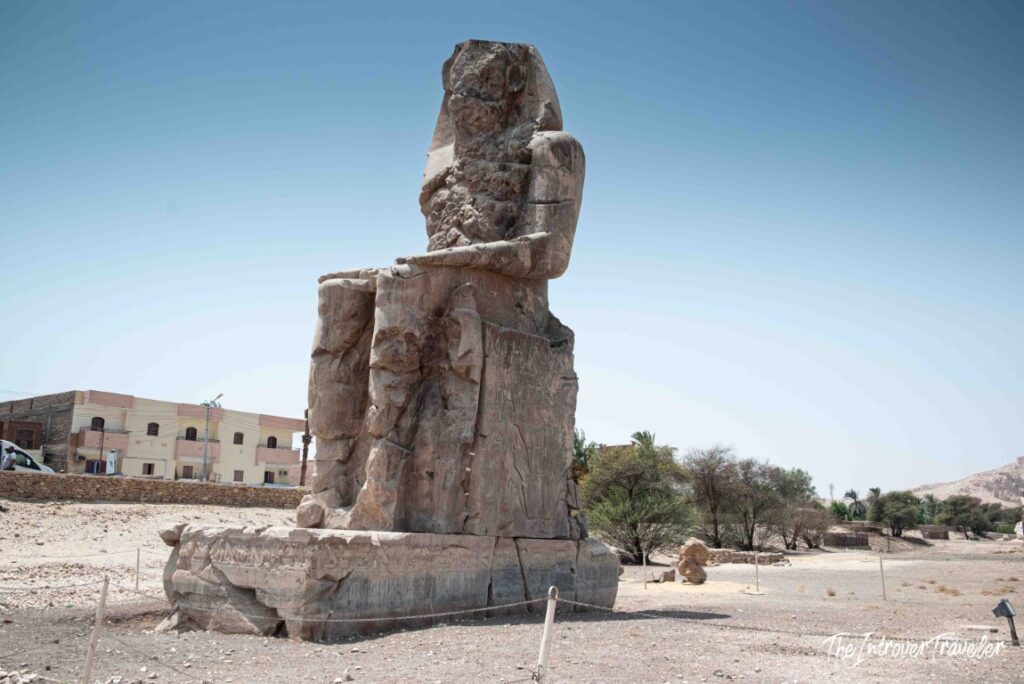
A brief note deserves to be added on the Colossi of Memnon, whose visit is typically included in the tourist itinerary that also encompasses the Mortuary Temple of Hatshepsut and the Valley of the Kings, which most visitors to the West Bank encounter almost by accident, as they rise without warning from the middle of what appears to be a suburban roadside: two seated figures of Amenhotep III, each originally around eighteen meters tall, flanking what was once the entrance to his funerary temple, the largest ever built in Egypt and now almost entirely vanished. The colossi themselves are genuinely impressive in their dimensions and in the quiet authority of their damaged faces; in antiquity they were among the most famous monuments in the known world, visited by Greek and Roman tourists who came to hear the mysterious sound the northern colossus emitted at dawn, attributed to the mythological Memnon singing to his mother Eos. What surrounds them today, however, is a setting of spectacular incongruity: a bus parking lot, a scattering of souvenir stalls, and, on the horizon behind them, a ragged fringe of half-finished concrete buildings in that particular shade of exhausted beige that seems to be the default architectural finish of the Egyptian periphery. The contrast between the scale and antiquity of the figures and the indignity of their current surroundings is one of the more dispiriting sights on the West Bank, and a useful reminder that the relationship between modern Egypt and its ancient heritage is not always one of careful stewardship.
VII. Practical notes
The temple of Deir el-Bahari is located on the West Bank of Luxor, accessible by taxi, microbus, or bicycle from the ferry landing. It is typically combined in a single day with the Valley of the Kings, the Valley of the Queens, and the Ramesseum, all within a few kilometers of each other. The visit takes between one and two hours at a relaxed pace.
The site is fully exposed to the sun, and in summer the heat reflected from the cliff face and the light-colored stone is intense. Arriving as early as possible, immediately at opening, is strongly advisable both for the temperature and for the quality of the experience: the site in the first hour of the morning, before the tour buses arrive, is a substantially different place from the site at mid-morning.
Ticket prices are subject to periodic revision and should be verified on-site or through a reliable recent source. Photography is permitted throughout most of the site.
Personally, I visited the site after returning from a week of diving in the Red Sea, relying on the services of Dive UK Hurghada, which, in addition to competently assisting divers with dives in Hurghada and the surrounding area, also organizes trips to the archaeological sites of southern Egypt. The itinerary, departing at 5 a.m. from Hurghada, included, for the sake of giving a sense of reasonably sustainable travel times: one day in Luxor with visits to the Karnak Temple, the Valley of the Kings, the Valley of the Queens, and the Mortuary Temple of Hatshepsut, an overnight stay in Luxor, followed by a 5 a.m. departure for Abu Simbel, visit to the temple and return to Hurghada by dinner time.