Last visit: May 2022
Where: at the north-western tip of Sardinia, municipality of Porto Torres
What: National Park and Marine Protected Area
Duration of visit: a whole day
My rating: 10/10
There is a paradox at the heart of Asinara’s story, and it is the paradox that makes this island unlike anywhere else in Sardinia. For more than a century Asinara was a place of confinement: a lazaretto, a penal colony, a prisoner-of-war camp, a maximum-security prison. An island you could not go to, where the human presence was reduced to jailers and prisoners, where no one built holiday homes, hotels, beach clubs, or paved roads. The result of this century of prohibition is that, when the prison closed in 1997 and the island became a National Park, what people found was one of the best-preserved stretches of Mediterranean nature in existence. The prison acted as its guardian. What speculation devoured elsewhere survived here precisely because it was off-limits.
Asinara deserves to be told on two planes that intertwine: the natural and the historical. They are inseparable. You cannot understand the island’s nature without its prison history, and you cannot grasp the weight of that prison history without seeing how beautiful the land is on which it was written.
Where it is and what it is today
Asinara closes off the north-western corner of Sardinia, opposite Porto Torres, of which it is administratively part. It covers about 52 square kilometres and has more than a hundred kilometres of coastline, made of coves, headlands, and cliffs. It is long and narrow, with a sinuous profile, and some trace the name to this very shape: the Romans called it Sinuaria, “the sinuous one”, and according to this hypothesis the present name derives from there, later sliding by assonance toward the donkeys that do in fact populate it. The other, more immediate hypothesis links the name directly to the donkeys.
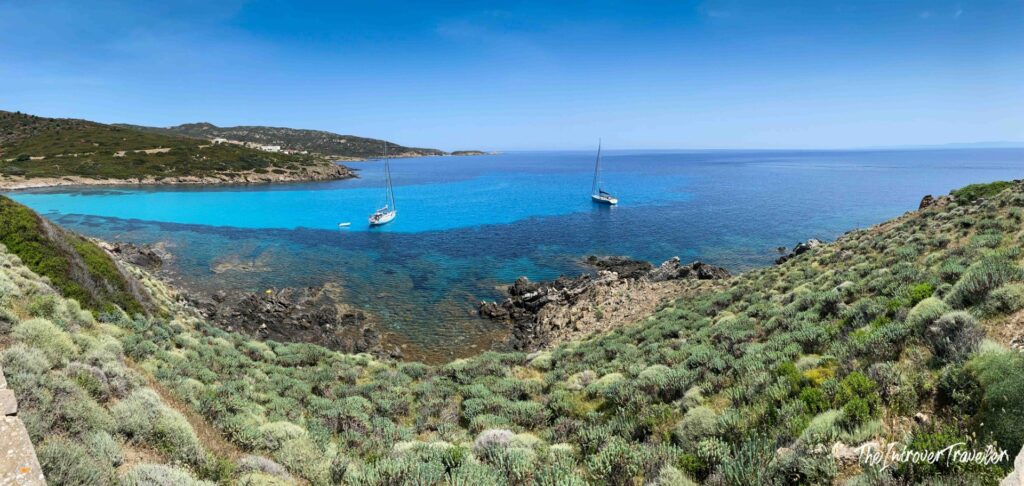
Today the island is entirely a National Park, established in 1997, surrounded by a Marine Protected Area. There are no permanent residents, no hotels in the usual sense, no clubs. You reach it by sea, and you move along the single main road on foot, by bicycle, by shuttle, or on electric vehicles. Some areas, classified as “Zone A”, are strict reserves and access is forbidden to protect particular species. This severe regime is the reason Asinara resembles no other Sardinian destination: you go for the nature and the history, not for the services.
The white donkeys, and the others
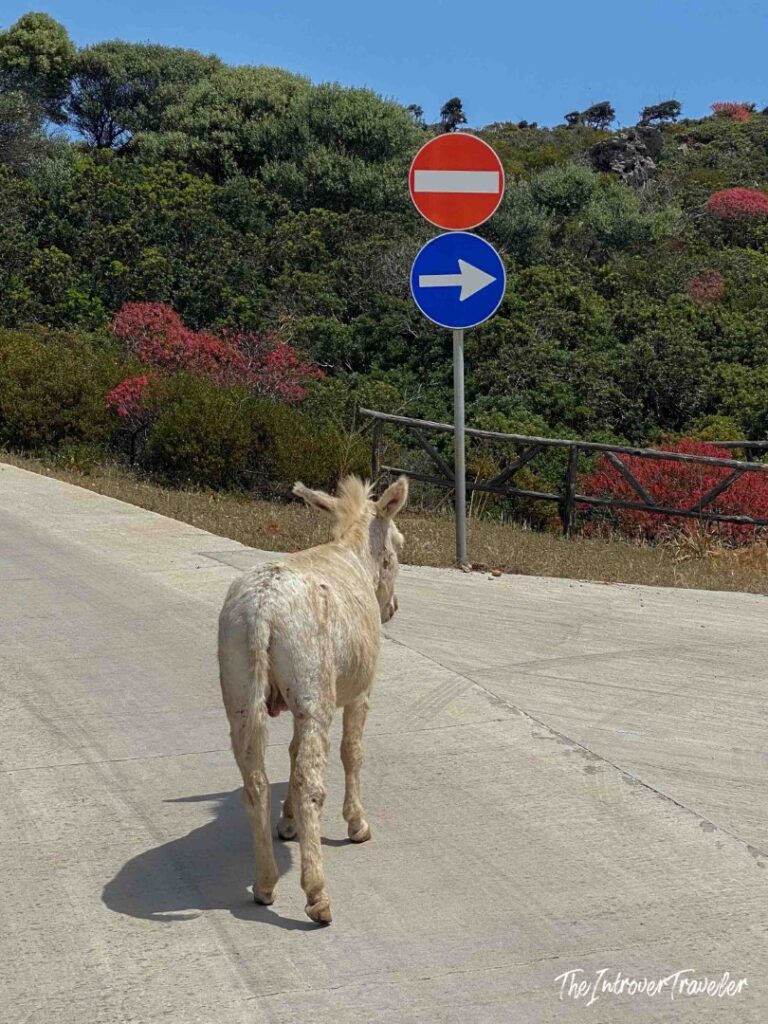
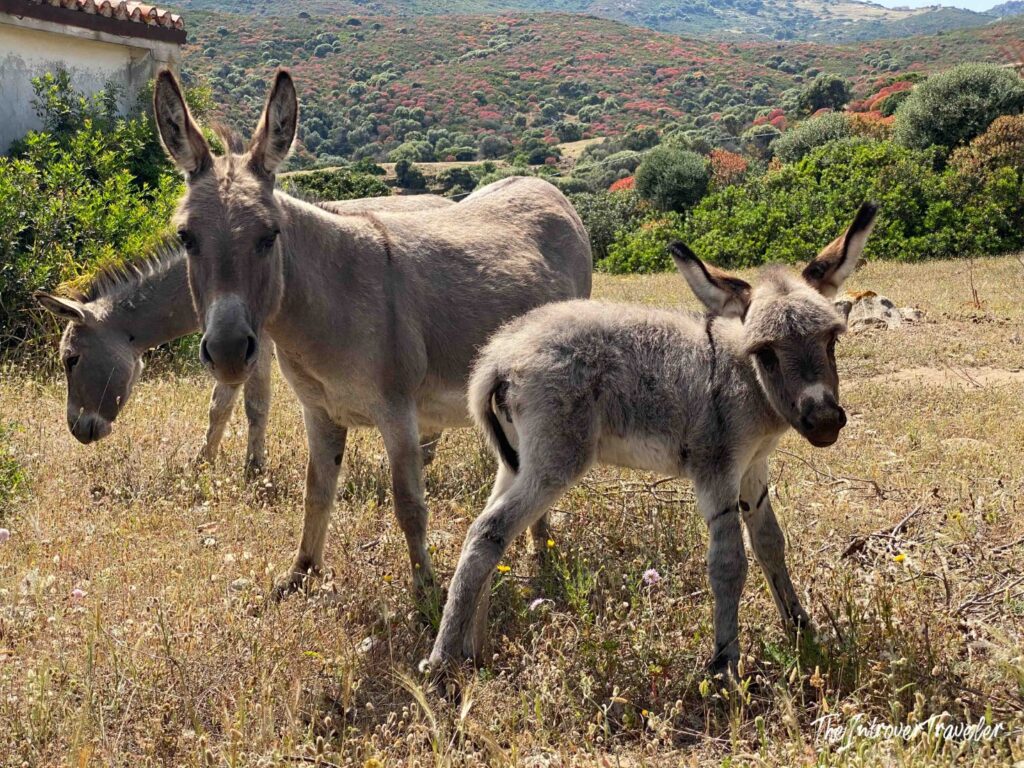
The island’s symbol is the white donkey, and it deserves a clarification, because it is not simply a pale-coloured donkey. These are albino donkeys, entirely lacking pigmentation, the result of a natural genetic mutation: white coat, light eyes. They are a distinctive population, considered unique, and they graze freely on the island, often a few metres from the paths, used to human presence but not tamed. Alongside them live grey donkeys too, in fact more numerous than the white ones.
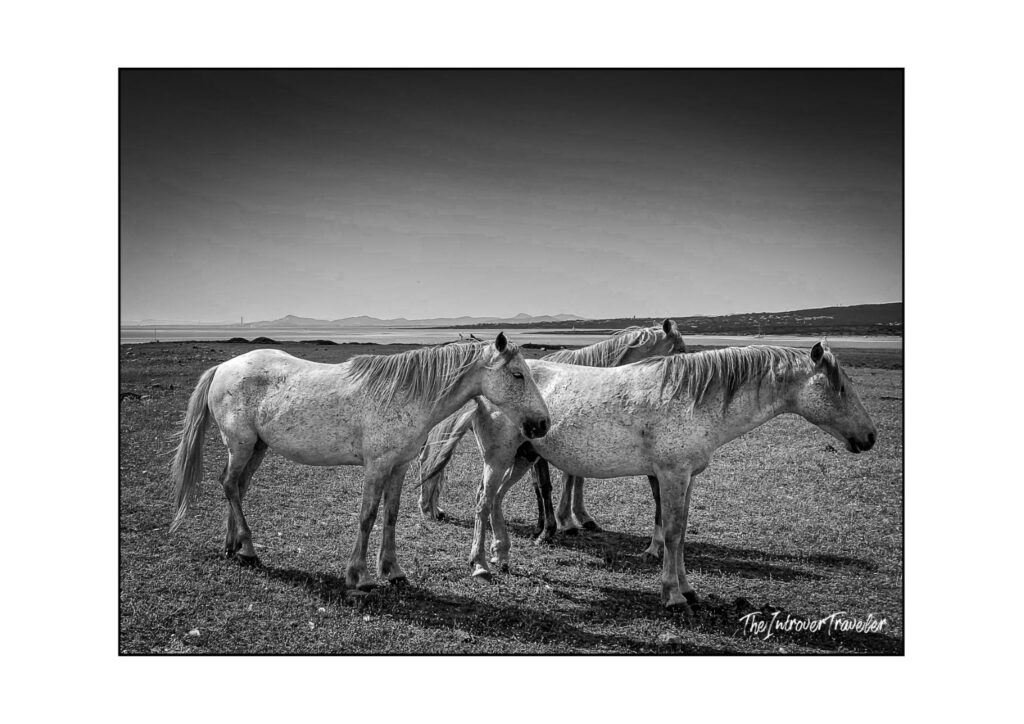
But it would be reductive to stop at the donkeys. Asinara hosts a surprisingly rich fauna for an island of this size, around eighty species of land vertebrates. Many of these animals are the direct legacy of the prison history: goats, horses, and other livestock used in the agricultural penal colony which, when the prison closed, went feral. Today mouflon, wild boar, feral horses, feral goats, and hares roam free across the island. The horses in particular leave a strong impression: you may see them galloping in a herd along the beaches or across the ridges, one of those sights that justify the trip on their own.
The absence of natural predators, combined with the hunting bans, means these herbivores thrive undisturbed. There are no foxes or martens; the only small carnivores are the cats of a managed colony at Cala d’Oliva. The surrounding sea is equally alive: the area falls within the Cetacean Sanctuary, and dolphins and bottlenose dolphins pass through the surrounding waters, with fin whales and sperm whales further out.
The shrubs that turn red: the spurge
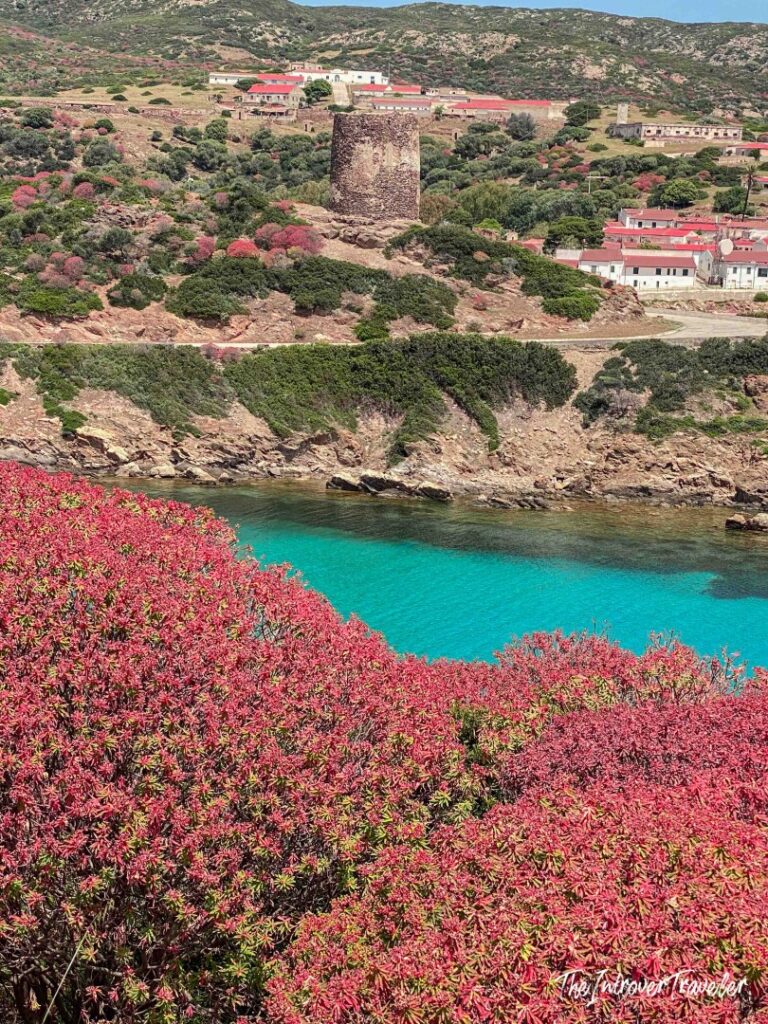
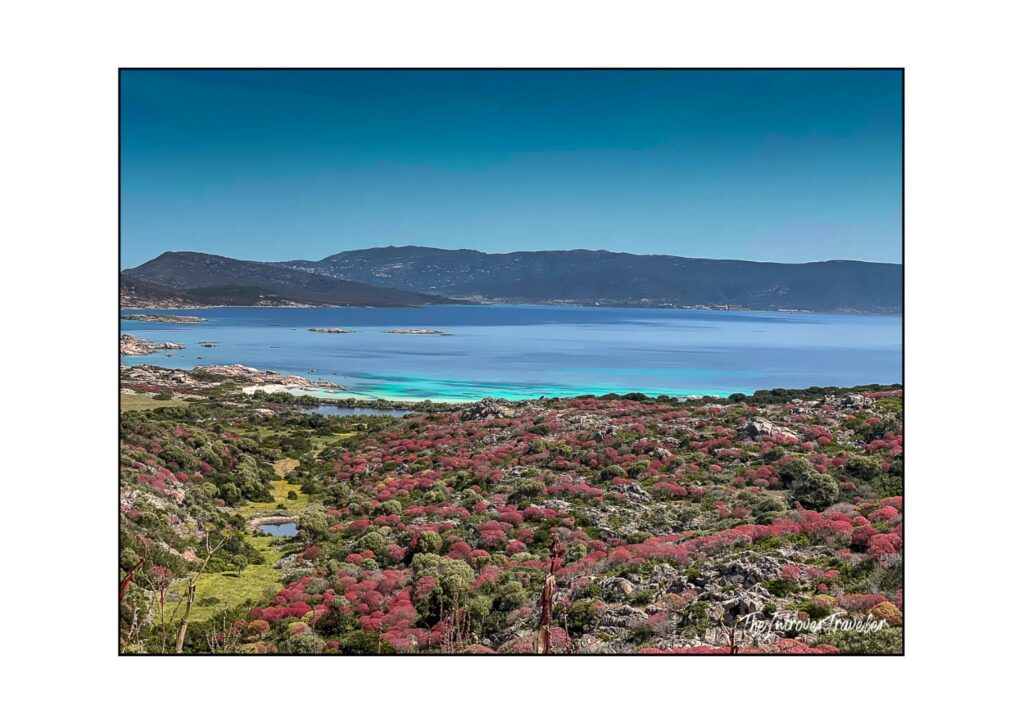
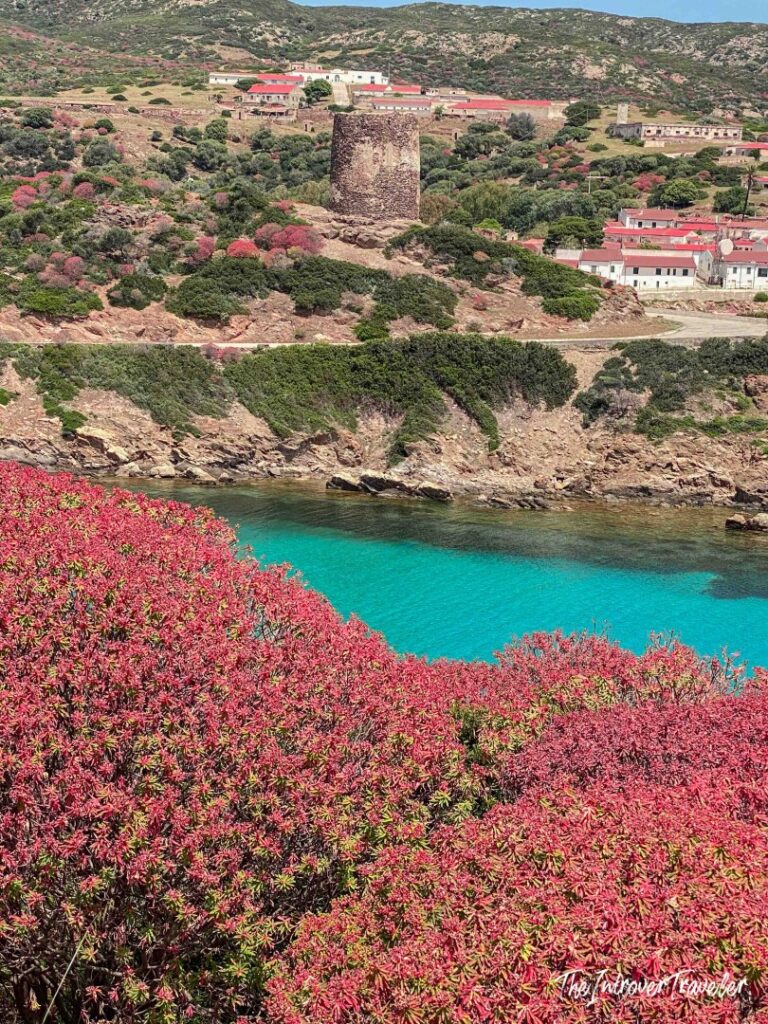
There is a botanical phenomenon that strikes anyone who visits the island at the right time, and that is the colour change of the scrub. The agent is the tree spurge (Euphorbia dendroides), a shrub very common on Asinara that has a spectacular seasonal colour cycle. For most of the year it is deep green, then it turns yellow in the winter months, and in late spring it takes on a vivid red colouring that transforms entire slopes of the island, before shedding its leaves completely in summer to defend itself against drought.
Those red shrubs people remember after a spring visit are these. And there is a detail that ties the spurge too to the island’s particular ecology: the plant is toxic, secreting an irritant latex from cut branches, and for this reason herbivores do not browse it. The result is that, on an island where goats, mouflon, horses, and donkeys graze unchecked and keep much of the vegetation low, the spurge thrives precisely because nothing eats it. The red scrub of late spring is, in a sense, the colour of what the animals cannot touch.
The rest of the vegetation is the classic Mediterranean scrub adapted to a dry, windy environment: mastic, Phoenicean juniper, wild olive, cistus, myrtle, with few wooded areas, among them a small holm-oak wood at Elighe Mannu. The flora numbers nearly seven hundred species, around thirty of them endemic, a sign of how much the isolation favoured rare plant forms.
The history: a century of confinement
Here begins the other half of the story, the one that shaped all the rest.
Asinara’s use as a place of isolation begins in 1885. Until then the island had been inhabited, sparsely, by families of shepherds and fishermen, around 500 people. By Royal Decree the Italian government confiscated the land and forced the residents to move across to Stintino, on the Sardinian mainland, to make way for two functions: a maritime quarantine station, a lazaretto for infectious and especially tubercular patients, and an agricultural penal colony. It was the first in a series of confinement functions that would follow for over a century, organised in eleven separate detachments scattered across the island, among them the Central Detachment and Cala d’Oliva, today the Park’s Museum of Memory.
During the First World War the island became a prisoner-of-war camp: thousands of Austro-Hungarian prisoners were interned here, in very harsh conditions, and many died, so much so that an ossuary remains on the island in their memory. In the 1930s, after the war in Ethiopia, Asinara took in Ethiopian deportees, among them, according to the sources, a daughter of the Negus Haile Selassie. Under Fascism it was also a place of internal exile.
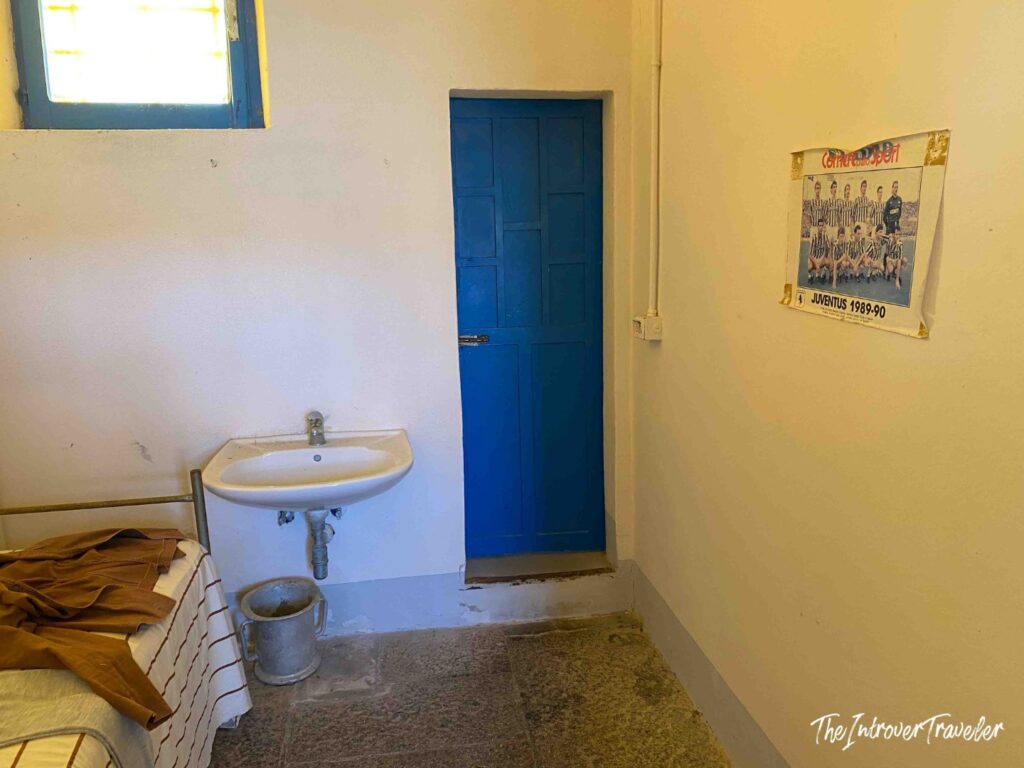
The Fornelli complex itself was born in the 1930s as a judicial sanatorium, used as a tuberculosis ward during the Second World War, and later converted into a prison for common criminals. From the Years of Lead onward it became the island’s maximum-security detachment.
The Years of Lead and the revolts
The prison was never a single building, but a system of eleven detachments spread across the island, each with a different level of security. There were sections where the inmates, mostly Sardinian shepherds convicted of minor offences, worked and moved almost freely about the island (the so-called “unconsigned”), and there were extremely harsh sections. The two best known are the Fornelli detachment, to the south, and the Cala d’Oliva bunker, to the north.
On 25 June 1971 the first fifteen prisoners convicted of mafia-related crimes were transferred to Fornelli, and over the following years the number of “special inmates” grew, bringing figures from the extreme right, the extreme left, and various organised-crime groups. During the Years of Lead, Fornelli became one of the prisons used for the Red Brigades and members of the Anonima Sarda. In 1979 the imprisoned Red Brigades members staged a carefully planned revolt, remembered as the “Battle of Asinara”: they had managed to smuggle in explosive, and for hours they devastated a wing of the prison using beds and tables as battering rams, in an attempt to render the structure unusable and force a transfer. The Red Brigades called Asinara an Italian “lager”. After the revolt, surveillance was drastically tightened. At the end of 1980 came what was called the “zero hour”: Fornelli was emptied, all inmates transferred to undisclosed destinations, and the detachment stayed closed for more than ten years.
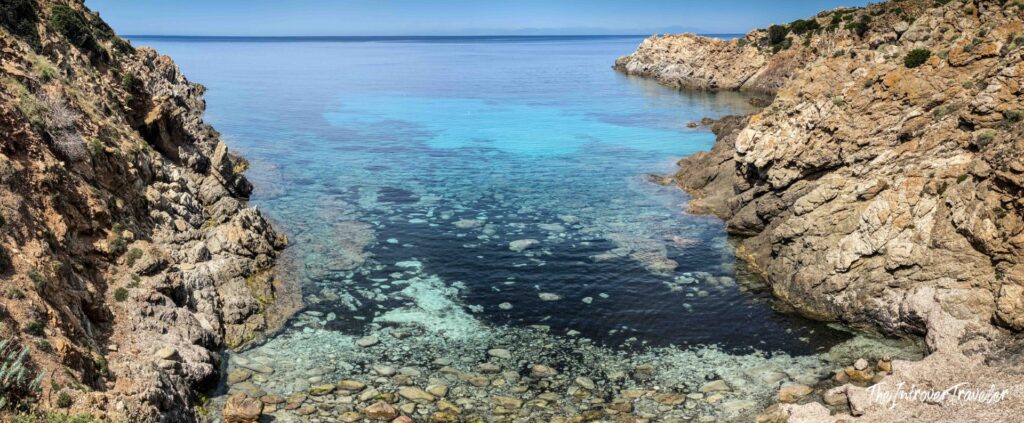
One detail gives the measure of how impregnable the island was considered: in the whole history of the prison, the only successful escape was that of the Sardinian bandit Matteo Boe, in 1986, using a dinghy organised from outside. All other attempts failed, often tragically, because the Fornelli strait that separates the island from Sardinia has very strong currents, and several escapees died at sea.
Falcone and Borsellino: the summer of 1985
There is a chapter in Asinara’s history that reverses the meaning of the place. Not only a prison, but also a refuge.
In the summer of 1985 Italy was living through one of the bloodiest seasons of the fight against the mafia. In Palermo, commissioner Beppe Montana and deputy police chief Ninni Cassarà had just been murdered. The two leading magistrates of the anti-mafia pool, Giovanni Falcone and Paolo Borsellino, were writing the committal for the maxi-trial against Cosa Nostra, the first great trial that would bring hundreds of mafiosi to the dock. Working in Palermo had become too dangerous, for them and for their families.
So, within forty-eight hours, Falcone and Borsellino were moved with their wives and children to Asinara, considered the safest place in Italy. They stayed in the red-brick guesthouse of Cala d’Oliva, working on the eight thousand pages of the committal, managing now and then to go down to the beach with the children. It is documented that they stayed on the island for less than a month and that, with a detail that says a great deal about the integrity of the two, they paid the State out of their own pockets for the cost of their forced stay.
From those days remains a black-and-white photograph that became famous: the two magistrates smiling, Falcone whispering something into Borsellino’s ear, both laughing. Seven years later, in 1992, they would be killed in the Capaci and via D’Amelio bombings, less than two months apart.
Riina in the bunker, and the jailers who spoke Sardinian
And here the story closes in a bitter circle. After the 1992 bombings, the State reopened and reinforced Asinara’s hard prison precisely to lock up the mafia bosses under the 41-bis regime, the strictest isolation provided for by Italian law. Among them arrived, on 21 December 1993, the man held to be the instigator of those massacres: Salvatore Riina, the “boss of bosses” of Cosa Nostra, arrested in January of that year after decades on the run.
Riina was locked in the Cala d’Oliva bunker, a cell of around twenty square metres in a structure nicknamed “the discotheque”, because the lights stayed on twenty-four hours a day, day and night, and it was never dark. Closed-circuit cameras recorded every movement, and an officer noted on a register anything at all, even when he went to the toilet. “They want me buried alive”, are said to have been his only words on the first day. He stayed there until July 1997, about four years, without ever seeing the open sky.
One detail of this detention is at once curious and revealing. To guard Riina, around thirty officers were assigned, deliberately all Sardinian. The reason was simple and ingenious: among themselves they spoke the Sardinian language, so that the boss, a Sicilian, could not understand what they said, could not pick up information, intercept communications, or attempt any approach. On an island that was already a physical barrier made of sea and currents, language became a further wall, invisible and impassable. Sardinian, the language of shepherds and of the “unconsigned” prisoners, became the security instrument against the most powerful criminal in Italy.
And there was one last, almost literary touch. For years, at the entrance to the guardhouse of the Fornelli prison, that black-and-white photograph of a smiling Falcone and Borsellino hung on the wall. The imprisoned mafia bosses, when they passed in front of that image, would lower their eyes so as not to see it. The two magistrates the mafia had killed went on watching, from the wall, the men of the organisation that had killed them.
The visit today
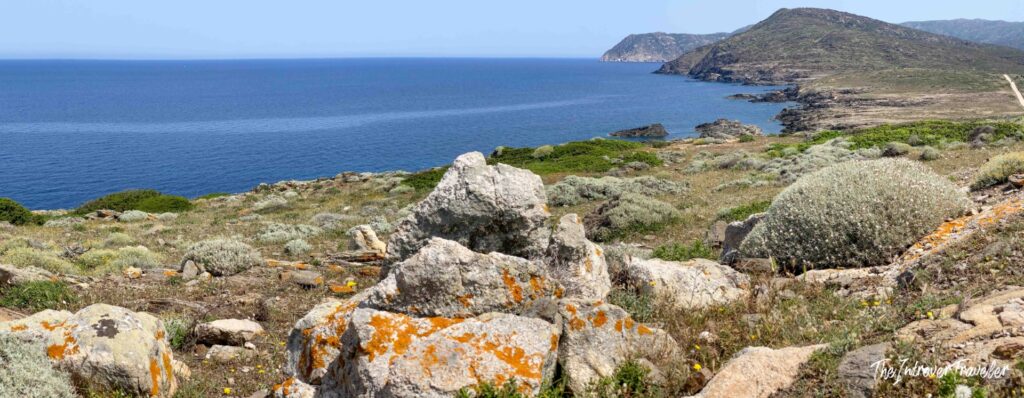
The prison closed for good in 1998. Today Asinara is visited as a National Park, and the experience is double: on one side the nature, on the other the memory.
You arrive by ferry or authorised boats from Porto Torres or from Stintino, landing at Cala Reale or Cala d’Oliva. Cala d’Oliva is the island’s only small village, with the buildings of the former penal colony partly turned into a museum. You can travel the island on foot, by bicycle, by shuttle, or on electric vehicles, along the road that connects the various detachments. It is worth taking a guided tour: a good guide ties together the natural and historical layers that, left to yourself, are easy to miss, and several detachments are only properly understood with someone explaining them. The former prisons, from Fornelli to the Cala d’Oliva bunker, can be visited, and Riina’s cell is one of the most requested stops, although stepping inside, as visitors often write, leaves a grim impression. Fornelli itself is currently closed as unsafe, with plans to restore it and reopen it as a memorial and cultural centre.
A few recommendations. Spring is the best season, both for the climate and for the flowering, including the red scrub of the spurge. Bring water and sun protection, because the island is dry and has little shade. And bear in mind both dimensions of the place: you do not go to Asinara only to swim in spectacular coves, even if you can, but to cross a place where the history of twentieth-century Italy, from terrorism to the mafia, took material form inside a landscape of rare beauty.
The sea turtle rescue centre
One stop worth building into the visit, especially with children, is the marine animal rescue centre at Cala Reale, run by the CRAMA association since 2009 and housed in the old lighthouse-keeper’s quarters, now the island’s Sea Observatory. It functions, in effect, as a hospital for sea turtles, mostly loggerheads (Caretta caretta), brought in injured by boat propellers, tangled in fishing nets, or sickened by the plastic they swallow. The staff treat them, rehabilitate them in a series of tanks, and release them back into the sea once they have recovered, which over the years has meant a few hundred turtles returned to the wild. In summer the observatory opens to the public for a couple of hours in the late morning, and you can see the current patients up close. It is a low-key, unsentimental operation, and it fits the logic of the whole island: the same isolation that once made Asinara a prison now makes it a refuge, this time for the animals the open Mediterranean keeps injuring. You can also support a turtle’s treatment through a remote adoption scheme, if that is the kind of thing you go in for.
Is it worth it?
Without doubt. Asinara is one of the most intense places in Sardinia, and perhaps one of the most instructive in Italy, because it holds together things that usually stay separate: natural beauty and the memory of pain, white donkeys grazing free and cells where men were buried alive, the refuge of the magistrates and the prison of their killers. It is not a beach outing and should not be treated as one. That said, the sea around Asinara is paradisiacal, and there is of course nothing wrong with treating yourself to a swim in one of its coves: the point is simply that it would be a waste to reduce the island to that. It is a place that asks to be understood, not just photographed. Go with the time to walk it and with the disposition to let yourself be touched by its underlying paradox: that its untouched beauty is the child of a century of confinement, and that the freedom its animals enjoy today grew up exactly where it was denied to men.