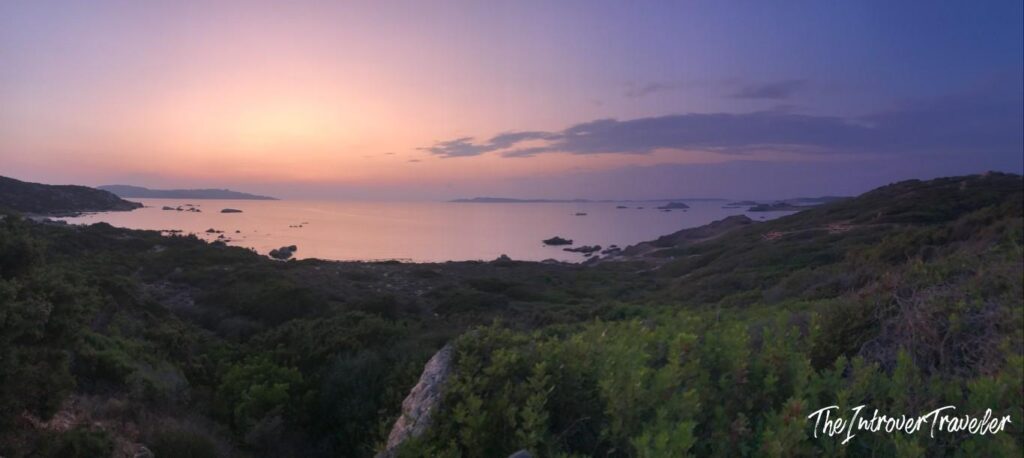
Last visit: July 2026
How to get there: ferry from Palau (20 minutes, roughly every 30 minutes in summer, every hour off-season; around 8 euros per person, more with a car)
Best time to visit: June and September, when the water is warm and the crowds manageable. July and August are for people with either a high pain threshold or a very large boat.
My rating: 10/10
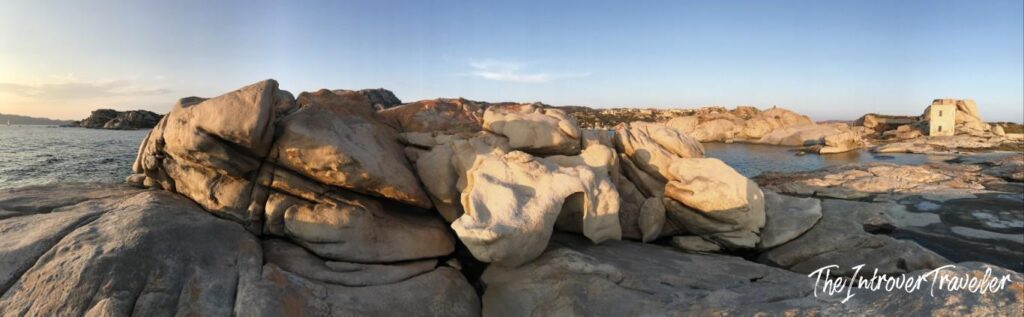
There is a shelf in the Strait of Bonifacio, a few miles of shallow water between Sardinia and Corsica, that until about eighteen thousand years ago was dry land. You could have walked across it. Then the glaciers retreated, sea levels rose, and the granite plateau that had been sitting there since the Carboniferous, roughly three hundred million years old, Variscan granite, pink-orange and shot through with quartz, flooded. What had been hills became islands. What remained above the waterline became one of the most beautiful archipelagos in the Mediterranean.
That is the origin story of La Maddalena: not a volcanic drama, no tectonic fireworks. Just very old rock and a slow inundation. The seabed still preserves the granite forms that erosion sculpted during the last glaciation, submerged but intact. The result is over sixty islands, islets, and rocks scattered across twenty thousand hectares of protected sea, shaped by the mistral that has been blowing in from the northwest for longer than anyone has been around to complain about it.
I have seen a few marine paradises in my life. I have been to the Maldives, I have been to the Red Sea, I have been to Indonesia, I have been to Mexico… In my personal ranking, for the beauty of the sea and the landscape, La Maddalena comes first. And if my personal opinion is, quite rightly, irrelevant, it is enough to remember that the great wealthy people of the world, people who can choose to have only the very best, are all, in August, almost without exception, in northern Sardinia… That must mean something…
The Islands
Seven main islands make up the core of the archipelago: La Maddalena (the only inhabited one, around ten thousand residents), Caprera, Spargi, Budelli, Santa Maria, Razzoli, and Santo Stefano. Together with the surrounding islets, they form the Arcipelago di La Maddalena National Park, established in 1994 as the first national park in Sardinia and the only one in Italy that coincides entirely with a single municipality.
La Maddalena is the hub: the ferry lands here, the restaurants are here, the dive centres are here. The town itself is pleasant without being spectacular, built around a small piazza and a waterfront lined with the kind of low-key bars that have not yet decided to become fashionable. The Church of Santa Maria Maddalena is worth a stop not for its architecture but for what is inside: the so-called Treasure of La Maddalena, a collection of sacred furnishings, some of which were donated by Admiral Horatio Nelson, who used the archipelago as a base during his years in the Mediterranean. Nelson is not a figure you encounter much in Italian churches, which gives this particular detail an agreeably disorienting quality.
Caprera is connected to La Maddalena by a causeway and is, in most respects, the more interesting of the two. It is almost entirely protected land, which means it is wild in the way that places only become when nobody is allowed to build on them. Umbrella pines and pink granite cliffs. Cala Coticcio, known locally as “Sardinian Tahiti,” a cove with water so transparently turquoise it looks like a stock photo that turned out to be real. And the Garibaldi Compendium: the house museum of Giuseppe Garibaldi, who was exiled to La Maddalena in 1849, liked it enough to come back, and spent the last years of his life on Caprera. He is buried there.
The museum is one of those unexpectedly moving places where a famous historical figure becomes a comprehensible human being: the tools he used, the letters he wrote, the bed he died in. The bed, in particular, has a history.
In the summer of 1939, with the war knocking on the door, my grandfather decided that Sardinia was safer and sent the whole family there. My grandmother, finding herself on Caprera with a small child and an afternoon to fill, took her to visit the house. The museum, in those years, was supervised with a certain informality. No custodian was in sight when they reached Garibaldi’s bedroom. My grandmother, seized by a cheerful irreverence, lifted my mother onto the bed of the hero of the Risorgimento. My mother, aged approximately three and with no particular views on Italian national history, promptly urinated on it. Nobody knew. Nobody said anything. The secret has been kept for more than eighty-five years, which I believe is long enough. Consider this the formal declassification.
Budelli is the most famous and the most restricted. Its Spiaggia Rosa, the Pink Beach, takes its colour from the shells of Miniacina miniacea, a foraminiferan, a microscopic single-celled organism, that lives on Posidonia rhizomes. When it dies, the pink calcite shell detaches, drifts ashore, and gets ground into the sand. The concentration of these shells, along with fragments of the bryozoan Miriapora truncata and fine coral, reaches 80 to 90 percent of the total sand composition; it is structurally closer to a tropical coral beach than to conventional Mediterranean sand. Not, to be precise, crustaceans, as is sometimes claimed. Foraminifera: a completely different phylum, far older, far simpler.
The beach was formally closed to swimmers and visitors in 1998, when the cumulative damage from years of mass tourism, including systematic removal of sand as souvenirs, made protection unavoidable. This is not especially recent history. I visited twice, in 2019 and in 2022. The current rules are: no landing on the beach, no swimming, no anchoring within 300 metres. In practice you moor at the regulation distance and swim in. The beach is accessible on foot and visible up close; what you cannot do is go into the water from it. The colour has recovered considerably since the closure, but decades of pilfered sand cannot be undone in a few years. You have to look for the pink patches; they are there, scattered across the white, but they no longer dominate it.
Before the park authority took over, Budelli had its own unofficial guardian: Mauro Morandi, a former physical education teacher from Modena who arrived by sailing boat in 1989 with vague plans to reach Polynesia, found the departing custodian of the island, and simply took his place. He lived there alone, in a wooden hut, for thirty-two years. In the summer he would intercept every visitor who appeared on the beach, explain exactly what they were looking at and why it mattered, and make sure they left with no sand in their pockets. He was, by all accounts, utterly inexhaustible on the subject. After years of conflict with the park authority, who eventually deemed his presence irregular and his dwelling unauthorized, he left in April 2021. He died in January 2025, aged 85. His is an odd kind of legacy: a man with no institutional standing who did more for one particular beach than any number of regulations, through the straightforward method of being there and never shutting up about it.
One more note on Budelli for film historians: the Spiaggia Rosa appeared in Michelangelo Antonioni‘s Red Desert in 1964, in a dream sequence that Monica Vitti narrates to her son.
A practical note for the visit: when I went in 2022, the water was thick with Pelagia noctiluca, the open-sea jellyfish with a sting effective enough to ruin the afternoon. In 2019 there were none. This is not a permanent condition; it varies by season and year, and is essentially unpredictable. A rash vest or a thin wetsuit top is reasonable precaution regardless.
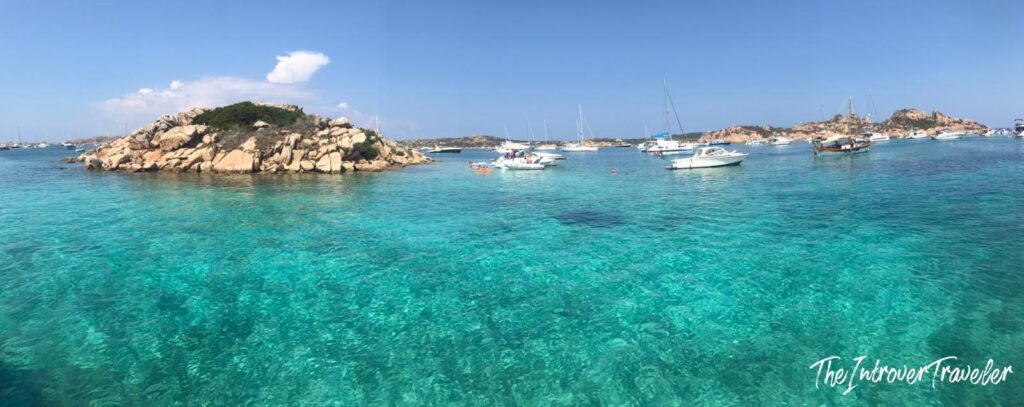
Spargi is the island most divers come for. The wreck of the Angelika, a merchant ship that went down in 1982 at between twenty and thirty metres, is the most accessible introduction to wreck diving in the archipelago. It is not the Thistlegorm. Anyone who has dived the Red Sea will calibrate expectations accordingly: the Angelika is a modest vessel of modest historical weight, and the comparison with a ship that played a role in a world war is not particularly flattering. But the structure is intact, the marine colonization is dense, and for divers whose wreck experience is limited or who simply enjoy exploring a hull in good visibility, it delivers what it promises.
The Secca di Washington, a reef system in the channel between Spargi and Budelli, is the archipelago’s signature dive site: three routes, walls covered in red gorgonians, groupers the size of labradors that have been protected long enough to lose any instinct to retreat. Barracuda and dentex in open water. Moray eels in every crevice.
Razzoli and Santa Maria form a pair at the northern edge of the archipelago, closest to Corsica. Razzoli is home to one of the finest remaining stands of Artemisia densiflora in the Mediterranean, an endemic shrub so rare it barely registers in popular awareness. Santa Maria has beaches that most day-trippers on organized tours never reach. Cala Lunga on Razzoli is a deep inlet sheltered from eastern winds, with a calm that feels earned rather than accidental. Both islands reward a private boat over a guided excursion.
The Water
The position of the archipelago inside the Strait of Bonifacio creates a hydrodynamic environment that does something remarkable to the light. The channels are shallow, the tidal range is minimal, the currents are strong enough to keep the water in constant motion and clean enough that visibility regularly exceeds thirty metres. The colour gradient from shoreline to depth, turquoise to emerald to indigo, looks engineered. It is not. It is physics applied to very old granite in very clear water.
The Posidonia oceanica meadows that cover much of the seabed are not incidental to this clarity: they are partly responsible for it. They are also why anchoring is so strictly regulated. Posidonia grows at roughly one centimetre per year. An anchor dropped in the wrong place can destroy a century of growth in the time it takes to eat lunch.
For divers, the national park status means a degree of marine abundance that is increasingly rare in the Mediterranean. Protected since 1994, the archipelago’s fish populations have had over thirty years to recover. The difference is visible: groupers that elsewhere would be memories of old fishermen’s stories are here common enough to be unremarkable. The biodiversity extends to nudibranchs, sea horses, and the occasional sighting of Caretta caretta sea turtles. In open water between the islands, sperm whales and common dolphins pass through on regular migration routes.
If the groupers at the Secca di Washington are not enough, the logical next step is a short crossing to Lavezzi, the French island a few miles north into the Strait of Bonifacio. The dive site there is known as the Città delle Cernie, the City of Groupers, or Mérouville in the Corsican guides: a colony of around thirty large dusky groupers that have coexisted with divers long enough to approach without hesitation. Past decades of feeding by divers have been banned by the French park authority, but the behavior they produced has persisted.
On this point it is worth being honest about what the dive actually is. Divers who have done it regularly describe the experience as something between a wildlife encounter and a circus: groupers that present themselves to be admired, circling at arm’s length, performing in the way that animals perform when they have been conditioned to expect an audience and possibly a snack. Whether this constitutes an authentic encounter with marine life is a matter of personal tolerance. It is not entirely unlike shark feeding in the tropics, where the spectacle is undeniably impressive and the naturalness of it is open to debate. For some divers the Città delle Cernie is one of the most memorable experiences in the Mediterranean. For others the whole thing feels slightly staged. Both reactions are legitimate. Go with open expectations and decide for yourself.
The crossing requires a dive centre with authorization to operate in French protected waters; the centres on La Maddalena handle this regularly.
The Beaches: A Practical Guide by Wind Direction
The mistral is the defining meteorological reality of the archipelago. It blows from the northwest, sometimes for days without pause, and knowing which beaches it renders useless and which it leaves alone is basic navigational literacy.
Sheltered from the mistral (reliable in strong westerlies): Cala Spalmatore on the northeastern shore of La Maddalena is the most sheltered cove on the main island, which is why you will usually find it full of anchored boats in any wind above 15 knots. Cala Napoletana on the north coast of Caprera is well-protected and consistently calmer than it has any right to be given its exposed position on the map. Cala Brigantina, between Coticcio and Portese on Caprera, is sheltered from the west and rarely crowded. Cala Granara on Spargi, on the eastern side of the island, is another reliable refuge.
Exposed to the mistral (avoid in any serious westerly): Cala Coticcio, for all its fame, faces north-northeast and is open to the Strait of Bonifacio. In calm conditions it is extraordinary. When the wind turns, it becomes uncomfortable quickly, and getting back out by boat requires more care than the conditions may initially suggest. The entire western coast of La Maddalena, including Cala Francese, turns unpleasant in strong westerlies.
The best coves, unconditionally: Cala Corsara on Spargi, when the wind allows, is the finest beach in the archipelago by most measures: four adjoining bays of white sand, pink granite sculpted by erosion into shapes that look deliberately artistic (the Witch’s Head, the Bulldog rock), obsidian arrowheads occasionally visible in the shallows from the passage of prehistoric populations using the islands as a bridge toward Corsica and the continent, and a central tafone, a wind-hollowed cave in the granite, large enough to enter. Cala Coticcio on Caprera in calm conditions earns its Tahiti nickname. Cala di Santa Maria on the island of Santa Maria is consistently underrated. Spiaggia del Cavaliere on Budelli, where swimming is permitted, is as close to perfect as a small beach can be.
On La Maddalena without a boat: Cala Spalmatore (northeast, sheltered, serviceable kiosk), Cala Francese (south, small, granite-framed, clear shallow water), Monti d’Arena (north, larger beach, accessible by car, exposed to wind, good for people who like a bit of drama in the landscape).
Getting Around: The Boat Question
I will be direct about this: renting a RIB changes the experience entirely. Not marginally. Entirely.
On a group boat tour departing from La Maddalena or Palau, you will see the highlights, swim at two or three coves, eat a packed lunch on a crowded deck, and return having seen the archipelago from the outside. This is a fine day out. It is not the archipelago.
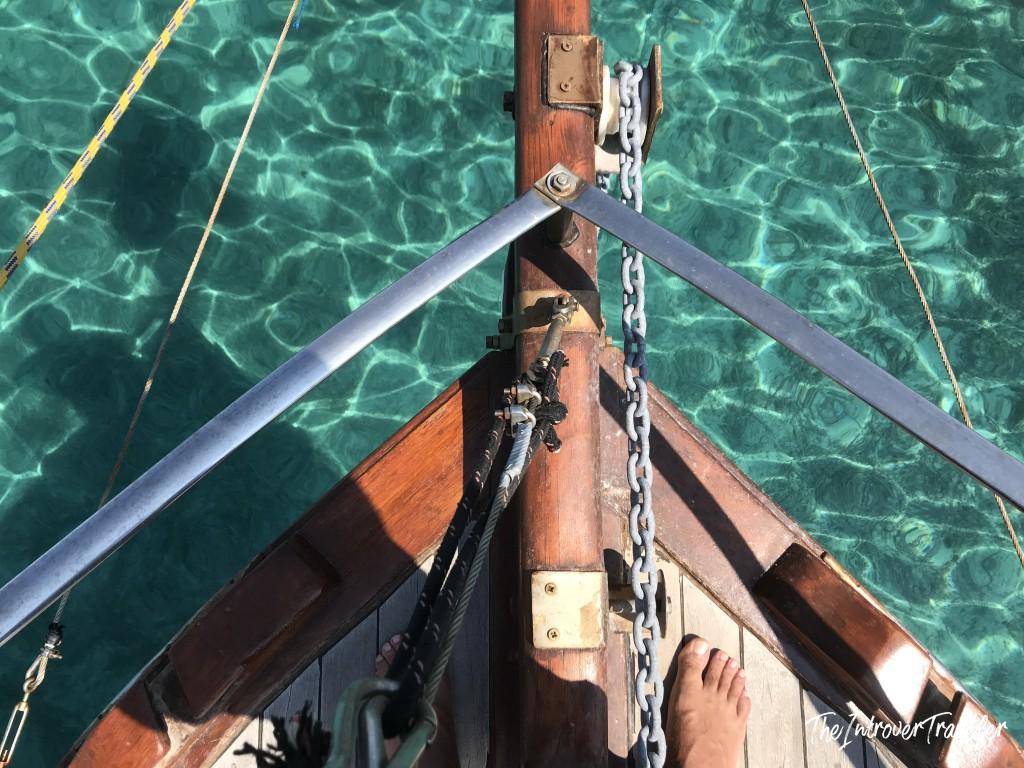
On a rented RIB, up to 40 horsepower without a licence, available from operators in both La Maddalena and Palau, you stop where you want and stay as long as you like. You reach the beaches that the tour boats skip. You leave a cove when it fills up and find another one five minutes away that is empty. Before departure, the operator sits with you for a few minutes in front of a map and walks you through the zones, the restricted areas, the Posidonia no-anchor zones, and the permitted moorings. It takes ten minutes, it is not complicated, and that is genuinely all the preparation you need.
If you prefer not to navigate at all, a skipper-guided private charter gives you local knowledge, access to restricted areas that require an authorised operator, and none of the logistics. Boats depart from Palau, La Maddalena, Baja Sardinia, and Porto Cervo.
One caveat: diving at the Protected Dive Points (PIP) in sensitive marine areas must be arranged through authorised dive centres, not independently. The centres on La Maddalena handle this without complication.
The Regulations
The archipelago is zoned, and the zones matter. Zone Ma is integral protection: no access, no transit, no anchoring. Zone Mb allows anchoring and mooring at designated buoys between 8 am and 10 pm. Overnight stays have been subject to legal challenges: a Sardinian administrative court provisionally lifted a nighttime anchoring ban for non-residents in mid-2025, pending a final judgment expected in early 2026. Check the current status with the Park Authority or a local marina before planning an overnight stop.
In every zone: no discharge of any kind, no anchoring on Posidonia meadows, no collection of biological material. The regulations are not bureaucratic noise. Three decades of enforcement have produced the water quality and marine abundance you came to see.
Practical Notes for Visitors
Getting to Palau: fly to Olbia (Aeroporto Olbia Costa Smeralda), then drive or take a bus to Palau, roughly 40 kilometres north. Alternatively, Olbia has ferry connections from the mainland (Livorno, Civitavecchia, Genoa). Palau is about one hour from Olbia by road.
The ferry: Saremar and Delcomar operate the Palau to La Maddalena crossing. In summer, departures run approximately every 30 minutes. The crossing takes twenty minutes. You can bring a car, a scooter, or a bicycle; in peak season, car spaces fill quickly, and booking in advance is sensible.
Getting around La Maddalena and Caprera: La Maddalena island has a road circuit accessible by car, scooter, or bicycle. Caprera is accessible from La Maddalena via the Passo della Moneta bridge. Buses run to Caprera but the schedule is seasonal. Every other island requires a boat.
Accommodation: staying on La Maddalena gives you the most flexible base. Hotels and B&Bs are concentrated in the town. Palau on the mainland is a reasonable alternative, particularly if you plan to rent a boat from there.
Season: June and September. The water temperature is still high (21 to 24°C), the boat tour queues are shorter, the coves are not shared with three hundred other people simultaneously. July and August are for those who find crowds motivating or who have already booked.
One More Thing
Among the people who understood the peculiar quality of this place was a man who came here more or less by force. Giuseppe Garibaldi arrived at La Maddalena under exile in 1849, having fought a guerrilla retreat across half the Italian peninsula after the fall of the Roman Republic. He could not stay; he was expelled and continued his wandering. But he came back. And eventually he bought land on Caprera, built a simple house, and spent the last twenty years of his life farming and reading and looking at the sea. He died there in 1882.
It is a particular kind of testimony. When someone with the option to go anywhere chooses to return repeatedly to one place and die there, it is worth noting which place.
His bed, for what it is worth, is still there.