Last visit: April 2025
Where: Supramonte, between Orgosolo, Urzulei, and Dorgali, central-eastern Sardinia
What: river gorge, one of the deepest in Europe
Duration: a whole day
My rating: 8/10
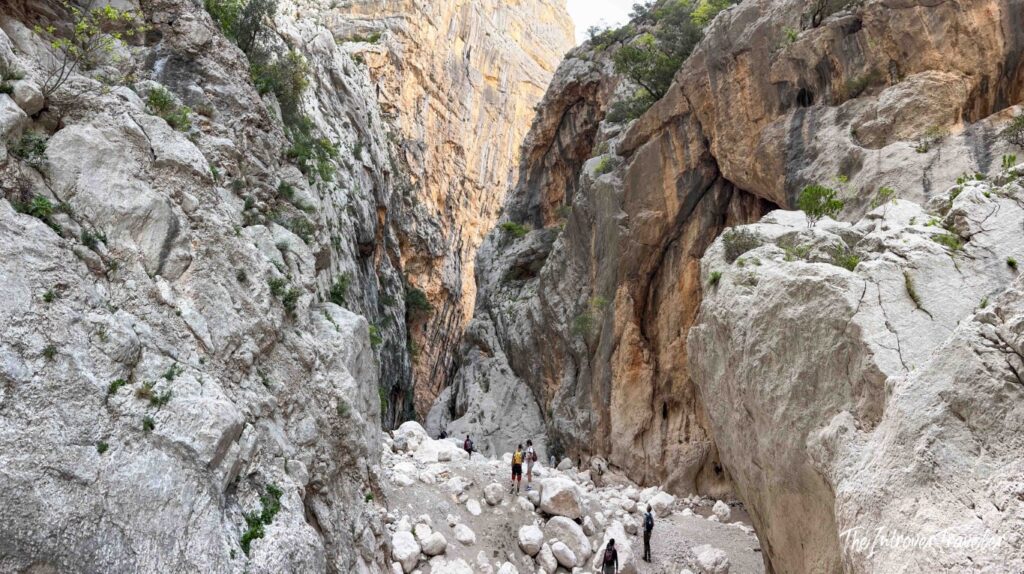
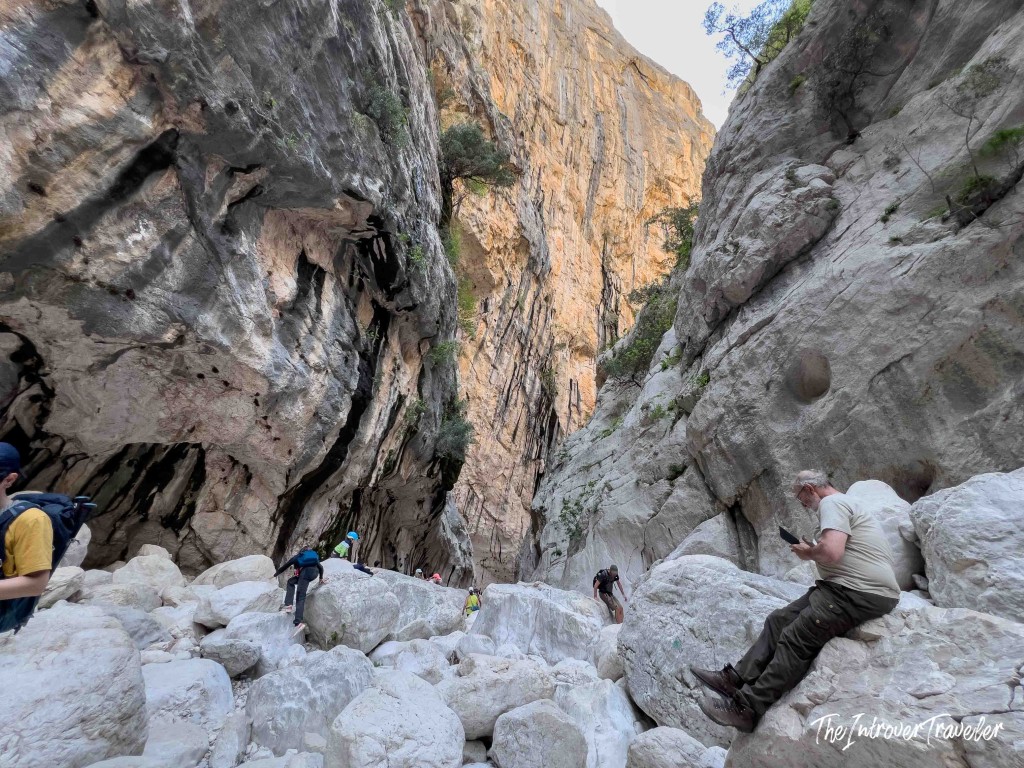
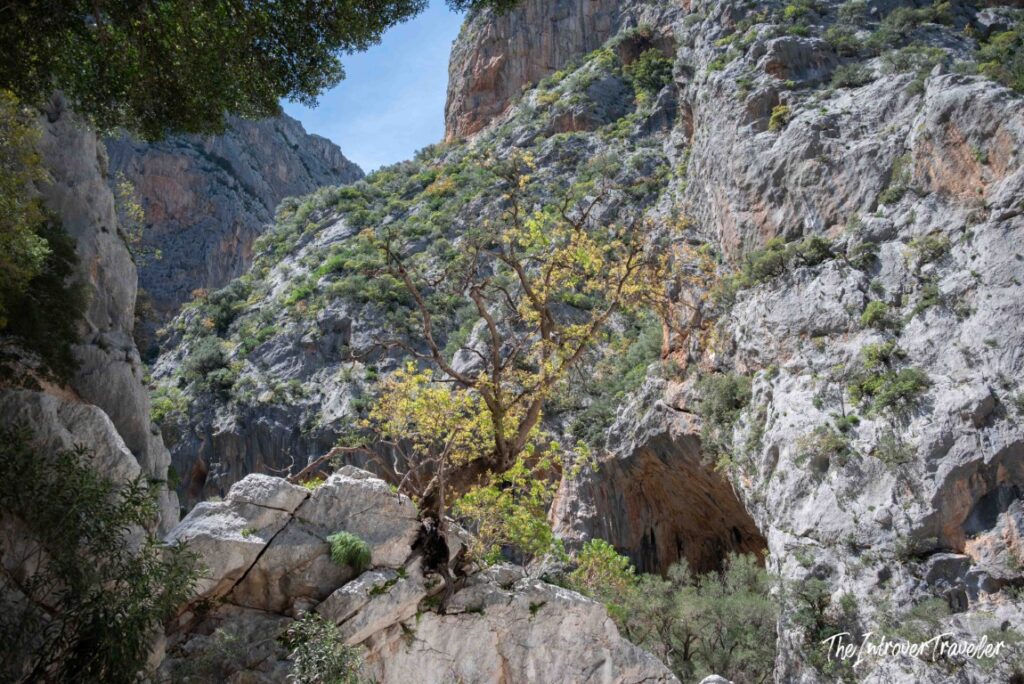
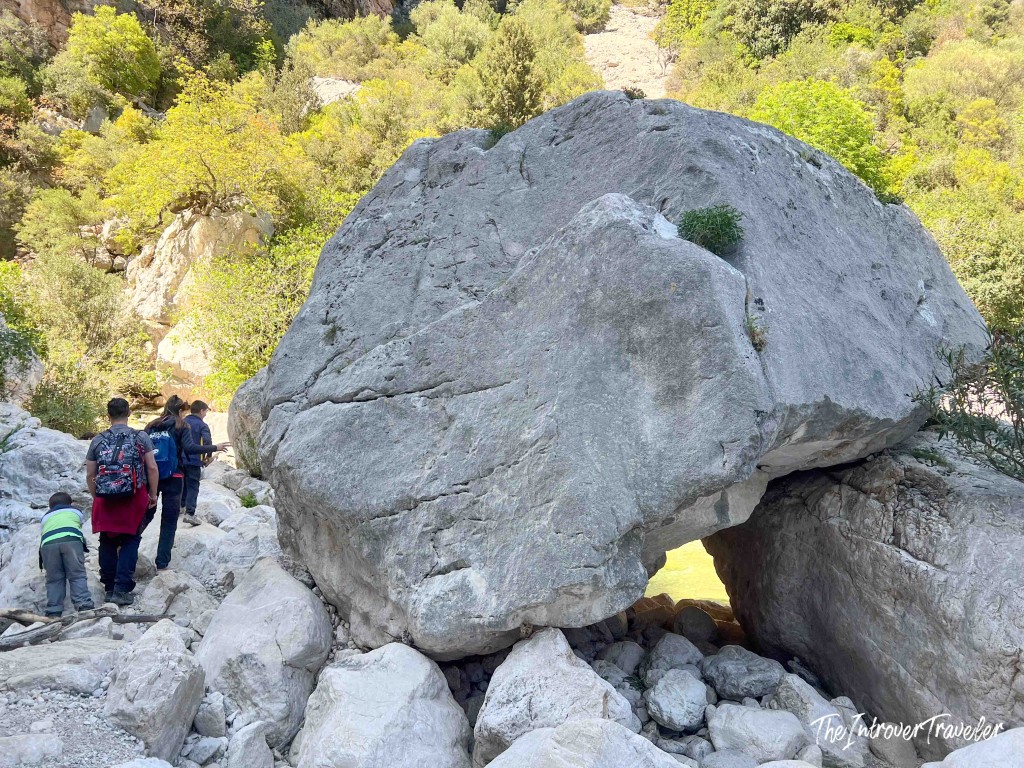
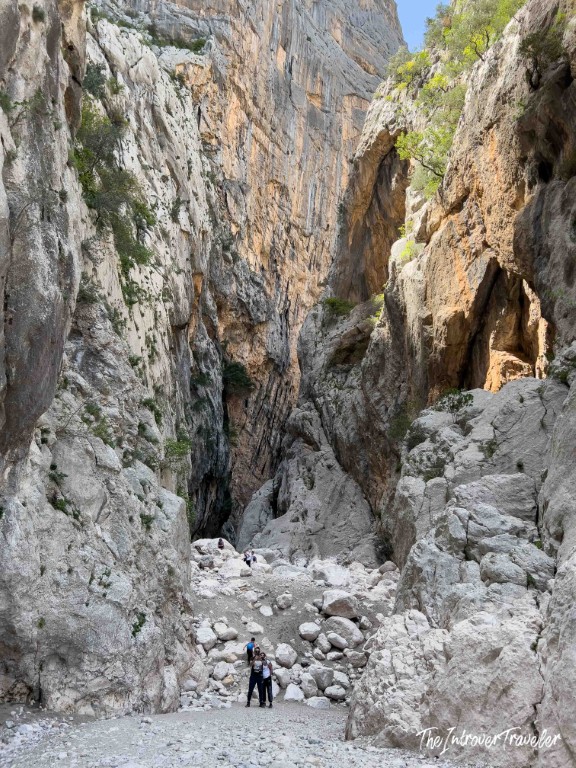
Gorropu is one of the few places in Sardinia where the adjective “spectacular”, which I normally use with suspicion, is simply accurate. It is a cleft about a kilometre and a half long, carved into the heart of the Supramonte, with walls that in places exceed 500 metres in height and a width that swings from the few metres of the narrowest passages to tens of metres in the broader stretches. It is considered the deepest gorge in Italy and one of the deepest in Europe. But more than the numbers, impressive as they are, what counts is the physical experience of being inside it: the narrow corridor of rock, the silence, the light that slants in for only a few hours a day, the white limestone blocks the size of houses cluttering the floor. It is a place that fills you with awe, in the literal sense of the word.
This post is analytical on purpose, because Gorropu is not a stroll, and the practical information here is not a detail: it is the difference between a good day and a day that ends badly. So take the time to read the part on the trails and on who can and cannot do them.
How it formed: geology
Gorropu was born from the meeting of two forces. The first is tectonic: the gorge opens along a fault line in the Mesozoic limestone of the Supramonte, that is, in a pre-existing fracture in the rock. The second is erosive: the Rio Flumineddu, the most important watercourse of the Supramonte, has carved and deepened that fracture for millions of years, smoothing the rock and dragging debris downstream, until it created the gorge we see today.
The rock is carbonate limestone of submarine origin, and this is the geologically most fascinating detail: the walls hold fossils that testify to a genesis on the sea floor, between roughly 190 and 60 million years ago. You are walking inside an ancient seabed that was uplifted and then incised by fresh water. A note that says a lot about the forces at play: during the flood of November 2013 the swollen Flumineddu managed to shift seemingly immovable blocks and to raise the riverbed by about two metres at the mouth of the gorge. Gorropu is not a finished landscape: it is still a work in progress.
Nature: the endemics and the microclimate
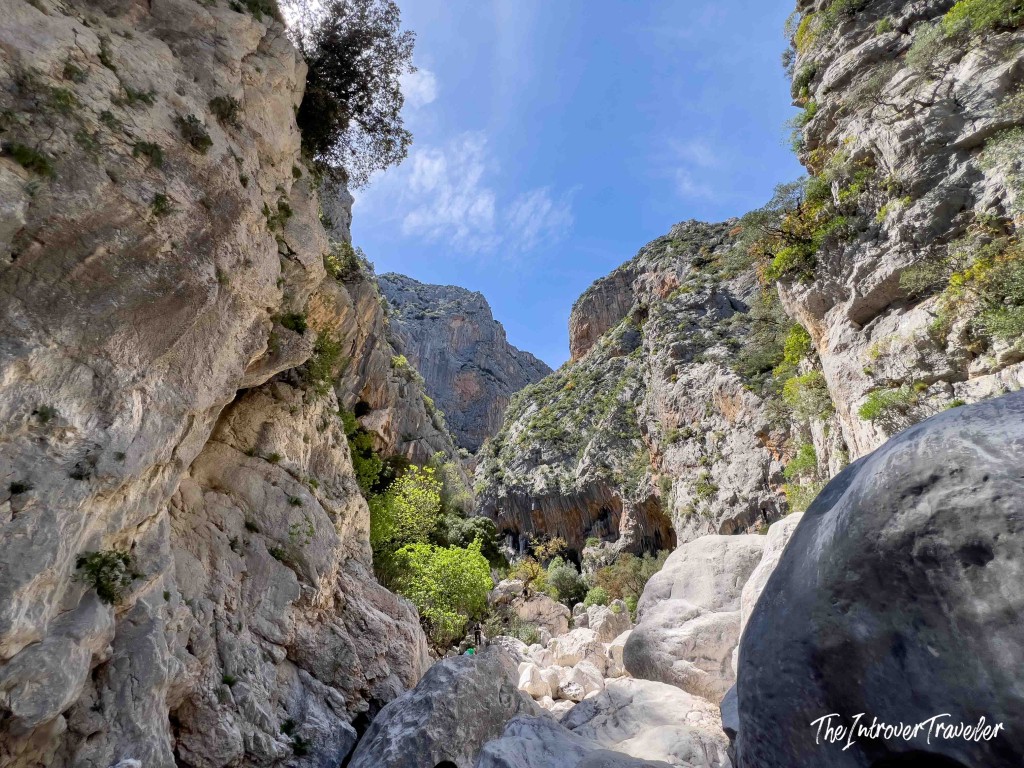
There is an ecological aspect that makes Gorropu unique and not merely scenic. The towering walls mean that wide areas of the gorge receive little or no direct sunlight, and this creates strong temperature swings and a particular microclimate, cool and shaded, different from that of the surrounding Supramonte. In this protected environment, endemic plant species have survived, relics of colder epochs.
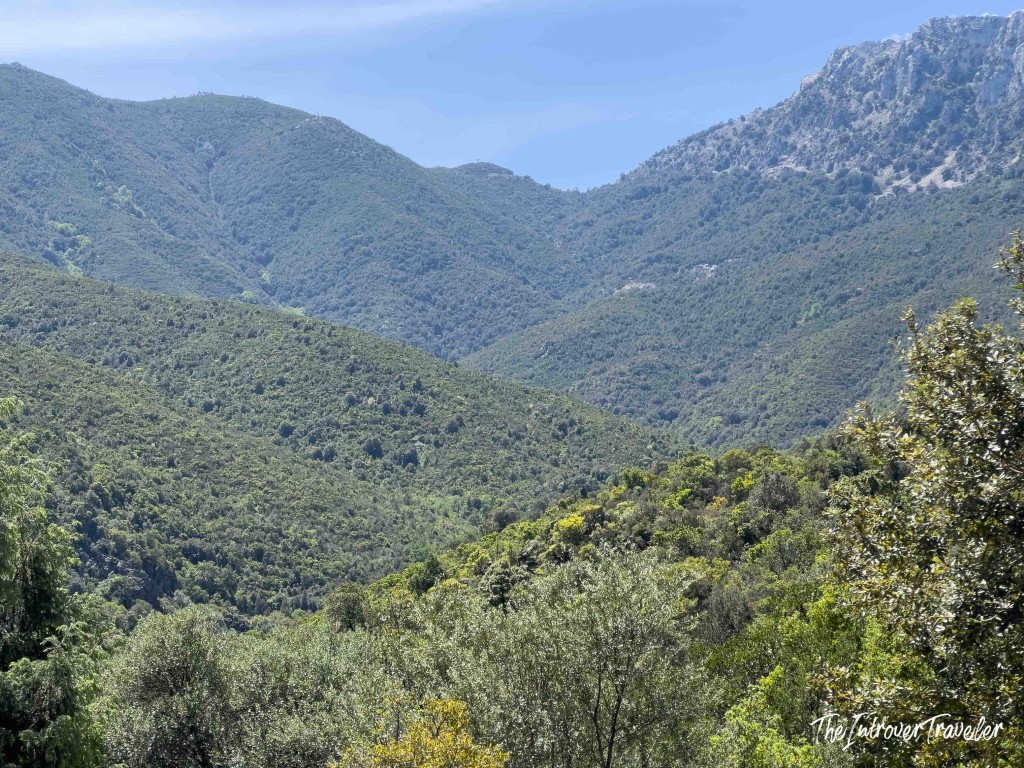
The most famous is the Gorropu columbine (also called the Nuragic columbine), a flower that grows almost exclusively here and in a very few other sites, and that blooms between mid-May and early June. If you go in that period, alongside the canyon you will also see this small botanical spectacle. The approach trail passes through woods of centuries-old holm oaks, strawberry trees, ferns, junipers, and the whole aromatic apparatus of high-altitude Mediterranean scrub. The area is also rich in Nuragic traces, villages, giants’ tombs, and the old shepherds’ folds (the cuiles), a sign that people have inhabited and used this land since the Bronze Age.
The three access routes: which to choose
Gorropu cannot be reached by car. You get there only on foot, and there are essentially three access routes, with very different characteristics. Choosing the right one for your physical condition is the most important decision.
The first and most frequented is the trail from Genna Silana (Forestas trail B-505). You start from the pass of the same name, at about 1,017 metres of altitude, at km 183 of the SS125 state road between Dorgali and Baunei, where there is a large car park. The route descends toward the gorge with a negative gradient of over 600 metres along about 4 kilometres. It is the shortest, but it has a precise catch: everything you descend on the way down you must climb back up on the way back. Reckon on about an hour and a half to two hours to descend and about double to climb back, on rocky and often slippery ground. The difficulty is graded E, hiking of medium-high level. It is the most panoramic trail, but the final climb, a constant ascent and perhaps under the sun, is what puts most people in difficulty.
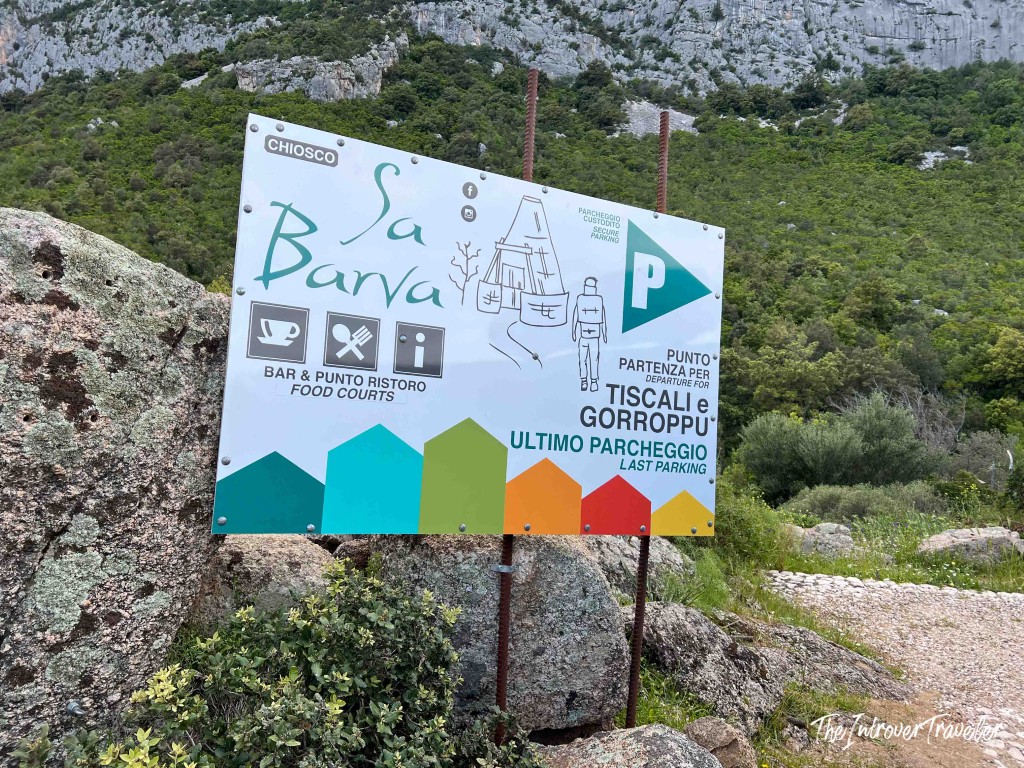
The second is the access from Sedda ar Baccas / Ponte Sa Barva, on the Dorgali side (being decidedly out of shape, I opted for this one). Here you follow the Flumineddu valley and reach the gorge “from below”, with a gentler approach and a much smaller gradient, around 200 metres. It is longer, about 12 kilometres round trip following the river, but far less punishing on the knees and the lungs, because there is no great final climb as at Genna Silana. It is the sensible choice for fit families or for anyone who does not fancy the return ascent.
The third group comprises the longer, more technical routes, for example from Urzulei or through the old folds, which let you see not only the gorge but the whole pastoral landscape of the Supramonte. Here a guide is not optional but a necessity, because the area is vast, wild, and the trails are not always marked.
A widely used middle option: several local guides offer a jeep or off-road service that covers part of the dirt-track route, significantly reducing the length and effort of the walk. For anyone who does not have the legs of an experienced hiker, it is often the most reasonable way.
Inside the gorge: the coloured-marker system
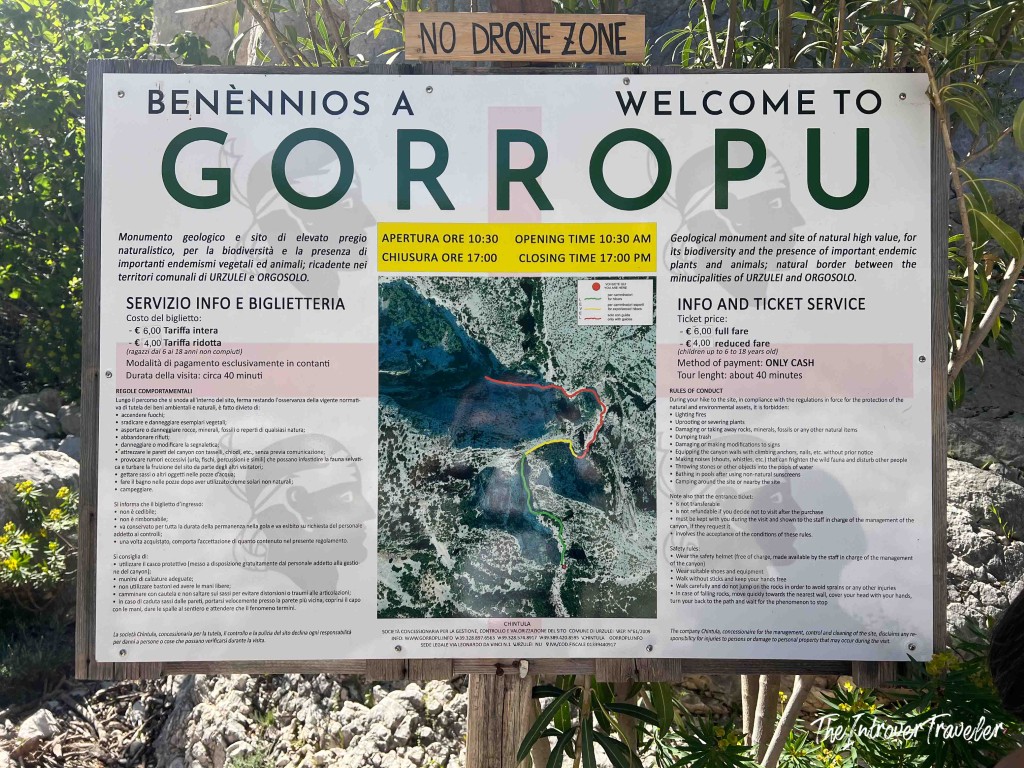
A point many do not expect: reaching the mouth of the gorge does not mean you have “done” it. Actual entry into the canyon is regulated and requires payment of a ticket (around 5 euros, but check the current amount), and the internal route, along the kilometre and a half of the gorge, is divided into stretches of increasing difficulty marked by dots in three colours.
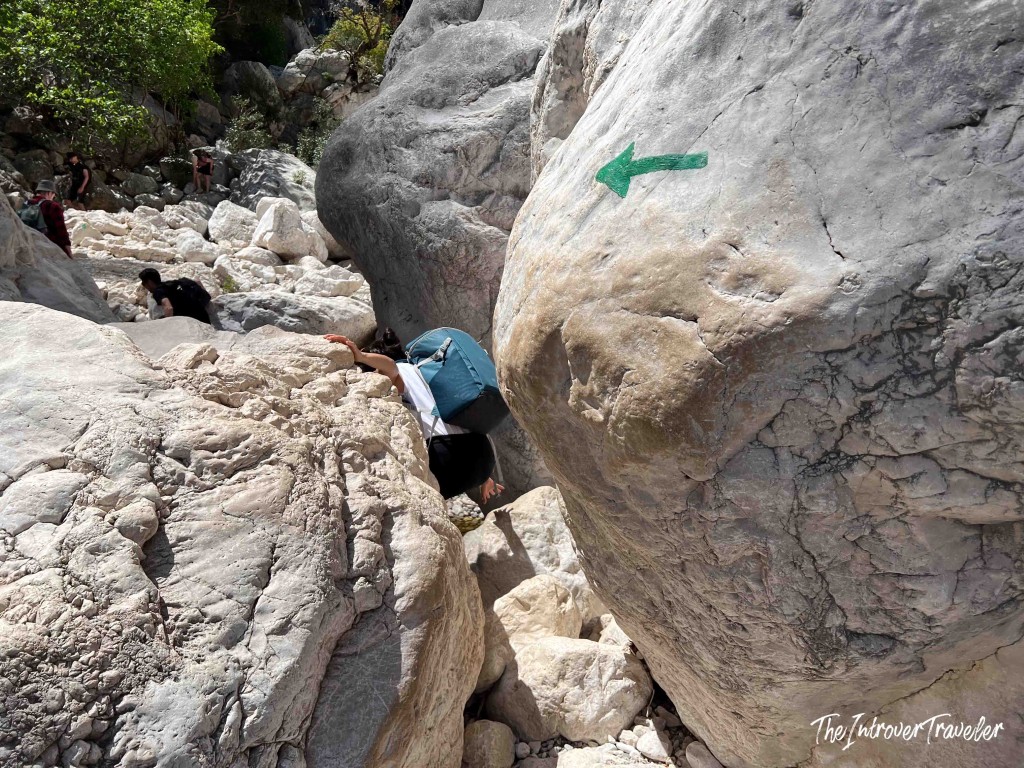
The green stretch is the initial one, accessible to practically everyone, even without experience, and on its own it already delivers the most impressive part of the view. The yellow stretch requires scrambling over larger and larger blocks, smooth and coated with a pale film that makes them slippery: it takes agility and attention. The red stretch is the most demanding, reserved for those with experience and equipment, with passages over enormous boulders where a misplaced foot costs you dearly. Most visitors stop at the green or the start of the yellow, and they are quite right to: there is no obligation to reach the end, and the beauty is already all there in the first stretches.
How long it really takes
It depends on the access route and on how far you go into the gorge. To give realistic numbers: from Genna Silana, reckon on a full day, roughly 2 hours of descent, the time inside the gorge, and a good 3 hours of ascent, plus stops. From Sedda ar Baccas, similar times or slightly longer in distance but with less vertical effort. In both cases it is a half-to-full-day excursion, not something to squeeze in between lunch and the beach. Start early, especially in summer.
Who can do it, and who should not
This is the section that matters most. Gorropu is within reach of many, but not of everyone, and lying about this means leaving people stranded halfway up the climb.
It is suitable for anyone in at least decent physical condition, with legs and knees trained for descent and ascent, and no serious heart, joint, or breathing problems. The green stretch inside the gorge is feasible for most people in good health. With children it is possible, but judge carefully: better the access from Sedda ar Baccas, and better not to push beyond the green stretch.
It is not recommended, or requires great caution, for those with heart or breathing problems (the climb back from Genna Silana is a prolonged, constant effort), for those with knee or hip problems (the steep descent over rock is as hard as the climb), for those who suffer badly in the heat if they go in summer, and for those unused to walking on uneven, slippery ground. It is not a route for city shoes, flip-flops, or sandals: you need hiking boots with a lugged sole. Trekking poles help a great deal, both on the way down and on the way up.
What to bring and when to go
Bring plenty of water, because there is none to be found along the route, more than you think if it is summer. Hiking boots, poles, a hat, and sun protection for the exposed stretches, something to eat. The best season is spring or autumn: cool weather, and in spring the flowering, including the columbine. I did it in April, and the sun was already beating down as in summer, so a hat and sunscreen are well worth packing even in the cooler months. Summer is possible, but the heat, especially on the way up and in the exposed stretches, can become a serious problem. Winter offers clear, evocative days, but with the risk of wet and slippery ground.
One more thing: some stretches of the river are swimmable, so if you like you can bring a swimming costume for a dip among the rocks. Be warned that the water is cold, but after the climb back it may be exactly what you want.
A final recommendation, which holds even though the main trail is well marked: for the longer, more technical routes, rely on a local guide. It is not only a question of not getting lost, although in such a vast and wild area the risk is real; it is that a guide makes you understand what you are looking at, from the geology to the endemics to the Nuragic traces, and turns a tiring walk into something you take home with you.
Is it worth it?
Yes, plainly. Gorropu is one of the most powerful natural places in Sardinia, and the only real reason it does not earn a full ten is that it demands physical effort and planning, and so it is not for everyone equally. But if you are in condition to take it on, even just in the opening stretch, it is an experience that puts a good many other, more comfortable and more crowded “wonders” into perspective. You step into a crack in the earth millions of years old, you walk on the floor of a vanished sea, and for a few hours the rest stops mattering. Go prepared, go with respect, and Gorropu will repay you.


