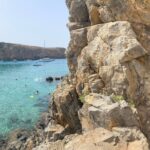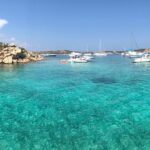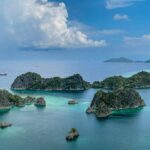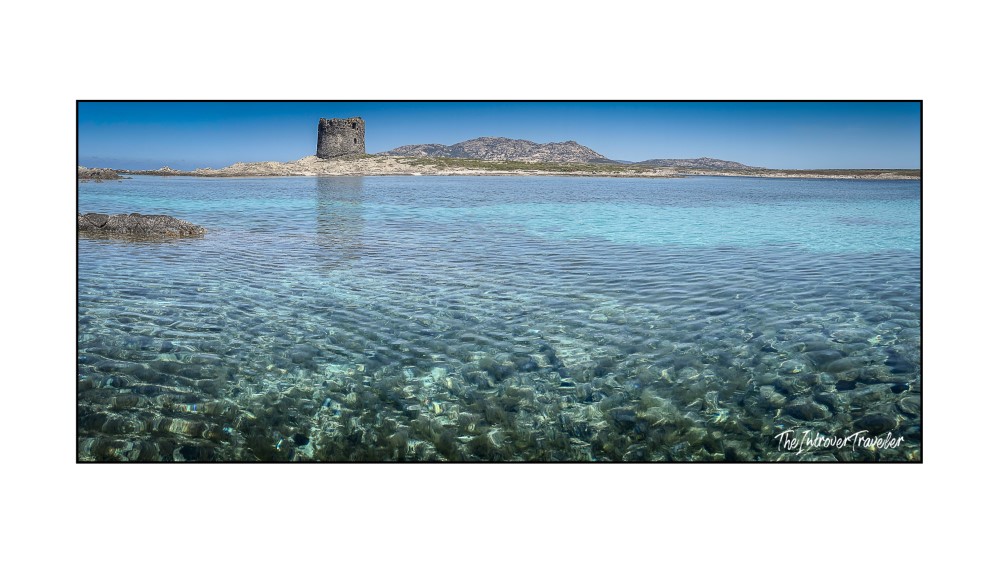
For decades Sardinia has been sold with a single photograph: a crescent of white sand and a turquoise sea, ideally captioned “the Maldives of the Mediterranean.” The photograph does not lie (or it lies by understatement, because in my judgment Sardinia is far more beautiful than the Maldives, at least in terms of landscape), but it is the most superficial thing you can say about this island, in the literal sense: it is the surface. What makes Sardinia truly unforgettable to anyone who knows how to look is far older and far harder than the sand. It is the stone, the scrub and the wind, and all three tell the same story of deep time I have already chased while writing about its food and its language. Geologically, this is one of the oldest lands in Europe, and it shows.
The Maquis: The Scent Before the Scenery
In Sardinia you smell the landscape before you see it. When you roll down the car window in the interior in summer, you are hit by a resinous, bittersweet smell that is the island’s olfactory signature: it is the macchia mediterranea, the dense evergreen tangle of shrubs that covers everything that is not bare rock or cultivated field.
The protagonists are always the same, and we have already met them in the kitchen: mastic (Pistacia lentiscus), myrtle (Myrtus communis), the strawberry tree (Arbutus unedo) that in late autumn carries white flowers and red berries at the same time, juniper, the rockrose that in spring bursts into pink and white bloom, broom, the tree spurge (Euphorbia dendroides) that in summer, to defend itself from the drought, turns red and sets the cliffs ablaze with orange. Here and there even the dwarf palm (Chamaerops humilis) appears, the only palm native to Europe.
But if I had to name a single plant as the island’s fragrant icon, I would choose Helichrysum. The curry plant is a small silvery shrub with golden-yellow flowers, endemic to Sardinia, Corsica and the Balearics, which grows stubbornly on the arid, stony soils that face the sea. Its smell is somewhere between curry and honey, intense enough to cling to you, and its flowers are called “everlastings” because they do not fade even once dried. The Helichrysum is the maquis reduced to its essence: tenacious, frugal, fragrant, able to thrive where almost nothing else takes root. Exactly like the Sardinians.
The Trees: Olives That Have Seen the Nuraghi and Junipers Bent by the Wind
If the maquis is low and dense, Sardinian trees tell two different things: age and wind.
Age has a precise monument, and it stands in Gallura, near Lake Liscia. It is called S’Ozzastru, it is a wild olive (Olea europaea var. sylvestris), and according to the estimates of the University of Sassari it may be around four thousand years old, which makes it probably the oldest tree in Europe. To give a sense of scale: when this trunk was already a sapling, the Nuragic civilization had yet to be born, the Phoenicians had not set foot on the island, Rome did not exist, and Stonehenge was still under construction. The whole island is dotted with centuries-old wild and cultivated olives with twisted trunks, but S’Ozzastru is the patriarch, a living being older than anything the people around it have ever built. I find this entirely consistent with a land that produces an off-the-scale number of centenarians, that still speaks a language only a short step from ancient Latin, that holds hundreds of Nuraghi: Sardinia is an ancient land from whatever angle you look at it.
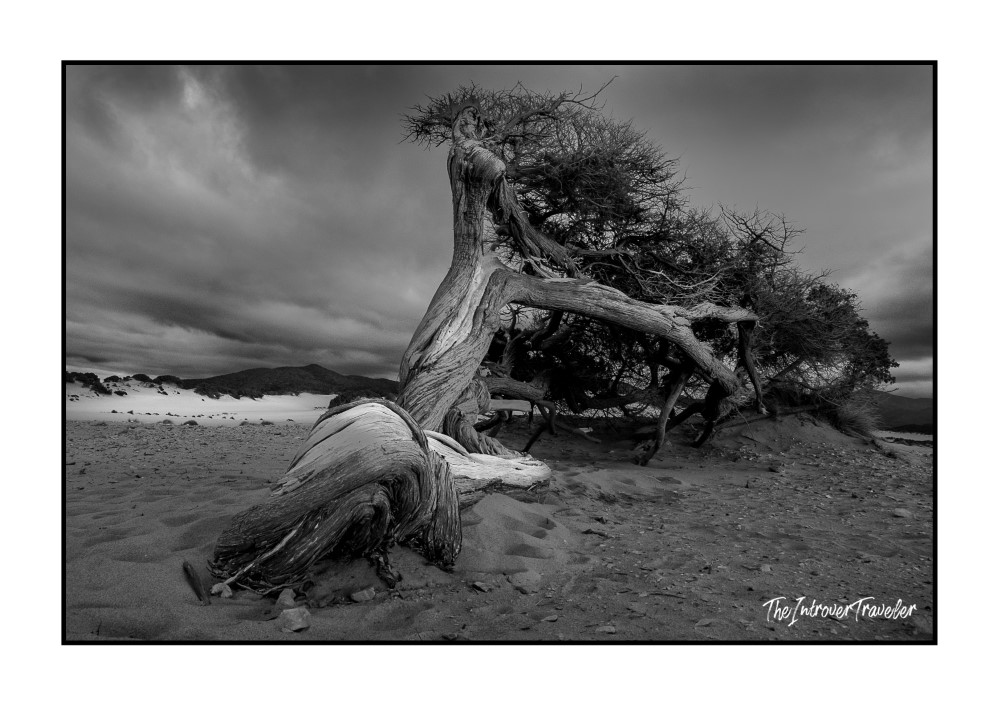
The wind, by contrast, sculpts. Along the coasts exposed to the maestrale, the dominant northwesterly wind, the junipers and pines do not grow straight: they grow bent, flattened, modeled into a flag shape in the direction the current blows, with their branches all on one side like hair combed by force. They are among the most recognizable photographic subjects on the island, and they are also a small biology lesson: the shape of those trees is the physical record of decades of wind. Further inland, in Gallura, the trees become cork oaks (Quercus suber), which around Tempio Pausania and Calangianus are still stripped by hand, leaving the trunks bare and rust-colored, another image that stays with you.
Ancient Stone: From the Granite of Gallura to the Metasiltstones of the Sulcis
Here lies, in my view, Sardinia’s real landscape greatness, the one the sand hides. The island is an open-air geological museum, and it changes its character of rock depending on where you are.
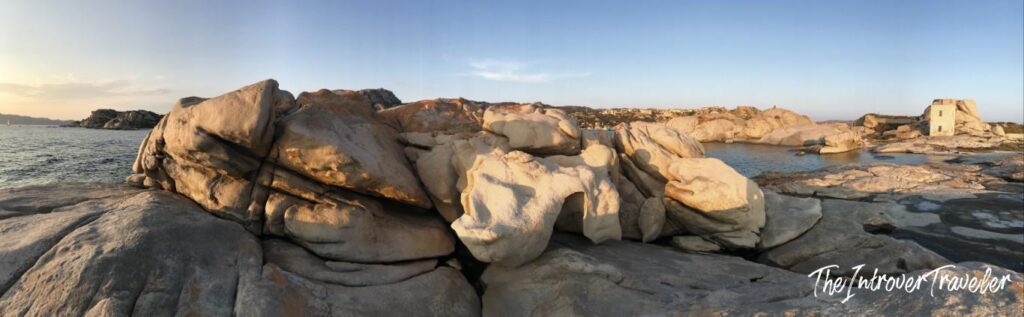
The northeast is the kingdom of granite. Gallura and the Costa Smeralda rest on the Sardinian-Corsican batholith, an enormous mass of intrusive rock emplaced about three hundred million years ago. That granite, exposed and then worked for millions of years by rain, thermal shock, salt and above all the maestrale, has eroded into shapes that look carved by a hand: the tafoni, niche-like cavities hollowed into the rock, and the great rounded boulders that at Capo Testa, in the Valle della Luna or in the Roccia dell’Orso at Palau take on shapes that set off your pareidolia. It is no accident that the Romans already considered Capo Testa a precious quarry, from which they cut columns to ship to Ostia. The pinkish granite and the very fine white sand that comes from its crumbling are the chromatic trademark of the Costa Smeralda, the yachts aside.
At the opposite extreme, geographic and geological, is the southwest: the Sulcis-Iglesiente, which guards some of the oldest rocks in Italy. Along the coast of Nebida and Masua the Cambrian metasiltstones and metasandstones come to the surface, clastic formations more than five hundred million years old, lightly metamorphosed and then folded by the ages. It is in this setting that the Pan di Zucchero rises, a white colossus of one hundred and thirty-three meters that juts from the sea off Masua: a Cambrian limestone that erosion has shaped into the tallest sea stack in the Mediterranean. Sheer on the cliff opposite, carved into the rock in the 1920s, is the mining gallery of Porto Flavia, because here the most ancient geology and the mining history are inseparable: this is the land of lead and zinc, and the ruins of the mines are by now as much a part of the landscape as the rock itself, in this land that always stayed poor while handing its riches to whoever came, in turn, to plunder it.
Then there is a third stone, and it is the Mesozoic limestone of the Supramonte, on the eastern coast. Here water did the work that elsewhere the wind did, carving the limestone into vertiginous gorges like Su Gorropu, one of the deepest canyons in Europe, with walls that exceed four hundred meters, and monumental coves like Cala Goloritzé, dominated by the Aguglia, a rock pinnacle more than one hundred and forty meters tall. Granite in the northeast, Paleozoic rocks in the southwest, limestone in the east: three different mineral Sardinias, each with its own light and its own color.
To these three stones a fourth is added, smaller but perhaps the most fascinating of all, because it is also the first commodity Sardinia ever exported. In the center of the island, behind the Gulf of Oristano, rises Monte Arci, an extinct volcano whose lava flows left behind obsidian: the black, glassy volcanic glass that forms when silica-rich lava cools all at once, and that fractures into shards with razor-sharp edges. In the Neolithic, before metals existed, those edges were the most advanced technology around, perfect for making blades, arrowheads and scrapers. Monte Arci is one of only four obsidian sources in the entire central-western Mediterranean, together with Lipari, Palmarola and Pantelleria, and its quality was such that already from the sixth millennium BC the Sardinian “black stone” was traded by sea to Corsica, to northern Italy as far as Liguria and the Po Valley, and above all to southern France. Today chemical analyses make it possible to tell apart the different types of the deposit, which archaeologists call SA, SB and SC, and therefore to take a blade found in Provence and trace it back to the exact Monte Arci outcrop it came from: a designation-of-origin traceability, five thousand years before the DOP. At Pau, on the slopes of the mountain, a museum is devoted entirely to it, the only one in Europe. And it is worth pausing on this: long before the granite the Romans shipped to Ostia and the wine the Nuragics loaded into their jars, Sardinia was already exporting its sharpest stone.
The Transparent Sea: Why the Water Looks Like That
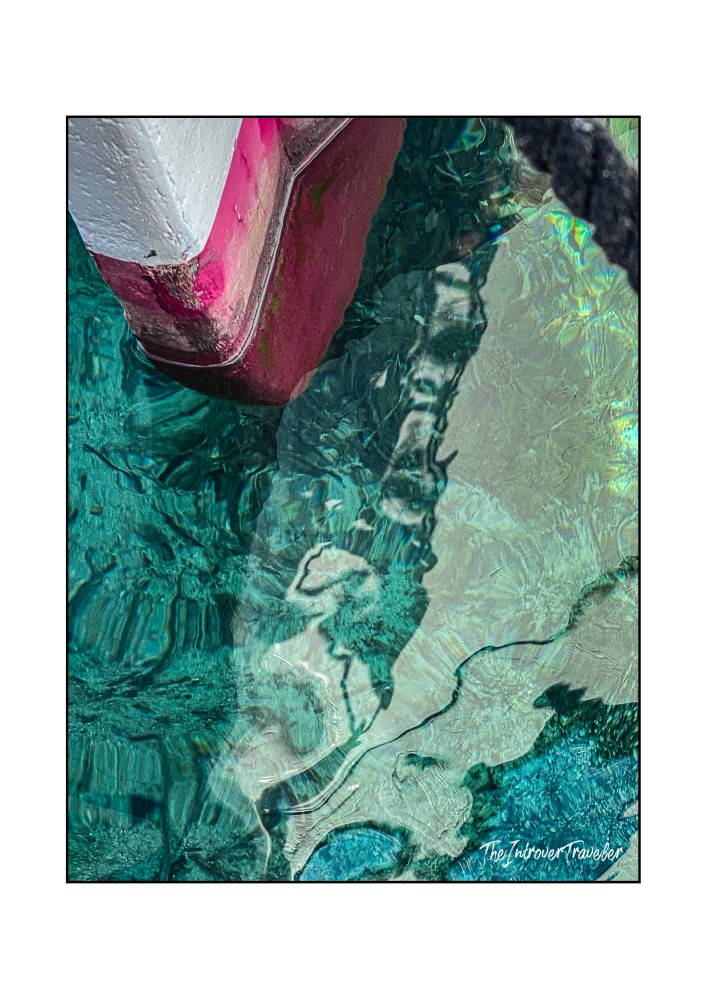
And so we come to the sea, the postcard one, which is worth understanding rather than merely photographing. The transparency of Sardinian water is not a miracle, nor, please, “the Caribbean”: it is the result of precise causes, all of them Mediterranean.
The first are the meadows of Posidonia oceanica, the seagrass endemic to the Mediterranean that carpets the sandy seabed. Posidonia oxygenates the water, keeps it clear, holds the sediment in place and, with its dead leaves piled on the beaches, protects them from erosion. The beached “seaweed” that some tourists find unsightly and would like removed, and that is not even seaweed, is in reality the reason that beach still exists. The second cause is the sand: in large part it is not muddy organic sand but pale grains of quartz and crumbled granite, or carbonate fragments, which reflect the light and give the shallows that blinding turquoise. At Is Arutas, near Cabras, the beach is literally made of quartz grains like rice. At Budelli, in the La Maddalena archipelago, the famous Pink Beach owes its color to the fragments of a microorganism, the foraminifer Miniacina miniacea: it is so fragile that since 1994 it has been forbidden to set foot on it. The third cause is the most banal and the most important: the absence of large muddy rivers and of widespread coastal industry keeps the water clean. The Sardinian turquoise is not catalog exoticism, it is ecology.
The Animals: The Island That Kept Its Own
A landscape is not only stone and plants, and Sardinia, isolated forever, has preserved a fauna that has vanished elsewhere. On the mountains the mouflon survives, the wild sheep that is almost the island’s symbol, and the Sardinian deer, an endemic subspecies, has come back from the brink of extinction. On the basalt plateau of the Giara di Gesturi, among cork groves and seasonal ponds, the cavallini della Giara still live in the wild, small wild horses unique in the world. In the lagoons of Cagliari and Oristano the pink flamingos nest, and at Molentargius you can see them in a fully urban setting. On the cliffs of Bosa the griffon vultures wheel, huge birds that have returned to breed. And there is at least one absence that weighs: the monk seal, which once inhabited the Grotta del Bue Marino on the Gulf of Orosei and which today has practically vanished from Sardinian waters, a reminder of how fragile even paradise can be.
A Beauty That Endured
In the end, the thread that ties together the maquis, the bent trees, the granite and the water is the same one that ties together the food and the language I have already written about: isolation and old age. Sardinia is beautiful with the beauty of things that have lasted a long time. The wind that twists the junipers is the same that sculpts the tafoni; the drought that reddens the spurge is the same that selected the Helichrysum; the time that made a wild olive a thousand years old is the same that left half-billion-year-old rocks exposed at Masua. This is not a domesticated landscape, it is a landscape that survived.
That is why, here too, the advice is the same one I give for the food and the words: do not stop at the beach. The white sand and the turquoise water are sublime, but they are the first layer. Beneath, and around, there is an island of ancient stone and tenacious scents that is worth far more than a turquoise postcard, and that asks only to be looked at with a little more attention.