Everything a foreign traveler needs to know before stepping on an Italian train: operators, tickets, classes, validation, strikes, and the unwritten rules no guidebook tells you.
If you’re planning a trip across the country, this Italy Train Guide explains how rail travel really works, from Trenitalia and Italo to ticket validation, delays and hidden rules.
Two Operators, One Rail Network
Unlike many countries where a single national company runs all trains, Italy has two main high-speed operators that often serve the same routes. They are completely separate companies with separate websites, apps, tickets, and loyalty programs. A Trenitalia ticket is not valid on an Italo train, and vice versa. Always double-check which company your ticket belongs to before boarding.
Trenitalia held a monopoly for decades, then Italo burst onto the scene and upset the apple cart. Trenitalia responded the way any monopolist would: by trying to block the newcomer at every turn. More recently, Italo has faced some financial difficulties, and if you travel with them you might occasionally notice signs of a company under pressure (the odd service hiccup, some deferred maintenance). That said, the same is true of Trenitalia. If I had to draw a bottom line, it would be this: Trenitalia still behaves, decades on, like a state-backed company that can get away with mediocre service because it enjoys a near-monopoly position. Italo, on the other hand, operates as a genuine free-market competitor, trying to offer the best possible service at the most competitive price. Personally, I tend to go with Italo because I find the value for money is better, but keep in mind that Italo only covers the main high-speed routes (essentially the Turin-Milan-Bologna-Florence-Rome-Naples corridor).
Trenitalia
- Type: State-owned (Ferrovie dello Stato)
- Network: High-speed, intercity, regional, and commuter trains across the entire country
- Website: trenitalia.com
- App: Trenitalia
Italo
- Type: Private company (NTV, Nuovo Trasporto Viaggiatori)
- Network: High-speed trains only, connecting major cities (Rome, Milan, Naples, Florence, Venice, Turin, Bologna…)
- Website: italotreno.it
- App: Italo Treno
💡 Pro tip: When planning a trip, always compare both websites. They sometimes have very different prices for the same route and time slot. Italo often has aggressive promotions; Trenitalia has a wider network and is the only option for regional and intercity routes.
Types of Trains
Not all Italian trains are created equal. The type of train dramatically affects your travel time, comfort, and price.
- Frecciarossa / Frecciargento / Frecciabianca (Trenitalia): High-speed trains (up to 300 km/h). Frecciarossa is the fastest and most comfortable. Reserved seating. Air conditioning, power outlets, Wi-Fi.
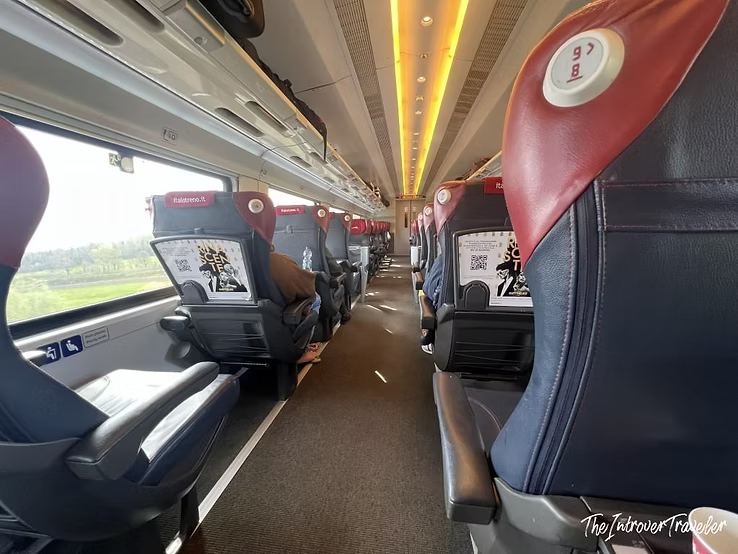
- Italo (NTV): High-speed trains competing directly with Trenitalia. Similar speed and comfort. Reserved seating. Wi-Fi, snack bar, leather seats in higher classes.
- Intercity / Intercity Notte (Trenitalia): Longer-distance trains, slower than Frecce. They stop at more cities. Intercity Notte are overnight trains with sleeping options.
- Regionale / Regionale Veloce (Trenitalia / Trenord): Local and suburban trains. Much cheaper but slower, more crowded, and sometimes less reliable. No reserved seating.
Italy train guide: How to Book
- Pick your operator. Go to trenitalia.com or italotreno.it (or use their respective apps). Both sites support English. Compare prices on both before buying.
- Search your route. Enter departure city, arrival city, date, and time. The system will show all available trains with prices.
- Choose your fare and class. Cheaper fares (“Super Economy” on Trenitalia, “Low Cost” on Italo) are non-refundable and non-changeable. Flexible fares cost more but allow changes or cancellations.
- Pay online. Credit/debit cards, PayPal, and other methods are accepted. You will receive an e-ticket by email or in the app.
- Board the train. For high-speed trains, just have your e-ticket (on your phone or printed) ready. A conductor will scan it on board. No need to validate anything at the station.
⚠️ Important: Regional train tickets. If you buy a ticket for a Regionale train, you must validate it before boarding by stamping it in the small green-and-white machines on the platform. If you bought online and have a QR code, no validation is needed. But a paper ticket without a stamp can get you a fine of up to €50, even if you have a valid ticket. Inspectors are strict about this.
Classes and Comfort Levels
Trenitalia (Frecce): From lowest to highest: Standard, Premium, Business, and Executive. Executive is essentially a first-class lounge on rails with very few seats, welcome drinks, and meals included. For most travelers, Standard is perfectly comfortable.
Italo: From lowest to highest: Smart, Comfort, Prima, and Club Executive. The naming is different, but the concept is the same. Smart is equivalent to Trenitalia’s Standard.
💡 Pro tip: If you book early (2 to 4 weeks in advance), you can often get Business or Prima class tickets for the same price as a last-minute Standard ticket. Early booking is the single best way to save money on Italian trains.
Things That Might Surprise You
1. Stations Can Be Confusing
Major cities often have more than one train station. In Rome, for instance, Roma Termini is the main station, but high-speed trains also stop at Roma Tiburtina. In Milan, you have Milano Centrale, Milano Rogoredo, and Milano Porta Garibaldi. Always check which station your train departs from, especially with Italo, which sometimes uses secondary stations.
2. Platform Announcements Come Late
The departure platform (“binario”) is typically displayed on the big screens in the station only 15 to 20 minutes before departure. Don’t panic if you don’t see your platform listed yet. Look at the yellow departure boards (electronic or paper) or the main screens. Italians usually crowd around the screens and then rush to the platform once it’s announced.
3. Strikes Happen Regularly
Italian rail strikes (“sciopero”) are common, sometimes happening multiple times per month. However, most strikes have guaranteed minimum service: certain trains are required to run even during a strike, particularly during peak hours (roughly 6:00-9:00 and 18:00-21:00). Check the Trenitalia or Italo website on the day of travel for updates. If your train is cancelled due to a strike, you are generally entitled to a full refund.
4. Your Ticket Is Tied to a Specific Train
High-speed tickets (Frecce and Italo) are valid only for the specific train printed on the ticket. You cannot hop on an earlier or later train unless you change your booking first (if your fare allows it). Regional tickets, on the other hand, are typically valid for any regional train on the same route within a set time window (usually 4 hours from validation).
5. No Turnstiles or Gates
Italian train stations are open. There are no gates, no ticket barriers, and no security checks. You walk straight onto the platform. This feels strange if you’re used to the London Underground or Tokyo Metro. But don’t be tempted to ride without a ticket: inspectors do check regularly, and fines are steep.
6. Seat Reservations Matter
On high-speed trains, your ticket includes a specific seat and coach number. Sit in your assigned seat. If someone is in your seat, politely show them your ticket. On regional trains, there are no reserved seats, so it’s first-come, first-served.
7. Luggage
There are no strict luggage limits on Italian trains, but space is limited. Overhead racks and areas near the doors are available for large bags. There are no porters. On crowded regional trains, large suitcases can be a real nuisance, so pack smart.
8. Food and Drinks
High-speed trains have a bar car where you can buy coffee, sandwiches, snacks, and drinks. Prices are higher than at a regular bar. You are allowed to bring your own food on board, and most Italians do. Regional trains generally have no food service at all.
9. Wi-Fi and Power Outlets
High-speed trains offer free Wi-Fi, though the quality can be inconsistent, especially in tunnels and rural areas, or, to put it less diplomatically: it sucks, it’s often unusable, and it’s not up to the standard you’d expect from a civilized country in the second quarter of the 21st century. Power outlets are available at every seat on Frecce and Italo trains (but they don’t always work). Regional trains may or may not have them.
10. The “Quiet Car”
Some Frecce trains have a designated “Silence” area (usually coach 3 on Frecciarossa). Phone calls and loud conversations are not allowed there. If you value a peaceful ride, book a seat in this coach. As of 2026 Silence Area is not available on Italo (shame on them). The stereotype that paints all Italians as loud is not, like all stereotypes, entirely accurate. That said, respect for silence and other people’s personal space is less commonly practiced in Italy than in other Western countries. So you’ll find it much more common to encounter someone talking at full volume and forcing their conversation on the entire coach than to find a car where everyone is quietly minding their own business. However, if you do get up and deliver a well-placed headbutt to the noisy passenger’s nose, you’ll generally receive far more approval than disapproval, so feel free to go ahead.
Useful Vocabulary
- Binario = Platform (“Binario 5” = Platform 5)
- Partenza = Departure (yellow boards at stations)
- Arrivo = Arrival (white/blue boards at stations)
- Ritardo = Delay (very common word to know)
- Sciopero = Strike (check online before traveling)
- Biglietto = Ticket
- Convalida = Validation (stamp your regional ticket!)
- Carrozza = Coach / Car (coach number on your ticket)
- Posto = Seat (“Posto 12A” = Seat 12A)
- Uscita = Exit
- Fermata = Stop (mostly used for buses/metro)
- In orario = On time
- Soppresso = Cancelled (the word you hope you never see)
Quick Summary of Key Rules
- Validate paper tickets for regional trains before boarding. No stamp = potential fine.
- Trenitalia and Italo are separate companies. Tickets are not interchangeable.
- Check your station name carefully. Large cities have multiple stations.
- Sit in your assigned seat on high-speed trains.
- Book early for the best prices. Last-minute high-speed tickets can be 3 to 4 times more expensive.
- Download both the Trenitalia and Italo Treno apps before your trip. Having your tickets on your phone is the easiest way to travel. Both apps show real-time train status, platform numbers, and delay notifications.