Author and title: Robert Kurson – Shadow Divers: The True Adventure of Two Americans Who Risked Everything to Solve One of the Last Mysteries of World War II
Summary: The story of two technical divers and the discovery of the wreck of a UBoat
Recommended for: Divers who want to read a gripping and shocking story of technical diving and wreck diving
My rating: 4 / 5
The plot
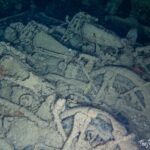
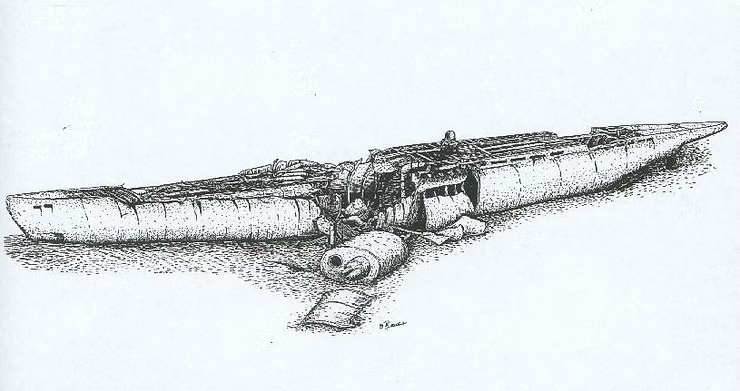
In 1991, two technical divers, two true pioneers of wreck diving, discovered the wreck of a World War II submarine off the East Coast of the United States, in a location where no submarine was historically recorded to have sunk. The two became obsessed with naming the wreck, both for the glory of being the first to claim its discovery, but also, as the search became more complex, to honor the memory of the crew members.
It was the early days of technical diving, trimix was not yet widespread, and the wreck lay at over 70 meters in an area with strong currents, very poor visibility, and difficult access. The two divers assembled a search team, composed of divers passionate about wreck diving, to gradually penetrate the hostile environment of the wreck, obsessively searching for clues that would help solve the mystery.
Shadow Divers Book Review
Shadow Divers isn’t just a book about diving: it’s one of those texts that speaks to divers from the inside , capturing obsessions, fears, mental automatisms, and that particular attraction to risk that technical divers know all too well. Robert Kurson takes a seemingly marginal discovery as his starting point—an unknown wreck off the coast of New Jersey—and transforms it into a story that’s halfway between news and halfway between thriller.
For an advanced recreational or technical diver, the book’s strength lies primarily in its operational context . The dives described are not “underwater adventures” in the tourist sense, but true extreme technical missions : depths of over 70 meters, often zero visibility, cold and dirty waters, unpredictable currents, long and complex decompressions, redundant equipment pushed to the limits of the era’s capabilities, and an impenetrable and potentially lethal environment like that of a collapsed submarine wreck. Kurson doesn’t indulge in didactic explanations, but he beautifully conveys the brutality of an environment where every mistake—even the smallest—is punished without appeal.
From a technical standpoint, Shadow Divers is particularly interesting because it recounts a historical phase of diving that is now almost archaeological: the transition period between advanced deep air and the systematic use of trimix . For those who today train with modern standards, advanced computers, and consolidated protocols, reading these pages has an almost educational value. Not so much to “imitate”—which would be foolish—as to understand the origins of many rules that are now taken for granted . The book is, implicitly, a lengthy empirical demonstration of why certain operational choices have been abandoned.
Many incidents that occur during the investigation into the crime are described almost as if they were a real-time commentary, and every diver feels as if they are witnessing the events with their eyes open: an experience that is both educational and traumatic.
But Shadow Divers is not a manual, and its focus is not on the technique itself, but on the psychology of the divers involved . Kurson describes with surgical precision the mix of expertise, ego, a sense of invincibility, and peer pressure that can push highly experienced divers to surpass objective limits. This is where the book becomes disturbing—and valuable—for those who practice complex diving: many dynamics are recognizable, familiar, even uncomfortable to admit.
The wreck, which will prove to have enormous historical weight, is almost a narrative pretext. The real theme is the price of technical diving when it becomes an identity , when the line between exploration and obsession becomes blurred until it disappears. And it is precisely this approach that makes the book particularly incisive for a diving audience: there is no moralism, but no indulgence either.
Narratively, Kurson writes effectively, with a brisk pace and an almost cinematic construction. At times he simplifies or dramatizes, as often happens in American nonfiction, but without ever descending into caricature. The result is a book that is readable even by non-divers , but which offers divers something more: a deep, almost intimate level of reading that speaks of operational choices, risk management, and personal responsibility.
In conclusion, Shadow Divers is highly recommended for advanced or technical divers, not for the sake of extremes, but as a tool for reflection. It’s a book that won’t make you a better diver in a practical sense, but it can make you a more aware diver . And in an activity where awareness often weighs more than equipment, that’s no small thing. But it’s not just that; it’s also the story of a dedication that becomes obsession, and the testament of a crew who sacrificed their lives to a war they didn’t believe in.