Most travel writing about diving destinations is interchangeable for a reason: it is produced by people who have never been there, for people who have never been anywhere. Reefs are always “pristine”, visibility is always “exceptional”, marine life is always “abundant”, and somehow every destination is simultaneously the best in the world. The same prose would describe a flooded quarry, provided the budget allowed.
This page is meant to be the entry point to the diving section of the blog. Treat it as a map. The actual guides, with information about specific places, currents, operators, costs and what can plausibly go wrong, are linked throughout. The point of this page is to explain why those places dive the way they dive, and to make the much-asked question “where should I dive next” slightly less useless than it usually is.
The destinations currently covered, all based on direct experience, are:
- the Red Sea and the Thistlegorm wreck (Egypt)
- the Maldives
- Raja Ampat (West Papua, Indonesia)
- Cozumel (Mexico)
- Mafia Island (Tanzania)
- the cenotes in Yucatan (Mexico)
- Marettimo (Sicily, Italy)
The list will grow as I dive more places worth writing about.
Index
Why Diving Travel Is Different from Normal Travel
Environmental Models of Global Diving Destinations
Skill Progression in Scuba Diving Travel
Liveaboards, Logistics and Dive Travel Planning
Scuba Diving Safety and Risk Awareness
How to Choose Your Next Diving Destination
Diving as a Way of Understanding the Ocean
Frequently Asked Questions About Scuba Diving Travel
Season windows for every species mentioned on this page are in DiveAtlas, the free destination database of this blog: search by species, month and level and see which destinations are in season when you can actually travel.
Why Diving Travel Is Different from Normal Travel
Why diving travel is not normal travel
Tourism is built to keep tourists comfortable. Hotels are designed around them, restaurants serve their food, museums hang their pictures at eye level, even the more adventurous itineraries are calibrated so that nothing too unfortunate happens between the airport and the souvenir shop. Diving travel does not work this way, and the reason is unusually simple: at 25 metres depth, the environment does not want you there. Everything follows from this.
The destination matters, but less than people assume. Operators, weather, currents and your own competence on the day account for more than most travel writing acknowledges. The same reef with the wrong boat, the wrong week or the wrong divemaster can deliver a trip that feels like a waste of money even when the underwater life is, objectively, extraordinary. The destination is necessary but not sufficient: booking the Maldives does not, by itself, guarantee that the Maldives will work.
You cannot evaluate the operator until you are already underwater with them. The boat looks fine in the photos. The reviews look fine on the website. The price is reasonable. None of this tells you whether the captain has working oxygen on board, whether the briefings are accurate, whether the divemasters can count to eight before pulling up the anchor. The first dive is the audit, and by then you have already paid. This is the central asymmetry of diving travel and the reason why operator selection deserves more attention than destination selection.
Most of the cost is invisible. A diving trip is not expensive because of the hotel. It is expensive because of compressors, tanks, boats, fuel, guides, insurance, recompression chamber agreements and the salaries of people who are competent enough to keep you alive. Trips that look unusually cheap are usually cutting one of these. Trips that look unusually expensive are not necessarily cutting any.
Failures are asymmetric. A normal travel mistake means waiting three hours at a station or eating a bad meal. A diving mistake means you have somewhere between zero and ninety seconds to fix it before it becomes someone else’s problem. This is not pessimism, it is the physics of the activity. Most accidents start as small, recoverable issues and become serious only because someone froze, hesitated or did the wrong thing. The full anatomy of how this happens is covered in a dedicated post on the dangers of scuba diving.
The temporal scale is wrong. A week of diving is not seven independent days. It is seven days of cumulative nitrogen, cumulative fatigue, cumulative sun exposure and, if no one is paying attention, progressively worse decisions. The first day of a liveaboard is statistically more accident-prone than the last because divers are rusty, but the third and fourth are when fatigue starts to compromise everything else. The week functions as a single physiological event.
Conditions cannot be negotiated. The destination does not have a “weekday menu”. Channels in the Maldives open and close according to tidal exchange. Mafia Island has whale sharks when it has whale sharks. Visibility in Mexico’s cenotes depends on whether anyone has stirred up the halocline an hour earlier. Treating diving like a museum that opens at nine in the morning is the fastest way to be disappointed.
The practical consequence of all this is that a diving trip is best understood not as a vacation but as an operation. The operation can be more or less enjoyable, more or less expensive, more or less spectacular, but it remains an operation. People who internalize this enjoy diving more, because they stop being annoyed when the ocean refuses to perform on schedule.
Environmental Models of Global Diving Destinations
The variable that actually matters when comparing diving destinations is not visibility, marine life or photographic potential. It is the physical structure of the underwater environment, because that structure determines how you will dive, what your gas consumption will look like, where your attention will be, and what kinds of mistakes are likely to hurt you. A reef in the Caribbean does not dive like a channel in the Indian Ocean, even when the photographs look interchangeable on Instagram.
What follows is a deliberately small taxonomy: six recurring environments, each illustrated by a destination I have actually dived. The point is not to rank them but to make the differences visible enough that “where should I go diving next” becomes a slightly more answerable question.
(All destinations discussed are based on direct diving experience).
Stable Reef Systems
The Red Sea
The Red Sea is the most underrated diving destination in the world for one specific reason: it is so accessible from Europe that everyone assumes it must be mediocre. It is not. Visibility routinely exceeds 25 metres, reef structures are well developed, and the marine life is rich enough that anyone telling you it is “not what it used to be” is comparing it to a paradise they probably never saw.
What makes the Red Sea a stable reef environment is the combination of oligotrophic water (nutrient-poor, hence clear), moderate currents, predictable seasonality and a coastline densely served by operators competing on price. The classic offshore sites (Brothers, Daedalus, Elphinstone, the Thistlegorm) are not technically demanding for a competent diver, but they are dramatic enough to ruin most other Mediterranean diving permanently for anyone who visits them.
This is also the place where most European divers should consolidate their basic skills before going anywhere more demanding. The Maldives at 30 dives is a worse trip than the Red Sea at 30 dives followed by the Maldives at 80. Practical information is in the Red Sea guide, and the Thistlegorm has its own post.
If you want to know more about the skills required to dive in the Red Sea, read this guide.
Flow Reef Systems
Cozumel
Flow reef environments are reefs swept by constant water movement. Unlike tidal current systems, where water accelerates predictably twice a day, flow environments have a steady current running along a wall or reef structure. The diver does not swim. The diver hovers, gets pushed by the current along the reef, and surfaces somewhere down the coast where the boat is waiting.
Cozumel is the textbook example, and the reason it works as a destination is precisely that the experience is unusual: an entire week of diving in which you essentially do not finn. Air consumption drops dramatically. Photography becomes harder because you cannot reliably stop in front of a subject. Group coordination matters more than on a static reef, because the current does not negotiate with stragglers.
The marine life is solid (turtles, eagle rays, the occasional shark, dense reef fish) without being spectacular by Indo-Pacific standards. The actual reason to go to Cozumel is the drift itself, and the fact that the Yucatan peninsula combines Caribbean diving with cenote diving, which is a pairing essentially unavailable elsewhere. Full guide here.
Current Channel Systems
The Maldives
The Maldives are not, in any meaningful sense, a beginner destination, and the industry’s tendency to market them as such has produced a steady stream of people doing channel dives they should not be doing. Channel diving is current-driven: tidal exchanges accelerate water through narrow passes between atolls, marine life concentrates where the current concentrates food, and the diver’s job is to descend fast, position correctly against the reef, and not get blown into the blue.
Negative entries are the norm. Reef hooks are not optional. Briefings are precise because they have to be. The reward is the kind of marine encounter (grey reef sharks, hammerheads, mantas, schooling tuna) that other destinations spend pages explaining you might possibly see if you are very lucky.
The Maldives also require a liveaboard. Resort diving from a single atoll is technically possible but reduces the range of accessible channels by an order of magnitude, and the channels are the entire point of the destination. Full guide is here.
Click here for my guide to liveaboard diving in the Maldives.
Biodiversity Epicenters
Raja Ampat
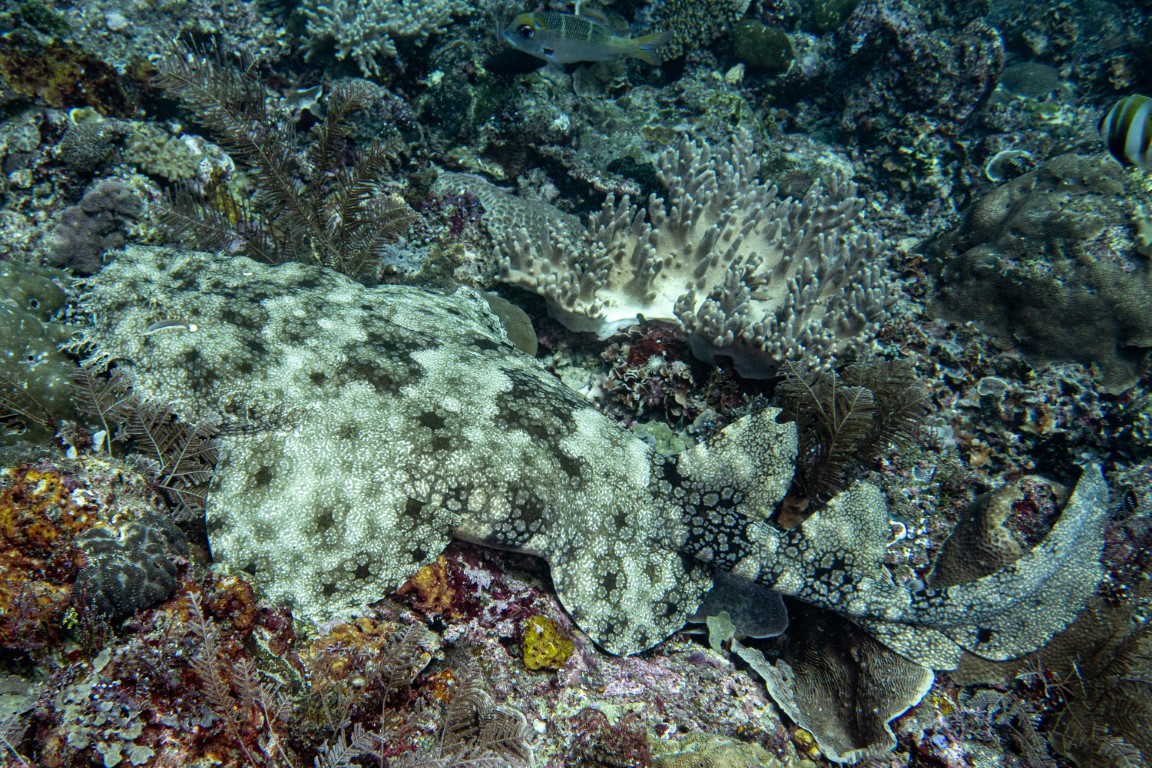
Raja Ampat sits inside the Coral Triangle and has the highest recorded marine biodiversity on the planet. This sounds like marketing copy and is in fact a measured scientific result. The practical consequence is that the diving is dense rather than dramatic: a single five metre stretch of reef may contain more species than entire reefs in the Caribbean.
This changes what good diving feels like. In Raja Ampat the reward is not covering ground. The reward is staying still long enough to see what is actually in front of you, which usually turns out to be several things at once. Macro subjects (nudibranchs, pygmy seahorses, mantis shrimps) coexist with mid-water reef fish and the occasional pelagic. Currents are usually mild but not absent, and a few sites are genuinely current-driven.
Unusually for a top-tier destination, Raja Ampat works from both liveaboards and resorts. I covered all the most renowned dive sites from a resort base, which combined liveaboard-grade access with the stability, safety and lower cost of land-based diving. Full guide is here, and for a less structural and more atmospheric account, see these travel notes.
Coastal Productivity Systems
Mafia Island
Some of the best diving in the world looks worst in photographs. Coastal productivity systems are fed by nutrients from river outflow or seasonal upwelling, which means the water is rich, the food chain is busy, and visibility is mediocre because the column is full of plankton.
Mafia Island, off the Tanzanian coast, is the relevant example. In season, plankton blooms attract whale sharks in numbers essentially unmatched anywhere else, and the supporting ecosystem is unusually productive. The aesthetic, however, is not the clear-water postcard most divers were sold by their first trip to Sharm el Sheikh. Greenish water, suspended particles, and the realisation that high visibility and high productivity are usually inversely correlated.
This is not a destination for divers who measure dives in metres of visibility. It is a destination for divers who have started to understand that what they are seeing matters more than how clearly they are seeing it. Guide here.
Expedition and Remote Diving Environments
Remote Indonesia, Galapagos, Cocos, Tuamotu
At the far end of the spectrum sits expedition diving: destinations remote enough that getting there is half the operation, evacuation is a logistical problem rather than a phone call, and the boat is not a hotel but a self-contained system that has to function for a week with no external support.
The diving in these places is often extraordinary. The trade-off is that everything else is harder. Travel time can exceed a working week. Insurance becomes a serious line item rather than a box you tick. Equipment redundancy stops being a paranoid preference. The selection of the operator stops being important and becomes definitional, because there is no fallback.
This is the part of dive travel where money buys less than experience does. A new diver with a large budget will have a worse time at Cocos than an experienced diver with half the budget. None of these destinations are covered in detail on this blog yet, for the simple reason that I have not yet been to them. The list of where I plan to go is further down this page.
Skill Progression in Scuba Diving Travel
What makes you a better diver is not a card. Certifications mark the floor of what an agency will let you do, not the ceiling of what you can actually do. The real progression happens through repeated exposure to different kinds of water, and the reason this matters for travel is that destinations are not interchangeable in terms of what they ask from you.
A rough approximation, with the caveat that nothing in diving is actually this tidy:
Stage one. Stable reef. Most of your cognitive load goes into monitoring yourself: depth, air, position. Buoyancy is wobbly. Memory of a dive is dominated by what you saw, not by what was happening around you. The Red Sea, the Egadi islands, most Mediterranean destinations sit here.
Stage two. Drift. You start operating in moving water without fighting it. You stop thinking of currents as something that has gone wrong. Group cohesion becomes a habit rather than a checklist. Cozumel, the Egyptian deep south, milder Caribbean and Indo-Pacific diving.
Stage three. Channel. Negative entries are no longer events. You know what a reef hook is for, and you accept that some dives have to be aborted because the timing is wrong. Maldives, the harder Red Sea sites, the stronger Indo-Pacific channels.
Stage four. Ecological literacy. Your attention shifts from “what did I see” to “what was happening on this reef”. You can tell a healthy reef from a sick one without being told. You stop chasing big animals and start watching the system. Raja Ampat, the Coral Triangle in general, productive coastal environments like Mafia.
Stage five. Expedition. You make decisions a divemaster used to make for you. You evaluate operators, weather windows and your own physical state independently. You learn that the most advanced thing a diver can do is sit out a dive when something is off. Remote liveaboards, Cocos, Galapagos, Tuamotu.
Two things matter about this scheme. First, it is descriptive, not prescriptive. Plenty of divers spend decades happily at stage two and have excellent diving lives. The point is not to advance, the point is to align where you go with what you can actually do. Second, most divers self-locate one or two stages above their real level, which is the underlying reason most diving accidents are not caused by the ocean.
Liveaboards, Logistics and Dive Travel Planning
Liveaboards exist for a single reason: some of the best diving in the world is far from any coastline. Resorts cannot solve this problem. A boat that sleeps, feeds and dives you in the middle of nowhere can. That is the entire business case.
In practical terms, a liveaboard is a closed operational system that has to run for a week with no external support. Compressors, generators, navigation, oxygen, food, water, the toilets, all have to work. When something stops working, the consequences range from inconvenient to serious depending on where you are and what failed. The correct way to think about a liveaboard is not as a floating hotel but as a small expedition vessel that happens to also serve dinner.
A few practical consequences follow.
The operator matters more than the boat. Modern liveaboards are largely indistinguishable in their photographs. Wooden hull, sundeck, air-conditioned cabins, dive deck, tender. The differences that actually matter are not visible in photographs: the experience of the crew, the safety culture of the captain, the maintenance regime of the engine room, the actual presence of working emergency oxygen, the realistic distance to a recompression chamber. There is a dedicated post on liveaboard safety with the questions worth asking before booking.
Fatigue is the silent variable. Three or four dives a day for six consecutive days is not the same as 18 to 24 independent dives. Nitrogen accumulates. Sleep deteriorates. Sun exposure, dehydration and the general logistics of waking up at six every morning compound. By day four, many divers are making worse decisions than on day one, often without noticing. Skipping a dive is a skill, not a failure.
The schedule will not be negotiated with you. Weather, currents and tidal windows decide what you dive and when. Itineraries are rough sketches. Sites get swapped, the order changes, sometimes a dive is cancelled. Treating this as a service failure is a category error. The ocean is not a tour operator.
Liveaboard or land-based is a real choice. Liveaboards are more intensive, often more spectacular and usually more expensive. Land-based diving is more flexible, slower, and gives you faster access to medical infrastructure. Some destinations can be done from either (Raja Ampat, parts of the Red Sea). Some cannot reasonably be done without a liveaboard (the Maldives, the more remote Indonesian destinations). For the rest, the choice usually comes down to whether you actually enjoy being on a boat for a week, which not everyone does.
If you are comparing operators or scoping out routes, the Liveaboard.com catalogue is the most comprehensive available.

Scuba Diving Safety and Risk Awareness
Scuba diving is, statistically, safe. The accident rate per dive is comparable to or lower than several mainstream sports, and modern equipment, training and dive computers have substantially reduced fatalities over the last two decades. This is true, and it produces one of the most dangerous misconceptions in the activity.
Diving is safe not because the environment is forgiving but because successful divers continuously manage risk. Underwater you are breathing through a machine, you cannot freely return to the surface at will, and your physiology is incompatible with your environment in several measurable ways. The statistics describe what happens when these constraints are respected. They do not describe what happens when they are not.
Two specific points are worth making, because they get the least attention.
Most accidents are human factors. Reports from Divers Alert Network consistently show that the overwhelming majority of serious incidents start with the diver, not the environment. Running out of gas, losing buoyancy, panicking after a minor equipment problem, going too deep on air, surfacing too fast. Sharks and exotic environmental dangers are statistical noise. The boring, predictable causes do almost all of the work.
Experience is not protective on its own. A pattern observed across many adventure sports, including diving, is the gradual erosion of margins as people get more comfortable. Familiar environments stop generating attention. Procedural shortcuts start to feel harmless. This is sometimes called normalisation of deviance, and it explains why diving accidents are not concentrated in beginners. They are distributed roughly evenly across experience levels, with a notable spike in divers who are competent enough to feel comfortable but not yet competent enough to know what they should still be worrying about.
Dive travel adds its own pressure. A trip costing several thousand euros and requiring a year of planning creates a real incentive not to skip a dive, even when skipping it is the right call. Remote destinations amplify this further: the dive in front of you may be the only chance you ever get to do that specific site. The ocean does not care about any of this, and the moment your decision-making starts being driven by sunk costs rather than current conditions, you are already in trouble.
Detailed safety posts on the blog:
- Is scuba diving dangerous? Awareness and management
- EPIRB and PLB: GPS location devices for diving
- Why descents go straight to the bottom
- Correct weighting in scuba diving
The full collection is tagged here.
How to Choose Your Next Diving Destination
The standard answer to this question is to pick something from a “top ten reefs in the world” list, which would be useful if the lists agreed with each other, which they do not. A more productive approach is to work through four questions in order, and then look at the map.
1. What kind of diving have you actually done? Not what your certification card says. What you have done. If your last serious diving was 35 reasonably calm dives in the Red Sea, the Maldives are a stretch and Cocos is a fantasy. If you have 200 dives across three or four environmental contexts, your range is wide. Be honest with yourself. Nobody is checking.
2. What are you trying to get out of this trip? Macro photography, big animals, technical progression, doing nothing for a week between dives, ticking a famous destination off a list. These are all legitimate, and they point to different destinations. A macro-rich biodiversity reef and a pelagic-rich current channel are not the same trip with different fish.
3. What is the actual season? A surprising number of expensive trips are ruined by people who booked for the right destination at the wrong time of year. Whale shark windows, manta seasons, monsoon reversals, plankton cycles. Some destinations are good all year. Many are not. The right season usually matters more than the right destination.
Free tool, no signup
Question three, answered: DiveAtlas
Getting the season wrong is the most common avoidable mistake in dive travel, and no destination page will tell you when to go. DiveAtlas lists more than a hundred destinations people actually travel to for one specific encounter, each with a month by month grid, filtered by species, month and certification level. No invented probabilities, no reef that once had a whale shark swim past it.
Start from what you want to see
Species, month, level. Map included.
4. What can you tolerate logistically? Forty hours of travel including layovers. Thirty hours in transit followed by a five hour transfer boat. Local food for a week with no alternatives. A liveaboard with thin walls and six other divers. Some destinations require all of this, and the diving has to justify it. For many people, it does. For others, it does not, and that is also a legitimate answer.
Once these four are settled, the destination usually picks itself. Pillar pages that pretend otherwise are mostly providing entertainment, not decision support.
Choosing the operator carefully matters more than choosing the destination. The Liveaboard.com catalogue is the most usable directory for comparing routes, vessels and seasons.
Equipment
Over time I will expand the posts covering specific equipment choices for dive travel. For now, the broad question is how much of your own kit to bring.
Three options:
- Rent everything on site. Cheaper to fly with, but you have no idea what condition the gear is in until you are using it. Acceptable for the first dive trip or two, before you have your own setup. Less acceptable once you do.
- Bring everything. Maximum reliability, maximum baggage. Standard practice for divers who travel often.
- Bring critical items, rent the rest. Usually mask, dive computer, regulator. Sometimes also a thin wetsuit. The BCD and tank stay with the operator. This is the compromise most experienced travelling divers settle on.
Detailed posts on individual items:
- Buying guide to dive computers
- Guide to buying an underwater photo/video camera
- DIN vs Yoke: choosing the right regulator fitting
- The right dive suit for tropical waters
- Weight belt or integrated BCD pockets?
Books
- Jack Jackson. Dive Atlas of the World. An illustrated reference to the best sites. It’s a classic reference for divers seeking an overview of the planet’s most celebrated underwater destinations. Richly illustrated and geographically organized, it combines practical information with striking visuals that convey the diversity of global marine environments. While not a technical guide, it remains an engaging starting point for divers planning their next expedition. Very analytical, though at times somewhat digressive. My rating: 4/5.
- Chris Santella. Fifty Places to Dive Before You Die: Diving Experts Share the World’s Greatest Destinations. Fifty Places to Dive Before You Die by Chris Santella is an engaging collection of dive destinations narrated through the voices of experienced divers and explorers. The book emphasizes inspiration and storytelling rather than technical detail, offering a broad overview of iconic sites around the world. An enjoyable read that works best as a source of ideas for future dive trips rather than as a practical guide. I consider it more a book to read in the evening to spark the desire to book your next trip rather than an analytical guide to the world’s best diving destinations. My rating: 3/5.
- Carrie Miller. 100 dives of a lifetime. The World’s Ultimate Underwater Destinations. A visually stunning exploration of some of the most remarkable dive sites on the planet. Rich photography and concise descriptions make it an inspiring coffee-table book for divers dreaming about future destinations. I consider it the right balance between analytical depth, completeness, and content. My rating: 5/5.
Diving as a Way of Understanding the Ocean
Dive travel changes the diver more than it changes the destinations. The first few trips are about seeing things. After a while they are about understanding them. Big animals stop being the point and the reef itself becomes the point. Visibility matters less, behaviour matters more. Briefings become more interesting than they used to be. You start noticing what is missing from a reef rather than what is present on it.
This is not a spiritual observation. It is a description of what happens when an adult spends three hundred hours doing the same activity in twenty different places. The activity teaches you what to look at, and after a while you start looking at it.
The point of this page is to compress some of that into a map, so it does not require three hundred dives to acquire. It will not entirely succeed. Maps never substitute for the territory, and the territory is the water.
Where I’m going next
The list, roughly in the order I would actually like to get there:
- Socorro (Mexico)
- Jardines de la Reina (Cuba)
- Tonga
- Tuamotu (French Polynesia)
- Rarotonga (Cook Islands)
- Okinawa (Japan)
- Cocos Island (Costa Rica)
- Galapagos (Ecuador)
- Komodo (Indonesia)
- Malapascua and Tubbataha (Philippines)
- Nosy Be (Madagascar)
- Azores (Portugal)
Frequently Asked Questions About Scuba Diving Travel
What is scuba diving travel?
Travel where the trip is built around the diving rather than the destination. The country, the food and the hotel matter less than the operator, the dive sites and the season. Most diving destinations are mediocre as conventional tourism. The reason to go is what happens underwater.
How do I choose the right diving destination?
By matching your actual experience and your specific objectives to the environmental type of the destination, and then booking the right season. There is no universally best destination. There are destinations that are right for a given diver in a given month, and destinations that are wrong, and the wrong ones outnumber the right ones for most people. The framework is described further up this page.
Liveaboard or resort?
Depends entirely on the destination. The Maldives are not really doable without a liveaboard. The Red Sea works both ways (but liveaboard wins). Raja Ampat is one of the rare top-tier destinations that works extremely well from a resort. The general rule is that liveaboards give you more dives, more remote sites and more intensity, while land-based diving gives you flexibility, slower pacing and faster access to medical infrastructure.
Is diving dangerous?
Statistically, less than people think. Practically, more than the statistics suggest, because the statistics describe well-managed dives by competent divers. The vast majority of accidents are human factors, not environmental hazards. The dedicated post is here.
How experienced do you need to be to travel for diving?
Lower bound: open water certification and ten or twenty dives, for stable reef destinations like parts of the Red Sea. Upper bound: none. The most demanding destinations require years of experience across multiple environments, but most people overestimate how much experience they have for the destination they are looking at.
When is the best time to go diving?
Almost never the time that is most convenient for your work schedule. Diving seasons are determined by ocean conditions, not by calendars. Whale shark windows, manta seasons, monsoon reversals, plankton cycles. Each destination has a right window and several wrong ones. Getting the window wrong is the most common avoidable mistake in dive travel.
Should I bring my own equipment?
The longer you intend to dive, the more reason there is to own your own gear. At minimum, a mask, a dive computer and a regulator you trust are worth bringing on any serious trip. The full setup makes more sense once you are travelling several times a year.
Are liveaboards suitable for beginners?
Some are, in calm destinations. Many are not. The combination of four dives a day, six consecutive days, remote conditions and limited fallback options compounds the consequences of inexperience. If you have under fifty dives, the calmer Red Sea itineraries are a reasonable first liveaboard. Most other liveaboards are not.
Why do diving conditions vary so much around the world?
Because the ocean is not a uniform fluid. Currents, temperatures, nutrient flows, geological structures and biological productivity vary across every dimension. The destinations that look interchangeable on Instagram are not interchangeable in the water. The six environmental types described above are a first approximation of this.
What makes a destination good?
The match between the diver, the operator, the conditions on the specific week, and the destination itself. The destinations that produce the most disappointed reviews are almost always good destinations dived badly. The destinations that produce the most surprised, enthusiastic reviews are often mediocre destinations dived well.