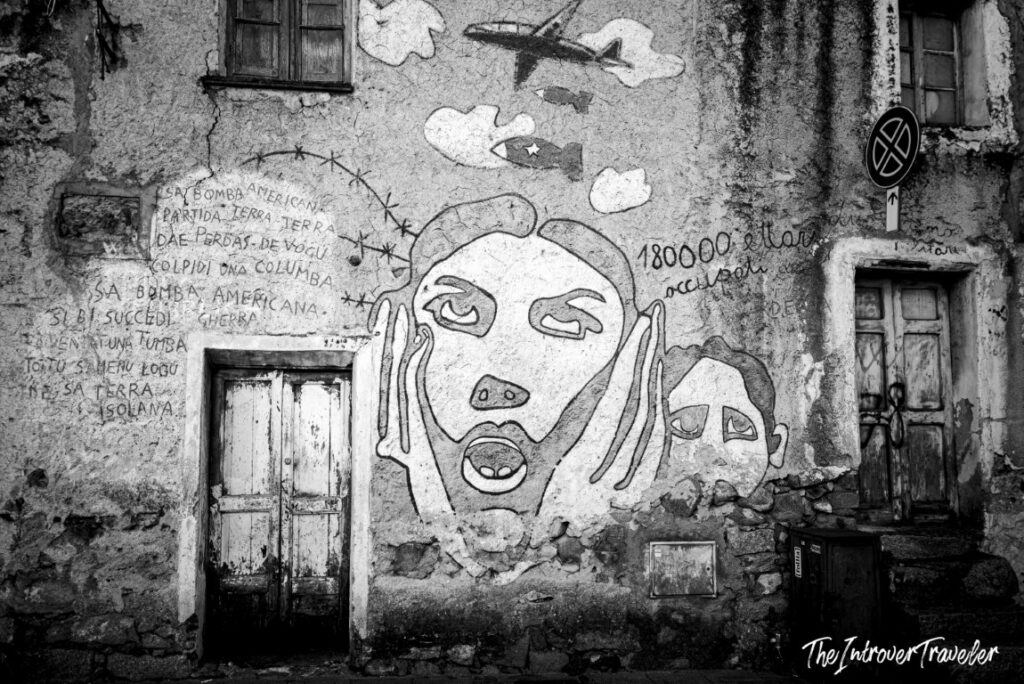
To anyone arriving, as they say in Sardinia, from the continent, one thing is immediately striking: how much the local language still prevails over standard Italian, more than in other parts of Italy where the use of the local dialect is in any case still common.
This may not be widely known abroad, but Italy is a young state, little more than 150 years old, created by unifying, more or less by force, a patchwork of local states that, for all their geographical unity, had different histories, cultures and languages. The Italian language only really began to spread after the Second World War, with national television, but the generations born before the war still have the local language or dialect as their first tongue; it is only with the baby boomers that Italian takes hold for good and the local languages begin to turn into endangered phenomena in need of protection.
This is especially true in Sardinia, where the language, or rather the local languages, have a thousand-year story to tell.
There is an infallible way to irritate a Sardinian: call the language they speak a “dialect.” It is a mistake the mainlander makes with the same nonchalance with which they order “spaghetti bolognese,” and with equally embarrassing results. Because on this point, for once, Sardinians and scholars agree completely: Sardinian is not a dialect of Italian. It is a language, and what is more one of the most conservative in the Romance world.
I have written elsewhere about how Sardinian cuisine is the autobiography of an island that spent its history defending its own identity. The language is the same story told with sounds instead of flavors, and it may tell it even more nakedly.
A Language, Not a Dialect
The difference between “language” and “dialect” is largely political, as the great German linguist Max Leopold Wagner, the father of Sardinian linguistics, was already pointing out in the 1950s. Wagner described Sardinian as an archaic Romance tongue with no close kinship to any dialect of the peninsula, and observed that calling it a “dialect” was a matter of power relations rather than grammar. The grammar, in fact, says the opposite.
Sardinian descends directly from Vulgar Latin and has preserved features the other Romance languages have lost. You see it best through an example that is worth three pages of theory. The Latin sentence Pone mihi tres panes in bertula, put three loaves in my saddlebag for me, in current Sardinian sounds like Ponemi tres panes in sa bèrtula. It is not a translation, it is almost the same sentence survived intact for two thousand years. Sardinian says kentu where Italian says “cento,” because it kept the hard c of the Latin centum, and it preserves the final s of plurals that Italian dissolved into a vowel. It is Latin kept in mothballs by isolation, exactly as carasau is bread kept under salt.
This is not just the opinion of fond philologists. Since 1997 a regional law has recognized Sardinian as equal in dignity to Italian, and since 1999 the national law 482, the one on historic linguistic minorities, has included it alongside eleven other communities (Albanian, Catalan, Greek, Slovene, Croatian, Germanic, and then French, Franco-Provençal, Friulian, Ladin, Occitan). Translated: the Italian state itself, on paper, admits that Sardinian is a language. The less glorious part is that this protection has largely remained a dead letter, full bilingualism never arrived in schools or in administration, and UNESCO today classifies Sardinian as “definitely endangered.” It is the most robust minority language in Italy in absolute numbers, spoken by around a million people, and it is dying slowly all the same, because the grandparents speak it and the grandchildren barely understand it. To grant a language the dignity of a language and then let it fade out is a masterpiece of thoroughly Italian hypocrisy.
The Many Voices of Sardinian
Having said that Sardinian is a language, it must be said at once that it is not “one” in the sense of single and compact. Anyone expecting a uniform idiom is caught off guard, because Sardinian proper splits into two great families. Logudorese, spoken in the center-north, is considered the more conservative variety, and within it the Nuorese of the Barbagia is often pointed to as the most archaic Sardinian of all. Campidanese, spoken in the south around Cagliari, has taken a few more phonetic shortcuts. The same Latin word clavem, key, becomes crae in Logudorese and crai in Campidanese: a small difference that tells of centuries of separate roads.
This fragmentation is not a detail, it is the reflection of the same geography that shaped the cuisine. Isolated valleys, closed communities, dividing mountains: every village guarded its own speech the way it guarded its own recipe. The price of all that richness is the absence of a single standard, a concrete problem the moment a language wants to enter official documents and the classroom. In 2006 the Region adopted the Limba Sarda Comuna, a reference spelling norm based on a middle variety, not to invent a new Sardinian but to give it a written and shared one. The reaction was the one you would predict in Sardinia: part of the speakers, the Campidanese above all, saw it as the crowning of a Sardinian that was not theirs. Even when it comes to saving itself, the island argues over which version of itself to save.
The Other Languages of the Island
Here comes the part that throws anyone who pictures Sardinia as a monolithic block. The island also speaks languages that are not Sardinian at all.
In the north, the Gallurese of Gallura and the Sassarese of Sassari sound to the ear like relatives of Sardinian, but linguists place them elsewhere: they are varieties of Corsican and Tuscan origin, Italo-Romance idioms that arrived with the migrations from nearby Corsica, grafted onto a Sardinian base. They are spoken in Sardinia, but linguistically they belong to another family. It is a paradox that says a great deal: even inside the island’s borders, “Sardinian” and “spoken in Sardinia” are not synonyms.
Then there are the two true islands within the island, the enclaves I already met when writing about food. The first is Alghero, where they speak alguerès, an archaic variant of Catalan brought by the Aragonese conquerors in the fourteenth century and survived for nearly seven hundred years. Around a fifth of the inhabitants still speak it, the streets carry signs in two languages, and in 2004 the president of the Catalan Generalitat called the town Catalunya de fora, Catalonia overseas. The Catalan of Alghero enjoys the national protection of law 482, because Catalan is one of the recognized minorities: a Sardinian town that speaks the language of Barcelona, protected by the Italian state as such.
The second enclave is Carloforte, on the island of San Pietro, and its linguistic story is even more absurd. Here they speak Tabarchino, which is not Sardinian, not Catalan, but Genoese: the Ligurian dialect of the eighteenth century, brought in 1738 by a community of coral fishermen who for two centuries had lived on the Tunisian islet of Tabarka. An archaic Genoese, frozen in time, survived better in Sardinia than in Genoa. And here the injustice that still stings the people of Carloforte kicks in: Tabarchino is protected by the Sardinian regional law of 1997, but it stays outside the national law 482. The state protects the Catalan of Alghero and ignores the Genoese of Carloforte, for reasons more bureaucratic than logical. Two enclaves, two imported and jealously guarded languages, two opposite treatments.
A Language as a Statement
In the end, talking about language in Sardinia means talking about the same thing food talks about: belonging. Sardinian did not survive because it was convenient or useful, it survived because it was the most direct way of saying “we are not you.” Its fragmentation tells of the isolated valleys, its Latin words tell of two thousand years of resistance to assimilation, and even the Catalan and Genoese enclaves tell of an island so used to being conquered that it turned the languages of its conquerors into pieces of its own identity.
The trouble is that today this identity is defended on road signs and at conferences, while in the homes people speak more and more Italian. A very ancient language risks becoming a relic on a bilingual plaque. It holds for Sardinian, it holds for alguerès, it holds for Tabarchino. If Sardinia really is an island that speaks for itself, it is worth stopping to listen while it still does.