Last visit: december 2021
Duration: 1 hour
My rating: 6/10
There is a hall inside the Hofburg where, several mornings a week, grown men in brown tailcoats and two-cornered hats persuade very expensive white horses to hop. People pay to watch. They have been doing so, in one arrangement or another, for about four and a half centuries. This is the Spanish Riding School, and it belongs to that category of Viennese institutions that manage to be a living, authentic art form and an exceptionally well-run gift shop at the same time. You can admire it and raise an eyebrow at it in the same afternoon, which is more or less what I did.
What the Lipizzaners actually are
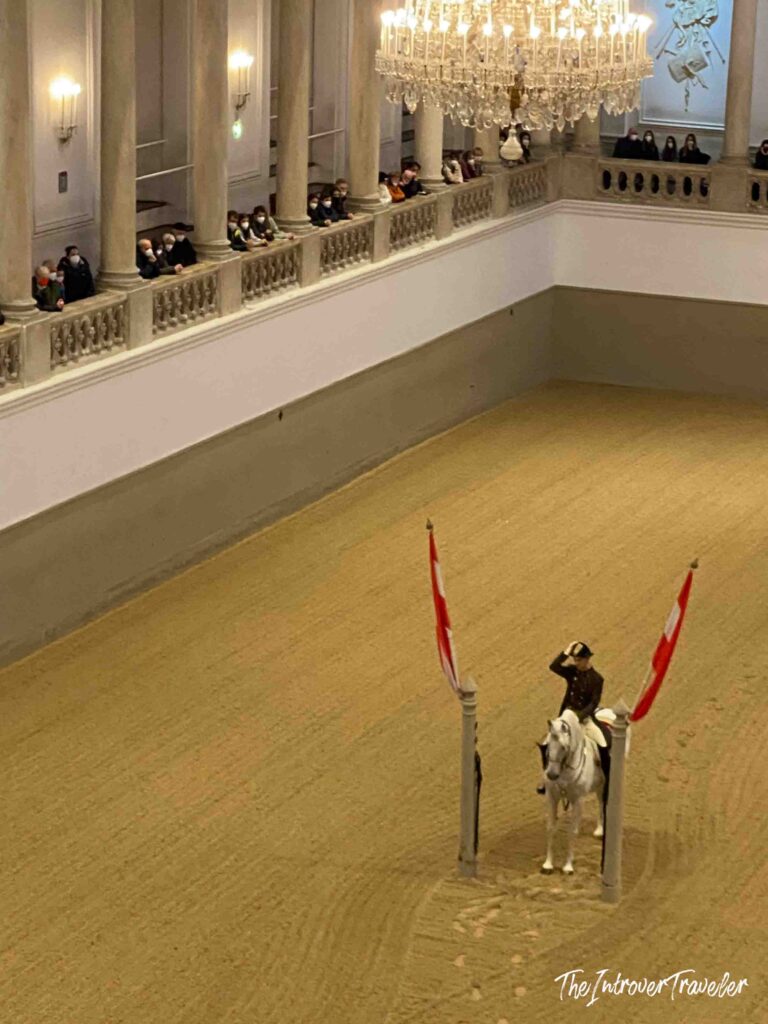
The horses are the point, so let us start there. Lipizzaners are one of the oldest deliberately bred European breeds, going back to the stud at Lipica (today in Slovenia, then Habsburg territory), founded in 1580 by Archduke Charles II. The foundation stock was a mongrel aristocracy of Spanish, Arab, Berber and Italian horses, crossed to produce the compact, muscular, intelligent, slow-maturing animal the courts of the era wanted under a saddle. The word “Spanish” in the school’s name refers to those founding Iberian horses, not to any Spanish location. Vienna is the venue. Spain is the bloodline.
Their most famous trick they perform with no training at all: they are born dark, bay or nearly black, and turn grey and then almost white as they grow, usually between the ages of six and ten. The few that stay dark are kept, by tradition, as a sort of good-luck exception.
What the school adds is classical dressage, the discipline once called High School or Haute École. The Spanish Riding School is one of the so-called Big Four classical academies, alongside the Cadre Noir in Saumur, the Portuguese School of Equestrian Art and the Royal Andalusian School. Its signature is the set of movements known as the airs above the ground: the levade, in which the horse balances at a low angle on its hindquarters; the courbette, a controlled forward hop on the hind legs; and the capriole, in which the animal leaps and kicks out behind at the top of the jump. They descend from the battlefield horsemanship of the post-medieval centuries, though it is honest to note that nearly all of them expose the horse’s belly so completely that they were almost certainly drilled for display and discipline rather than ever used in real combat.
Why Vienna treats this as more than a horse show
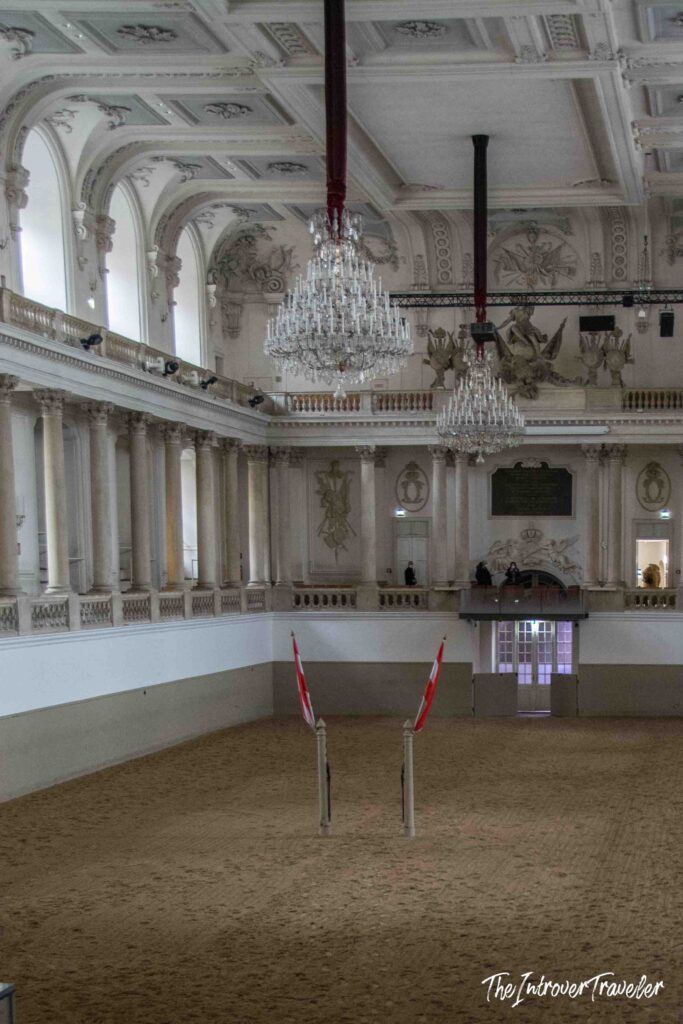
The school is older than almost every empire that later collapsed around it. The court riding arena dates to 1565, and the hall in which it performs, the Winterreitschule, is a white baroque hall completed in 1735 under Charles VI, designed by Joseph Emanuel Fischer von Erlach. It is often called the most beautiful riding hall in the world, and for once the brochure is not lying. Crystal chandeliers, a portrait of Charles VI to which the riders still raise their hats as they enter, and a floor of raked sand: it looks like a ballroom that happens to smell of horse, and seeing it with your own eyes is the best part of the show.
For Vienna the institution is a thread running straight into the Habsburg machinery, and the city has clung to it accordingly. In 2015 the school’s classical horsemanship was inscribed on the UNESCO list of intangible cultural heritage. Then there is the founding myth every guide will tell you: the rescue of the herd in the final chaos of the Second World War, when the school’s director Alois Podhajsky appealed to General Patton to protect the mares, an episode later turned into a 1963 Disney film. It is a flattering story, and it does a great deal of quiet work, because it frames the school as something to be saved rather than something to be questioned. Hold that thought.
When, where and how to actually see them
Everything happens in the Hofburg, in the centre of the old city. The visitor entrance is on Josefsplatz, the address given as Michaelerplatz 1, a few steps from the Michaelerplatz tram and bus stops. The complex is open daily, roughly 9 to 16. There are three distinct ways in, and they are not equivalent.
The performances are the full production: riders in brown tailcoats and bicornes, classical Viennese music, the school quadrille (billed, plausibly, as the longest and most difficult in the world), the pas de deux, the work on the long reins and the airs above the ground as the headline act. They last roughly 70 to 90 minutes, with a reduced 45-minute version on some dates, and cluster at the weekend, high season running from April to October. Tickets run from about 25 euros for standing room to 130 euros and up for the good seats. The weekend shows sell out months in advance, so it pays to book early.
The morning training session (Morgenarbeit) is the connoisseur’s option, the one I would steer an introvert toward, and the one I went to myself. It is a training session open to the public, about an hour, on weekday mornings from 10 (sometimes a second slot around 11:30), and it costs far less, roughly 17 to 28 euros. You watch the real work, not the choreography: loosening, gymnastics, young grey colts being eased into the routine and finished stallions being polished. The more spectacular jumps are deliberately kept rare here, to spare the horses, which tells you something useful about how demanding those jumps are. Weekday mornings in low season are the quietest and the best value.
The guided tours (about 55 minutes, roughly 13 to 25 euros) take you through the baroque halls and the Stallburg stables, and are the cheapest structured way in if what interests you is mainly the building and the history.
A few practical notes the marketing tends to bury. Photographs and filming are strictly forbidden during both the performances and the morning training (the photos here I obviously took on the sly, while a zealous attendant was shouting “no photo” at someone a little further along). No dogs, no children under three. The galleries are reached by stairs, in a protected historic building with no lift, which rules them out for anyone with limited mobility. Book directly at srs.at for the lowest price and the full calendar; resale platforms such as Tiqets add convenience and a fee, a reasonable trade if you want everything arranged in advance. [TIQETS AFFILIATE LINK]. And calibrate your expectations: this is not a circus of nonstop leaping. The production is measured, there is a fair amount of elegant walking and announcing in two languages, and the spectacular airs arrive as punctuation. If you are after fireworks, you have come to the wrong building.
The part nobody, in tailcoats, wants you to dwell on
Here is the question that hangs over the whole affair, and that I promised myself I would not dodge.
Let me say up front that this is a blog that is politically incorrect in fact, not only in intent. I consider myself an environmentalist, which is a different thing from being inclined to indulge animal-rights fanaticism (I trust I do not have to explain the difference between an environmentalist and an animal-rights activist), so I will not start from the assumption that the riding school is a concentration camp for horses, but I will try to weigh, as even-handedly as I can, whether what you are watching is a circus act that is merely very, very, very posh, or a refined display of the intense bond that has tied man to horse for millennia, in which the horse comes away gratified by its daily work with its trainer.
Take the generous reading first. Its defenders argue, with some justification, that the airs above the ground are stylizations of things horses already do on their own. Stallions rear, kick, spin and leap in play, in displays of dominance and at the sight of a rival, and anyone who has watched Iberian horses in a paddock has seen untrained animals throw a decent capriole at a mirror. The classical method is slow, measured in years, built on physical conditioning and on the principle of lightness, maximum effect with minimum force. Its genealogy goes back to Xenophon, who twenty-four centuries ago insisted that a horse is trained through reward and never through anger. The Spanish Riding School positions itself explicitly against the uglier habits of the modern competition circuit, in particular rollkur, the hyperflexion of the neck that haunts Olympic dressage. And the school breeds its own horses, keeps them for life and retires them rather than discarding them, which is more than can be said for most of the industries that use animals. A capriole, its defenders add, demands a strength and coordination that a frightened, resentful animal simply could not produce. There seems to me to be a kernel of reasonableness in this.
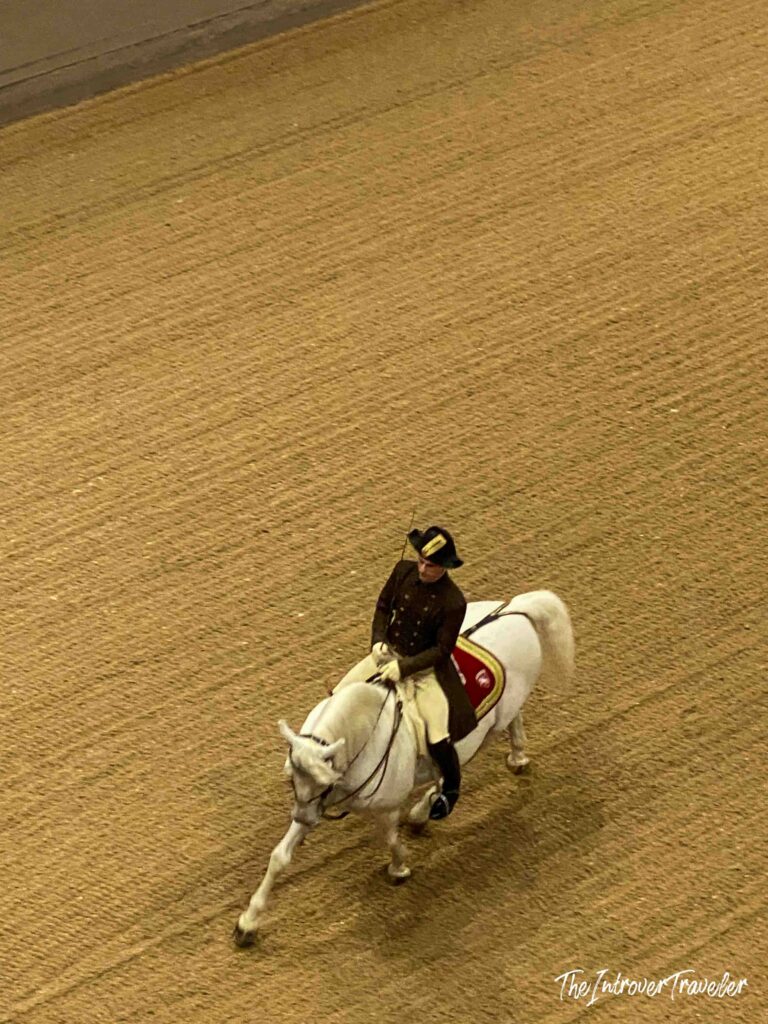
Now the more uncomfortable reading. The public spectacle exists, and has existed since the empire fell in 1918, largely to pay the bills, which means the welfare of the horse and the convenience of the box office do not always pull in the same direction. The airs are genuinely punishing: the levade is so taxing to hold that many horses never produce a good one, the capriole is reckoned the hardest movement in the discipline, and even the school’s own training routine keeps the jumps rare to protect the animals. The gentle vocabulary (the whip described as a conductor’s baton, the side reins, the cavesson and the pillars described as aids) does not change the fact that they are instruments of pressure, however delicately applied. And the consoling line that “the horse enjoys it” is, conveniently, unfalsifiable. The horse cannot be asked. The one who profits from the answer is the same one supplying it.
So how much intensive training, how much outright violence, is really behind all this? The honest answer has to hold two things together. The daily reality is not the caricature of whips and terror. It is slow, repetitive physical conditioning that most horses bear calmly, closer to the gym than to the torture chamber. But “bearing” is not “consenting”, the work is real strain on a stallion’s joints, back and tendons, and the polished facade has lately shown serious cracks. In November 2025 the Austrian government ordered an official investigation after an internal staff survey, from 2023, described the mistreatment of young horses. It landed in the middle of a management crisis: the director had been dismissed that September over expense irregularities, a new supervisory board was being installed, and the Court of Audit had already raised welfare concerns. The school categorically denies any cruelty, maintains there has never been mistreatment and calls the welfare of its horses the first priority. Nothing has been proven, and an internal survey is not a verdict. But it means that, as things stand, the serene narrative of “no harm, the animal is gratified” cannot simply be taken on faith, because at least some of the people inside the building have apparently said otherwise.
So where does all this leave the visitor with a conscience and a 25-euro standing ticket? Roughly here. Classical dressage done properly is probably the least coercive way humans have devised to make a large animal perform, and the Spanish Riding School, at its best, is a real and rare art rather than a fairground turn. But “least coercive” is not the same as “the horse signed up”, and an institution that insists on its own virtue while a government investigation is open is asking for a trust it has not entirely earned. Go, if you go, with your eyes open and not with the brochure in your hand. The horses are extraordinary. Whether they would choose any of this is a question they are not allowed to answer, and the people in tailcoats would prefer you did not ask it too loudly.