My rating: 6/10
Before October 2026: 9/10
Price: €70 a month, €840 a year, tax-deductible for businesses (October 2026)
Web: https://www.americanexpress.com/it-it/aziende/carte-di-pagamento/business-platino/
For a long time I had wanted to write a post about the benefits of the American Express Platinum card.
I meant it sincerely. Not the sponsored kind of sincere, with a discount code at the bottom and a cheerful influencer pretending a credit card changed his life, but the sincerity of a customer who had done the maths, found that they worked, and felt slightly smug about it. I travel a lot, I hate queues more than I hate most people, and for years a rectangle of metal in my wallet had quietly turned airports from a punishment into something close to a pleasure.
I had the outline ready. Lounges, insurance, points, hotel perks, a neat little calculation showing that the card pays for itself. This is that post. It just did not end the way I had planned, which, as anyone who has ever booked a connecting flight through Frankfurt knows, is the natural destiny of all travel plans.
In short
- What it is: the Italian Amex Platinum, in my case the Business version, a charge card with a fee of €70 a month.
- Why I loved it: for a frequent traveller, lounge access, travel insurance, the annual voucher and the tax deduction on the fee more than cover its cost, before you even count the points.
- What happened: I made one unusually large payment, my pension contributions. Amex authorised it, waited for the monthly statement and collected the money. A few days later, one night in October 2026, while I was in Rome for an exhibition, it suspended my Platinum and Gold cards and imposed a limit below what I normally spend in a month, for at least six months. No clear explanation followed.
- The lesson: the benefits are real. But a card that costs this much should not be able to switch itself off without telling you why.
A necessary premise: this is the Italian card
Before we start, a warning for readers outside Italy. American Express is not one card but a family of national products that share a name, a colour and very little else. The American Platinum is a different animal, with a different fee, its own ecosystem of lounges and a catalogue of credits and perks that would deserve a post of its own. What follows concerns the cards issued in Italy, and specifically the Platino Business, which is the one I hold as a self-employed person with a VAT number. Where the personal Platino differs, I say so.
If you are reading this from New York, half of what follows will sound modest. If you are reading it from Milan, it will sound about right.
The benefits: why I was happy to pay
Lounges, with someone else included
The headline benefit is free membership of Priority Pass at Prestige level, the top tier of the programme, which means unlimited visits to its network of airport lounges for the cardholder. Amex itself puts the retail value of that membership at €459 a year.
The detail that makes the difference, though, is the guest. Each Platino Business cardholder can bring one guest free of charge on every visit; additional guests are charged €30 per person per entry. The fee also includes a supplementary Platino Business card, which comes with its own Priority Pass, so a couple travelling with two Platinum cards can walk in with two guests. Anyone who has ever paid thirty euros for the privilege of eating dry crackers in a lounge in Bergamo knows that this adds up quickly.
Add Fast Track at the main Italian airports, which lets you skip the security queue, and the experience of departure changes completely. I have spent a good part of my life in airports, and I can say with some authority that the difference between the queue and the Fast Track lane is the difference between Dante’s Inferno and his Purgatory: you are still not in Paradise, but at least you can see it from there.
The personal Platino also gives access to The Centurion Lounge, the lounges run directly by American Express, which are mostly in the United States. It is one of the most talked-about benefits on the web, the kind that points bloggers describe in the tone usually reserved for religious apparitions. I have been, and in my experience it is not quite the miracle it is made out to be: a good lounge, not a reason to buy the card.
Insurance that actually covers something
This is the benefit that matters most and that nobody talks about at dinner, because insurance is boring until the moment it is the only thing that matters.
The Platino Business includes:
- Medical assistance and expenses abroad up to €1,000,000.
- Travel accident cover up to €525,000.
- Travel inconvenience cover: up to €400 per person if your luggage has not arrived after 4 hours, and a further €400 after 48 hours; up to €200 per person for hotel, meals and drinks if a flight is cancelled, delayed by more than 4 hours or a connection is missed.
- Trip cancellation and interruption up to €6,000, for sudden illness or injury.
- Purchase protection up to €12,000 for items bought with the card and stolen or damaged within 90 days.
The cover extends to supplementary cardholders and their families.
What this means in practice is that I have not bought a single travel insurance policy in years. Not for a weekend in Rome, not for a diving trip to the Maldives, not for the United States, where a broken ankle can cost as much as a small car. Amex itself estimates the value of comparable cover, based on its own annual multi-trip policy, at around €1,230 a year. That figure is generous, as all figures in a company’s own brochure tend to be, but even if you halve it, and then halve it again, it remains a serious number.
That said, not all that glitters is gold here either. Like every insurance policy, this one is a contract written by people who are paid to imagine the situations in which they will not pay you, and it has its exclusions, its conditions and its fine print. That deserves a post of its own, and I am planning to write one on the limits of the cover that comes with the Platinum.
Membership Rewards: points that become miles
Every euro spent earns 1 Membership Rewards point, and 3 points with a handful of partners (among them ITA Airways, Italo, Apple Store, Vodafone and Fastweb). The points do not expire as long as you hold an eligible Amex card. American cardholders, it must be said, play in another league, with points multiplied several times over on flights and hotels: compared with them, we Italians are collecting crumbs. But crumbs, if you collect enough of them, still make a loaf.
You can use them to reduce your statement balance, which is the worst possible use and the one the app makes easiest, or transfer them to airline loyalty programmes, which is where they become interesting. Emirates, for example, states that Italian cards convert at 5 points to 4 Skywards miles or 5 to 2, depending on the type of card.
The value of a mile used for a long-haul flight in business class is many times the value of the same point used to knock a few euros off your statement. To give you an idea: in August 2026 I flew two people from Milan to Tokyo and back, in Qatar Airways business class, spending about €400 in total out of my own pocket. Two lie-flat seats across half the planet, there and back, for the price of a mediocre weekend in Venice. This is the whole art of points collecting: patience, a spreadsheet, and the willingness to fly to Tokyo via Doha when you could go direct.
Hotels and car rental
The hotel benefits come in two forms. Fine Hotels + Resorts is a collection of over a thousand luxury hotels where bookings made through Amex include perks such as upgrades when available, breakfast, late check-out and on-site credits; Amex estimates the average value at around €500 per stay. The Hotel Collection offers a credit of up to US$100 per stay of at least two nights, plus an upgrade when available.
Then there are the elite statuses. The personal Platino has historically given status with several hotel chains, among them Hilton, Marriott, Meliá and Radisson, and with car rental companies such as Hertz, Avis and Maggiore.
A word of realism, though. Here we are in the world of real luxury, and these benefits pay off mainly for people who were going to spend a great deal of money in five-star hotels anyway. A hundred-dollar spa credit is a gift if you were already booking a €700 room; it is a bait if you were not. I am not that kind of traveller, and I have never booked a hotel I would not otherwise have chosen just to cash in a perk. So in my personal calculation these benefits count for nothing, and I suspect the same is true for most readers of this blog.
The rest
An annual €150 travel voucher, usable on the Amex travel website for flights, hotels or car rental. Up to €120 a year on FREENOW for taxis and urban mobility. Up to 58 days before the spending is debited from your bank account. A discount on airport parking, eSIM and a few other things that are pleasant but would not justify the card on their own.
About FREENOW, in my experience the benefit is largely nominal: what the voucher takes off the bill is roughly cancelled out by fares that, on the rides I have taken, came out at about double what I would normally pay. A discount on an inflated price is not a discount; it is a marketing department with a sense of humour.
Before the experts write in: credit card, charge card, debit card
A short paragraph for the pedants, who in my experience arrive in the comments faster than a taxi with a FREENOW voucher.
Yes, I know the difference. A debit card takes the money directly from your bank account, at the moment you pay or within a few days: the bank risks nothing, because it is spending money you already have. A revolving credit card lends you money and lets you repay it in instalments, with interest, which is the business model of most credit cards in the world. The Amex Platinum is neither: it is a charge card, in Italian a carta a saldo. Amex advances the money for your purchases and you repay the whole balance at the end of the cycle, in a single debit, without interest. Technically it is credit, short-term and interest-free, and that is why Amex evaluates your creditworthiness and reserves the right to authorise or decline each transaction.
And precisely because it is credit, the point of this story becomes sharper, not weaker. The moment of risk for the issuer is the one between the purchase and the payment of the statement. Once the statement has been paid in full, the credit no longer exists. As we will see, that is exactly when Amex decided to intervene.
The maths: does the card pay for itself?
Here is the calculation I was so proud of. I have kept it deliberately conservative, valuing each benefit at what I would actually spend without it, not at what the brochure says, and leaving out everything I do not really use.
| Benefit | Assumption | Value per year |
|---|---|---|
| Lounges | 10 departures a year, me plus one guest, at about €30 per entry (the price Amex itself charges for an extra guest) | €600 |
| Fast Track | 10 uses at about €8 each (Amex’s own estimate) | €80 |
| Travel voucher | Used once | €150 |
| Travel insurance | The price of an annual multi-trip policy I would otherwise buy | €300 |
| Tax deduction on the fee | €840 deducted at a marginal rate of about 45% | €378 |
| Total | €1,508 |
Against this, the fee: €840 a year.
The last line is the one that makes the business version particularly attractive. For a business or a professional, the fee is a deductible cost, within the usual rules on business expenses. If you sit in the top Italian income tax bracket, 43 per cent plus regional and municipal surcharges, your marginal rate is around 45 per cent, and the deduction gives you back almost half of what you pay: the real cost of the card drops to about €460 a year.
So: €1,508 of tangible value against a fee of €840, a surplus of almost €700 a year, before counting a single Membership Rewards point, a single flight to Tokyo, a single euro of purchase protection. For someone who travels with a certain frequency, the Platinum is not a luxury. It is one of the few things in the travel industry that gives you more than it takes.
That was the post. I had it practically written.
Then I went to Rome.
The plot twist
One unusual payment
It all started with a single payment, well above my usual pattern. Nothing exotic, nothing illegal, nothing involving offshore accounts or a yacht registered in the Cayman Islands: just my social security contributions, paid to the pension fund for self-employed professionals. It is hard to imagine a less glamorous use of a metal card, or a less suspicious destination for money. Nobody, as far as I know, has ever laundered the proceeds of crime by paying them into their own pension.
I thought about it before paying, and I made what seemed a perfectly reasonable calculation. A card with no pre-set spending limit decides transaction by transaction whether to authorise a payment. If Amex did not like this one, it would simply decline it, and I would pay some other way. That is how the system is supposed to work: the card says yes or no at the till, and both of you know where you stand.
The card said yes. The payment went through. The monthly statement arrived, the full balance was debited from my bank account on the due date, and the debit was successful, as it always is. From Amex’s point of view, at that moment, the operation was closed: it had authorised the payment, collected the money and earned its commission on the transaction.
Then it waited.
A night in Rome
A few days later, in October 2026, I was in Rome for a weekend to see the Pontormo exhibition at the Scuderie del Quirinale, the same weekend in which I was turned away from the entrance for showing up two hours before my time slot. Apparently it was my weekend for being refused by institutions.
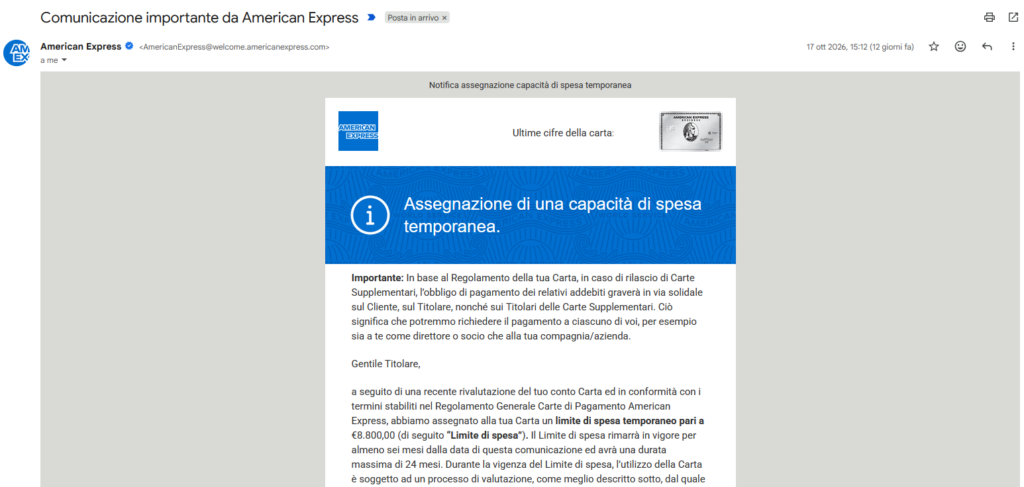
During the night, an email: my Platinum and Gold cards had been suspended.
A few hours later, a second email: a spending limit of €8,800 had been imposed on the account. The figure is not random. It roughly matches what I had already spent in the current month, which means that at the moment I received the communication I had already used it up. The cards were not formally blocked, but in practice they were, until the end of the month: a limit you have already reached is a lock with a more polite name.
I was in Rome with a piece of metal in my wallet that had become, overnight, an elegant coaster.
And the end of the month is not the end of the story. The new limit is below my average monthly spending, so even when it resets I will not be able to use the card as I did before. I was told it will stay in place for at least six months. Nobody has guaranteed that it will be lifted after that. And nobody has told me what I did wrong, which means I do not know what I am supposed to avoid doing for the next six months in order to earn back the right to use a card I have never stopped paying for.
Let us put the timeline in order, because the order is the whole point:
- I make an unusual payment.
- Amex authorises it.
- Amex debits it from my bank account, and the debit succeeds.
- Only then, a few days later, at night, Amex decides the payment was a problem.
If the payment was too risky, the moment to say so was at the till, when a simple “declined” would have cost me nothing but the time to take out another card. Saying it afterwards, once the money has been collected in full, is like a restaurant that lets you order the tasting menu, charges you for it, smiles as you leave, and then bans you for six months for having eaten too much.
“No pre-set spending limit”
The Platinum is presented as a card with no pre-set spending limit. It is one of its most advertised features, together with the metal, the lounges and the vague sense of belonging to a club. On the business card, Amex speaks of a spending capacity designed for business, ideal for handling extraordinary expenses and managing payment flows with greater flexibility.
To be fair, and I want to be fair, because this post is meant to be the analysis of an informed customer and not the tantrum of a disappointed one, the small print on the personal Platino says clearly that the card does not offer unlimited spending: every transaction goes through an authorisation process based on various factors, and can be declined. Amex has never promised that the sky is the limit. It has promised that the limit is not fixed in advance.
But there is a difference between a limit that is not fixed and a limit that can be lowered, at night, below your normal monthly use, without warning, without explanation and for an undefined period. The first is flexibility. The second is a sword of Damocles with a monthly fee.
And the irony is that the system worked exactly as advertised, right up to the moment it did not. The card did what a card without a pre-set limit is supposed to do: it evaluated an unusual transaction and approved it. The problem is not the authorisation. It is the retroactive punishment for a transaction the issuer itself authorised, and for an “extraordinary expense” of exactly the kind the card is advertised for.
The call centre: two operators, two theories
I called customer service. The answers were, let us say, evasive.
The first operator explained that in the last month my spending had been higher than my average. This was true, and it was obviously the result of that one unusual payment, the very one Amex had approved and collected. It was also true that nobody had ever told me this was forbidden, or even inadvisable. A card whose main selling point is flexible spending turns out to be punishing you for spending flexibly. It is like being fined by the gym for attending too often.
The second operator had a different theory. What had triggered the algorithm, he suggested, were some PayPal payments made with the “Friends and Family” option to the private tutor who gives my son physics lessons. Nobody had ever flagged these payments as a problem. And then, with the tone of someone revealing a state secret, he mentioned that a payment like that could be money laundering.
Let us pause here for a moment, because the scene deserves it. The amount in question was about one hundredth of my monthly spending. If I were laundering money, I would be doing it at a rate that would make the Camorra die of laughter, and I would be doing it through a physics teacher, which is not a method I have ever seen in a single episode of any crime series. Somewhere, an algorithm looked at a father paying for his son to understand Newton’s laws and saw Pablo Escobar.
Honesty requires adding a detail, because it is the kind of thing an informed customer should know. PayPal’s own terms reserve the “Friends and Family” option for personal transfers with no commercial transaction underneath. Paying a tutor for a lesson is, strictly speaking, buying a service. So the option was, on paper, the wrong one. But the tutor does not have a VAT number: he is a private individual giving lessons, not a shop, and treating him as a merchant would have been at least as artificial as treating him as a friend. Whatever his tax arrangements are, they are his business; and if there were ever anything irregular in them, it would be a curious form of justice to suspend my card for it. “Technically the wrong PayPal button” and “money laundering” sit at slightly different distances from a criminal record, and nobody had ever pointed out the first before accusing me, however hypothetically, of the second.
And then I asked the machine
Since the humans were not helping, I asked an AI. It offered another hypothesis: what might have stirred the algorithm’s sensitivity was the fact that I had paid taxes and social security contributions with my Amex card, including the very payment that started it all, in order to accumulate Membership Rewards points.
This is where the story becomes almost perfect. That strategy, paying taxes and contributions by card to earn points, had been suggested to me by the Amex call centre itself. It is not a secret technique; there are entire blog posts written by Italian points collectors on how to pay invoices and taxes with the Platino Business to maximise rewards, some of them produced in collaboration with Amex.
I do not know whether this was really the trigger. Nobody has told me, and I will not pretend to know how American Express’s risk models work. But I find the hypothesis delightful: the company suggests a way to use the card more, the customer follows the advice, and the company’s algorithm interprets the advice as a symptom. It is the financial equivalent of a doctor prescribing you a medicine and then reporting you to the police for having it in your bloodstream.
The rigidity of the answer
What strikes me most, in the end, is not the suspicion. Suspicion is part of the job of anyone who lends money. It is the rigidity of the response.
There are only two possible reasons for an issuer to worry about a customer like me. The first is solvency: a spending peak might suggest that I cannot afford what I spend. If that is the concern, any bank in the world knows what to do. It asks for bank statements, a tax return, some proof that the customer can pay, and then decides. It does not switch off the service while continuing to charge the same monthly fee it charges customers who enjoy it in full. In any case, the most convincing proof of solvency had already been provided: the statement had been paid, in full, on the due date.
The second is money laundering. If that is the concern, the customer should at least be put in a position to show what he actually did, which in my case means producing a few receipts for physics lessons and the payment slip of a pension contribution. Instead, there is no procedure, no request for documents, no conversation: only a limit, a duration and a silence. A suspicion that cannot be answered is not a precaution. It is a sentence.
What the law says, in brief
Italian law on payment services allows an issuer to block a payment instrument for justified reasons connected to security, suspected fraudulent or unauthorised use, or, where credit is involved, a significant increase in risk. It also requires the issuer to inform the customer of the block and to give reasons, in advance where possible or at the latest immediately afterwards, unless doing so would conflict with security reasons or legal provisions.
So Amex was within its rights to act, and it did inform me promptly, I will give it that: nobody can say the emails arrived late. I will only note, as a customer and not as a judge, that the risk the law has in mind is the risk of not being paid, and in my case every euro had already been paid. Whether the reasons were given is another matter. Two operators, two different theories and one hypothetical accusation of money laundering do not, in my view, amount to an explanation. It is possible that the explanation could not be given, because anti-money-laundering rules sometimes forbid an institution from telling a customer what it suspects. If that is the case, the call centre would have done better to say so, rather than improvising theories like a student who has not studied for the exam.
The bill: what exactly am I paying for?
Let us go back to the calculation, because it now needs a new line.
I pay €840 a year for a card whose most advertised feature, the flexibility of spending, can disappear from one day to the next, for a reason that is not clearly explained to me, at a moment that the card itself does not choose for my convenience. On a weekend away. At night.
And I keep paying. The fee has not been reduced, suspended or even mentioned. For the next six months, at least, I will pay €420 (six instalments of €70) for a card I cannot use as I used it before, and I will be forced to put part of my ordinary spending on other cards, which, incidentally, means those euros will earn points somewhere else. The service has been cut; the price has not. In any other sector this would have a name, and it would not be “premium”.
Here is the paradox that I still cannot get past. A card issuer earns money when its customers use its cards: from the commissions on every transaction, from the fees, from the loyalty that keeps a customer paying €70 a month. A customer who spends a lot, and pays every statement in full and on time, should be the customer every issuer dreams of. Instead, I have been penalised for spending too much, and only after every single payment had been successfully collected. If the logic is risk, I struggle to see it: the riskiest moment for a charge card is the one before the bill is paid, not the one after. If the logic is something else, nobody has told me what it is.
The lounges are still there. The insurance is still there. The points are still there. But the whole point of a premium card is not the sum of its benefits; it is the certainty that it will work when you need it. A charge card that stops working without warning while you are travelling is not a travel card. It is a souvenir.
And there is a subtler problem. If you do not know what triggers the controls, you cannot avoid triggering them. The customer is left in the position of a man walking through a minefield with a map written in invisible ink, guessing which of his ordinary habits (a payment to a tutor, a pension contribution, a month of higher spending) might be the one that blows up. And in my case the minefield has a deadline: six months during which I am supposedly on probation, without knowing which behaviour is being evaluated or what result would get me back to normal. For a product that costs this much, I do not think it is unreasonable to ask for the map.
My rating went from 9 to 6. Not because the benefits are fake; they are very real. But because a benefit you cannot rely on is worth much less than its face value, and transparency, at this price, is not an optional extra. It should be included in the fee, together with the lounge.
What I learned: how not to wake up the algorithm
I cannot tell you how Amex’s systems work, and neither, apparently, can Amex’s call centre. But the anti-fraud and risk controls of card issuers in general tend to react to a recognisable set of behaviours, and after this experience I spent some time studying them. If you hold a premium card, here is what is worth knowing.
Operations that commonly attract attention:
- Payments to private individuals through PayPal, money transfer apps or similar services, especially with options designed for personal transfers.
- Top-ups of other accounts or wallets, such as funding an e-money account or another card with your credit card. This is the classic way of “manufacturing” spending: the money goes round in a circle, comes back to you and leaves a trail of points behind it.
- Sudden spending peaks, meaning a month that is well above your usual pattern, even when every single purchase is perfectly ordinary.
- Gift cards and prepaid instruments, which are a classic tool of fraud and therefore a classic object of suspicion.
- Gambling and betting, for the same reason.
- Large payments to tax authorities and pension funds. Not because they are cash in disguise: once you have paid your taxes, the money is gone, and it is certainly not coming back to you by any route I know of. The most plausible reading, and it is my own interpretation, is that a risk model may see a large tax payment on a card with up to 58 days of deferral as a sign that the customer is using the card as a short-term loan to cover a cash shortfall. In my case the reading would be wrong, since the statement was paid in full on the due date, but it is the only one I can find that makes any sense.
None of these is illegal. All of them, taken together or in a particular sequence, can make an algorithm nervous.
Let me be clear on one point, though. Apart from a few negligible payments to a physics teacher, I have never made any of these operations, except the one that is the whole point of this story: a pension contribution, made with the card at the suggestion of the issuer itself, authorised and collected. So the list does not explain what happened to me; if anything, it makes it harder to explain. And it leaves the central question open. If these operations are red flags, the simplest thing in the world is to decline them at the till, before they happen. An algorithm that lets a transaction through and punishes it afterwards is not protecting anybody from risk. It is just setting a trap.
Before a large expense, or before a period of higher spending:
- Do not take an authorisation as approval. This is the lesson I paid for. The fact that the card accepts a payment at the till does not mean the issuer is happy with it: the evaluation can come later, after the money has been collected, and its consequences can last months. An authorised transaction is not a closed one.
- Tell the issuer in advance. A phone call or a message explaining that you are about to pay for a house renovation, a long trip or a tax bill costs ten minutes and may save you a weekend.
- Make an advance payment. Many issuers allow you to pay part of the balance before the statement closes, which increases the available headroom and signals that you have the money.
- Avoid concentrating unusual operations. If you need to make several out-of-pattern payments, spread them over time.
- Do not travel with a single card. This is the most obvious lesson and the one I had forgotten: always carry a second card from a different issuer, on a different circuit, ideally kept in a different pocket.
- Keep a written trace. If something goes wrong, a formal complaint to the issuer, and then, if needed, the banking and financial ombudsman (the Arbitro Bancario Finanziario, in Italy), work better when you can document what you were told and when.
What I will do now
I have not slammed the door. That would be the reaction of a man writing a rant, and this is not one. But I am rethinking the structure, and these are the options I am considering, in no particular order of preference.
Revolut Ultra for everyday spending and miles. Revolut’s top plan costs around €60 a month, earns 1 RevPoint per euro spent, convertible into airline miles, and includes unlimited lounge access for the holder through a different network. It has no hotel status and fewer insurance guarantees, and lounge guests are usually paid for separately. It is not a better card than the Platinum; it is a different card, and it would not be the first time a neobank froze an account without much explanation either. No issuer is immune. The point is not to find a perfect one, but to stop depending on a single one.
A traditional credit card for deposits and rentals. Car rental companies and many hotels want a real credit card for the deposit, and a debit card often will not do. A conventional bank credit card, with a known and fixed limit, is boring, cheap and, for that very reason, predictable. In a moment like the one I lived through in Rome, boring is exactly what you want.
The Platinum, demoted. I may keep it for what it does best: lounges and insurance. But it would no longer be the card I rely on to pay for everything, and it would no longer be the card on which I concentrate my spending to earn points. Which is somewhat ironic, because concentrating spending on the card is precisely what Amex encourages you to do.
I will decide calmly. Possibly in a lounge.
Verdict
For a long time I had wanted to write a post about the benefits of the American Express Platinum card. I have finally written it. The benefits are all there, they are real, and for a frequent traveller they still more than cover the fee.
It is just that the post has a different ending from the one I had imagined, and the most valuable lesson in it is not on the list of benefits. It is that a premium card is worth exactly as much as your certainty that it will work, and that certainty is not a matter of metal, lounges or points. It is a matter of trust, and trust, unlike Priority Pass, cannot be included in the fee if one side reserves the right to withdraw it at night without saying why.
Six out of ten. Nine for the benefits, minus three for the night in Rome.
Has anything similar happened to you, with Amex or with another issuer? Tell me in the comments: I would like to know whether I was the victim of an algorithm, of a physics teacher, or simply of my own good faith.
Frequently asked questions
How much does the Amex Platino Business cost in Italy? €70 a month, for a total of €840 a year (October 2026). The fee is tax-deductible for businesses according to the applicable rules, and includes one supplementary Platino Business card and up to 98 supplementary Gold Business cards.
Is the Amex Platinum a credit card or a debit card? Neither, strictly speaking: it is a charge card. Amex advances the money for your purchases and you repay the whole balance at the end of the cycle, without interest. A debit card takes the money directly from your account; a revolving credit card lets you repay in instalments, with interest.
Does the Amex Platinum have a spending limit? It has no pre-set limit, which is not the same as no limit. Every transaction is subject to authorisation, and the issuer can reduce your spending capacity. In my case, after an unusual payment that Amex had authorised and collected, a limit below my usual monthly spending was imposed without warning, for at least six months.
If Amex authorises a large payment, does that mean it is fine with it? Not necessarily. In my experience, the authorisation at the till and the issuer’s later assessment are two different things: the payment was approved and collected, and the restriction came a few days afterwards. Before an unusual expense, call the issuer, even if you expect the card to accept it.
Can I bring a guest into the lounge with the Italian Platinum? Yes. Platino Business cardholders and supplementary Platino cardholders get Priority Pass Prestige and can bring one guest free on every visit. Additional guests cost €30 per person per entry.
What insurance does the Platino Business include? Medical assistance up to €1,000,000, travel accident cover up to €525,000, cover for lost luggage and delayed or cancelled flights, trip cancellation up to €6,000 and purchase protection up to €12,000. Supplementary cardholders and their families are covered too.
Why can Amex suspend a card? Italian law allows an issuer to block a payment instrument for justified reasons connected to security, suspected fraud or, where credit is involved, increased risk, with an obligation to inform the customer and give reasons, unless this conflicts with security or legal provisions.
What should I do before a large payment with a premium card? Tell the issuer in advance, make an advance payment on the balance if possible, avoid concentrating unusual operations, and always travel with a second card from a different issuer.
Is Revolut Ultra a good alternative to the Amex Platinum? It is a different product: cheaper on lounges and points, weaker on hotel benefits and insurance, and with its own risks. For many travellers the best answer is not to replace one card with another, but not to depend on a single one.