I travel a lot, and I have noticed that the same few behaviours ruin more journeys than any delayed train or cancelled flight: the video played out loud, the call on speakerphone, the seat slammed back at dinner time, the bare feet on the armrest, the hand reaching for the canvas.
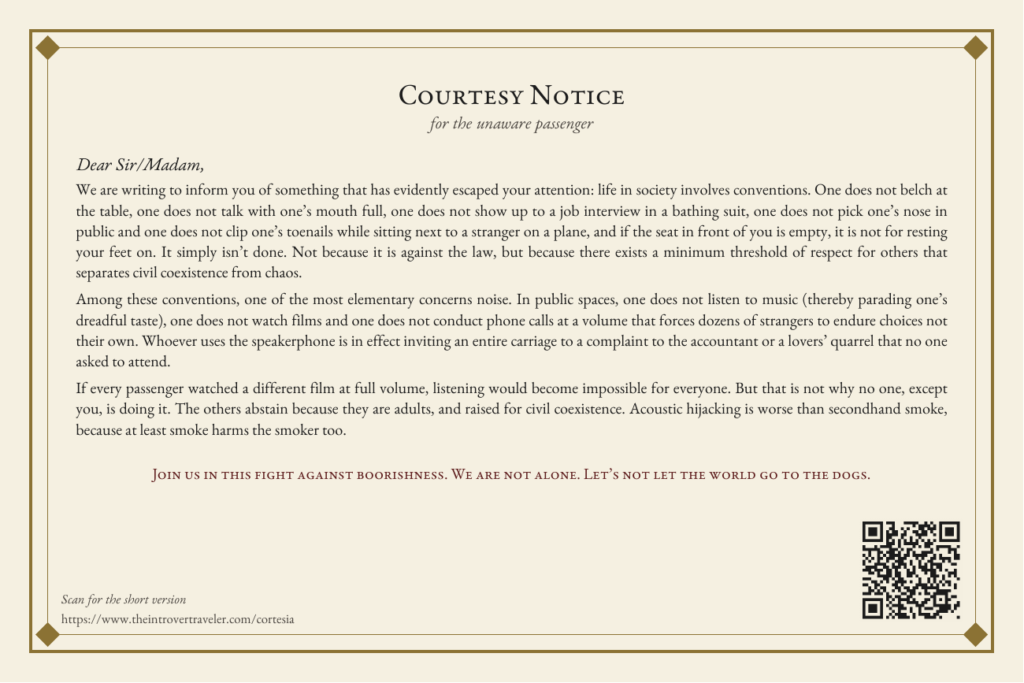
None of this is illegal. It simply isn’t done, and the people doing it rarely know. So I wrote them a card. Two, in fact: one for trains and buses, one for planes. Both are formatted like a 1940s dinner invitation, because nothing makes a rebuke land harder than impeccable manners. You pass the card to the person in question, with a small nod, and go back to your book.
Below the cards you will find the longer version: a short courtesy manual for the places where strangers are forced to share space. It is not exhaustive and it is not neutral. It is what I would put on the wall, if they gave me a wall.
The cards
They are 10 x 15 cm, one side, in English, French, German, Spanish and Italian. Each one ends with a QR code. If the person scans it, they land on a page with one sentence on it, in very large letters. You can imagine which one.
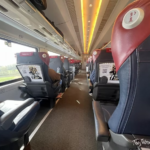
- Trains and buses: noise, speakerphone, films without headphones, feet on the seats.
- Planes: the seat reclined at dinner time, the seat in front used as a handle or a drum, the stolen middle armrest, the socks, the coat spread across three spaces in the overhead bin, the cabin crew treated as waiters, and the sprint into the aisle the moment the wheels touch the runway.
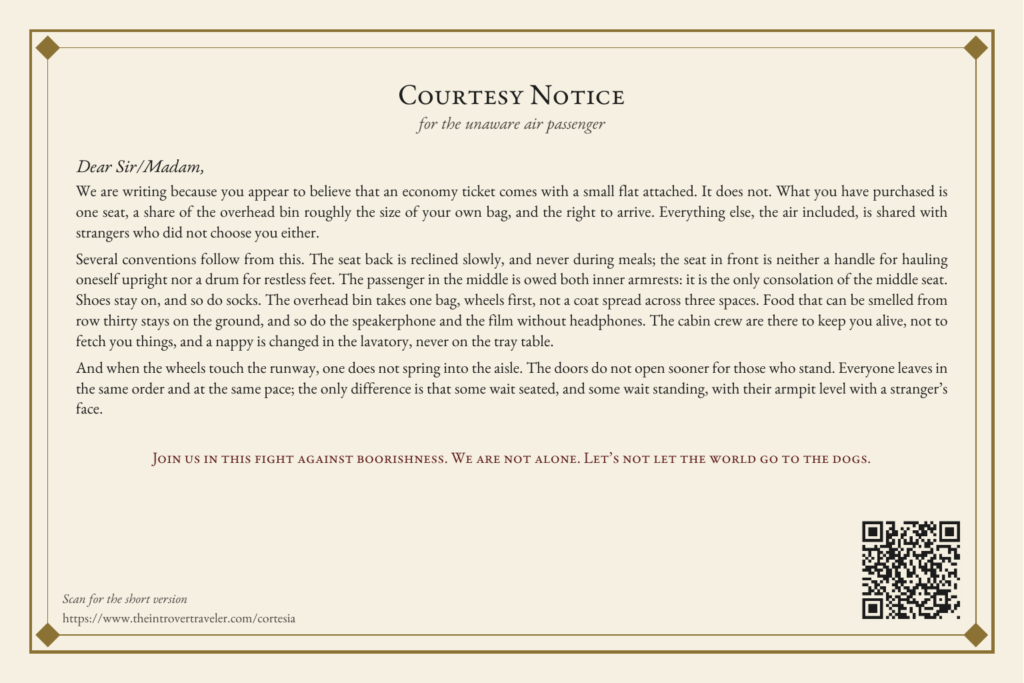
If you would rather have packs printed on proper paper and posted to you, there is a waiting list on the same page. I will only print them if enough people ask.
At the airport
Arrive at security ready. Liquids already in their little transparent bag, laptop and tablet ready to come out, belt off, coins out of your pockets. You have known for twenty years that this moment was coming. The queue behind you should not pay for your surprise.
Stand on one side of the escalator, walk on the other. In most of Europe you stand on the right. Wherever you are, do what the locals do, and never stop dead at the top of an escalator or at the end of a moving walkway to read the departures board. There are forty people arriving behind you, and they cannot brake.
Do not crowd the gate before your group is called. The boarding groups exist for a reason, and the plane will not leave earlier because you are standing in front of the desk. Sit down until your number comes up.
Your bag does not have a ticket. At a full gate, one seat per person. The same goes for the charging sockets: charge, then make room.
Read the baggage rules at home, not at the desk. If the airline charges you for a bag that is too big, pay with dignity, complain later to customer service, and remember it next time. The person at the desk did not write the rules.
At the baggage carousel, stand one step back. If everyone stands one step back, everyone can see. When your suitcase comes, step forward, take it, step away.
Dress for public transport, not for the beach you just left. And dress in layers: the cabin will be cold.
On the plane
Board quickly. Put your bag up, sit down, free the aisle. Arrange your life once you are seated, not while thirty people wait behind you. The small bag goes under the seat in front of you, not in the overhead bin.
One bag in the overhead bin, wheels first. Your coat goes on top of it or on your lap, not spread across three spaces.
Recline slowly, and never during meals. Look behind you first. If the person there is eating or working on a laptop, wait. You do not have to go all the way back.
The seat in front is not a handle and not a drum. Do not haul yourself up by grabbing it, and do not kick it. If your child is the one kicking, that is your job, not the passenger in front’s.
The middle seat gets both inner armrests. It is the only consolation of the middle seat. The window has the wall and the view, the aisle has the legroom and the freedom.
Shoes stay on. On long-haul flights you may take them off, if your socks are clean. You never walk barefoot in the cabin, and certainly not into the lavatory. Feet stay on the floor: not on the empty seat, not against the bulkhead, not on the armrest of the person in front.
Headphones, always. For films, games, music, voice messages. And take them off during the safety briefing: it is the one announcement that might actually matter.
Lower your voice. Especially if you are talking across a stranger, from the window seat to the aisle seat.
Food that can be smelled from row thirty stays on the ground. So does the perfume you were about to reapply in your seat.
Leave the lavatory better than you found it. If something is wrong or the paper has run out, tell the crew, discreetly.
A nappy is changed in the lavatory, on the changing table. Never on the seat, never on the tray table where someone will put their food in an hour.
The cabin crew are not waiters. They are there to keep you alive. Follow their instructions even when they seem absurd. If you have a complaint, make it calmly, ask for the senior crew member if necessary, or write to the airline once you land.
Say hello to your neighbour. You are going to spend hours at a distance usually reserved for close family. A nod when you sit down and a word when you leave cost nothing.
When the wheels touch the runway, stay seated. Get up when the seatbelt sign goes off and the row in front of you starts moving. The doors do not open sooner for those who stand. Everyone leaves in the same order and at the same pace; the only difference is that some wait seated, and some wait standing, with their armpit level with a stranger’s face.
On trains, buses and the metro
Let people off before you get on. It is faster for everyone, including you.
Move inside, away from the doors. The space next to the door is a passage, not a balcony.
Take your backpack off. In a crowded carriage, hold it in front of you or put it between your feet. On your back, it hits a face every time you turn around.
Seats are for people, not for bags. On a full train, your bag goes on the rack or on your lap. Pretending to be asleep next to it does not count.
On a train with reserved seats, sit in yours. If someone shows you a ticket for the seat you are in, you move. You do not explain that the other one has no socket.
The quiet carriage is quiet. Not quieter. Quiet.
Headphones, always. Films, music, video calls, voice messages. Calls are made at a low voice, short, and never on speakerphone: nobody asked to attend your complaint to the accountant or your lovers’ quarrel.
Feet off the seats. With shoes or without, on the seat in front of you or on the one beside you. Someone will sit there after you, in clean trousers.
Offer your seat. To an elderly person, a pregnant woman, someone with a child in their arms or a crutch. Do not wait for them to ask: most people won’t.
Eat with discretion. On a long train, a meal is fine. On a crowded metro, nothing that smells, drips or crunches.
In museums
Do not touch the works of art. Keep those hands down! Not the canvas, not the frame, not the marble, not “just a little bit”. The oils on your fingers do damage that restorers spend years undoing, and if everyone touched “just a little bit” there would be nothing left to see.
Keep your distance. Do not point at a painting with a pen or a phone a few centimetres from the surface, and do not lean on walls, plinths or display cases. The alarm is not an overreaction.
Flash off. And before taking any photograph, check whether photography is allowed at all.
The work is not a backdrop for your photoshoot. Take your picture, then move. Ten minutes of selfies in front of a masterpiece means ten minutes in which nobody else can see it. Selfie sticks stay at home.
Look, then make room. In front of the famous works there is always a crowd. Look as long as you need, then step aside and let the next person in.
Headphones for the audio guide. And guided groups do not block a whole room: the guide speaks for the group, not for the museum. More about audio guides here.
Your backpack goes to the cloakroom. If there is no cloakroom, wear it in front of you. A backpack turning around in a crowded gallery is a hazard to people and to sculptures.
Phone on silent, no calls in the rooms. You are in a museum, not in a waiting room.
Follow the route. In one-way exhibitions, do not walk against the flow to get back to something you missed: go round again.
Children by the hand. Museums are wonderful for children, and children are welcome. Running between the sculptures is not.
Explain the painting quietly. Especially if you are not sure. The whole room can hear you, and someone in it may know.
A practical note
The cards, and this manual, are meant for behaviour that affects other people, not for people who simply look, dress or travel differently from you. Use them with a smile, and keep one in your pocket. The day you need it, you will be glad you did.