Last visited: August 2026
My rating: 8/10
Web: https://jikkocutlery.com/
In my post on Kappabashi and Tsukiji I told the story of the Santoku I bought in Tokyo: a novice’s purchase, made after wandering through a district capable of satisfying any request, and ending with an all-purpose knife I still use with satisfaction today. A Santoku, however, was never built for sushi. When I found myself in Osaka with the precise intention of buying a yanagiba, things took a completely different turn, both for the knife and for the shop.
A small disclaimer, the same one I made for the Kappabashi and Tsukiji article: I am not a knife expert, and what follows is the account of someone who did a bit of research before leaving and then handled the negotiation on the ground as a complete novice. I think my first-hand impressions are still useful, because I imagine they reflect the same conditions faced by anyone reading a blog post while preparing a trip to Japan; experienced chefs will not need my suggestions. A second, Osaka-specific disclaimer: while in Tokyo Kappabashi and Tsukiji are, without much doubt, the two natural reference points for anyone looking for a knife, in Osaka the picture is less clear cut. The city has its own cutlery street, Sennichimae Doguyasuji, and I am certain there are other excellent shops that would deserve attention (another shop I had planned to visit, without managing it for lack of time, was Tower Knives, run by the Canadian Bjorn Heiberg and fairly well known among enthusiasts). In this post I only recount my own experience at Jikko, with no claim that it is the only address of note in the city.
Two Restaurants, One Recurring Name
At both restaurants where I had dinner in Osaka, Sumi Kappo Hirac and Sushi Amato Ura Namba (reviews on the way, which I will link here once published), I noticed the same thing: the chef was working with a Jikko knife. It is not a huge statistical sample, two restaurants do not make a trend, but it was enough to make me curious, especially after already having, in Tokyo, the experience of a chef who proudly claimed loyalty to one specific supplier.
The Plan for Sakai, Skipped for Lack of Time
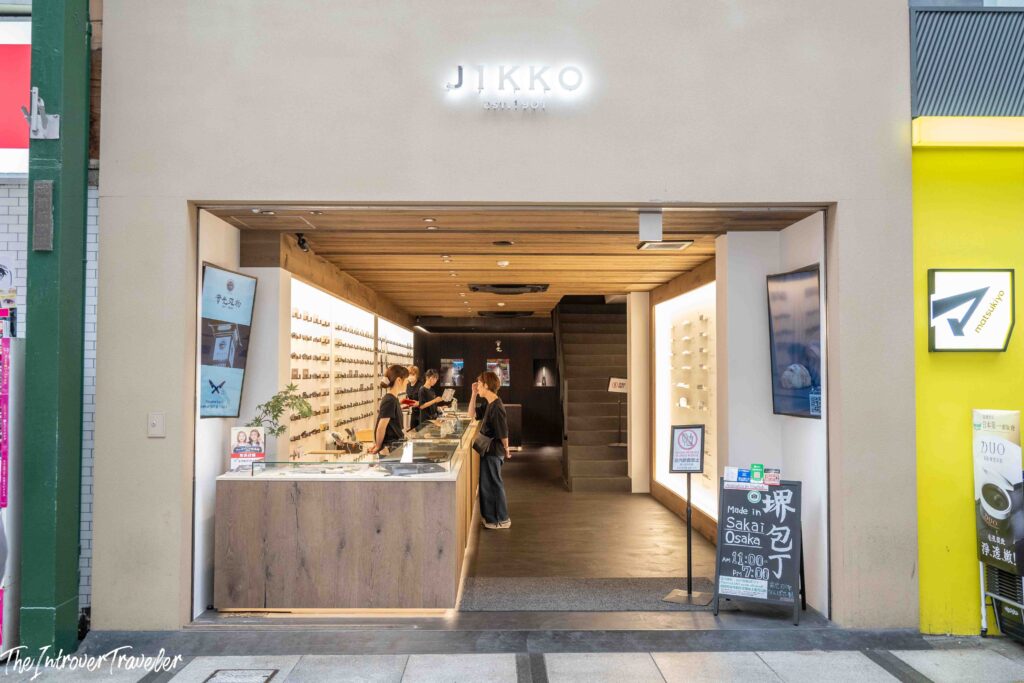
The original plan was different: a visit to the knife district of Sakai, the city a few minutes by train from Osaka that claims centuries of tradition in blade forging. I did not manage it in time. I therefore limited myself to Jikko’s Namba Ebisubashi shop, a two-minute walk from Namba Station (the name on my credit card statement, “Jikko da ban shi zhon”, is such a garbled transliteration that it was no help at all; only by checking the official site did I work out which shop it actually was). Ebisubashi is not the company’s historic home: that, complete with an open forge and a sharpening workshop, remains the Sakai Main Shop in Sakai-ku, which is exactly the place I did not manage to visit. Ebisubashi is, all the same, a shop that, from my research, appears to be the main outlet for Sakai’s production within the city of Osaka itself, and it was in any case the choice of both chefs I met in the city: reason enough not to look elsewhere.
Sakai: Six Hundred Years of Blades, and Where Jikko Fits In
Sakai is not a district that improvised its way into knife making greatness over the last few decades. Its history of metalworking begins as early as the fifth century, when the city, surrounded by imperial burial mounds including the enormous kofun of Emperor Nintoku, drew blacksmiths to forge the tools needed to build those tombs. That technical grounding passed, over the centuries, into swordmaking during the Heian and Muromachi periods. The shift towards the knife as we understand it today, though, came with the Nanban trade: in the mid sixteenth century the Portuguese introduced tobacco to Japan, and Sakai began producing specialised blades to cut its leaves, the tabako-bōchō. The quality of those blades was such that the Tokugawa shogunate granted the city’s smiths the Sakai Kiwame quality seal and, in effect, a monopoly on official sales: from that point on, the name Sakai became synonymous with a quality blade across Japan. With the Tokugawa peace and the resulting decline in demand for swords, the artisans redirected the skill they had built up towards kitchen knives, particularly the deba bōchō, and developed the tradition of single-bevel blades, known in Japanese as kataba: blades sharpened on one side only rather than both, capable of a cleaner, sharper cut but demanding a more experienced hand, the tradition that still defines high-end Japanese cuisine today. Sakai retains a peculiarity that sets it apart from other Japanese knife-making districts: production is still split between three distinct specialists, the blacksmith who forges the blade, the sharpener who gives it its edge, and the craftsman who fits the handle, each of whom works on the same knife in sequence.
Jikko belongs to this history from 1901, the year the family founded the business in Sakai; the company has now reached its fourth generation and is one of the city’s historic brands most associated with the hand-forging of single-bevel blades, thanks in part to a proprietary finishing technique called hatsuke, designed to maximise both sharpness and its retention over time. For generations Jikko sold almost exclusively to professional chefs, before opening retail shops aimed at private customers too, including the one in Osaka I walked into. If, according to some industry sources, roughly ninety per cent of Japan’s top chefs source their knives from Sakai, the coincidence I observed at the tables of Sumi Kappo Hirac and Sushi Amato Ura Namba starts to make rather more sense.
Inside the Shop: More Rolex Than Market
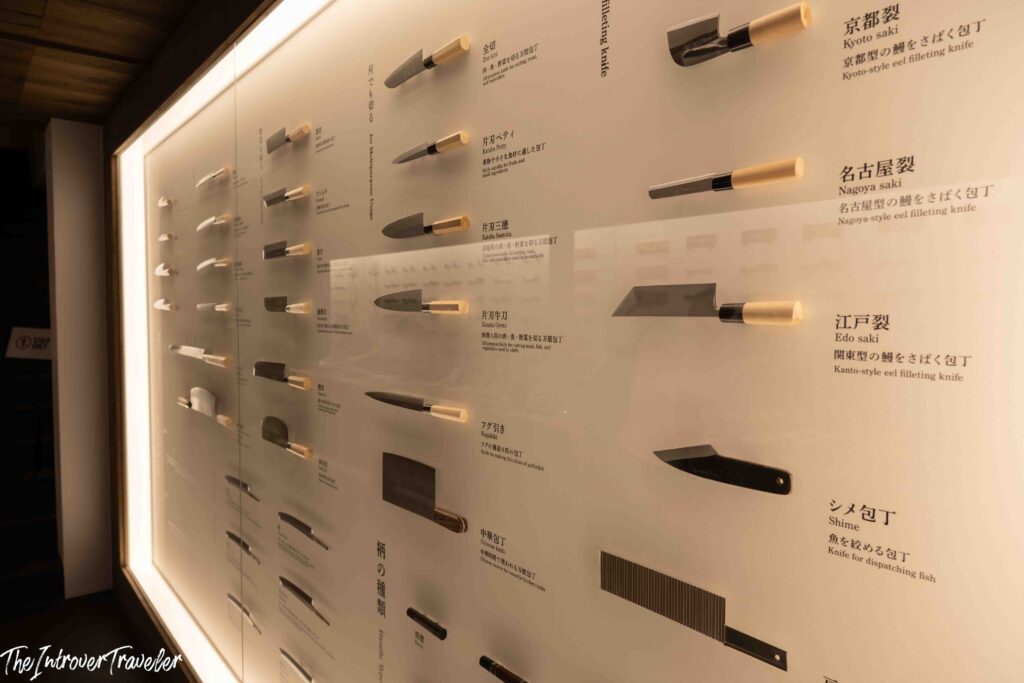
My impression of Jikko, compared with Tsukiji and above all Kappabashi, was mixed. In the two Tokyo markets I had found an almost limitless offer, capable of satisfying any request: dozens of shops, hundreds of blades, the sense that you could spend an entire day just comparing models. At Jikko in Osaka, the atmosphere felt closer to a luxury boutique: the sensation, almost, of walking in to buy a Rolex rather than stepping into a craftsman’s workshop. What is on display is fairly limited; compared with the shops in Kappabashi, where hundreds of knives line the walls, here we are talking about a few dozen knives, all clearly of considerable quality. The shop’s fittings are not those of a workshop but those of a luxury retail space. My sense is that this shop functions as a glittering showcase, offering only a select few pieces from a much larger, high-level production that actually happens in the forges of Sakai: anyone after the very best will not be disappointed, but anyone hoping to spend a while being talked through several different options might be.
I walked in explicitly asking for a single-bevel (kataba) yanagiba, for right-handers, in white steel (Shirogami) grade 2, and when asked directly I was indeed shown a knife with exactly these characteristics. When I asked to see other comparable models, though, there was essentially nothing else on offer: the knife shown to me first was, in practice, the only real option on the table. On top of that, since this was to be my first carbon steel yanagiba, I had also intended to buy a cheaper yanagiba to practise sharpening on without risking damage to the finer one, but when I asked to see an “entry level” yanagiba, the answer was, in substance, that there was not one available.
The shop assistant, as happens almost everywhere in Japan, spoke very limited English, which did not help, although I had already run into the same problem in the Tokyo markets. In the end the conversation went almost entirely through Google Translate, with translations going back and forth from Japanese: a method that works, but that makes an already complicated negotiation, once you start talking about steels and finishes, rather exhausting.
The Knife
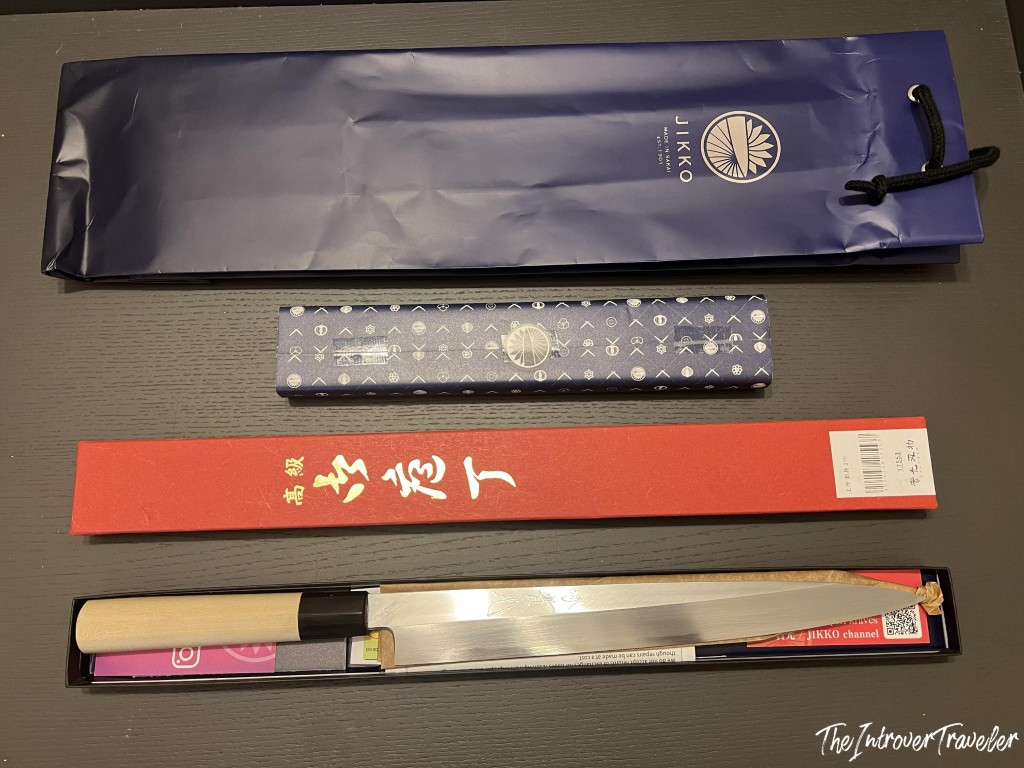
What I brought home, at a price of 33,000 yen, roughly 180 euros, is a single-bevel, 270mm yanagiba for right-handers in white steel (Shirogami) grade 2: the same carbon steel already discussed in the Kappabashi article, capable of an extreme edge but decidedly demanding when it comes to maintenance (it needs drying and oiling with almost obsessive consistency to prevent oxidation). The single-bevel blade, sharpened on one side only, is built precisely for the motion needed to cut sashimi: a single, clean pull, without tearing the fish’s fibres, unlike the sawing motion we would use with a Western double-edged knife.
I cannot yet say whether I will be able to look after the first professional knife of my life properly, but I can already say one thing: it is without doubt the best knife I have ever handled. My need for a sashimi knife comes from my own habit of cooking raw fish (a fairly common dish in Italy too, even if Japanese sashimi is far more famous), and tuna in particular; the texture of tuna fillets meant that, even with the Santoku bought on my previous trip, some cuts tended to shred. My first use of the yanagiba, by contrast, left me stunned: the blade sinks into the fish like a hot knife through butter. The comparison might sound excessive, but the sensation really is exactly that of handling a razor, and I can confirm it with a first-hand anecdote. As I explained in the other post, carbon steel needs constant drying to avoid oxidation; if you watch any video of a Japanese chef working on sashimi, you will notice he wipes the blade on a dry cloth after every single cut, and that is what I did on my first use too. I took a dry tea towel and, intimidated by how sharp the tool was, folded it over twice before running the blade, still faintly damp from the first cut, across it; a few seconds later I felt a burning pain in one finger, and looking at my hand I discovered, to my surprise, a clean cut across a fingertip.
The Hidden Advantage: A Weak Yen and Tax-Free Shopping
A practical detail that tends to get forgotten in the excitement of buying: at authorised Japanese shops it is possible to buy net of consumption tax (currently 10 per cent) by showing your passport at the till, exactly as already described in the Kappabashi article. Factor in the exchange rate, which held steady above 180 yen to the euro for much of 2026, one of the weakest levels for the yen in decades, the absence of import duties or importer margins, and the fact that you carry the knife home in your own suitcase with no shipping costs, and the sums are quickly done: a handcrafted knife that in a Western shop, once you add the distributor’s mark-up and transport, would cost a good deal more, works out at roughly half the price when bought directly from Jikko.
One warning though, because the rules of the game are about to change: from 1 November 2026, Japan is moving from an instant tax exemption at the till to a refund system on departure. Anyone buying after that date will pay the full price at the point of sale and will need to claim the refund at the airport before leaving, complete with customs validation. The financial advantage remains, but the process becomes more complicated.
In Short
For now, the tally of my Japan trips reads like this: a Santoku bought as a total beginner in the ocean of choice that is Kappabashi, and a yanagiba bought with only slightly more awareness, in the almost silent boutique that is Jikko in Osaka. Had I had one more day in the schedule, I would have gone straight to Sakai to see the forges; I did not, and the yanagiba I now use for sashimi still carries that city’s name, even if bought a few train stops away. For anyone with more time than I had, the Sakai district remains the trip you really ought to make; for anyone happy with a free afternoon in Osaka, Jikko is a more than respectable shortcut, provided you already know what you want before walking in.


