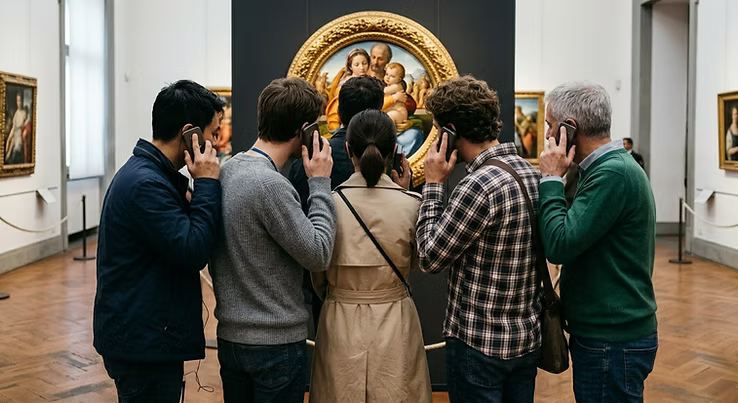
I have developed, over the years, a theory. It is not a scientific theory. It does not involve peer review, reproducible experiments, or funding from the European Research Council. It is a theory born of prolonged observation in the field, the field being every museum I have ever entered, from the Uffizi to the Met to the Borghese Gallery, where I have been forced to share oxygen with the Audio Guide People.
You know the Audio Guide People. You have seen them. You have been stuck behind them. They move through museum halls with the speed and spatial awareness of a municipal road resurfacing crew, except the road resurfacing crew occasionally finishes and leaves. The Audio Guide People never leave. They are eternal. They are stationed in front of every painting you want to see, feet cemented to the floor, heads tilted at a medically concerning angle, one finger pressed to their ear as if receiving classified intelligence from MI6, when in fact they are being told that Raphael was born in Urbino in 1483.
Raphael was born in Urbino in 1483.
That’s it. That’s the intelligence. A man was born somewhere. The Audio Guide People absorb this information with the solemnity of someone hearing the results of their own biopsy. They nod. They squint at the painting as if trying to detect traces of Urbino in it. They press pause. They move three feet to the left. They press play. A woman was born somewhere else, in another year. They nod again. The entire visit to the Sistine Chapel, one of the supreme achievements of human civilization, unfolds exactly like this: press, nod, shuffle, press, nod, shuffle, for forty-five minutes, until they emerge on the other side and say to their spouse, “Well, that was something.”
It was indeed something. What it was, they couldn’t tell you.
Here is what the audio guide actually does. It provides a surrogate of culture, a prêt-à-porter version of knowledge, designed specifically for people who do not want to endure the inconvenience of actually learning something. It takes a person who has read nothing, studied nothing, prepared nothing, and spent zero hours of their life developing even a rudimentary sensitivity to the visual arts, and it whispers into their ear a few crumbs of secondhand information, chewed and digested by someone else, the cultural equivalent of those protein bars that taste like compressed sawdust but technically contain nutrients. The audio guide user consumes these crumbs and walks away believing they have dined. They have not dined. They have licked the wrapper.
And the crumbs are sterile, because the entire process that would have made them meaningful has been skipped. The information arrives dead on arrival. Knowing that Caravaggio used chiaroscuro is utterly, cosmically useless if you have not first spent time reading about his life, studying his paintings, training your eye to recognize what his darkness does and why. Without that process, without the slow, unglamorous labor of learning, the audio guide’s data points are just words floating in a void, unanchored to anything, connecting to nothing, forgotten before the visitor reaches the next room.
Because here is the thing, and I say this with all the affection I am capable of mustering for someone blocking my view of Caravaggio’s David with the Head of Goliath while fumbling with a device that looks like a 2003 Nokia: you cannot appreciate art in thirty-second installments. You cannot. It’s not a matter of opinion. It is a structural impossibility, like trying to learn the piano by reading the tracklist of a Chopin album on Spotify, or understanding Japanese cuisine by watching a man eat sushi in a TikTok that lasts eleven seconds and has 4.7 million likes.
The capacity to stand before a painting and actually feel something requires preparation. It requires having spent time, real time, boring time, solitary time, reading about the artist’s life, their obsessions, their technique, their failures. It requires having trained your eye, slowly, painfully, over weeks and months, until you can look at a Vermeer and understand why the light falls exactly where it falls, why that particular shade of yellow exists nowhere else in the history of painting, why the woman reading the letter seems to breathe. This is not information that can be compressed into a forty-second audio clip narrated by someone who sounds like they are simultaneously recording the safety instructions for a regional Ryanair flight.
The audio guide is, in this sense, a perfect metaphor for our times. We live in the age of the 140-character take, the era inaugurated by Twitter, in which all of human thought must fit into a capsule small enough to be swallowed without chewing. We don’t read articles; we read headlines. We don’t watch films; we watch trailers, and then we watch people react to trailers, and then we read someone’s tweet about the reaction to the trailer, and at the end of this chain of increasingly diluted engagement we believe we have an opinion about a film we have never seen. The audio guide is the museum version of this phenomenon: a device that allows you to form an opinion about a painting you have not looked at, using information you will not remember, in a building you entered only because TripAdvisor said you should.
One of the worst moments comes when you finally manage to secure your spot beside a painting and would like to enjoy it, perhaps in silence, but to your left there is a Spanish tourist, to your right an English one, and behind you a German and a Scandinavian, each with their audio guide at full volume pouring into your ears like a cacophonous Dolby Surround symphony risen from Babel.
And here is the worst part, the truly unforgivable part: the audio guide doesn’t even have the decency to be honest about what it is. It doesn’t say, “Hello, you are about to receive a laughably superficial gloss on a work of art that deserves weeks of your attention, delivered in a format designed for people with the attention span of a fruit fly on methamphetamine.” No. It says, in its warm, reassuring, public-television-narrator voice: “Welcome to the gallery. This guide will enrich your visit.“
Enrich.
In the same way, I suppose, that a packet of ketchup enriches a Wagyu steak.
If I were the director of a major museum, which I am not and will never be because I lack the diplomatic temperament required to smile at donors who pronounce “Caravaggio” with a hard G, I would replace all audio guides with a single laminated card handed to every visitor at the entrance. The card would read:
“You are about to enter a building containing objects that took years to create, that embody centuries of accumulated human genius, suffering, and technical mastery, and that cannot be understood in the time it takes to boil an egg. If you have not read a single book about the artists whose work you are about to see, do not despair: the gift shop sells several. Buy one. Read it at the hotel tonight. Come back tomorrow. Look again. Come back the day after. Look again. In three days you will see more than the audio guide could show you in three hundred years. In the meantime, please stand to the right.“
Or, actually, better yet, and here I am being serious, smug and snobbish: I would establish one day per week in which admission costs double, say 24 euros instead of 12, and the use of audio guides is strictly forbidden. One day per week in which the zombie hordes are financially discouraged from entering, and the experience of art is left, just once, to those who actually love it.
I know, I know. The obvious objection. Opening museums to the masses, all while being ever so democratic, brings rivers of money, and that money presumably goes toward preserving artistic heritage. Presumably. Although the recent security failures at the Louvre and the Uffizi suggest that all those millions of tickets are not exactly being reinvested in world-class protection of the works. But let’s assume, charitably, that the money helps. Fine. I am not proposing to close museums. I am not proposing to restrict access. I am proposing one day. One single day per week where the price of entry buys you something that no audio guide can provide: silence, space, and the possibility of an authentic encounter with beauty.
So here is my petition: how many of you would be willing to pay double for a museum ticket in exchange for a room where no one is pressing play, no one is blocking your view, no one is taking a selfie with Botticelli’s Venus, and the only sound is the quiet, almost imperceptible hum of a painting that has been waiting five hundred years for someone to actually look at it?
I sign first.
Because when I see him walk into the Uffizi, the John Doe from Kansas, and head toward the Tondo Doni a split second before me, I want to rip that greasy little gadget from his ears and smash it on the floor and shatter it to pieces, like a guitar in the hands of John Belushi during a toga party, and then stomp on it compulsively as if I were Fred Astaire in tap shoes.
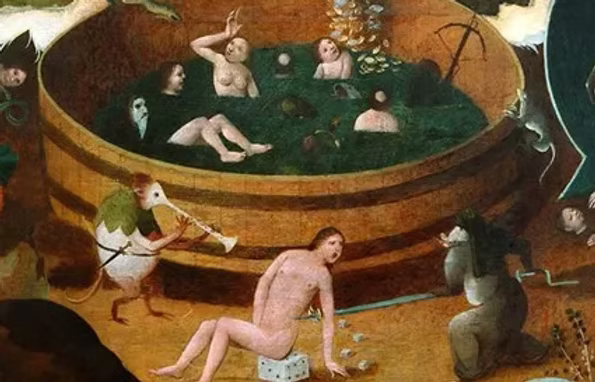
And for the incurable audio guide addicts, for those who will not be separated from their little plastic oracles, I leave it, as always, to the divine Hieronymus Bosch to conceive a suitable eternal punishment: impaled for eternity through the buttocks while a suckophant from Yellow Submarine blasts into their ears, on a loop, “Raphael was born in Urbino in 1483.“
The Rant, in pure Italian vernacular: Ma puttana impestata pigra e oziosa, ci vuole tanto a leggersi qualche pagina prima di entrare in un museo?!
After audio guides, what will museum curators come up with next to attract visitors? Popcorn, as if we were at the cinema?! Will we have to get used to contemplating Botticelli with the smell of melted butter filling our nostrils?!