Last visit: December 2025
Where: Sinis peninsula, Cabras, province of Oristano
When to go: spring or autumn, armed with every available means of defence against mosquitoes
Length of visit: from 30 minutes to two hours
My rating: 6/10
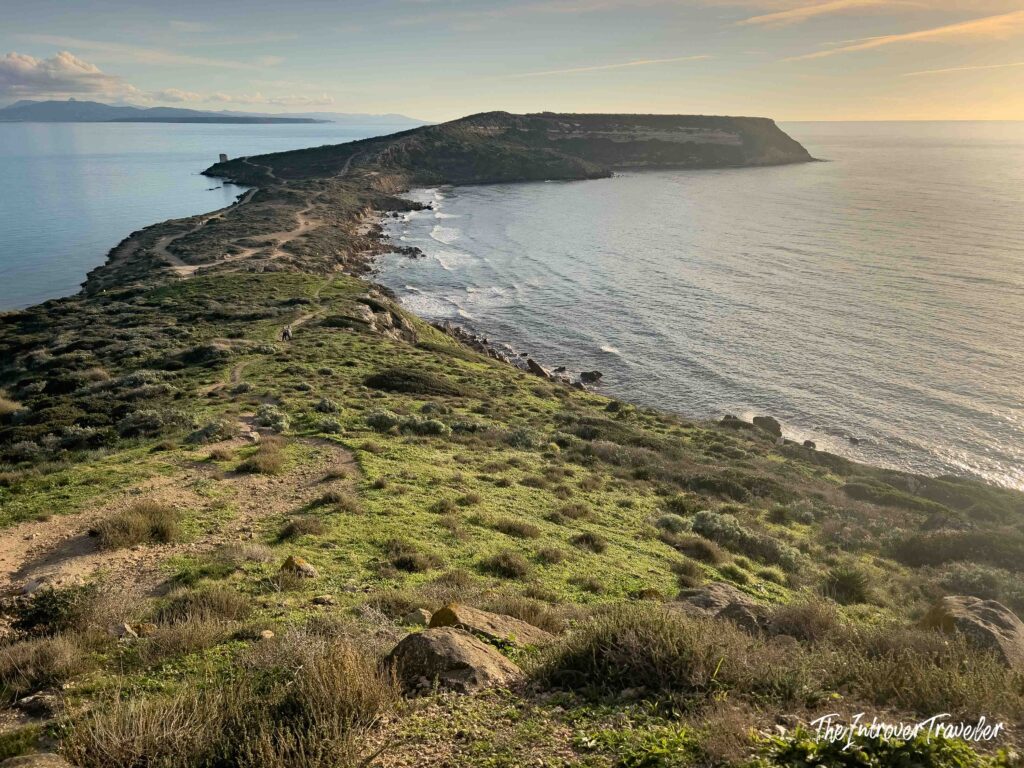
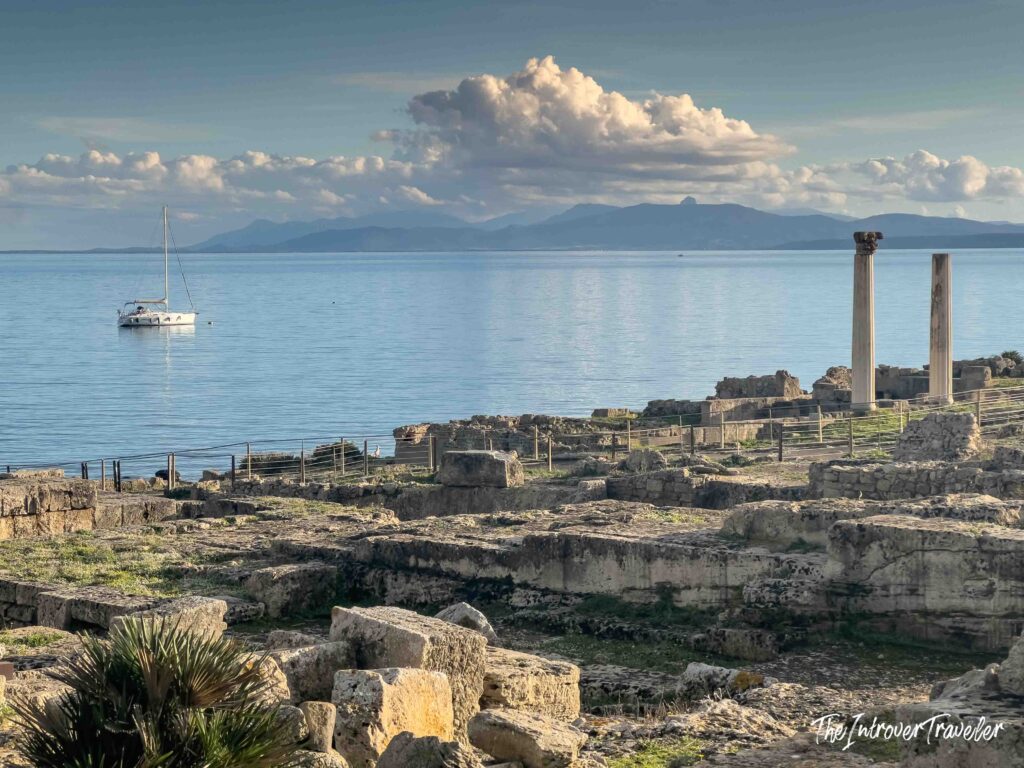
Tharros sits at the southern tip of the Sinis peninsula, in central-western Sardinia, on a strip of land squeezed between the Gulf of Oristano and the open sea, where the headland of Capo San Marco closes off the bay. It is one of those sites that have everything they need to be a brochure spectacle: ruins by the sea, columns against the blue, sunsets the photographers will sell you as once in a lifetime. For that reason I want to start by dismantling expectations rather than inflating them. Tharros is an interesting site and worth the visit, but for reasons that are not exactly the ones the postcard suggests, and with a few limits that it is only honest to declare up front.
A history three millennia long, summarised without fanfare
The most remarkable thing about Tharros is its longevity. Few places in the Mediterranean have been continuously inhabited for so long. On the rise of Su Muru Mannu, the highest point of the site, there was already a Nuragic village of circular huts in the Bronze Age, of which traces remain in the northern sector. Then, toward the end of the eighth century BC, the Phoenicians arrived and founded a trading post here, exploiting the strategic position: a peninsula with the sea on both sides, ideal for people who lived by maritime exchange.
In the sixth century BC the city passed under the control of Carthage, and it was in this Punic phase that it received its first real urban organisation: reinforced walls, excavated necropolises, a monumental layout. With the Roman conquest, from 238 BC onward, after the First Punic War, Tharros entered the period whose remains we see most substantially today: baths, a water distribution system, paved streets, the urban layout you walk through now among the stones. After Rome came the Byzantines, who made it an episcopal see, and for a time it was even the capital of the Giudicato of Arborea, one of the four states into which medieval Sardinia was divided.
Then, around 1070, the end. The episcopal see was transferred inland, to Oristano, more sheltered from the Saracen raids that were making life on the coast untenable. The population followed, and Tharros was progressively abandoned. There is a phrase that recurs in the local guides, according to which the stones of Tharros were used to build Oristano: it is well attested, preserved even in an old Sardinian saying, and it explains why so little, proportionally, remains of a city inhabited for nearly two thousand years.
What you see, and what you do not see
Here comes the first necessary piece of honesty. Most of what is visible at Tharros today belongs to the Roman and late-Punic phase, that is, to the last part of its history. Of the archaic Phoenician city, the one of the origins, practically no domestic structure is known: archaeologists know it was there, from the necropolises and the grave goods, but the exact location of the first settlement is still a matter of hypothesis. So when Tharros is described as an “ancient Phoenician city”, the label is correct as to its founding but misleading as to what you actually walk through: you are strolling, for the most part, in a Roman city built on top of the earlier phases.
There is then a second absence, more painful, and it is the one that in my view makes Tharros a genuinely instructive site, beyond the photogenic columns. Most of what Tharros contained is no longer at Tharros. The Punic necropolises were extraordinarily rich: gold and silver jewellery, Egyptian-style amulets, scarabs, imported Greek pottery, objects that document a city embedded in the great trade routes of the Mediterranean. Almost none of this is on site today.
The story of the nineteenth-century excavations of Tharros is a story of plunder. From the seventeenth century onward the grave goods were already prey to treasure hunters. But the big hit came in the mid-nineteenth century, when a series of digs, some official and others much less so, systematically emptied the tombs. The most cited case is that of Gaetano Cara, at the time director of the Cagliari museum and superintendent of the excavations, who handled the sale of an enormous quantity of finds. After the Louvre declined because the sum requested was considered excessive, the material ended up in London, where the British Museum bought around fifteen hundred pieces for a thousand pounds (sources differ on the exact figure). Another lot, of several thousand objects, was auctioned at Christie’s. Today finds from Tharros are scattered between the British Museum, the Louvre, and the museums of Turin, Rome, Cagliari, Sassari, and Oristano. The Mont’e Prama Foundation, which manages the site, has begun restitution requests, and in April 2026 some of these objects were exhibited temporarily at the Museo Civico of Cabras.
I say this is the most instructive thing about Tharros because it tells, better than any explanatory panel, how archaeology worked in the nineteenth century: digging not to understand but to sell, dispersing grave assemblages without recording their composition, treating a thousand-year-old cemetery as a mine. The scientific damage is incalculable, because without the documentation of what lay alongside what, many of those objects have lost much of their meaning. Visiting Tharros with this in mind changes the experience: you are not looking at an intact city, but at the emptied shell of a city, whose contents are scattered across half of Europe.
The tofet, a more serious note
On the northern rise, near the walls, lies the tofet, the open-air Phoenician-Punic sanctuary. It is one of the best preserved in the western Mediterranean, and deserves a mention that goes beyond the picturesque. In terracotta urns were placed the cremated remains of newborns and very young children, accompanied by stelae carved with sacred symbols. As to what exactly took place in these sites, the discussion among scholars is anything but closed: the traditional interpretation, which speaks of child sacrifice, has been strongly contested by those who consider it more likely that it was a burial area dedicated to those who died in the very first years of life. This is not the place to take a position, but it is worth knowing that the gruesome version you will sometimes hear told is only one of the hypotheses on the table, and is today rather controversial.
The current state and the visit
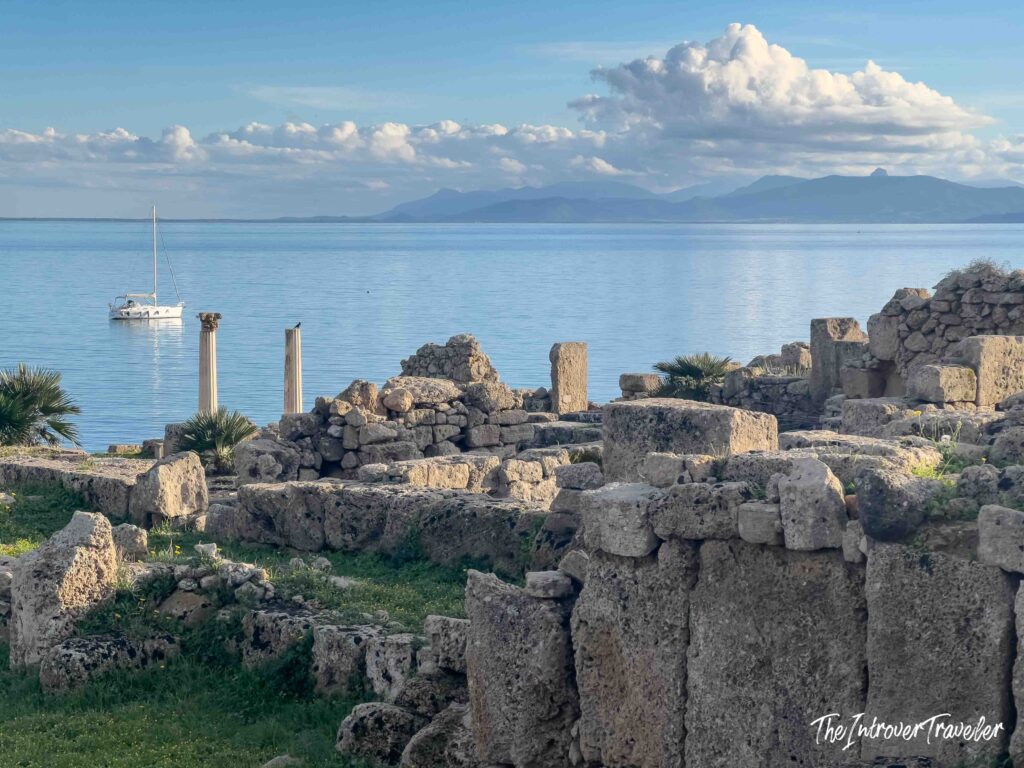
The site is managed by the Mont’e Prama Foundation and is visited for a fee. In recent years it has had some relaunch work, with a new ticket office and facilities. You walk it on foot along the Roman streets, among the remains of the baths, the foundations of the temple, the few raised columns you will see in every photograph (and which, it is worth knowing, are the result of anastylosis, a modern reassembly of original elements, not a miracle of preservation).
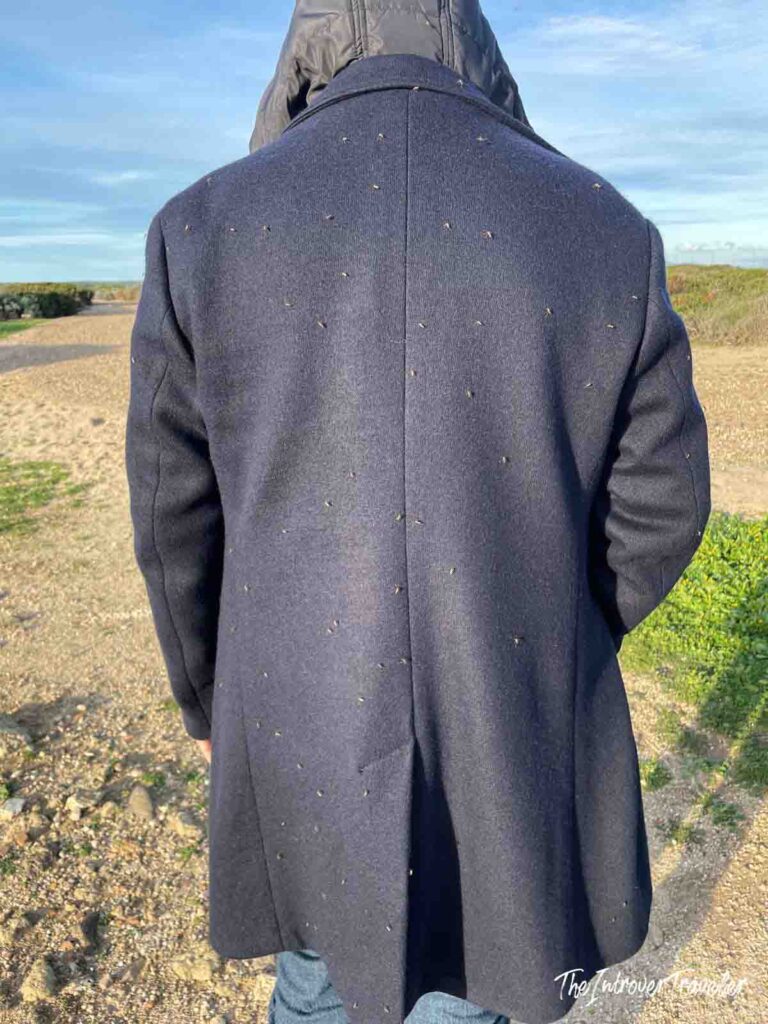
The visit takes from half an hour to two hours, depending on how much you care to read the panels and climb to the Spanish tower of San Giovanni, which dominates the headland and offers the panoramic view the place is known for. On this, though, I feel a due clarification is necessary: I visited Tharros in mid-December, on a fine day with the temperature around 15 degrees, but I had to bundle up in a coat and hood because I had never seen so many mosquitoes, not even in the banana grove in Tanzania that until then I had considered the mosquito capital of the world. If the place was this infested with mosquitoes in winter, I dare not imagine what it is like in the other seasons. This decisively discouraged me from reaching the headland, and my visit ended in half an hour.
The ticket can be combined with the tower and with the Museo Civico of Cabras, and this, in my opinion, is the sensible combination: the museum holds the finds from the Sinis, including the tofet, and above all the Giants of Mont’e Prama, the extraordinary Nuragic statues that on their own are worth the detour; since 2026 the Giants that for decades had been at the Archaeological Museum of Cagliari have also been reunited at Cabras. To visit Tharros without stopping at the museum means seeing the container and skipping most of what filled it.
Does it have tourist value? Yes, but in measure
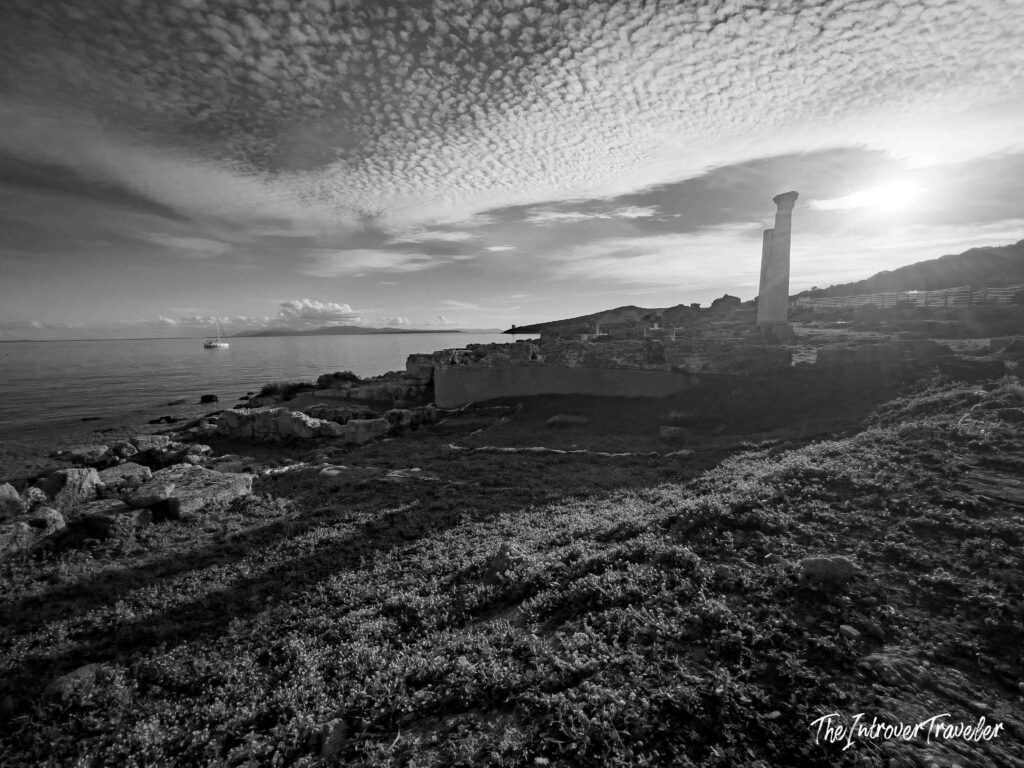
Tharros is one of the most visited archaeological sites in Sardinia, and its location makes it a natural hub for a day in the Sinis: there is the beach of San Giovanni right next to it, there is Is Arutas with its quartz sand a little to the north, there is the lagoon of Cabras with its fishing tradition, there is the museum with the Giants. As a single stop, taken on its own, it risks leaving rather nonplussed anyone who expected a Pompeii by the sea: it is not, and whoever sells it to you as such is selling you an expectation the site cannot meet. The site has some suggestive views, the charm of a place with a thousand-year history, but comparing it to Pompeii is an abuse of marketing, to put it mildly.
As part of an itinerary through the Sinis, on the other hand, Tharros makes complete sense. Its strength is not the monumentality, which is modest, but the stratification and the position: the idea that on that same scrap of land Nuragic people, Phoenicians, Carthaginians, Romans, and Byzantines succeeded one another for nearly three thousand years, each building on the ruins of the last, is in itself more fascinating than any column. If you arrive with this awareness, and with the story of the plundering in mind, Tharros becomes a site that makes you think. If you arrive expecting the view and nothing else, you will be left with just a few nice photographs at sunset, which is not nothing, but is not all the place would have to say either.