Last visit: February 2022
Where: Masua, a hamlet of Iglesias, Sulcis-Iglesiente, south-western Sardinia
What: industrial archaeology site + sea stack + beach
Duration: two hours
My rating: 6/10
There are places in Sardinia that sell themselves on the sea alone, and places that are worth it for what people built on top of, or in this case inside, the rock. Masua belongs to the second category, although it has the sea too, and good sea at that. It is a coastal hamlet of Iglesias, in the Sulcis-Iglesiente, the mining region of south-western Sardinia, and the reason you go is mainly one: Porto Flavia, one of the most striking works of industrial archaeology you are likely to see.
What the Masua mines are
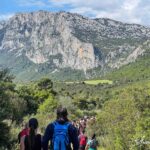
The Masua area was mining country for centuries. The lead and zinc deposit (with silver) was among the most important in the territory, worked since the end of the seventeenth century and active until around 1960, when the area’s extractive activity entered its final phase of abandonment. The whole Iglesiente is dotted with these sites, because the local geology, which is also the oldest in Italy, concentrated here the deposits that people exploited for millennia, from the most remote times down to the twentieth century.
A historical note that gives the measure of the conditions in which people worked: in 1882 a very young Gabriele D’Annunzio, then nineteen and a correspondent for the Cronaca bizantina, visited the Masua mine and wrote a brutal report on it, describing undernourished miners subjected to gruelling rhythms. It is worth keeping in mind, because the photogenic beauty of the place risks making one forget that these sites were born of the toil and exploitation of thousands of people.
Porto Flavia: what it is, and why it is extraordinary
Let us start with a common misconception: Porto Flavia is not a mine. It is a loading port, and that is exactly what makes it brilliant.
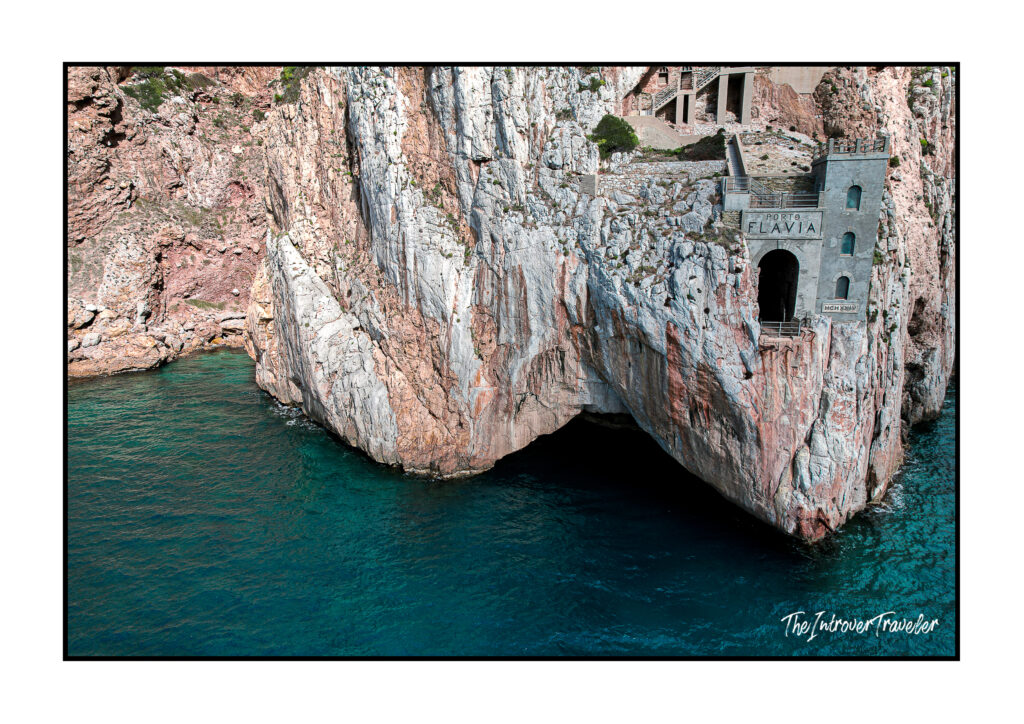
Before it was built, the ore extracted at Masua was loaded by hand onto small sailing boats, the bilancelle, taken to Carloforte, and there transshipped onto the larger vessels that distributed it across Europe. A slow, costly, laborious process. In the 1920s the Venetian engineer Cesare Vecelli designed a radical solution, and gave the work the name of his daughter Flavia. Built between 1922 and 1924, Porto Flavia is essentially a port carved into the rock face, sheer above the sea.
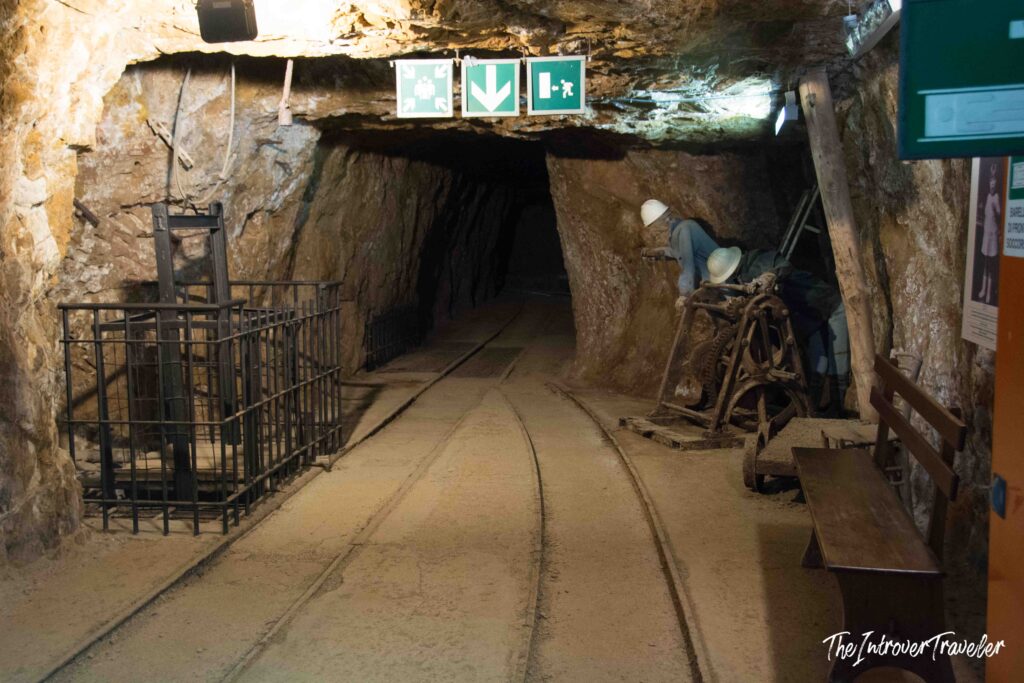
It works like this. An upper tunnel, about 600 metres long, brought the ore from the mines into the interior of the cliff. There the material was unloaded into nine huge vertical silos carved into the rock, capable of holding up to 10,000 tonnes. From a second, lower tunnel, the ore descended by gravity onto a conveyor belt which, at loading time, was extended outward by some twenty metres through an opening in the cliff, dropping the material directly into the holds of the ships moored below. No more sailing boats, no more loading by hand. A revolution.
The visit today
Porto Flavia stayed operational until the 1960s. After decades of abandonment, it was restored in the early 2000s and is now seen on a guided tour lasting about an hour. Booking is mandatory, especially in summer.
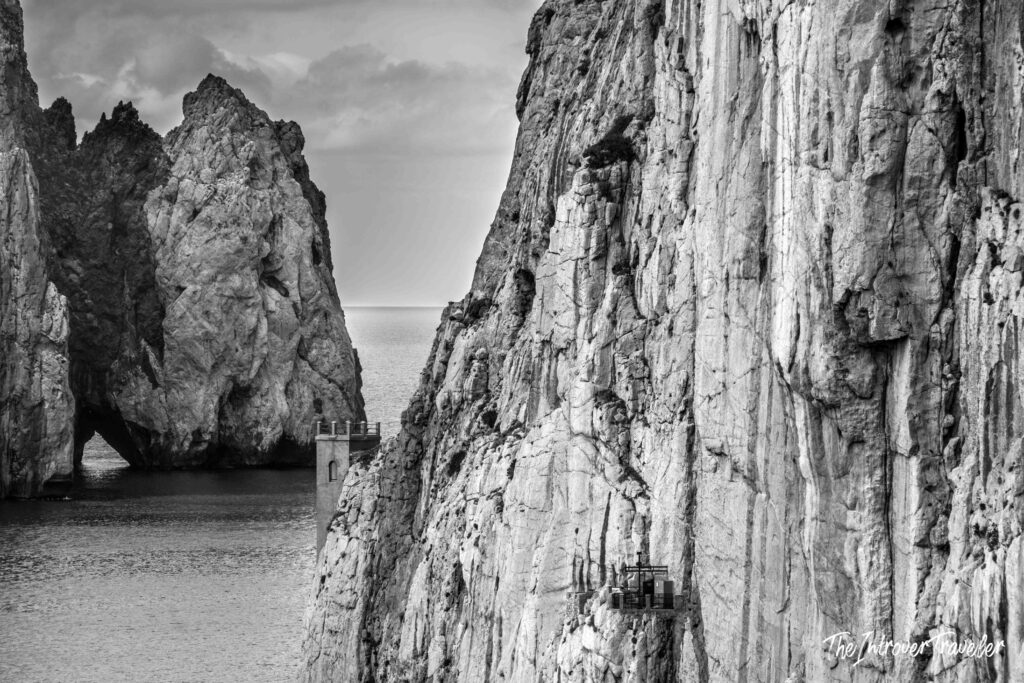
The route takes you inside the tunnel, to the point where it opens sheer above the sea, and that moment is the reason you come. You step out through a window cut into the rock, halfway up the face, with the void below and the sea stack of Pan di Zucchero in front of you. It is a view that repays the trip. Along the tunnel there are panels, historical photographs, and the remains of the machinery, and nearby there is also a museum of mining machinery for those who want to go deeper.
A practical note: you arrive from Iglesias following the signs for Masua, and from Cagliari it is about an hour and a quarter by car. Without your own vehicle it is awkward. Booking is done through the official channels of the site or the tourist portals.
Pan di Zucchero: the island that is not an island
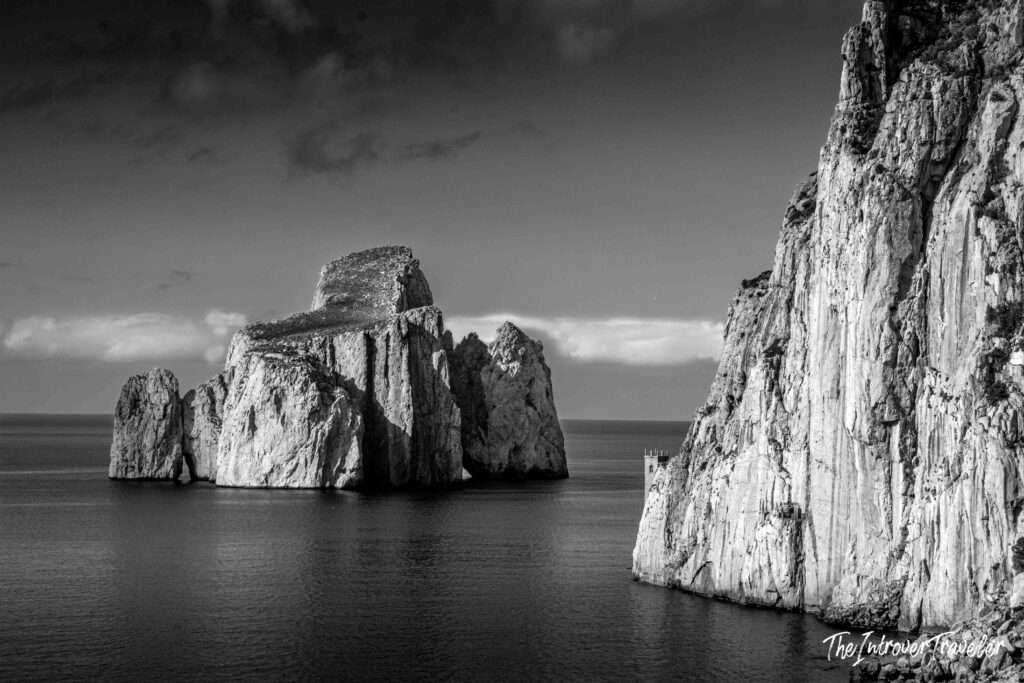
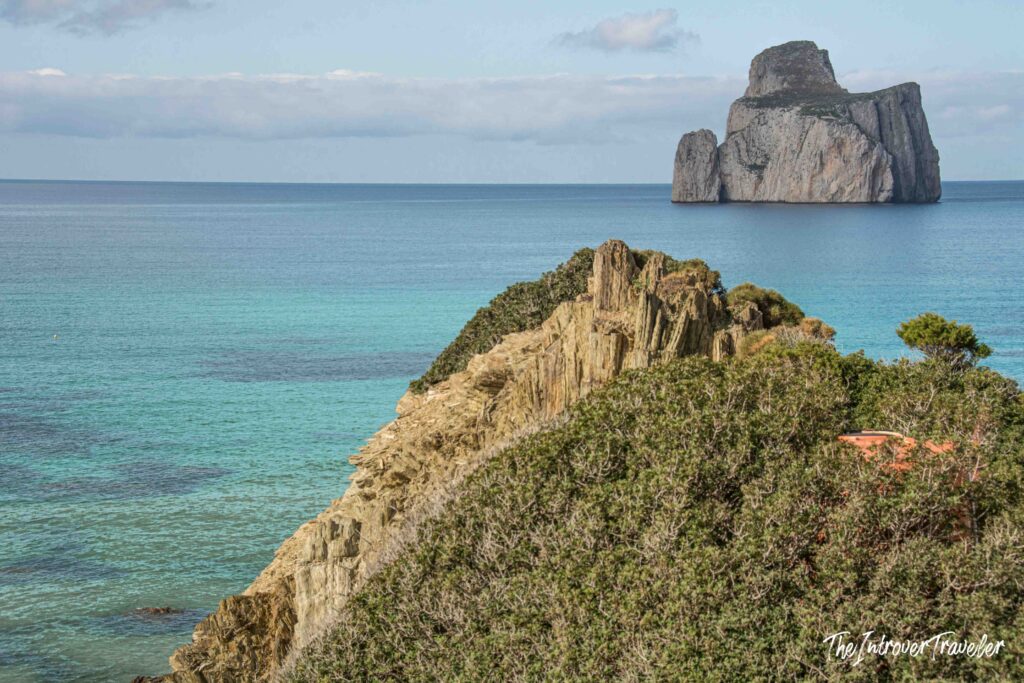
In front of Porto Flavia, about three hundred metres from the coast, rises Pan di Zucchero. I call it an “island” here because that is how it is perceived from the mainland, but technically it is a faraglione, a monolithic stack detached from the coast. It is 133 metres high, the tallest sea stack in the Mediterranean, and it was once joined to the mainland, until tectonics, karst processes, and marine erosion isolated it.
The Italian name recalls the Pão de Açúcar of Rio de Janeiro for its shape, but the association is late: the original Sardinian name was Concali su Terràinu. It is made of Cambrian limestone, the oldest rock in Italy, and beside it stand three minor stacks, called s’Agusteri and il Morto. You can reach it by dinghy or boat from the inlet of Masua, and climbers, with specialised guides, scale its walls.
The beach of Masua and its geology
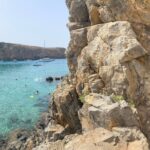
At the foot of all this is the beach of Portu Cauli. It is a crescent of amber and golden sand, closed at both ends by rock, with a shallow sandy seabed that shelves gently. It is sheltered from the prevailing winds, which makes it a quiet spot, suitable for families too. Behind it stand the buildings of the old mines, a small mining village you can wander freely.
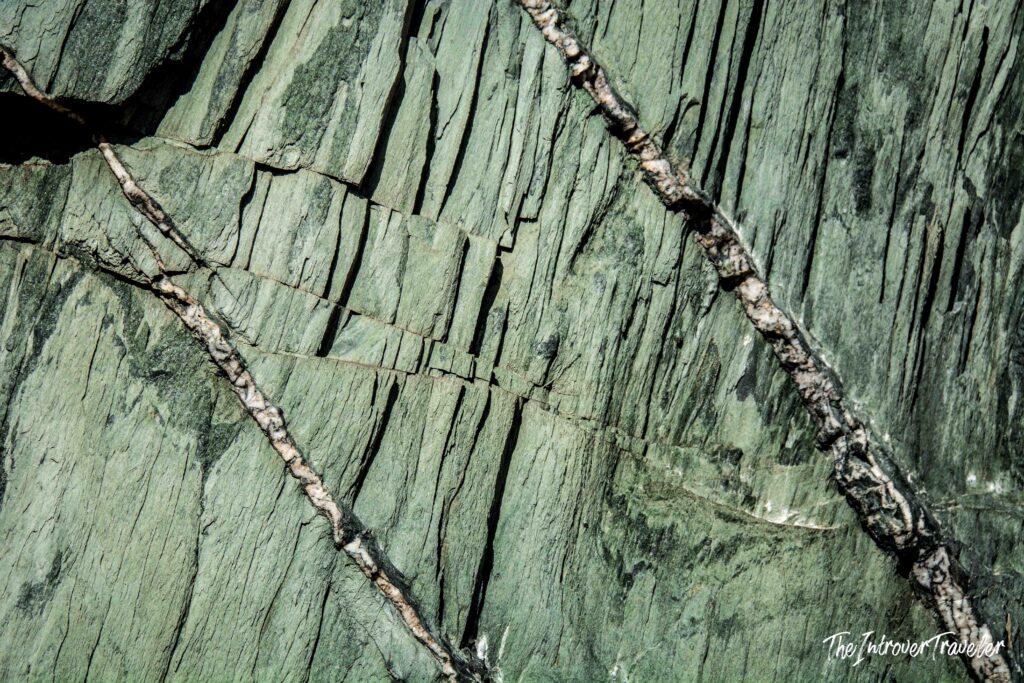
It is worth saying a few words about the geology, because there is a detail here that many people miss. The rocks of the area belong to the ancient Cambrian successions of the Iglesiente, the oldest in Italy. The ones that give the beach its most surprising visual character are metasiltstones, that is, fine sediments originally laid down in the Cambrian and then transformed by metamorphism during the Variscan orogeny, in the late Palaeozoic. These rocks have a high content of chlorite and iron oxides, and this produces an alternation of red and green layers, depending on which of the two components prevails: the green of the chlorite, the red of the iron oxide. It is this chromatic layering, not some generic “green rock”, that is the real geological spectacle of the place, and it is worth stopping to look at it up close rather than settling for the view of the stack.
The stack itself, on the other hand, is a different material: Pan di Zucchero is Cambrian limestone, whitish and tending to cerulean, of the Gonnesa Formation. So within a few hundred metres you have two different chapters of the same extremely ancient geological story: the metasiltstones layered in red and green on the beach, and the monolith of pale limestone rising from the sea. Add the green-blue of the water and the golden sand, and you understand why this stretch of coast is one of the most distinctive in Sardinia.
Is it worth it?
Yes, and without hesitation, but for the right reasons. Porto Flavia is one of those works that deserve to be seen because they tell a story of ingenuity, toil, and exploitation, all at once, and because the view from the window on the cliff face is genuinely rare. Pan di Zucchero and the beach complete the picture and make for a full day. Put it in an itinerary of the Sulcis-Iglesiente, perhaps together with the other mining hamlets like Nebida or with the dunes of Piscinas, and you will have one of the least banal days in south-western Sardinia, far from the beach-umbrella tourism and inside a landscape where industrial history and the oldest geology in Italy look each other in the face.