Last visit: June 2026
When: Every second half of June
Duration: 1,5 hours for the game, a whole afternoon if you want to follow the procession
Web: https://cultura.comune.fi.it/calcio-storico-fiorentino
My rating: 7/10
The brutal nature of Florence
Florence has a vice the tourist brochures prefer to keep quiet: for centuries it has held together, within the same circuit of walls, the heights of the sublime and the bottom of the pit. The city that bred within itself, generation after generation, a lineage of universal geniuses (Dante and Giotto, Brunelleschi and Donatello, Leonardo, Machiavelli, Michelangelo) is the same one that, when it came to settling scores, did not bother with niceties. On the contrary: it brought to the task the same inventiveness it reserved for its frescoes.
Take the Pazzi conspiracy. On 26 April 1478, inside the Duomo and during Mass, the conspirators stabbed Giuliano de’ Medici to death (nineteen blows), missing his brother Lorenzo by a hair, who took refuge, wounded, in the sacristy. The city’s response was instantaneous and of rare ferocity. Archbishop Salviati was hanged from the windows of the Palazzo della Signoria still wearing his pontifical vestments; alongside him dangled Francesco de’ Pazzi and a string of accomplices; the summary executions ran past eighty. Old Jacopo de’ Pazzi, head of the family, was dug up some weeks after his death, dragged through the streets with the same rope that had hanged him and finally thrown into the Arno river, but not before his decomposing head had served as a macabre door-knocker at the entrance of the Pazzi house. As a perpetual reminder, Lorenzo commissioned Botticelli to paint a pittura d’infamia with portraits of the hanged men on the façade. The Florentines, it must be said, did not improvise even in their revenge.
And then there is the export brutality, because at that they excelled just as much. Caterina de’ Medici, Florentine by birth and for thirty years queen mother of France, is the figure to whom tradition attributes the staging of the St Bartholomew’s Day massacre (23-24 August 1572), when in Paris and then across half of France thousands of Huguenots were slaughtered. Historians have argued for centuries over how heavily her hand really weighed and how much belongs to the legend of the wicked Italian queen, but the point, for our purposes, holds: the Florentines led the field not only in brutality for domestic consumption, but also in the kind meant for export.
A city that defended itself from itself
The towers and fortified palazzi still glimpsed in the centre (lopped off, swallowed by later buildings, reduced to stubs of raw stone amid the plaster) served less to keep out the foreign enemy than to defend Florentines from Florentines. The thirteenth-century case-torri were private urban castles, and their height was the measure of a family’s prestige. Guelphs and Ghibellines, Buondelmonti and Amidei (the feud that tradition has erupting from a marriage promise broken around 1215), then Cerchi and Donati, Bianchi and Neri: allied families shut themselves into networks of connected towers, the so-called società delle torri, as ready for attack as for defence. After the rout at Montaperti (1260) the Ghibellines razed dozens of Guelph towers to the ground, and the Guelphs, once back in the saddle, returned the favour with interest; in the end the government had to legislate to force them down to an acceptable height. The most spectacular violence in Florence was almost always self-produced. And once a year this civic disposition still finds, to this day, a regulated outlet.
Historic football: what it is and where it comes from
The origins are lost, as always in these cases, between history and suggestive hypothesis. It is said to descend from the Roman harpastum, itself heir to a Greek game; what is certain is that in the sixteenth century calcio in livrea (or calcio in costume) was played in the Florentine squares, a pastime of the well-to-do classes. Lorenzo the Magnificent is said to have played it too. The first rules set down in writing we owe to Count Giovanni de’ Bardi, in 1580. But the match that entered legend is another: on 17 February 1530, with the city in the grip of the imperial siege, the Florentines set about playing in Piazza Santa Croce out of pure mockery, to show Charles V’s troops that they were not afraid. It is the partita dell’assedio, the siege match, and it is re-enacted every year.
The tradition faded for a few centuries and was dusted off in 1930, under the Fascist regime, for the four-hundredth anniversary of the siege. A not insignificant detail: after the war the left-wing administration took it up again in a touristic and sociable key. Contested civic heritage, then, useful to opposing ideologies, which makes it all the more Florentine.
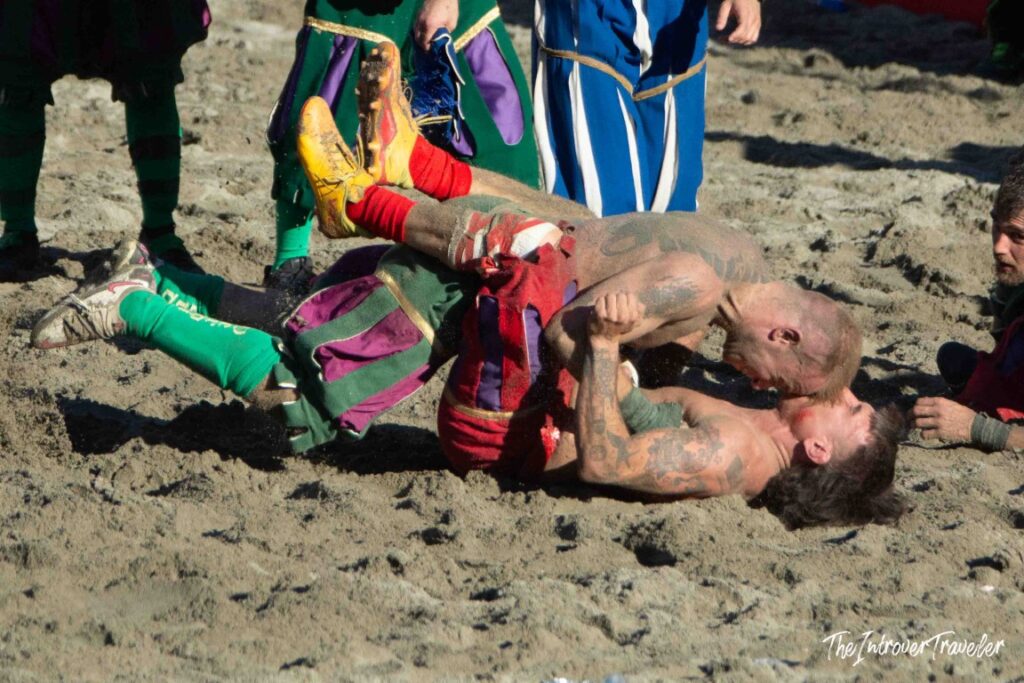
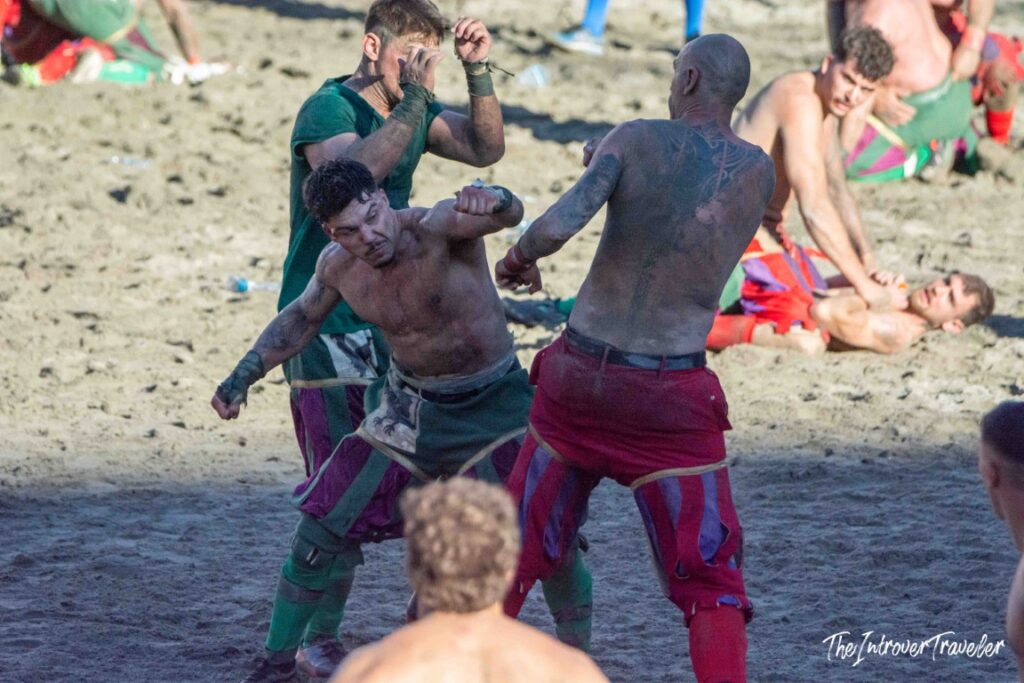
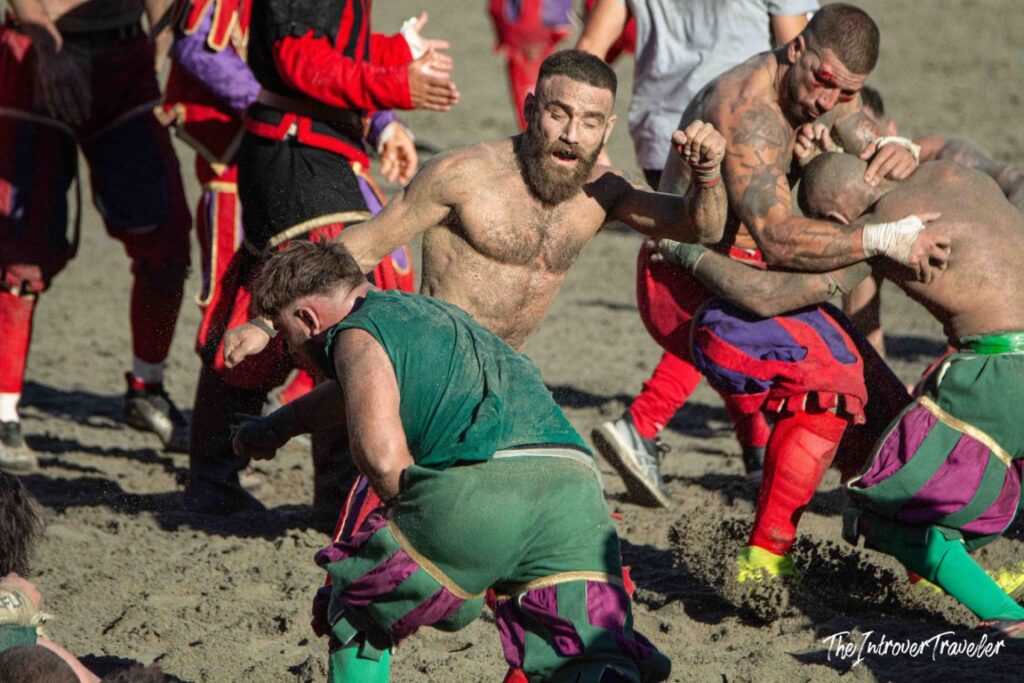
The rules, today, are what you would expect from a game born to hurt. Four teams, one for each of the historic quarters: the Azzurri of Santa Croce, the Rossi of Santa Maria Novella, the Bianchi of Santo Spirito, the Verdi of San Giovanni. Twenty-seven calcianti per side, fifty minutes, a sand pitch laid out in Piazza Santa Croce, two semi-finals and a final fixed for 24 June, the feast of Saint John, patron of the city. A caccia is scored by sending the ball over the opponents’ back line along the full width of the pitch; anyone who misjudges the aim and sends it too high gives away half a caccia to the other side, which explains why it does not pay to overdo things. Hands and feet are admitted on equal terms. As for the rest, historically almost everything was permitted (head-butts, punches, elbows, chokes); today blows from behind and kicks to the head are forbidden, and it is prohibited for more than one player to set upon the same opponent, on pain of expulsion. The threshold, as you can see, is generous.
Who plays? Florentines, essentially: you must be born in Florence or have lived there for at least ten years. For a few seasons up to three “foreigners” per team could be fielded, but the exemption was scrapped precisely to seal off the fiorentinità of the game; and after a series of incidents those with criminal records have been excluded. Nobody is paid: they play for glory, for the quarter and for the sheer pleasure of the brawl. The historic prize was a Chianina heifer, now faded into a dinner for the winners. Felt by the citizenry? Enormously. In Florence everyone supports the colour of their own quarter, usually the one they were born in, and in the trattorie the photographs of the calcianti stay pinned up all year like holy cards.
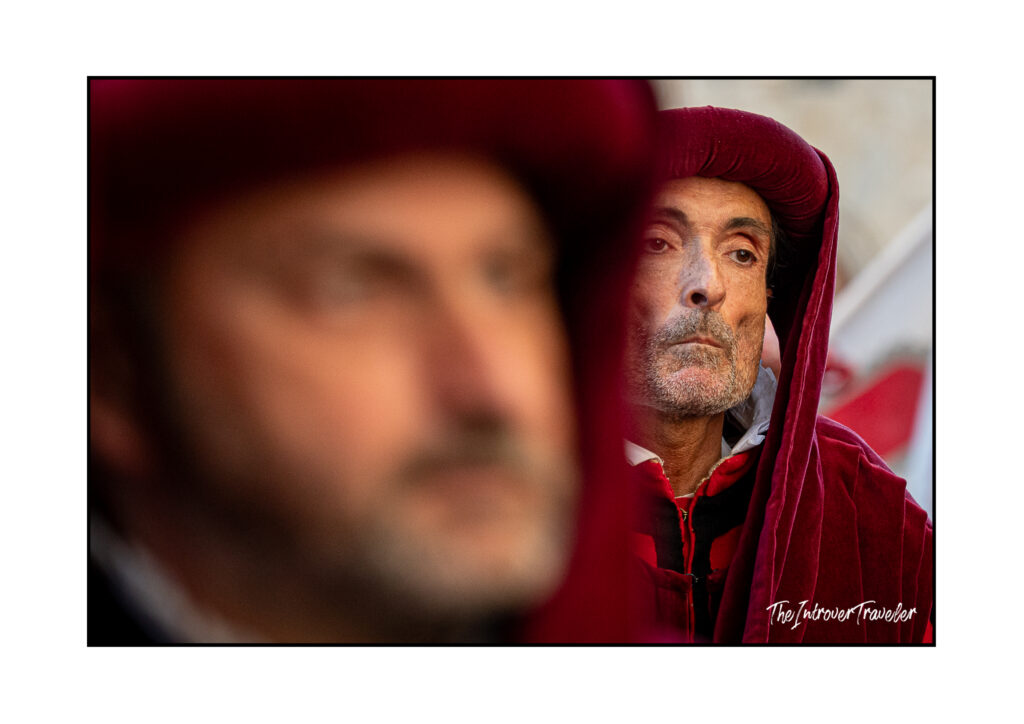
The procession: inside a fresco
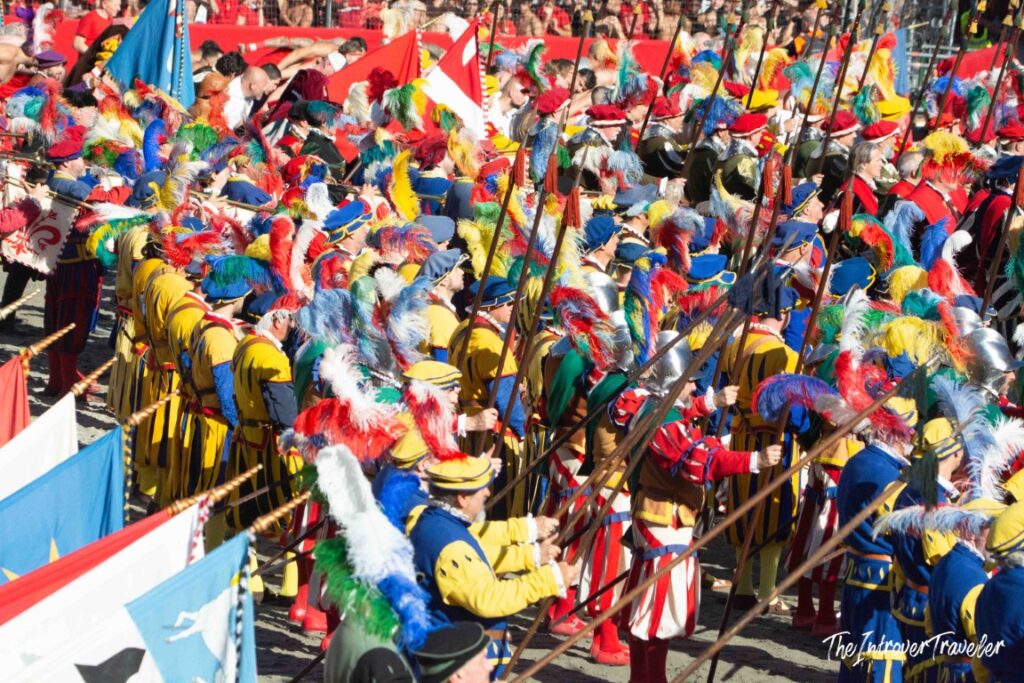
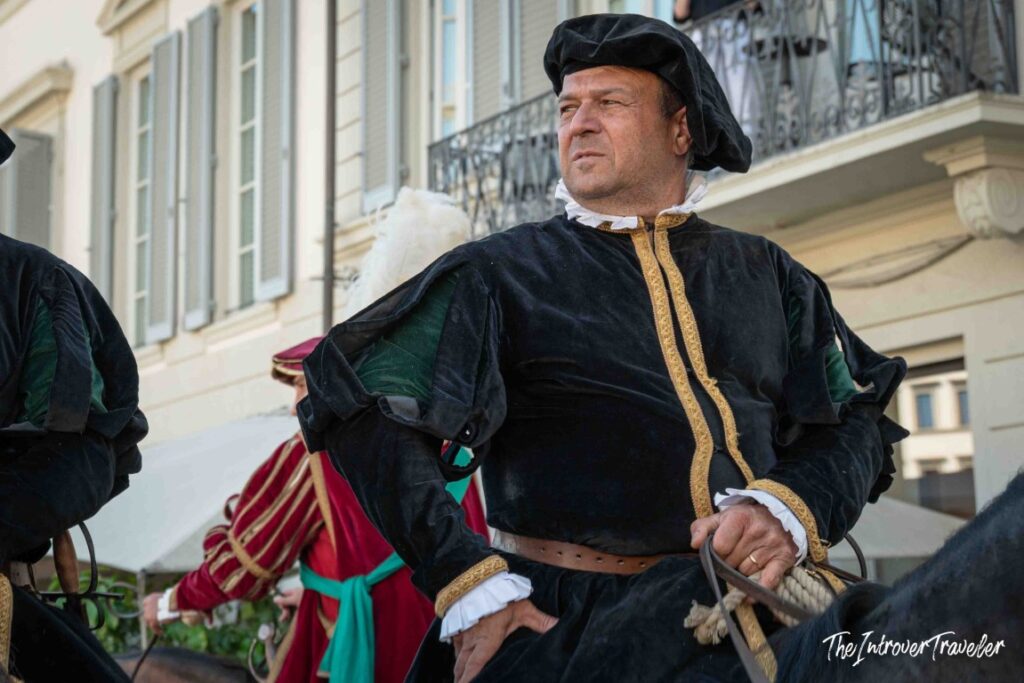
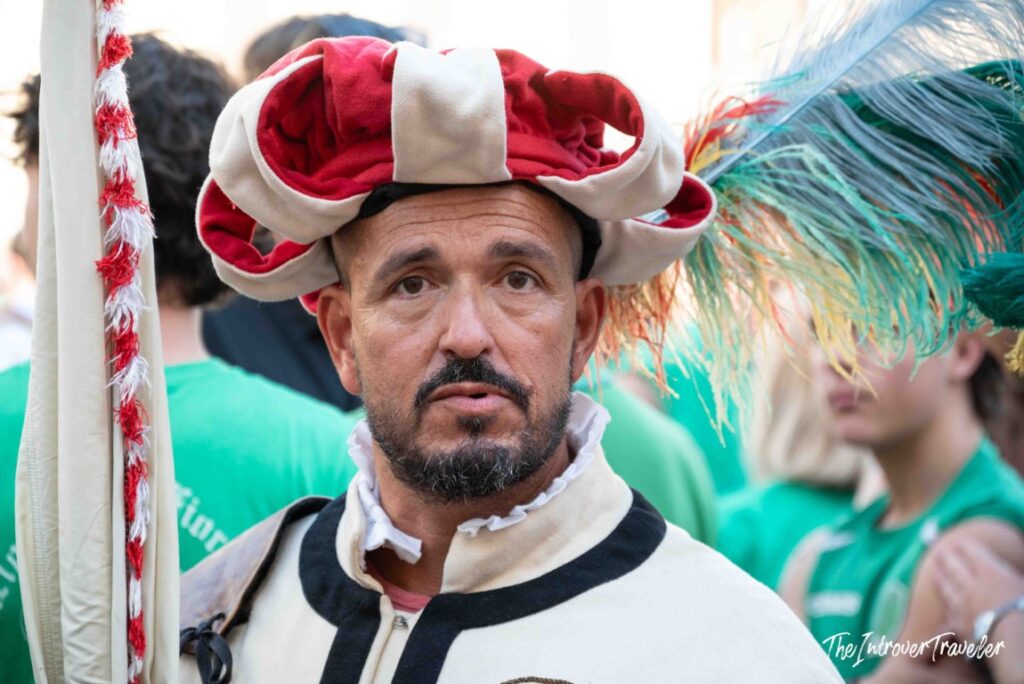
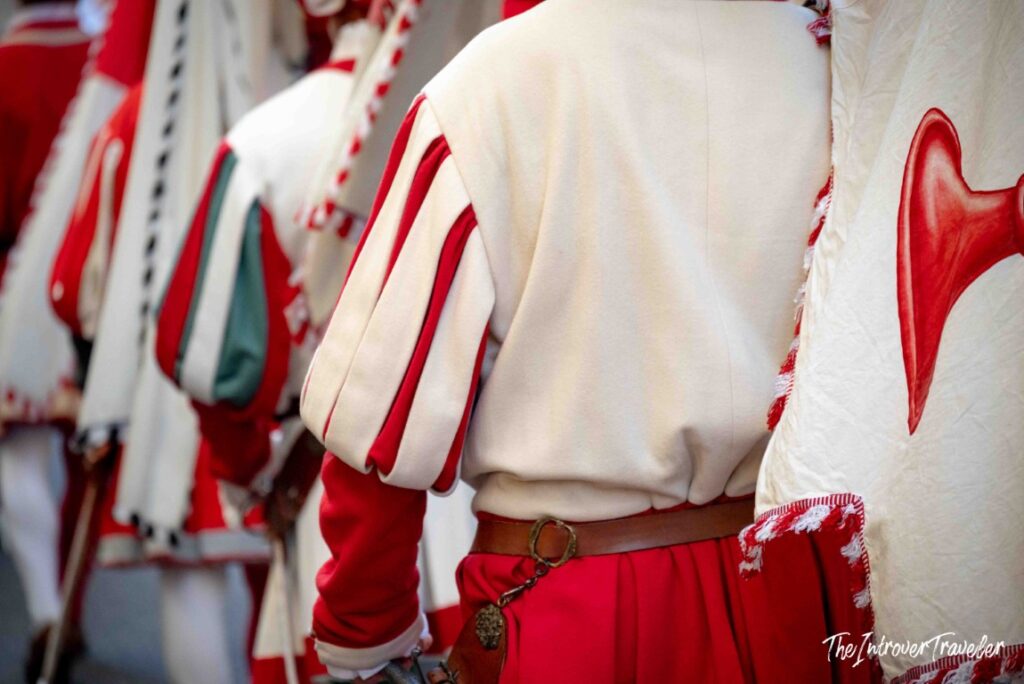
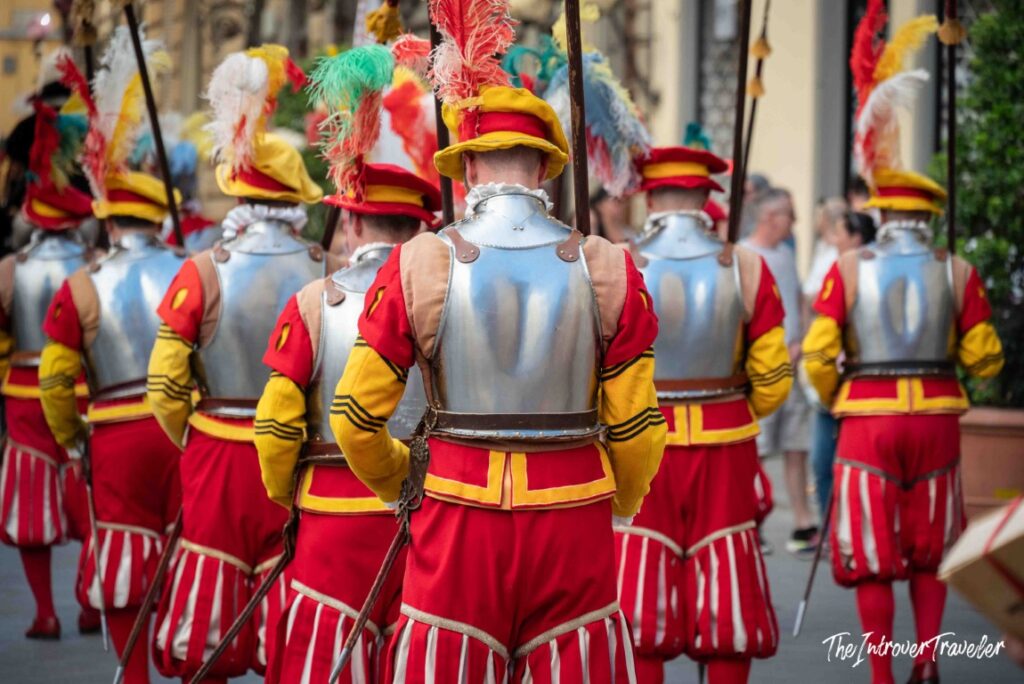
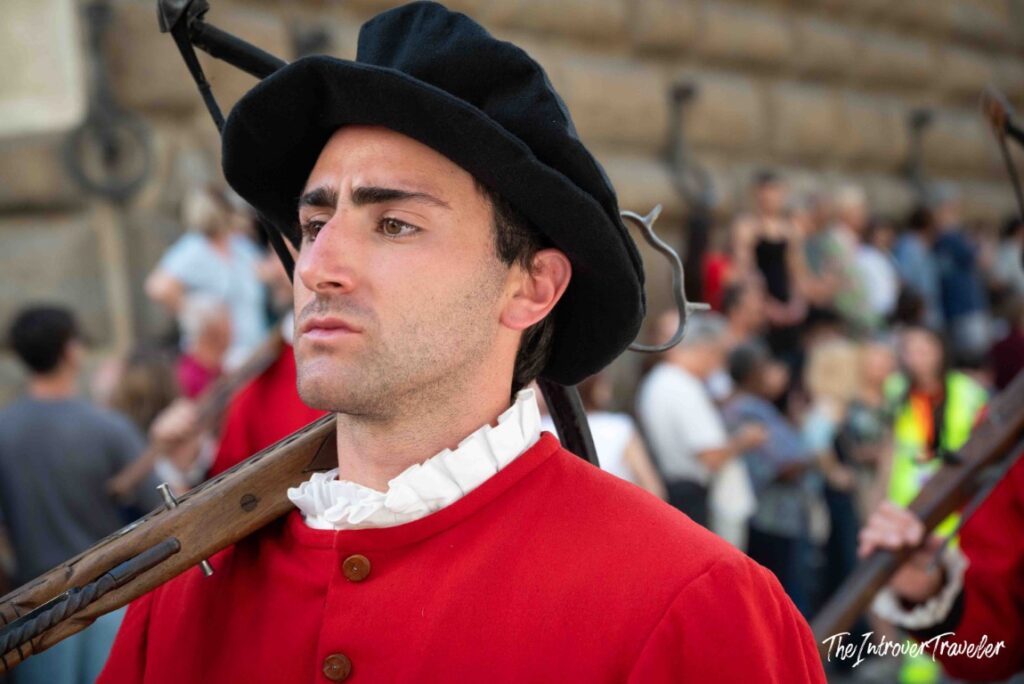
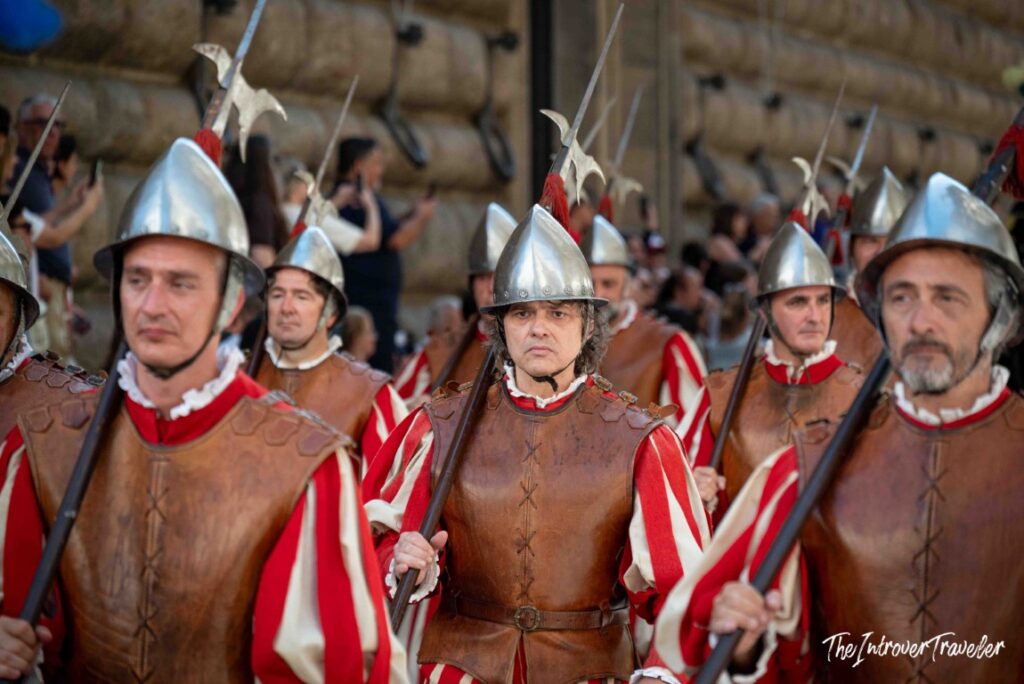
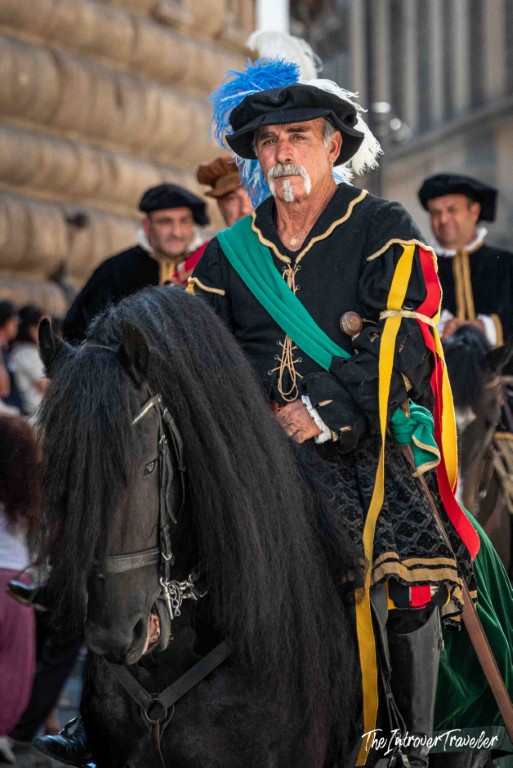
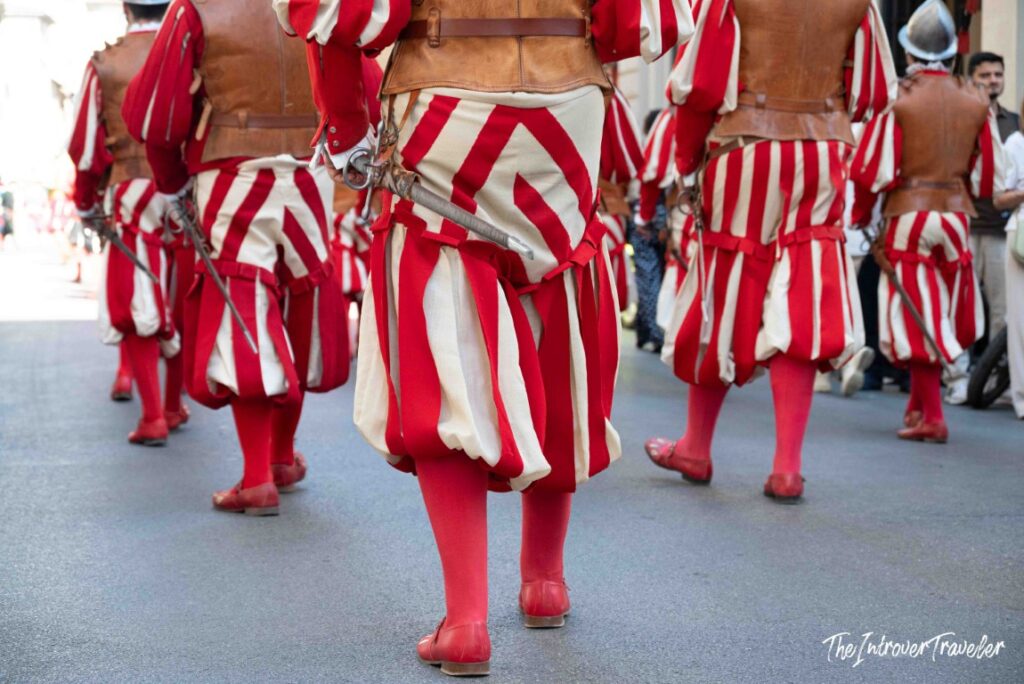
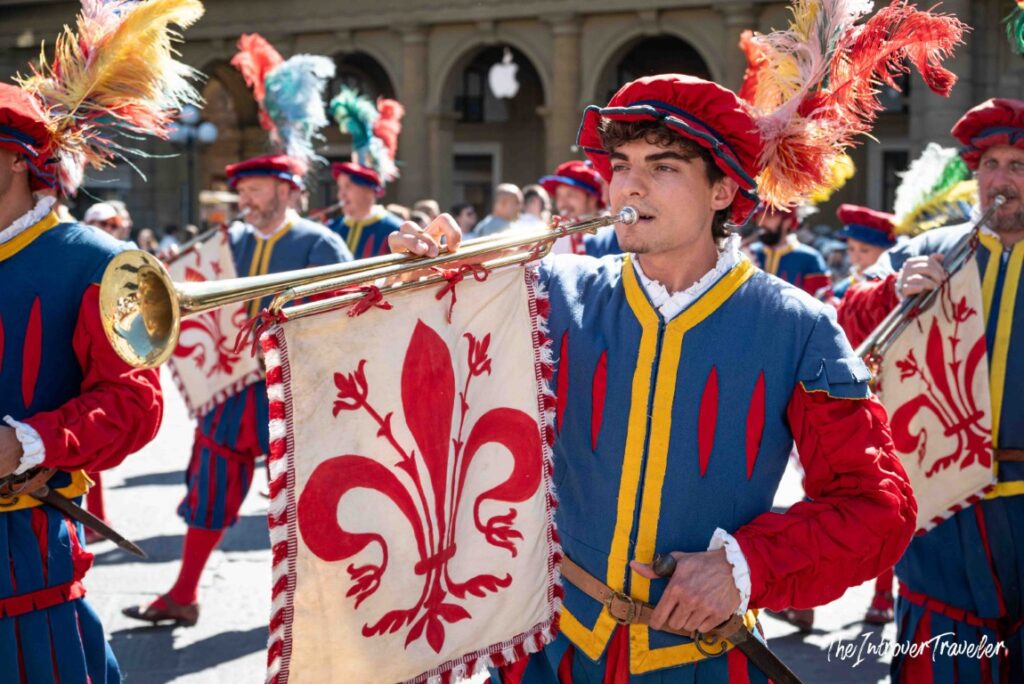
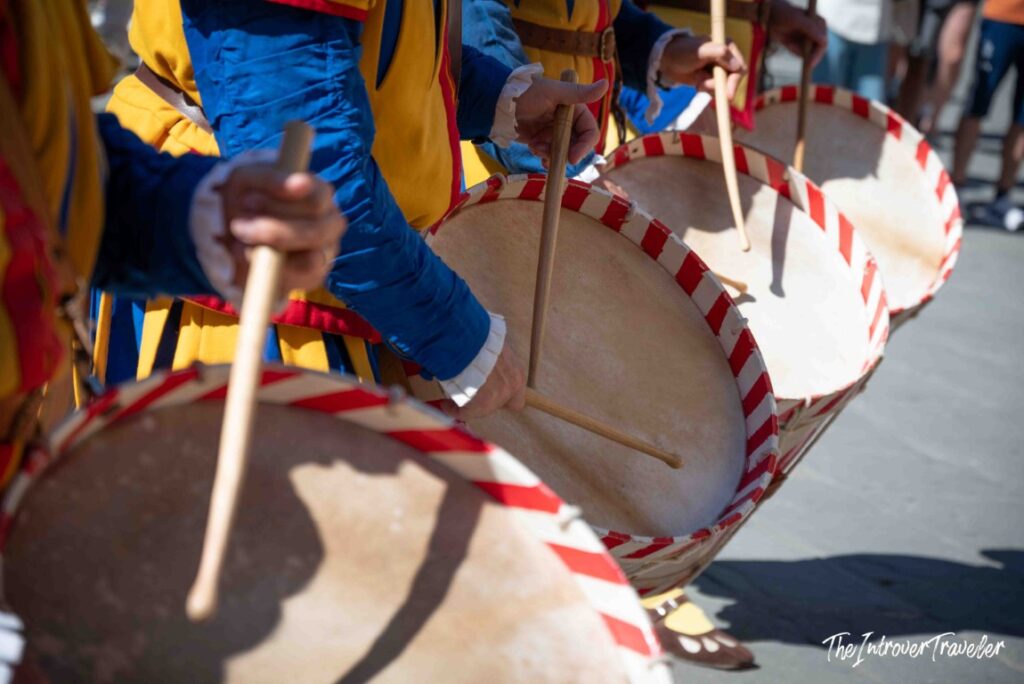
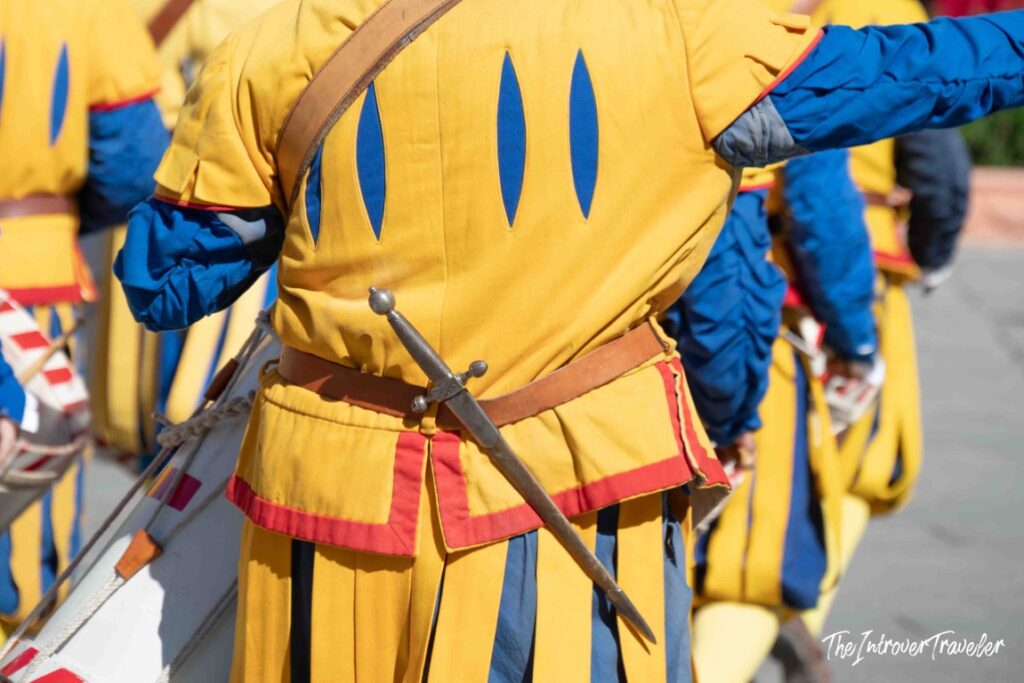
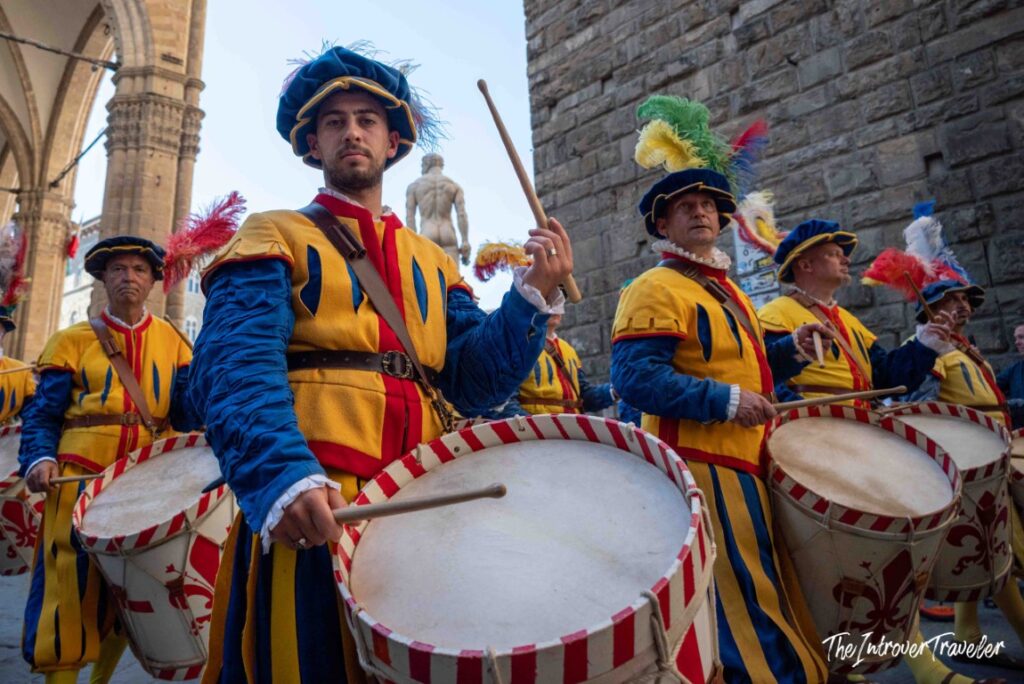
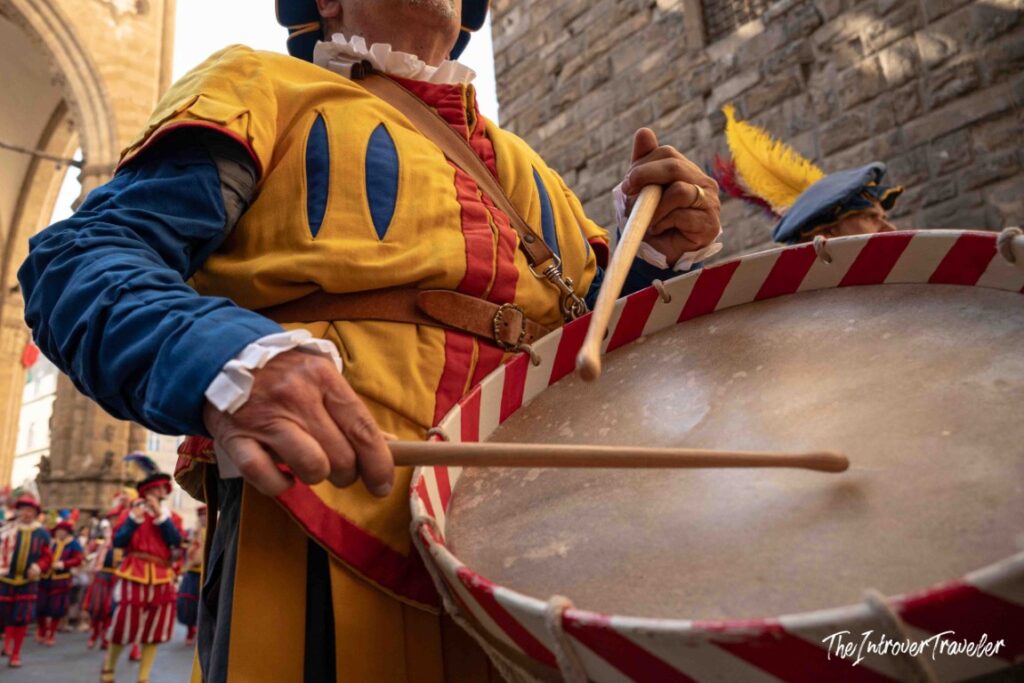
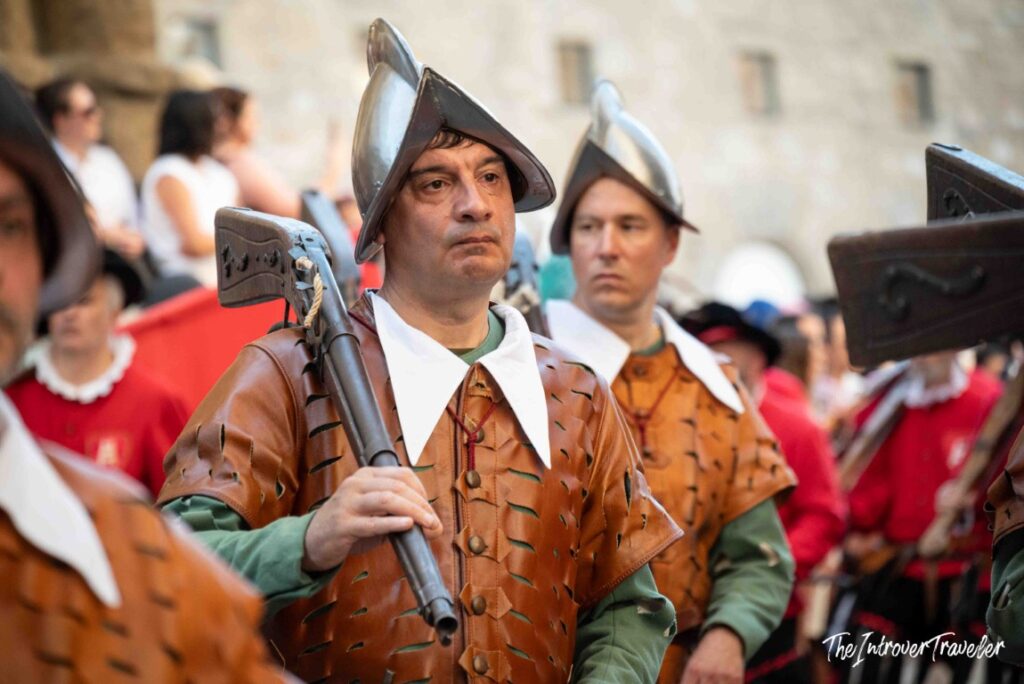
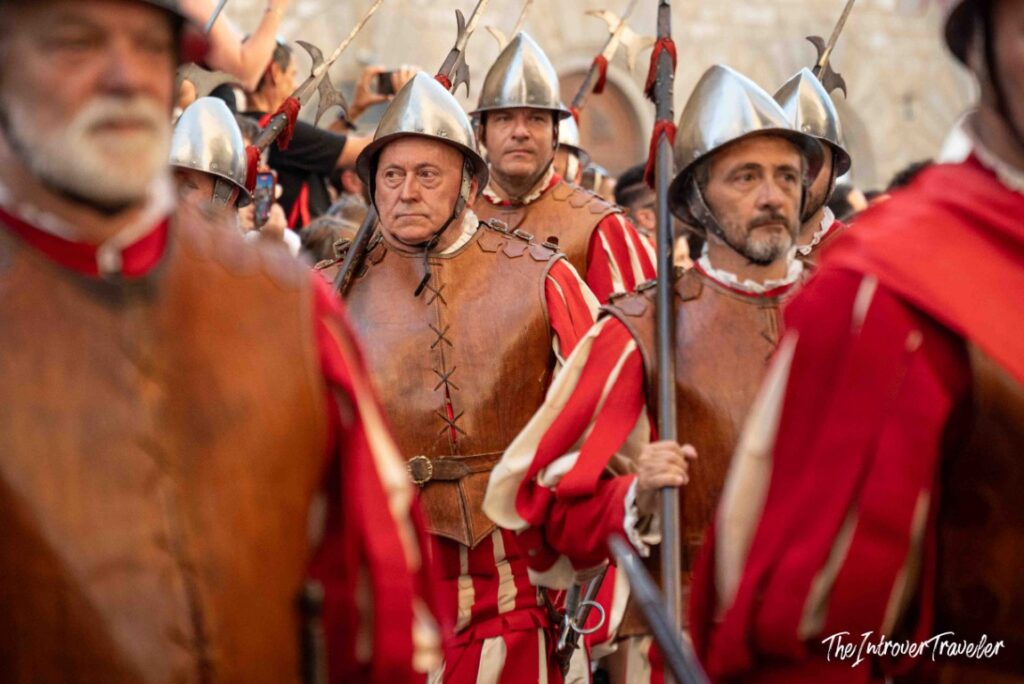
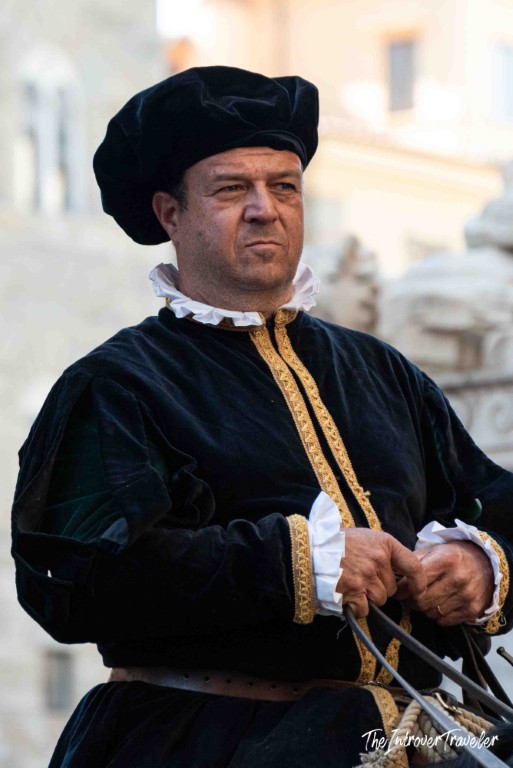
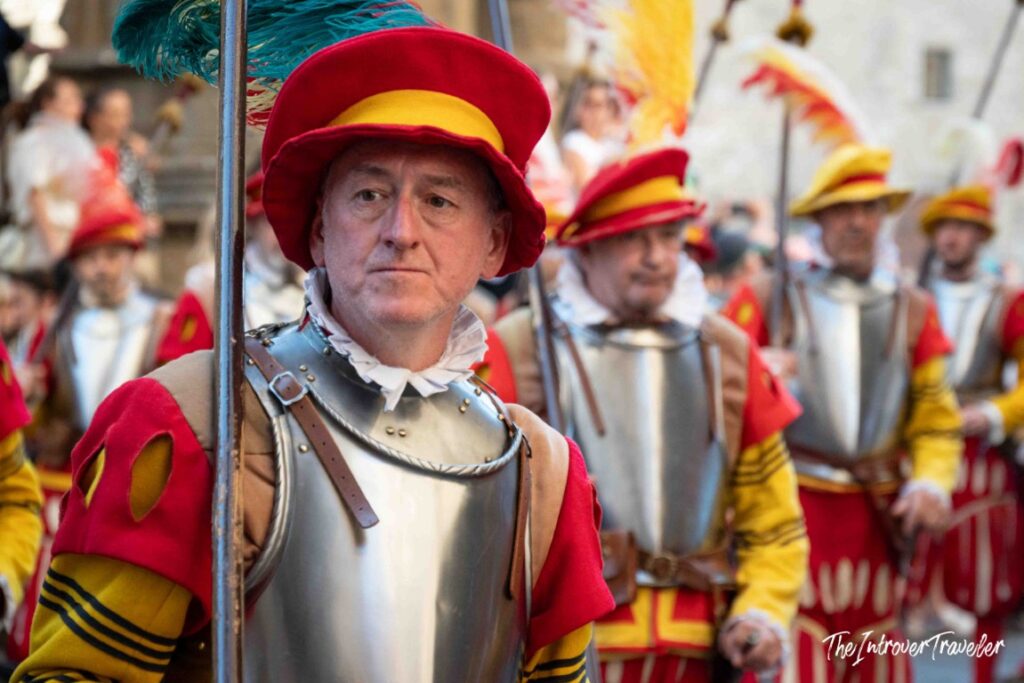
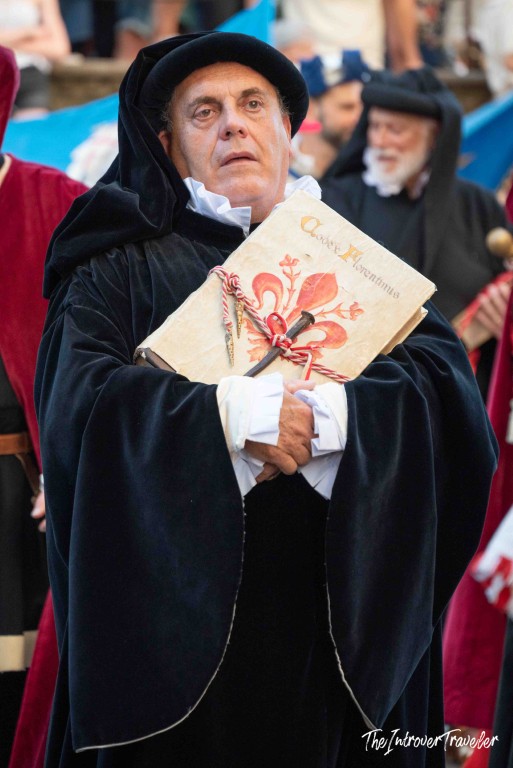
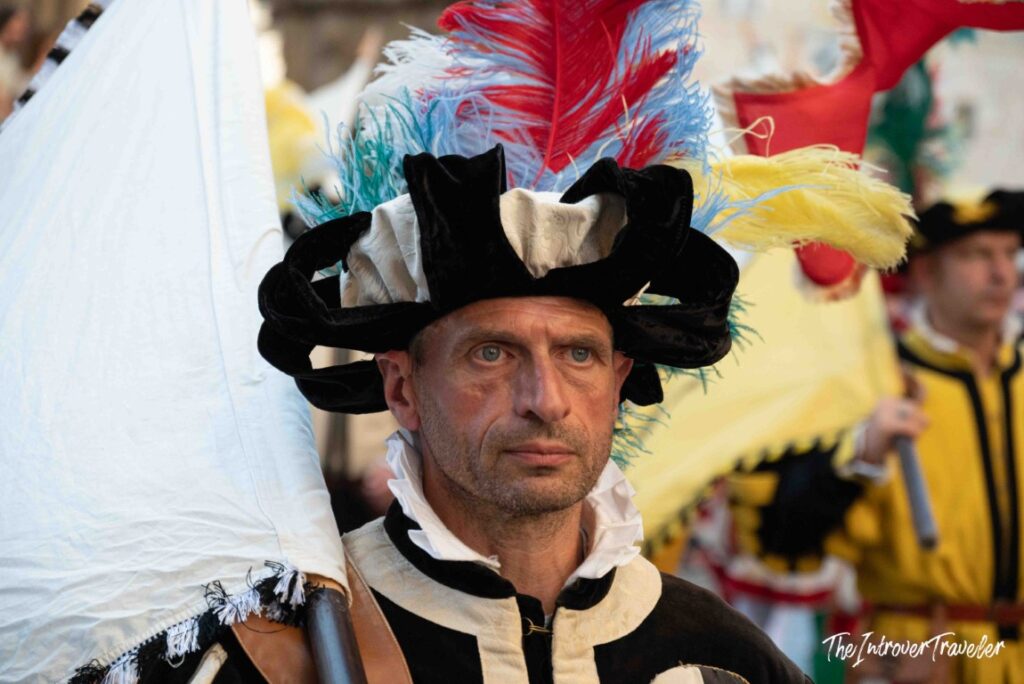
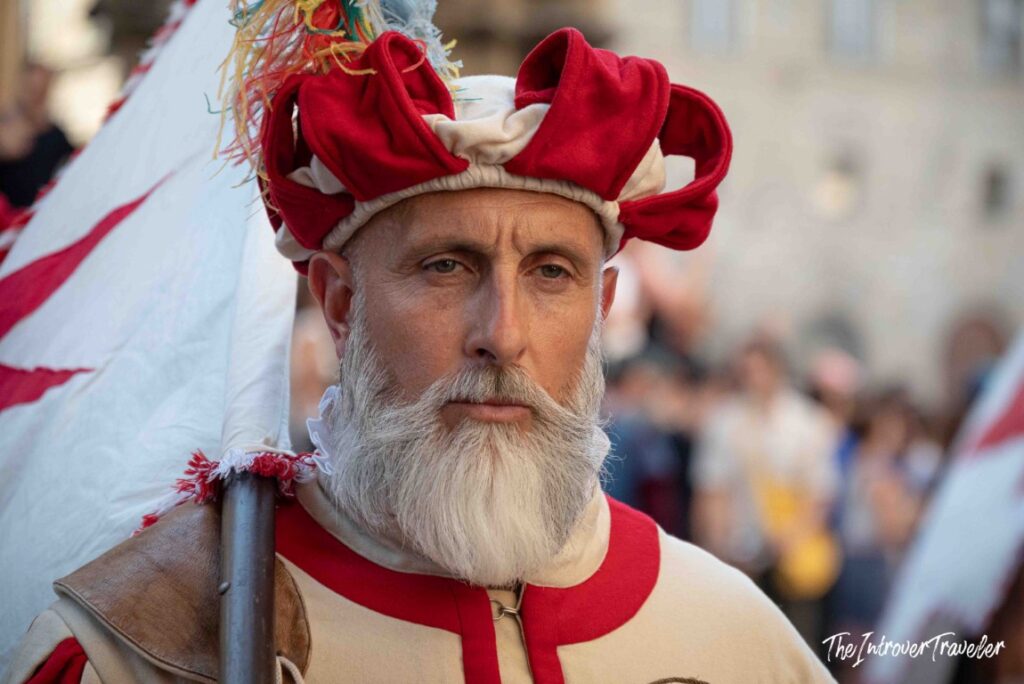
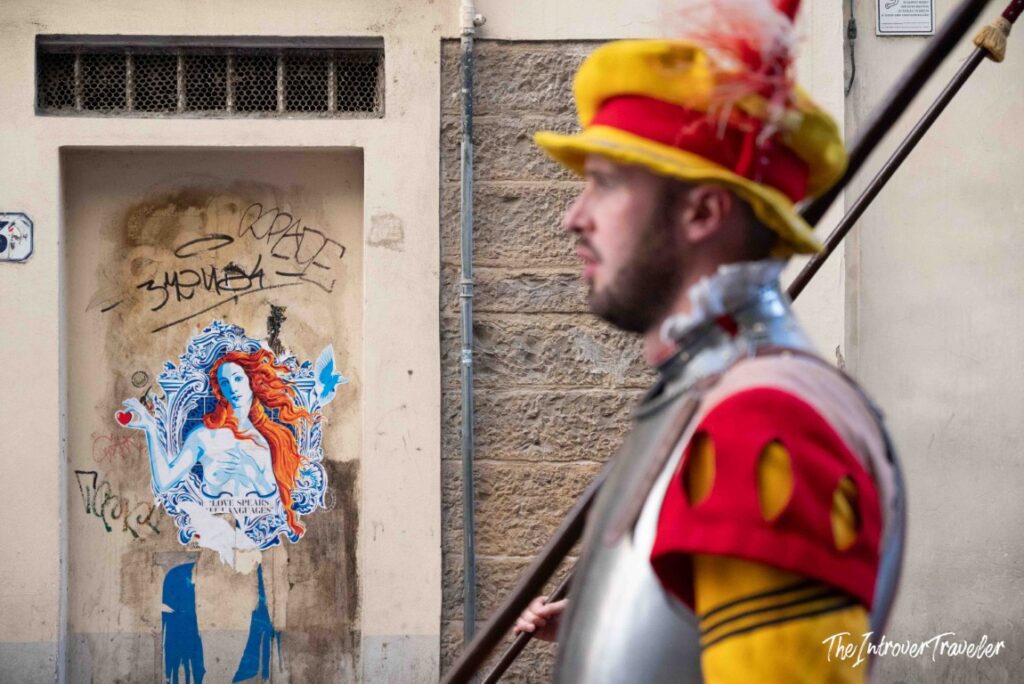
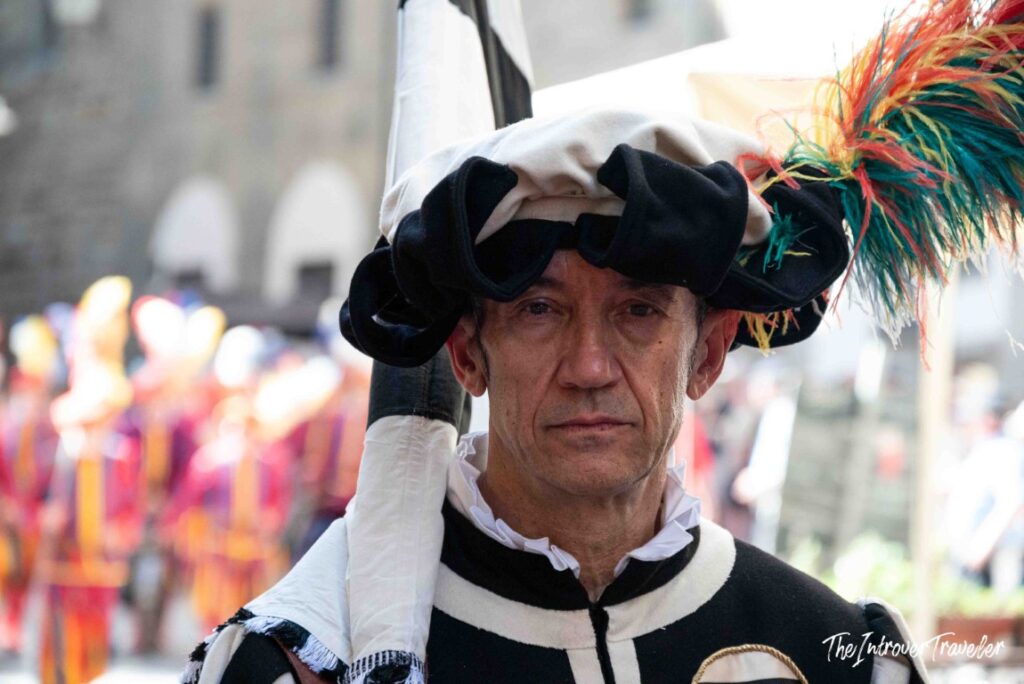
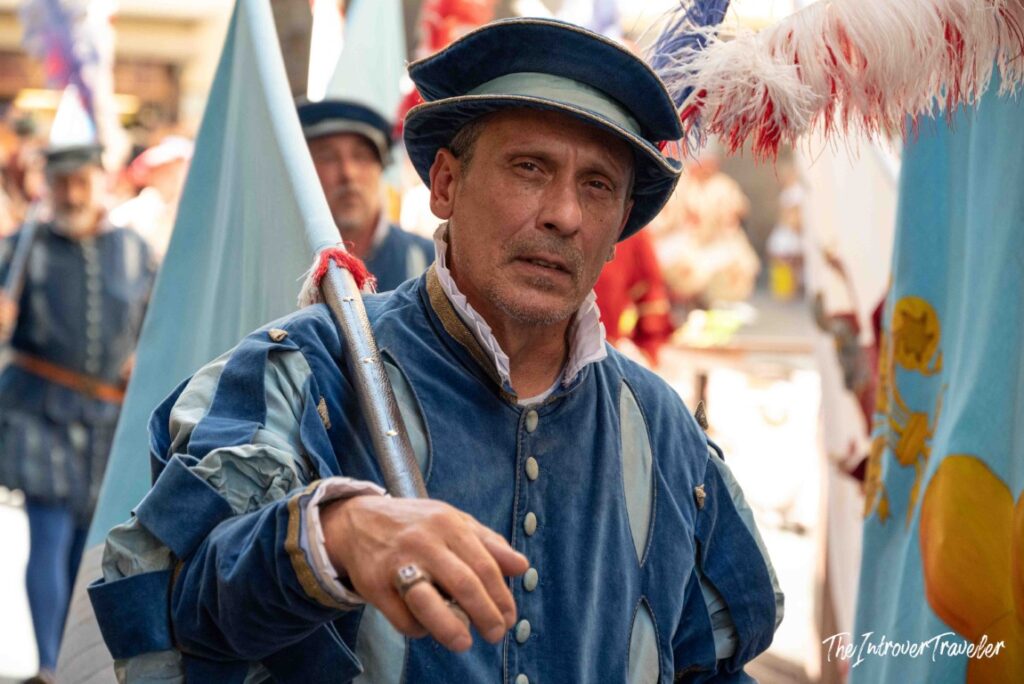
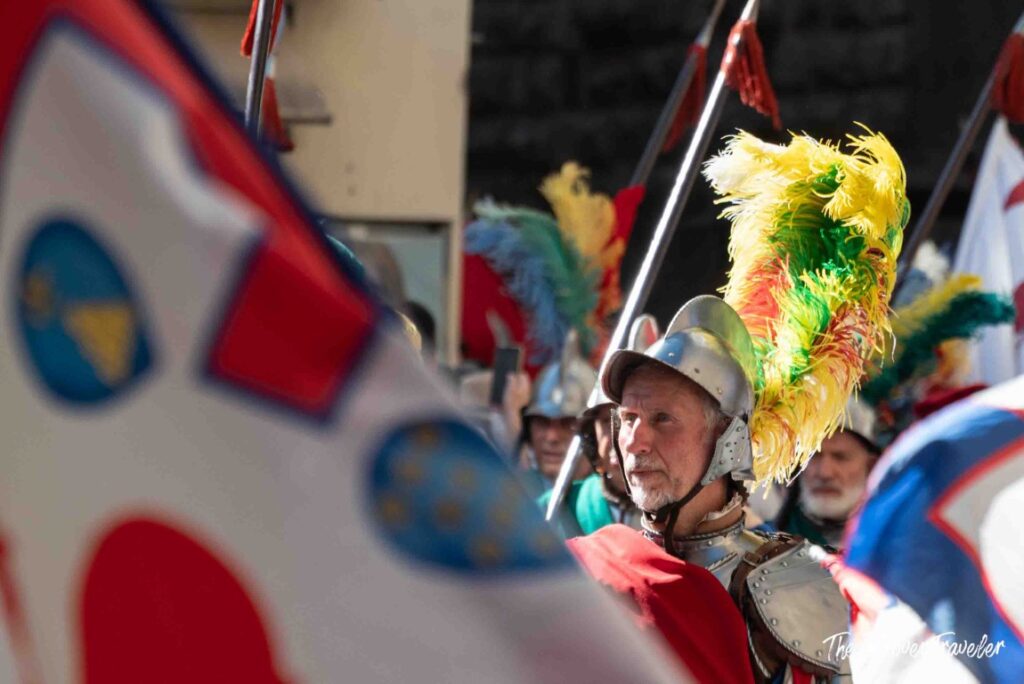
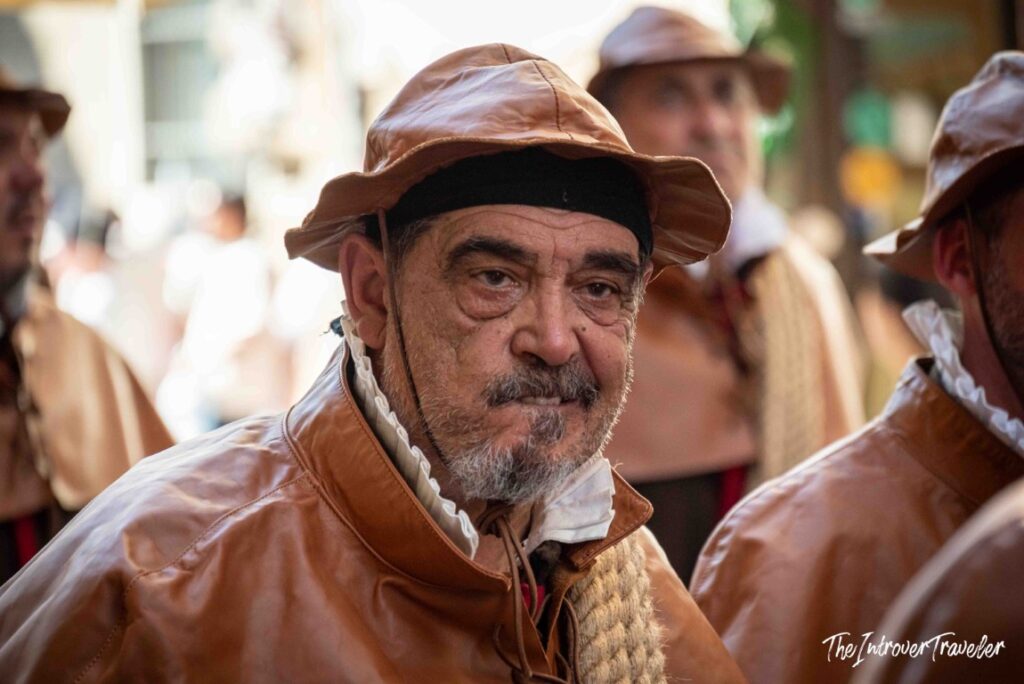
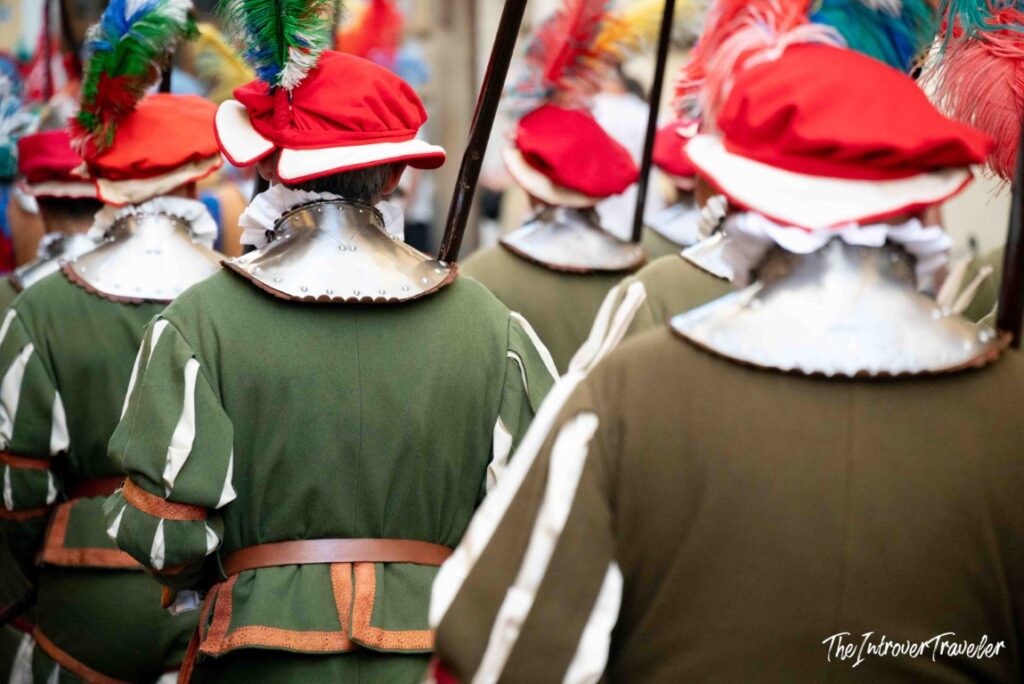
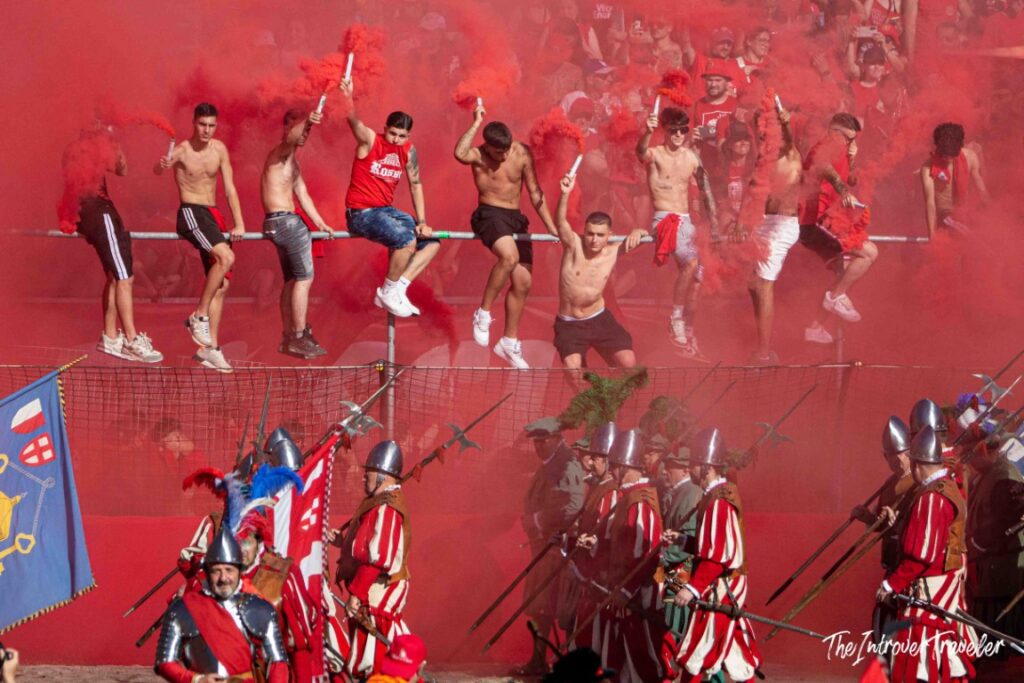
The day as a spectator begins long before the whistle, or rather the cannon shot, with the historic procession of the Florentine Republic. Here the investment is staggering: more than five hundred figures in Renaissance costume, flag-throwers (the Bandierai degli Uffizi), men-at-arms, magistrates, musicians, a quantity of fabric, armour and insignia that leaves you stunned. This is not a village pageant, it is a stage machine.
Following the procession through the streets of Florence, you really do feel you have ended up inside a fresco by Ghirlandaio or Paolo Uccello, and not only for the quality of the costumes and the staging. It is the faces that strike you. The physiognomy seems to have shifted little in five centuries from the one fixed in Florentine art: the same noses, the same cheekbones, the same jaws you see frescoed in the chapels. The suspicion arises, perhaps an unkind one, that the Florentines, jealous of their own primacy, took good care not to corrupt the stock with too many foreign marriages.

The match: the inferno
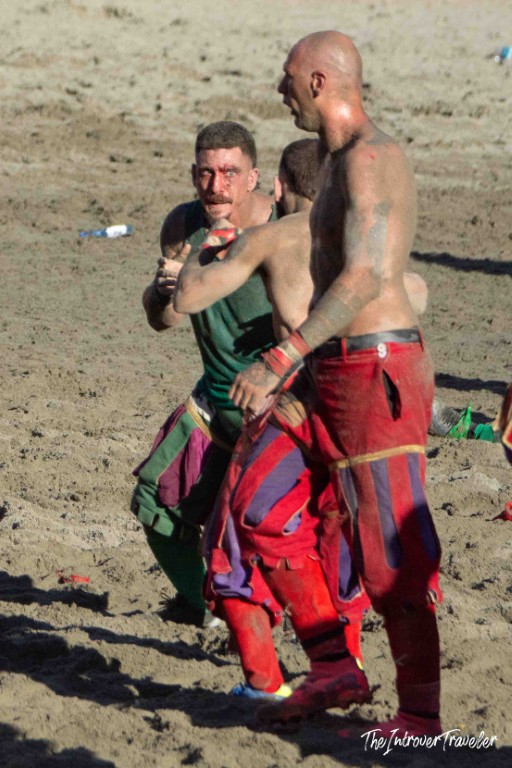
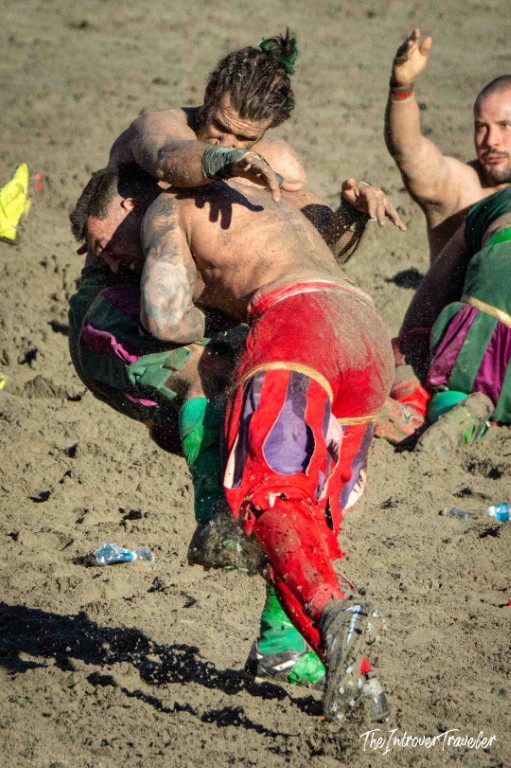
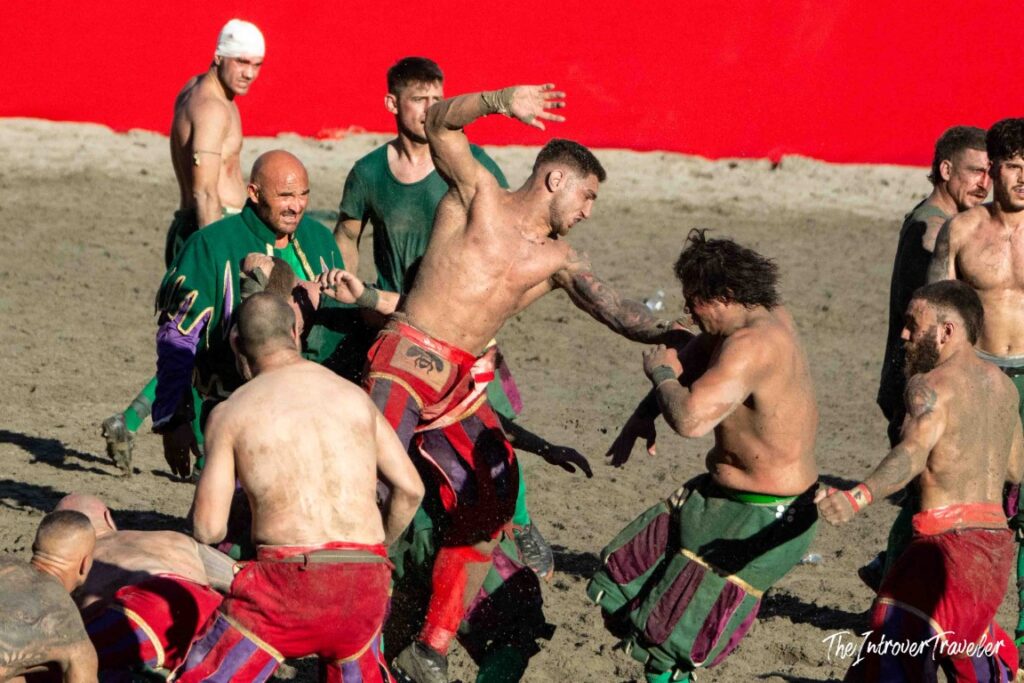
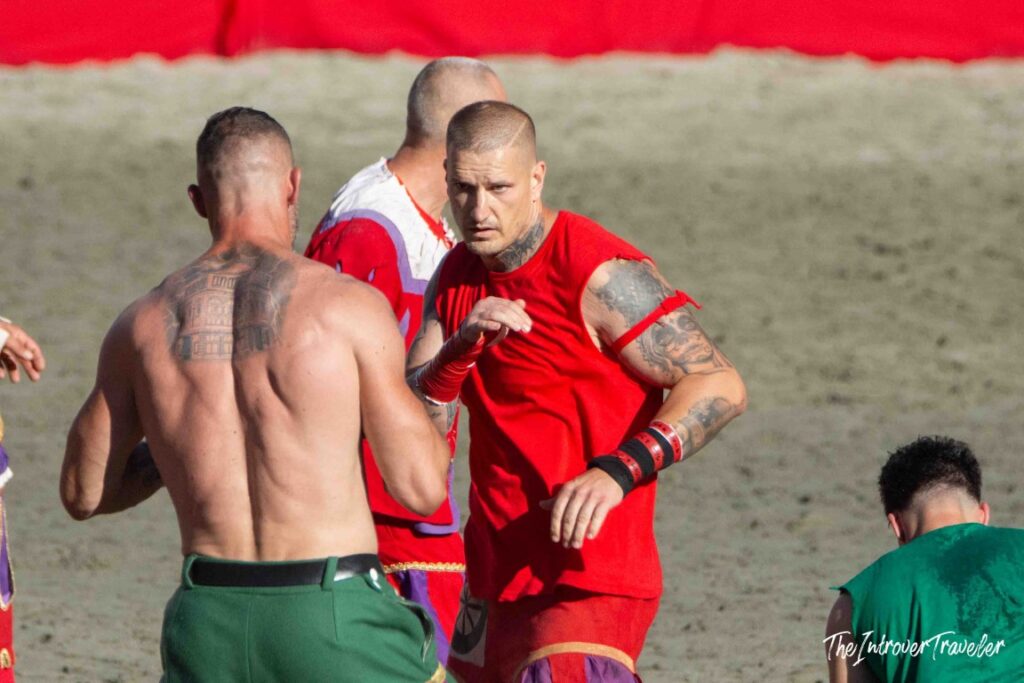
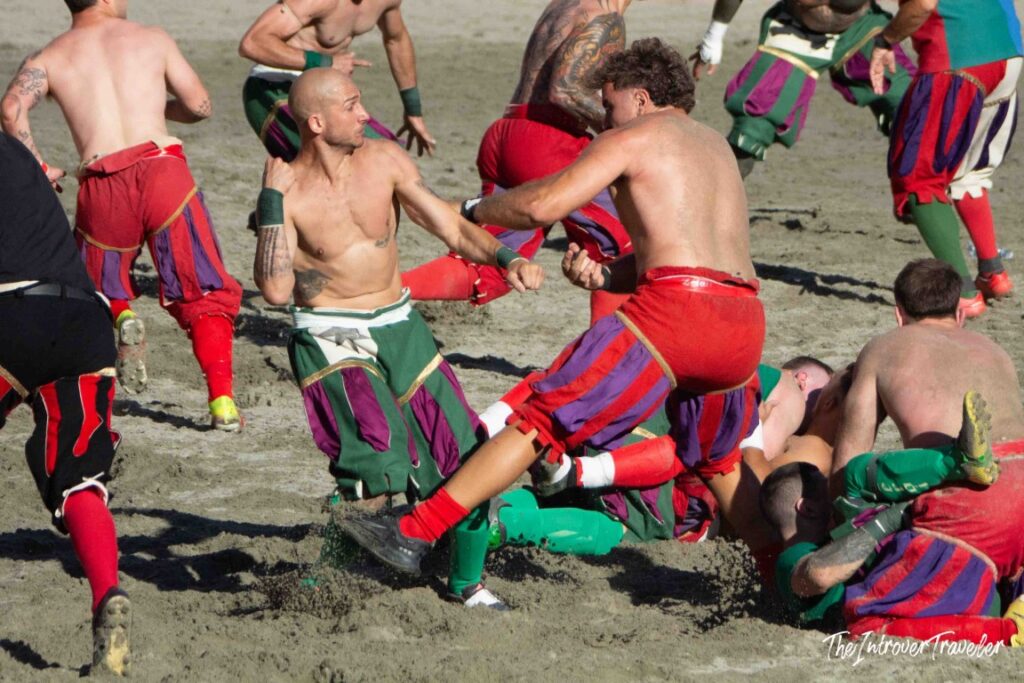
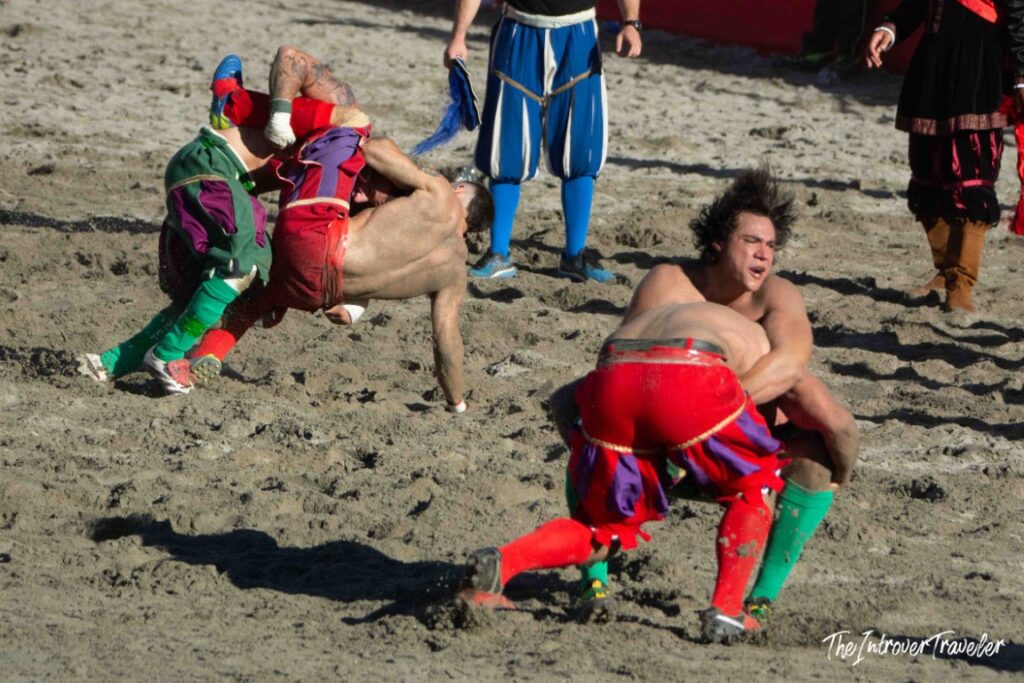
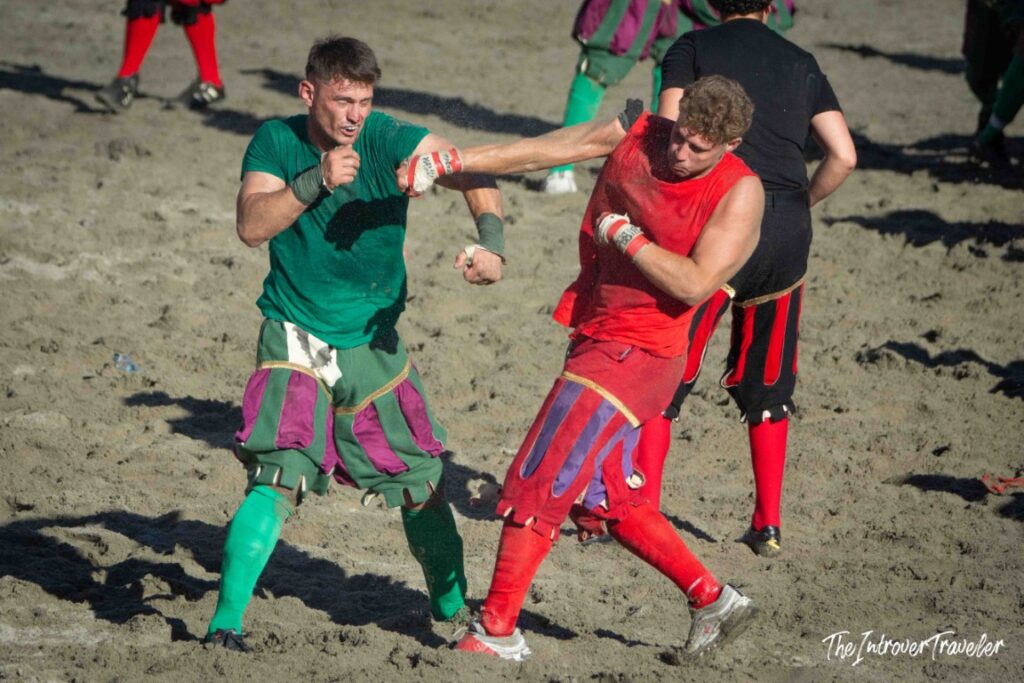
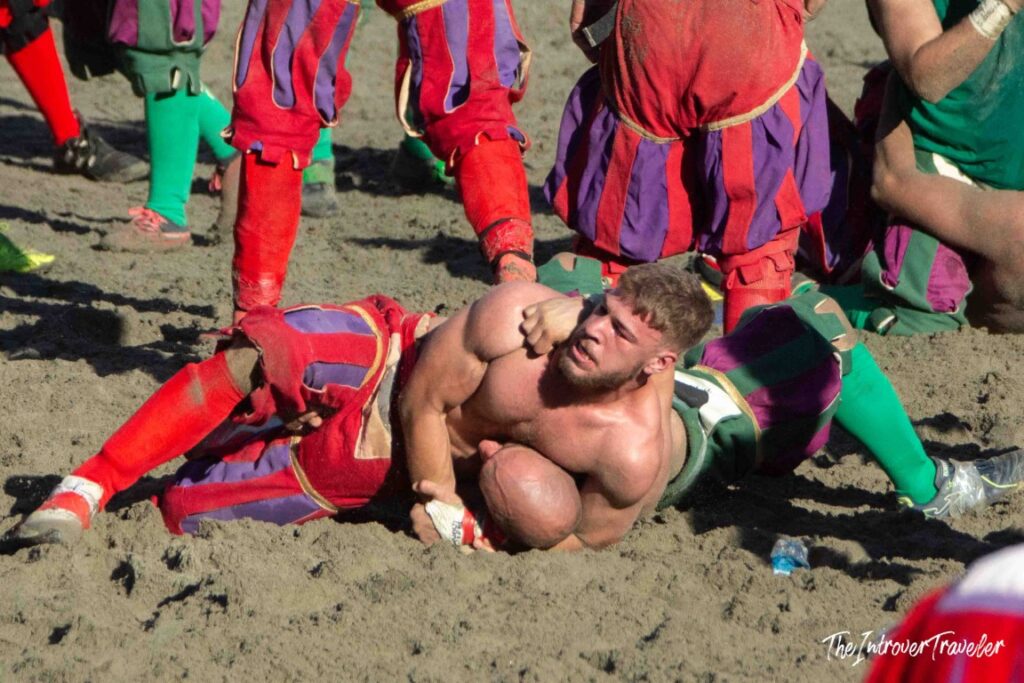
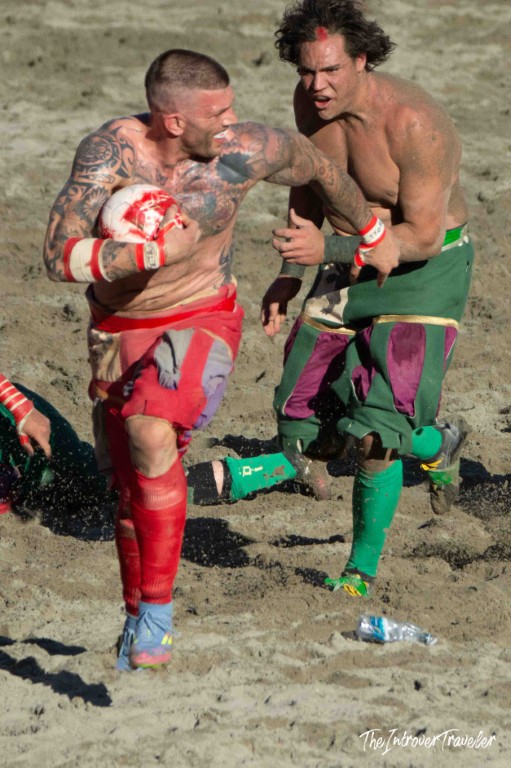
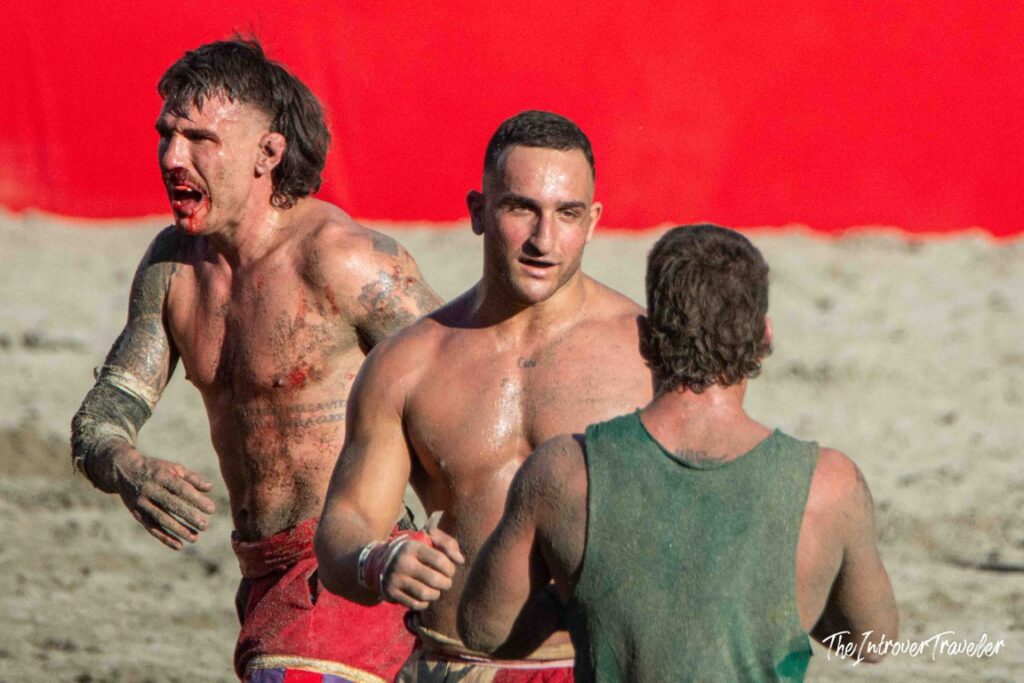
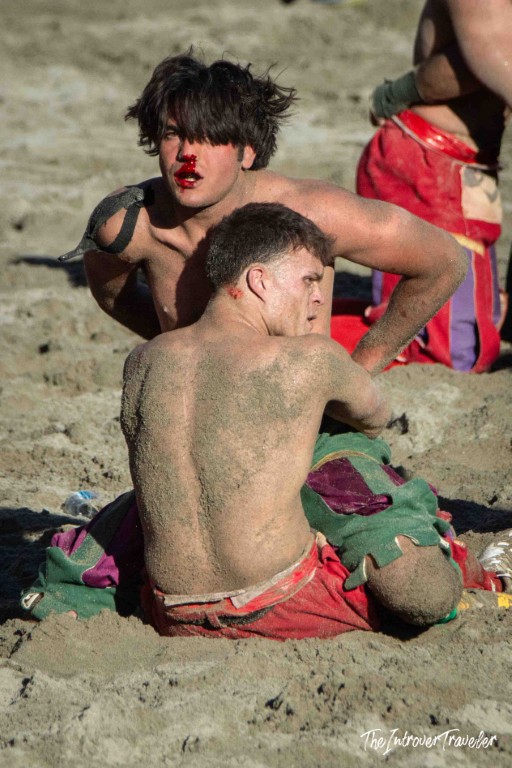
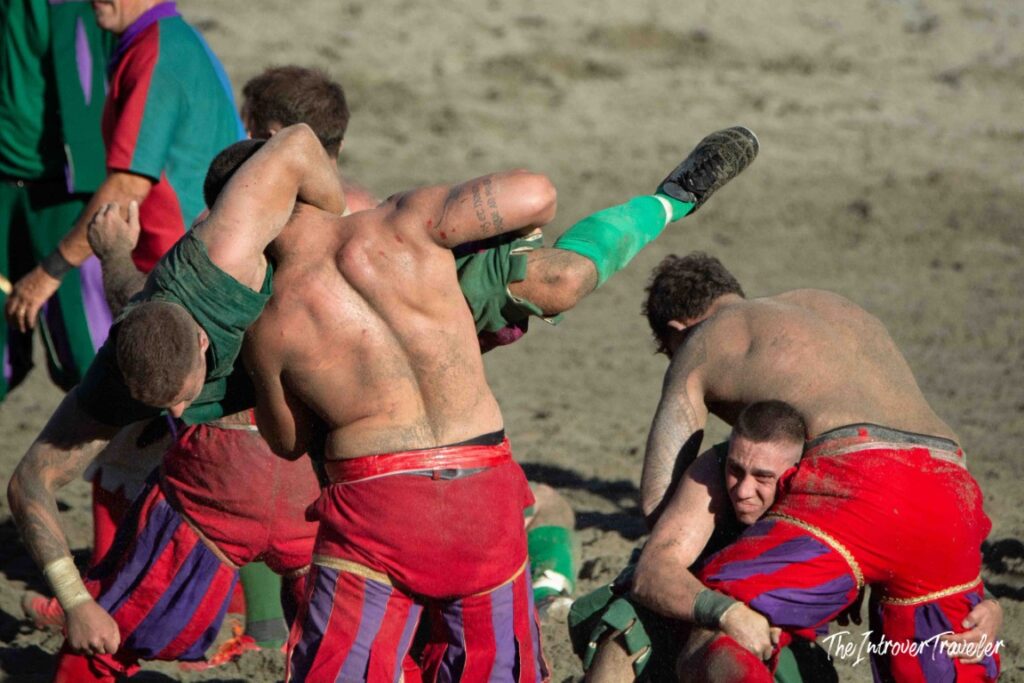
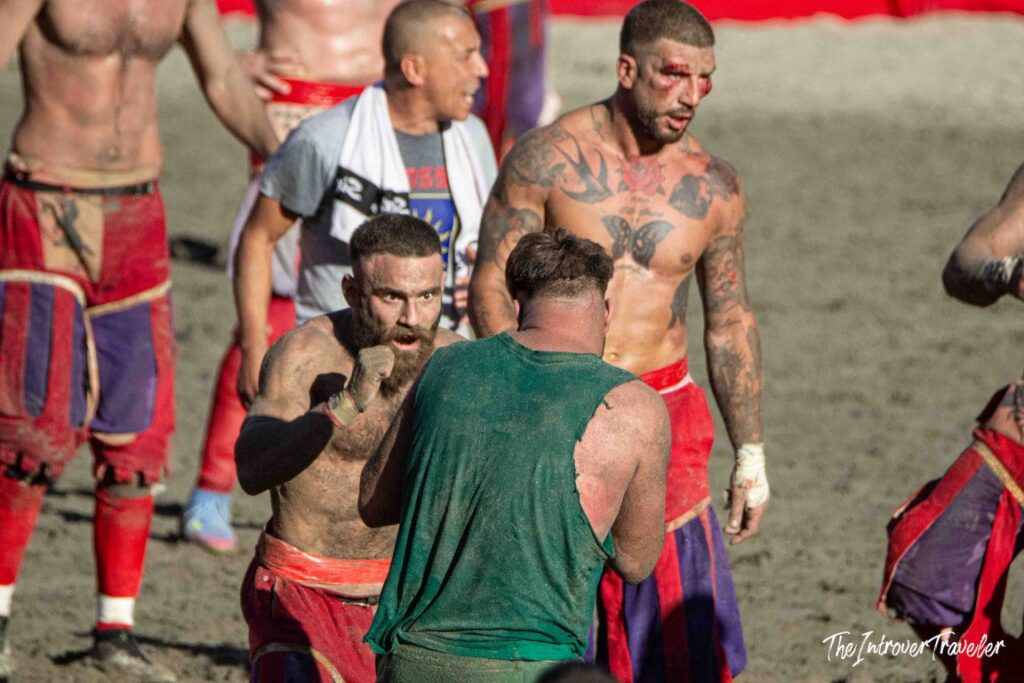
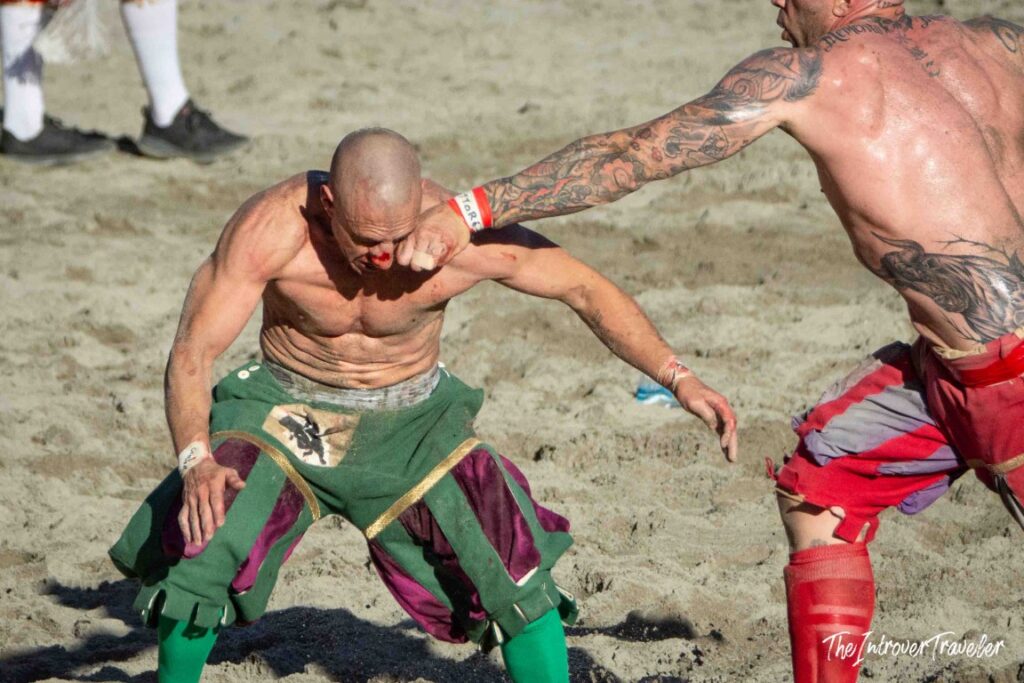
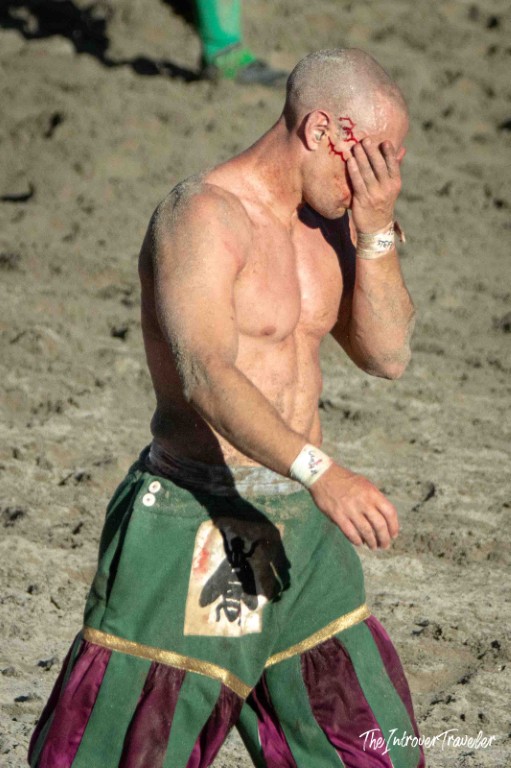
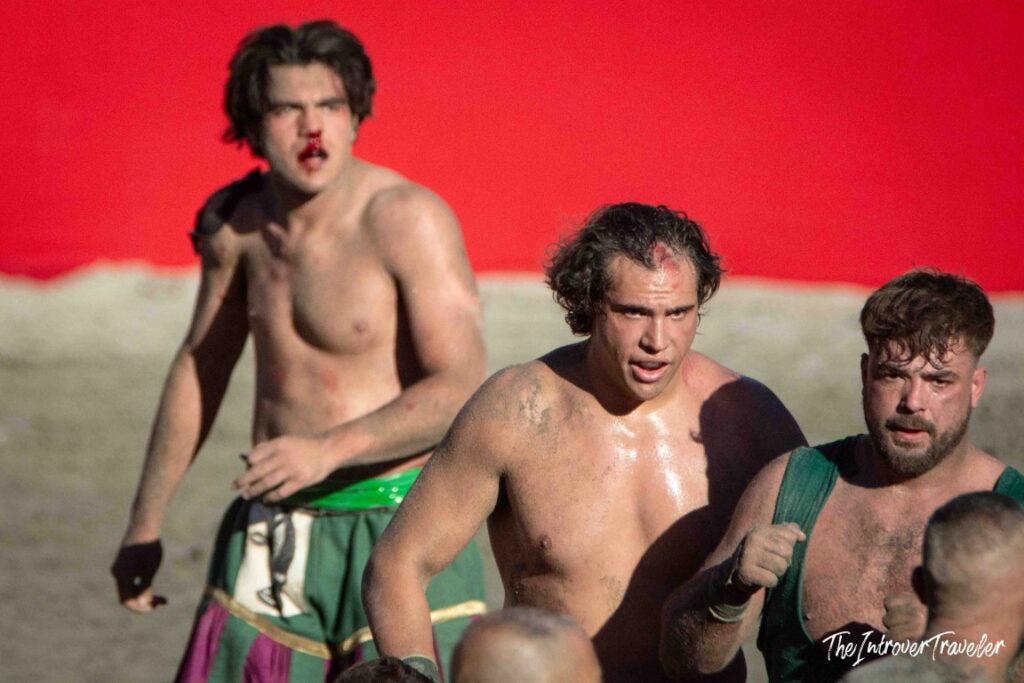
Then the match begins, and it is another matter entirely. Picture Quentin Tarantino called in to shoot the remake of the football match in Bedknobs and Broomsticks. The calcianti lay into each other for all they are worth, in a fairly bloody fashion, and give the impression of being there to settle the feuds and slights of the past year rather than to direct the ball, which rolls almost forgotten in a corner of the pitch. I saw no compound fractures or dislocated limbs, but tufts of hair torn out, head-butts full in the face, kicks, punches, tackles and ballistic projections of one’s opponent in abundance.
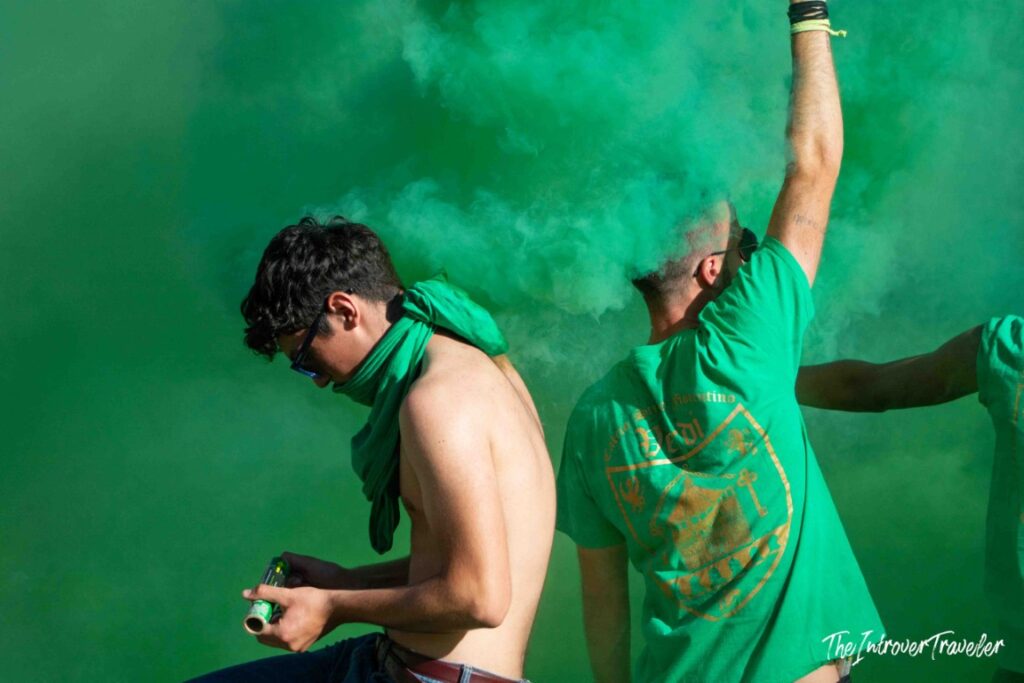
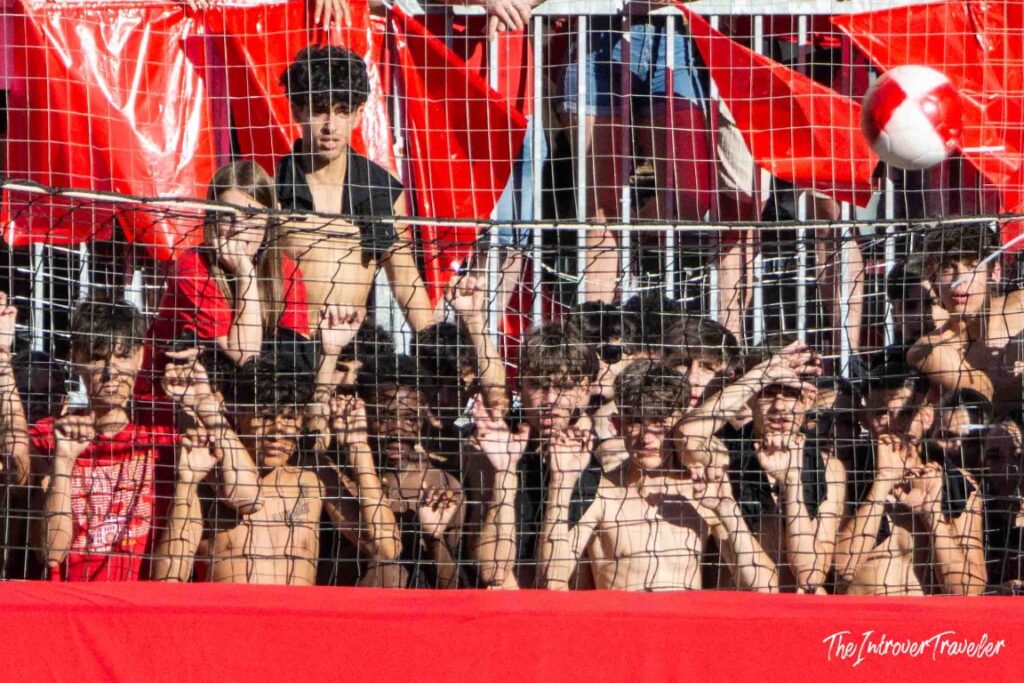
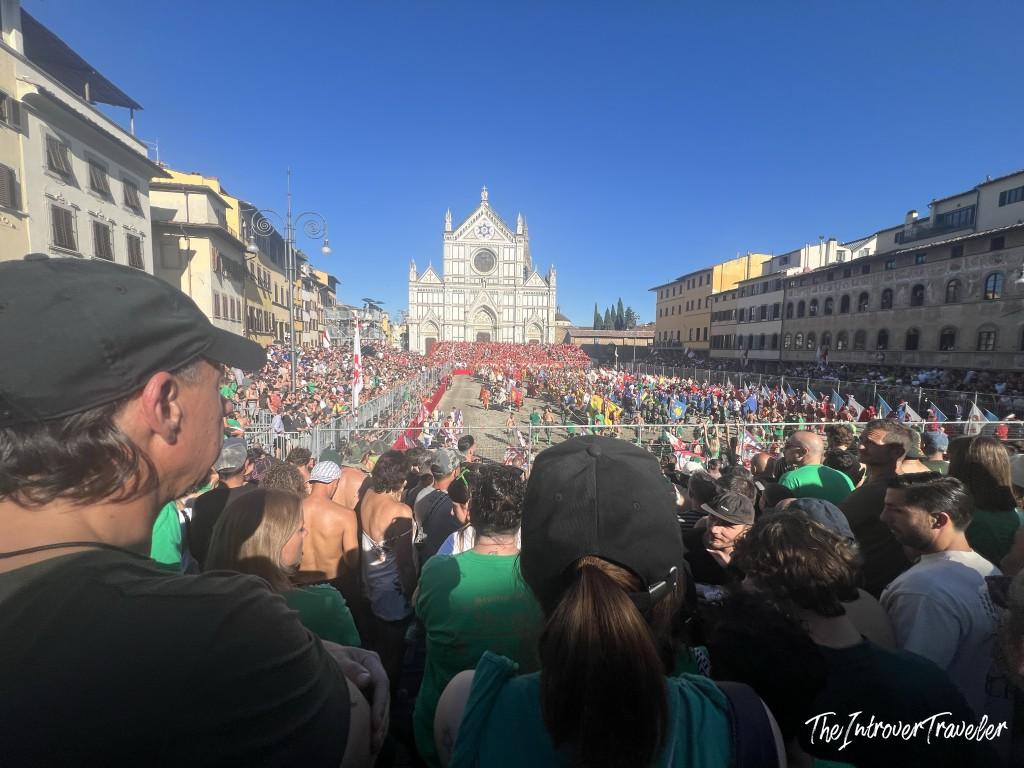
In the stands the show is no less. I was planted among the greens, and at regular intervals the chant picchia verde (hit them, green) went up, which seemed to be the only tactical programme the supporters required. The creativity in delivering blasphemies, insults, obscenities and scurrilities (more the women than the men, in case anyone was wondering) reached heights of pure sublimity, and I pity the foreigners in the stands, condemned to miss such linguistic finesse expressed in a Tuscan of the strictest observance.
An inexhaustible reserve of brutes
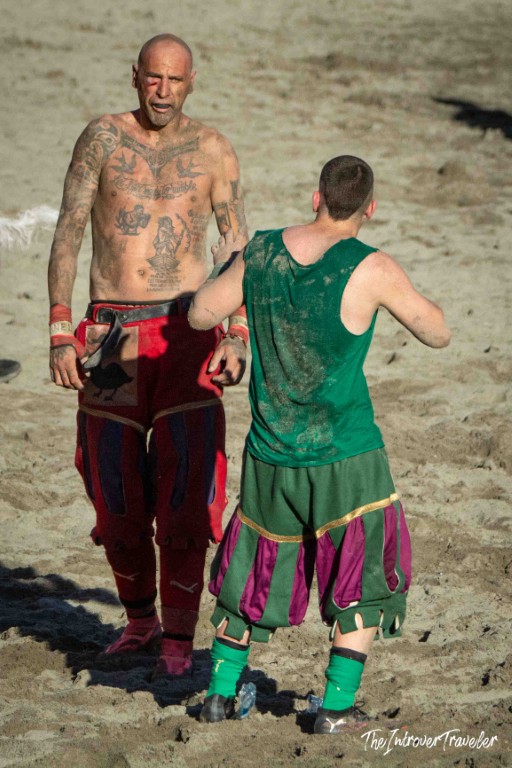
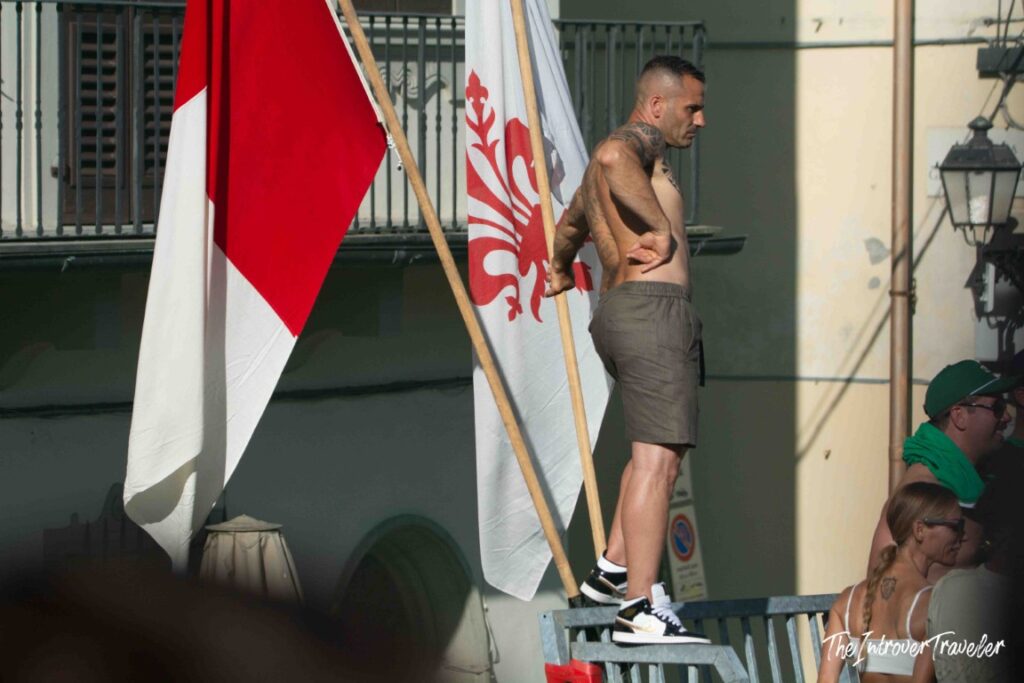
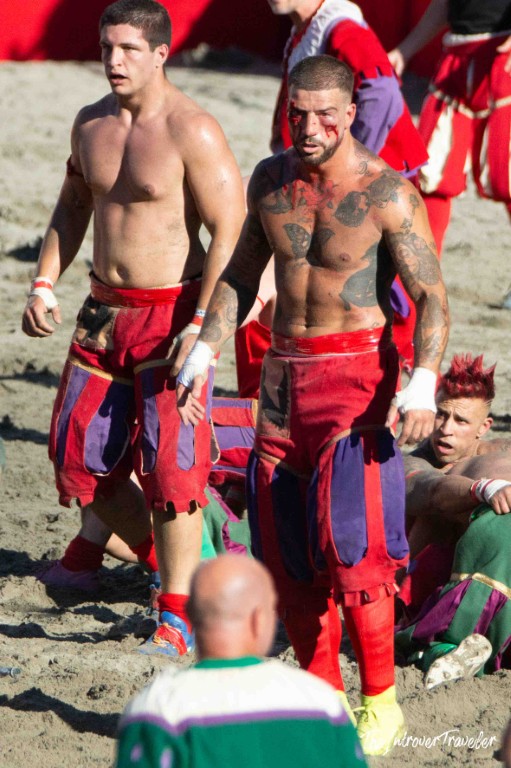
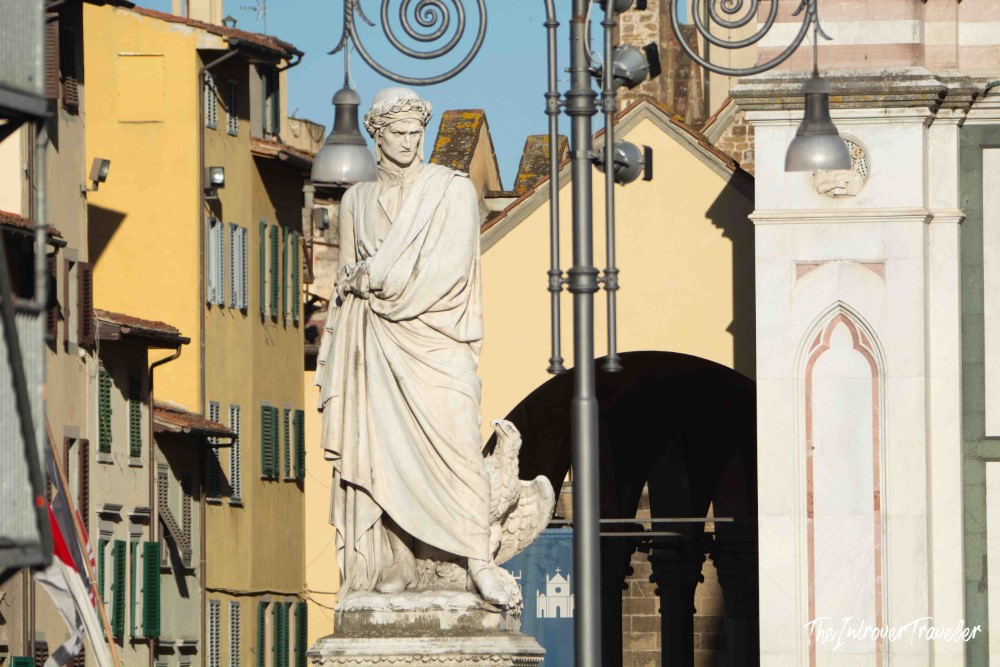
An almost anthropological question remains. How does a relatively small city like Florence turn out an apparently inexhaustible lineage of brutes with sculpted abdominals, endowed with enough epidermal surface to host infinite variations of menacing tattoos and a physiognomic variety that would have sent Cesare Lombroso into raptures? It is the same gene pool that produced the dome and the David, let us remember, merely declined in the key of a Dantean circle of hell. The continuity with the frescoes of the procession, at this point, no longer seems a fantasy of mine.
I do not wish to fall into clichés and binary, Manichaean simplifications, but I suspect that a hypothetical survey of the calcianti‘s political faith would tip the scales, to quote Tim Rice and Andrew Lloyd Webber, slightly to the right of Attila the Hun.
Practical information
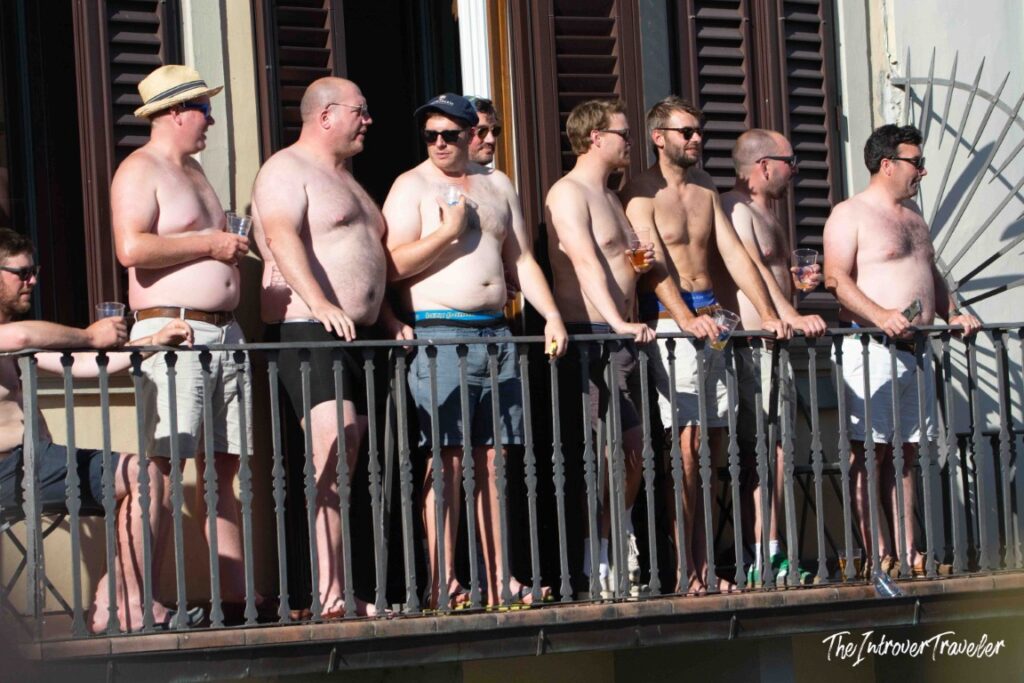
The tournament is played over three matches in June: two semi-finals in mid-June and the final on 24 June, the feast of Saint John, all in Piazza Santa Croce. Tickets sell out fast and go on sale only a few weeks ahead, so book the moment they appear; the cheaper curve are tied to the teams, which means that when you buy you are effectively choosing which set of supporters to spend the afternoon among. Water bottles and flasks are not allowed inside, so do not count on bringing your own. Plan to be in your seat at least half an hour before kick-off, both to claim a decent spot (the numbering on the ticket is theoretical: the locals colonise the stands by colour, first come first served) and to watch the procession file into the arena, which is half the spectacle. The stands are cramped and the rows desperately narrow, so once you are wedged in you are there for the duration: getting out mid-match is a minor feat of contortion. My own advice is to enter from Via dell’Anguillara and aim for the gradinata facing the façade of Santa Croce, the best vantage point in the square. And if you mean to photograph anything beyond a wall of backs, bring at least a 300mm: the action is far away and it moves fast.
To follow the procession from the very beginning, you need a little improvisation. I had relied on a few local newspapers, which stated that the procession would leave from Piazza della Parte Guelfa at 4 p.m., where, of course, there was no one. I asked some carabinieri who were setting up roadblocks for the passage of the procession, but since they were not Florentine, they knew nothing beyond the orders they had been given. In the end, I asked a few young men wearing calcio storico shirts, and you will see plenty of them around the city on match days, who directed me toward Piazza di Santa Maria Novella, where I did in fact find the procession ready to set off.
Verdict
My wife was rather horrified, by the brutality on the pitch as much as the verbal brutality in the stands. I, besides being thoroughly amused, almost grew fond of this chemically pure expression of fiorentinità.
I should preface this by saying that I loathe every form of violence with all my heart, and I loathe the spectacularization of violence just as much. Yet my perception, whether because of the genuine suggestive power of the staging, or because of the paroxysmal breaching of the limits of the surreal and the grotesque, gradually shifted toward amusement. It was probably an effect of the suspension of disbelief, which led me to believe that the people down there were not actually beating one another to death with their bare hands.
It is certainly also a matter of subjective sensibility, but the spectacle is not comparable to what a gladiatorial show in ancient Rome might have been. In this case, we are dealing with consenting adults who train for an entire year in anticipation of the event, with the aim of taking and giving a thorough beating, because no one will convince me that the result of the match matters in the slightest, and with a few thousand fellow citizens who take part in the event with great fervor, exulting with joy when Pierino gets punched in the nose or when Giulio is spun through the air. And I believe this offers an effective cross-section of Florentine society and culture.
Beyond the historical and cultural aspect, I was also amused by the metaphorical one. It is true that the colours represent a precise local belonging (the Azzurri for the Santa Croce quarter, the Rossi for Santa Maria Novella, and so on) and that the animosity may well spring from neighbourhood parochialism; but to a non-Florentine observer this chromatic belonging is lost, and the appearance is of two factions massacring each other simply for belonging to opposing factions, with little need of pretexts, rather as between the inhabitants of Lilliput and Blefuscu. Watching the red and green kits go at each other in the sand, I could not help thinking how perfect a representation this was of our hyper-polarised times.
For the record, the greens cannot have hit hard enough, because they came out of the match decimated and, until I lost count, trailing 16 to 2. The outcome of the match was commented on by the lady behind me, in a crescendo of hoarseness and aphonia, in terms that would guarantee an X rating in most countries and Italy’s expulsion from the UN, were the latter to investigate the event thoroughly. She called into question the virility of the players in green uniforms and of their ancestors up to the fourth degree, as well as the morality and ethnicity of the players in red uniforms, creatively combining popular Middle Eastern deities with common barnyard animals, while expressing regret over the dark and adverse designs of fate.