The problem nobody admits to having
You have done this. I have done this. Everyone who has ever walked through Florence with a folded map and good intentions has done this.
You spend four days in a city with roughly the artistic density of a neutron star, you queue for the two things everyone queues for, you take the photograph, you eat something disappointing near the queue, and you go home. Then, six months later, you read something and discover that a Pontormo you would have crossed a continent to see was in a side chapel two hundred metres from where you ate that disappointing sandwich. Nobody told you. The map did not tell you. The guidebook gave it four lines on page 213, between a paragraph about a hotel that closed in 2019 and a box-out about gelato.
This is the specific misery of travelling in Italy: the art is not concentrated, it is scattered. Rome, Venice, Florence, Naples, Bologna, Siena, Mantua. These are cities where the masterpieces are not politely gathered in one building with a ticket desk and a cloakroom. They are distributed across churches with unpredictable opening hours, minor museums with no marketing budget, sacristies, oratories, private chapels, staircases. Fragmentation is the defining feature of the Italian artistic patrimony, and it is precisely the feature that no travel planning tool has ever taken seriously.
So I built one. It is called Flâneur, it is online now, and this post explains what it does and why it exists.
What Flâneur actually is
Flâneur builds custom art itineraries for people who travel because of art rather than in spite of it. You choose a city, you tell it who you are, you select the works and the artists you want to see, and it returns a day-by-day itinerary with timings, walking distances, museum blocks, monuments, and places to eat that will not insult you.
It sits on top of the ArtAtlas database: 22,000 catalogued artworks, 300 artists, 2,000 cities. That archive was not scraped in an afternoon. It is the accumulated result of years of cataloguing, cross-checking and correcting, and it is the reason Flâneur can do things that a generic itinerary planner cannot.
Flâneur is not an AI, and that is the entire point
Let me be direct, because this is the question everyone will ask. Why would you pay for an art itinerary when you can ask a chatbot for one, for free, in eleven seconds?
Three reasons, in ascending order of importance.
1. It does not hallucinate
Flâneur does not generate text about art. It queries a verified archive. Every work it suggests exists, is attributed correctly, and is in the place where Flâneur says it is. Ask a large language model for a list of lesser-known Caravaggios in Rome and you will receive a beautifully written paragraph containing, with a probability that is not small, at least one painting that has been in Berlin since 1897, one that was destroyed in 1943, and one that has never existed at all. The prose will be immaculate. The confidence will be total. You will discover the error while standing in front of a wall.
A statistical model produces plausible sentences. An archive produces facts. For planning a trip around objects that are physically located in specific buildings with specific opening hours, this distinction is not academic.
2. It knows about the secondary works
This is the part I care about most. A language model reflects the statistical mass of what has been written about art, which means it reproduces the canon and little else. Ask it about Florence and you will get the Birth of Venus, the David, the Duomo, and a polite gesture towards the Bargello. Fine. Those are magnificent and you should see them.
But the works that turn a trip into an education are rarely the works with the most text written about them. They are the second Ghirlandaio, the predella nobody photographs, the Rosso Fiorentino in the town you were passing through anyway. Flâneur surfaces them because they are in the archive with the same status as the famous ones, catalogued by hand, not weighted by how often the internet mentions them. Statistical prominence and artistic interest are two different variables, and confusing them is how you end up seeing exactly what everyone else saw.
3. The direction of authorship is reversed
With a chatbot, you write a prompt and it decides what goes into your trip. Your role is passive: you receive a proposal and you accept, reject, or argue with it in natural language until you lose interest. You are a customer being served.
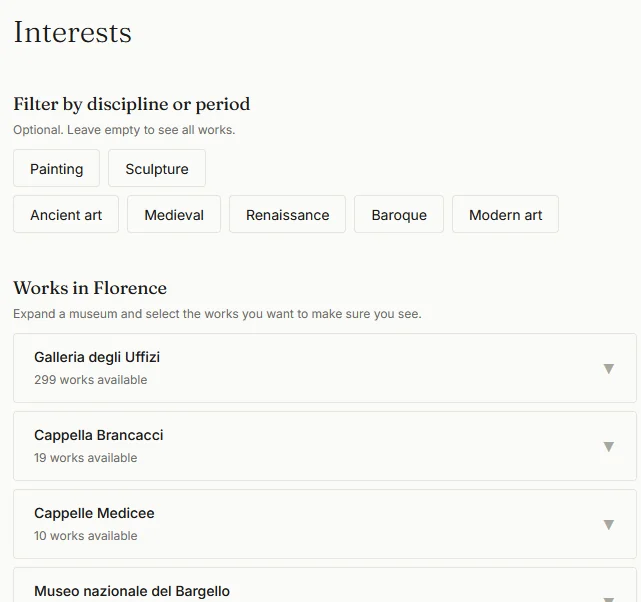
With Flâneur, you open the catalogue of a city and select works the way you order from a menu in a restaurant. This one in, that one out, this artist yes, that period no, this museum for a full day, that church for twenty minutes. The engine then does the hard part, which is not choosing the art but solving the logistics: opening hours, closing days, geographical clustering, walking times, museum fatigue, lunch. The result is not a suggestion. It is your itinerary, built from choices you made, with the tedious optimisation handled for you.
Both approaches have a right to exist. One gives you an acceptable result for nothing. The other gives you a tailored result for the price of two museum tickets. I am not going to pretend the free option is worthless. I am going to point out that “free and roughly right” and “paid and exactly right” are different products, and that people who fly to Venice specifically to look at Carpaccio tend to know which one they want.
Three ways of engaging with art, three itineraries
The profiling engine offers three settings, and they produce genuinely different trips rather than three shades of the same one.
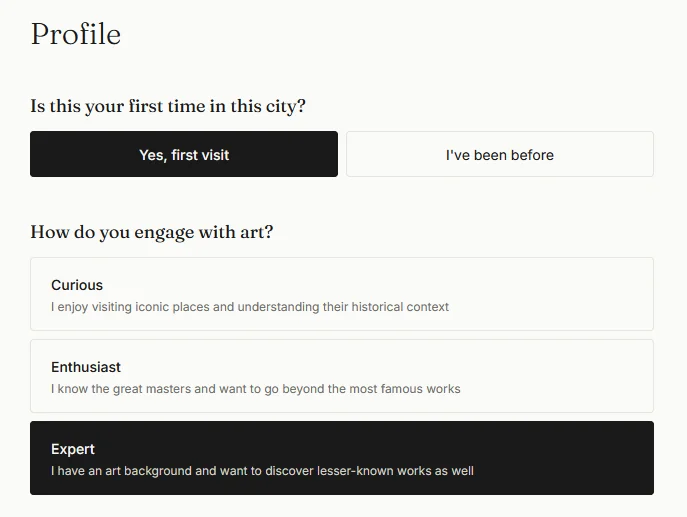
Curious. You are not an art historian and you have no interest in pretending to be one. You want to see the great things, understand why they are great, and not be marched through nine consecutive rooms of fifteenth-century panel painting until your will to live evaporates. The engine does all the work: low art intensity, the iconic sites, historical context, and deliberate gaps in the day for a coffee, a walk, a nap, a shop. No niche works, because niche works are a punishment if you have not asked for them.
Enthusiast. You know the great masters and you want to get past the postcard. You select the artists you care about from those actually present in the destination, and the engine builds a medium-intensity itinerary around them, mixing the canonical with the things you would not have found alone.
Expert. You have a background in art and travelling is, functionally, a delivery mechanism for looking at it. You plan analytically, work by work, museum by museum, choosing from the full catalogue of the city. The engine then compresses your choices into a high-intensity itinerary designed to extract the maximum quantity of art from the available hours. There is no mercy in an Expert itinerary. You did not ask for mercy.
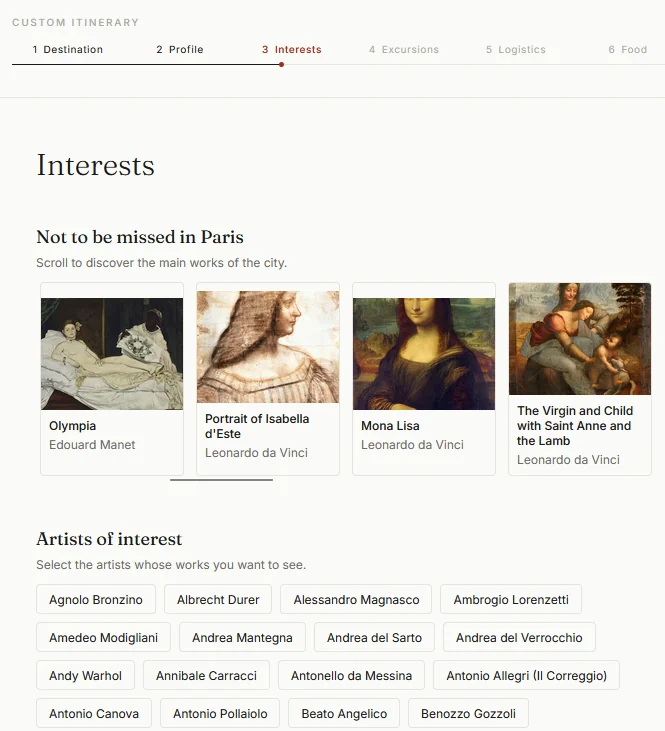
A worked example: Florence
Florence is the case that justifies the whole project. It has more art per square metre than almost anywhere on earth, distributed across dozens of institutions, and an itinerary built badly there wastes more than an itinerary built badly anywhere else.
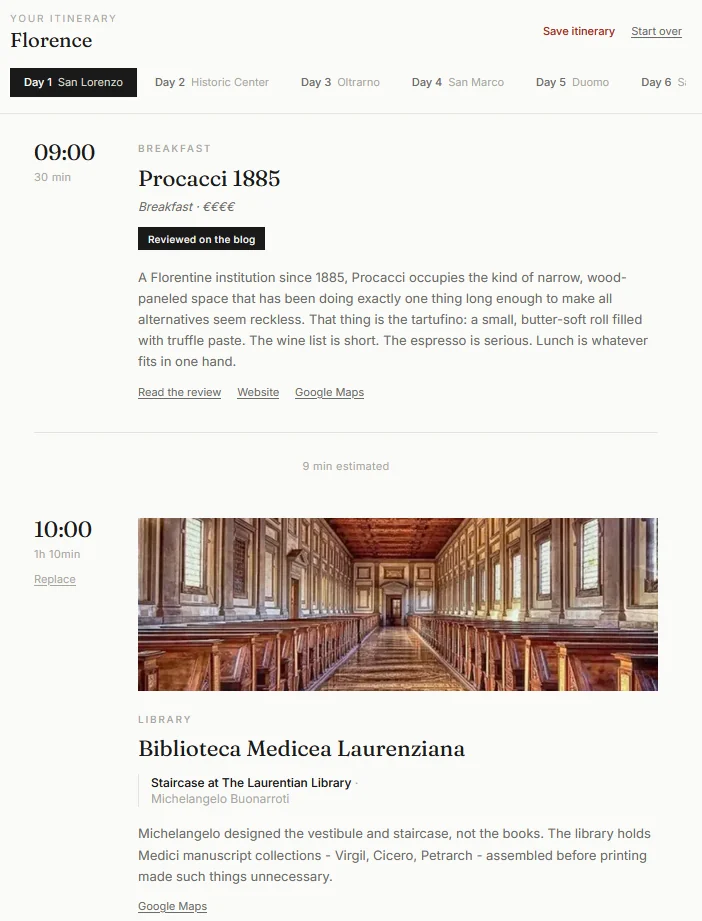
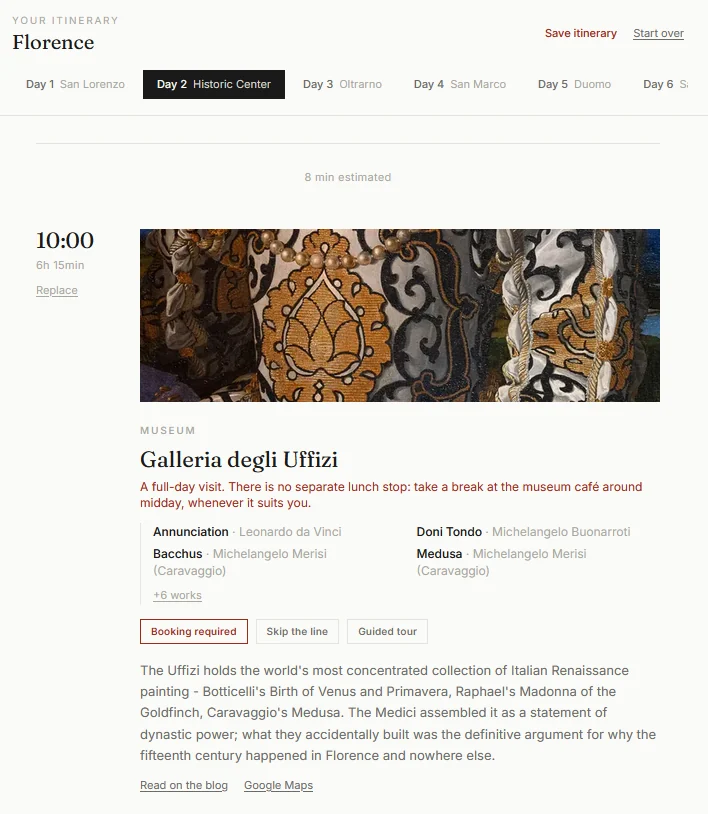
Note two things in that screenshot. First, the itinerary is geographically coherent: a day is built around a district, not around a list of famous names scattered across the city that would have you crossing the Arno four times. Second, the works are named individually. Not “visit the Laurentian Library”, but the specific object by the specific artist, so you know what you are standing in front of and why it is there.
It also assumes you eat
An art itinerary that ignores lunch is written by someone who has never been hungry in a foreign city at half past two.
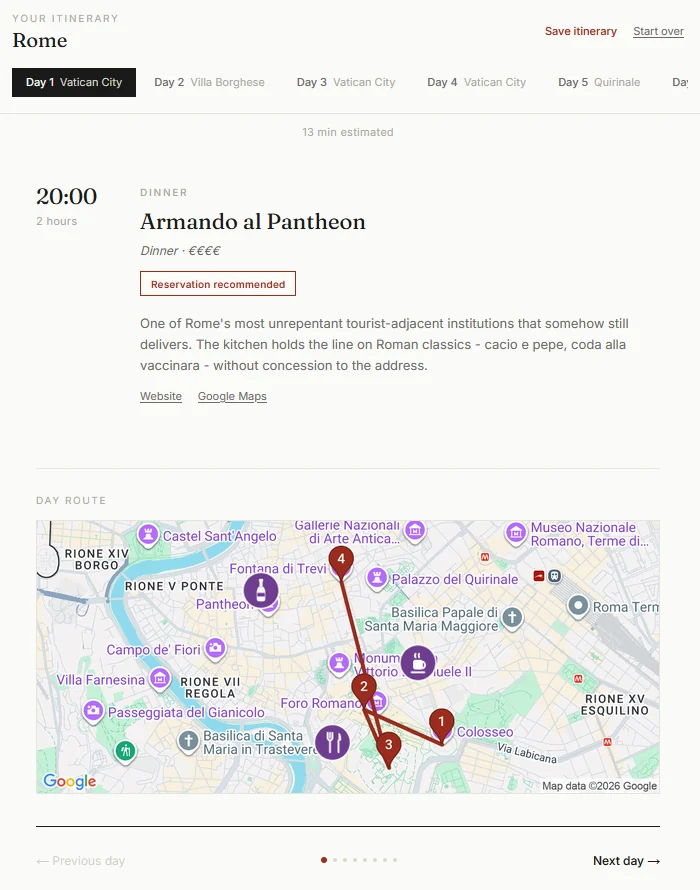
Flâneur carries a database of a thousand restaurants across the cities it covers, in two categories. The first are places reviewed on this blog, where the quality is “guaranteed” in the sense that I went, I ate, I wrote it down, and I have no incentive to lie to you. The second are places selected over weeks of research through gastronomic magazines, food writers, and the more serious end of food video, with a single organising principle: no tourist traps. Not one.
The database covers every category and cuisine, and it deliberately under-represents starred restaurants. Anyone can open the Michelin guide and tell you to go to a restaurant with two stars and a four-month waiting list. The difficult and useful work is finding places that are excellent without requiring you to remortgage anything, which is most of what is in there, alongside some expensive fine dining for the nights when that is the point.
And it does not pretend you are only there for the art
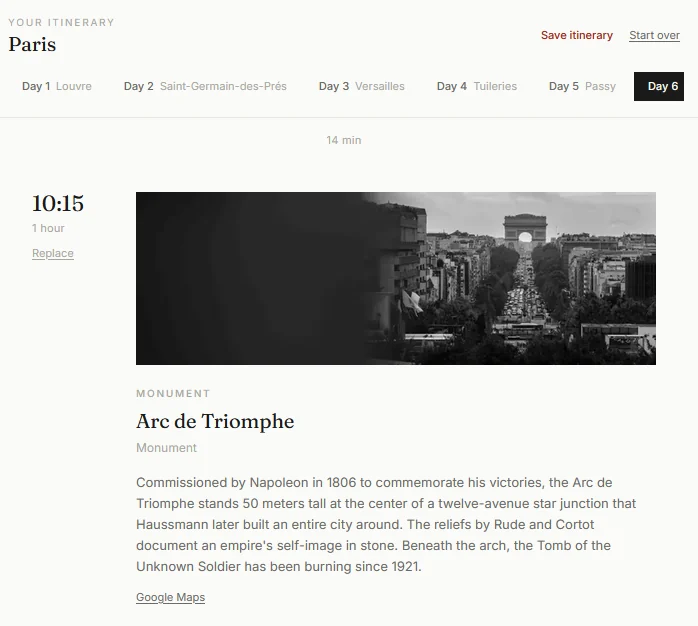
Even the most committed art traveller wants to see the Eiffel Tower once. Flâneur includes the monuments and landmarks that any visitor reasonably expects: the Arc de Triomphe, the Colosseum, the Rialto bridge, the things that are not primarily artistic destinations but are part of what it means to have been somewhere.
It includes them, and it lets you remove them. If you have seen the Eiffel Tower and would rather spend that hour at the Musée Gustave Moreau, one click and it is gone. The engine does not moralise about your choices in either direction.
Why this matters beyond my own convenience
I am going to be briefly sincere and then stop, I promise.
Mass tourism does not damage cities by bringing people to them. It damages them by bringing everyone to the same forty square metres, at the same time, for the same photograph. The Uffizi is crushed while a church eight minutes away holding a masterpiece is empty. Venice suffocates in the space between San Marco and the Rialto while entire sestieri stand silent. The problem is not volume, it is distribution.
Every itinerary that sends a traveller to the twelfth most famous thing instead of the first is a small correction to that distribution. It spreads spending across more of the city, gives minor institutions the visitors that justify their existence, and gives the traveller a better day, because the twelfth most famous thing is usually more moving than the first and is definitely less crowded. Slow cultural tourism is not a lifestyle aesthetic. It is the only version of tourism that does not eventually consume the thing it came to see.
That is the argument. Making it easy to act on is the product.
Cities, roadmap and price
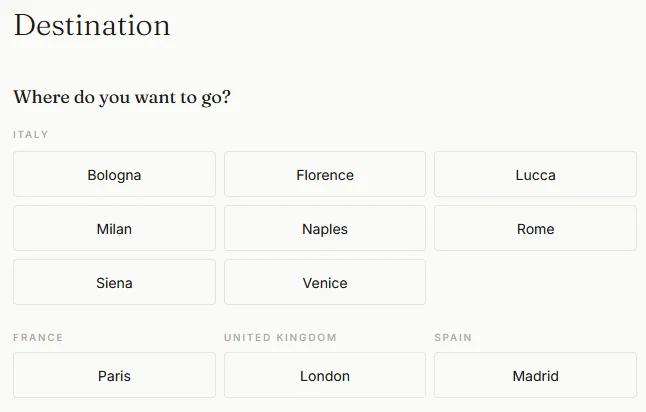
Flâneur currently covers eleven cities: Bologna, Florence, Lucca, Milan, Naples, Rome, Siena, Venice, Paris, London and Madrid. The target is twenty within a year, and the queue includes New York, Tokyo, Amsterdam, Copenhagen, Berlin, Ferrara and Mantua. Ferrara and Mantua are on that list for the same reason Lucca and Siena are already on it: cities of that size have extraordinary art and almost no decent planning tools, which is exactly where a database is worth more than a search engine.
Prices run from 5 euros for a Curious itinerary in a secondary city to 30 euros for an Expert itinerary in a major art capital. At the bottom of that range you are paying less than a spritz for something considerably better than an hour of searching and a chatbot’s best guess. At the top you are paying for something that functions as a specialist art guide, for people who happen to also want to eat properly, at roughly the cost of a single museum ticket in most of Europe.
What is online today is the beginning, not the finished thing. The city list will grow, the archive will keep growing, and services that are not in this first version will arrive over the coming months. If you use it and something is wrong, missing, or stupid, tell me. I would rather hear it from you than not hear it.
Build your itinerary on Flaneur
Now go and look at something nobody photographed.