Last visit: November 2024
My rating: 10/10
Duration of the visit: 2/3 hours
Web: https://galleriaborghese.cultura.gov.it/en/
Planning a trip to Rome as someone who cares about art is not a simple business. Museums alone: no other city in the world offers this many at the absolute top level. The Vatican Museums are an encyclopedia nobody ever finishes reading, the Capitoline Museums are the oldest public museum in Europe, Palazzo Barberini and the Galleria Corsini between them hold four centuries of painting, the Galleria Doria Pamphilj is the finest private picture gallery in Italy, and Palazzo Altemps has the Ludovisi collection. In that crowd, the Borghese Gallery stands out for the sheer richness and intensity of what is on its walls.
In barely twenty rooms, spread over two floors of a building you could walk across in five minutes, you find the highest concentration of sculpture by Gian Lorenzo Bernini anywhere in the world, six paintings by Caravaggio (no other museum on earth has as many), Raphael’s Deposition, Correggio’s Danaë, Titian’s Sacred and Profane Love and Canova’s Pauline Borghese. There is nowhere else in Europe where you move from one absolute masterpiece to the next in fifteen seconds of walking. The Louvre has far more, but diluted over kilometres; the Prado has Spanish painting beyond comparison, but it is a museum, not a house. The Borghese is a house that has remained exactly what it always was: a machine for impressing guests, still working precisely as designed four hundred years ago.
And if the works themselves, relatively few in number but of an extraordinary standard, were not enough, the building adds its own share of the stupefaction. At the Borghese Gallery the building is not the container of the art: it is one of the works. The polychrome marble on the walls, the frescoed ceilings room by room, the Roman mosaic floors, the niches with the busts of the emperors are not a frame, they are content. The display of power, wealth and refined taste for which the palace was designed still performs its function today, exactly as it did four centuries ago.
This guide is meant to be read before you go, and it is written for every kind of visitor: those who do not know where to start, and those who have already been and want to go deeper.
Planning a trip to Rome around the art?
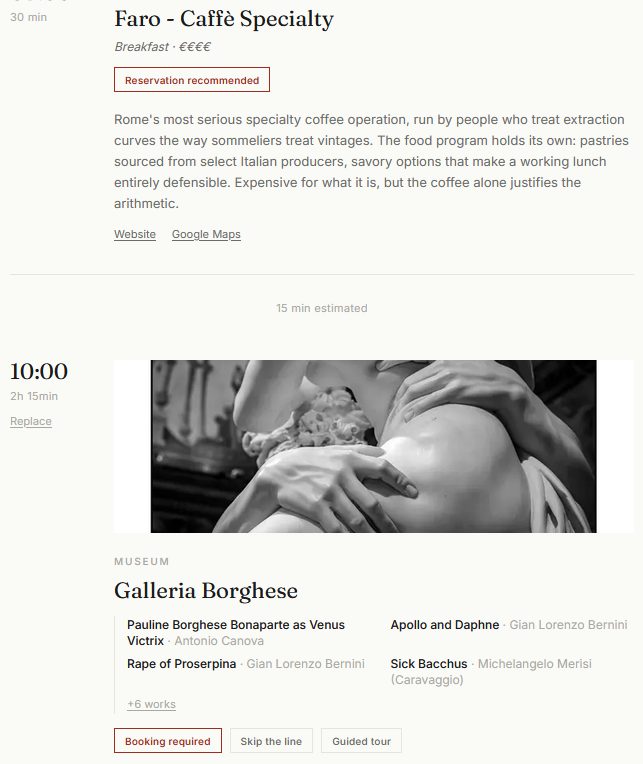
The Borghese Gallery is the clearest example of why a Rome art trip is a logistics problem before it is a taste problem. Entry is by booked slot only, the slots sell out weeks ahead, and the museum sits in a park twenty minutes from the nearest thing you will want to see next. Get the order wrong and you either miss the booking or waste the afternoon.
Flâneur builds a personalised Rome art itinerary around you. Tell it how deep your interest in art runs and what your days should look like, and it maps a route through the art that matters: the Borghese and the Vatican Museums, the Caravaggios scattered through the churches, Bernini’s Rome well beyond this one gallery, and the quieter stops most visitors never reach. Every day comes with real opening hours, church closing times, transfer times, meal breaks, directions and booking links.
Pick the Expert profile and you compose the day yourself, choosing from all the art indexed in the city. This is exactly where a general-purpose AI falls short: an LLM guesses a plausible Baroque itinerary, Flâneur knows which slot to hold, which door is open when, and in which order to walk them.
Build your Rome art itinerary or see every city on flaneur.travel
In short: what you need to know in thirty seconds
- Where: Piazzale Scipione Borghese 5, inside Villa Borghese, Rome.
- Booking: compulsory for everybody, including free and under-18 tickets. This is not advice, it is a rule. Book weeks ahead, ideally months.
- How long the visit lasts: two hours on paper, because the museum runs on timed slots. In practice, once you are inside nobody comes to time you: allow two and a half or three hours if you want to look properly.
- The single most useful tip in this article: if the official slots are sold out, check the authorised resellers (Tiqets, GetYourGuide and the like). They frequently still have availability on time slots the official website reports as closed.
The palace: a war machine disguised as a country villa
Who Scipione Borghese was
In 1605 Cardinal Camillo Borghese, from a Sienese family transplanted to Rome, was elected pope as Paul V. Two months after the election he formally adopted his nephew Scipione Caffarelli, son of his sister Ortensia and of Francesco Caffarelli, who took the Borghese name and was made a cardinal at twenty-six.
This is the mechanism of the cardinal nephew, and in the seventeenth century it was not yet a scandal: it was administration. The pope is an absolute sovereign but elected late in life, and he needs a man of total trust to run the court, the diplomacy and the money. Scipione Borghese (1577-1633) accumulated within a few years a set of offices that on their own describe his weight: head of the Consulta, secretary of Briefs, grand penitentiary, camerlengo, prefect of the Segnatura di Grazia. He was effectively prime minister of the Papal States, and for sixteen years, until his uncle’s death in 1621, the most powerful man in Rome after the pope himself.
What sets him apart from other cardinal nephews is what he did with that power. He did not build a military dynasty, he did not compulsively buy up fiefs, he did not finance wars. He bought art. With a voracity his contemporaries recorded as pathological, and which modern sources tend to describe in terms of sheer unscrupulousness.
Three episodes are enough to establish the method.
The seizure from the Cavalier d’Arpino, 1607. Giuseppe Cesari, known as the Cavalier d’Arpino, was the most successful painter in Rome, the man decorating the dome of St Peter’s. He became caught up in criminal proceedings (the trigger was the wounding of his rival Pomarancio) and a search of his house turned up harquebuses. Acquitted of the wounding, he was convicted of illegal possession of firearms. He bought his freedom by surrendering his entire collection of paintings to the Apostolic Chamber: one hundred and seven pictures. Which the pope, as it happens, donated shortly afterwards to his nephew. Among those hundred and seven were two youthful Caravaggios, the Boy with a Basket of Fruit and the Sick Bacchus, probably left behind in the workshop by Merisi himself when he was working there as a specialist in flowers and fruit.
The theft of Raphael’s Deposition, 1608. The altarpiece Atalanta Baglioni had commissioned from Raphael in 1507 for the family chapel in San Francesco al Prato, in Perugia, in memory of her son Grifonetto, killed in a feud, left the city one night with the connivance of the friars and arrived in Rome. Paul V gave it to his nephew and regularised the irregularity with a papal instrument. To placate Perugia, two copies were commissioned: the one by the Cavalier d’Arpino is still there, Lanfranco’s is lost. The original is in Room 9 of the Borghese Gallery, signed and dated in gilded letters at the lower left.
The arrest of Domenichino, 1617. Domenico Zampieri was painting the Hunt of Diana for Cardinal Pietro Aldobrandini. Scipione saw it, wanted it, and asked to buy it. The painter answered honestly that he could not: it was already sold. Scipione sent men to take it from his house by force, and not content with that had the painter arrested and held in jail for several days, until he agreed to hand it over. Final payment: one hundred and fifty scudi, and not for one picture but for two, because in the same operation the cardinal also helped himself to the Sibyl.
It matters to hold both things together, because the Borghese Gallery exists thanks to both: an exceptional eye and an indefensible method. Scipione recognised Caravaggio when half of Rome considered him an obscene painter, understood Bernini at twenty, bought Titian when Titian was not yet a safe investment. And he did it by blackmailing people, confiscating their property and having them arrested. The most beautiful collection in Rome is also the best-documented case of abuse of office in the history of art.
The relationship with Bernini
Gian Lorenzo Bernini was born in Naples in 1598, the son of the Florentine sculptor Pietro Bernini, who moved to Rome when the boy was seven or eight. The legend, built up by the seventeenth-century biographers Filippo Baldinucci and Domenico Bernini, tells of a child prodigy who astonished Paul V.
What is documented is more interesting than the legend. Between 1618 and 1625, that is between the ages of twenty and twenty-seven, Bernini produced for Scipione Borghese the four great groups that changed European sculpture: Aeneas, Anchises and Ascanius (payment recorded in 1619), the Rape of Proserpina (1621-1622), the Apollo and Daphne (1622-1625) and the David (1623-1624). To these can be added minor works such as the Amalthea Goat and the Bust of Paul V.
The relationship was not that of a patron and a workshop artist. It was mutual construction: Scipione gave Bernini the one thing a twenty-year-old cannot buy, namely permission to fail on enormous and enormously expensive blocks of marble, and Bernini gave Scipione the one thing money cannot buy, namely originality. Because the point of the four Borghese sculptures is not technical skill, which in Rome in 1620 was not rare. It is the idea of putting modern sculpture into direct competition with the antique, in the same rooms, on the same terms, and winning. The two men were close enough that the face of the David is said to have been carved by Bernini from his own reflection in a mirror held up by Scipione Borghese himself.
The collaboration also had a side that is rarely discussed: it was advertising. The four sculptures were not destined for a private drawing room, they were displayed in a villa the cardinal systematically opened to diplomats, prelates, travellers and the merely curious. They were a manifesto. Whoever left Villa Pinciana went and told people what they had seen, and both patron and sculptor grew in stature as a result.
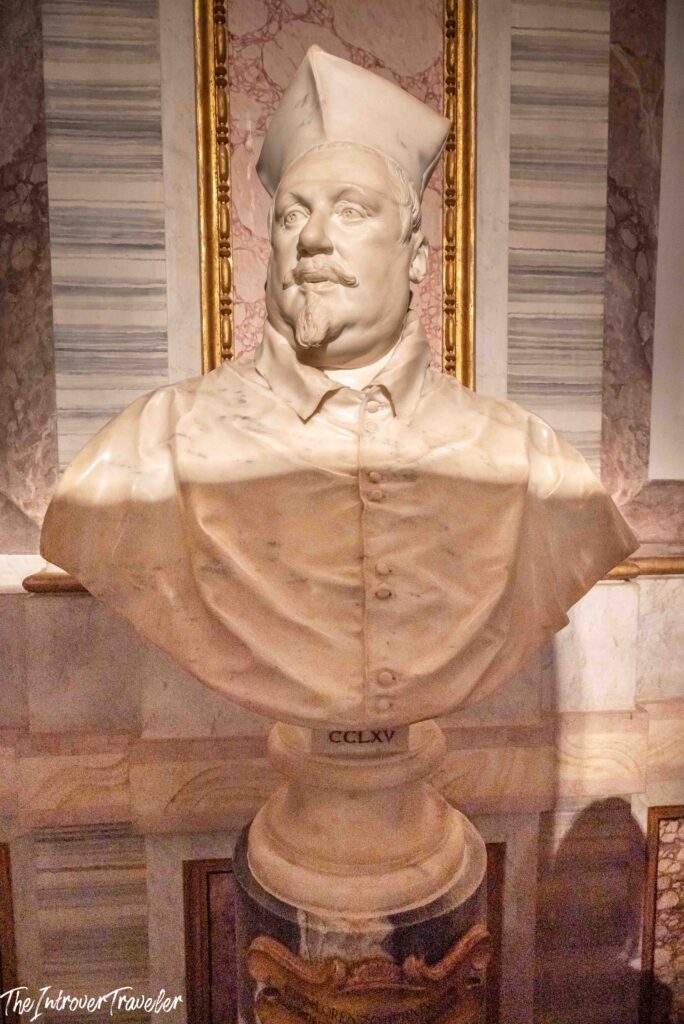
One detail that closes the circle: in 1632, ten years after the death of his uncle the pope and long out of power, Scipione finally had himself portrayed by Bernini. He did not commission the bust: Urban VIII had it made and gave it to him. Scipione reciprocated with five hundred scudi and a diamond. It was the last act of a relationship fourteen years long, and it is also, as we shall see, the absolute summit of Bernini’s portraiture. What happened after the Borghese years, when the Barberini took over as patrons, is the subject of a separate piece: Bernini and the Barberinis, at Palazzo Barberini.
The villa: built to be a museum
This is the point most visitors miss, and it changes the way you see the building entirely.
Villa Borghese Pinciana is not a family palace converted into a museum. It was born a museum. Construction began in 1607 on land the family already owned outside Porta Pinciana and proceeded substantially until 1613 under Flaminio Ponzio, the trusted architect of both the pope and the cardinal. On Ponzio’s death the site passed to the Fleming Jan van Santen, Italianised as Giovanni Vasanzio, who completed the structure and later built the Aviary and the gardens.
The layout follows the model of the sixteenth-century suburban villa, like the Farnesina alla Lungara or the Villa Medici on the Pincio: projecting wings linked by a portico, a light structure, set into greenery. But the intended use was different. Scipione did not live here permanently. The building was conceived as a place for the display of ancient and modern art, for music, for study, for the contemplation of nature (with rare plants and animals, hence the Aviary), and even for showing off the technology of the day: automata, mirrors, lenses, curious clocks. An architectural Wunderkammer, where natural, mechanical and artistic marvels sat on the same level.
The original façade was itself a catalogue: ancient reliefs and sculptures set into the plaster, so that the wealth inside was announced from the outside. Anyone arriving understood what they would find before they crossed the threshold.
The great eighteenth-century remodelling, or why the rooms look like this
The present appearance of the interiors is not seventeenth-century. It is the result of a decorative campaign begun in 1770 by Prince Marcantonio IV Borghese and directed by the architect Antonio Asprucci. And from the point of view of the visit, it is the most important thing to know about the building.
Asprucci assembled a team that reads like a Who’s Who of late eighteenth-century Rome: the painters Mariano Rossi, Domenico Corvi, Christoph Unterberger, Anton von Maron, Giuseppe Cades, Nicolò Lapiccola, Tommaso Maria Conca; the sculptors Vincenzo Pacetti, Agostino Penna, Tommaso Righi; the silversmith Luigi Valadier. The walls were clad in polychrome marble and Roman stucco, the vaults filled with fresco cycles, the floors given ancient mosaics.
But the brilliance of the operation is not decorative, it is curatorial, and it is nearly two centuries ahead of its time. Asprucci invented a new display principle: he placed a masterpiece, ancient or modern, at the centre of each room, and then built the entire decorative apparatus of that room, ceiling included, around the iconographic theme of that work. The room does not contain the work: it comments on it. It is a permanent exhibition conceived as a total environment, and despite all the later losses Asprucci’s logic can still be read in every single room.
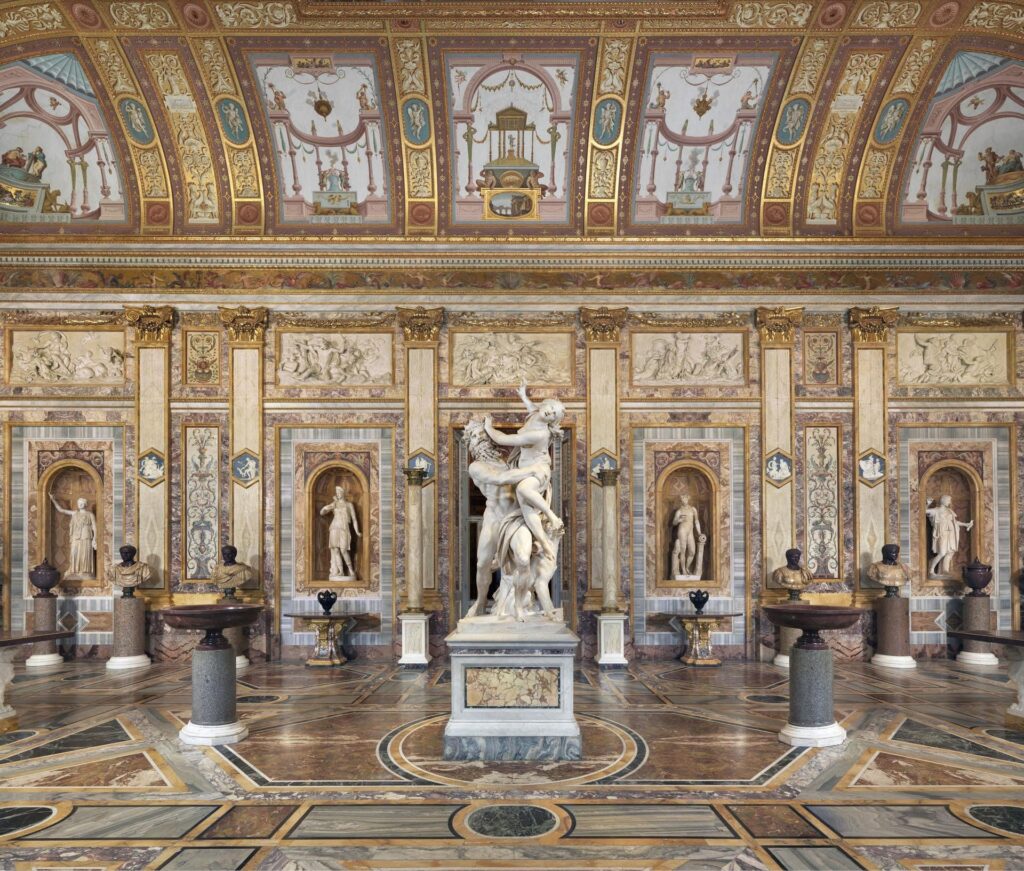
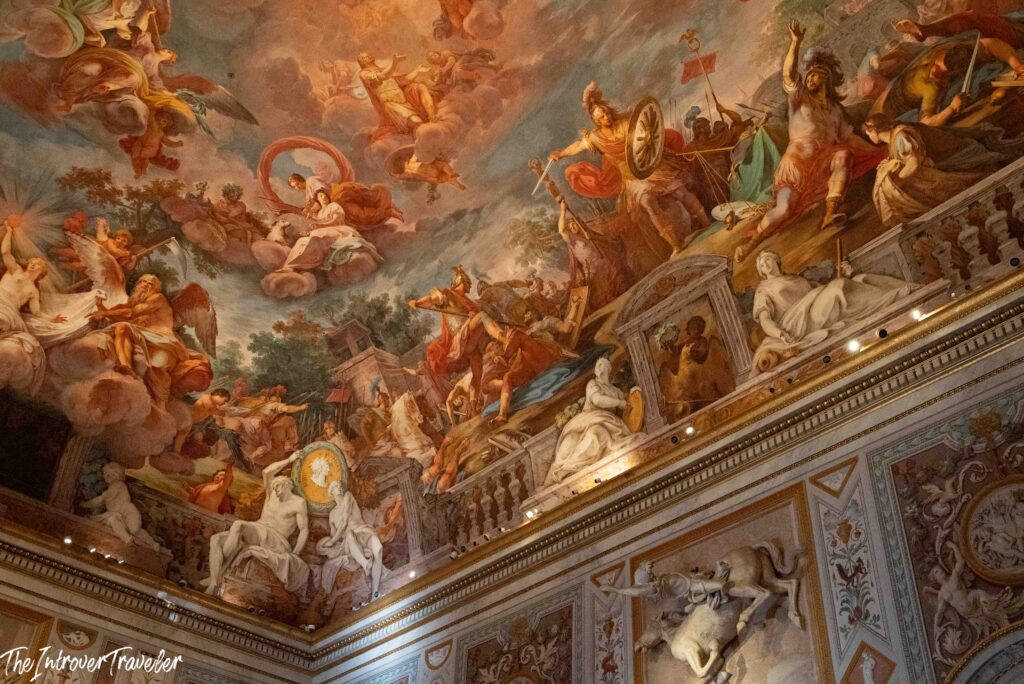
The most spectacular result is the entrance Salone. The vault is by Mariano Rossi, painted between 1775 and 1779, and shows Romulus received into Olympus by Jupiter to favour the victory of Furius Camillus over Brennus, king of the Gauls. The choice of subject was not casual: on 8 August 1775 Marcantonio’s first-born son had been born and christened Camillo, after the Roman dictator who defeated the Gauls. The same Camillo who thirty years later would marry Pauline Bonaparte and sell half the collection to his brother-in-law Napoleon, in some sense a descendant of those very Gauls defeated by Furius Camillus. History has a sense of humour no writer would dare to invent.
In the Salone, beyond the vault, look at three things. The group of Marcus Curtius Leaping into the Chasm, made up of an ancient horse of the second century AD and a rider carved by Pietro Bernini in 1618: it used to be outside, on the façade towards Porta Pinciana, and Asprucci had it moved high up onto the wall opposite the entrance in 1776, where it still floats in a way that is both absurd and magnificent. The busts of the Twelve Caesars by Giovan Battista della Porta in the niches above. And the floor: the Mosaic with hunting scenes and combats between gladiators and beasts, early fourth century AD, from the Borghese estate at Torrenova on the Via Casilina, set into the floor in the nineteenth century. People walk over it absent-mindedly while looking for the room with the David. It is one of the most important gladiator mosaics in existence.
There is also, still in the Salone, the Attacking Satyr, a colossal Roman statue of 120-140 AD with the body in torsion, already owned by Cardinal Scipione. Tradition holds that it inspired Bernini’s David. Look at it, then go and look at the David, then come back. It is the quickest way to understand how the relationship between ancient and modern worked in this house.
The wound of 1807, and why there are fewer statues than there should be
In 1807 Prince Camillo Borghese, husband of Pauline Bonaparte, agreed to sell France, at the wish of his brother-in-law Napoleon, six hundred and ninety-five pieces including statues, vases and reliefs. The valuation was carried out by Ennio Quirino Visconti, a celebrated antiquarian, who initially assessed the collection at around six million francs. The sum agreed at signature was thirteen million. Eight were actually paid. The remainder was only partly covered by the transfer of the fief of Lucedio, near Vercelli, where Camillo moved as governor general of the transalpine departments of the empire. The shipments, which went on until 1811, cost the French government a further eight hundred thousand francs.
Those marbles are today the classical glory of the Louvre. The Gladiator by Agasias of Ephesus, the Hermaphrodite, the Borghese Vase, the Silenus with the Infant Bacchus: all there. The rooms of the Borghese still carry their names (Room of the Gladiator, Room of the Hermaphrodite, Room of the Silenus) and no longer have the statues those names refer to. In Room 8, for instance, in place of the Silenus there is now a Roman Dancing Satyr restored by Bertel Thorvaldsen, who added the crotala. In Room 6, in place of the Gladiator that left for Paris in 1808, since 1888 there has been Bernini’s Aeneas and Anchises.
Camillo tried to make amends, and partly succeeded: purchases, excavations on the family estates along the Via Prenestina, works retrieved from other Borghese houses. And in 1827, in Paris, he bought Correggio’s Danaë for two hundred and eighty-five pounds. In 1833 an entail finally blocked any further dispersal. In 1892 the Italian state bought, in a first sale of works excluded from the entail, the two Bernini busts of Scipione Borghese. In 1902 it bought everything else: the building, the garden and the collection.
The museum closed in 1983 for a complete restoration and reopened in June 1997, fourteen years later. What you see today, the plasterwork, the statues on the façade, the double-ramp staircase, is the product of that campaign. Nothing, however, can yet be called final, because in May 2026 an international ideas competition was launched for a new pavilion of up to three thousand square metres next to the museum, with an estimated cost of nine to ten million euros and a winning design to be chosen by the end of the year. The stated aims are accessibility, an auditorium, better visitor facilities and the display of more than two hundred works currently in storage. No, I do not feel the need for it. And yes, I know, I know that the French built the Pyramid at the Louvre. But this building does not need a new structure in steel and glass.
The four masterpieces everybody comes for
I have written dedicated posts on all four, so here I will keep to essentials and practical points. They are in the first rooms of the ground floor and in Room 1, and they are the reason 90 per cent of visitors buy a ticket.
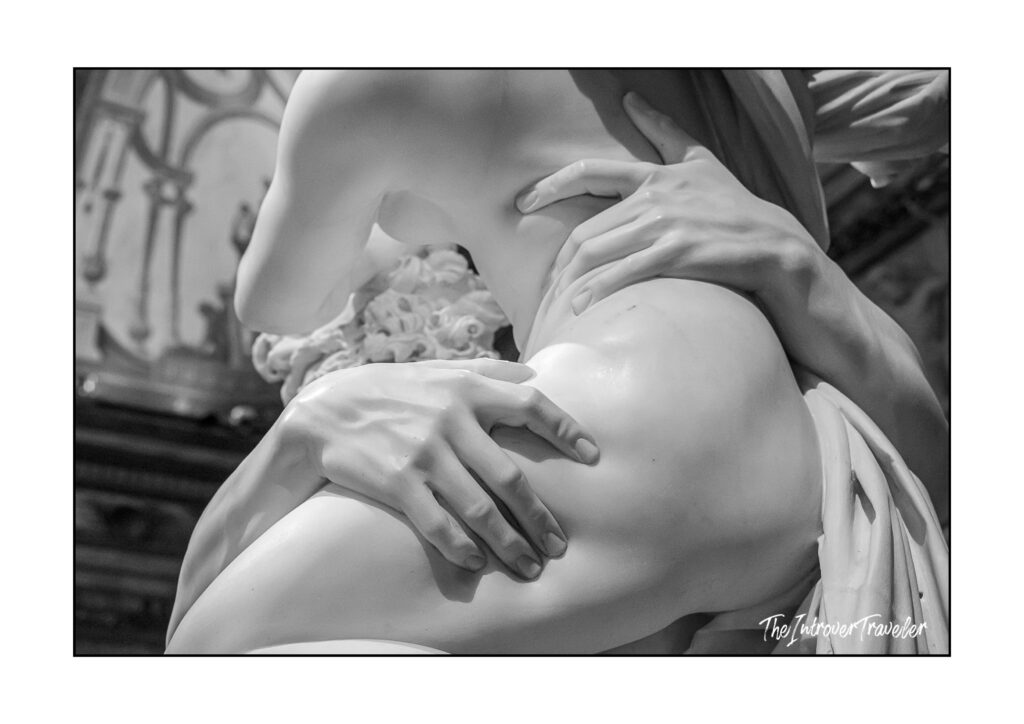
Rape of Proserpina (Room 4, Room of the Emperors). Marble, 1621-1622, height 255 centimetres without the base. Bernini was twenty-three. This is the work of the hand sinking into the thigh, of marble turning into flesh, the most photographed detail in Western sculpture, and for once the fame is deserved, because the detail is not an isolated piece of virtuosity but the structural pivot of the whole group: the entire composition is built on the difference between yielding flesh and gripping muscle. A curious piece of history: Scipione gave it away almost immediately to Cardinal Ludovico Ludovisi, the new cardinal nephew, in all likelihood as a political homage after the death of Paul V. It stayed at Villa Ludovisi until 1908, when the state bought it and brought it back here.
David (Room 2). Marble, 1623-1624, height 170 centimetres. The break with tradition is absolute: Donatello’s David, Verrocchio’s and Michelangelo’s all stand still, before or after the action. Bernini’s is inside the action, twisting, sling loaded, and above all looking out of the statue’s own space towards a Goliath who is not there. The viewer finds himself in the middle of a duel.
Apollo and Daphne (Room 3). Marble, 1622-1625. The most technically insane sculpture ever carved: laurel leaves two millimetres thick, bark climbing the legs, hair turning into branches. It has to be seen by walking around it, because it is built for a sequence of viewpoints that tells the metamorphosis like a film.
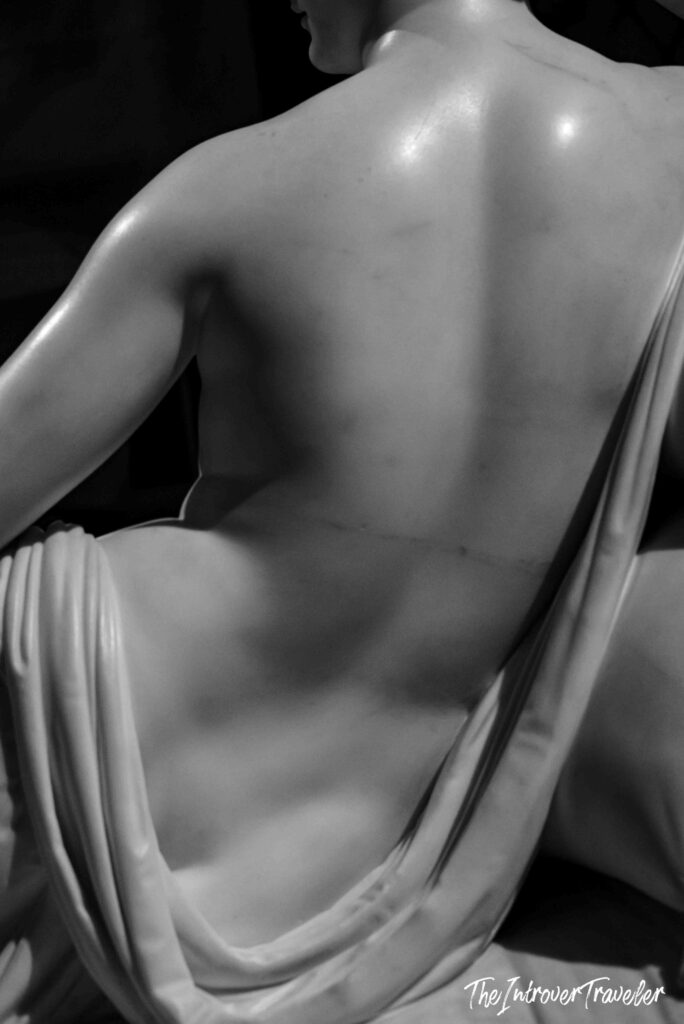
Pauline Borghese as Venus Victrix (Room 1). Antonio Canova, commissioned by Prince Camillo in 1804 and finished in 1808. Marble polished and finished with acqua di rota to give the surface its sheen. The bravura piece is the mattress, which appears to give under the weight. It reached the villa in 1838, thirty years after it was carved, and it is the last great acquisition in the history of the collection.
The two Bernini works that, in my opinion, do not work
Here begins the part that will earn me a few indignant emails. Bernini is a genius, and I do not doubt it for a second. But a genius also produces works that only half succeed, and the automatic canonisation of everything that comes off a famous chisel is the opposite of art history. You are allowed to criticise Bernini. Vasari criticised Michelangelo. Longhi criticised Raphael. It is not blasphemy, it is critical judgement.
Aeneas, Anchises and Ascanius
It is the first large group Bernini made for Scipione, when the sculptor was barely twenty, and the attribution to Gian Lorenzo alone (against the old hypothesis of a collaboration with his father Pietro) was confirmed precisely by the discovery of that payment.
The subject comes from the second book of the Aeneid: Aeneas carries his father Anchises to safety from burning Troy, the old man clutching the statuettes of the Penates, while little Ascanius follows with the fire of Vesta. The political meaning is transparent: imperium passes from Troy to Rome through Aeneas, and from Rome to the Church; Aeneas holding up his aged father is the young cardinal nephew holding up his elderly uncle the pope. And scipio, in Latin, is the staff you lean on to walk. The patron had a pun carved for himself, two metres twenty high.
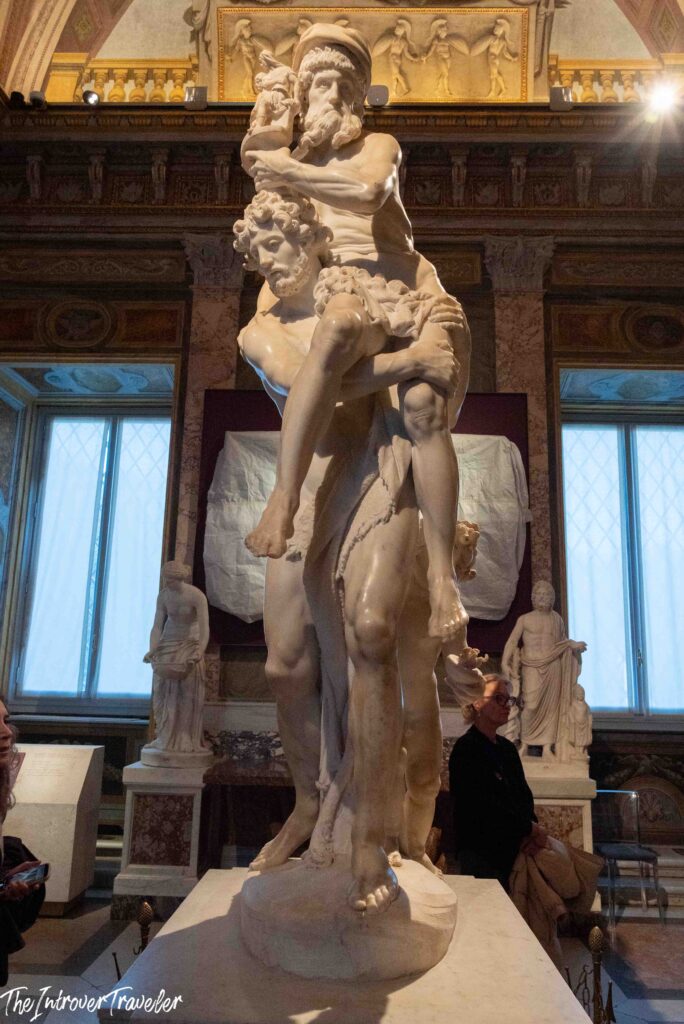
There are passages of genuine virtuosity. The most obvious is the differentiated treatment of the three skins: the soft flesh of the child, the taut skin over the adult’s muscles, the wrinkled and withered surface of the old man. It is the classical theme of the three ages of man translated into tactile surface, and it works: the body of Anchises, with its paralysed leg and spine bent by age, has a physicality of real old age, almost unpleasant, that holds its own against the old men painted by Caravaggio (and the comparison is not mine: Caravaggio’s Saint Jerome was in this same collection, and the scholarship cites it as a term of comparison).
Then there is the face of Aeneas, which is the finest thing in the group. A suspended face, not straining, with a sweetness that seems out of place in a scene of flight. Anyone looking at it thinks immediately of Michelangelo, and they are right: the quotation is documented. Recent scholarship points to the Risen Christ in Santa Maria sopra Minerva, reproduced in mirror image. Which, if anything, is even more interesting: Bernini does not quote the dead Christ, he quotes the risen one, and he puts that face on a man running from a burning city.
So why does the work fail to move?
Because the composition as a whole is clumsy. The three figures are stacked vertically in a way that never resolves: Aeneas supports his father’s left leg with both hands, the other leg of Anchises hangs free in front of his son’s torso, and the interlocking that ought to look elegant reads instead as confusion, with a legibility problem that no viewpoint entirely solves. Ascanius pokes out from behind like an afterthought. The animal skin partly wrapping the three nude bodies explains nothing and helps less. Bernini had planned a privileged viewpoint, frontal and to the right (you can tell from the areas deliberately left unfinished), but even from there the group remains a superimposition of excellent parts that never becomes a whole.
As I said, Bernini was twenty when he carved this. He already possessed the formidable command of the chisel that would make him famous for centuries. But virtuosity is not enough, making art is something else, and here Bernini is, in my very modest opinion, an immature artist.
Truth Unveiled by Time
The biographical context is dramatic and you need to know it, because it is the only thing that makes the work moving. Bernini, architect of the Fabbrica di San Pietro since 1629, was charged by Urban VIII with completing the two bell towers of the basilica begun by Carlo Maderno. The project failed: cracks appeared on the façade and the pope ordered the first tower dismantled. Then Urban VIII died, and the new pope, Innocent X Pamphilj, not only shelved the project but preferred Francesco Borromini as his architect. Bernini, at forty-seven, was the most famous man in Rome and the most discredited.
So he carved, for himself, an allegorical group: Truth unveiled by Time. The meaning is declared and desperate: time does justice to wrongs suffered. The figure of Time, which was to hover above supported by columns, obelisks and ruined mausoleums, was never carved, because after only two years Bernini was back in papal favour and had neither the time nor the need to finish it. On his death his heirs sold the block of marble intended for Time. The Truth stayed in the Bernini house, bound by an entail passing it to the eldest male heir with a prohibition on selling, as a moral lesson to his descendants, until 1924, when it was placed on deposit at the Borghese Gallery. The state bought it at the end of the 1950s.
All of this is magnificent. The problem is the sculpture.
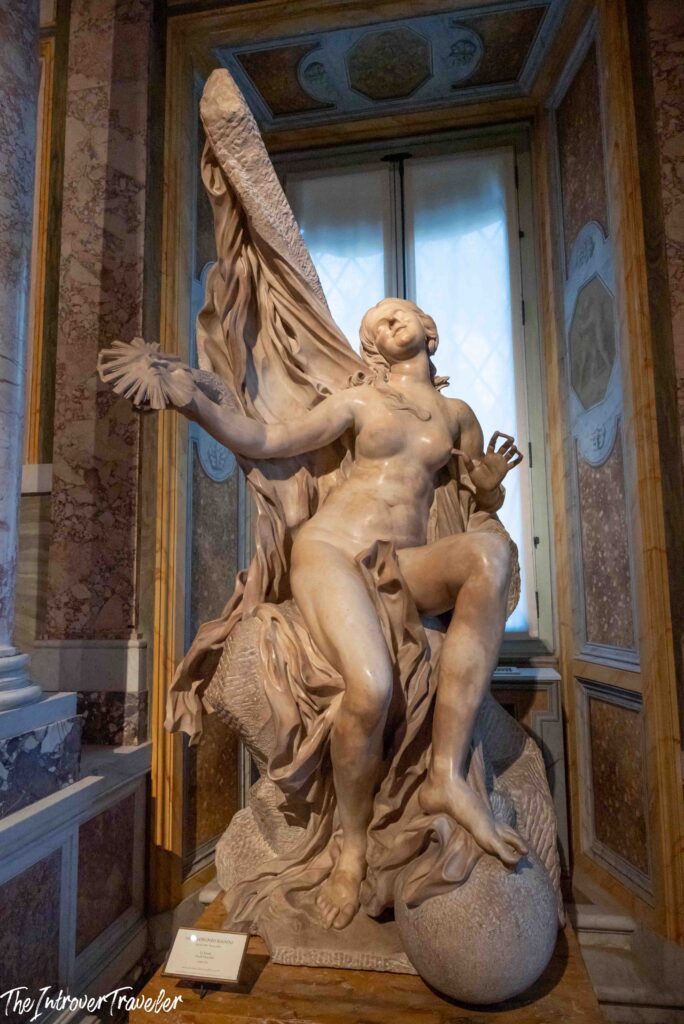
The Truth is Baroque in the pejorative sense of the word: too much rhetoric, too many attributes, too little figurative thought. The young woman sits on a rock, holds a solar disc with a human face in her right hand, rests her left leg on the terrestrial globe, all of it according to the iconography already codified in Cesare Ripa’s Iconologia. It is an allegory compiled from a manual, and it shows. The flesh is polished and burnished over almost the whole surface until it seems to emit light, which is both a technical feat and the symptom of the problem: it is a surface that wants to astonish, not a figure that wants to say something.
But the real disaster is the expression. That smile is not the serenity of truth revealing itself: it is an embarrassed, tight smile, the smile of someone who has just said the wrong thing and is trying to get out of it. The upward gaze, which should be seeking Time, becomes, without Time, the look of someone hoping that somebody will turn up and rescue the situation.
The image that comes to me when I look at it, and I apologise to the Bernini faithful, is of a woman who has just congratulated another woman on her evident pregnancy and been told “I am not pregnant.” That precise millisecond of paralysed smile. The Truth in the Borghese Gallery has exactly that expression.
The objection will be that the work is unfinished, that half the group is missing, that it must be judged as a fragment. It is a serious objection and I accept it in part: without Time, the unveiled Truth is a naked woman smiling into the void, and that is not her fault. But incompleteness explains the missing meaning, not the unhappiness of the pose and the face, which were settled from the preparatory drawings now in Leipzig and the Louvre. Bernini in 1650 was not a beginner. This one simply did not come off. Again, in my very modest opinion.
That said: go and see it. An unsuccessful Bernini is still one of the most interesting things in any museum, and understanding why something does not work teaches you more than admiring something that does.
The equestrian model for Louis XIV: seventy-six centimetres of pure energy
This is, as far as I am concerned, one of the three or four most beautiful things in the museum, and most visitors walk past it without stopping because it is small, brown and not made of marble.
The story is a tragedy in three acts. Louis XIV wants an equestrian monument for a Paris square. Colbert writes to Bernini in December 1667 asking him to proceed, with a precise instruction: base it on the Constantine the sculptor had just executed for the Scala Regia in the Vatican. In the summer of 1669 the block of marble arrives in Bernini’s studio, and he leaves it untouched for years. Since 1666 he has been drawing a pension from the French court, so he decides, in agreement with Colbert, to have the statue carved by the students of the newly founded French Academy in Rome, reserving only the face for himself. Work begins in 1671 and finishes in 1677 or 1678. In 1680 Bernini dies and the statue is still in Rome awaiting shipment. When the king finally sees it in 1685 he loathes it enough to demand its destruction. He then settles for having it transformed by the sculptor François Girardon into a Marcus Curtius, and banishes it to the Orangerie at Versailles, where it still stands.
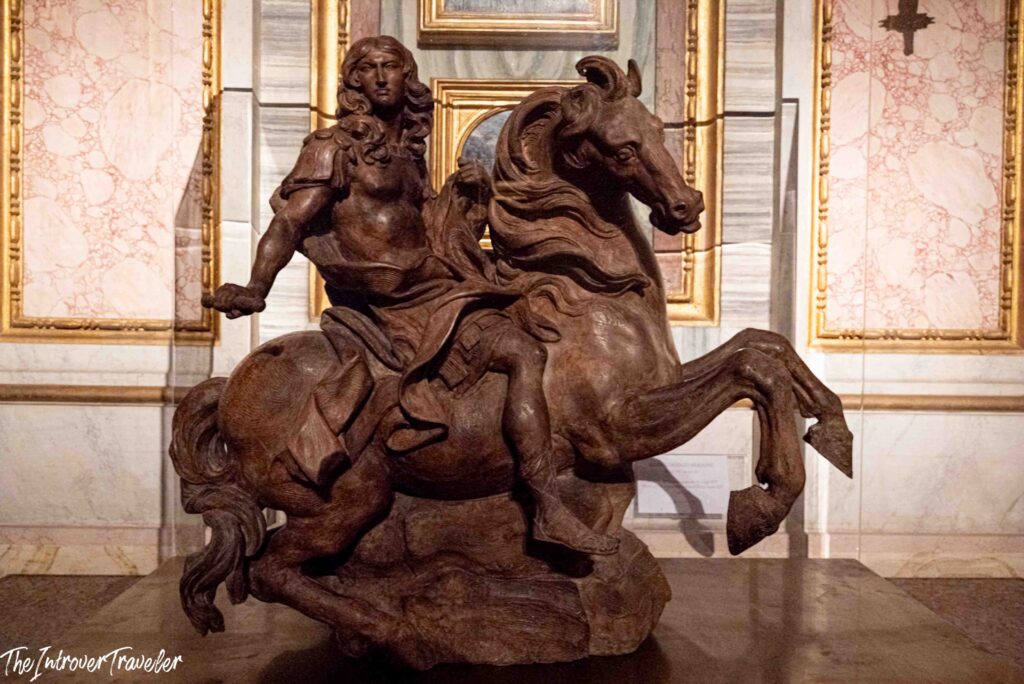
The marble, in other words, is a failed work and not autograph into the bargain. The model is considered original, made by Bernini’s own hand, as he had promised the patron. And that is the point: that terracotta is the only surviving trace of the idea, before it passed through the hands of the students and the chisel of Girardon.
And it is an overwhelming idea. The horse rears on a rocky base, the king in armour holds the sceptre, the diagonal is violent, the modelling nervous, dirty, fast. You can still see the pins used for the horse’s legs and for the sovereign’s arms and legs, the marking points on his throat, cuirass and feet used for scaling up, and the striations across the surface designed to catch the light differently from the way marble catches it, perhaps with a teaching function for the French students, indicating the direction in which to move the tools.
It is the difference between seeing a work and seeing an artist thinking. In the Versailles marble there is a monument. Here there is a seventy-one-year-old genius who in a few hours of work in clay solved a problem nobody had solved before: how to make an equestrian portrait that is not static, that is not the usual horseback stroll of a Roman emperor, but an ascent. The horse does not advance, it climbs. The rock under its hooves is not a support, it is a symbolic mountain.
Walk slowly around it. Then reflect that the king of France saw it, or rather saw its translation into marble, and ordered it destroyed. Some aesthetic judgements age worse than others.
The two busts of Scipione Borghese: the summit, and the stupidest way to talk about them
Still Room 14. Two marble busts, both of 1632, heights 77.2 and 78 centimetres.
Start with the story, which is the best Bernini anecdote there is and for once is documented.
In 1632 Scipione Borghese had been out of power for eleven years. Urban VIII, for whom Bernini was working full time at St Peter’s, commissioned a portrait of the old cardinal from the sculptor and gave it to him. Scipione reciprocated with five hundred zecchini and a diamond worth a hundred and fifty scudi. The payment of five hundred scudi to Bernini is recorded in the cardinal’s warrants in December 1632.
With the work finished, during the final polishing, a flaw emerged in the block: a pelo, a crack, running across the cardinal’s forehead. It is still there, perfectly visible. Bernini carved the bust again from scratch. According to Baldinucci it took him fifteen nights; according to Domenico Bernini, the artist’s son and therefore an interested witness, three days. You can argue about the timing. You cannot argue about the fact that he did it.
The two biographers’ versions of the episode diverge instructively. Baldinucci holds that Bernini presented the damaged bust first, that Scipione “was inwardly disturbed” but concealed it so as not to upset the sculptor, and that Bernini then surprised him with the flawless replica. Domenico tells it differently: the cardinal, seeing the second bust, immediately noticed from a certain livelier expression that this was not the figure he had seen a few days earlier, asked for an explanation and had the first one delivered to him as well. Two versions of the same episode, one glorifying the coup de théâtre and the other the patron’s eye. The seventeenth century in two paragraphs.
The reason for that flaw is itself revealing about Bernini’s method: unlike Michelangelo, the master with whose legacy Bernini openly and repeatedly measured himself, Bernini did not personally select the block he was going to carve, because for him sculpture was manipulation, skill and invention, not the selection of material. A piece of technical arrogance that cost him fifteen nights of work.
Now, the works themselves.
They are the moment the Baroque portrait is born. Before these two busts, the carved portrait is a pose: the sitter looks straight ahead, motionless, and likeness is obtained by copying features minutely. Bernini does exactly the opposite. He turns the head to one side, parts the lips slightly, and fixes a precise instant in the marble: somebody has just interrupted the cardinal while he was speaking, and he is turning towards them. Scholars call these “speaking portraits”, and the definition is right. Bernini was convinced that likeness was not obtained by copying a face in repose, but by rendering individuality, and that individuality was visible only in movement, in the transience of a state of mind.
The result is something that did not exist in sculpture: a living man, fat, intelligent, self-assured, faintly insolent, caught in an ordinary moment of an ordinary conversation. It is more modern than the ninety years of portraiture that followed. The likely influence comes from contemporary painting by Rubens and Van Dyck, but transferring it into marble is an operation without precedent.
Then there is the handling of surface, which is almost impertinent. Bernini delivers at once the tactile sensation of skin, taut and damp on the face, creased on the neck where it meets the collar, and the shifting surface of the silk mozzetta: the folds run at different angles, catch the light differently, and produce the effect of watered silk. Stone imitating silk, and not for fun: because the cardinal is a man of silk.
The two versions, at first sight identical, differ. In the second the shoulders are squarer, the mozzetta is less rumpled and no longer reveals the neck, a horizontal fold across the bottom separates the last pair of buttons, the polish is more uniform and the expression slightly less absorbed. A small irony of the material: the marble of the second bust has also cracked since, with a fissure running diagonally across the mozzetta.
Scipione had no doubt which one he preferred. He displayed the first, the one with the crack across the forehead, in the Room of the Emperors on the ground floor, among the busts of the Caesars. The second, the “perfect” one, ended up in the gallery on the first floor, in a position of lesser prestige. In other words: the patron knew perfectly well that the flaw in the marble took nothing away from the force of the first portrait, and that the replica, impeccable as it was, had lost something. It is the sharpest critical judgement ever passed on these two works, and it was passed by a seventeenth-century cardinal simply by deciding where to hang them.
The button, Instagram, and the tendon of Moses
In recent years the two busts have acquired a second life on social media thanks to one detail: a button on the mozzetta carved with such precision that it looks real, which turns up in an infinity of posts, reels and carousels captioned along the lines of “this detail will leave you speechless”.
It is the stupidest possible way to talk about a work of art.
Because reducing to that button two sculptures that invented a genre means completely inverting the relationship between means and end. The button is not the point: it is a by-product. Bernini was not demonstrating that he could carve buttons, he was constructing the illusion of a living silk surface, and the button is one piece of that surface. Isolating it, blowing it up, putting it on the cover and stopping there turns a work about power, old age, intelligence and conversation into a circus act.
The mechanism is always the same: take the most easily verifiable detail, the one anyone can recognise without knowing anything, present it as the key to the work, and you have content that travels. The cost is that the reading of the work is simplified until it is debased, and the public learns that artistic greatness is the same thing as manual precision.
Another example I see circulating on social media to the point of exhaustion is Michelangelo’s Moses in San Pietro in Vincoli. One of the most terrifying and complex sculptures of the Renaissance, an old man in a moment of restrained fury, with a psychological tension that nails you to the floor. Try searching for anything about it: nine times out of ten you will land on discussions of a single detail, the extensor muscle of the little finger of the right arm, carved in contraction in a way that is anatomically consistent with the position of the finger. It has become the most repeated fact about that statue, as if the value of the work were decided there. Michelangelo reduced to a good anatomy manual. The rest, which is to say everything, evaporated.
Look at the button, by all means. But look at it after you have let Scipione Borghese’s stare hypnotise you.
Caravaggio: six canvases in one room, and a reflection problem
Room 8, Room of the Silenus, the last on the ground floor.
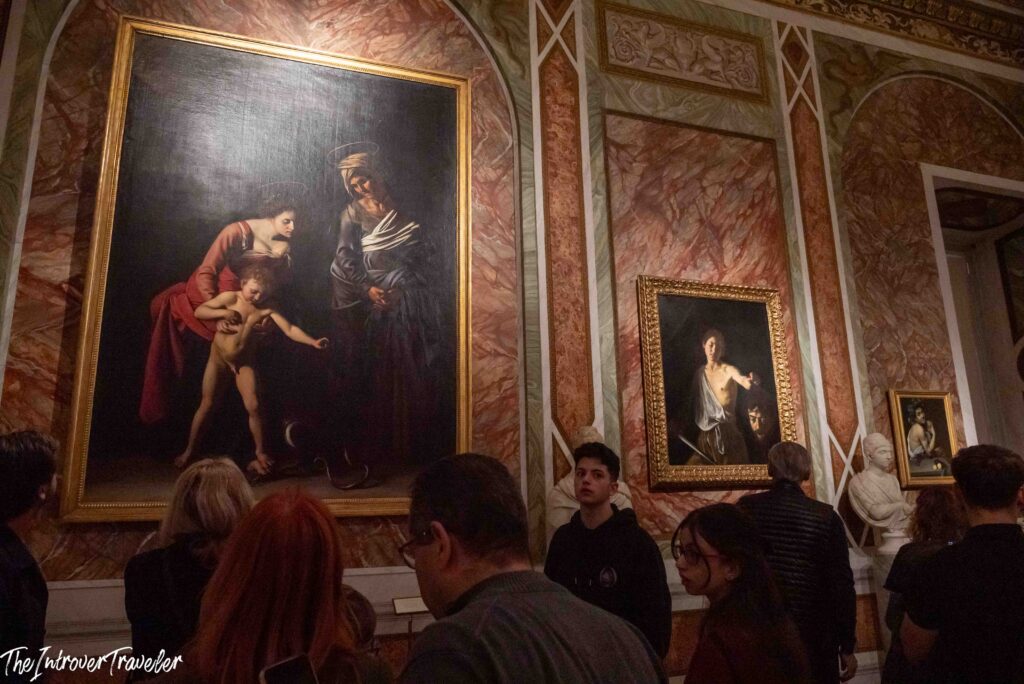
No museum in the world holds six paintings by Caravaggio. The Borghese Gallery does, and they are all in the same room. The figure becomes more impressive still when you add what the museum itself states: Cardinal Scipione owned twelve Caravaggios. Half of them have gone over the centuries. What remains covers the artist’s entire arc, from his beginnings to the last months of his life.
Boy with a Basket of Fruit, oil on canvas, about 1595, 70×67 centimetres. From the 1607 seizure from the Cavalier d’Arpino. This is the work of the period when Caravaggio was employed in Arpino’s workshop as a specialist in flowers and fruit, and everything is already there: mimesis without any interpretative filter, fruit with its real blemishes, leaves already curling.
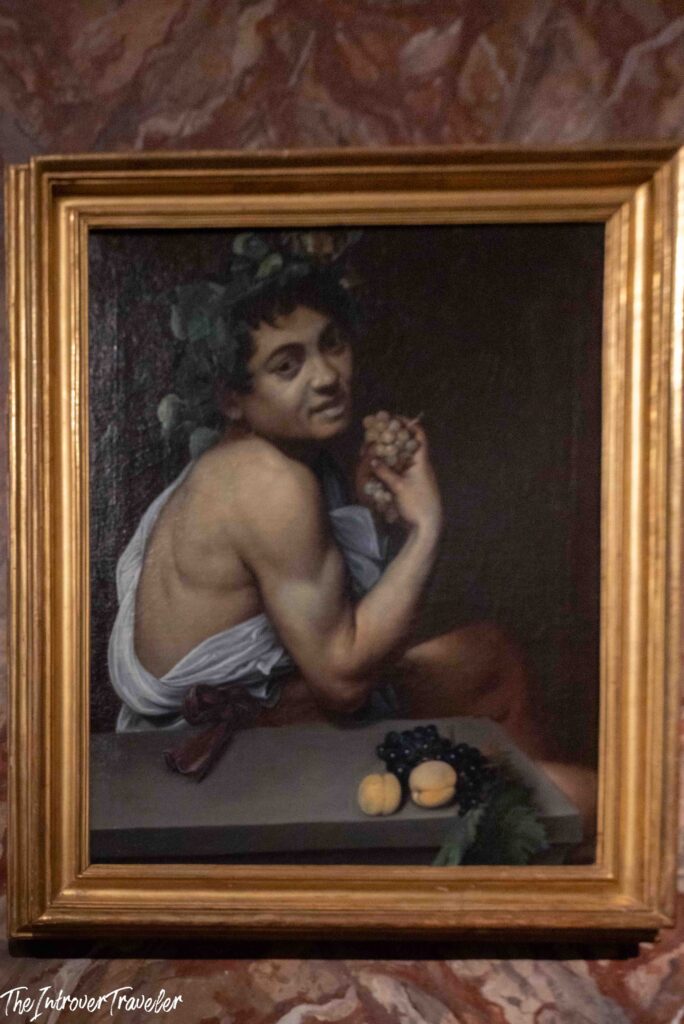
Self-Portrait as Bacchus, known as the Sick Bacchus, oil on canvas, about 1595, 67×53 centimetres. Also from the Arpino seizure. The young man has the attributes of Bacchus and a bluish, unhealthy complexion, in violent contrast with the green grapes in his hand. Critics have recognised a self-portrait here, connecting it to a documented hospital stay of the painter at the Ospedale della Consolazione.
Madonna dei Palafrenieri, oil on canvas, 1605, 292×211 centimetres. Commissioned in the autumn of 1605 by the Archconfraternity of the Papal Grooms for their altar in St Peter’s. In April 1606 the work was shown to the faithful. A few days later it was removed and transferred to the nearby church of Sant’Anna dei Palafrenieri, where Scipione Borghese saw it and bought it for a hundred scudi. The reasons for its removal are still debated: decorum (the Virgin’s neckline, the nakedness of a child no longer in swaddling clothes) or theology. What the picture shows is Mary crushing the serpent with the help of Jesus, assisted by Saint Anne portrayed as an old working woman, her face marked by time. This is Caravaggio’s revolution in a single figure: the grandmother of Christ has the face of a seventy-year-old peasant.
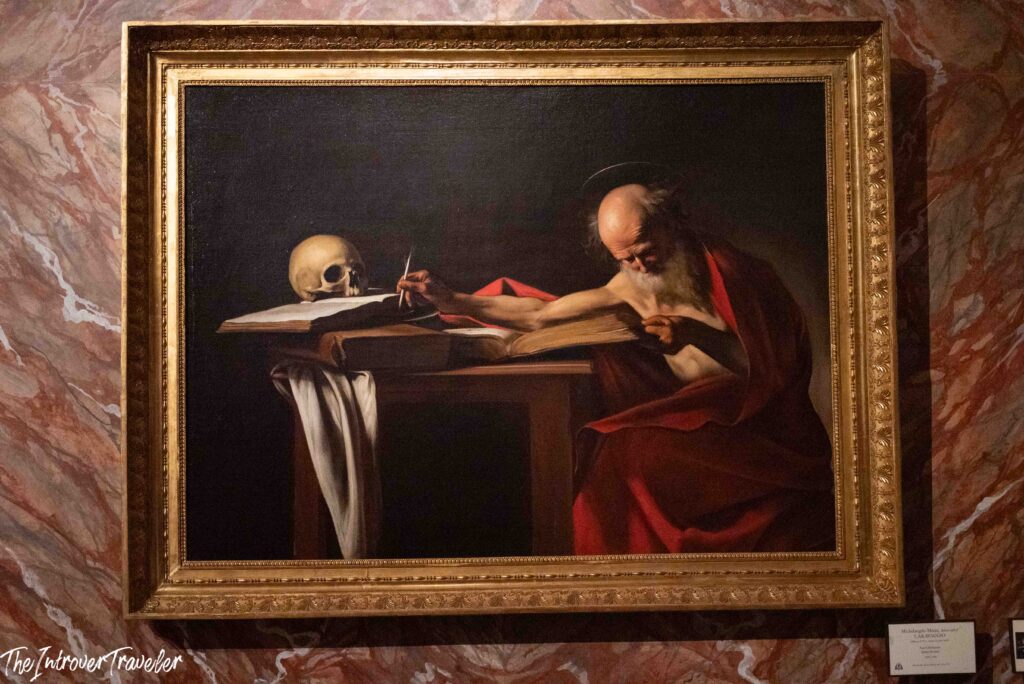
Saint Jerome, oil on canvas, 112×157 centimetres. Painted for Scipione Borghese. The saint writes, stretching out his arm to dip his pen in the inkwell, in an extremely bare interior. His bald head catches the raking light and answers the skull resting on another book. This is the mature Caravaggio, dark palette, no concessions.
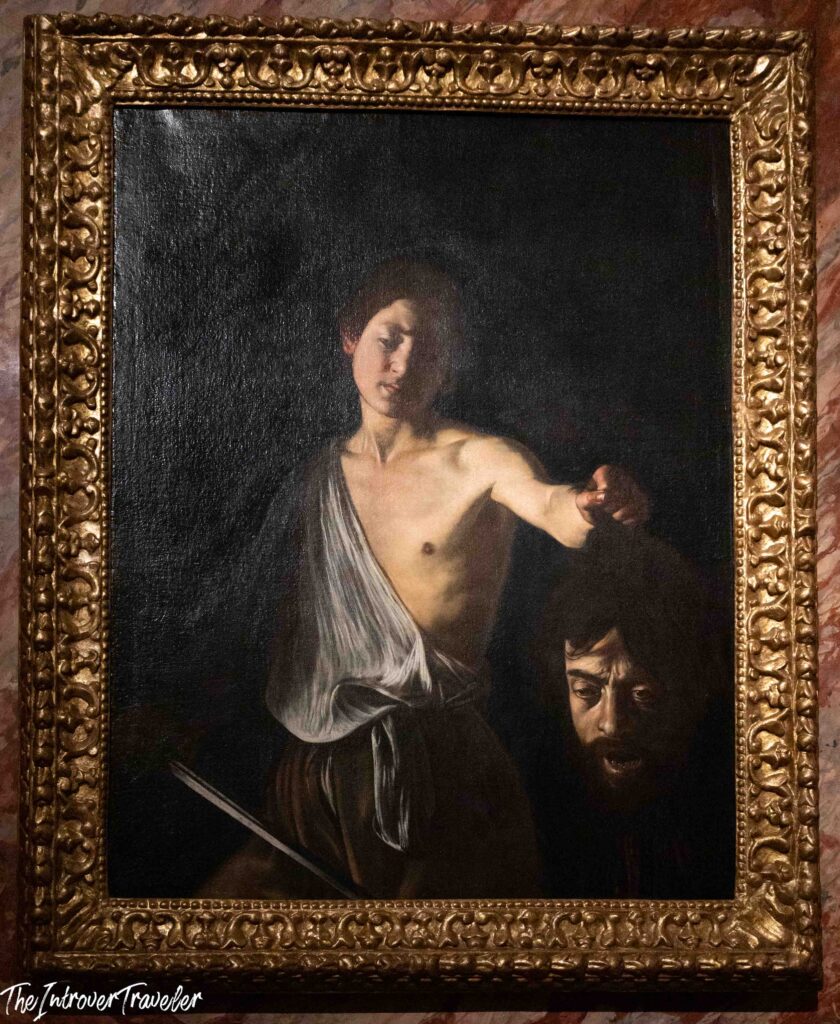
David with the Head of Goliath, oil on canvas, 125×101 centimetres. The dating is one of the great open problems of Caravaggio scholarship, uncertain within a span from 1606 to 1610, the end of the Roman period or the second Neapolitan stay. What is certain is that by 1613 the canvas was already in Scipione’s collection. David does not triumph: he holds the severed head and looks at it with a moved melancholy. In Goliath’s face Caravaggio painted himself; Manilli already noted it in 1650, adding that the David was “his little Caravaggio”. On the blade of the sword appears the abbreviation “H.AS O S”, read by scholars as the Augustinian motto Humilitas Occidit Superbiam. Hence the most widely accepted hypothesis: the picture as a gift to the cardinal, to be passed on to Paul V, in order to obtain a pardon for the killing of Ranuccio Tomassoni. A man under sentence of death who paints himself decapitated and sends the picture to the one person who can save him. In my judgement, the best Caravaggio in the Borghese Gallery.
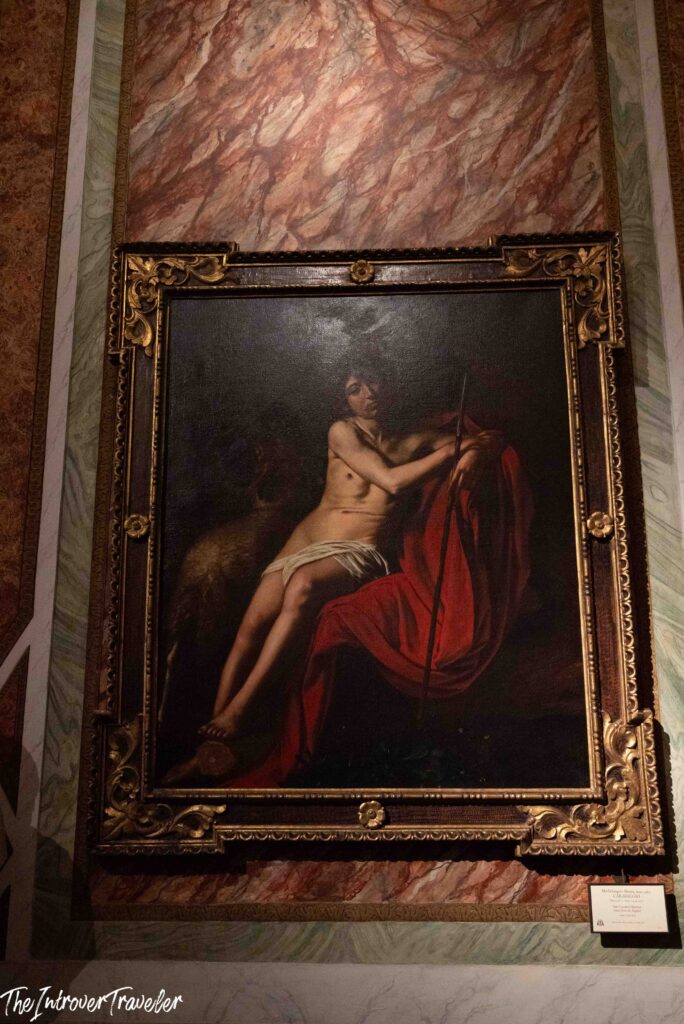
Saint John the Baptist, 1610. An introspective Baptist, lean flesh, a landscape in shadow. Its story is almost more remarkable than the David’s. On 29 July 1610 the bishop of Caserta, Deodato Gentile, wrote to Scipione Borghese that Caravaggio had died at Porto Ercole. The felucca that had carried him to the Tuscan beach had returned to Naples with his belongings, handed over to the Marchesa Costanza Colonna: among the painter’s effects were three pictures, “the two Saint Johns and the Magdalen”. The prior of Capua impounded them, claiming them as the inheritance of the Order of Malta; the viceroy intervened; and in the end one of the two Saint Johns reached Rome. This is it. The last painting by Caravaggio to arrive at its destination, with its author already dead on a beach.
The problem with the room
Here I have to say something awkward.
The Room of the Silenus is not well lit. The six canvases hang on walls with eighteenth-century architectural decoration, in a space conceived in 1775-78 for an entirely different purpose, and the present lighting produces reflections on the painted surface from almost every angle. It is very hard to find a position from which a Caravaggio, that is a painting built on dark grounds and emergent light, can be read without a veil of stray light flattening the blacks and throwing irritating reflections across the surface.
This has a consequence no guidebook writes down and I am happy to write: for the Saint Jerome and the David, the work is objectively easier to read in a good monograph or a high-resolution reproduction from the museum’s own database than in front of the original. It is an unpleasant paradox, but it is true, and denying it only makes people feel inadequate when they stand in front of the canvas unable to see what they have read about. There are works that look irrelevant in the reproductions of a monograph, and there are (rare) cases of works that read better in reproduction (in my view this happens often with El Greco). Personally I find the Borghese Caravaggios generally disappointing, partly for the lighting problem mentioned above, partly because the concentration in a single room and the growing popularity of the maudit artist pack the crowd in front of these few works and make contemplating them harder still.
I am not saying it is the curators’ fault: this is a protected interior, with frescoed vaults and historic walls, where I imagine hanging an LED bar is not straightforward. But the result for someone who has bought a ticket and has two hours does not change.
Disclaimer: my photographs of the works in the Borghese Gallery are terrible, I know. Not because I have a balance problem, but because photographing those pictures means standing at an angle to the surface and tilting the camera until you find the one axis on which the reflection does not cover the painting. I am publishing them as they are, with a certain embarrassment, to give a sense of what the visit is actually like. Anyone after square, clean, properly lit images will find them on Wikipedia or on the collection website.
Correggio’s Danaë: the masterpiece of an underrated colossus
Room 10, Room of Hercules, first floor, above the porphyry fireplace.
Antonio Allegri, known as Correggio, is statistically the great Italian painter the general public knows least about. Everyone knows who Raphael is, everyone knows who Titian is, plenty know who Mantegna is. Of Correggio people vaguely remember, perhaps, the domes in Parma. It is a glaring disproportion, because we are talking about an artist who effectively invented single-handed the illusionistic ceiling that three generations of Baroque painters would copy, who brought into Italian painting a soft, undeclared sensuality with no precedent, and who, when he paints a female body, achieves a softness Titian does not even attempt.
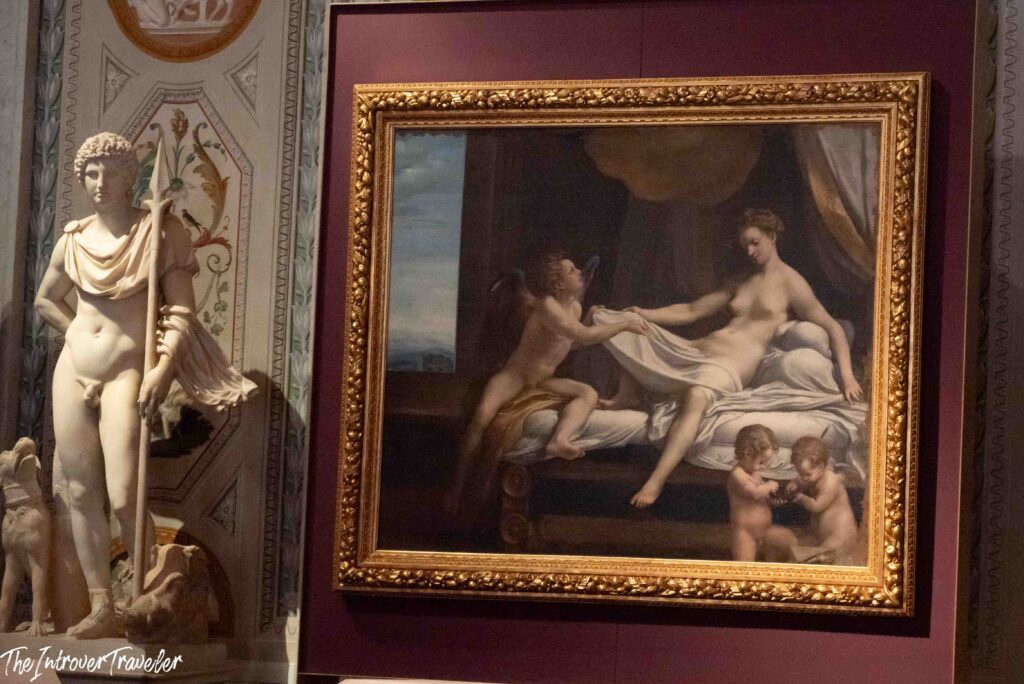
The Danaë was part of a series of four canvases dedicated to the loves of Jupiter, painted for the Duke of Mantua Federico II Gonzaga and given by him to Charles V, perhaps in 1530 and more probably in November 1532. The other three are now Jupiter and Io and Ganymede at the Kunsthistorisches Museum in Vienna, and Leda and the Swan at the Gemäldegalerie in Berlin. Four masterpieces, four different cities.
The subject is Ovidian: Danaë, daughter of King Acrisius, shut in a tower so that she should bear no children, is joined by Jupiter transformed into a shower of gold. The way Correggio handles it is the reason the work is great. No leering, no vulgarity, none of the later Danaës that look like an advertisement for something. The princess lifts a white sheet delicately away from her abdomen, symbol of the virginal veil, to receive the golden cloud that bathes her belly. Beside her a winged youth of dazzling beauty, not some generic cupid but Hymen, protector of marriage, caught as he tests the first drops of rain in the palm of his hand. That gesture sits at the exact centre of the composition and forces the viewer’s gaze downwards towards the woman’s lap. It is a piece of direction of frightening subtlety.
At the lower right, two cupids rub the tip of a dart and a coin on a touchstone, to test the quality of the gold. This is the detail Vasari mentions in the Lives (“who were testing their arrows on a stone”), and it is what made it possible to identify with certainty the picture he described. The meaning is that Jupiter’s love for the princess is genuine, pure, beyond price. The execution of those two children is, in the words of the museum’s own catalogue entry, among the highest achievements in the painter’s output.
And then there is the picture’s own history, which deserves a book on its own. Follow it, because it is a European novel: Federico II Gonzaga, Charles V, then in 1584 the Milanese collection of the sculptor Leone Leoni where Giovanni Paolo Lomazzo saw it, in 1601 the collections of Rudolf II in Prague, in 1648 the Swedish troops who carried it off to Stockholm at the end of the Thirty Years’ War, in 1655 Christina of Sweden who brought it to Rome, in 1689 Cardinal Decio Azzolini to whom the former queen left it, in 1697 Prince Livio Odescalchi, then Pierre Crozat, then Philippe II Duc d’Orléans until 1780, then the London market, the Duke of Bridgewater, Henry Hope, the Paris dealer Bonnemaison, and finally in 1827 Prince Camillo Borghese, who bought it for two hundred and eighty-five pounds.
With one detail I love: in order to bring it into Rome without paying the crushing tax imposed by the papal government, Camillo’s minister, Evasio Gozzani, had it imported under a deliberately false attribution, so that it would slip in unnoticed. One of the most beautiful canvases of the Italian sixteenth century came back to Italy under a false name, as a tax dodge.
A sour note
On my last visit, in November 2024, the Danaë was not visible: the room was being prepared for an exhibition and the picture was screened off behind panels. I managed to steal a photograph with a telephoto lens through a gap between the panels, and that is the one published here: it is not a good photograph, but then all the photographs in this post are terrible.
On the same occasion the Amalthea Goat with the Infant Jupiter and a Young Faun was not on display either, the small group attributed to a very young Bernini (35 centimetres high, dated 1617-1618 or 1622-1623), which for centuries was taken for an antique sculpture. It is a piece that matters, because it is the Bernini who imitates the antique so well that he fools the connoisseurs, which is the technical precondition for everything he did afterwards.
Practical moral: in a museum that hosts temporary exhibitions integrated into the permanent route, some works may be temporarily invisible, moved or screened off. If you are going for one work in particular, try to check in advance.
The other works worth being there for
If the ground floor is largely given over to Bernini’s prodigies and to Caravaggio, the first floor holds a staggering density of masterpieces per square metre. I will summarise them briefly here, partly because a post cannot demand half an hour of reading, partly to indulge my own particular tastes.
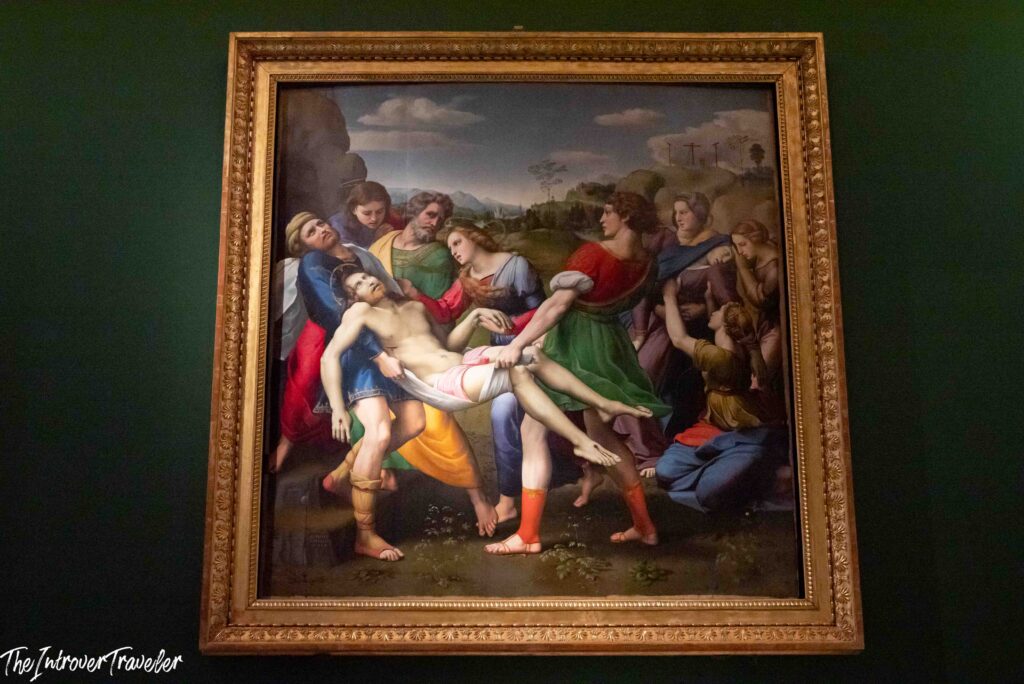
Raphael, Deposition (The Carrying of Christ to the Tomb), 1507. Signed and dated at the lower left in gilded letters: RAPHAEL VRBINAS MDVII. This is the altarpiece stolen from Perugia in 1608 described above. It was the central section of a complex: above it was a lunette with God the Father Blessing, now in the Galleria Nazionale dell’Umbria, and below a predella with the Theological Virtues, now in the Vatican Museums. The work was dismembered and the three pieces are in three different cities.
Look at it knowing two things. The first is that it is a work of rupture: Raphael starts from the traditional scheme of the Lamentation over the Dead Christ and works on it for years, through dozens of preparatory drawings, until he turns it into something new, the “carrying”, where the scene is not static but in motion. The second is that Raphael was twenty-four and openly measuring himself against Michelangelo: the dangling arm of Christ looks to the Vatican Pietà, and the kneeling woman at the lower right repeats the twist of the Virgin in the Doni Tondo. This panel is probably the reason Julius II summoned him to Rome the following year.
It is a work that gives me mixed feelings. I should say in advance that among the great names of the Renaissance, Raphael is not among my favourites. With some exceptions (the prodigious Vatican Stanze, the portrait of Baldassare Castiglione, the portrait of Bindo Altoviti, to name only a few), much of Raphael’s output oscillates between works still too indebted to Perugino and mannered madonnas with pink cheeks. This work is an anomaly in his production, for the reasons I have just given, and it does not look like him. Given that I am not a Raphael enthusiast, while fully acknowledging his immense talent, this ought to be neither a good nor a bad thing, but it leaves me with a vague sense of unease.
In the same Room 9 there is also Raphael’s Lady with a Unicorn (1505-1506), a portrait with an extraordinary history: until 1936 the sitter appeared as Saint Catherine of Alexandria, complete with the wheel of her martyrdom, and only restoration brought the unicorn back to light, while X-rays showed that earlier still, beneath the unicorn, there had been a small dog. Longhi had restored the attribution to Raphael in 1927. Room 9 also holds works of varying quality by Perugino, Botticelli, Pinturicchio and Andrea del Sarto. The ceiling is by Anton von Maron, with five canvases devoted to the story of Aeneas and Dido, among them a Flight of Aeneas from Troy: there is a network of cross-references between the rooms of this house that rewards anyone who follows it.
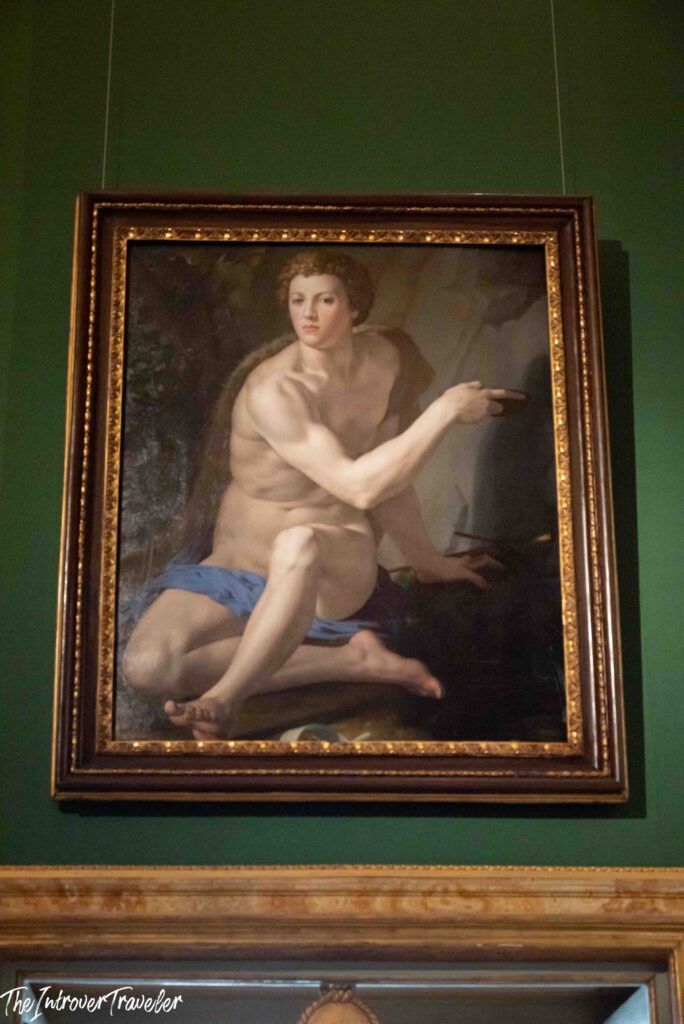
Bronzino, Saint John the Baptist. Bronzino is a passion of mine and I have to be honest: this is not one of his best works. The great Bronzino is the one of the Florentine portraits, of the Eleonoras of Toledo in dresses that look like armour, of the Allegory with Venus and Cupid in the National Gallery, that is of an enamelled coldness that keeps you at a distance and forces you to look. The contorted pose and the polished modelling are here, but the result is more academic than disquieting. It remains a picture with a fine story: it is signed on the stone at the lower left and is thought to be a portrait of Giovanni de’ Medici in the guise of the Baptist, painted to celebrate his appointment as cardinal in 1560 and as archbishop of Pisa the following year. It was already in the Borghese collection by 1610, when a payment of six scudi for the frame is documented. Once again the position, high up above a door, three metres off the ground, does not help you read it.
Lucas Cranach the Elder, Venus and Cupid Carrying a Honeycomb, 1531. The format is anomalous, extremely narrow and tall, forcing the figure into an unnatural vertical. The subject comes from an idyll attributed to Theocritus, summarised in the Latin inscription at the upper right: while Cupid steals honey from the hive, a bee stings him; so too the pleasure we seek is brief, destined to end, and harms us because it is mixed with pain. In the seventeenth century it was displayed opposite the Venus with Two Cupids by Brescianino, a pupil of Andrea del Sarto: two opposite ways, one German and one Tuscan, of painting the same goddess in the same decade. It is a seventeenth-century curatorial pairing that the Gallery has preserved, and it still works.
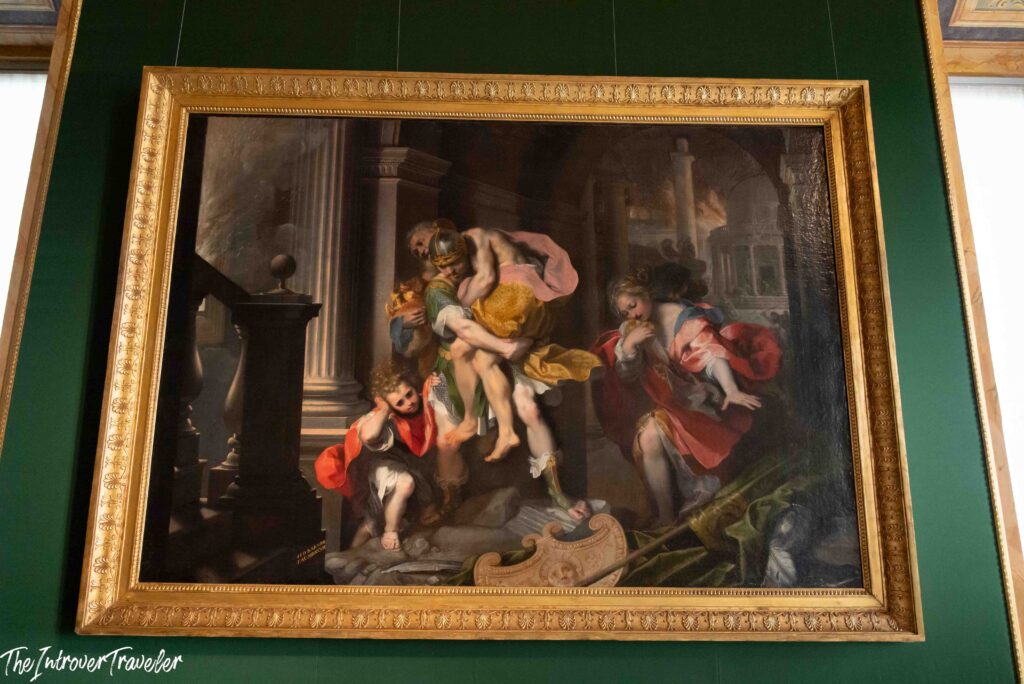
Federico Barocci, Aeneas Fleeing Troy, 1598. Signed and dated. It is the second version of the subject: the first, painted between 1586 and 1589 for the Emperor Rudolf II, is lost. This one was commissioned by Giuliano Della Rovere, who probably gave it to Scipione Borghese, in whose collection it is documented from 1613. It is the only secular subject Barocci painted in his entire career, portraits aside. I mention it because I think Barocci is an important artist who deserves more attention. But not only that: it is probable that this very painting suggested to Scipione Borghese the idea of commissioning from Bernini a marble group on the same subject. If that is the case, the sequence runs: Raphael paints the Fire in the Borgo in the Vatican; Barocci works on it and produces this canvas; Scipione buys the canvas; then he asks a twenty-year-old to translate it into marble; and that twenty-year-old becomes Bernini.
Titian, Sacred and Profane Love, 1514-1515. Two women on either side of a Roman sarcophagus turned into a fountain, one clothed and one naked, a cupid stirring the water. On the meaning there are five centuries of hypotheses and no agreement.
Other names you will meet without looking for them, scattered through the rooms of the first floor: Antonello da Messina, Giovanni Bellini, Lorenzo Lotto, Lanfranco, Domenichino, Dosso Dossi, Parmigianino, Rubens, Veronese, Bassano, Sodoma…
How to organise the visit
On paper the slot lasts two hours. In practice, from my own experience and that of people I know, once you are in nobody comes to check how long you have been there: the limit exists to stagger arrivals, not to clear the rooms with a stopwatch. So two hours is the baseline, two and a half or three are realistic if you want to take your time. That said, it still pays to have an order.
- Arrive fifteen minutes before your slot. The cloakroom is compulsory for backpacks and takes a while.
- Go straight up to the first floor. Against instinct and against the flow. The ground floor has the Bernini sculptures, which are the magnet: 90 per cent of visitors start there, and for the first half hour the ground floor is packed while the upper floor is nearly empty. Invert the order and you get half-empty rooms, and you reach the sculptures once the rush is over.
- First floor, 55-60 minutes. Suggested order: Room 9 (Raphael, Perugino, Pinturicchio, Bronzino), Room 10 (Correggio, Cranach), Room 14 (the Scipione busts, the equestrian model, Lanfranco’s vault, Bernini the painter), Room 20 (Titian). The rest at a glance.
- Go down. Ground floor, 45-50 minutes. Salone of Mariano Rossi (five minutes with your head tipped back, no less), Room 1 (Pauline), Room 2 (David), Room 3 (Apollo and Daphne), Room 4 (Proserpina), Room 6 (Aeneas and Anchises, Truth), Room 8 (the six Caravaggios, and if you agree with me that the works are almost illegible thanks to the lighting, you will give them a few minutes and then go and buy the Gallery catalogue, where you can admire them with a touch of melancholy).
- Last ten minutes: do a quick second lap of the first floor and fill your eyes with beauty before you leave.
If you have time before or after, the park of Villa Borghese is the best thing around it, and the Galleria Nazionale d’Arte Moderna and the Etruscan Museum at Villa Giulia are both within walking distance.
Practical information
Booking. Compulsory for all ticket types, including free tickets and under-18s. There is no way of turning up at the ticket desk and hoping. Slots hold 180 people and at weekends, on public holidays and in high season they sell out weeks ahead. Book as soon as you have the dates of your trip, with weeks to spare.
Where to buy. The official channel is the museum website, purchases section, or the telephone (+39 06 32810, Monday to Friday 9:30-18:00). You can buy a maximum of five tickets at a time.
If the official slots are sold out. It is worth checking the authorised resellers, Tiqets and GetYourGuide first among them. They quite often still have availability on time slots the official site reports as closed, because they work from their own allocations. Two honest warnings: the price is normally higher, because it includes commission and often extras such as an audio guide or a guided tour; and the museum states expressly that it takes no responsibility for tickets sold at a mark-up by third parties. That said, between paying a few euros more and not getting in at all, the choice is easy.
Last-minute tickets. Every day the museum releases a limited number of last-minute tickets at the ticket desk, roughly thirty minutes after the start of each slot. They are not guaranteed and are not available on free-admission days. It is a lottery, not a plan.
Roma Pass. The Gallery is part of the Roma Pass 48 and 72 hours circuit, but booking is still compulsory and must be made by email (romapass@tosc.it) or through the dedicated portal, with the card then presented at the ticket desk for validation.
Frequently asked questions
How long does a visit to the Borghese Gallery take? The slot is two hours (less for the last one, at 17:45), but it mainly exists to stagger arrivals: once inside, nobody checks how long you stay. In practice: two hours is reasonable, two and a half or three is the right amount of time to look properly.
Are two hours enough? Two hours is the right amount of time to see the museum without rushing; three hours is perfect if you want to take all the time you need in front of all your favourite works, and there will be plenty of them, and to take in the building in all its richness.
Can you visit without booking? No. Booking is compulsory for every ticket category, free tickets and minors included. There is a daily allocation of last-minute tickets sold at the ticket desk about half an hour after the start of each slot, but it is not guaranteed and is not available on free-admission days.
How much is a ticket? As of September 2026, when I am writing this, 16 euros full price, 11 euros for the last slot, 2 euros reduced for 18-25 year olds, free under 18. Plus 2 euros of compulsory booking fee for everyone. The price can rise during temporary exhibitions.
Is it true that you can find tickets on Tiqets when the official site is sold out? It happens often. Authorised resellers work from their own allocations and can have availability on slots the official site reports as closed. The price is higher because it includes commission and often extra services.
How many Caravaggios are there? Six, all in Room 8: Boy with a Basket of Fruit, Sick Bacchus, Madonna dei Palafrenieri, Saint Jerome, Saint John the Baptist and David with the Head of Goliath. It is the highest concentration in any single museum in the world. Cardinal Scipione originally owned twelve.
Which is the one work not to miss? It depends what you are after. In terms of sheer popularity, Bernini’s Apollo and Daphne, David and Rape of Proserpina, and Canova’s Pauline Borghese, are the works that bring most visitors here.
Can you take photographs? Yes in the permanent collections, without flash. Normally not in temporary exhibitions. The lighting in the rooms makes it hard to get good images in any case, especially in the Caravaggio room.
Is it suitable for children? Far more than people think. Bernini’s sculptures tell stories, they are large, monumental, and they leave open-mouthed even visitors with no specialist preparation.
Is the building itself worth it? Yes. The frescoed vaults, the polychrome marble, the gladiator mosaic in the floor of the Salone and the eighteenth-century decorative scheme are part of the content, not of the frame.
How can I find all of Bernini’s works in Rome? If you want to explore all of Bernini’s works in Rome in a practical and visually clear way, continue on ArtAtlas: https://artatlas.it/artists/bernini/bernini-in-rome It is one of the most useful ways to see where Bernini’s works are actually located across the city and to build a serious itinerary instead of relying on the usual fragmented lists.
How can I plan an art itinerary in Rome? With Flaneur, the art itinerary engine of The Introvert Traveler. You tell it how many days you have and what kind of traveller you are, from curious beginner to seasoned art lover, and it builds a day-by-day route through the city’s museums, churches and masterpieces, with the same opinionated selection you find on this blog and a curated choice of restaurants along the way. No algorithmic top tens, no tourist traps: just the art worth your time, in an order that makes sense on foot.
If you are planning a trip to Rome you may also be interested in my other Rome posts, and in reserved-entry tickets for the Borghese Gallery.
Related posts:
 Apollo and Daphne by Gian Lorenzo Bernini (Borghese Gallery, Rome): marble on the verge of the impossible
 Bernini and the Barberinis: Art, Power, and Invention in the Baroque. Review of the exhibition at Palazzo Barberini.
 Gian Lorenzo Bernini’s Pluto and Proserpina (Borghese Gallery, Rome): a marble narrative between pathos and technical virtuosity