Last visit: May 2012
My rating: 7/10
Visit duration: 2 hours
Website: https://www.museothyssen.org/en
For whom: only for true art lovers; not recommended for casual tourists
If you find yourself in Madrid and, after visiting the Prado and the Reina Sofía, you’re left overwhelmed by the profusion of spectacular works exhibited by the city’s two main museums, you might feel the need to regain your aesthetic balance. In that case, the Thyssen-Bornemisza Museum is precisely what you need: a quieter, more intimate collection, far from the monumental and emotionally taxing canvases of Goya, Velázquez, Bosch, and Picasso.
Built around the refined collecting taste of one of the most prominent European families of the 20th century, the Thyssen-Bornemisza is a connoisseur’s museum—an understated haven rarely overrun by the shouting of mass tourism, selfie sticks, or compulsive audio guide users.

The ideal pinnacle: Portrait of Giovanna Tornabuoni by Domenico Ghirlandaio
At the heart of the collection, set like a gem among the Renaissance rooms, lies what I consider the museum’s finest masterpiece: The Portrait of Giovanna Tornabuoni by Domenico Ghirlandaio. The young wife of Lorenzo Tornabuoni, who died prematurely, is here immortalized in the austere iconographic tradition of the Medici: shown in profile like an imperial coin, with the hieratic and timeless posture of a classical heroine.
It is a portrait in which every element is calibrated to convey nobility and gravitas: the sumptuous yet modest attire, the gold embroidery, the cameo depicting a classical figure on her chest, the Latin inscription behind her that serves as an epitaph, and the dark background from which emerge—like apparitions—an ancient amphora and a prayer book, alluding respectively to the deceased’s beauty and piety. Ghirlandaio does not idealize, he sublimates: Giovanna is no longer merely a woman, but an effigy—no longer a person, but an archetype of feminine virtue according to the moral code of 15th-century Florence.
The painting, in excellent condition, is a consummate example of Ghirlandaio’s plastic virtuosity. He does not confine himself to calligraphic precision, but rather places his technical skill at the service of symbolic representation. On a purely aesthetic level, the work is a true visual feast: from the richness of the brocade, to the purity of the complexion, to the tactile realism of the braids.
Anyone who, like me, has a soft spot for profile portraits of women from the early Renaissance will surely delight in comparing this one with the portraits by Antonio del Pollaiuolo, housed at the Metropolitan Museum and the Museo Poldi Pezzoli in Milan; or with Alesso Baldovinetti’s portrait at the National Gallery; or again with the Portrait of Battista Sforza by Piero della Francesca at the Uffizi.
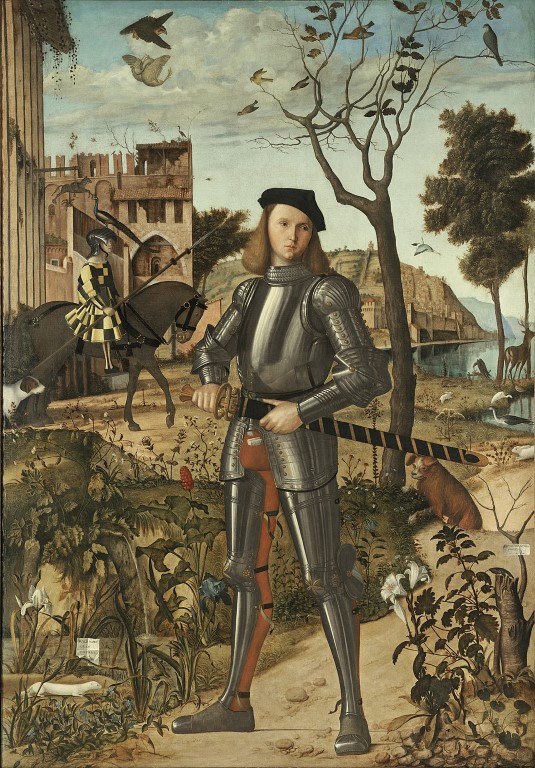
Chivalric Humanism: The Knight by Vittore Carpaccio
Equally precious, though less familiar to the general public, is Portrait of a Knight by Vittore Carpaccio. The man—stern, hieratic, armed yet motionless—emerges with quiet composure, set against a background imbued with a quasi-metaphysical atmosphere. The landscape is rendered with meticulous detail: a garden populated by symbolic animals, classical ruins so dear to Venetian painting from the 16th to the 18th century, and troubled skies. As often in Carpaccio’s work, the portrait serves as a pretext for allegorical meditation: the figure is less an individual than the embodiment of an ideal of civic and chivalric virtue.
For my personal taste, this is among the finest works by the Venetian painter—whether for its perspectival coherence, the sculptural rendering of the armor, the lush richness of the landscape, or the overall composition, which, while somewhat chaotic, proves ultimately effective.
The itinerary, built and verified
An art lover planning a trip to Madrid?
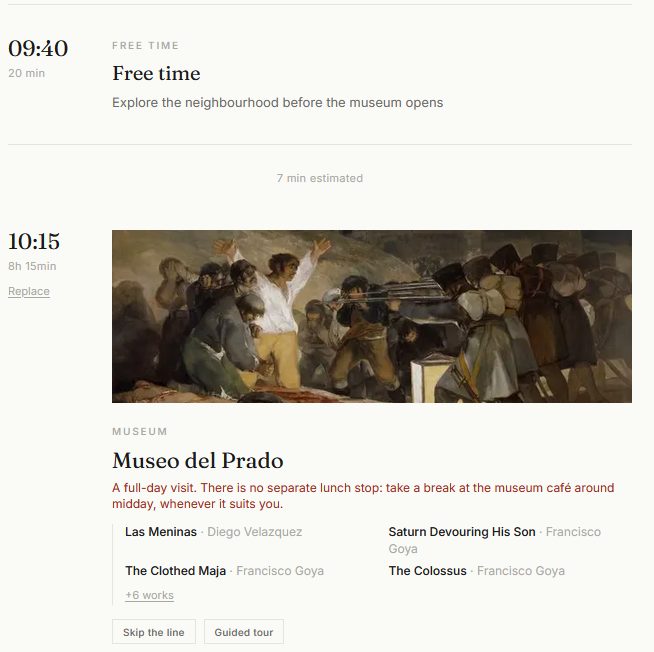
The Golden Triangle alone is three world-class museums a few minutes apart: the Prado for Velazquez, Goya and Bosch, the Reina Sofia for Guernica, the Thyssen-Bornemisza for the sweep in between. But Madrid does not end at the Paseo del Arte. Goya frescoed a whole ceiling at San Antonio de la Florida, where he is also buried; Sorolla’s house is kept much as he left it; a Bosch hangs quietly at the Lazaro Galdiano. A general-purpose AI will point you at the big three and stop there.
Flâneur does not. Tell it whether you are Curious, an Enthusiast or an Expert, pick the works and the rooms that matter to you, and it builds the day around them: real opening hours, the Reina Sofia’s Tuesday closure that the Prado does not share, the walks between the smaller museums that keep their own days, even the gaps of free time before a museum opens. Checked stop by stop, not guessed at, complete with meal breaks and booking links. Pick the Expert profile and you compose the day yourself, choosing from every work indexed across the city, with a depth, flexibility and precision no chatbot can match.
The Violence of the Sacred: Saint Catherine by Caravaggio
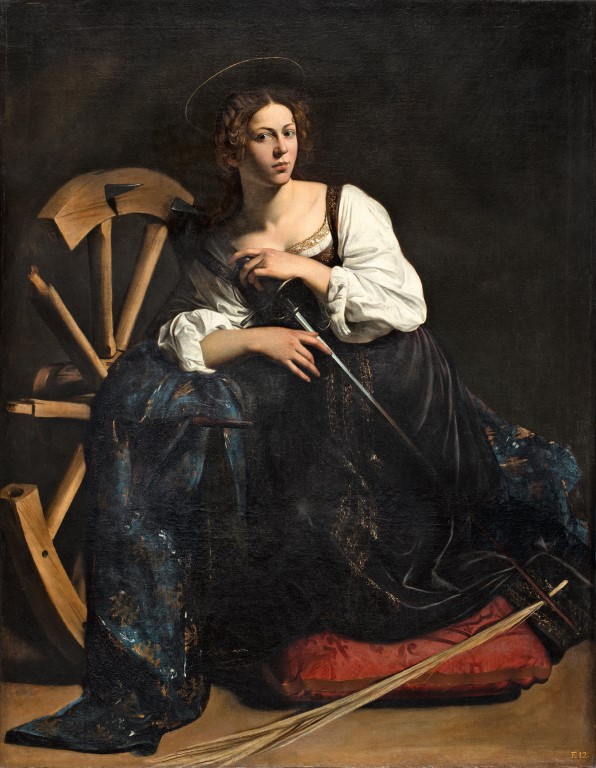
In radical contrast to Ghirlandaio’s rarefied abstraction and Carpaccio’s moralized allegory, we now encounter Caravaggio and his Saint Catherine of Alexandria. Here, the saint is no longer an ethereal emblem of virtue, but a living, carnal, tangible being—true to Caravaggio’s popular and visceral style. The figure—reportedly modeled on a Roman prostitute, as is typical in Caravaggesque iconography—holds the sword and the spiked wheel of her martyrdom, but her melancholic gaze, the polished smoothness of her skin, and the raking light that enhances her corporeality all speak a language that is profoundly human and dramatically immediate. The saint is no longer a symbol, but a lived experience.
Stylistically, the work reminds me—due to its chromatic affinities—of the Madonna of the Pilgrims in the Basilica of Sant’Agostino in Rome. On the narrative level, it almost feels like a prelude to the more famous Judith Beheading Holofernes at Palazzo Barberini.
Other Notable Works of the Thyssen Bornemisza museum in Madrid
Rembrandt’s Self-Portrait: Among the countless self-portraits by Rembrandt, this is certainly not my favorite; the features feel somewhat muted, and the miraculous play of light that defines the Dutch master is notably absent. And yet, I can’t help but feel a thrill every time a Rembrandt appears on a museum wall.
Fragonard’s The Swing: An artist I’ve always regarded with a certain condescension, but who has recently begun to pique my interest. Here, despite the quintessential Rococo frivolity, there’s a particularly velvety touch; the application of oil paint is so delicate it at times resembles watercolor.
Degas’ Ballerina: More than a portrait, it’s a snapshot of a gesture. The tutu is a vibrant, almost elusive stroke—suggesting that true art can never be fully grasped. The colors are unusually saturated for Degas, evoking, in some ways, a Saul Leiter photograph.
John Singer Sargent: I tend to think of Sargent as a Giovanni Boldini who didn’t quite believe in himself, yet the elegance of some of his works is undeniable. His portrait of the Duchess of Sutherland is pleasing in its exploration of infinite shades of green.
Paul Klee: Childlike and intellectual as always, here he seems almost to be flirting with Cubism, using warm earth and brick tones.
Francis Bacon: The Portrait of George Dyer is yet another variation on Bacon’s signature theme—disjointed, screaming figures trapped in existential cages. Two unusual aspects stand out here: first, the color palette, uncharacteristically luminous and soft; second, the motif of mirrors and reflections, which I find particularly fascinating across all visual arts—from Parmigianino’s Self-Portrait, to Velázquez’s Las Meninas, from Vivian Maier’s mirrored self-portraits to Orson Welles’ cinematic labyrinths.
Thyssen-Bornemisza Museum. Conclusion
The Thyssen Bornemisza Museum in Madrid is a small, niche institution, built primarily around the private collection of the Thyssen family. Those interested in taking selfies in front of iconic masterpieces can safely look elsewhere, while true art lovers will find here a delightful diversion from the more renowned museums of the Spanish capital.