Santa Prassede on the Esquiline: the Chapel of San Zeno, the mosaics of Pope Paschal I, a “Cosmatesque” floor younger than the Titanic and a bust carved by a teenage Bernini. An honest guide to one of the most beautiful and least crowded churches in Rome.
Walk out of Termini station. You have just dodged an unlicensed taxi driver, two phone-case sellers and a man having a heated argument with a pigeon. Walk for less than ten minutes towards Santa Maria Maggiore, turn into a side street that seems designed specifically not to be noticed, push open a wooden door in an anonymous side wall, and you find yourself in the year 817.
This is not a figure of speech. It is chronological accounting. What you have above your head was put together tile by tile when Charlemagne had been dead for three years, Venice was a village on stilts with ambitions and, in Constantinople, an emperor was having sacred images scraped off the walls. Rome, at that very moment, was gluing them on in gold.
This is the thrill of Santa Prassede in Rome, and it is a very specific thrill: not the thrill of grandeur (for that there’s St Peter’s, with its queues and metal detectors), but the thrill of survival. A basilica from the dawn of the Christian Middle Ages, with a Byzantine soul, which has reached us almost by accident, three minutes’ walk from one of the four papal basilicas that steals all its tourists.
The itinerary, built and verified
Planning a trip to Rome?
Art is the reason you’re going to Rome? Flâneur is the art itinerary generator built on The Introvert Traveler’s research: every place in the city where art is worth your time, including the minor churches, side chapels and small museums nobody tells you about, organized into an efficient personalized Rome art itinerary. Answer a few questions about how deep your interest runs and what your days should look like, and it maps the route, complete with real opening hours, church closures, transfer times and booking links.
Meals aren’t left to chance either: lunch and dinner breaks come from the restaurants recommended on this blog, not from whoever bought the top spot on a review site. Prefer to compose the day yourself? Pick the Expert profile and choose from every artwork indexed in Rome.
In Brief: The Verdict in Thirty Seconds
- Rating: 9/10
- Time needed: 20 minutes. Half an hour if you stop in front of the Chapel of San Zeno properly, that is, until you run out of coins.
- Ticket: free. But bring 1 and 2 euro coins: the chapel lights are coin-operated. In Rome, Paradise has a meter.
- Address: Via di Santa Prassede 9/a. You enter through the side door; the monumental entrance on Via di San Martino ai Monti is normally closed.
- Opening hours (updated October 2026): usually open in the morning and afternoon, with a lunch break. Sources disagree on exact times and services change them: check before you go.
- Who it’s for: anyone who loved Ravenna, Monreale or the Chora in Istanbul; anyone looking for the Rome that isn’t on Instagram; anyone who wants to understand what happens to art when East and West talk to each other.
- Who it’s not for: people who only walk into a church if there’s a Caravaggio. There is no Caravaggio here, and thankfully no crowd either.
- The most useful tip in this article: don’t photograph the nave floor thinking you’re capturing a medieval masterpiece. It dates from 1916-1918. The real medieval pieces are elsewhere, and I’ll point you to them below.
Year 817: A Pope, a Lorry-Load of Bones and a Team of Mosaicists
To understand Santa Prassede, you have to understand Paschal I, pope from 817 to 824. A saint, for the record. And this is where the fun begins.
Paschal was a man with two obsessions. The first: relics. Ninth-century Rome had a logistical problem: the catacombs outside the walls were full of martyrs and far from safe, and a pope with even a modicum of business sense understood that the holy bodies had to be brought inside the city, where pilgrims could venerate them without the risk of being robbed on the Via Salaria. So Paschal did what a modern manager would call “asset consolidation”: an inscription preserved in the basilica records the transfer of the relics of 2,300 saints, names 86 of them and specifies where the remains of St Zeno were placed. Two thousand three hundred. It is the most macabre house move in the history of art, and it is the reason this church exists in the form you see.
The second obsession: mosaics. Besides Santa Prassede, Paschal rebuilt Santa Cecilia in Trastevere and Santa Maria in Domnica, and in all three he left his own portrait. Holding a model of the church, like a developer presenting a rendering to the planning committee.
Then there’s the part you won’t find on the information panels, cosmetically airbrushed out. In 823, two senior officials of the papal palace, leaders of the pro-Frankish faction, were blinded and killed by the pope’s servants. Paschal was accused of ordering it; he got away with an oath of purgation before a synod of thirty-four bishops, and the imperial commission went back to Aachen without punishing anyone. He died the following year. Today he is a saint, with his feast day on 14 May. I confess a certain professional admiration: an oath of purgation is, in essence, a self-certification. The Middle Ages got there twelve centuries before Italy’s self-certification law, and with far better results for the declarant.
The “Byzantine Contamination”: Why Rome Breathes Constantinople
While Paschal was renovating Rome, the second wave of Iconoclasm was raging in Constantinople: Emperor Leo V the Armenian had reopened the war on sacred images. Paschal sided with Theodore the Studite and the defenders of icons, sent legates to Constantinople to no avail, and welcomed fleeing Greek monks to Rome, housing them in the monasteries he was founding.
Here is the contamination. The mosaics of Santa Prassede are not “Byzantine” in the way the Chora’s are: there is none of the almost painterly refinement of the Palaiologan era, nor the industrial scale of Monreale with its 6,500 square metres of tesserae. They are something stranger and, to me, more moving: an Eastern language spoken with a Roman accent, by a city that at that moment was watching from a safe distance as the East destroyed its own works of art. In Constantinople they were scraping them off the walls. Here they were making them bigger.
There is a historical irony that should give pause to anyone who talks about “defending identity” today: the most Byzantine moment in Roman art coincides with the moment Byzantium was disowning its own art. Identity, it seems, survives better in exile.
The Apse and the Arches: A Copy, and Thankfully It Shows
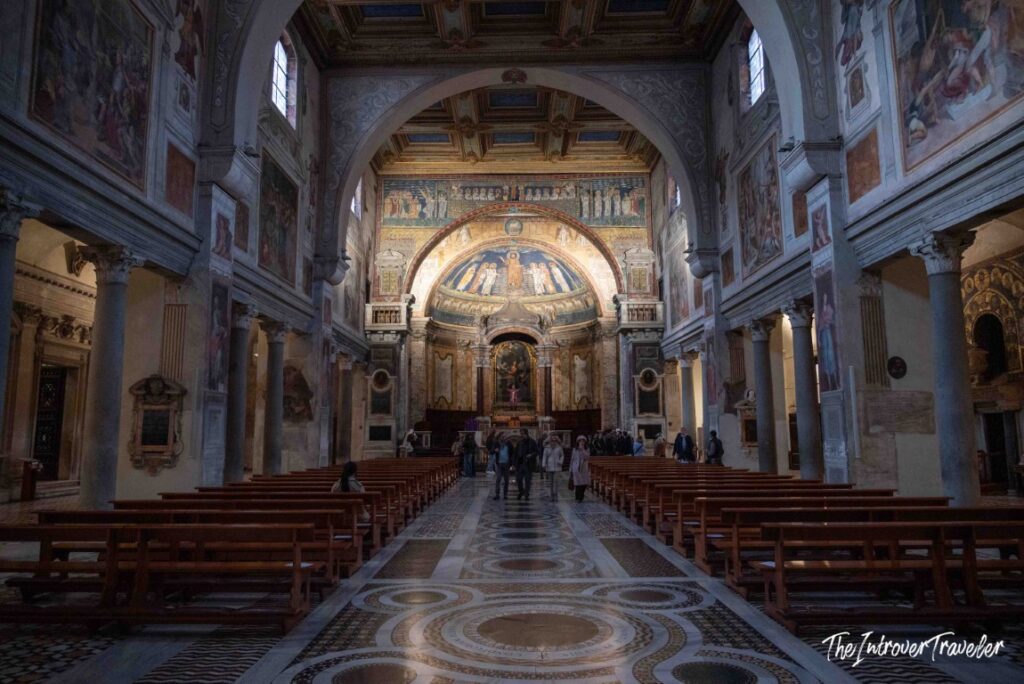
Walk in, let your eyes adjust to the darkness, and look towards the end of the church.
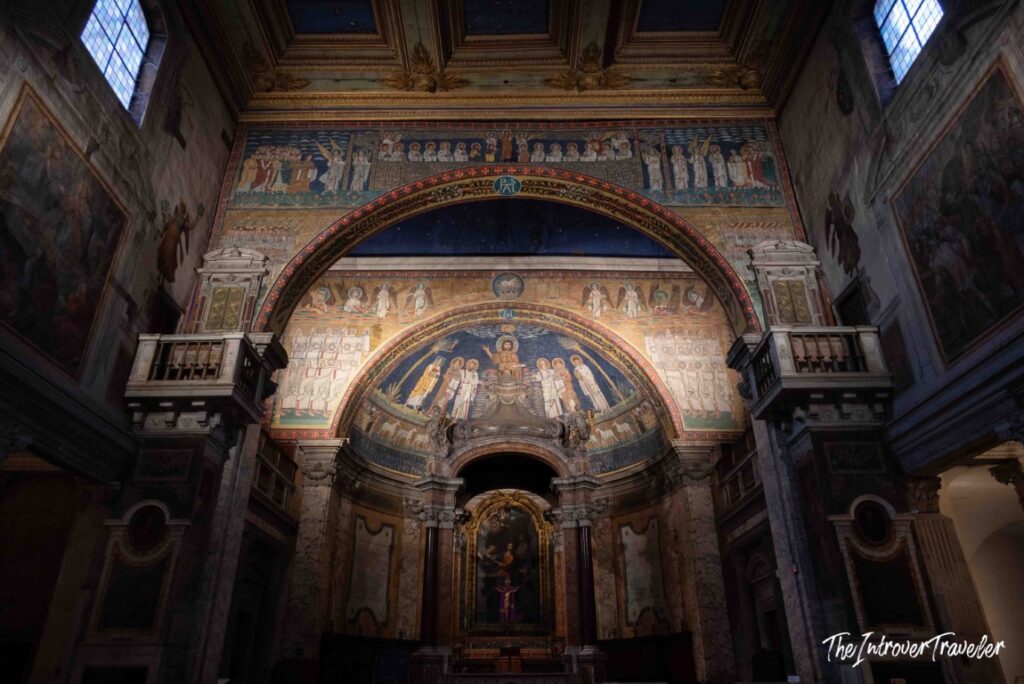
The apse vault reproduces almost literally the composition of Santi Cosma e Damiano in the Forum, a sixth-century mosaic: Christ in the centre against a blue sky streaked with reddish clouds, Peter and Paul presenting Saints Praxedes and Pudentiana, and two more figures at the sides. On the left, Paschal I with the model of the church and a square halo, which in the visual grammar of the time signals that the subject was alive when the mosaic was made (at least according to a traditional interpretation that is now being questioned). It is, in practice, the “staff” badge of commissioning popes. Below, a long inscription in which Paschal declares that he gathered the bodies of many saints here, trusting that this would earn him access to the heavenly dwelling. The first otherworldly planning amnesty in history: I build you a church, you open the gate for me.
If you have seen Santi Cosma e Damiano, the comparison is merciless, and all the more instructive for it. Three centuries later, the figures have flattened, the outlines have hardened, the drapery has lost its volume and become drawing. A purist would say “decadence”. I say it is the exact moment when art stops imitating the body and starts imitating the idea. From here to medieval painting is a straight line.
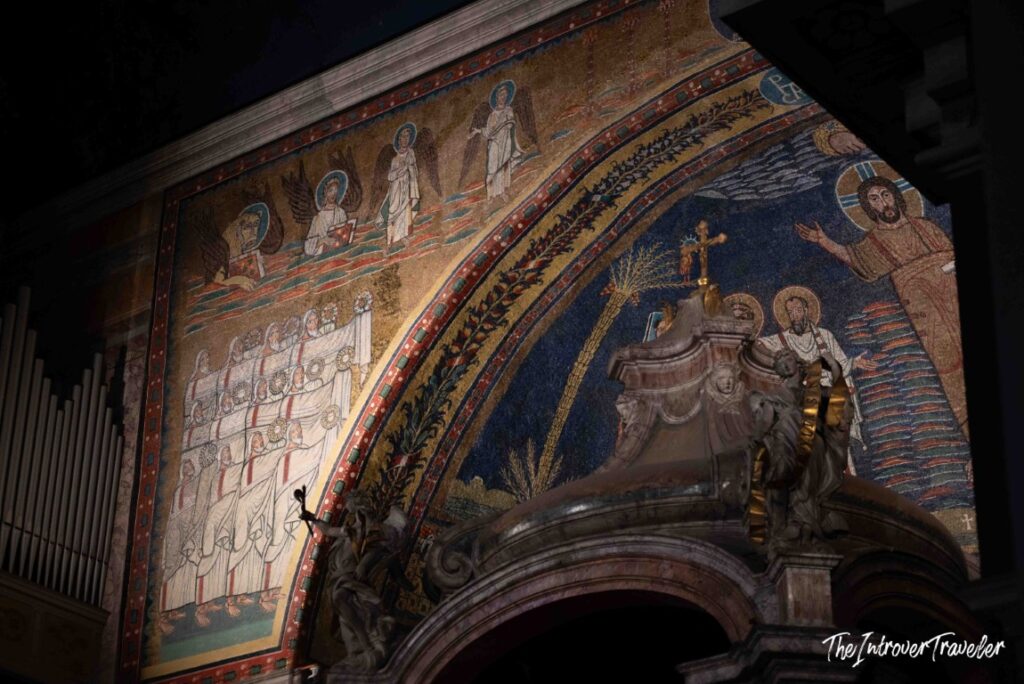
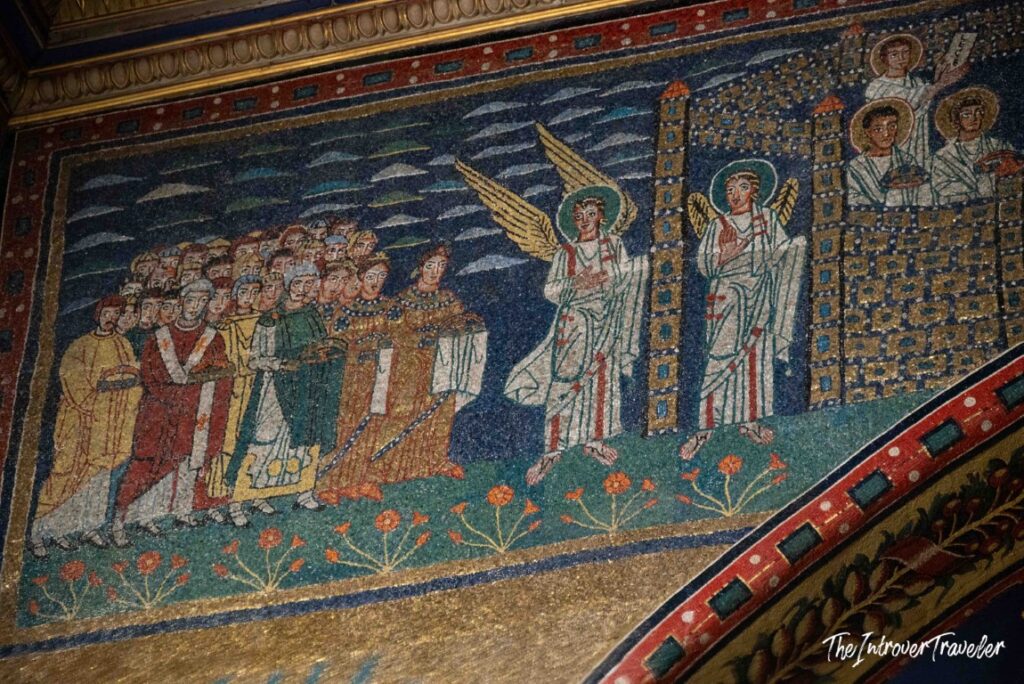
The apse arch and the triumphal arch are the part I enjoyed most. On the triumphal arch is the Heavenly Jerusalem: a walled city, studded with gems, with angels at the gates vetting entry and a crowd of the elect queuing with crowns in hand. It is the first gated community in Western history, complete with winged bouncers and a guest list. Those inside stay inside; those outside wait for judgement. It’s hard to tell whether it’s theology or a Saturday night outside a club in Testaccio, but the effect is identical.
On the apse arch, on either side, the twenty-four Elders of the Apocalypse offer their crowns to the Lamb, in white rows so regular they look like a choir of minor canons. From below, with the lighting as it is, many details are lost: this is the half point I deduct from the rating, and I’ll come back to it.
A curiosity that won’t weigh you down: according to the most recent studies, the mosaic decoration of the basilica was completed in about a year, between 817 and 818, and that of the Chapel of San Zeno the following year. In a country where it now takes six years to rebuild a roundabout, this is more supernatural than the Apocalypse itself.
The Chapel of San Zeno: Coin-Operated Paradise
And here we are at the reason you came, even if you don’t know it yet.
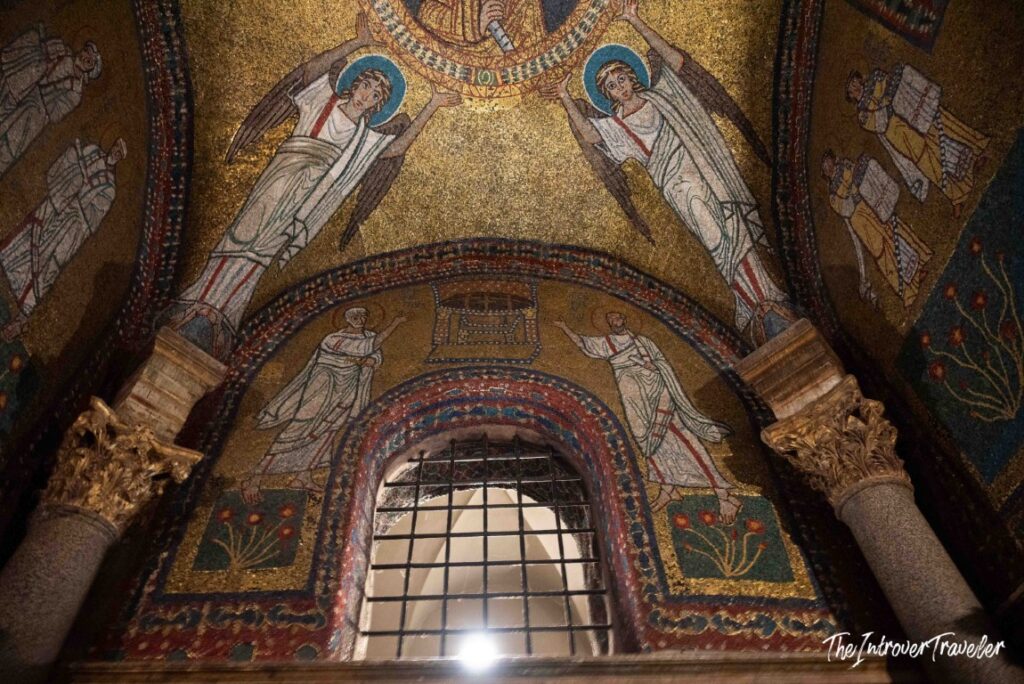
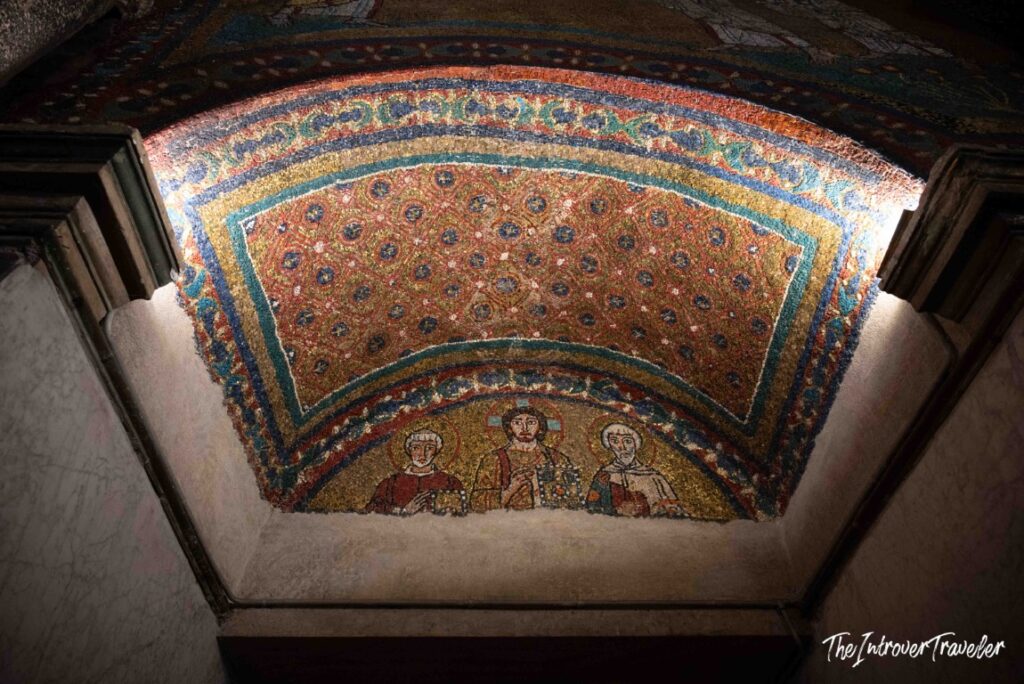
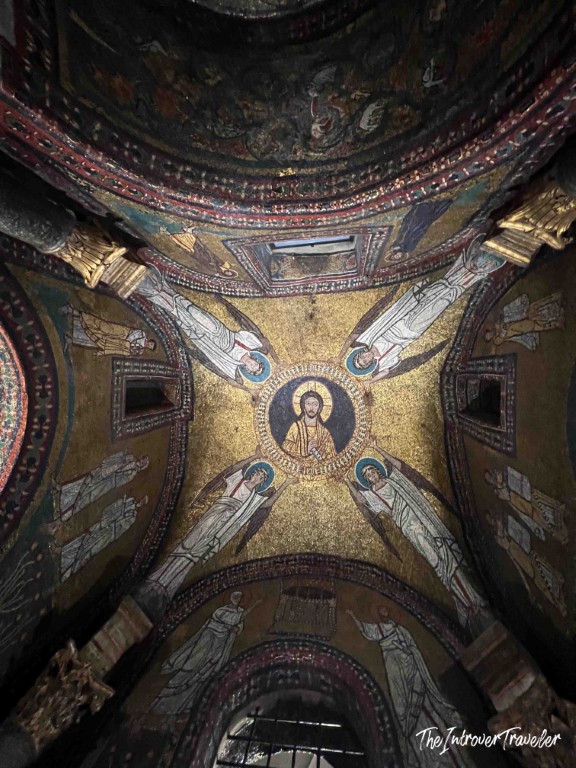
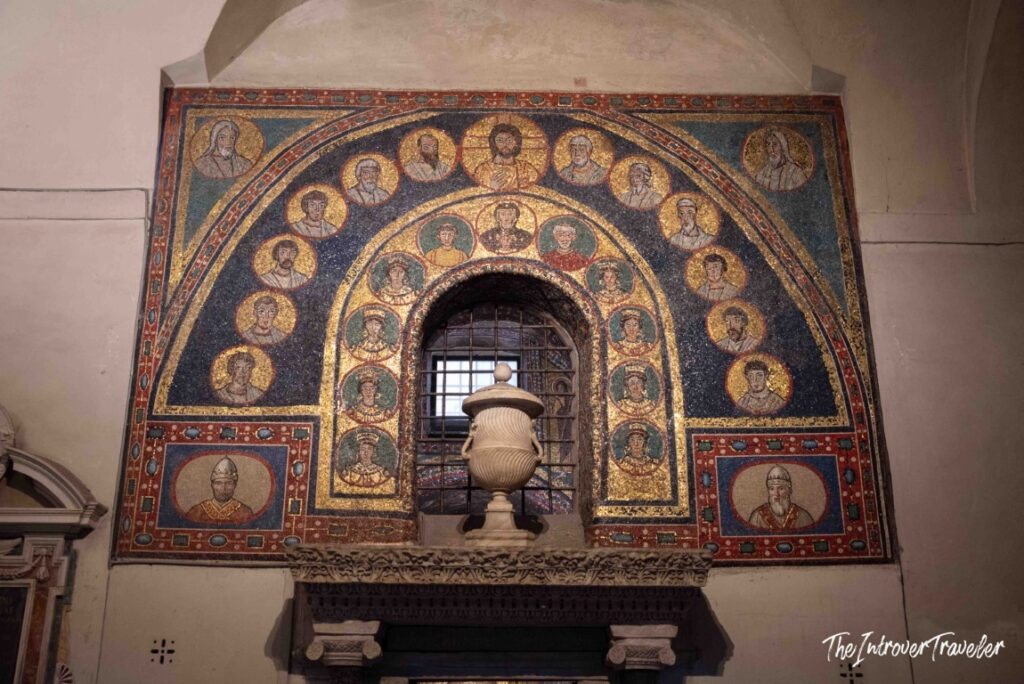
Halfway down the right aisle is a doorway framed by two ancient columns and topped by an urn, surrounded by a double row of mosaic medallions: Christ and the apostles in the outer ring, the Virgin and female saints in the inner one.
Paschal built this chapel as a mausoleum for his mother, Theodora. The first documented case of papal funerary nepotism? Probably not, but certainly the most beautiful. Next to the entrance there is a little machine: you put in a euro, the light comes on, and for a few minutes you enter what since the Middle Ages has been nicknamed the Hortus Paradisi, the Garden of Paradise.
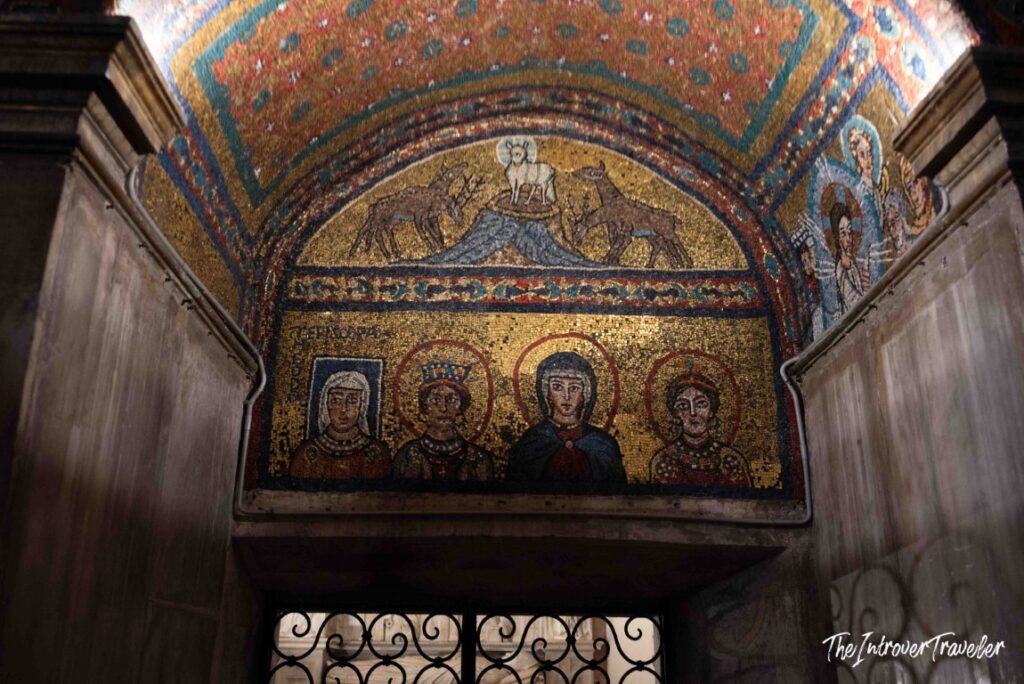
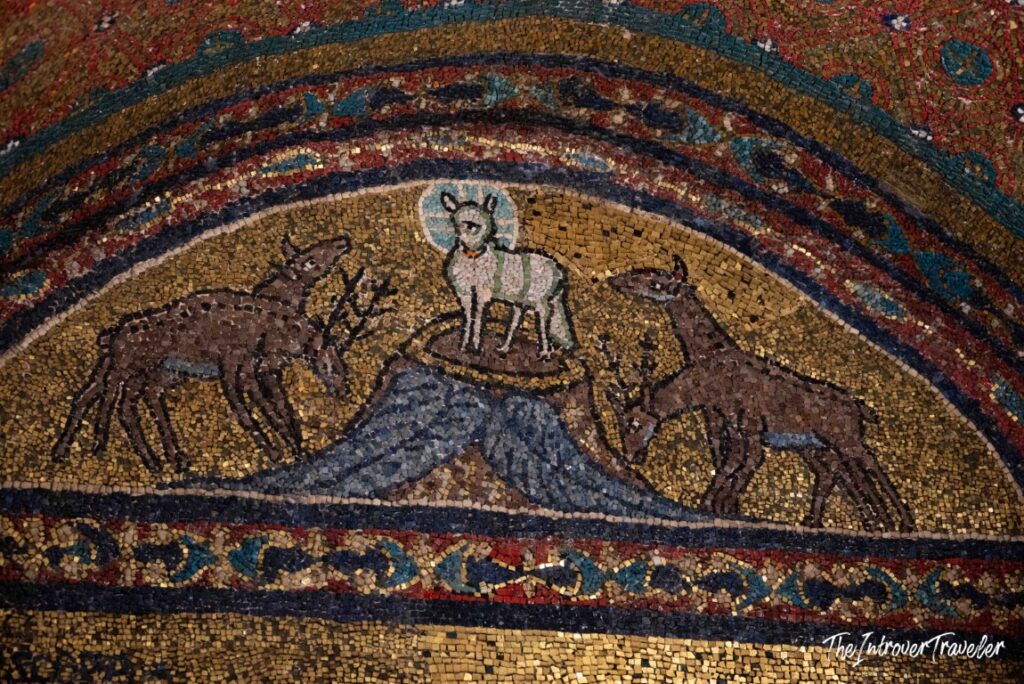
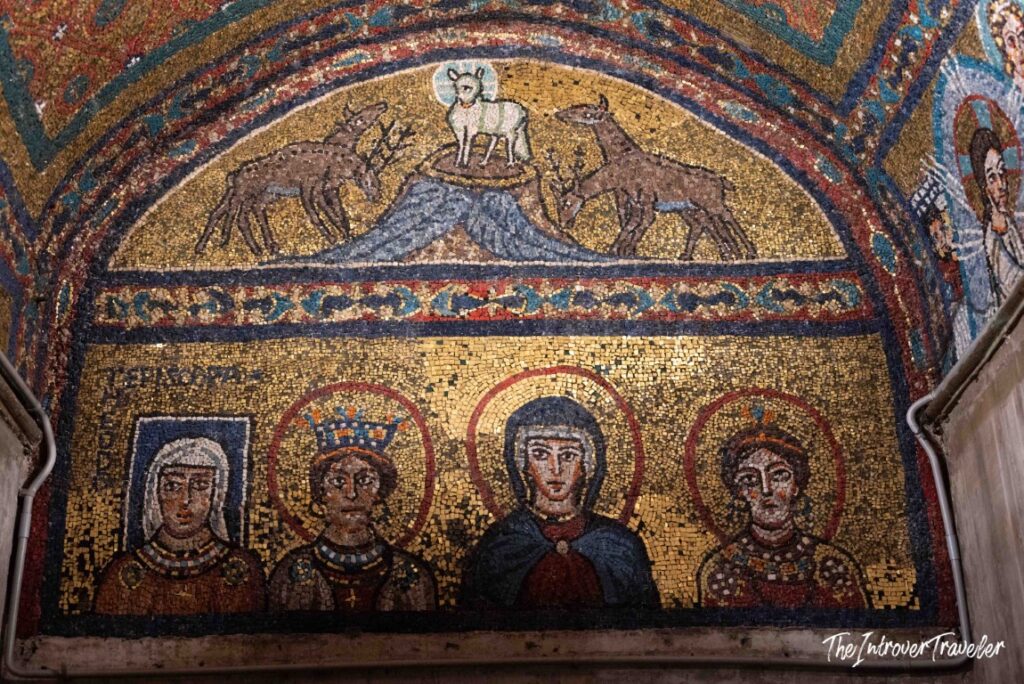
It is a box a few metres across, entirely lined with gold. In the vault, four standing angels hold up a medallion of Christ, like celestial caryatids. On the walls, male and female saints, the Lamb on a mountain from which the four rivers of Paradise flow, with deer drinking from them. A thread of natural light comes in through the small window and, when the machine switches off, it becomes the only source: and that’s when you understand why the Byzantines considered gold not a colour but a form of light.
The comparison is inevitable, so let’s make it. Monreale is vaster, Ravenna older and richer, the Chora more refined and more human. But none of those places shuts you inside the gold in such a small space. At Monreale you look at Paradise from the outside, like a spectator. At San Zeno you’re inside it, like an embarrassed guest at a party that’s too smart for you.
I’ve already written a Rant about monuments that only show you their treasures if you’ve had the foresight to bring 15 euros in 50-cent coins, so I won’t dwell on it.
Theodora “Episcopa”: The Woman Bishop Who Gives Theologians a Headache
On the left wall, four female busts on a gold ground. From the right: Pudentiana, the Virgin, Praxedes and, at the far end, a woman with a white veil and a square halo, that is, alive when the mosaic was made. Beside her, the inscription: Theodora episcopa.
Episcopa. Feminine of episcopus. Bishop.
This is where art history becomes a minefield. The traditional reading holds that the title was honorific, meaning “mother of the bishop”, since the Bishop of Rome was her son. The alternative reading points out an inconvenient detail: Paschal’s father, Bonosus, is never called episcopus, so perhaps the title was not merely a reflection of the son. Some even suggest the inscription was altered at a later date from an illegible original.
I won’t tell you which side to take, because nobody knows for certain. I’ll just say that it’s rather amusing that the most debated iconographic evidence for women holding episcopal roles in the Church of Rome sits inside a chapel built by a pope, a few hundred metres from a papal basilica, and that almost nobody goes in.
The Column of the Flagellation: Faith, Logistics and a Pinch of Scepticism
In a small room next to the chapel is the fragment of column that tradition identifies as the one Christ was bound to for the flagellation, brought to Rome in 1223 by Cardinal Giovanni Colonna, titular cardinal of none other than Santa Prassede. The cardinal’s name (Colonna means “column”) and the nature of the relic coincide in a way no copywriter would have dared.
As for authenticity, even the most serious Catholic sources admit there is no proof and that plenty of objects with the same claim circulated in the Middle Ages. It is the same economy that produced enough fragments of the True Cross to build, as someone once said, a fleet. Look at it as you would a historical document on the thirteenth-century relic trade: in that sense, it is entirely authentic.
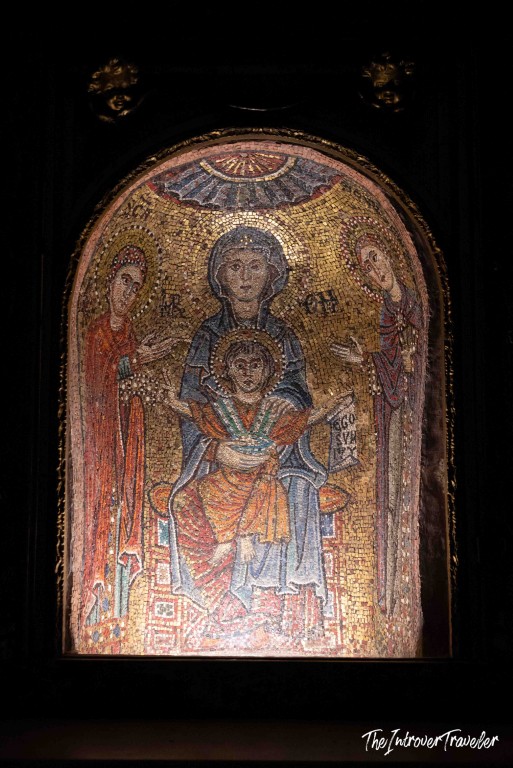
The other presence in the chapel, the niche with the Madonna and Child between Praxedes and Pudentiana, is a thirteenth-century addition, and it shows: the figures are softer, the faces more expressive, the language already the one that will lead to Cavallini and, further on, to Giotto. Four centuries of art history in a square metre.
The “Cosmatesque” Floor: Rome’s Most Honest Fake
Go back into the nave and look down. A splendid floor, inlaid with coloured marble, porphyry roundels, geometric bands. Everyone photographs it (and I fell for it too, visiting the church before researching this post) thinking: Cosmati, thirteenth century, Middle Ages.
No. The nave floor was relaid in neo-Cosmatesque style in 1918, replacing an eighteenth-century floor of marble slabs. It is younger than the Titanic. It is a fake with a pedigree, made in the middle of the First World War by a superintendent who wanted to give the church a “medieval” look which, in that form, it had never had.
I find it marvellous for precisely that reason. Twentieth-century Italy spent decades “restoring” churches by stripping out the Baroque to invent a Middle Ages more medieval than the Middle Ages; the entire city of Bologna is the product of an urban revolution carried out around the turn of the century to give it a “more medieval” image. Santa Prassede is one of the most successful cases: a fake floor that tells the truth about the taste of an era. During that work, incidentally, fragments of early medieval church furnishings re-emerged from the old floor levels and were later arranged in the Chapel of the Crucifix.
In the middle, towards the old entrance, a large red porphyry disc covers the well into which, according to legend, Praxedes poured the blood of the martyrs she had collected with a sponge. Legend, precisely: the historical existence of the two sisters is extremely shaky, and according to a widely held theory the very name Pudentiana may derive from the adjective that designated the ecclesia Pudentiana, the church of Pudens. A saint born of a grammatical error. Careers have been built on less.
Where to Find the Real Cosmati
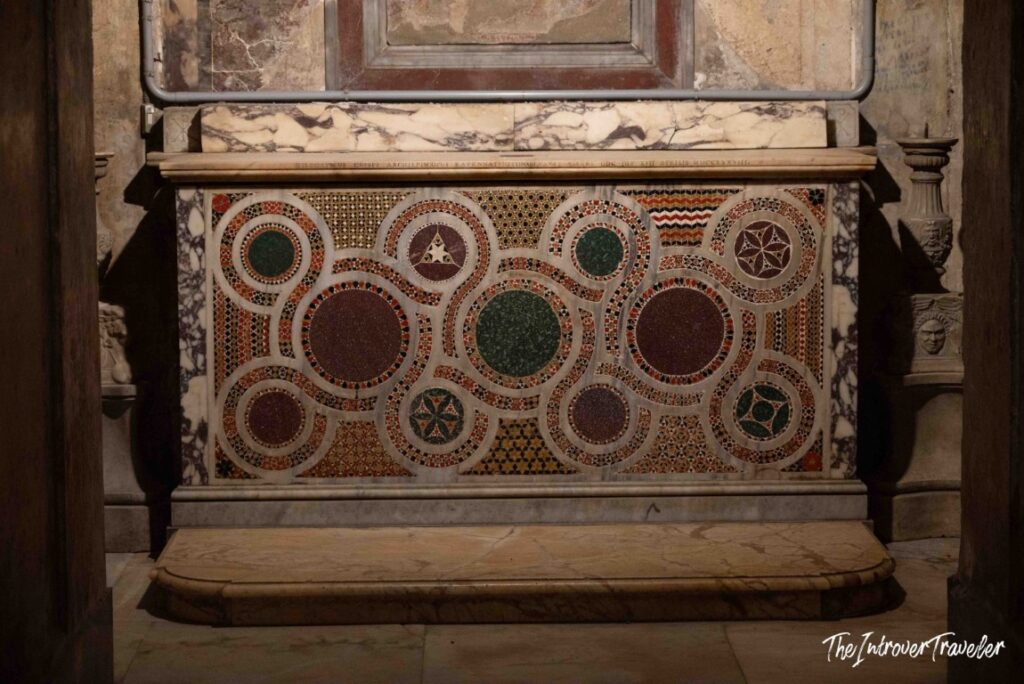
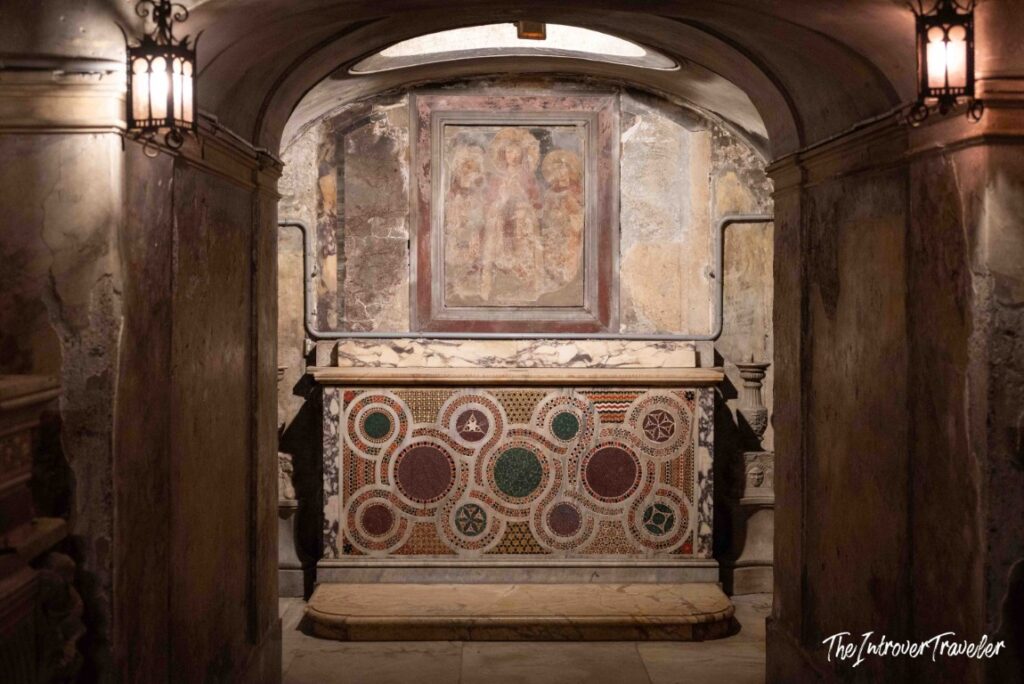
If you want authentic medieval marble, go down into the crypt. At the end of the corridor, past four sarcophagi stacked in pairs (one of which, according to tradition, holds the relics of Praxedes and Pudentiana), there is an altar with a Cosmatesque frontal that comes from the old high altar. Roundels of red porphyry and green serpentine, stars, triangles, chequerboards of tiny tesserae: this is the real Middle Ages, with no superintendent’s touch-ups. Above it, a fresco of the Madonna between the two saints, reworked several times. Magnificent. For what it’s worth, I don’t remember ever seeing another Cosmatesque altar in my life, even allowing for my cognitive deficits.
And look at the floor of the Chapel of San Zeno too, in polychrome marble with a porphyry disc in the centre: that one is the original, and it’s why the chapel deserves its “garden” nickname even underfoot.
Bernini, Aged Fifteen, at the End of the Right Aisle
Leaving the chapel, on the third pier of the right aisle, is the funerary monument of Giovanni Battista Santoni with a marble bust. It was carved by Gian Lorenzo Bernini when he was between fourteen and eighteen. His biographer Filippo Baldinucci, who had a soft spot for the child-prodigy legend, dated it to 1609, when Bernini was ten. And some also see the hand of his father, Pietro.
Either way, it is one of Bernini’s very first portraits, and everything is already there in embryo: the lively gaze, the flesh that seems to breathe. At that age I had only just learned to ride a Vespa without falling off. Bernini was carving bishops. Life is unfair, and art history documents it with precision.
Why It’s Empty, and Why You Should Be Grateful
Santa Prassede has a neighbourhood problem. Three minutes away is Santa Maria Maggiore, a papal basilica, with its unending stream of tour groups, and tour groups don’t make detours down Via di Santa Prassede. Ten minutes away is Termini, which everyone flees towards the centre without looking back. So the most Byzantine church in Rome remains, for most visitors, a doorway in a side street.
The same fate has befallen Santa Pudenziana, a few steps away, with one of the oldest apse mosaics in Rome. And San Pietro in Vincoli, a fifteen-minute walk away, where Michelangelo’s Moses at least has the advantage of being famous. The Esquiline quarter is one of the densest art districts on the planet, and everyone crosses it dragging a wheelie suitcase.
For you, it’s a gift. You’ll walk into a place twelve hundred years old with, at most, a dozen other people and a Vallombrosan monk (monks of this order have looked after the basilica without interruption since 1198) watching you with the patience of someone who has seen eight centuries of visitors go by. There are no influencers who’ve put on a Prada dress specifically for a duck-face selfie; there are no Chinese tour groups following a guide with a red-ribboned stick who shouts without telling off her clients as they paw works that survived the Sack of 1527 intact. This is Rome flexing all its beauty just for you, with nobody to bother you while you enjoy it in silence.
How to Plan Your Visit
Getting there. On foot from Termini in under ten minutes, via Piazza dell’Esquilino or Via Cavour (or on your way to the station when you have an hour before your train). You enter through the side door at Via di Santa Prassede 9/a.
When to go. Early morning or late afternoon, avoiding Mass times, when you can’t walk around the church and the chapel stays in semi-darkness. Published opening hours vary from source to source: check before you set off.
What to bring. Coins. The light in the Chapel of San Zeno stays on for a few minutes per euro. Allow at least three or four goes if you really want to look.
Dress code. It is a working church: shoulders and knees covered, as in all Roman basilicas.
The route. Nave and apse, Chapel of San Zeno, Santoni monument, crypt. Then Santa Pudenziana, then Santa Maria Maggiore and, if your legs still hold out, San Pietro in Vincoli for the Moses. A whole afternoon of early Christian and medieval art within a one-kilometre radius.
Verdict: 9, and the Missing Point
Santa Prassede is one of the most beautiful churches in Rome, and one of the least visited relative to what it offers. The Chapel of San Zeno alone is reason enough to catch a train: the most intense Byzantine experience Rome has to offer, and one of the most intimate I have ever had, Istanbul and Sicily included.
The missing point is all about the lighting. The apse and the triumphal arch, a first-rate mosaic cycle, remain in a gloom that makes them only half legible, and the chapel is literally coin-operated. I understand the reasons: a living church is not a museum, the monks don’t have the Vatican’s budget, and permanent electric light damages the mosaics (perhaps; I have my doubts). But the result for the visitor is a masterpiece you see intermittently, like a streaming series with a dropping connection. On this point, as I said, I refer you to my Rant.
Go. Go with coins in your pocket, without hurrying, after getting off the train and before diving into the Rome everyone knows. Because the beauty of this city isn’t only the Colosseum, which is on every fridge magnet. It’s the fact that, five minutes from the most chaotic station in Italy, there is a twelve-hundred-year-old room of gold waiting for you, and almost nobody knows.
Frequently Asked Questions
How long does it take to visit the Basilica of Santa Prassede?
Half an hour is enough, including the Chapel of San Zeno and the crypt.
How much does it cost to get in?
It’s free. You only need coins to switch on the lights in the Chapel of San Zeno.
How far is Santa Prassede from Termini station?
Under ten minutes on foot. It’s three minutes from Santa Maria Maggiore.
Why is the Chapel of San Zeno so important?
It is the most complete space entirely lined with Byzantine mosaics surviving in Rome, commissioned by Paschal I in the ninth century as a mausoleum for his mother Theodora. It is nicknamed the “Garden of Paradise”.
Is the floor of Santa Prassede medieval?
The nave floor isn’t: it’s neo-Cosmatesque, made between 1916 and 1918. The floor of the Chapel of San Zeno and the Cosmatesque altar frontal in the crypt are original.
Who was Theodora “episcopa”?
The mother of Pope Paschal I, depicted in the Chapel of San Zeno with a square halo. The meaning of the title “episcopa” is still debated by scholars.
What else is there to see near Santa Prassede?
Santa Maria Maggiore, Santa Pudenziana with its early Christian apse mosaic, and San Pietro in Vincoli with Michelangelo’s Moses.