Last visit: February 2025
My rating: 7/10
Visit duration: 2 to 3 hours
Web: https://www.galleriaaccademiafirenze.it/
Address: Via Ricasoli 58/60, Florence
Opening hours: Tuesday to Sunday, 8:15 AM to 6:50 PM; closed on Monday, January 1, and December 25
Skip the line ticket: https://tiqets.tp.st/SkSs4hr4
Guided tour: https://tiqets.tp.st/gEKZdvU8
Introduction
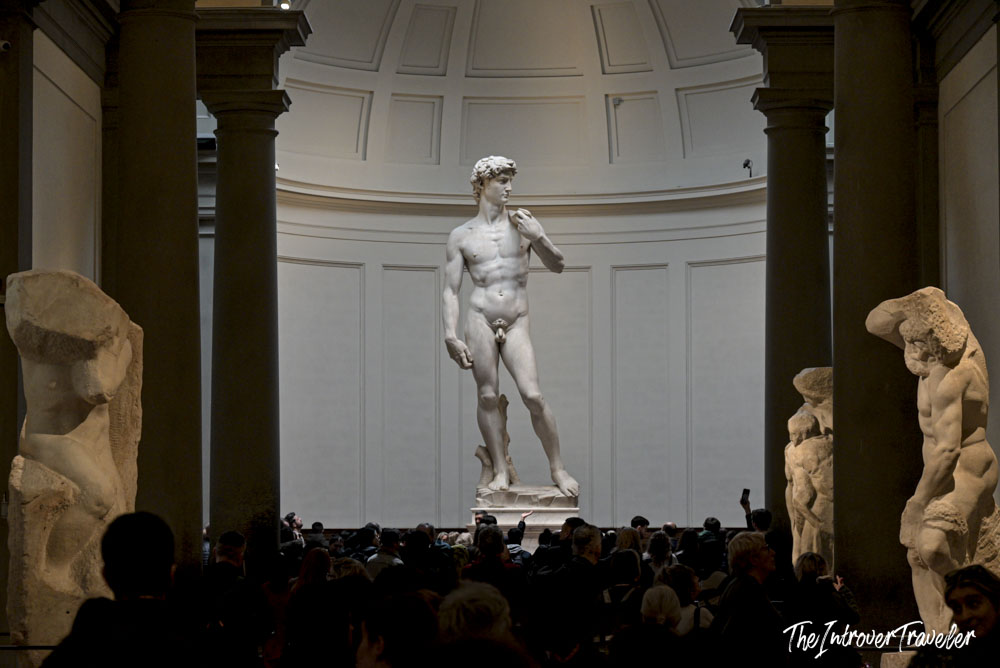
The Galleria dell’Accademia is, to most visitors, the David museum. And it is. Michelangelo’s David alone justifies the queue, the price of admission, and the existence of an institution essentially constructed around it. I have already covered the David and the Prisoners in two dedicated posts, to which I refer the reader interested in those works. This post is about everything else.
Because the Accademia is not only Michelangelo. Behind the rotunda and along the corridor lie a few rooms that house, in varying degrees of neglect by the average visitor, a focused collection of Tuscan painting from the late thirteenth to the late sixteenth century, the original full-scale plaster model of one of the most famous Mannerist sculptures in existence, a peculiar painted Venus designed by Michelangelo and executed by Pontormo, a small but high-quality museum of historical instruments, and a plaster cast collection that almost nobody bothers to enter. Most visitors devote ninety percent of their time to the David and ten percent to a hurried walk-through of the rest. That ratio is wrong, and this post is an attempt to correct it.
History of the Museum
The Galleria dell’Accademia was founded in 1784 by Grand Duke Pietro Leopoldo of Lorraine as a teaching gallery attached to the Accademia di Belle Arti, the school of fine arts that had absorbed the original Accademia delle Arti del Disegno founded by Vasari in 1563 (the first art academy in Europe). The original purpose of the gallery was pedagogical: students of the Accademia needed exemplars to copy and study, and the new institution provided a corpus of works for that purpose. It was, in essence, a museum for working artists, not for tourists.
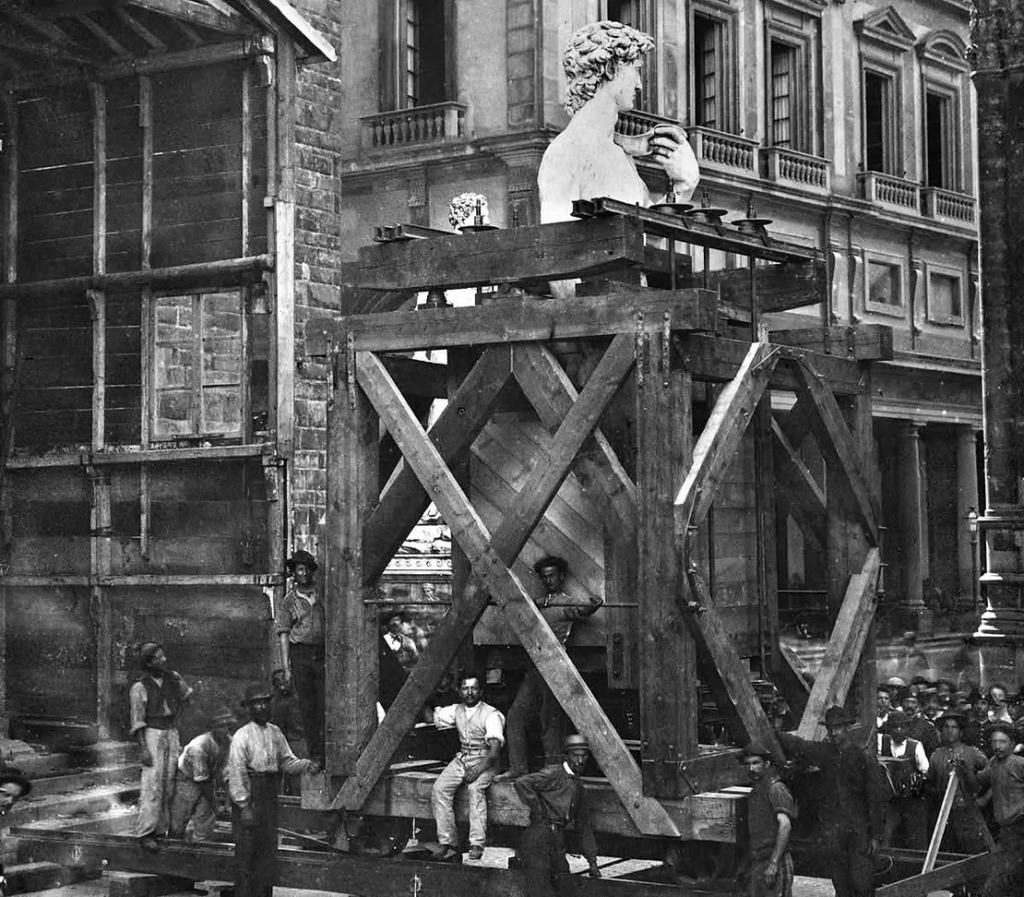
Its current identity as the David museum dates only to 1873, when Michelangelo’s statue was transferred from Piazza della Signoria to protect the marble from weathering and pollution. The Tribuna designed by Emilio De Fabris specifically to house it transformed the Accademia from a relatively modest didactic gallery into an obligatory stop on the Florentine tourist circuit. The four Prisoners, until then displayed inside the Grotta del Buontalenti at the Boboli Gardens, followed in 1909.
Everything else in the museum, that is to say the entire collection of Tuscan paintings and the gallery of plaster casts, was assembled gradually from the patrimony of suppressed monasteries, religious orders dissolved during the Napoleonic and Lorena-era reforms, and donations of various kinds. The result is a collection that is overwhelmingly Florentine, overwhelmingly religious, and concentrated on the Trecento and Quattrocento.
The Accademia in the International Museum Context
Compared to the Uffizi, which is twenty minutes on foot away, the Accademia is what one might call a focused museum: small in scale, narrow in scope, and dominated by a handful of universally famous works. The visitor who comes for the David and the Prisoners and dedicates an additional hour or two to the rest of the collection will walk away having seen everything the museum has to offer. There is no Caravaggio, no Raphael, no Titian, no Leonardo. The Accademia is not, and was never intended to be, a comprehensive survey of Italian art.
What it offers, instead, is two things. The first is the unrivaled experience of standing before the David and the Prisoners in the same building, the closest (with the sole exception of the Medici tombs) a museum visit can get to a Michelangelo monograph in three dimensions. The second is a slice of Florentine art that complements rather than competes with the Uffizi: where the Uffizi tells the story of the Tuscan Renaissance through its biggest names, the Accademia tells it through devotional altarpieces, workshop products, and second-tier masters who, however, were the connective tissue of the artistic culture that produced those biggest names.
The comparison most people instinctively make is therefore unfavourable to the Accademia, but it is also the wrong comparison. The right comparison is with what the Accademia actually is: a small, idiosyncratic museum built around a handful of masterpieces and surrounded by a quiet but serious collection that rewards the visitor willing to slow down.
Beyond David and Prigioni: A Selective Walk Through the Collection
What follows is an opinionated walk through the works that, on my last visit, struck me as worth slowing down for, organized roughly in the order in which a visitor would encounter them.
The Sala del Colosso: Giambologna’s Plaster Model of the Rape of the Sabines
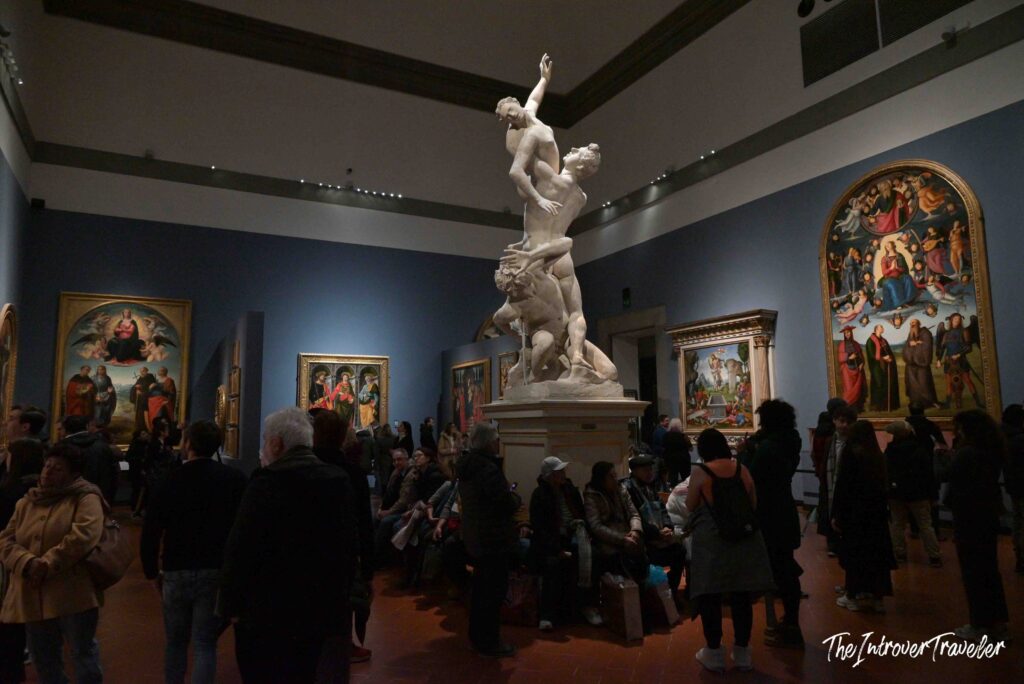
The first large room one enters from the entrance hall is the Sala del Colosso, dominated by the full-scale plaster model of Giambologna’s Ratto delle Sabine (1582), the working model from which the marble version now standing in the Loggia dei Lanzi was carved. The marble is the more famous object, but the plaster has its own claim on the visitor’s attention: it is the genesis of the marble, the artist’s actual three-dimensional draft, and it sits at the very heart of late Mannerist sculpture’s formal experiment.
Giambologna’s composition is the textbook example of the figura serpentinata, a sculptural formula that Mannerist artists pursued obsessively from the mid-sixteenth century onwards. The principle is simple to state and almost impossible to execute: a multi-figure group whose forms spiral upwards in such a way that the work has no privileged viewing angle and no front, demanding instead that the viewer circumambulate it. The Sabines is the most ambitious realization of this idea in marble, three figures in vertical stack (an old man crouching, a young man standing, a woman lifted overhead), each twisting in a different direction, each anatomically perfect, all carved from a single block.
The plaster model is also a useful reminder of how sixteenth-century sculptors actually worked. Giambologna did not improvise on the marble. He drew, modelled in wax, modelled in clay, and finally produced this full-scale plaster, which functioned as the unambiguous reference for the team of carvers who roughed out the marble under his direction. Standing before the gesso, with its rougher and more nervous surface, one sees the live invention in a way the polished marble at the Loggia dei Lanzi no longer permits.
My rating: 8/10.
Pontormo’s Venus and Cupid: Michelangelo Through Another Hand
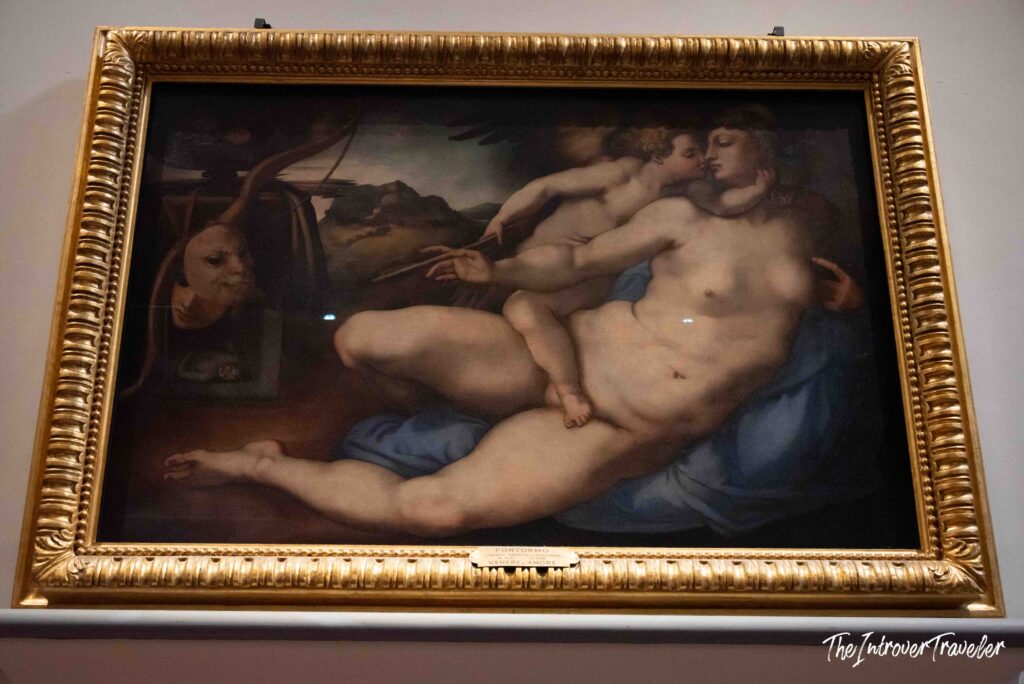
In the corridor leading to the David hangs one of the more peculiar paintings in the entire Florentine collection: the Venere e Amore by Pontormo. The peculiarity is iconographic, technical, and historical at once.
The composition is not Pontormo’s. It is Michelangelo’s. The painting was executed by Pontormo from a now-lost cartoon by Michelangelo, which Bartolomeo Bettini had commissioned around 1532 to decorate his Florentine palace, and the collaboration is documented by Vasari. What we see, then, is a joint product: Michelangelo provided the design, Pontormo provided the execution, and the resulting painting hangs at the intersection of two of the greatest artists of the Cinquecento.
The Venus is unmistakably Michelangelo: the elongated, muscular body, the contrapposto so radical it borders on contortion, the awkwardness of the proportions when one attempts to read the figure in conventionally classical terms, the bony face of the kissing Cupid that recalls some of the Sistine ignudi. But the painting is Pontormo through and through: the cool, unsettling palette of grays, blues, and pale flesh tones, the disturbed atmosphere, the bow and quiver hanging on a wall like an inventory item, the carnival mask in the lower left whose presence has never been satisfactorily explained, the sense of a scene that ought to be erotic and is instead troubling.
At the Museo di Capodimonte in Naples, there is a remarkable room housing several cartoons, including an original cartoon by Michelangelo for the Pauline Chapel in Rome. One of these cartoons is a beautiful copy, often attributed to Hendrick van den Broecke, of this subject.
My rating: 8/10.
The Quattrocento Rooms: Florentine Devotional Painting
Beyond the Tribuna del David and the Galleria dei Prigioni, the museum opens onto a series of smaller rooms dedicated to fifteenth-century Florentine painting. Here the masterpiece-per-square-metre ratio drops sharply (the masterpieces are next door at the Uffizi), but several works repay attention.
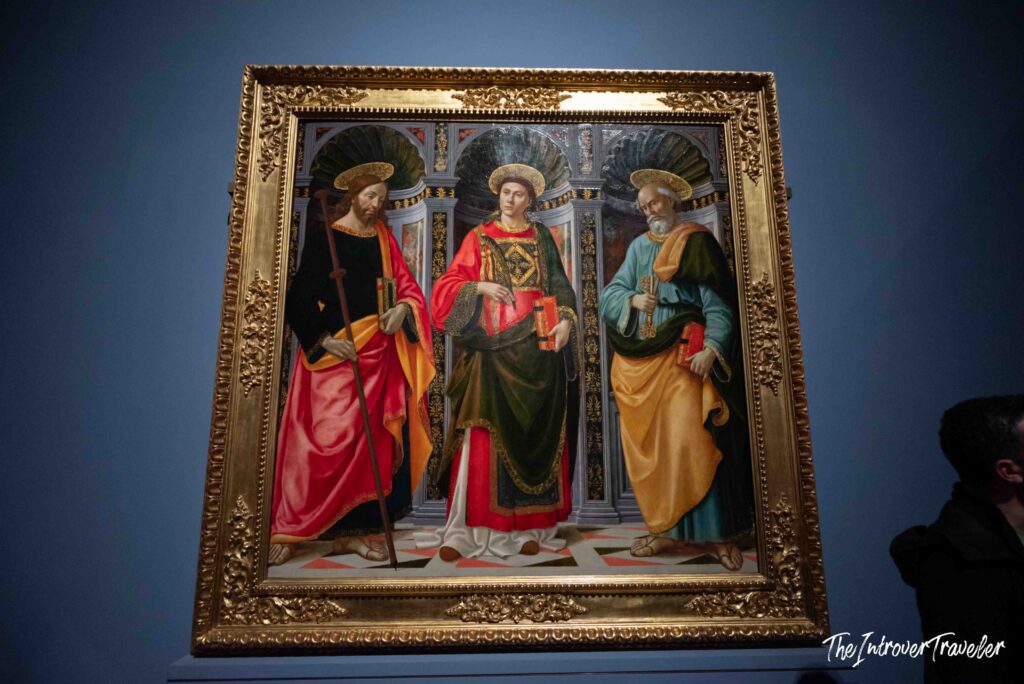
Three Saints (Saints James, Stephen, and Peter), late Quattrocento Florentine. A typical late fifteenth-century altarpiece, with three full-length saints framed by classicizing niches with shell vaults: Saint James the Greater on the left with his pilgrim’s staff, Saint Stephen in the centre as a young deacon in red dalmatic with a book, Saint Peter on the right with the keys of the kingdom. The execution is competent rather than exceptional, in the manner of a workshop product close to Domenico Ghirlandaio’s circle. What is interesting is the architectural setting, which functions as a miniature theatre for the figures and demonstrates how thoroughly Albertian perspective and Brunelleschian classicism had been absorbed into the standard repertoire of even a workshop-level Florentine artist by the 1480s. The figure of Saint Stephen in the centre, the young deacon in red dalmatic, is the most carefully painted of the three.
Rating: 6/10.
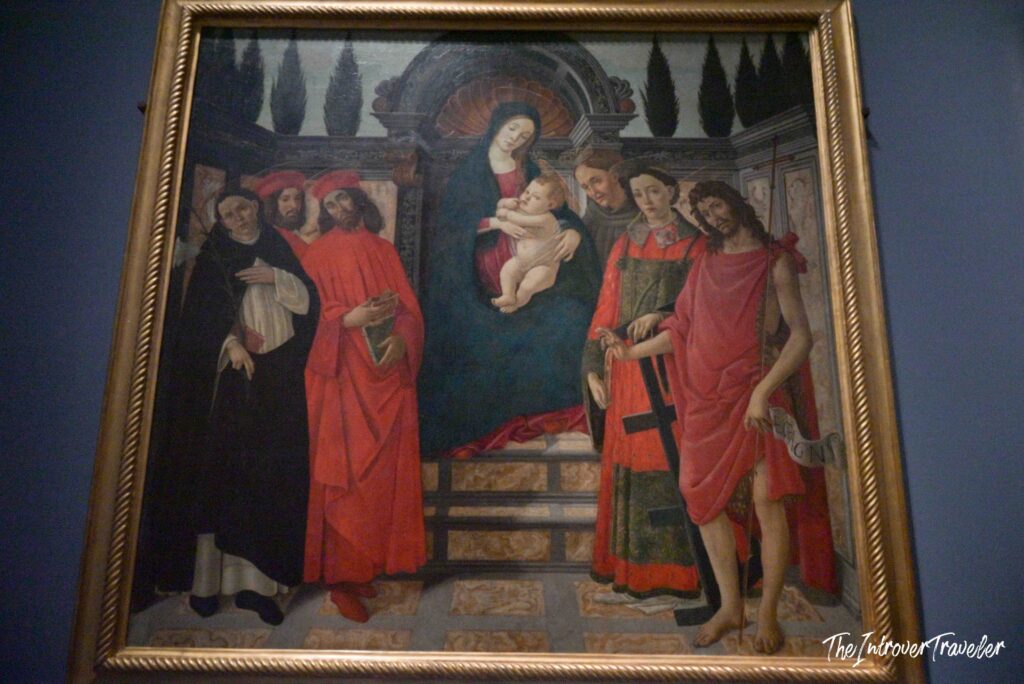
Madonna and Child Enthroned with Saints, attributed to Botticelli or his workshop. A sacra conversazione of the standard Florentine type: the Virgin enthroned with the Child, surrounded by saints (a Dominican on the left, a saint in red robes who may be one of the Medici patron saints Cosmas or Damian, a young deacon saint with a black cross who is probably Saint Stephen, John the Baptist on the far right with his characteristic camel-hair garment and his banner reading Ecce Agnus). The composition is conventional, but the heads, particularly that of the Virgin and of John the Baptist, are unmistakably Botticelli or Botticelli-trained: that long, melancholy face that Sandro repeated obsessively from the late 1480s onwards, the slightly drooping eyelids, the elongated proportions. The cypresses framing the architectural backdrop are another signature device, returning identically in several signed Botticelli works.
Rating: 7/10.
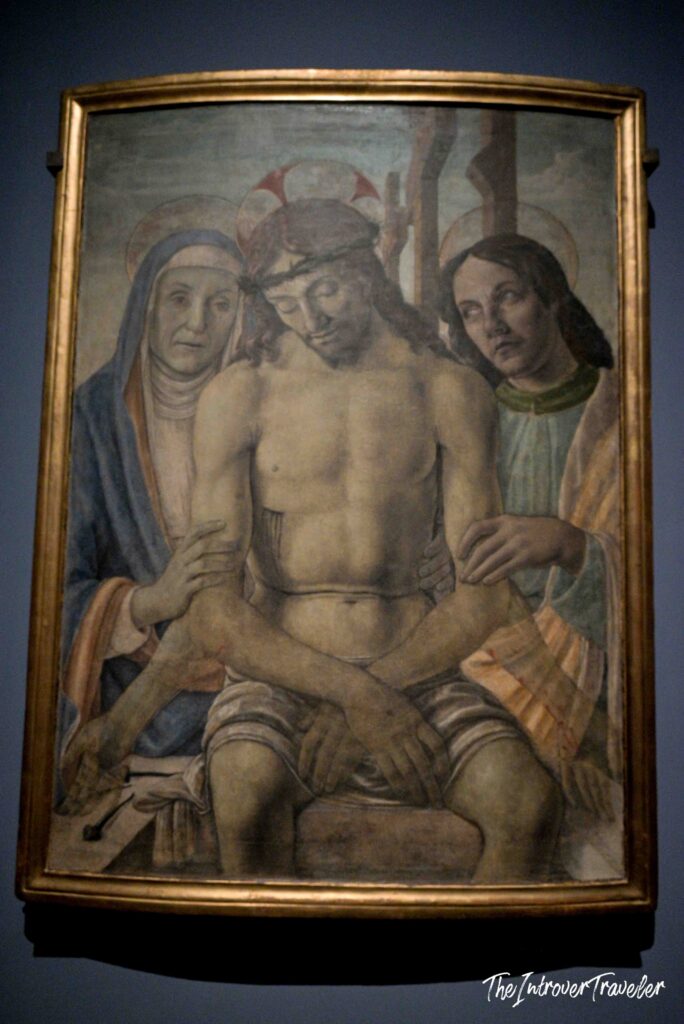
Lamentation over the Dead Christ, Master of the Fiesole Epiphany, late fifteenth or early sixteenth century. One of the more curious objects in the museum: a Pietà painted in an almost exclusively grayish-brown palette, as if the work had been left at the underdrawing stage or had deliberately suppressed colour. The composition, with the dead Christ supported by the Virgin and a young saint (likely John the Evangelist), has the calm horizontal symmetry of a Bellinian Pietà transposed to the Florentine idiom. The Master of the Fiesole Epiphany, an artist on whom, as far as I know, very little has been studied or written, is systematically presented as an epigone of Cosimo Rosselli; yet in this work I find tangible echoes of Botticelli and of Bellini’s Pietà in the Vatican Pinacoteca. In any case, I find the diachronic representation of Christ’s arms particularly curious.
Rating: 7/10.
The Sale Bizantine and Trecentesque: the Gold Backgrounds
For visitors with a tolerance for late medieval gold-ground painting (and not everyone has one, which is fair), the Accademia houses one of the finest collections of thirteenth- and fourteenth-century Florentine panel painting in the world. Many of these works arrived from suppressed monasteries and have never travelled more than a few miles from where they were painted. This is, alongside the David, the most distinctive holding of the museum, and it is criminally underused by visitors.
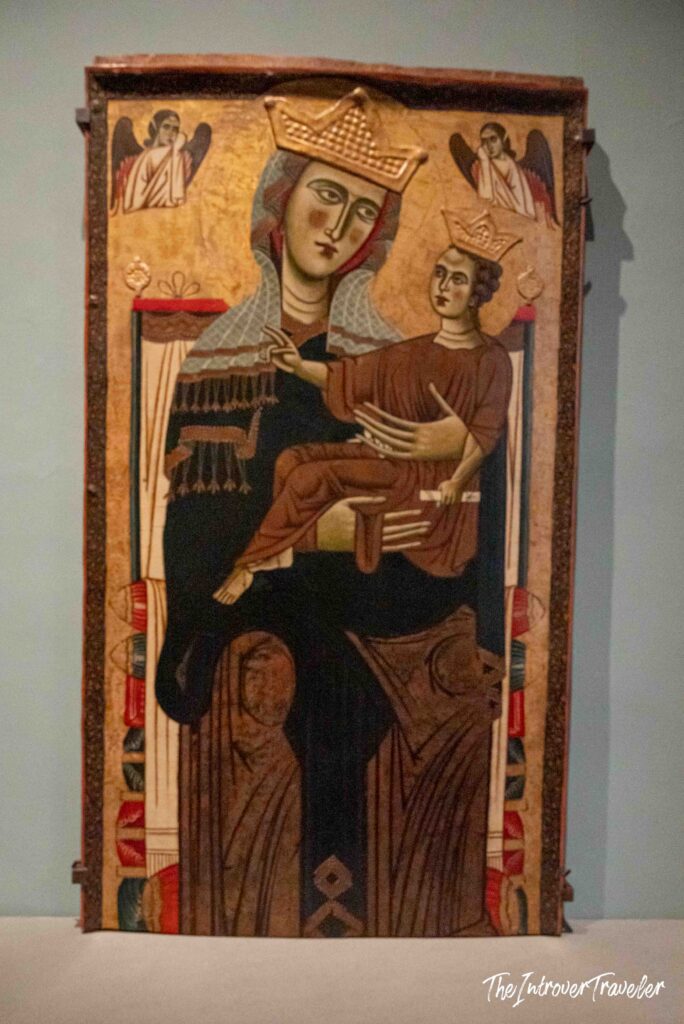
Madonna and Child Enthroned, anonymous Tuscan master, thirteenth century. A frontal, hieratic icon-Madonna in the Italo-Byzantine manner, with the Virgin crowned as Maria Regina, the Christ Child rendered as a small adult king (also crowned), two angels in the upper corners, and a tiny donor figure at the foot of the throne. The painting belongs to the visual world that Cimabue, Giotto, and their generation would, within a few decades, decisively dismantle. To stand in front of it is to see what Italian painting was before Florence reinvented it: an art governed by the iconic conventions of Constantinople, with the figures stylized into geometric flatness, the drapery rendered as ornamental linear pattern, and the gold ground signalling sacred space rather than physical space.
My rating: 7/10.
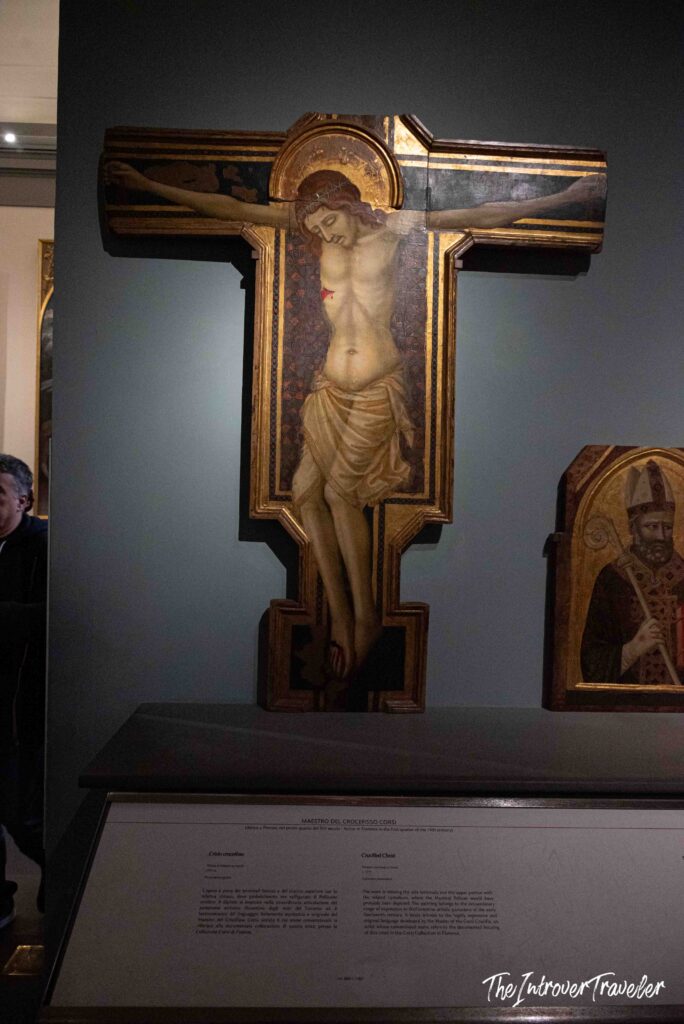
Crocifisso by the Maestro del Crocefisso Corsi, c. 1315. A painted wooden crucifix from the early Trecento, missing its lateral terminals and the upper cimasa (where the Mystic Pelican would have appeared). The work is by a still-anonymous Florentine master who took his conventional name from the Corsi Collection in Florence, in which the crucifix was documented in the nineteenth century. The body of Christ is anatomically observed in a way that already marks the distance from the Italo-Byzantine tradition: the slightly slumped posture, the visible musculature, the blood from the side wound rendered with linear precision rather than as decorative arabesque. The work belongs to that extraordinary articulation of the Florentine artistic panorama at the beginning of the Trecento that produced, alongside Giotto, a pluralism of expressive languages still being mapped today.
My rating: 6/10.
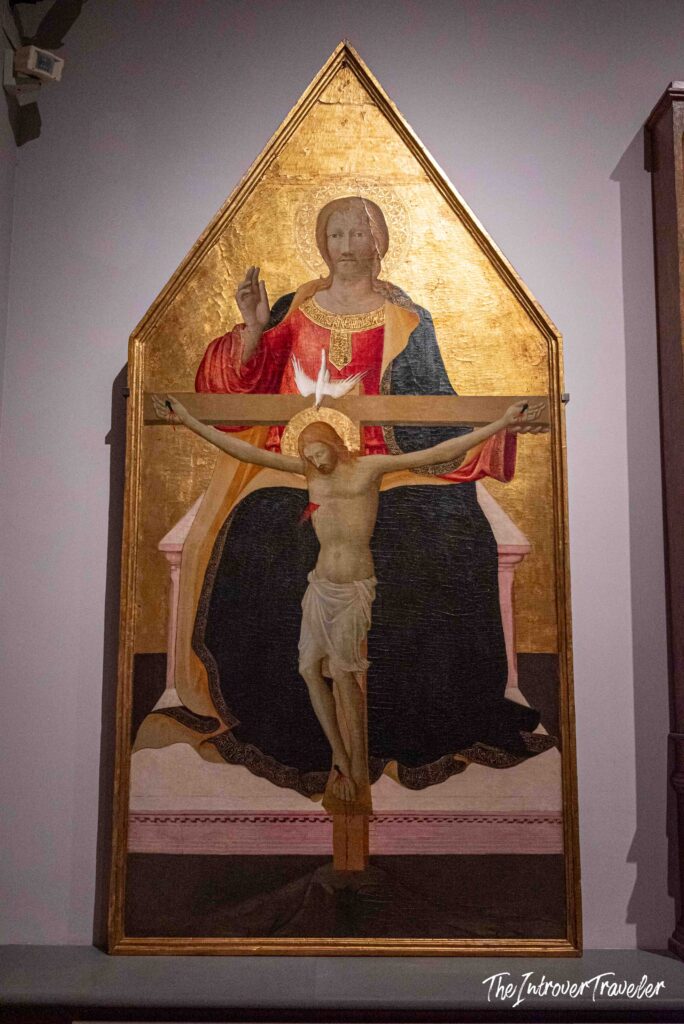
Throne of Mercy (Trinity), Florentine school, fifteenth century. A panel painting on a triangular gable, depicting the Gnadenstuhl iconography in which God the Father holds the cross with the dead Christ, the dove of the Holy Spirit hovering between them. The gold background and the slightly archaizing style place the work in the orbit of late Gothic Florentine painters operating into the Quattrocento, who continued to produce works of this kind for ecclesiastical clients well after the formal innovations of Masaccio had become available. The iconography is one of the most theologically dense in all of Christian art: the entire Trinity in a single image, where the Father offers the sacrifice of the Son and the Holy Spirit binds them together. The visual paradox of God the Father presenting his own Son crucified is not, in Florentine devotional painting, an embarrassment to be smoothed over; it is the point.
My rating: 6/10.
The Gipsoteca Bartolini
A separate and somewhat unexpected wing of the museum is dedicated to the Gipsoteca Bartolini, the collection of plaster models and casts left to the Accademia by the neoclassical sculptor Lorenzo Bartolini (1777-1850) and supplemented by works by his pupil Luigi Pampaloni. The space looks like a sculptor’s studio frozen in time: rows of plaster busts, full-figure models, working maquettes, with the small dark marker points (the punte di repere) used to transfer measurements to marble still visible on the surfaces.
It is a strange room. As a glimpse into how nineteenth-century sculptors actually worked, it is unique. As a destination in its own right, it is an acquired taste. Most visitors pass through it quickly, and most visitors are right to do so if they have no specific interest in Bartolini, in neoclassicism, or in the technical history of sculpture. I was among them. Your mileage will vary.
Rating: 5/10 with significant variance depending on tolerance for nineteenth-century academic sculpture.
The Museum of Musical Instruments
On the way out, the museum hosts a small but high-quality collection of historical instruments belonging to the Conservatorio Cherubini, including instruments by Stradivari, Amati, and other major builders of the late seventeenth and eighteenth centuries. For most visitors, this is the section that receives the least attention; I am one of them.
Practical Tips
A handful of practical observations:
- Booking in advance is essentially mandatory. The Accademia, like the Uffizi, receives a volume of visitors that vastly exceeds the available walk-in slots, particularly in high season. I use Tiqets, which allows reservation in advance and cancellation up to 24 hours before, and accumulates Membership Rewards points if you pay with American Express (my referral link). Visiting in low season (October to March) and on weekdays remains the only sane strategy.
- The standard ticket is currently €20; the new combined Accademia and Bargello ticket valid for 48 hours is €26. If you are also visiting other museums in the Bargello system (Cappelle Medicee, Orsanmichele, Palazzo Davanzati), the 72-hour cumulative ticket at €38 is the better arithmetic.
- The visit itself is short by museum standards. One hour is sufficient for the casual visitor, two hours for the art enthusiast who wants to look carefully at the paintings as well as the David. There is no need to dedicate an entire day, and there is no point in exhausting yourself.
- Strategy inside the museum. The David and the Prisoners are concentrated in a single corridor and the Tribuna, which is essentially the first thing one sees on entering. The temptation, given the crowds, is to power through quickly and leave. The right strategy is the opposite: spend as much time as possible in the Tribuna in the relatively quieter early morning, then dedicate the rest of the visit to the painting collection, where the visitor density drops sharply once you move away from the corridor.
- There is no proper café inside the museum, and there is no cloakroom for substantial luggage. Plan accordingly.
- For breakfast before the visit, my recommendation in Florence remains Melaleuca. For lunch and dinner, see the Florence tag for restaurant reviews.
Conclusion
The Galleria dell’Accademia is a small museum that happens to contain one of the greatest sculptures ever made, surrounded by a quiet but serious collection of Tuscan painting and sculpture spanning roughly four centuries. The David and the Prisoners are reason enough to visit; the rest of the collection is the reason to stay. Most visitors do not stay. They should.
If one is comparing it to the Uffizi, the Accademia is plainly the lesser institution: smaller, narrower in scope, and missing the breadth of names and works that make the Uffizi a near-comprehensive survey of Italian Renaissance painting. But that comparison, although natural, is not the right one. The Accademia, in addition to housing the most famous male nude in the history of art, also preserves a slice of Florentine devotional painting, late medieval gold-ground panels, Mannerist sculpture in its preparatory state, and a peculiar Pontormo executed from a Michelangelo cartoon, that together constitute a self-contained and genuinely useful introduction to what the artistic culture of the city actually looked like, decade by decade, in the centuries when the Renaissance was being made.
That introduction deserves the hour or two that nearly nobody gives it.