So much has been written about Michelangelo Buonarroti that anyone with the nerve to write about him again owes a justification. Here it is straight away. What you find online about Michelangelo falls mostly into two categories. On one side there is the schoolbook reverence, made of stock formulas, dates learned by heart, capitalised adjectives and a general Holy Week tone. On the other side there is the pop version, in which Michelangelo is the finger of Adam on t-shirts, the David on fridge magnets, and the inevitable Carol Reed film with Charlton Heston climbing the Sistine scaffolding with the motor credibility of his own wax effigy. In between, not much. Things change of course if you have the appetite to dig into the considerable monographic literature, or even better into specialist journals, but the second in particular is not within everyone’s reach, and this is a blog, which at best can aim to do a little popular intelligence work.
This post tries to sit between the two categories of web writing just mentioned. It is long by design, because Michelangelo is one of those cases where shortening does more damage than expanding. It is not a specialist essay, I lack the credentials and you probably lack the patience, but it is written with the intention of being historically accurate, and of staying honest even when honesty is uncomfortable. As when discussing homosexuality. Or Michelangelo’s personality. Or that pathologically tedious relative, his father, who wrote mainly to ask him for money.
We start in Florence 1475 and finish in Rome 1564 with a reading list and a map of the works. In between there is everything needed to understand why, five centuries later, Michelangelo is still the central problem of Western art rather than a closed chapter.
Florence 1475, or the luck of being born in the right place
Michelangelo was born on 6 March 1475 in Caprese, in the Casentino, where his father Ludovico was serving as podestà. It is a calendar detail and nothing more, because a month later the family returned to Florence and from then on, for the next twenty years, Michelangelo basically did not move. So when we say Michelangelo is Florentine, we mean it in the strong sense. Florence is not the registry office, it is the raw material.
The Florence in which Michelangelo grew up, the one between 1475 and 1492, is one of those historical accidents that do not repeat themselves. Lorenzo de’ Medici was governing, Botticelli was painting the Primavera (1482) and the Birth of Venus (around 1485), Leonardo was still in the city until 1482, Verrocchio kept a workshop, Poliziano wrote poetry, Pico della Mirandola published the Nine Hundred Theses (1486), Marsilio Ficino was translating Plato. There is a concentration of talent per square metre that is statistically inexplicable, and that remains one of the unsolved mysteries in the history of culture. At the fish market you could simultaneously meet the philosopher who was rewriting the idea of the soul and the banker who was financing half of Christendom.
Yet, even within this context, Michelangelo was perceived immediately as a case apart. Not as “another talented Florentine”, which was a statistically unremarkable occurrence. As an anomaly. Vasari, in the proem to his Life, even stages a divine intervention: the Heavenly Father, seeing that artists kept missing the mark in their pursuit of perfection, decided to send to earth a genius who could serve as “an example in every art and in every profession”. This is hagiographic iconography, and Vasari knew it perfectly well. But it serves a real fact: his contemporaries already lived him as predestined.
His father, Ludovico, had a different plan. He wanted to make him a wool merchant or a functionary, and when the boy showed he wanted to draw, he beat him for it, because to the Buonarroti, a family of decayed minor nobility that still cared about its nobility, art looked like manual labour, workshop stuff, unworthy. Condivi, who heard the story directly from Michelangelo, writes that his father and his father’s brothers “held that art in hatred“, that Michelangelo “was disliked, and often strangely beaten“, and that to them, “ignorant of the excellence and nobility of art, it seemed a disgrace that it should be in their house.” It is a detail worth keeping in mind, if you have children and find yourself called on to steer them toward their future career.
In the end Ludovico gave in. In 1488 Michelangelo entered at thirteen the workshop of Domenico Ghirlandaio, then the most important fresco specialist in Florence, on a regular contract: three years of apprenticeship, with a small stipend. It was a sensible choice. Ghirlandaio had just finished the frescoes of the Tornabuoni Chapel in Santa Maria Novella, knew everything about the buon fresco technique, and ran a crew. Michelangelo probably stayed less than the agreed three years, but that fresco-by-days technique he learned well, and twenty-five years later he would prove it on about 500 square metres of vault in the Sistine Chapel.
The real leap, though, came shortly after. In 1489 or 1490 Lorenzo the Magnificent decided to open in the garden of San Marco a kind of informal sculpture school, putting in charge as master Bertoldo di Giovanni, an elderly pupil of Donatello, and entrusting him with a collection of ancient marbles. It was, in effect, the first art academy in European history. Michelangelo was recommended to Lorenzo by Ghirlandaio himself and admitted to the garden. He started copying the ancient marbles. Lorenzo saw him at work, was struck, and showing more talent-scouting foresight than Ludovico Buonarroti, had him moved into Palazzo Medici and seated him at his own table. He was fifteen.
At Palazzo Medici, between 1490 and 1492, Michelangelo literally had dinner with Marsilio Ficino, Pico della Mirandola, Angelo Poliziano. The boy from the Casentino who was supposed to become a wool trader was sitting at the table of the most important philosophical centre in Europe. He did not speak much, as far as we can tell, but he listened, like a good introvert. And what he listened to would stay with him for the rest of his life.
Marsilio Ficino, Neoplatonism and the idea that lasts centuries
To understand Michelangelo you need to pause for a moment on something that at first looks like academic boredom: Florentine Neoplatonism. Bear with the paragraph, I promise it pays off.
Marsilio Ficino is the personal philosopher of Lorenzo the Magnificent. He has translated into Latin the whole of Plato, the Orphic Hymns, the Corpus Hermeticum and Plotinus. He has founded an Academy (informal, no regulations, more a network of cultured friends) that met at the Medici villa of Careggi and tried to hold together an improbable thing: Christianity on one side, Greek Platonic philosophy on the other. The underlying thesis was that revealed truth and philosophical truth were the same thing seen from different angles. A bold synthesis, theologically on the edge, which lasted exactly as long as the patience of the Inquisition held, but which in the meantime produced a new language for talking about beauty, soul, love and art.
In the Platonic system mediated by Ficino, the material world is an imperfect reflection of perfect Ideas that exist elsewhere, in the intelligible realm. The beautiful things we see, a rose, a human face, a statue, are partial participations in absolute Beauty, which is one and coincides with the Good and with God. Art, then, does not imitate nature as it is: it tries to reach, through nature, the perfect idea that nature only partially realises. The artist is a mediator.
This thing, in a textile workshop, would sound abstract. In the head of a fifteen-year-old who watches Ficino speak at table, it is dynamite. Michelangelo takes it seriously. And he will use it, in different ways, for the rest of his life.
The most famous example is that celebrated sonnet:
Non ha l’ottimo artista alcun concetto
ch’un marmo solo in sé non circonscriva
col suo soverchio, e solo a quello arriva
la man che ubbidisce all’intelletto.
Translated in prose: the statue is already inside the block. The artist does not create it, he liberates it, by removing the excess marble (“soverchio”). The concept is Platonic in the purest tradition: the idea pre-exists the matter, and art’s task is to bring out what is already there. This is the thread that returns in three paragraphs of this same post: in the non finito, in the poetics of sculpture, and indirectly even in the painterly practice. Hold on to it. It will come back.
A useful footnote: Michelangelo was not a theorist, and the Neoplatonism he professes is not Ficino’s strict version, but a metabolised one, blended with Christianity, especially in the last twenty years of his life, and with a death-and-salvation anxiety that would have struck Ficino as excessive. But the frame holds. When the old Michelangelo, in his eighties, smashed the Pietà Bandini with a hammer because a flaw in the marble would not let him liberate the figure as he saw it, he was literally doing what the sonnet describes. It is not rhetoric. It is method.
The personality: what is legend, what is documented
The Michelangelo handed down to us by the popular version, of which Charlton Heston represents the cinematic point of no return, is a precise figure: surly, isolated, unkempt, obsessed with work to the point of forgetting to eat, to wash and to answer letters. A kind of secular hermit with a chisel in his hand. Let us see how much of this holds up to the sources, because some of it does and some does not, and the distinction is worth making.
On the fact that he was solitary, Condivi is explicit, but also more nuanced than one might expect. He says that Michelangelo, as a young man, had thrown himself into the arts so completely that “for a time he very nearly withdrew altogether from the company of men, keeping company with very few”. And he immediately adds an important correction: for this some thought him “proud, others odd and fantastical, when he had neither of these vices”. Solitude, according to Condivi, was operational, not characterological. When he had work to do, he cleared the field. Quoting Scipio Africanus, Michelangelo used to say that he was “never less alone than when alone”.
Condivi also dismantles the idea of the complete misanthrope. He lists a notable number of close friendships, above all cultured cardinals and humanists: Reginald Pole, Cardinal Crispo, monsignor Claudio Tolomei, Donato Giannotti, Tommaso de’ Cavalieri. We are not dealing with an isolated man, we are dealing with a man who drastically selected his company. It is different. A textbook introvert, maybe that is why I like him so much. He was also, it should be said, a man who at a certain point found himself at the top of every possible hierarchy in European art, and therefore had the sociological licence not to answer dinner invitations.
On the question of physical unkemptness, the sources give a mixed picture. It is true that he worked in difficult hygienic conditions, and that during the Sistine he spent four years in absurd postures, writing to himself in a famous sonnet: “I’ ho già fatto un gozzo in questo stento” (“I’ve already grown a goitre from this drudgery”). But the nineteenth-century caricatures of a chronically filthy Michelangelo are, precisely, nineteenth-century. The letters show a man who managed considerable estates (in Florence he owned several properties, bought houses for the family, kept accounts with various bankers), who dressed as a gentleman when needed, and who was received in audience by popes and cardinals without their noses being turned up.
The anecdotes about the rivalry with Leonardo and Raphael, both proto-dandies devoted to high-society company and fashionable clothes, have long fascinated biographers and generated a tradition that plays on the contrast between two opposing stereotypes of the ideal artist, the elegant socialite and the brilliant grouch. They should be taken with scepticism.
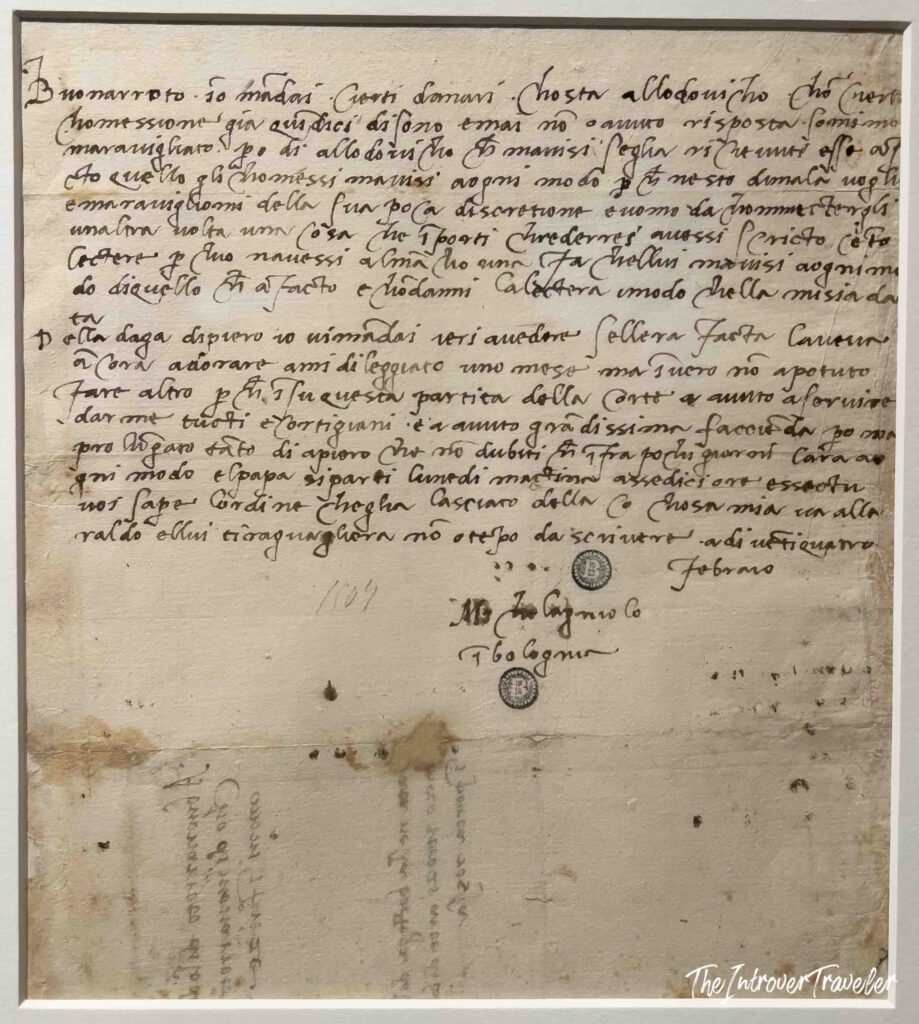
What is on the other hand documented in granular detail is the difficult relationship with his family, and in particular the maddening pattern by which his father Ludovico, his brother Buonarroto and the other relatives wrote to him. The Letters of Michelangelo are, for entire years, an epistolary of money requests. The father wanted cash for lawsuits, the brother wanted capital for the wool shop, the uncles were always in trouble. Michelangelo paid. And he paid while complaining, beautifully, in letters that today are first-class material for anyone teaching the stylistics of passive aggression, written in unbeatable handwriting and in a sublime sixteenth-century Italian. He said he was tired, that he was working for them, that they did not appreciate him, that they only wrote when they needed something, and then he paid anyway.
There is a recurring line in the letters to relatives that deserves to be isolated: the reproach for the poor quality of their correspondence. Michelangelo once writes to Buonarroto, exasperated, saying in substance that his letters are dreadful, that they make no sense, that he cannot even tell who wrote them. Among other things, in the middle of the family wanting money, there was also the fact that the absolute genius of Christendom was surrounded by people who probably did not read and who wrote with great difficulty. It is a humanising detail, and it explains why he cared so much about the humanist cardinals: there at least he found someone to talk to.
The quarrels with Leonardo, the friction with Julius II, the negotiations with patrons
The relationship with Leonardo da Vinci is another of those things that pop culture has turned into a cartoon. There exists the Anonimo Magliabechiano, a collection of mid-sixteenth-century Florentine anecdotes, which reports an encounter in Piazza Santa Trinita. Some gentlemen were discussing a passage from Dante, see Leonardo go by, and ask him for clarification. Leonardo, brisk, points to Michelangelo who was arriving: ask him, that’s his field. Michelangelo, irascible, reacts badly: “Explain it yourself, you who designed a horse to cast in bronze, and could not cast it, and abandoned it out of shame“. A venomous, targeted reference to the colossal equestrian model for Francesco Sforza, which Leonardo had worked on in Milan for years and never cast (it was destroyed when French crossbowmen used it for target practice in 1499).
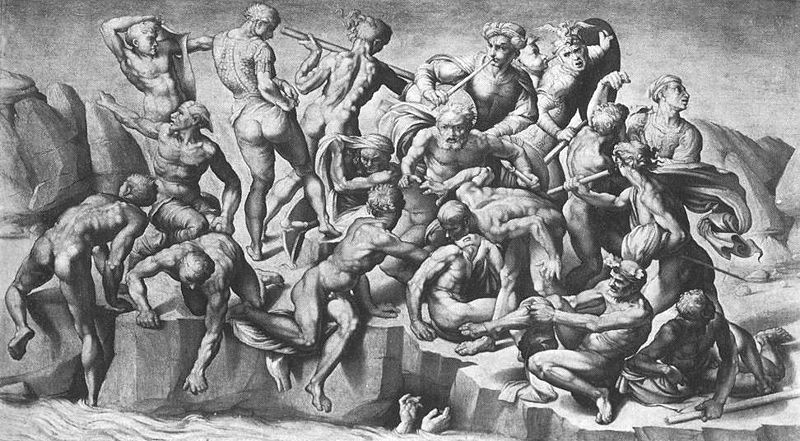
Anecdotes like this, as said, are to be taken with caution, but the substance is probably true. Michelangelo and Leonardo were radically incompatible. Leonardo was Olympian in his curiosity, distracted, infinitely diluted across a thousand projects, fluid in manners, and politely suspicious of organised religion. Michelangelo was focused like a laser beam, religiously tormented, physically wiry, polemical. The legend of direct competition culminates in the battle cartoons for the Salone dei Cinquecento in Palazzo Vecchio in 1504, where Florence literally put them against each other, Leonardo to paint the Battle of Anghiari, Michelangelo the Battle of Cascina. Neither fresco was ever completed. The fact that the city could afford to ask the two greatest artists in the world to fresco a hall simultaneously is what should really astonish us about Florence, not the brawl that followed.
The relationship with Julius II is, on the other hand, the most tormented, the best documented, and the one over which Michelangelo essentially lost twenty years of his life. Della Rovere, who ascended to the throne in 1503, is the warrior pope who wants to inaugurate his era with a pharaonic funeral monument, to be placed at the centre of the future new St Peter’s. Michelangelo arrived in Rome in 1505, received the commission, went to Carrara, chose the marbles, had them transported to Rome, and then the Pope changed his mind, also under pressure from Bramante who, according to Condivi, painted the tomb-in-life as “ill omen”. Michelangelo fled Rome in anger in 1506. Julius had him summoned back, in ultimatum tones, to Bologna, where he received him with the celebrated line reported by Condivi: “Tu avevi a venire a trovar noi, ed hai aspettato che noi vegnamo a trovar te” (“You should have come to find us, and instead you’ve waited for us to come and find you”), which curiously and inversely echoes a famous saying attributed to Muhammad about the climbing of mountains. Evidently Julius II’s will was more immovable than the prophet’s, or Michelangelo more changeable than an orographic feature. In any case Michelangelo apologised, was forgiven, and from then on he would live through the “tragedy of the tomb”: a monumental project that would shrink over the following decades down to the modest tomb in San Pietro in Vincoli with the famous Moses, and that would cost him quarrels, renegotiated contracts, displeased papal heirs, threatened lawsuits. Forty years of headaches, and the legend of Michelangelo’s incompatibility with deadlines perpetuated for eternity.
On patrons in general, the letters show a Michelangelo who dealt as an equal. Not out of arrogance, but because he had understood early a sociological fact: those who commissioned the works needed them more than he needed the commission, or at least as much, because Michelangelo was hardly averse to money, but I will return to this in a future dedicated post. His replies to cardinals are firm, to popes diplomatic but never servile, to popes’ nephews frankly brutal. It is a behaviour that in the sixteenth century was not obvious for an artist. It was the beginning of a profession that today we take for granted.
Michelangelo and homosexuality (no embarrassment required)
This is the chapter that forces us to be careful on two opposite fronts. On one side you cannot write about Michelangelo in the twenty-first century pretending the question does not exist, because for some it is embarrassing. On the other side you cannot turn him into a contemporary identitarian banner, because that is anachronistic and produces historical damage. The categories with which we think about sexual orientation today are largely nineteenth-century, and applying them to a sixteenth-century Florentine is like using a metre to measure temperature. That said, the documentary dossier is considerable, and deserves to be read for what it actually says.
Let’s start with the simplest thing. Michelangelo never married, is not known to have had relationships with women, has no known children, and all the affective relationships of any intensity that can be reconstructed from his papers are with men. Full stop. For completeness, since we are still inside the tight circle of the Ninja Turtles, analogous reasoning can be made about the sexuality of Leonardo da Vinci, whereas Raphael flattens onto a boring heterosexuality to which he seems to have been particularly devoted. On the factual level of Michelangelo’s homosexuality there is no debate among scholars. The debate begins when you enter the how.
Tommaso de’ Cavalieri is the most documented case. He was a Roman nobleman, beautiful in the judgement of contemporaries, of good family, whom Michelangelo met in Rome in 1532, when Cavalieri was perhaps 22 or 23 and Michelangelo was 57. For Cavalieri, Michelangelo wrote some of the most explicit sonnets in his canzoniere, plus a series of “presentation drawings” that are among the most finely worked things he ever produced on paper: the Rape of Ganymede, the Punishment of Tityus, the Fall of Phaethon, the Dream. Drawings on mythological subjects in which male nudity is central, and in which the themes (abduction of the beloved by the god, amorous punishment, dream and desire) speak clearly enough. As an aside, Michelangelo almost never gave drawings as gifts. They were his most valuable currency; from the workshop he hid them. For Cavalieri he made them on purpose, and very fine ones.
The sonnets for Cavalieri are declarations of love without ambiguity. One of the best known opens with “Sì amico al freddo sasso è ‘l foco interno“, and plays on the surname (“Cavalieri”, meaning “horsemen”, on which Michelangelo builds metaphors of riding that are not particularly subtle). The relationship lasted until Michelangelo’s death, thirty-two years later. It was Cavalieri who stood by him in his last days, in 1564. The most surprising thing is that it was an entirely daylight relationship: Cavalieri married, had children, Michelangelo always treated him with respect, and in the sonnets he complained about his own age as an obstacle, about common morality as a cage, never about the fact that Cavalieri had his own parallel married life.
Cecchino Bracci is the most extreme and least known case. Cecchino was the nephew of Luigi del Riccio, a banker and close friend of Michelangelo. He was a Florentine teenager, considered exceptionally beautiful, who died at fifteen in 1544. Michelangelo had not known him particularly well in life, as far as the letters show, but on his death, at Luigi del Riccio’s request, he composed for him a series of funeral compositions: about fifty, including sonnets, madrigals and quatrains, written over several months and almost all hinging on the wordplay on the surname (the beloved “arm/braccio”, the buried “arm”, the divine “arm”). Fifty funeral compositions for a fifteen-year-old, written on affective rather than family commission, are a statistically non-trivial datum, whatever interpretive frame you choose.
Febo di Poggio is a minor and melancholy story. A Florentine youth, perhaps a servant or an artisan, with whom Michelangelo had an involvement of some kind. The relationship ended with a surviving letter from Febo in which he asked for money and complained of having been abandoned. Not a glorious episode. I mention it because it restores the concrete, unsublimated dimension of an affective life in which not everything was sonnet. The comparison may be a stretch, but for anyone who has read or studied a little of the life and work of Pier Paolo Pasolini, that letter leaves little to the imagination.
The most editorially interesting case is that of the Rime. Michelangelo’s poems were not published in his lifetime. They were published in 1623 by his great-nephew Michelangelo Buonarroti the Younger, who was a Florentine man of letters with a respectable career. The great-nephew did a very Florentine thing: he corrected the pronouns. All the sonnets in which the object of desire was explicitly male were grammatically cleaned up to redirect the love toward a generic female addressee. Textual truth was restored only in the critical edition of Cesare Guasti in 1863 and definitively settled by Enzo Noè Girardi’s critical edition of 1960. For two and a half centuries Italy read a sweet, Petrarchan Michelangelo who was not exactly what he had written.
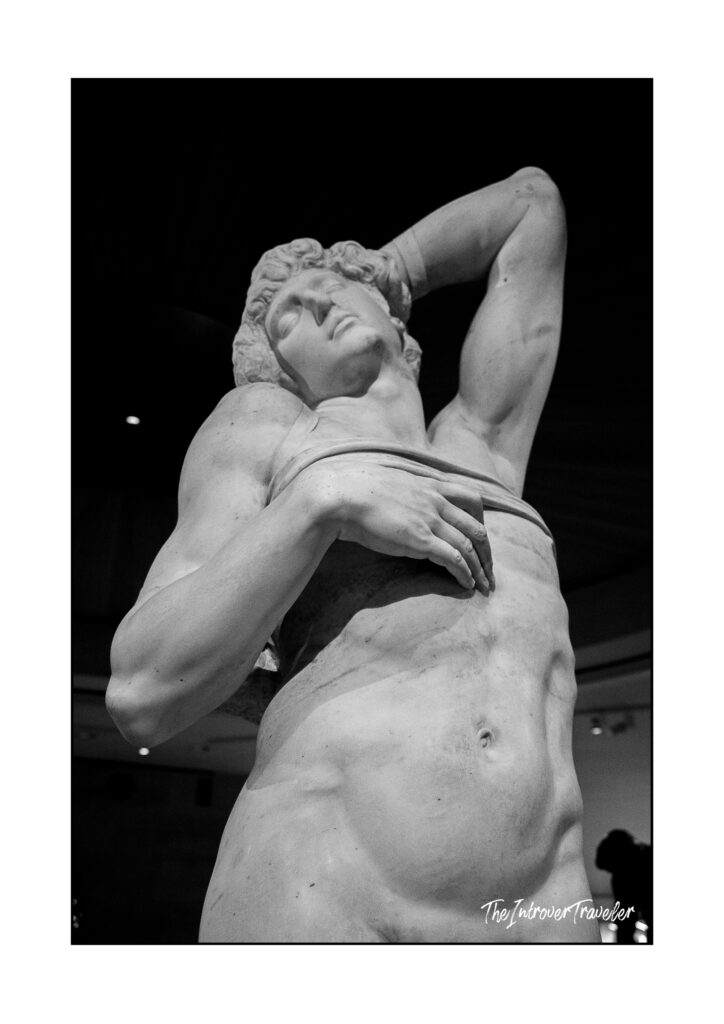
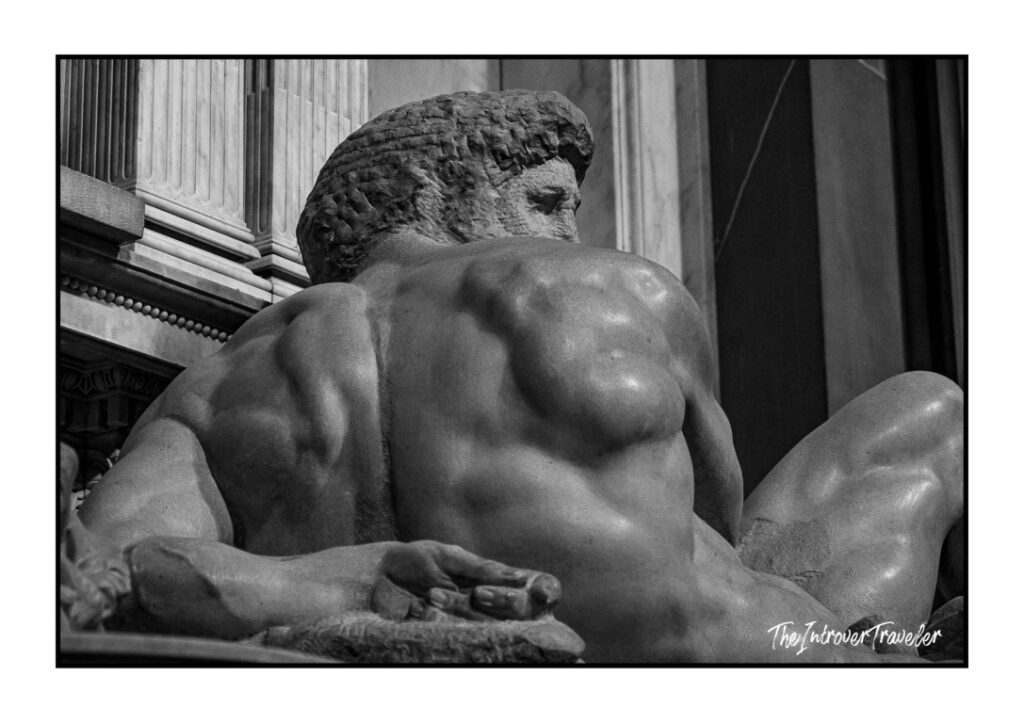
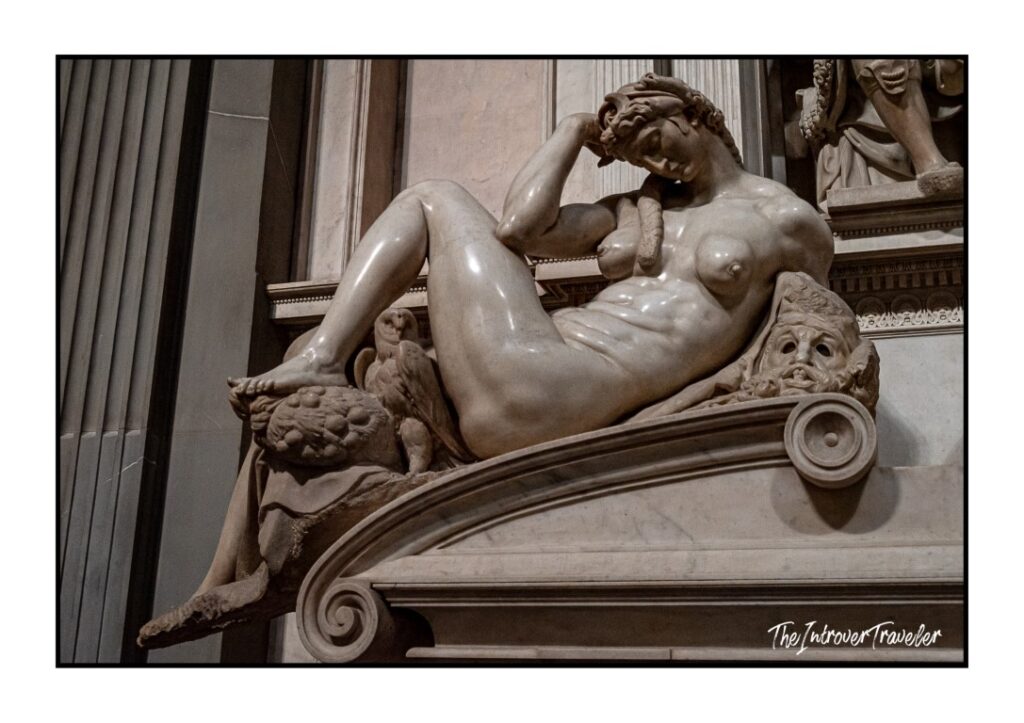
Having said all this, the interesting question is not whether Michelangelo was homosexual, he plainly was in the terms in which we can apply the category. The interesting question is how much that influenced the art. Here we need to be candid. The human body that Michelangelo studies, sculpts and paints throughout his life is overwhelmingly the male body. His Sibyls on the Sistine have the shoulders of a dockworker. The Night in the New Sacristy has been accused of being a disguised male figure. The Ignudi on the Sistine are a study of male bodies in the round. In the Last Judgement, on a vast work, the identifiable female figures are a handful. Everything else is male anatomy in action, investigated from every angle, in every twist, in every state of tension.
Can the same be said of other sculptors of the time? In part. Renaissance artistic culture had an institutional preference for the male nude as the testing ground of disegno. But in no other major sixteenth-century artist is the disproportion so systematic, and in no other is the male body invested with such expressive, dramatic, sensual charge. To argue that this choice has no relation to Michelangelo’s affective history would require a level of naivety frankly not worth defending. To argue the opposite, that all of Michelangelo is explained by his homosexuality, would be an even bigger nonsense, because his obsession with the human body in tension has a thousand other components: the study of antiquity, titanic ambition, the theology of Resurrection, the anatomical culture of the time (Michelangelo dissected corpses in Santo Spirito in Florence, with the prior’s permission, in exchange for a wooden Crucifix that is still preserved there).
The truth, as often, is less spectacular and more interesting. Michelangelo’s homosexuality is one of the components that explain why his subject was, dominantly, the male body. Not the only one, but one. And the fact that the religion of the time prevented it from existing publicly as such probably contributed to making it emerge even more condensed and powerful in the works. The male body as object of artistic investigation was permitted. As an openly declared object of desire it was not. The ambiguity between the two is one of the places where Michelangelo’s art breathes. Why is it worth discussing Michelangelo’s homosexuality? It is still a debated subject: not everyone takes it for granted that Michelangelo was homosexual in the sense we give to the term today. For what it is worth, I am convinced that he was, and this seems evident to me from a careful reading of his biography and an understanding of his work. But what I find interesting is the possibility of reading an entire corpus of works, the lifelong obsession of the greatest artist of all time, undoubtedly shaped by the author’s homosexuality, free from the ideological contamination that today inevitably marks the relationship between art and homosexuality. The inexhaustible exploration and investigation of the forms of the male body and its beauty is not purely aesthetic, but clearly also springs from passion.
The itinerary, built and verified
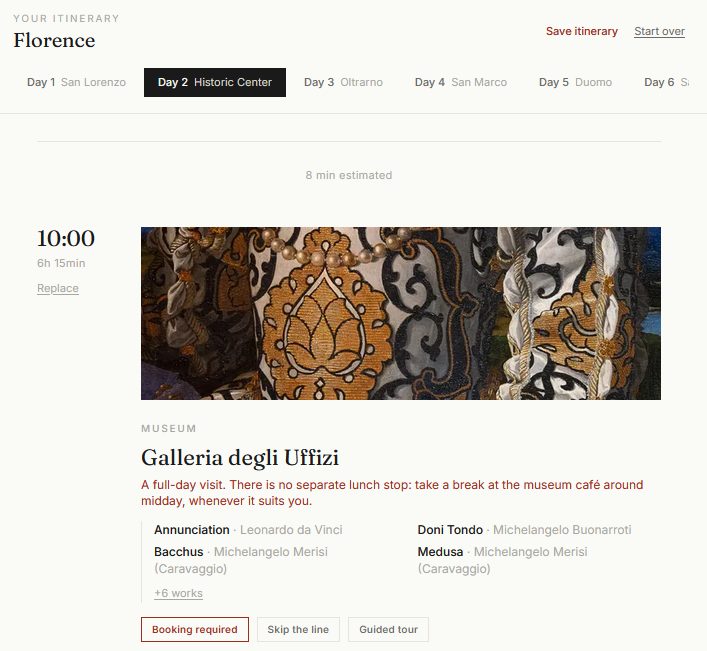
Seeing every Michelangelo in Florence or Rome?
Michelangelo never sits in one place. In Florence he runs from the David and the unfinished Prisoners at the Accademia to the Medici tombs at San Lorenzo, the Doni Tondo at the Uffizi and the Bacchus at the Bargello. In Rome it is the Sistine Chapel ceiling, the Pieta in St. Peter’s and the Moses at San Pietro in Vincoli. Flâneur builds a personalized itinerary around all of it: answer a few questions about how deep your interest runs and what your days should look like, and it maps the route, complete with real opening hours, transfer times, meal breaks, directions and booking links.
A general-purpose AI will send you to the David and the Sistine Chapel and call it done. Flâneur knows the rest, where each work sits, which days it closes, and how to see it all in one coherent Renaissance itinerary. Pick the Expert profile and you compose the day yourself, choosing from every Michelangelo indexed in the city, with a depth, flexibility and precision no chatbot can match.
The draftsman: virtuoso but never pleased with himself
For any Renaissance artist drawing was the foundation. It was the discipline, the grammar, the base on which everything else was built. Vasari had turned it into a proper theology, writing that drawing is “the father of the three arts” (architecture, sculpture, painting), a kind of ordering principle without which matter stays silent. Within this value system, being recognised as a great draftsman was not an accessory compliment. It was the compliment.
Michelangelo was one of the greatest draftsmen ever (my own irrelevant personal opinion: one of the greatest, with limits. I rate above him, for instance, Leonardo, Raphael and Pontormo, just to cite the first that come to mind, though in Pontormo’s case it is hard to imagine him without Michelangelo’s decisive precedent and influence). His contemporaries knew it, we know it. The surviving sheets, kept at the Louvre, the British Museum, the Uffizi, Casa Buonarroti, the Ashmolean in Oxford, the Royal Collection at Windsor, are one of the standards against which every other sixteenth-century draftsman is measured. Anatomical studies, heads, drapery, studies of male nudes, designs for the Sistine, designs for the New Sacristy, preparatory cartoons for the Last Judgement. The range is dizzying: from the lightning shorthand in red chalk to the finely finished metalpoint drawing that looks like an engraving.
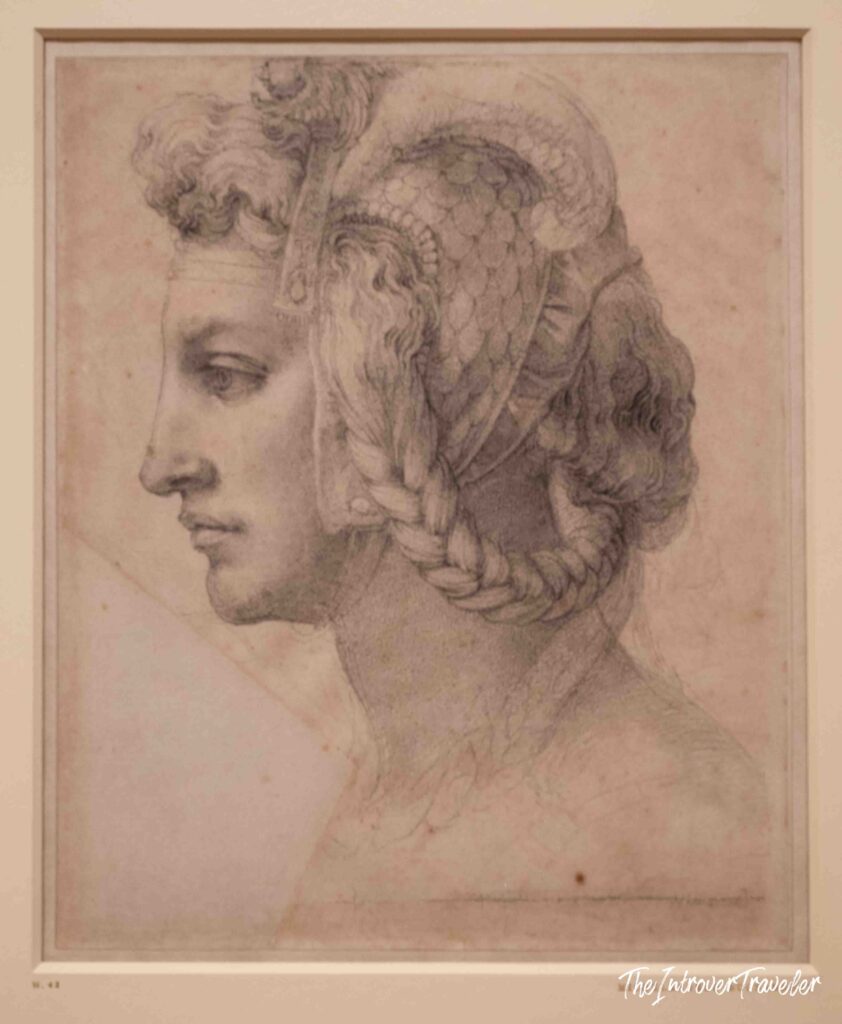
And yet Michelangelo’s relationship with his own drawing is one of the psychologically more curious facts of his biography. He was dissatisfied. Chronically. Vasari writes that Michelangelo, seeing universal admiration around him and at the same time feeling objectively better than everyone, could never be satisfied, because he knew from inside where he wanted to arrive and where he had not yet arrived. It is a feature of the stylistics of absolute genius: anyone with a very clear idea of a higher level sees clearly the distance that separates him from that level, even when from the outside it seems he is already there.
The consequence is one of the most spectacular acts of cultural vandalism in history: Michelangelo, on more than one documented occasion, systematically burned large quantities of his own drawings. It was not a symbolic purge, it was a physical destruction. He wanted, at least according to some interpreters, to erase the traces of his own imperfect attempts, of his preparatory studies, of everything that might show the process. He wanted only the finished works to survive of him. Vasari reports the thing as a chronicler’s fact, without judgement, with that slightly stunned tone of someone narrating a disaster that has just happened under his eyes.
Luckily his heirs, at his death, did not stick to the plan. They had been instructed to complete that final bonfire, and in part they followed instructions, but in large part they saved what they could. Much of what we have today comes from that family disobedience. Lionardo Buonarroti, the nephew, set aside folders that the old man had ordered destroyed. Casa Buonarroti in Florence still preserves a core of those rescued sheets. One should thank Lionardo every time one walks into the museum.
Michelangelo’s drawing is not functional in the nineteenth-century sense. It is not “the first step before the painting”. It is an act of thought in itself. Vasari describes how Michelangelo, once an idea was conceived, would turn it in drawing from every angle, until exhausted, and then no longer felt like putting it into paint, because in paint nothing could be added. This is one of the places where you see that Michelangelo is already outside the artisanal logic of the fifteenth century. His work is mental matter before it is physical matter.
The drawings for Cavalieri are the limit case. There the drawing was not preparation for anything. It was the work. A “presentation” as a finished object, to be delivered to a friend the way one would deliver a poem. It is a shift in the status of drawing that would have enormous consequences on later visual culture. From Michelangelo onward the sheet becomes a collectible object, and in effect the market for drawings as an autonomous category is born. A quiet revolution, started by a man who wanted to make a bonfire of his own drawings.
The sculptor: terribilità, antiquity, body
Michelangelo defined himself as a sculptor before a painter. He wrote it in his letters, repeated it to the popes who asked him for frescoes. “I am not a painter” (apocryphal quote), he would say, half out of stubbornness, half out of identity. In his head the hierarchy of the arts was firm: sculpture came first, because it dealt with the three-dimensional human body, and because it forced the artist to confront the hardness of matter.
Michelangelo’s sculptural apprenticeship is different from that of his contemporaries, and I personally find this fact one of the more surprising in his biography. He did not go through an organised sculptor’s workshop, as was usually the case. He went through the garden of San Marco and Lorenzo’s collection of ancient marbles. That is, through direct frequentation of antiquity. Bertoldo di Giovanni, the elderly custodian of those marbles, had been a pupil of Donatello, but his role at San Marco was more curatorial than didactic. Michelangelo learned by looking at Greeks and Romans, and copying them. It is a fundamental origin: his measure is not the contemporary master, it is ancient statuary. It is not entirely reckless to say that Michelangelo, who as a painter and draftsman had received solid training at Ghirlandaio’s workshop, as a sculptor was self-taught.
Two ancient pieces in particular worked on his head for the rest of his life. The first is the Belvedere Torso, a mutilated male marble torso from Hellenistic Greece, found in Rome in the fifteenth century and already then considered a peak of ancient sculpture. Michelangelo studied it at length, called it his master, and according to Vasari refused to restore it because it was already perfect like that, mutilated and powerful. His male nudes, from the Sistine Ignudi to the figures of the Last Judgement, are full of anatomical quotations from that torso. The second is the Laocoön, dug up on the Esquiline in January 1506, with Michelangelo present at the discovery in the company of Giuliano da Sangallo. The dramatic torsion of the group, the muscle under pressure, the tragedy of the father’s cry as he is wound by serpents, became immediately one of the formal reservoirs from which Michelangelo would draw for the rest of his career. The back of the Laocoön reappears, in disguise, in half of all his subsequent figures.
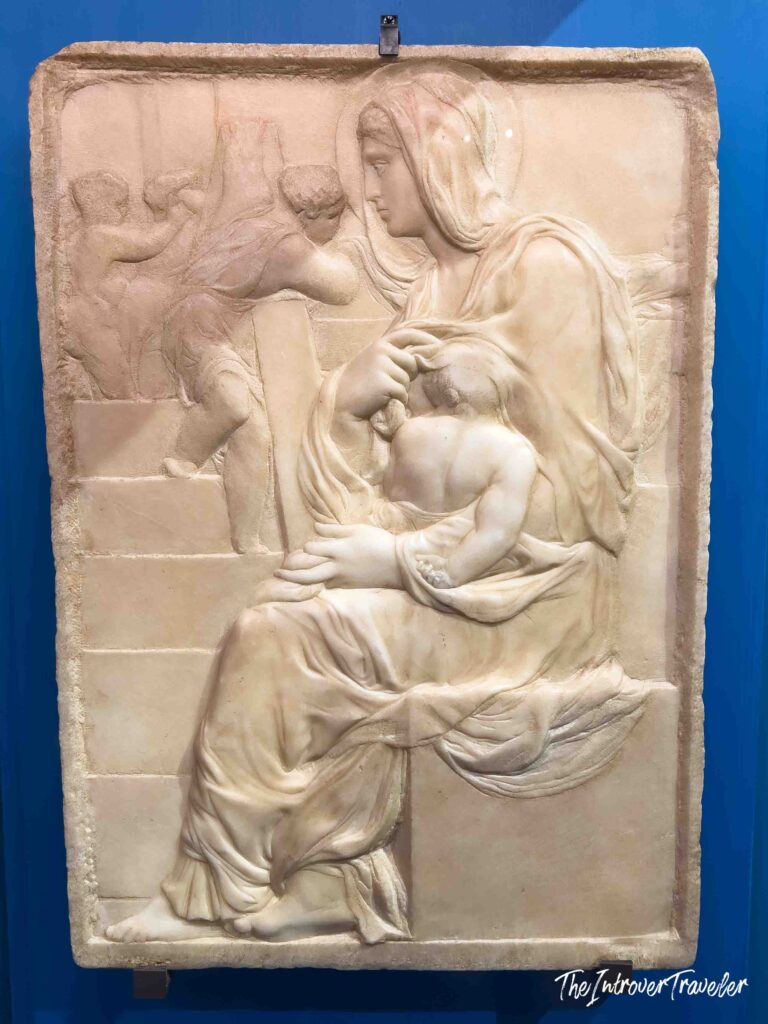
On top of this double foundation (anatomy studied from life, anatomy studied from antiquity) Michelangelo builds his own sculptural idiom, at least according to official criticism (to me, instead, some influences, however documented, look overrated; think of the Madonna of the Stairs, executed at sixteen, where the interest in the male body is already there in the bodybuilder’s back of the infant Christ, long before Michelangelo could have seen the Roman works). The distinctive traits are few and recurring. A conception of muscle mass almost always oversized with respect to nature, with torsos that have the power of a wrestler even when representing youthful figures. A preference for torsion, the “figura serpentinata”, in which the body never stands straight on two parallel feet but coils on itself, as if creating internal tension in the stone. A skin treatment that varies from the mirror polish of the Pietà Vaticana to the rapid, at times almost violent scratch of the late statues.
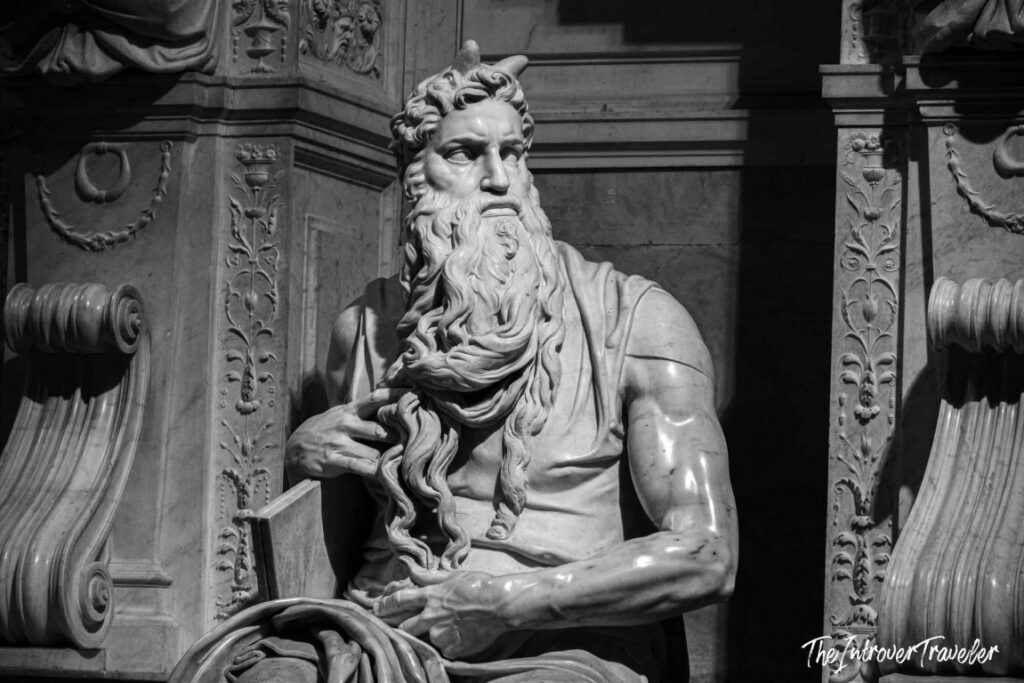
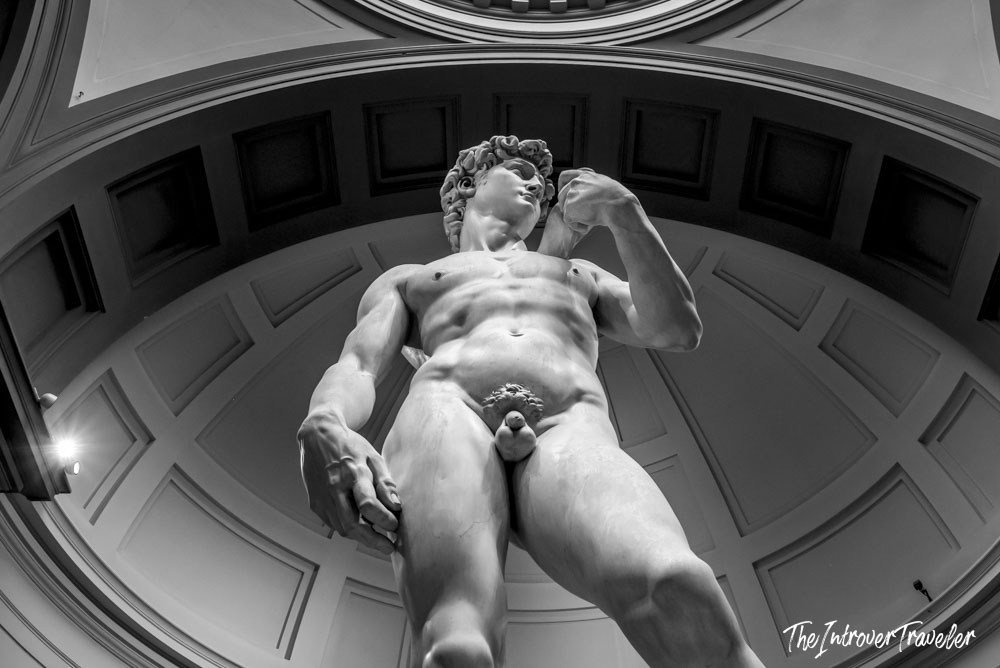
Vasari, to describe the complex of these qualities, coins a term destined to travel: terribilità. It is a word that today sounds strange, but in sixteenth-century Italian it means something precise: the capacity to inspire reverential awe, to strike the viewer with a force that goes beyond aesthetic pleasure; the pathos inscribed in marble. Michelangelo’s terribilità is the Moses of San Pietro in Vincoli that fixes you and makes you feel inadequate. It is the David, that seen in person stops you in your tracks. It is the power of authority embodied in stone. A quality that cannot be taught and that very few artists have had.
The David, sculpted between 1501 and 1504, is the textbook case of youthful terribilità. Michelangelo was twenty-six. They had given him a block of marble that two previous sculptors had already badly roughed out, leaving a shape that was all height, narrow, with almost insurmountable geometric problems. From that block, considered half-worked and essentially discarded, he pulled out a figure over five metres tall, perfectly balanced, with a nervous energy that classical marble had never had (except perhaps in Hellenistic sculpture). The Florentine David is not the winner. It is the moment just before the throwing of the stone. It is the wait. All the future action is compressed in the twist of the neck, the swelling veins of the right arm, the furrowed brow. It is an iconographic revolution as well as a technical one. Donatello, two generations earlier, had sculpted the David in post-victory pose, with Goliath’s head at his feet. Michelangelo turns him ninety degrees in time, puts him in the “before” rather than the “after”, and changes everything.
The Pietà Vaticana, sculpted before the David, between 1498 and 1499 when Michelangelo was twenty-three, is on the other hand the textbook case of polished finish. A marble surface so lustrous that the marble looks like flesh. It is the only work Michelangelo signed, and the signature comes after an episode that became legendary (even if not very plausible): it is said that some Lombard gentlemen, admiring the statue in St Peter’s, attributed the work to a Milanese sculptor. Michelangelo, irritated, allegedly returned at night and carved his own name on the band crossing the Virgin’s chest. A Vasari anecdote, probably embellished, but one that captures with precision a fact of character: for Michelangelo authorial identity was already, at the end of the fifteenth century, a non-negotiable matter.
Over the following years, until his death, Michelangelo would sculpt other capital figures. The Moses for the tomb of Julius II, with those horns that come from the Vulgate and that beard that lives a life of its own. The Slaves and the Prisoners, some finished (Louvre), others left to emerge from the block (Galleria dell’Accademia). The sculptures of the New Sacristy in San Lorenzo, with Day and Night, Dawn and Dusk, allegories that have the energy of cosmic figures imprisoned in a tomb. The three late Pietàs, which are the place where the non finito explicitly becomes a poetics. It is a production that, looked at across sixty years, shows an unsettled tension: Michelangelo never stops re-arguing with his own sculpture. The late statues are pictorially different from the early ones. He is another sculptor, with the same signature.
The painter: from reluctance to rewriting art
The story of Michelangelo’s painting starts with what is claimed to be a story of sabotage, or at least that is how it has come down as legend. In 1508 Julius II ordered him to fresco the vault of the Sistine Chapel. Michelangelo had been preparing to spend the autumn of his life sculpting the Pope’s tomb, and now found himself accepting a commission for which he did not consider himself equipped. Condivi, and with him much of subsequent historiography, names the culprit: Donato Bramante. Bramante was Julius II’s trusted architect, was working on the St Peter’s project, and was, according to Condivi, intimidated by the surgical eye of Michelangelo, who had already publicly pointed out defects in some of his Vatican constructions.
The trap, according to this reconstruction, was twofold. Either Michelangelo refused the papal commission, and incurred Julius’s wrath. Or he accepted, and according to Bramante he would inevitably fail, because painting was not his trade and at that scale it was an undertaking that put anyone in difficulty. On top of this, Bramante himself hoped, according to Condivi, to see Michelangelo “come out much less than Raphael”, who was meanwhile frescoing the Vatican Stanze next door.
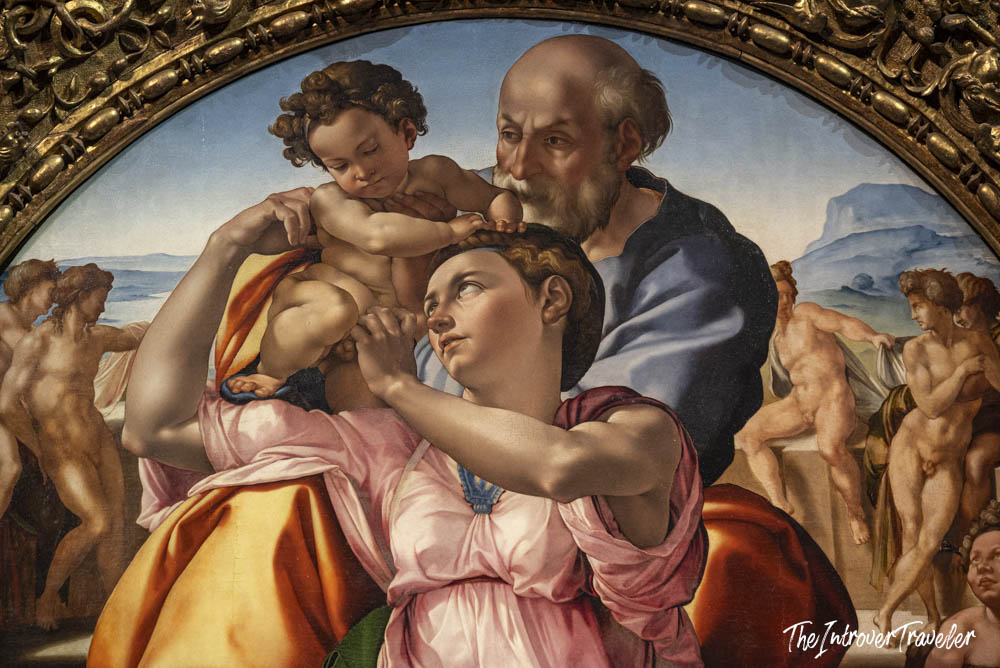
The opposite happened. Between 1508 and 1512 Michelangelo produced on the vault of the Sistine one of the most spectacular displays of force in the entire history of art. A complex iconographic programme on biblical subjects, organised in nine central stories from Genesis, with Prophets, Sibyls, Ancestors of Christ, Ignudi, and Old Testament scenes. On a surface of about 500 square metres. Alone, in very large part. With the buon fresco technique, in which each “giornata” of work must be completed before the plaster dries, with no room for second thoughts.
The technical fact, rediscovered only with the restoration carried out by the Vatican Museums between 1980 and 1994, is that Michelangelo was a technically more sophisticated painter than had been thought for centuries. The apprenticeship at Ghirlandaio’s workshop had not been a decorative episode: it had left him with a mastery of fresco that, once he freed himself of assistants after the first three panels (the Flood, the Sacrifice of Noah, the Drunkenness of Noah), allowed him to work with spectacular technical confidence. The restoration also brought out a stylistic fact that twentieth-century criticism had missed: Michelangelo painted with a typically Tuscan colour, bright, contrasted, far from the dull chiaroscuro that the soot of candles and later interventions had laid over the figures. It is a chromatic Michelangelo who explains, among other things, the immediate impact of the Sistine on artists such as Rosso Fiorentino, Pontormo, Andrea del Sarto and Beccafumi, that is, the founders of Florentine Mannerism.
Because this is the innovative reach of the Sistine. Not only the achievement of a technically prodigious undertaking, but the creation of a new language that subsequent generations would copy and develop. Mannerism is born in large part as both a reaction to and continuation of the Sistine. Pontormo, Rosso Fiorentino, Bronzino, Parmigianino build their idiom out of the logic of Michelangelesque torsions, of figure elongation, of unnaturalness as a deliberate choice. Tintoretto too, El Greco at Toledo too, even Caravaggio (by opposition) come from that ceiling. It is hard to think of a single artistic artefact that has had a comparable cultural impact.
Twenty years later, between 1536 and 1541, Michelangelo returned to the Sistine, to paint on the altar wall the Last Judgement, on commission from Paul III Farnese. This is a Michelangelo of sixty, marked by the Lutheran Reformation, by the Sack of Rome in 1527, by the spiritual unrest of the time. The Judgement is darker than the vault, athletic in an almost violent way, dominated by a beardless Christ-judge with the physicality of an ancient statue and the gesture of someone sweeping the damned aside. The controversies over the nudes, the demands to “cover up” the figures, the breeches painted by Daniele da Volterra after Michelangelo’s death in 1564, are already another chapter of the story, a Counter-Reformation chapter that would tighten the limits of the permissible. But in the meantime, in that 1541 in which the Judgement was unveiled, the world had seen another revolution. Michelangelo’s painting had redefined once again the limits of the genre.
The architect: the self-taught man who redrew Florence and Rome
Michelangelo the architect is the category least known to the general public, and probably the most spectacular when viewed from above. Because two of the most important cities in the world, Florence and Rome, are largely what we see them as today because of a man who had stumbled into architecture almost by accident.
He had not done an architectural apprenticeship. He had not studied Vitruvius systematically. He had looked at the ancient buildings of Rome with the eye of a sculptor, and then they had asked him to design. His first important architectural commission is the facade of San Lorenzo in Florence, wanted by Leo X Medici. Michelangelo developed a monumental project, had the wooden model built, went to Carrara to choose the marbles. The facade was never built, because of costs and internal Medici politics, and today San Lorenzo still displays its rough stone front, a magnificent relic of a missed opportunity. But in the middle of that affair Michelangelo had learned the craft.
The first architectural masterpieces are born in the same San Lorenzo complex, between 1520 and 1530. The New Sacristy, conceived as a Medici family mausoleum, is a small marvel. It picks up Brunelleschi’s Old Sacristy plan, but deforms it, stretches it, makes it restless. The pilasters do not rest in tranquillity, they compress. The members are not decorative but structural in the expressive sense. The tombs themselves, with those sarcophagi on which the allegories of Day, Night, Dawn and Dusk cannot stay still, are already in tension with the architecture that hosts them. It is an architecture that makes you think. Vasari was right: Michelangelo, in architecture too, had “broken” something.
The Laurentian Library, right next door, is even more radical. The tripartite staircase that leads up to the reading room is one of the strangest spaces in Renaissance architecture. The three flights occupy almost the entire vestibule, constrict the space, strangle it, push the visitor down with a physical sensation of volume. The windows above the doors are blind, they have brackets that support nothing, columns that slot into the walls as if set upside down. They are details that would make a Vitruvian theorist twitch. Michelangelo puts them there on purpose, to say that rules are a tool, not a limit. From this freedom is born, eighty years later, the Baroque. Bernini’s and Borromini’s compositional principles start here.
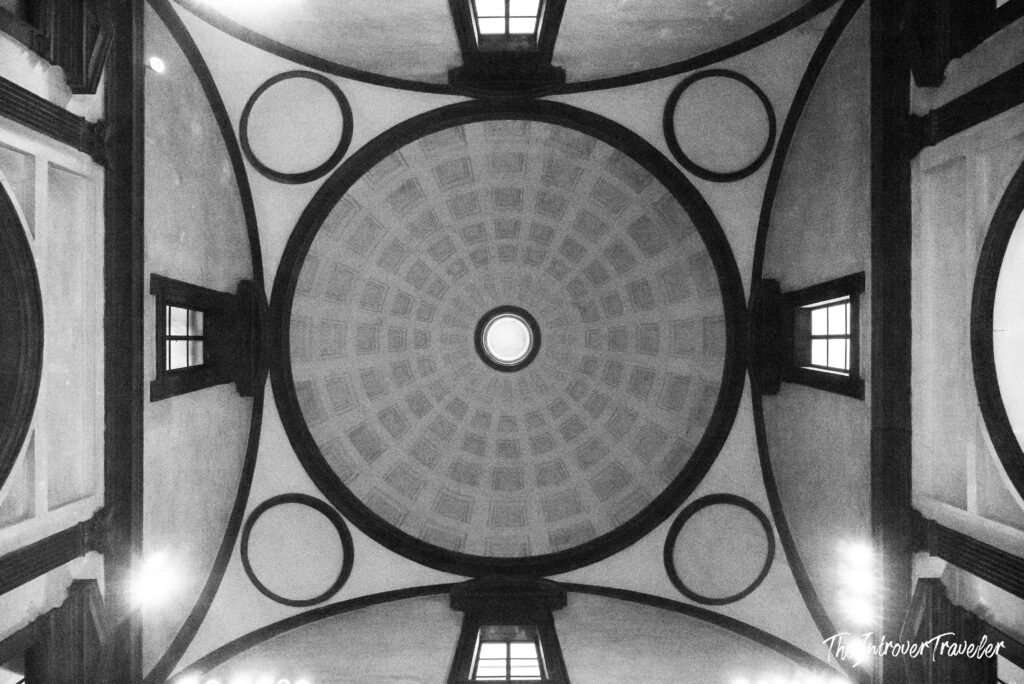
In Rome, from 1534 onward, Michelangelo becomes the architect of the city. In 1538 Paul III entrusts him with the redesign of the Capitoline Hill. The Capitol then was a ruined area, with the Senatorial Palace in poor shape, a square shaped like a scalene trapezoid, and nothing around. Michelangelo designs an oval piazza at the centre, with the twelve-pointed star on the pavement, the Senatorial Palace redone at the centre, the two side palaces converging slightly toward the facade in a forced perspective that makes the square look bigger than it is. At the centre, on a pedestal he designed himself, he places the equestrian statue of Marcus Aurelius, which until then had stood at the Lateran and had been saved from destruction because it was mistakenly believed to be of Constantine. Michelangelo’s Capitol is one of the earliest examples of integrated urbanism in Europe. It is not “a palace in the square”, it is the square thought together with the palaces that enclose it, as a single organism.
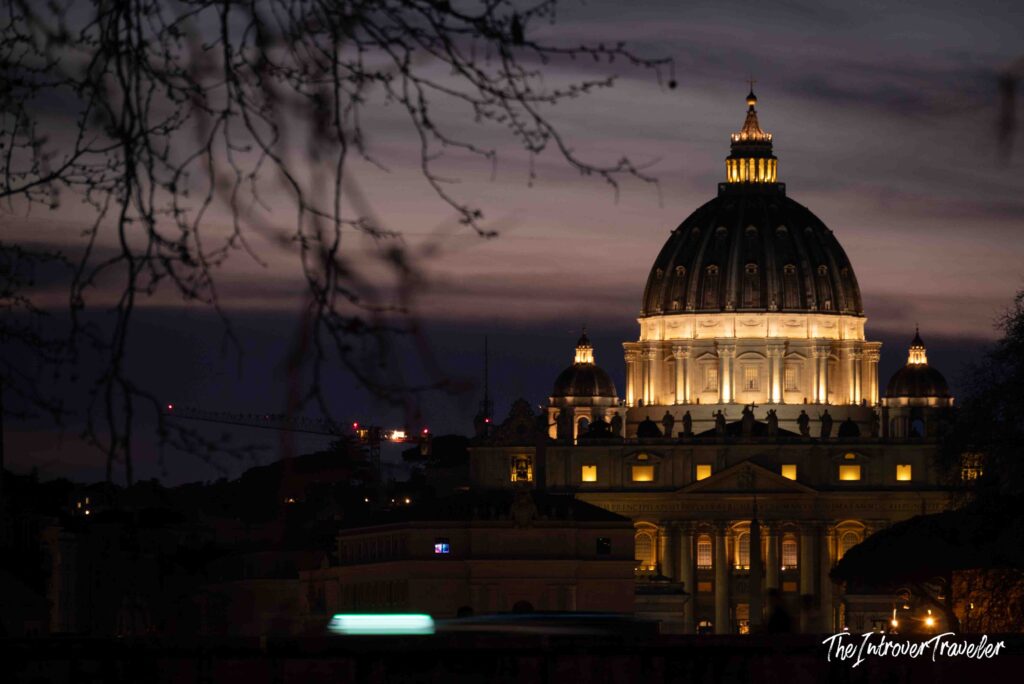
In 1546 Paul III appoints him architect of the Fabric of St Peter. Bramante had been dead for some time, Raphael and Sangallo had taken turns on the site, the project had grown like a tumour in a thousand different directions. Michelangelo took Sangallo the Younger’s model and demolished it verbally, letter after letter to the cardinals. He accused it of being redundant, decorative, illegible. He proposed a return to Bramante’s central plan, cleaned up, simplified, with a gigantic dome. He worked on St Peter’s until his death and at seventy-three was still climbing scaffolding. Beware what you read online; what often gets recycled is the gratifying fairy tale of Michelangelo working for free for the good of Christendom. Michelangelo did not get out of bed for free. It is true that he received no fee, but it happened because Pope Carafa, with whom relations were dreadful, had revoked the life income granted to him by Paul III. On Michelangelo (as on everything else, for that matter) finding quality information is not easy, and once nonsense gets into print it spreads like an oil stain. In any case, back to St Peter’s, at his death the dome was completed up to the drum. The current dome, finished by Giacomo della Porta twenty years later, preserves the Michelangelo idea, though with a more elongated profile. That dome, seen from anywhere in Rome, is Michelangelo’s signature on the eternal city.
The last important architectural work is Porta Pia, commissioned in 1561 by Pius IV. Michelangelo was eighty-six. To restore the context for the modern reader: this was still a time when a city gate was a work of absolute prestige, because it was the first and last thing anyone entering or leaving Rome would see. Michelangelo designed a complex facade, with elements eating into one another in a game of solid and void, curved and triangular pediments stacked, blind windows in dialogue with real windows, an architectural writing already completely outside Renaissance grammar. Porta Pia is where European architecture changes code. Without Porta Pia you do not understand Borromini’s Baroque. It is a late, experimental, slightly enigmatic work, and it deserves to be visited deliberately, because it is easy to walk past it without realising that there inside lies a central knot in the history of world architecture.
To summarise the point. The architect Michelangelo did not come out of academic training. He shaped himself looking at the Pantheon, the Baths of Caracalla, the Colosseum. He brought into architecture the sculptor’s thinking, that is, the plastic sense of mass, torsion, expressive deformation. And he left to Florence and Rome some of their identitarian works. Without Michelangelo St Peter’s dome isn’t there, the Capitol isn’t there, Porta Pia isn’t there, the New Sacristy and the Laurenziana are not there. Just this would be enough for a career. It is unsettling that this was the “second trade” of a man who had already sculpted the David and painted the Sistine.
The poet, the linguist, Vittoria Colonna
Michelangelo wrote, throughout his life, a substantial quantity of verse. The exact figure depends on which edition you look at, but we are in the order of three hundred compositions, including sonnets, madrigals, quatrains, fragments, funeral epigrams. For a man who did not consider himself a poet, it is a lot. For a poet who did not consider himself a literary artist, it is even better.
Michelangelo’s poetry is a textbook case of non-professional writing at the highest level. He was not a humanist man of letters like Pietro Bembo, who was codifying Petrarchism as the linguistic standard of the sixteenth century. He did not have the elegance of a Della Casa or a Vittoria Colonna. He had, on the other hand, something professionals often lack: conceptual urgency, nervous harshness, the ability to push the sonnet to breaking point to fit a dense philosophical thought inside. His verses do not flow. They stumble, they twist, they show off brutal enjambements, they end on a tight knot. They are made like his sculpted figures: in internal tension. Even in literature Michelangelo cannot contain his unstoppable need to create, to give voice to his own fertility.
The sonnet on the concetto and the marble, already quoted at the beginning, is the best-known monument. But there are many others of equal intensity. The Sistine sonnet (“I’ ho già fatto un gozzo in questo stento”, “I’ve already grown a goitre from this drudgery”) describes his own body deformed by work with a realism that has no precedent in the poetry of the time. The sonnets for Cavalieri are philosophical declarations of love, in which desire for the beloved blends with desire for absolute beauty in the Platonic sense. The funerary epigrams for Cecchino Bracci are exercises in style on a painful subject, written on a friend’s commission, and they show how Michelangelo could produce verses cold, on request, with quality.
But the human summit of his poetry is the exchange with Vittoria Colonna. Vittoria was Marchioness of Pescara, widow of the Marquis Ferrante d’Avalos who died in battle in 1525, and one of the most cultured women in Italy. She published a Petrarchan canzoniere of high quality, was close to the reforming group within the Church that sought mediation with Lutheranism (the movement later known as “Spirituali”), and corresponded with the major religious thinkers of the time. She met Michelangelo in Rome around 1536. She was forty-six, he was sixty-one. From this came the most important friendship of Michelangelo’s old age.
Their relationship was epistolary and grounded in spiritual conversation. They met in convents, wrote letters, exchanged sonnets, discussed Christ, salvation, grace. Michelangelo dedicated to her some of his loftiest sonnets, in which reflection on beauty fuses with reflection on prayer. He gave her several very fine religious drawings, among them a Crucifixion, a Pietà and a Samaritan Woman at the Well, which were for her objects of personal devotion. When Vittoria died, in 1547, Michelangelo stood beside her body and kissed only her hand. He later confessed, in the conversations reported by Condivi, that he regretted not having kissed her face too. She was the only female figure of any standing in his affective life, and she was an intellectually equal figure. An important sociological point: in all of Michelangelo’s correspondence, Vittoria is the only female interlocutor to whom he writes as an equal, discussing philosophy and God.
One last linguistic note. Michelangelo’s Tuscan, in the letters and the poems, is a Florentine Tuscan with strong oral imprint, with full syntactic licence, suspended constructions, frequent recourse to the technical lexicon of the arts. It is a language that a linguist of the time like Bembo would have considered barbaric. To a linguist of today it looks, on the contrary, as one of the liveliest writings of the sixteenth century, because it preserves spoken cadence and direct energy. When people say that sixteenth-century Italian was already perfectly codified, it is worth remembering that Michelangelo wrote to his relatives in an Italian that sounds very much like the Tuscan still spoken today in the small villages of the Mugello.
The non finito: where we can watch him work
The non finito is one of the most discussed themes around Michelangelo, and one of the most variously misunderstood. Some order needs to be made, because five centuries of overlapping interpretations have piled up on top of the historical fact.
Let us start with the factual datum. Michelangelo left a notable number of sculptural works not brought to completion. The Saint Matthew of 1506, today at the Accademia. The Prisoners of the early 1530s, at the Accademia. The Pietà Bandini at Santa Maria del Fiore, worked on in the 1550s and then partially shattered by Michelangelo himself in a moment of dissatisfaction. The Pietà Rondanini, today at the Castello Sforzesco in Milan, worked on until the very last days before his death in 1564. Plus a series of secondary figures in the New Sacristy, never completed. Plus dozens of other planned and never executed works. In numerical terms, the statues by Michelangelo left as completed are far fewer than one might think.
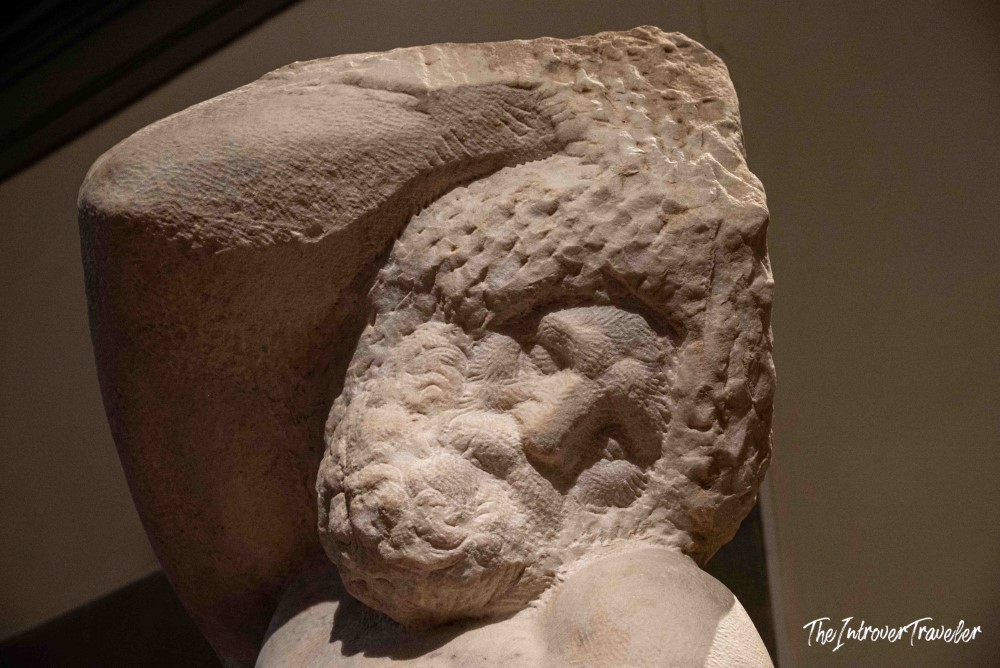
The historical causes are in part banal. Commissions changed. Popes died. Building sites stopped. Michelangelo moved between Florence and Rome. He did too many things at once. And yet popes died for other artists too, who have not left so many apparently incomplete works. The tomb of Julius II alone was supposed to have forty statues and ended with three. Vasari, a good chronicler, registers these external causes and at first makes them the main explanation of the phenomenon. Then, in the second edition of the Lives of 1568, he changes angle. He starts to see in the non finito something intrinsic to Michelangelo’s way of working, an “incontentabilità” (his term, “inability to be satisfied”) that prevents the artist from considering a work concluded once he has spotted even a minimal error in it.
Paola Barocchi, in a decisive essay from 1958, showed how Vasari gradually dares to grant Michelangelo’s non finito a positive aesthetic justification. From “incontentabilità” as a limit, to “licenza” as creative freedom. It is a crucial passage: for the first time in the history of European criticism the incomplete work is considered not a defect, but a legitimate manifestation of art. Michelangelo’s non finito is the point at which this conceptual revolution opens up.
What happens afterwards, up to the nineteenth century, is a swing. The classicist treatise-writers of the seventeenth and eighteenth centuries trace the non finito back to error. Lalande, travelling in Italy in 1769, explains it with “le grand savoir” accompanied by “trop de hardiesse”. Cicognara, still later, reduces it to a problem of unruly matter. It is only with the Romantic nineteenth century that the non finito is fully reappraised. Delacroix, in his Journal, builds around the Michelangelesque non finito a fully fledged aesthetic theory: the undisciplined geniuses, who obey only their own instinct, are the true shepherds of flocks, while fully finished artists are good shepherds but less powerful. Ruskin, in the Seven Lamps of Architecture, elevates the non finito to a proper aesthetic category, identifying it with sculpture understood pictorially. For Ruskin, the statues of the New Sacristy are “truer and more complete” than ancient statues, precisely because of their unfinished state, because they let you see the thought.
In the twentieth century the debate becomes more technical. Henry Thode, at the start of the century, sees in the non finito a conflict between intellectual aspiration and artistic realisation, a kind of disease of genius. Tolnay, in the 1940s, traces the non finito back to the psychology of Michelangelesque dissatisfaction. Sergio Bettini, in the 1950s, dismantles the category itself, arguing that each work must be evaluated case by case and that treating “non finito” as a unitary aesthetic category is an oversimplification. And it is Bettini who offers the most suggestive formula: for him Michelangelo’s unfinished works are “the index of a greater freedom won”, not the proof of a freedom failed.
Above all this, there is Michelangelo’s own Neoplatonic explanation, already recalled at the start of the post. The work of art is already inside the marble, the artist liberates it. When, while working, the artist senses that liberation will not succeed perfectly, because the material has a flaw (a knot, a wrong vein) or because the mental conception has shifted in the meantime, leaving the work in the state it has reached is the lesser evil compared to forcing the hand. Vasari reports a phrase attributed to Michelangelo that is worth remembering: he said he had not brought many statues to completion because “if he had had to be content with what he was doing, he would have produced few of them, or rather none”. It is a confession of method. The fact that many works remained half-done is not a mishap. It is the consequence of a method that demanded constantly raising one’s own internal bar.
For those who go to the Accademia in Florence, the point where this story becomes physical is the Galleria dei Prigioni. Four statues left at various stages of emergence from the block, with the Bearded Slave, the Young Slave, the Awakening Slave, the Atlas Slave. You can see the strokes of the point chisel, the paths of the drill, the routes through which Michelangelo had arrived (or had not arrived) at the inner figure. It is like watching a genius work in real time, five centuries later. Few places in the world offer such a clean experience, and it deserves to be seen by anyone who wants to understand how marble is really carved.
Florence and Rome, there and back
Michelangelo’s life mostly unfolds between two cities: Florence, where he grew up and trained, and Rome, where he worked from maturity onward. He moved between them several times, depending on commissions, popes, Florentine political revolts, his own temporary adherence to one political faction or another, wars. The result is a double impact: Florence and Rome shape him, and he shapes them.
How much Florence made Michelangelo has already been said above. It was the only context in which a talented fifteen-year-old could find himself dining with Marsilio Ficino and apprenticed at Domenico Ghirlandaio’s workshop in the same semester. It was also the city which, in the preceding generation, had produced Donatello, Brunelleschi, Masaccio, Leon Battista Alberti, Verrocchio. Michelangelo grew up inside a visual repertoire that was already the peak of European artistic culture. The structure of his figures, the trust in drawing as foundation, the philological attention to antiquity, the conception of the building site as civic laboratory, are all specifically Florentine traits. Even his temperament, polemical, autonomous, allergic to authority, is a classically Florentine trait of character, what Burckhardt would have called Renaissance individualism, sharpened by three centuries of communal life.
How much Michelangelo made Florence, you only need to look around. The David in front of Palazzo Vecchio (today the original is at the Accademia, but the urban effect remains) is one of the most recognisable identity symbols of the city, and San Lorenzo, the Medici church, bears Michelangelo’s signature at least as much as Brunelleschi’s.
In Rome the relationship reverses. Rome does not form him, it challenges him. When Michelangelo arrives for the first time, in 1496 at twenty-one, he finds a city in full rebuilding, with the Della Rovere and Medici popes reinventing the capital of Christendom. Above all he finds the ancient ruins, which were not visible in Florence and which change the scale of everything. The Colosseum, the Baths of Caracalla, the Pantheon, the Hellenistic statues of the Belvedere Torso and the just-rediscovered Laocoön are a standard against which an artist has to measure himself if he wants to stay in town. Michelangelo does not back down. On the contrary, he accepts precisely the challenge of scale. The Pietà Vaticana, sculpted for the French cardinal Jean Bilhères during that first Roman stay, is already a work of absolute standing. It is the calling card with which he announces himself to the world. From there on Rome becomes his permanent testing ground.
How much Rome owes Michelangelo is documented in plastic form by the topography. We all know the Sistine Chapel. The dome of St Peter’s is the city’s skyline, visible from miles away. The Capitol is the square through which Rome represents itself at its highest civic moments. Porta Pia is the point where via XX Settembre meets the walls. The Baths of Diocletian, converted by Michelangelo into the Basilica of Santa Maria degli Angeli, are one of the most powerful examples of ancient architectural reuse in modern times. Without Michelangelo, Rome would be a different city in its central iconography. Only Bernini, deliberately measuring himself against Michelangelo, would do more a century later.
Five centuries of critical fortune, in pills
A non-specialist guide to how the West has read Michelangelo, from 1564 to today. We move in stages, with no claim to exhaustiveness and with the awareness that to each epoch corresponds a slightly different Michelangelo.
The first stage is Vasari himself, who publishes the second edition of the Lives in 1568, four years after Michelangelo’s death, and is also the architect of the Florentine funeral, a gigantic post-mortem marketing operation in San Lorenzo. Vasari sanctifies. Michelangelo is “the divine one”, the evolutionary summit of the entire history of art, beyond which there is nothing more. It is a propagandistic and hagiographic reading, and Vasari is aware of it. But it is also the first time an artist is presented as a figure on a par with great political and literary men. A sociological revolution.
From the seventeenth to the eighteenth century, the consensus cracks. Baroque culture recognises Michelangelo as the father of its own language (Bernini measures himself explicitly against him), but the stricter classicist treatise-writers, especially in France with Bellori and then at the end of the century with the theorists of the Académie, start to complain of excesses: terribilità is judged insufficiently rational, the foreshortenings too violent, the proportions unnatural. The eighteenth century of Winckelmann, which canonises Greek “noble simplicity” as aesthetic standard, is less friendly to Michelangelo than to Raphael. Reynolds, in the Discourses given at the Royal Academy at the end of the eighteenth century, recovers Michelangelo as the model of the painterly Sublime, but it remains a reading compatible with academic classicism: Michelangelo is taken as master of idealised proportion, not as the tormented artist he was.
The Romantic nineteenth century is the great interpretive revolution. Delacroix, Stendhal, Symonds, Burckhardt build the Michelangelo that still dominates the popular imagination today. It is the solitary genius, religiously tormented, in titanic struggle with his own material, father of the modern precisely because of his ability to leave works unfinished. Symonds, in the biography of 1893, makes him the figure of the artist as interior hero, in continuity with Beethoven and Wagner. Romain Rolland’s biography of 1905 tightens this profile further: Michelangelo as the embodiment of aspiration that always exceeds realisation. It is in this climate that, a few decades later, Irving Stone’s 1961 novel The Agony and the Ecstasy is born, followed by Carol Reed’s 1965 film with Charlton Heston. “Torment” as an interpretive category becomes the standard seal for Michelangelo for the general public. It is not a wrong reading, it is a nineteenth-century reading, and it should be treated as such.
The twentieth century has added two important things. The first is a technical historiography, based on archives, on critical editions of the Letters and the Rime, on precise attributions. Charles de Tolnay published between 1943 and 1960 a five-volume monograph that is still today the starting base for anyone who wants to study Michelangelo seriously. Michael Hirst, John Pope-Hennessy, William Wallace, Antonio Forcellino, have continued in this direction. The second contribution is restoration. The restoration of the Sistine, carried out by the Vatican Museums between 1980 and 1994, and technically led by Gianluigi Colalucci, has physically changed what we see. It has revealed the Michelangelesque colour, the fresco technique, the work pauses, the in-progress corrections (and, here and there, has also erased things). It has reopened interpretive questions that had been considered closed. It has also generated fierce controversies (the best known being that raised by James Beck with his ArtWatch), which are a physiological part of any intervention on a work of this importance.
One transversal line deserves to be isolated: Michelangelo’s influence on sculptors after the sixteenth century. Bernini, as already said. But above all, in the modern era, Auguste Rodin. Rodin, on his Italian trip of 1875, went to see the Prisoners (today at the Accademia, then at the Grotta del Buontalenti in the Boboli Gardens) and the Medici Tombs. He returned to Paris convinced that the non finito was a legitimate expressive tool, and all his mature sculpture (the Thinker, the Burghers of Calais, the Balzac) is a conversation with Michelangelo. Without Michelangelo, no Rodin in the form in which we know him. And without Rodin, half of twentieth-century sculpture is unintelligible. It is a chain of artistic paternity worth keeping in mind when looking at the Prisoners in Florence.
Michelangelo demoted to pop icon
Running parallel to critical fortune there exists a Michelangelo of mass culture, in which the work has been progressively detached from context and reduced to logo. It is a process that deserves to be looked at directly, because it has consequences on how people relate to the works when they finally see them in person.
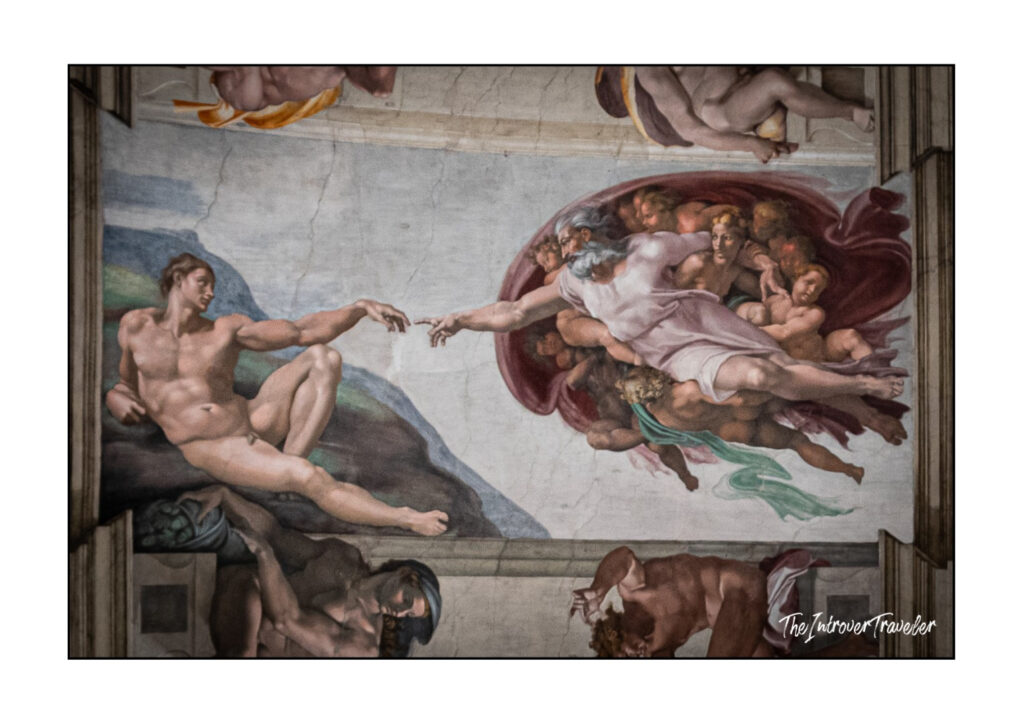
The visual fact is simple: two images by Michelangelo became, in the twentieth century, part of the global iconographic repertoire alongside the Mona Lisa, Munch’s Scream and very little else. The first is Adam’s finger touching God’s in the Creation of Adam, the central panel of the Sistine. The second is the face of the David. The two images have been reproduced on every possible support: t-shirts, fridge magnets, cushion covers, coffee mugs, underwear, self-help book covers, film posters, advertisements for anything from Coca-Cola to Pepsodent; your humble blogger, when separating from his first wife, in addition to the house, the children and the salary, also lost a barbecue apron with the David’s torso on it, which produced an entertaining trompe l’oeil over the amateur cook’s physique, improving the abs but not the virility. The Creation of Adam has also become, in more recent times, a standardised formal structure for online memes: you put any object in place of God’s hand, and you obtain a visual citation immediately legible to anyone in the world.
I do not want to descend into a silly stadium-style argument about whether Michelangelo trumps Leonardo as an artist, but probably the only other work that has entered the global imagination as much as the David and the Creation is the Mona Lisa. It is historically easy to verify, though, that the mass popularity of the Mona Lisa was born with the Louvre theft at the start of the twentieth century, while Michelangelo’s two works rooted themselves in mass culture by the sheer strength of their suggestive power.
The Carol Reed film The Agony and the Ecstasy definitively cemented Michelangelo’s pop image. Charlton Heston, already Moses in The Ten Commandments, and being one of those actors whose body was itself a statue, played a Michelangelo permanently on the edge of nervous collapse, dangling from wobbly scaffolding, in struggle with Julius II played by Rex Harrison. It was about as Hollywood as a Nolan production casting Black actors as Olympian deities, but it had the merit of bringing a very wide audience to take an interest in Michelangelo (including a small blogger in the middle of a curious childhood). It had the cost, however, of compressing his image around an emotional stereotype (the perpetually tormented artist) that reduces an artistic and intellectual story to melodrama, when it is infinitely more articulated.
What have we lost when we banalised Michelangelo into an icon? We have lost the possibility of seeing him. The Creation of Adam, seen in person in the Sistine Chapel after working through the queue at the Vatican Museums, has an effect that reproductions do not give: it is set inside a programme of nine panels, surrounded by Ignudi and Sibyls, in vertical dialogue with the floor and horizontal dialogue with the Last Judgement on the altar wall. It is a picture inside a figurative book, not a single illustration. Anyone walking in with only the detail of the finger in their head ends up having to reckon with the whole chapel, and generally walks out more dazed than enlightened.
The same is true for the David. Reproduced for five centuries, it is impossible to arrive in front of it not thinking you know it. Then you see it at the Galleria dell’Accademia, at the end of the Prisoners corridor, and you realise that it is taller than you remembered, that the marble has yellowish veins that photos do not render, that the real David is impressive also because you sense the difference between the worked marble and the original block. It is one of those cases in which reproduction, substituted for the object, has robbed the object of a significant part of its meaning.
This paragraph is not a moralistic complaint against mass culture. But the risk that works of extraordinary aesthetic and theoretical complexity get banalised into icons is not to be underestimated.
And when banalisation gets dressed up as the ideological militancy of the moment, things only get worse. Michelangelo conscripted as an icon of “patriarchal white supremacy” by some high priestess of the woke cult is recent news, not pre-emptive satire. I’ve written about that here.
There is then a second form of banalisation, less noisy but more insidious: technical reproducibility pushed to the point of farce. In St Peter’s itself, during the pre-Jubilee restoration, the Vatican Pietà has been replaced on display by a 3D-printed cast, in front of which tourists happily snap selfies without noticing. On the whole episode, and on what Marshall McLuhan and Walter Benjamin would have made of it, I have written a separate post.
The artist measuring himself against himself
Closing a twelve-thousand-word post on Michelangelo is a temptation to easy rhetoric. The risk is sliding into the same hagiographic register the post had started against. Let me try to keep my voice low and say one thing only.
Michelangelo is the clearest case the history of art knows of a man who worked sixty years to build his own work with no real adversary other than himself. He had immensely powerful patrons, but he handled them as equals. He had rivals, but he outclassed them. He had critical fortune already in his lifetime, but he did not particularly care. His problem, in a way that for those of us who are not geniuses of that calibre is hard to grasp from inside, was continuing to be at the level of Michelangelo. To maintain, decade after decade, the standard that he himself had set.
This explains nearly everything. It explains why he burned the drawings, why he left works unfinished, why he smashed the Pietà Bandini, why at seventy-three he was still climbing the scaffolding of St Peter’s. It also explains why, from his seventies onward, he kept exploring new paths. He did not need to do that for fame, he had plenty. He did it because it was the only way, within his mental frame, to remain worthy of his own name.
“Torment” is the convenient word with which we describe this. It has been since Stone’s novel made it standard, and indeed it comes too easily. It is, it should be said, also a word that captures a real datum: in the sonnets, in the letters, in the confessions to Condivi, Michelangelo describes in the first person an experience with depressive, persecutory, obsessive traits. “Torment” is not a Hollywood invention, it is documented. Only that it is documented in a frame more complex than the term suggests.
Maybe “internal competition” is more precise. Or, as some German critic of the early twentieth century proposed, “Unvollendetes”: permanent incompleteness as a way of being. Whatever we want to call it, Michelangelo’s work five centuries later continues to be the testing ground of Western sculpture, painting, architecture. Not because it is necessarily “the most beautiful”. Because it is the most ambitious, and because anyone who looks at it attentively ends up confronting a level of tension between ideal and realised that very few other artists have had the nerve to sustain for so long.
The closing invitation is simple. If you are in Florence, set aside a whole afternoon for the Galleria dell’Accademia, and another for the New Sacristy at San Lorenzo. If you are in Rome, book the first morning slot at the Sistine, not the afternoon one with the tour groups, and afterwards walk up to the Capitol, passing by San Pietro in Vincoli to see the Moses. Go to Bologna to see the three small Michelangelesque statues in the Ark of Saint Dominic, that very few people know about and that are youthful and beautiful. If you pass through Bruges, detour to the Madonna in the Church of Our Lady. If you are in London, the British Museum holds some of his most beautiful drawings. If you are in Paris, at the Louvre there are the Slaves from the second version of Julius II’s tomb. If you are in Milan, the Pietà Rondanini at the Castello Sforzesco is one of the most moving objects in the world. Five cities, about ten places, and you are already inside Michelangelo. The rest will come.
Essential library to go further
A reasoned short bibliography, for anyone wanting to replace the Charlton Heston film with something more solid (or simply with Andrei Konchalovsky’s beautiful Sin). With no claim to completeness, and listed roughly in order of readability.
As primary sources, absolute musts, there is Giorgio Vasari, Lives of the Artists. The Life of Michelangelo is the only one of Vasari’s Lives written on a still-living artist, and it has a narrative force that remains unmatched.
Ascanio Condivi, The Life of Michelangelo, translated by Alice Sedgwick Wohl and edited by Hellmut Wohl for Penn State University Press (second edition 1999), is the “authorised life” of the Master, written by a pupil under his substantial dictation. It should be read alongside Vasari for the counterpoint.
For anyone wanting to put their nose into Michelangelo’s daily life, the letters are a goldmine. For the non-specialist reader the most manageable solution is the anthology by George Bull, Michelangelo: Life, Letters, and Poetry, which gathers a selection of letters and sonnets. For a complete edition the historic reference is E. H. Ramsden, The Letters of Michelangelo, today a little harder to find new. Open it at random: you will find either an invective against his brother, or a sigh about a stomach ache, or a biting comment about a pope.
The Rime, in the critically edited and translated version by James M. Saslow, The Poetry of Michelangelo: An Annotated Translation, are the poetic core.
As for critical monographs, the most readable for the cultured general public is Antonio Forcellino, Michelangelo: A Tormented Life, which is also a good entry point. More academically demanding is Michael Hirst, Michelangelo, Volume I: The Achievement of Fame, 1475-1534; the second volume never appeared because Hirst died before completing it, but that gap has effectively been filled by William E. Wallace, Michelangelo, God’s Architect: The Story of His Final Years and Greatest Masterpiece, dedicated to the Fabric of St Peter. The same Wallace has also written an excellent general biography, Michelangelo: The Artist, the Man, and His Times, which is a rare balance between biography and analysis of the works.
On the restoration of the Sistine, Gianluigi Colalucci’s Michelangelo and I: Facts, People, Surprises, Discoveries in the Restoration of the Sistine Chapel is a first-person account by the chief restorer.
For anyone wanting a large-format illustrated volume, Frank Zöllner, Christof Thoenes and Thomas Pöpper, Michelangelo: The Complete Works, Taschen (XL edition), is indispensable for its editorial and iconographic quality: full-page reproductions and enlarged details that render the marble and the colour as few other volumes in the world can. It costs, but once it’s at home it makes you want to study him again.
Cristina Acidini, Michelangelo scultore, 24 ORE Cultura, 2010. Acidini’s text is solid and analytical, but the real bonus is the photography by Aurelio Amendola, which alone is worth the price of the book: among the finest sculpture photography ever produced in Italy, capable of showing Michelangelo’s marbles under angles and light that you often cannot catch even seeing them in person.
Carmen Bambach (ed.), Michelangelo: Divine Draftsman and Designer, Metropolitan Museum of Art / Yale University Press, 2017, is the catalogue of the legendary 2017-2018 MET exhibition in New York: over two hundred Michelangelesque drawings reproduced with museum-grade quality. A feast for the eyes. If you love drawing, it is a mandatory buy.
Horst Bredekamp, Michelangelo, Castelvecchi, 2025 (originally in German, Wagenbach 2021, translated into Italian by Simone Aglan-Buttazzi; no English edition currently available), is one of the most recent and ambitious additions to the literature: eight hundred and sixteen pages, over eight hundred colour illustrations, an iconological approach in the Warburgian tradition that introduces new categories such as panempathy, protean eros and inversion. Rich in both text and image.
Frequently asked questions about Michelangelo Buonarroti
Was Michelangelo gay?
Yes, in the terms in which the category can be applied to a sixteenth-century Florentine. Zero women in the letters, zero children, zero documented female relationships; on the other side a robust dossier of bonds with men, in particular Tommaso de’ Cavalieri. His great-nephew, in 1623, published the Rime changing the pronouns from masculine to feminine to cover the whole thing up (no, this had nothing to do with the inclusive pronouns so dear to woke ideology). For two and a half centuries Italy read a sweet, Petrarchan Michelangelo who was not exactly what he had written.
How long did Michelangelo take to paint the Sistine Chapel?
Depends on which Sistine. The vault, from 1508 to 1512, on about five hundred square metres, in a posture that no current workplace safety regulation would allow. The Last Judgement, on the altar wall, twenty years later, from 1536 to 1541. Total: about nine years of effective work, two separate sites, half a century straddled. Frequent follow-up question: was he really alone? He had a few trusted assistants, but he probably would not have written on LinkedIn “I love working in teams”. That said, he writes to his relatives that he feels lonely as a dog. Vasari confirms. We will have to believe him.
Why did Michelangelo leave so many works unfinished?
Partly because commissions fell through, popes died, building sites stopped. Partly because at some point he came to consider the non finito a legitimate choice rather than a failure. Vasari records his line: “if he had had to be content with what he was doing, he would have produced few of them, or rather none”. Translation: he kept raising the bar higher than his hand could follow, and when it did not work he left it there. The Neoplatonism of his youth had taught him that the statue is already inside the marble; when liberation failed, stopping was the lesser evil. It probably also helped that he signed more contracts, and cashed more down payments, than he could materially deliver.
Did Michelangelo and Leonardo da Vinci hate each other?
Nineteenth-century biographers turned it into a soap opera, but there is a bottom to it. They were radically incompatible: Leonardo curious, fluid, idle, distracted, politely suspicious of organised religion; Michelangelo focused, religious, polemical, devoted to revenue. The Anonimo Magliabechiano reports a verbal brawl in Piazza Santa Trinita, in which Michelangelo throws Leonardo’s famous equestrian model for Francesco Sforza back in his face: worked on in Milan for years and never cast. Florence in 1504 literally put them against each other painting two battles in the same hall of Palazzo Vecchio. Neither finished theirs. Let’s say yes, they had little patience for one another.
What is Michelangelo’s most famous work?
Depends on whom you ask. If global marketing: Adam’s finger touching God’s in the Creation of Adam, because it sells t-shirts, fridge magnets and memes. If art history: the dome of St. Peter’s, because it rewrote the skyline of Rome and European architecture for three centuries. If selfie tourism: the David in front of Palazzo Vecchio, which is by the way a copy, the original is at the Accademia. If you ask me: the Vatican Pietà, in which he touched the heights of the sublime more than any other man who has ever lived.
Did Michelangelo sign any of his works?
One alone. The Vatican Pietà, on the band crossing the Virgin’s chest: “MICHAELANGELVS BONAROTVS FLORENTINVS FACIEBAT”. According to Vasari’s anecdote he signed it at night, irritated, after overhearing some Lombard gentlemen attribute the statue to a Milanese sculptor. In that “faciebat”, rather than “fecit”, there is a profession of perfectionism borrowed from Pliny: the imperfect tense expresses the continuity of a work that never reaches perfection and is never complete. He never signed anything again. He had decided that by then everyone knew whose it was, and indeed he was right.
Did Michelangelo dissect bodies?
Yes, with regular authorisation. In Florence, at Santo Spirito, in exchange for a wooden Crucifix that still hangs there. A practice shared in Renaissance artistic circles, useful for understanding anatomy beneath the skin. His muscular bodies are not invented: they are investigated from inside. If you think about it before stepping into Santo Spirito, the experience changes, and the Crucifix above the altar takes on a slightly more macabre nuance.
Where can I see Michelangelo’s works today?
On ArtAtlas.it you’ll find every possible detail.
Geography of the works
For those who want to organise an itinerary, here is the essential map of Michelangelo’s works, city by city. All the main works are mapped in greater detail on ArtAtlas.
Florence. Galleria dell’Accademia (David, Prisoners, Saint Matthew, Palestrina Pietà). Museo dell’Opera del Duomo (Pietà Bandini). Medici Chapels at San Lorenzo (New Sacristy: Day, Night, Dawn, Dusk, Madonna with Child, tombs of Giuliano and Lorenzo). Basilica of San Lorenzo (Laurentian Library). Casa Buonarroti (Madonna of the Stairs, Battle of the Centaurs, drawings). Bargello (Bacchus, Pitti Tondo, Brutus, David-Apollo). Santo Spirito (early wooden Crucifix). See Michelangelo in Florence on ArtAtlas for coordinates and visits.
Rome. Vatican Museums: Sistine Chapel (vault and Last Judgement). St Peter’s Basilica: Pietà Vaticana, dome. San Pietro in Vincoli: tomb of Julius II with the Moses. Santa Maria sopra Minerva (Christ the Redeemer). Piazza del Campidoglio. Porta Pia (on via XX Settembre). Santa Maria degli Angeli at the Baths. See Michelangelo in Rome on ArtAtlas.
Milan. Castello Sforzesco, Museo della Pietà Rondanini. A dedicated room, recently arranged, in which the statue is placed at the centre of an almost sacred space. One of the most intense visits available.
Bologna. Basilica of San Domenico, Ark of Saint Dominic: three small statues (Saint Petronius, Saint Proculus, Angel candle-bearer) executed by the young Michelangelo in 1494-95. Often ignored by tourists, they are his first complete sculptural examples.
Bruges. Onze-Lieve-Vrouwekerk (Church of Our Lady): Madonna with Child, sculpted before 1506 and bought by a Flemish merchant family. It is the only sculpture by Michelangelo that left Italy in his lifetime.
London. British Museum, Department of Prints and Drawings: one of the most important collections of Michelangelesque drawings in the world. Royal Academy of Arts: Taddei Tondo (marble relief). National Gallery: two attributed paintings (the Entombment, the Manchester Madonna), both controversial.
Paris. Louvre: Dying Slave, Rebellious Slave (from the second version of Julius II’s tomb), plus several drawings in the Département des Arts Graphiques.
New York. Metropolitan Museum: a few drawings of the very highest level, including studies for the Sistine and for the Last Judgement.
Vienna. Albertina: a small but choice collection of drawings.
Ten cities, a whole life. For almost no other artist does a dedicated European itinerary make sense. For Michelangelo it does, and it is worth it.
If you’re interested in Michelangelo, continue on ArtAtlas to explore all his works
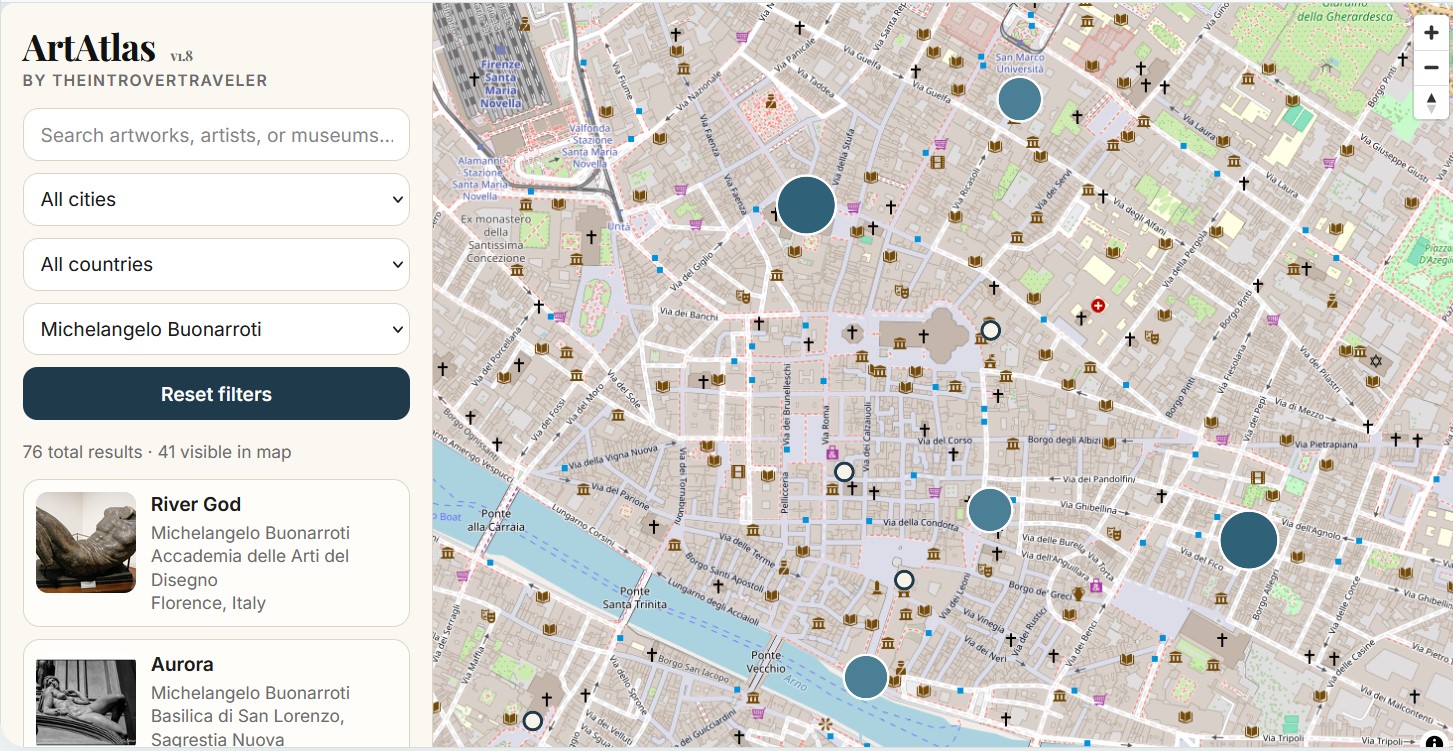
Michelangelo on TheIntroverTraveler
- Michelangelo’s David in Florence: A Complete Visitor’s Guide
- Michelangelo’s Sistine Chapel Ceiling Frescoes
- Michelangelo’s Prigioni at the Galleria dell’Accademia
- Michelangelo’s Medici Tombs in Florence’s New Sacristy
- Michelangelo’s Moses: the superhero we don’t deserve
- Michelangelo’s Madonna of Bruges
- Michelangelo Is Not a White Supremacist: Fighting Woke Ideology in Art History
- The New Restoration of the Sistine Chapel
- Marshall McLuhan, Michelangelo’s Pietà, and the 15 Minutes of Oblivion
Related posts:
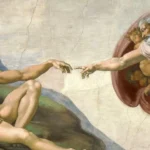 Michelangelo’s Sistine Chapel Ceiling Frescoes Explained: A Complete Guide to Technique, History, and Meaning
 Michelangelo’s Prigioni at the Galleria dell’Accademia: The Unfinished Slaves of an Impossible Tomb
 The Vatican Museums: The Museum You Never Finish. An Honest, Work-by-Work Guide to a Week That Isn’t Enough