Last visit: November 2024
My opinion: MUST SEE
Visit duration: 1 to 2 hours
Web: https://galleriaborghese.beniculturali.it/
Date of creation: 1623-1624
There is a question that every visitor to the Galleria Borghese eventually confronts, usually while standing in Sala II with the David on one side and the Apollo and Daphne on the other, in what is arguably the most concentrated square footage of sculptural genius in the history of Western art: which one is greater? It is a question without a correct answer, and for that reason a deeply productive one. The Apollo and Daphne is, without doubt, one of the most magnificent objects ever produced by human hands. But the David is something different and, in its own way, something more radical: it is the sculpture that most thoroughly dismantled what sculpture was allowed to be, and rebuilt it from the ground up. Bernini was twenty-three years old.
The David is located in Sala II of the Galleria Borghese in Rome, the same extraordinary sequence of rooms that contains the Rape of Proserpina and the Apollo and Daphne. Together, these three works constitute a cycle of youthful masterpieces with no real parallel in the history of art. Not visiting them on a trip to Rome is not an oversight. It is a tragedy.
The Borghese sculptures mark the beginning of a career that Urban VIII would transform into something of a different scale entirely. Bernini and the Barberinis traces what happened when the most powerful patron in Rome decided this sculptor should reshape the city.
1. Introduction to Bernini’s David: a new definition of sculpture
The David by Gian Lorenzo Bernini, executed between 1623 and 1624 in Carrara marble and now in Sala II of the Galleria Borghese in Rome, is in many respects the most conceptually revolutionary of the three great youthful groups. Commissioned initially by Cardinal Alessandro Peretti Montalto and acquired, following his death, by Cardinal Scipione Borghese in July 1623, the work was completed in the remarkable span of approximately seven months, in parallel with the resumption of work on the Apollo and Daphne, which had been temporarily interrupted to accommodate the new commission.
What Bernini proposes with the David is not merely a new interpretation of one of the most painted and sculpted subjects in the Renaissance tradition (suffice it to mention Michelangelo’s David, not only the world-famous one at the Accademia in Florence, but also the lesser-known one painted on the ceiling of the Sistine Chapel, or the immortal works by Donatello and Verrocchio at the Bargello). It is a redefinition of what sculpture fundamentally is. If Donatello’s David is an object of contemplative beauty and Michelangelo’s is a monument to physical and intellectual power, Bernini’s David is a story: not a state but a process, not a figure but an action, not a hero but a human being in the most intense fraction of a specific, unrepeatable moment, a freeze-frame from a cinematic sequence. The difference is not one of degree. It is one of kind.
2. Compositional structure and the conquest of time
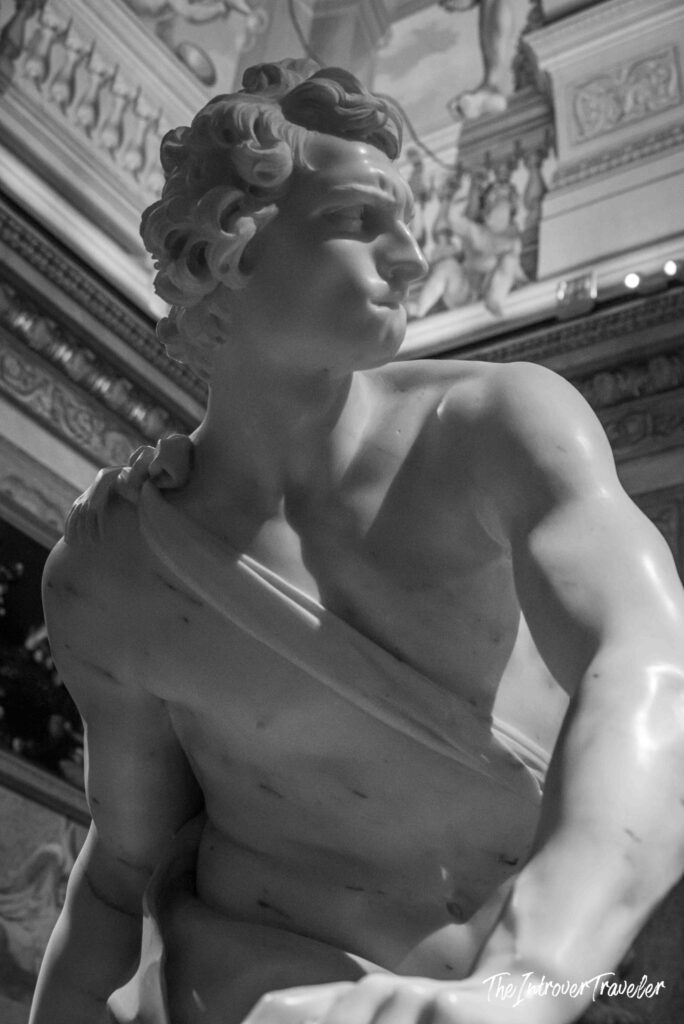
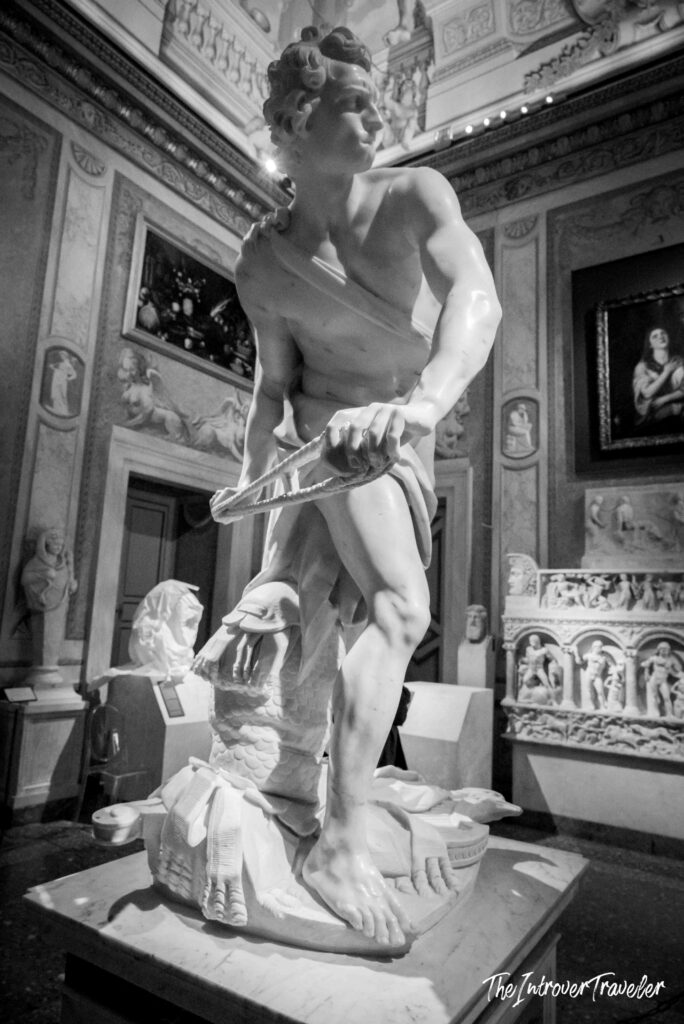
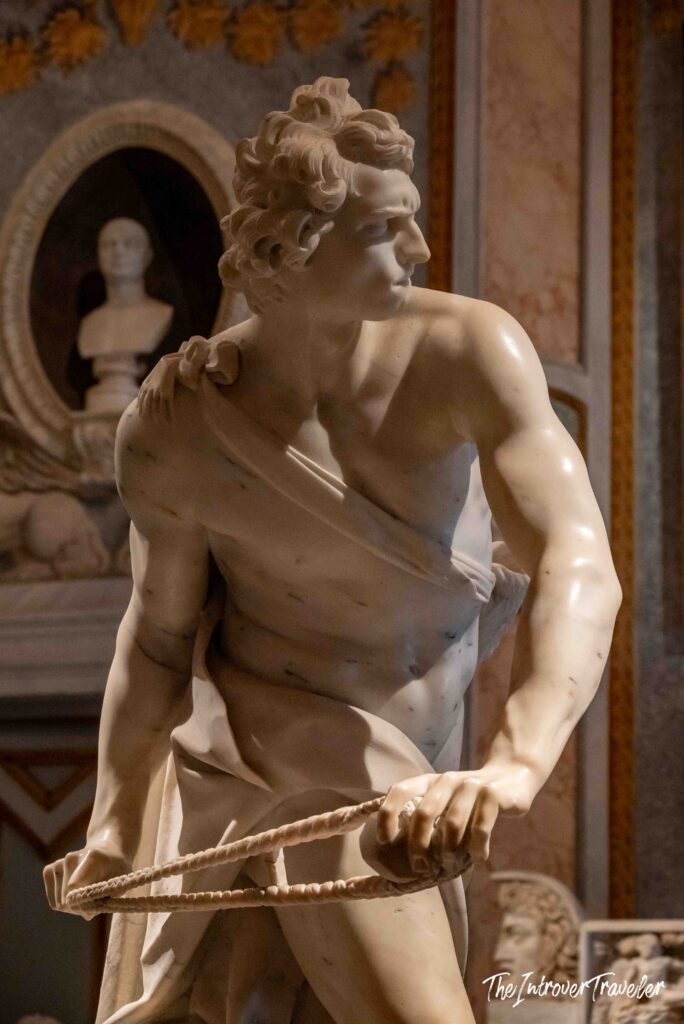
Every David before Bernini’s depicts the hero either before or after the duel with the giant Goliath. Donatello shows him victorious, resting his foot on the severed head. Verrocchio shows him in the same pose of achieved triumph. Michelangelo, in his colossus, shows him in the tense stillness that precedes the decision to fight, already formidable, already a monument. Bernini chooses none of these moments. He chooses the instant the sling is already in motion, the body wound to maximum torsion, the arm drawn back at the precise point where the release is milliseconds away. It is the most unstable, most transient, most physically improbable moment in the entire narrative, and it is the one Bernini carves into marble.
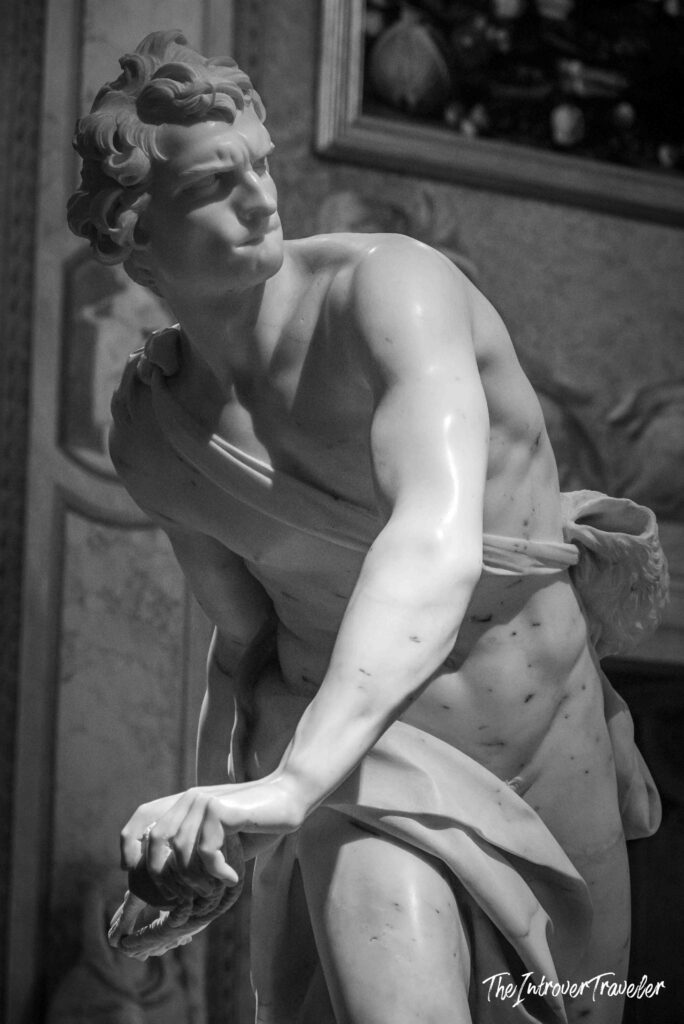
The result is a composition of extraordinary spatial aggression. The David does not occupy its pedestal: it erupts from it. The body twists along a powerful diagonal that projects forward and downward, the weight loaded onto the back leg, the torso rotating against the lower body in a coiled tension that seems to contain within it the kinetic energy of the throw that is about to happen. The invisible adversary is present in the composition as a structuring absence: Goliath is not there, but the direction of David’s gaze, the angle of his body, the trajectory implied by the loaded sling all construct him in the space in front of the sculpture, drawing the viewer physically into the scene. To stand in front of the David is to stand, involuntarily, in the place of the giant. The giant’s presence is suggested through subtraction; it is an ellipsis, an apophasis of the antagonist that was already implicit in its illustrious precedents, but here becomes more invasive, because David’s action cannot be conceived without the giant’s imminent presence.
This conquest of the surrounding space is one of the most radical innovations in the history of sculpture. Ancient and Renaissance statuary, however dynamic, remained essentially self-contained: the work created its own world and the viewer observed from outside it. Bernini dissolves that boundary. The David reaches into the room, implicates the viewer, demands a physical response. It is theatre, not display.
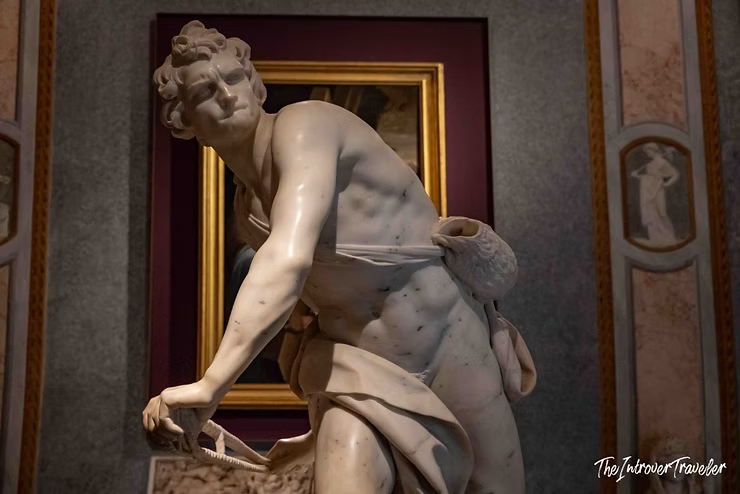
3. The face and the self-portrait
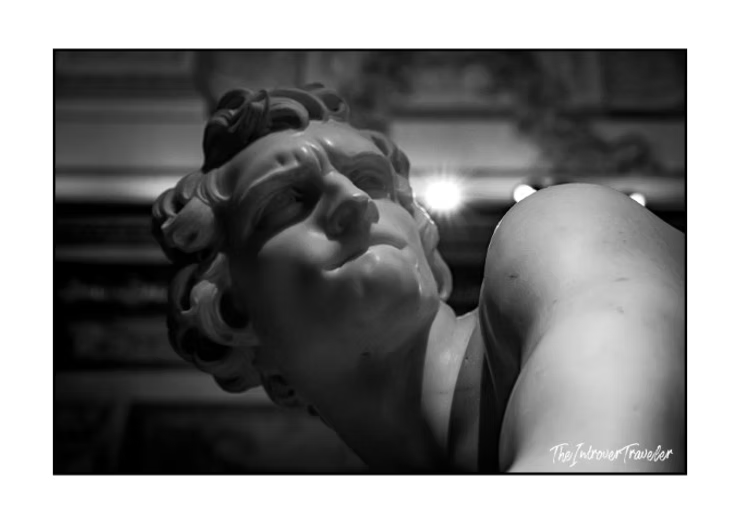
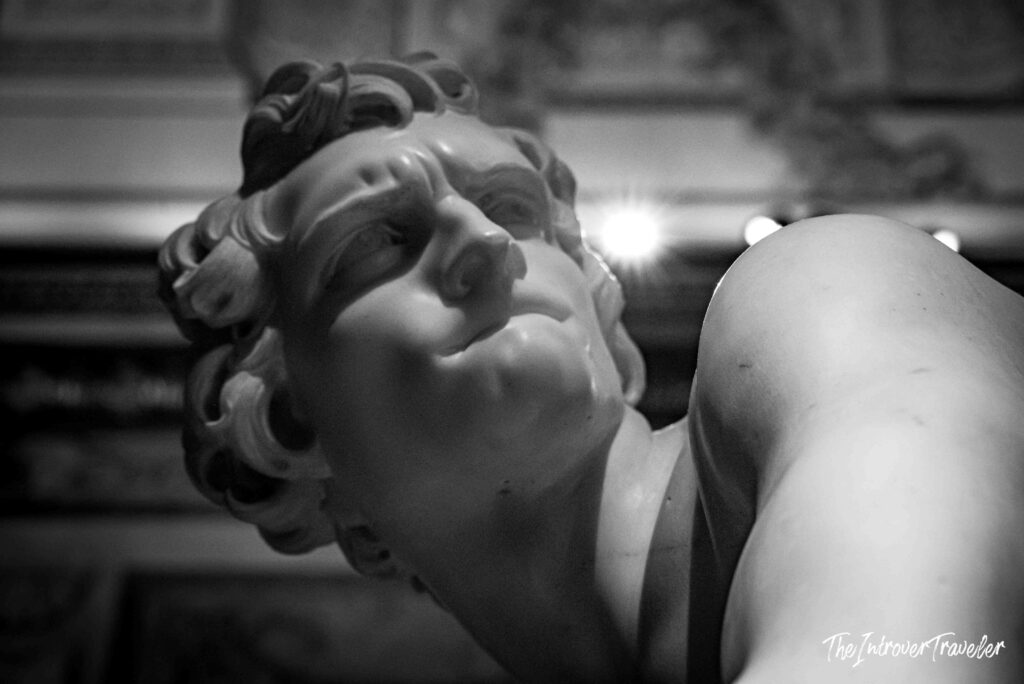
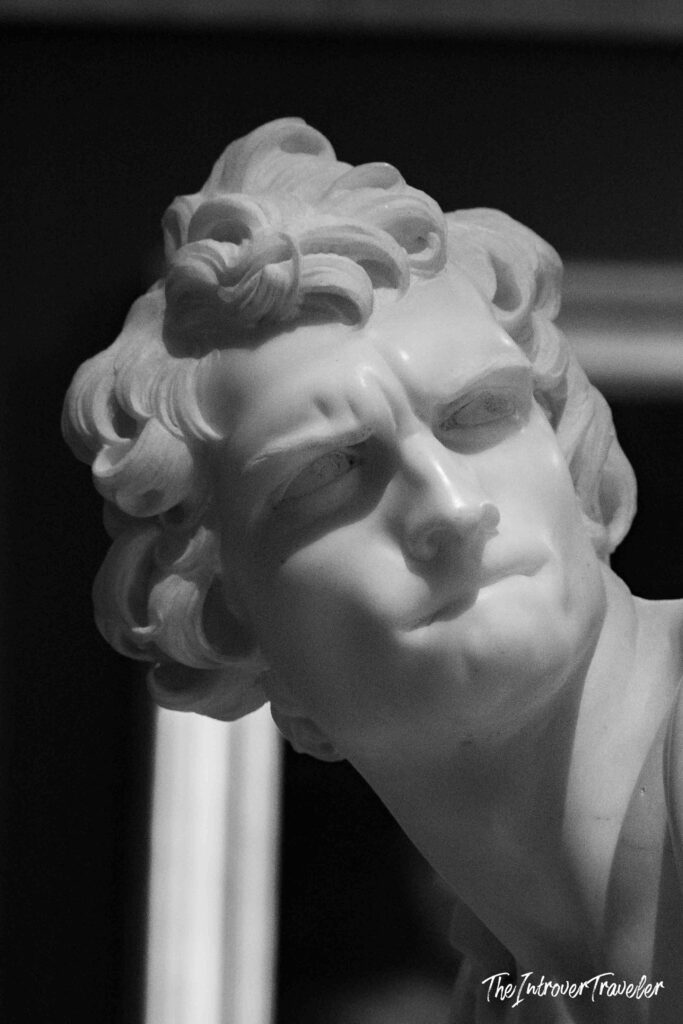
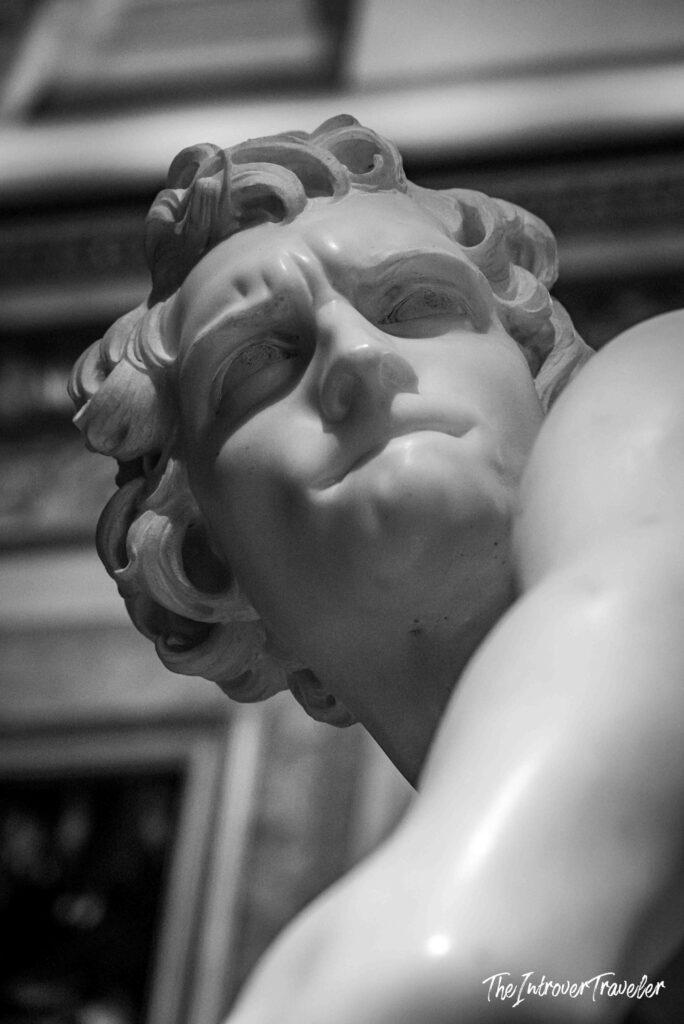
Among the most celebrated aspects of the David is its face: contorted in concentration, the brow furrowed, the eyes locked on a target, the lips pressed together and slightly bitten in an expression of absolute physical and mental focus. It is an expression that has no precedent in the tradition of heroic sculpture, which had always privileged beauty, composure, or noble suffering over this kind of raw, almost ugly intensity of effort.
The face is, according to a famous account recorded by Bernini’s son Domenico and confirmed by the biographer Baldinucci, a self-portrait. Cardinal Maffeo Barberini, the future Pope Urban VIII and Bernini’s most important patron, reportedly held a mirror for the young sculptor on multiple occasions so that he could study his own features in the act of intense concentration. The story, even if partly anecdotal, is significant: Bernini did not reach for an idealized model of heroic beauty, as every sculptor before him had done, but for the lived, specific, imperfect truth of a real human face doing a real human thing. The result is not a god or a type or an allegory. It is a person.
This choice sits at the heart of what distinguishes Bernini’s Baroque from the traditions it superseded. Where the Renaissance had sought the ideal and Mannerism had sought elegance, Bernini sought verisimilitude: not reality as such, but the absolute persuasion of reality, the complete suspension of disbelief. The David achieves this so thoroughly that one stands in front of it not thinking about marble but watching a young man about to hurl a stone, and feeling, obscurely, that one should step aside.
There is a further dimension to this face that deserves attention, and it is one that art history has not always foregrounded with the emphasis it merits. The expression of the David is, in some way, an anticipation of expressionism: the deliberate distortion of facial features beyond the threshold of conventional beauty in order to convey an interior psychological state with maximum intensity. The idea that a face can be made more truthful by being made less beautiful, that the grimace can carry more meaning than the composed ideal, is one that the twentieth century would codify into a movement. Bernini arrives at it, intuitively and completely, in 1623.
In painting, this territory had been explored before. From Bosch’s grotesque physiognomies to Leonardo’s studies of extreme expression, the two-dimensional arts had long granted themselves license to push the human face toward the caricatural, the monstrous, the expressively excessive. The painted surface, being illusionistic by nature, could absorb these distortions without rupturing the compact with the viewer.
Sculpture, and marble sculpture in particular, operated under entirely different constraints. The classical tradition imposed a canon of composed, idealized beauty that the material itself seemed to demand: to carve a grimace into Carrara marble, with all its luminosity and preciousness, felt like a category violation, an offense against both the subject and the stone. No sculptor of the ancient world, none of the Renaissance, had produced in marble a face like this one, twisted with effort, bitten lip, furrowed brow, eyes burning with a focus that excludes everything except the target. The tradition simply did not contain it. Bernini put it there, and in doing so expanded permanently what the human face in marble was permitted to express.
4. The narrative and allegorical dimensions
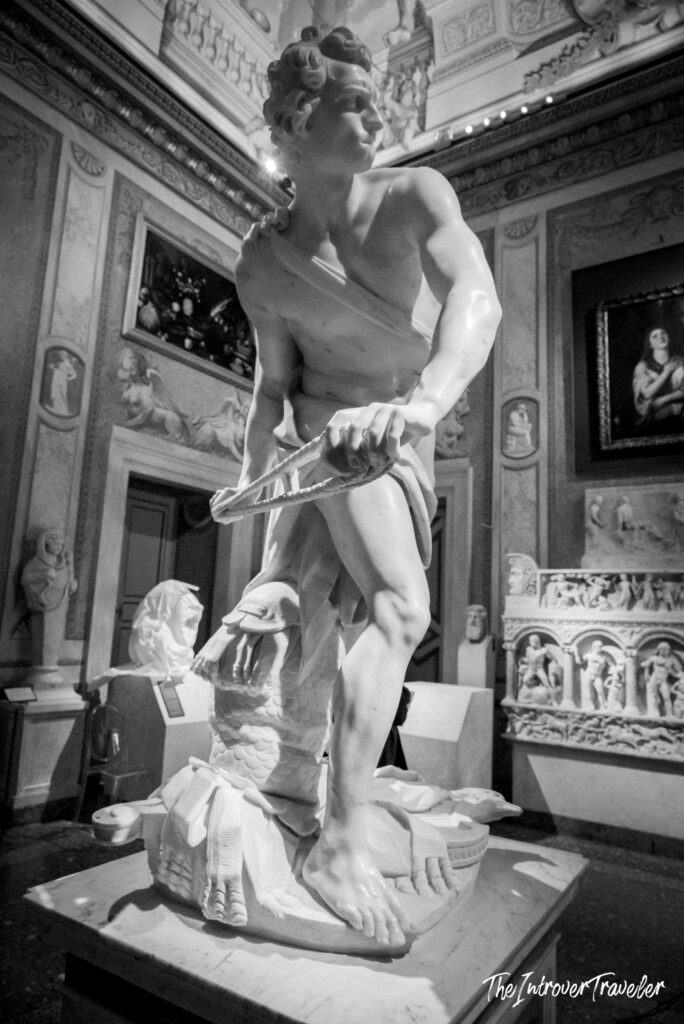
The biblical story of David and Goliath is one of the most semantically dense in the Old Testament: the shepherd boy who defeats the armored giant with nothing but faith and a stone is a figure of divine grace operating through apparent weakness, of courage without pride, of the reversal of worldly hierarchies by a higher order. Bernini’s representation captures all of this with extraordinary precision. At David’s feet lie the armor and sword of Saul, which the biblical narrative tells us he initially accepted and then set aside because they impeded his movement: the real force, the one that will bring down the giant, comes not from weapons but from the body itself, guided by faith alone.
The eagle’s head carved at the base of the harp at David’s feet carries a further layer of meaning. The eagle was one of the heraldic emblems of the Borghese family, and its presence in the composition transforms the biblical hero into an implicit celebration of the patron: Scipione Borghese, who had recently emerged victorious from a difficult conflict with the Ludovisi family following the death of Pope Gregory XV, is figured as a new David, triumphant through justice rather than force. This kind of encoded flattery was standard practice in the patronage culture of the Roman Baroque, and Bernini was its most accomplished practitioner, but the skill lies in the fact that the allegory never overrides the narrative. The David works entirely on its own terms as a human story, and the heraldic layer is a bonus for those who look for it.
The work was also conceived in explicit competition with Michelangelo. The biographical sources are explicit on this: Bernini saw the relationship with his great predecessor as the central challenge of his artistic identity, and the David was in part a direct reply to the Florentine colossus. Where Michelangelo’s David exalts the monumental, the permanent, the heroically static, Bernini’s David dissolves all of that into motion, time and psychological specificity. The hero of Florence is a marble ideal; the hero of Rome is a marble moment. Both are valid. Only one had ever been attempted before.
5. Technical virtuosity and the limits of the material
The technical achievements of the David are somewhat less immediately legible than those of the Rape of Proserpina, where the fingers sinking into flesh constitute a single, overwhelming image of sculptural illusionism.
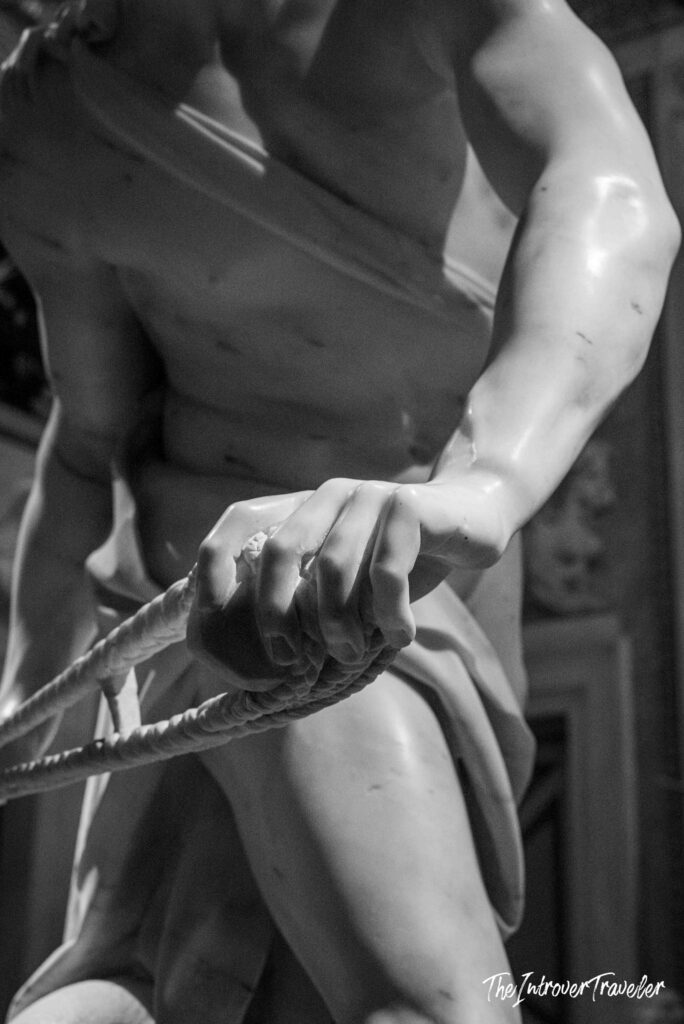
The management of the torsion alone represents a feat of structural calculation that still astonishes: the entire weight of the composition is loaded in ways that defy the conventional logic of marble’s structural properties, with mass cantilevered forward and the visual center of gravity pushed outside the physical boundaries of the figure. The sling, which in a 1670 archival document is recorded as having broken “in many pieces” and been reconstructed, projects into space with a fragility that borders on recklessness. The laces of the armor at David’s feet are rendered with a precision that suggests the work of a goldsmith rather than a sculptor. The sling was not carved from the same block as the David itself, an undertaking that would likely have been impossible (although Francesco Queirolo later proved otherwise) and that Bernini in any case did not attempt; even so, the figure in its complex volumetry is staggering even by comparison with the most audacious Mannerist compositions, such as Giambologna’s Rape of the Sabine Women. The back of the figure, visible to visitors who circle the pedestal, carries areas of intentionally unfinished marble that Bernini left rough to indicate how the work was to be placed against the wall, creating a deliberate dialogue between the finished and the merely present.
What strikes me most forcefully, standing in front of the David and having stood in front of the Proserpina and the Apollo and Daphne in the same visit, is the cumulative effect of the three works considered as a sequence. In the Proserpina, executed a year or two earlier, Bernini is already performing miracles; in the Apollo and Daphne, done simultaneously with or just after the David, he reaches a perfection of beauty that seems to belong to a different, higher category of human production. The David sits between them, and it is the most human of the three: the most physically raw, the most psychologically immediate, the most willing to sacrifice beauty in the service of truth. It is the work in which Bernini most clearly announces what his art is actually about, which is not the perfect rendering of the ideal but the perfect rendering of the real, in all its tension, effort and irreducible specificity.
The David is not the most immediately seductive of the three Bernini masterpieces at the Borghese, and it is perhaps the one that rewards the slowest looking. The Apollo and Daphne stops you in your tracks with its beauty; the Proserpina hits you with its pathos; the David takes a little longer, and then it takes you completely. It is the work that most changes the way you think about what sculpture can do, and about what a twenty-three-year-old is theoretically capable of. Both of these recalibrations are permanent.
If you are planning a trip to Rome you may be interested in these posts and these offers from Tiqets.
If you want to know more about Gian Lorenzo Bernini, you may be interested in these posts, or you may continue reading the page dedicated to Bernini on ArtAtlas.

Explore Bernini in Rome on ArtAtlas →Related posts:
 Apollo and Daphne by Gian Lorenzo Bernini (Borghese Gallery, Rome): marble on the verge of the impossible
 Gian Lorenzo Bernini’s Pluto and Proserpina (Borghese Gallery, Rome): a marble narrative between pathos and technical virtuosity
 Bernini and the Barberinis: Art, Power, and Invention in the Baroque. Review of the exhibition at Palazzo Barberini.